An Ef
fi
cient Coding Method for
Teleconferencing Video and Confocal
Microscopic Image Sequences
Vinay Arya
1, Ankush Mittal
1, Amit Pande
2and R. C. Joshi
1 1Dept. of Electronics and Computer Engineering, IIT Roorkee, Uttaranchal, India2Dept. of Electrical and Computer Engineering, Iowa State University, Ames, USA
In this paper we propose a three-dimensional vector quantization-based video coding scheme. The algorithm uses a 3D vector quantization pyramidal codebook-based model with adaptive pyramidal codebook for compres-sion. The pyramidal codebook-based model helps in getting high compression in case of modest motion. The adaptive vector quantization algorithm is used to train the codebook for optimal performance with time. Some of the distinguished features of our algorithm are its excel-lent performance due to its adaptive behavior to the video composition and excellent compression due to codebook approach. We also propose an efficient codebook-based post-processing technique which enables the vector quan-tizer to possess higher correlation preservation property. Based on the special pattern of the codebook imposed by post-processing technique, a window-based fast search
(WBFS)algorithm is proposed. The WBFS algorithm not only accelerates the vector quantization processing, but also results in better rate-distortion performance. The proposed approach can be used for both telecon-ferencing videos and to compress images obtained from confocal laser scanning microscopy(CLSM). The results show that the proposed method gave higher subjective and objective image quality of reconstructed images at a better compression ratio and presented more acceptable results when applying image processing filters such as edge detection on reconstructed images. The experi-mental results demonstrate that the proposed method outperforms the teleconferencing compression standards H.261 and LBG-based vector quantization techniques.
Keywords: confocal microscopic images, codebook,
codebook-preprocessing, rate distortion, vector quan-tization, window-based fast search
1. Introduction
Vector quantization has been widely used in im-age and video compression because of its supe-rior rate distortion performance over traditional
scalar quantization schemes and its simple de-coder structure. This method of compression has gained interest over conventional means of compression (i.e., DPCM and Transform cod-ing[1])because the conventional methods usu-ally employ some form of scalar quantization. Scalar quantization is not optimal as the suc-cessive samples in a digital signal are usually correlated or dependent. A vector can be used to describe almost any type of pattern, such as the patterns that arise in digital images.
Different approaches may be considered for video compression. Since lossless compres-sion approaches result in small comprescompres-sion ra-tios, we have considered the lossy compression techniques. Several studies dealing with vec-tor quantization-based lossy compression of im-ages has been proposed and applied to different image and videos[2-8].
Some of the main approaches developed are discussed in this section. Localized model-ba-sed approach to teleconferencing using three-di-mensional vector quantization[2] method uses LBG algorithm for creating a codebook. This codebook creating method does not vary with time. Thus this codebook needs to be trained for optimal performance with varying time, and hence varying input vector characteristics. To overcome this shortcoming, we have proposed an adaptive codebook approach.
memory, but at the same time they utilize the correlation among neighboring vectors. In [5], the inter-index correlation is exploited to code the indices more efficiently. Nevertheless, the easiest way to exploit the inter-vector correla-tion is to use the DPCM technique in the in-dex domain, i.e., to precede the entropy cod-ing of indices with a DPCM stage. Motivated by these considerations, a simple but efficient post-processing technique for adaptive code-book is proposed. The post-processing is done to reorder the codebook according to the po-tential of code words. The reordering is done once for all and is applicable to all existing codebook design methods. The post-processed codebook possesses a special structure which in turn leads to decreased first-order differential entropy, i.e., increased correlation between suc-cessive indices. This is beneficial to subsequent DPCM and entropy coding, and it improves the performance of the entire coding system. Another merit of the proposed post-processing techniques is that it imposes a certain structure to the codebook. This structure can be utilized to accelerate the searching process. Thus it re-lieves the computational requirement of the en-coder.
For microscopic medical images, Burt [6]and Adelson[7]introduced quantization into the im-age pyramid structure and proposed a multi-resolution lossy compression technique using a scalar quantizer. In 2003, Cockshott pro-posed a vector quantization-based 3D pyramid approach [8]. This method has 3D codebooks of size 2×2×4. By using multiple level local-ized codebooks with variable size, it is possible to get high compression even if there is some motion in microscopic image sequence.
Confocal Microscopic Image Sequence
Confocal laser scanning microscopy (CLSM), which is single photon microscopy, has been available to biomedical scientists for almost 20 years [9]. However, it is only in very recent times that affordable computer power has en-abled biologists to fully exploit the data con-tained within the large (>100Mb) image vol-umes. CLSM is used to collect 3D volumetric data describing the cellular organization and re-ceptor protein distribution through the vascular wall of small segments of human and animal arteries.
Briefly, arterial segments are stained with flu-orescent markers for the cell nucleus or beta-adrenergic receptors. Tissues are then slide mounted on the stage of either a NORAN3( nu-clear work)or Leica4 (receptor work) CLSM. Serial optical sections(x,yplane)are collected at intervals of 1μm down through the axial plane (z-axis) to produce a ’stack’ of optical planes which can be processed as a 3D volume. The processing, analysis and transfer of the result-ing data volumes are time inefficient. A robust non-lossy or low distortion lossy compression routine would be of great value for biomedical purpose, e.g. in studying vascular structure[10]. Furthermore, the emergence of multi photon microscopy as a practical laboratory tool now enables even greater depth penetration within thick biological samples. This, coupled with the studies involving multiple fluorophores im-aged over time period, results in the collection of data sets approaching 1 GB per experiment. Without efficient compression algorithms, man-agement of such enormous amounts of data will be very difficult.
Three-dimensional image compression meth-ods outperform their two-dimensional counter-parts in the sense of higher rate distortion perfor-mance for compressing volumetric image data. The state-of-the-art transform-based 3D com-pressors, such as 3D-SPIHT and 3D-DCT, are characterized by their rate control ability, where the qualities of the image are adjustable with re-spect to the rates, but are not explicitly control-lable. In[8], the authors discuss the differences between 3D microscopy raw data and the movie sequence. In microscopy the data corresponds to tracer densities at sub volumes in a 3D grid, with the size of the sub volumes constrained by the microscopy optics. This contrasts with the data in a movie sequence which has time varying 3D generating surfaces. In[8], the au-thors hypothesize that the higher order statistics of 3D microscopy data will differ from those of film and that the optimal compression strat-egy will differ from that used in film and video applications.
with error feedback so that the quality of the de-compressed image depends only on the encod-ing of coefficients from the finest band. This achieves some effective reduction of artifacts. In 3D microscopy, the raw data corresponds to tracer densities at sub volumes in a 3D grid with the size of the sub volumes constrained by the microscopy optics. The data is typically digi-tized as a sequence of 2D images i.e., a three dimensional array with time,xandyaxis as the three dimensions[8].
The paper is organized as follows. The vector quantization and adaptive codebook procedures are explained in Section 2. 3D vector quantiza-tion used for compression and encoding of tele-conferencing videos and confocal microscopic image sequences is described in Section 3. An efficient codebook post processing technique and a window-based fast search algorithm for vector quantization are explained in Section 4. The experimental results and analysis are given in Section 5. Section 6 gives conclusions and future work.
2. Vector Quantization and Code Book
Vector quantization (VQ) is used in sophisti-cated digital signal processing where in most cases the input signal already has some form of digital representation and the desired output is a compressed version of the original signal. VQ is usually employed for data compression purposes. A vector quantizer Q of dimension
k and sizeN is a mapping from a vector in k -dimensional Euclidean space, Rk, into a finite
set C containing output or reproduction points that exist in the same Euclidian space as the original point. These reproduction points are called code vectors or code words and this set forms a codebookCwithNdistinct code words. Thus the mapping functionQis defined as:
Q:RK →C (1) A vector quantizer can be decomposed into two components, the vector encoder and the vector decoder and likewise index, I, and a quantized output value, Q(x). The decoder is sometimes referred to as an “inverse quantizer”. Associ-ated with every N point, vector quantizer is a partition ofRkintoNregions or cells, and each
cell has an index. The encoder gives an index to the given vector. On the other end, the de-coder generates an output vector from a given index. The task of the encoder is to identify the location of input vector in one of theN geomet-rically specified regions ofkspaces. Decoding is simply a table lookup task fully determined by specifying the codebook. A decoder does not need to know the geometry of the partition to perform his job. Vector quantization has been widely used in image-coding systems because of its superior rate distortion(R-D)performance over traditional scalar quantization schemes and simple decoder structure.
Figure 1.Vector quantizer.
The encoder and the decoder can be separately modeled with a corresponding primary struc-ture. Let A denote the index generator, as the mappingA :BN → J and its inverse, the index
decoder, A−1 : (b1,b2, . . . ,bN) with and b is
restricted to have exactly one nonzero compo-nent. Then A(b) = I if bi = 1 and bj = 0
for j = i. Then the encoder operation can be written as:
E(x) =A(S1(x),S2(x),S3(x), . . .SN(x)) (2)
and the corresponding decoder operation is given by:
D(i) =
N
i=1
yiA−1(i). (3)
The Codebook
Different available methods of creating code-books essentially do the same basic tasks. For
Let Ci be the centroid of the training vectors
within cell i. The centroid is the multidimen-sional mean of the training vectors for a partic-ular cell. The centroid of the cells represents the output code vector associated with the cor-responding cells. In other words, during the encoding process when an input vector falls within a particular cell, the index of that cell will be transmitted as the codeword. For the decoding process, the centroid of the cell will be output vector [12]. The best codebook for a given set of training data is the one which will minimize the quantization error over the vector to be quantized. However, even for moderately sized codebooks, an exhaustive search for the best codebook results in an impractically large number of computations. So, codebooks are generated or trained using statistical clustering algorithms. The LBG algorithm named after Linde, Buzo and Gray, is a widely used clus-tering method for generating a codebook. The algorithm begins with an initial set of code-book vectors, assigns the training vectors to the nearest codebook vector, then re-computes the codebook vector as the centroid of all the vectors assigned to that codebook entry. The process is repeated until convergence, or till there is no reduction in the overall quantization error[13].
Adaptive VQ Codebook
The codebook discussed above(LBG)does not vary with time. We have used a time varying approach because of its ability to adjust its code-book vectors as new pattern becomes available, so as to accurately model the class representa-tion of the pattern. It is extremely important to train this codebook for optimal performance with varying time, and hence with varying input vector characteristics.
The proposed algorithm is adaptive with time. For each new vector we search for the near-est existing vector in the codebook, and if they are close enough then we calculate their aver-age with respect to codebook vector’s weight and store it instead of the original vector in the codebook. If we do not find codebook vector close enough to the new vector and the code-book is not full, we add it to the codecode-book. If the codebook is full, we remove LRU(Last
Re-cently Used)vector. This algorithm is intended to replace LBG algorithm to improve compres-sion performance.
3. 3D Vector Quantization for
Teleconferencing Video / Confocal Microscopic Images
The model introduced in this study is based on specific properties such as:
1. History: In teleconferencing and other med-ical image sequences typmed-ical motions of re-cent history are likely to repeatedly appear in the next frames. History parameter KP
relates to the typical length of cache move-ment. SinceKPdirectly relates to the
accept-able delay of the teleconferencing system, it should be determined according to the par-ticular purpose of communication.
2. Localization: The movements are primarily likely to reappear in the same area of the image where they have previously appeared [14].
3. Transformation: If the movements are not similarly repeated (up to the allowed dis-tortion of usually 25–40 db), details can be encoded as transformed versions of previous details[15].
4. Hierarchy: If a specific motion cannot be matched accurately according to coarse par-titioning of the frame, a more refined de-scription should be used [16,17]. The hier-archical approach introduces additional pa-rameters, mainly the factor by which the size ofAL is changed between adjacent levels of
the pyramidal representation. A factor of 2 is used in the present study.
We use 3D VQ to exploit the 3D correlations between voxels from intra-bands. It is different from the method using zero tree structure that exploits the correlations between coefficients from inter bands at different scales.
VQ
Output Indices
3D Vector
Frame i
Frame i+1
Figure 2.An example of forming an inter-band vector from two successive frames.
For instance, in Figure 2 we construct and eight-dimensional vector 2×2×2 (w×h×d)by sampling four neighboring pixels from framei
and four neighboring pixels at the same position from its next framei+1. This choice of vector shape is programmable[8].
4. Video Compression System and the Encoding Process
We achieve a very low bit-rate by applying the Vector Quantization (VQ) approach using Adaptive sparse codebooks. Figure 3 shows the
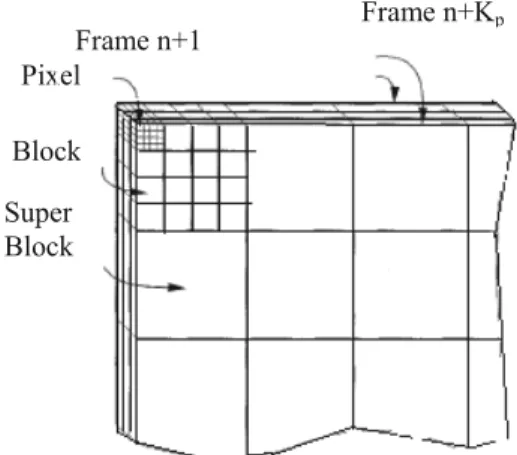
block diagram of the system. Frames are di-vided into frame portions called “super blocks” (z,y,t), each comprising 3D vectors.
In the above system the super block is 32×32×4 and the vector shapes are 8×8×4, 4×4×4 arid 2×2×4. Based on the recent history of the transmitted sequence, a localized codebook that best matches the data is created for each super block shown in Figure 4. Since the recent history of the transmitted sequence is used for training the codebooks, the same codebooks can be created at the remote receiver, hence only an index representing each codebook is transmit-ted via the transmission medium. A hierarchical
Frame n+Kp
Pixel
Block
Super Block
Frame n+1
Figure 4.Blocks and Super blocks — each block and
each super block contain 4 consecutive frames.
Index
X
Entropy
E
ncodi
ng
Entropy
Decod
in
g
Codebook Update
Decision
Codebook Update
Decision Vector
Decoder Vector
Encoder
Codebook Codebook
X
Channel
Local 8*8*4 Codebook
Neighboring 8*8*4 CB
Local 4*4*4 Codebook
Local 2*2*4 Codebook
Scalar Quantizer
B1
B3
B4
B5 b1
b2 B2
b3
b4 PSNR<T1
PSNR<T2
PSNR<T3
PSNR<T4
Figure 5.The hierarchical encoding process.
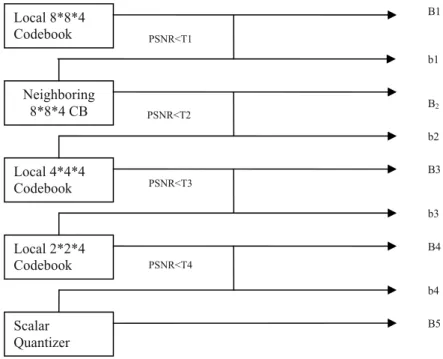
encoding process is performed in the hierarchi-cal encoder. An illustrative encoding process is shown in Figure 5.
The main steps in an encoding process are sum-marized next.
1. The dedicated localized codebook having the base vector 8× 8 × 4 from the base history-based VQ is searched. The block having aPSNRgreater than thresholdT1 is given as output.
2. For the vector with a PSNR less than T1, the search expands to include the codebook of adjacent super block. From this search, vectors having a PSNR greater than T2 are given as output.
3. The vectors unsatisfactorily encoded in 1 and 2 are further coded using more refined code-book of 4×4×4. Afterwards, a search is made for vectors having aPSNRgreater than
T3.
4. Remaining blocks are encoded using 2×2×4 codebook and are output if the encoded vec-tor have aPSNRgreater thanT4.
5. The vectors inadequately coded using code-book in the above steps are coded by scalar quantization.
Our decoder uses three-dimensional vector-qu-antization (x,y,t). We encoded the present
frames based on the recent localized history of the sequence. In Figure 5, B1 to B5 represent the encoded codes output to the receiver at the respective stage andb1 tob4 represent the con-trol bits for signifying whether the B1 to B5 codes of the next stage are to be used.
Thus the encoder encodes the input image data into various sized codebooks based on thePSNR
value of the difference frames. Taking the dif-ference frames for the encoding process in-stead of direct vectors improves the mance of our system. It enhances the perfor-mance and makes the system robust to illumi-nation changes.
5. An Efficient Codebook Post Processing
Technique and a Window Based Fast Search Algorithm for Vector
Quantization
In other words, the inter index correlation is: a)inherited from the inter vector correlation in the spatial domain and b)generated by the vec-tor quantizer. Our objective is to design a vecvec-tor quantizer of a high correlation preservation ca-pability. A natural way to achieve this objective is to order the code words in such a manner that ‘similar’ code words have close indices. In addition, the more similar the code words, the more closely the indices should be. More-over, an effective measurement of the similarity should be utilized to order the code words. We adopt the potential of a vector as a measure of similarity. The potential of a vector is define as:
P(x) =
K
i=1
Wi2 (4)
where Wi are the values (for pixels) stored in
the vector.
The potential here is identical to the energy of the vector. From the definition, we can easily obtain the following equality:
P(x)−P(x)≤P(x−x). (5)
We used the Window-based Fast Search(WBFS) algorithm, which first searches the window built around the predicated index to accelerate the codebook searching procedure.
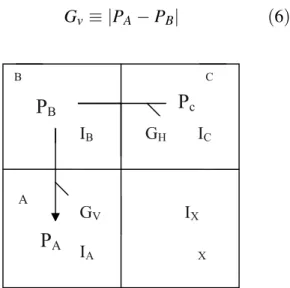
In Figure 6, vectors A,BandCdenote the left, left-above neighboring vectors of current vector
X, respectively. The horizontal potential gradi-ent(GH)and vertical potential gradient(Gv)are
defined as follows:
Gv≡ |PA−PB| (6)
C B C
IX
X
P
BP
cP
AGH
GV
IA
IB IC
A
Figure 6.Neighborhood of an input vectorXin a frame.
GH ≡ |Pc−PB| (7)
where PA, PB and PC are potentials of vector
A,B, andCrespectively. Then the prediction is made according to the relation:
if GH ≤GV →IX =IA, (8)
if GH ≥GV →IX =IC. (9)
The reordering is done once for all and is appli-cable to all the existing codebook design meth-ods. The post-processing codebook possesses a special structure which in turn can lead to de-creased first-order differential entropy, i.e. to in-creased correlation between successive indices. This is beneficial to subsequent entropy coding and helps to improve the performance of the entire coding system.
6. Experimental Results
The proposed video-compression system was developed and tested using “Salesman” and “Miss America” image sequences. These image sequences contain a moving head of a person in a stable background. Moreover, the perfor-mance of this system over microscopic images is tested by using the image sequence “Distri-bution of GFP inArabidopsiscells”[19]. In addition to visual inspection, the performance of the proposed compression system was eval-uated and compared to that of the existing ap-proaches, using a popular quantitative measure of the image quality known as the peak signal-to-noise ratio(PSNR), which is defined as:
PSNR=
10×log10 ⎡ ⎢ ⎢ ⎢ ⎣
2552
1
N1N2
N2
y=1
N1
x=1(f(x,y)−g(x,y)) 2
⎤ ⎥ ⎥ ⎥ ⎦
(10) where
— f(x,y)&g(x,y)are the gray levels of pixels from the original and reconstructed frames, respectively.
— N1×N2 is the total number of pixels in the
frame.
The degree of compression is measured by the compression ratio defined as:
CompressionRatio = OriginalFrameSize(bytes)
EncodedFrameSize(bytes)
(11) The performance of the proposed video-compres-sion system was compared with that of the ITU-T H.261 video-compression standard developed to facilitate video-conferencing and video-phone services over the integrated services digital net-work(ISDN) [20]. The H.261 standard operates at 1–30 kbits/s.
This coding scheme is a hybrid of inter-frame prediction, transform coding, and motion com-pensation. Inter-frame prediction removes tem-poral redundancy while transform coding re-moves spatial redundancy.
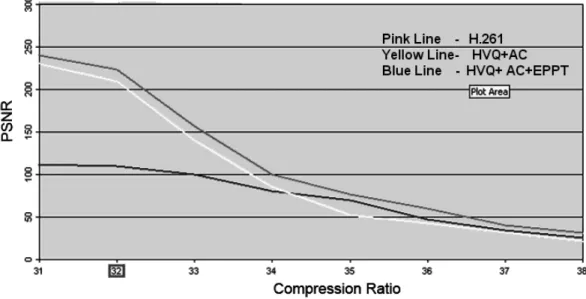
Figure 7 shows PSNR value decreases consis-tently as the compression ratio increases indi-cating that the proposed system produces sig-nificantly higher compression ratio values than the H.261 standard when the “Miss America” image sequence is encoded atPSNRbelow 35. The acronym HVQ means Hierarchial Vector
Quantization technique, AC refers to Adaptive codebook and EPPT refers to our Windows-based Efficient Post-processing Technique. The proposed “post-processing-based video codec” produced significantly higher compression ra-tio than the H.261 standard on “Miss America” image sequence for any PSNR value.
Figure 8 shows input and output of a frame from 26 to 28 of the “Miss America” video sequence. From the output frames at PSNR33, it can be seen that the image quality is not very good and frames of this quality cannot be used for medical images. However for teleconferencing video these frames are good because they provide a very high compression ratio. These outputs are obtained by applying VQ+AC+EPP. The visual quality of the image sequences reconstructed by the H.261 standard degraded sharply for high compression ratios, where the proposed system outperforms the H.261 standard.
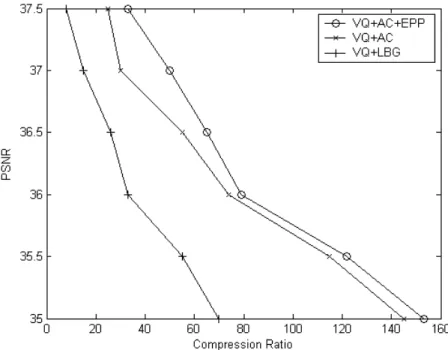
Figure 9 shows the average compression ratio values computed on the Confocal Microscopic image sequence after its encoding by the pro-posed system and the LBG-based method at dif-ferentPSNR values. It is evident that pyrami-dal codebook-based model with potential-based post-processing on adaptive codebook produces significantly higher compression ratio values than the 3D vector quantization with LBG code-book for confocal images.
Figure 7.Comparison of the proposed systems with the H.261 video-compression standard
Figure 8.The “Miss America” video sequence at PSNR value 33 and compression ratio 220.
Adaptive CB-based Hierarchical VQ
Hierarchical+
Adaptive CB
+CB PP H.261
“Miss
America” 204 220 110
Lab
Sequence 160 172 80
Table 1.Compression ratios atPSNR=32.
Adaptive CB-based Hierarchical VQ
Hierarchical+
Adaptive CB
+CB PP H.261
“Miss
America” 21.5 31 25
Lab
Sequence 13 19 16
Table 2.Compression ratios atPSNR=38.
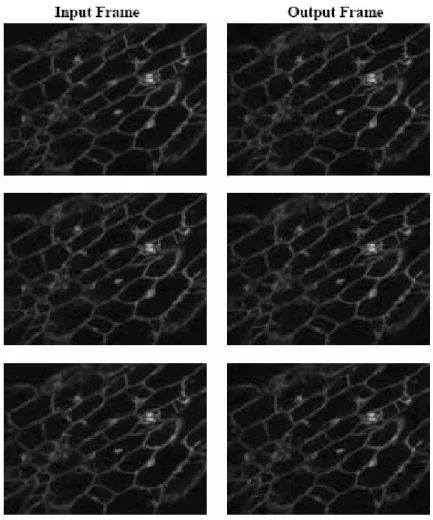
Figure 10. Output for set 1 at compression ratio of 42 andPSNRvalue of 38.
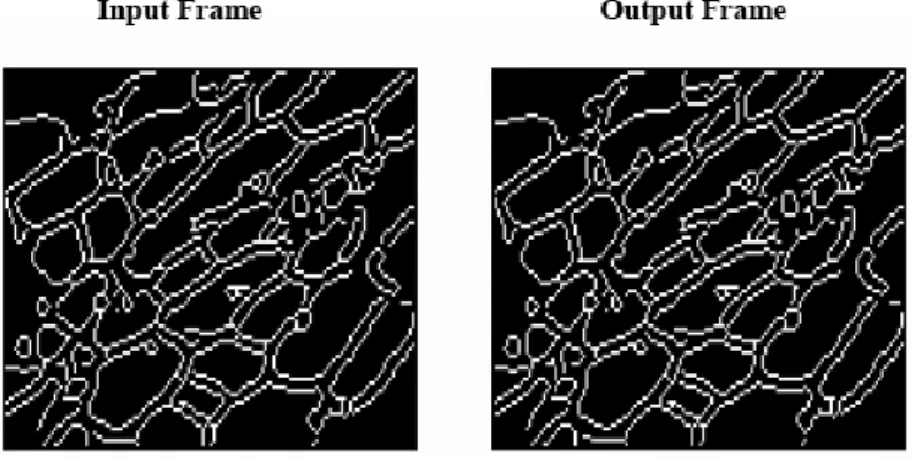
Figure 12.Output at compression ratio of 42 andPSNRvalue of 38 for edges of set 2 obtained using Canny edge detector.
The tables show the performance comparison of proposed method with H.261. The performance of the proposed video-compression system is compared with that of the LBG codebook-based video compression This coding scheme is vector quantization-based with localized codebook. Figures 10, 11, and 12 show the input and output frames for confocal microscopic images. The output frames are atPSNR38. The image qual-ity is very good and there is no perceptual vi-sual difference between these inputs and output frames. These outputs are obtain by applying VQ+AC+EPP.
Figure 12 shows that no loss of edges takes place when proposed system is applied on confocal medical images at high PSNR values. Edge preservation is important for medical images. We have used Canny edge detector for detect-ing edges.
7. Conclusion and Future Work
In this paper, a video compression scheme us-ing 3D vector quantization pyramidal codebook with adaptive codebook is discussed. The ap-proach exploits the fact that microscopy data has limited variations. The performance com-parison with coders like H.261 explains the effectiveness of our approach. Unlike other lossy approaches like MPEG-4 or H.263, our approach preserves most of the image data in microscopy images. We also introduced a 3D vector quantization pyramidal codebook-based model with potential-based post-processing on
adaptive codebook. The proposed approach outperforms the H.261 teleconferencing video compression standard at high compression ra-tios. With potential-based post-processing it outperforms H.261 even for low compression ratios. It gave good results for confocal mi-croscopic images and outperformed the LBG-based VQ methods. Moreover, it preserved the edges in confocal images.
Recent works help in achieving both on-the-fly compression and high compression efficiency, which reduces the power dissipation of the de-vice. Such techniques embedded with our adap-tive pyramidal codebook approach can be fused together to implement real time cheap teleme-dicine systems. In addition, faster algorithms for search can be used to make the application more robust.
References
[1] J. CHOU, M. CROUSE, K. R., A simple algorithm
for removing blocking artifacts in block-transform coded images.IEEE Signal Processing Letters,5(2) (1998), pp. 33–35.
[2] M. PORAT, Localized Model-based Approach to
Teleconferencing using Three-dimensional Vector Quantization.International Conference on Digital Signal Processing,(1997)Greece, pp. 841–844.
[3] A. GERSHO ANDR. M. GRAY,Vector Quantization
and Signal Compression. Norwell, MA: Kluwer, 1992.
[5] C.-H. HSIEH ANDJ. C. TSAI, Lossless compression
of VQ index with search-order coding.IEEE Trans. Image Processing,5(Nov. 1996), pp. 1579–1582.
[6] E. H. ADELSON, C. H. ANDERSON, J. R. BERGEN,
P. J. BURT ANDJ. M. OGDEN, Pyramid Methods in
Image Processing. RCA Engineer, 29 (Nov/Dec 1984), pp. 33–41.
[7] PETERJ. BURT ANDE. H. ADELSON, The Laplacian Pyramid as a Compact Image Code. IEEE Trans. Comm.,31(Apr. 1983), pp. 532–540.
[8] W. P. COCKSHOTT, Y. TAO, G. GAO, P. BALCH, A.
M. BRIONES, C. DALY, Confocal Microscopic
Im-age Sequence Compression using Vector Quantiza-tion and 3D Pyramid. PACS classificaQuantiza-tion number: 07.05.pj, July 15th, 2003.
[9] J. B. PAWLEY, Handbook of Biological Confocal Microscopy, 2nd Edition. Plenum Press, New York, 1995.
[10] C. DALY, A. MCGEE, E. VILA, A. BRIONES,
J. GIRALDO, S. ARRIBAS, C. GONZALEZ´ , J. M. GONZALEZ´ , E. SOMOZA, S. N. PAGAKIS, J. ADLER, J. C. PROVOST, A. MERLE, J. MADDISON, J. PEDER
-SON,ANDJ. C. MCGRATH, Analysing the 3D Struc-ture of Blood Vessels Using Confocal Microscopy. Microscopy and Analysis (UK),92(2002), pp. 5–8.
[11] Y. TAO, W. P. COCKSHOTT, A Hybrid Vector
Quan-tizer for Laplacian Pyramid Coding with Applica-tion to Volumetric Image Compression in Confocal Microscopy.SPIE on Photonics Asia 2004,(Nov. 2004)Beijing, China.
[12] P. H. WESTERNIK, D. E. BOEKEE, J. BIEMOND AND
J. W. WOODS, Subband Coding using Vector Quan-tization.IEEE Trans. Commun.,COM-36(1988), pp. 713–719.
[13] Y. LINDE, A. BUZO, R. M. GRAY, An Algorithm for
Vector Quantizer Design. IEEE Trans. Commun., 28(Jan. 1980), pp. 84–95.
[14] M. PORAT ANDY. Y. ZEEVI, The Generalized Ga-bor Scheme in Biological and Machine Vision. IEEE Trans. on Patt. Anal. and Machine Intell.,
PAMI-10(4) (1988), pp. 452–468.
[15] N. KATZIR, M. LINDENBAUM ANDM. PORAT, Curze
Segmentation under Partial Occlusion.IEEE Trans. on Patt. Anal. and Machine Intell., PAMI-16(5) (1994), pp. 523–519.
[16] M. PORAT ANDY. Y. ZEEVI, Localized Texture Pro-cessing in Vision: Analysis and Synthesis in the Gaborian Space.IEEE Trans. on Biomedical Eng.,
BME-36(1) (1989), pp. 115–129.
[17] T. EBRAHIMI, T. R. REED,ANDM. KUNT, Low Bit
Rate Coding of Image Sequences Using a Pyrami-dal Gabor Expansion.In Proceedings of the 1991
Picture Coding Symposium,(1991)Tokyo, Japan,
pp. 205–206.
[18] P. COSMAN, R. GRAY, AND M. VETTERLI, Vector
Quantization of Image Subbands: A Survey.IEEE Trans. Image Processing,5(Feb. 1996), pp. 202– 225.
[19] P. SCHELKENS, A. MUNTEANU, J. BARBARIEN, M.
GALCA, X. G. NIETO,AND J. CORNELIS, Wavelet Coding of Volumetric Medical Datasets. Submitted
to IEEE Trans. Medical Imaging, September 28,
(2001).
[20] ITU Recommendation H.261: Video codec for audio visual services at p*64 kbits/second, COM XV-R 37-E, 1990.
Received:June, 2006 Revised:January, April, December, 2007 Accepted: August, 2008
Contact address: Vinay Arya, Ankush Mittal, R. C. Joshi Dept. of Electronics and Computer Engineering IIT Roorkee Uttaranchal, India 247667 e-mail:vin [email protected] [email protected] [email protected] Amit Pande Dept. of Electrical and Computer Engineering Iowa State University Ames, IA-50011, USA e-mail:[email protected]
VINAYARYAcompleted his Masters(M. Tech.)at IIT Roorkee in 2005. His research interests include medical image processing and video cod-ing.
ANKUSHMITTALreceived the B. Tech.(Computer Science and Engg.) and M.S. by Research(Computer Science and Engg.)degrees from the Indian Institute of Technology, Delhi in 1996 and 1998 respectively. He completed his PhD degree at Electrical and Computer Engg. Dept, The National University of Singapore. For two years dr. Mittal was a faculty member at the Department of Computer Science, National University of Singapore. He is presently an associate professor at Electronics and Computer Engineering Department at IIT Roorkee. He is a recipient of Young Scientist Award from the National Academy of Sciences, India and from Indian Science Congress Association. He has contributed more than 150 research papers in journals and conferences of high re-pute. His research interests are in image processing, bioinformatics, Bayesian networks, and applications in e-learning.
AMITPANDEis currently a graduate student at Iowa State University, USA pursuing his research in developing efficient multimedia process-ing reconfigurable hardware architectures. He completed his under-graduation at IIT Roorkee where their major project was awarded with Institute Silver Medal, honored as third best major project in agilent engineering and with Technology Awards(India)in 2007. His research interests are in image processing, e-learning and applications in com-puter architecture.
R. C. JOSHIreceived his B.E. degree in electrical engineering from