User Interface Speci
fi
cation Issues
for Computerized Educational Systems
Andrina Grani´c and Vlado Glavini´c
Faculty of Natural Sciences, Mathematics and Education, University of Split, Croatia Faculty of Electrical Engineering and Computing, University of Zagreb, Croatia
Aside from the great progress in the field of human-computer interaction, particularly in the last years the need for the development of adaptive user interfaces in several application areas has been recognized. Our research is concentrated on intelligent tutoring systems, a generation of computerized educational systems that attempt to mimic the capabilities of human tutor. In order to support the above reasoning, in this paper we elaborate on the case study ofAKBB, a program intended for the development of an arbitrary domain knowledge base and of its user interface. In order to specify its design and behaviour, User Action Notation is advocated as a suitable method.
Keywords: computerized educational systems, intelli-gent tutoring systems, Adaptive Knowledge Base Builder, adaptive user interfaces, user interface specification.
1. Introduction
The goals of human-computer interaction are to provide functional, usable and well designed computer system interfaces, thus achieving their transparency and enabling end users to fully concentrate on the work. This is the main rea-son why in designing human-computer commu-nication the specification of a look and feel of the proposed interface, i.e. its design and es-sential behaviour, is quite important. The in-creasing desire for usable, user-centered com-puter systems influenced the development of more appropriate, adaptive communication be-tween a human user and the system. Conse-quently, adaptive human-computer interaction constitutes a promising solution to the provi-sion of usable user interfaces.
Rapid progress of computer technology made computer a strong tool in education altogether, resulting in the development of a generation of
computerized educational systems called intel-ligent tutoring systems, which could be con-sidered as emulators of human teachers in the process of learning and teaching. Since users can interpret these systems as user interfaces to some particular domain knowledge, the de-gree of their effectiveness and efficiency should inevitably depend on systems’ usable design brought to them.
Our research is concentrated on usable, user-centered, adaptive user interfaces for intelligent tutoring systems. The paper elaborates on the user interface specification issues forAdaptive Knowledge Base Builder, AKBB, an arbitrary domain knowledge generator with adaptive in-terface, discussing the possibilities of deter-mining the respective functionality at the user-machine interaction level, along with aspects of its adaptivity. The User Action Notation is advocated as a suitable one forAKBB user in-terface specification.
2. User Interfaces
requirements of an interaction, thus creating the need for adaptive human-computer interaction, e.g. 12].
2.1. Adaptive User Interfaces
It has been argued that adaptive user interfaces provide the only way to achieve certain usabil-ity goals, such as meeting the users’ changing knowledge and behaviour over time 3]. Within this context a user interface is called intelligent in the degree it adapts itself 13]and makes these communication decisions dynamically, at run-time ibid.], 20]. Intelligent user interfaces fa-cilitate a more “natural” user-computer interac-tion, attempting to imitate human-human com-munication and constitute a major direction in current human-computer interaction research, e.g. 16]. Several efforts towards the devel-opment of adaptive user interfaces have been reported in the literature since the early eight-ies when they appeared, resulting in a number of prototype systems in several application do-mains like intelligent help, (intelligent) tutor-ing, information filtering or intelligent multi-media systems 12], 14].
2.2. User Interface Specification
No matter how usable an interface design is, without a complete, thorough and understand-able specification, misunderstandings can arise and unusable or incomplete user interfaces will result. Considering existing user interface spec-ification methods it should be noted that presen-tly there is a number of them already developed which are in a greater or lesser degree suitable for the purposes of interface definition.
Grammar or diagram approaches are suited for some of the interaction styles like menus, com-mands or form fill-ins; however, they are clumsy for direct manipulation interface definition, be-cause they cannot conveniently cope with the variety of permissible actions and visual feed-back the system provides 24]. In addition, di-rect manipulation interfaces depend heavily on the context to determine the meaning of the in-put. Thus alternative methods are needed which could handle the rich world of direct manipula-tion interfaces (pointing, dragging, clicking).
Being a high-level notation to facilitate cap-turing the interaction design 6], 11], 19], the
User Action Notation, UAN, is a representative of such methods.
3. User Interfaces for Computerized Educational Systems
In the field of education computer technology has great impact and influence in three main aspects: computer as subject of teaching, com-puter as a tool for supporting the teaching pro-cess and finally computer as the teacher itself
8], 23].
3.1. Intelligent Tutoring Systems and Authoring Shells
Contemporary efforts in computer-supported learning and teaching have introduced tutoring systems with a certain level of intelligence. In-telligent tutoring systems, ITSs, are the gen-eration of computerized educational systems, which attempt to mimic the capabilities of hu-man tutors 8]. They are intended to improve the process of learning and teaching by adjusting the contents and the way of domain knowledge perception depending on students’ learning ca-pabilities 4]. As the need to cover a variety of different domains has arisen since, instead of having a number of specialized intelligent tu-toring systems, ITS generators were developed, which can be “programmed” for a particular domain by modifying the domain knowledge. Those systems are usually denoted as author-ing shells 1], and are still quite rare.
Because of their ability to express the cogni-tive model of human memory and reasoning, in some intelligent tutoring systems knowledge representation is based on semantic networks
users and the respective ITS is inherently com-plex, especially when supporting student inter-action because of the students’ dealing with con-cepts — the domain knowledge — yet not un-derstood very well 17]. Moreover, as users have various preferences, experience and knowledge, what is especially true with the diversity the stu-dent population provide, need results for sup-plying suitable alternative ways for different users to communicate with an ITS.
3.2. AKBB — Adaptive Knowledge Base Builder, a Domain Knowledge
Generator with Adaptive Interface
The vast majority of intelligent tutoring sys-tems, as well as authoring shells, insure reason-able designs simply by pre-defining the respec-tive interface, providing to and expecting from users to use one static user interface, i.e. not providing interface design adaptation at all 18]. Consequently, identification of users’ individ-ual differences and also their changing know-ledge and behaviour over time during the sys-tem’s use, as well as the incorporation of adap-tivity in the respective user interface, e.g. 9], enables the improvement of intelligent tutoring
system’s efficiency, effectiveness and especially usability, e.g. 10].
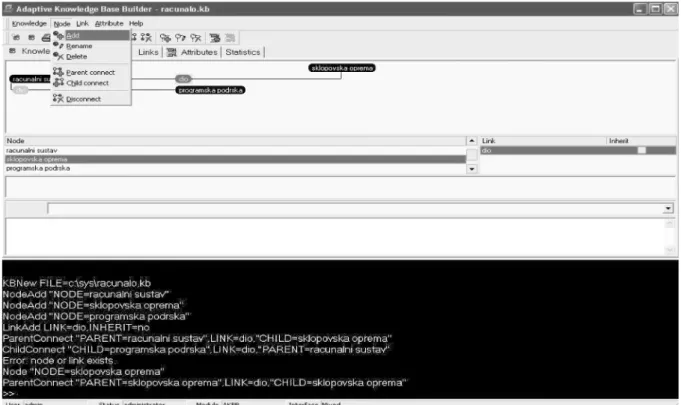
Our research is concentrated on the incorpora-tion of adaptivity in the user interface of the intelligent hypermedia authoring shell Tutor-Expert System, TEx-Sys 25], which has al-ready been used for some time at university and high school level education, providing the means for developing specialized intelligent tu-toring systems for particular domains of educa-tion. Thus, building upon the basic functiona-lity of TEx-Sys’ Developing module/shell, we conceptualized the Adaptive Knowledge Base Builder, AKBB, a domain knowledge generator with adaptive interface, see Figure 1.
3.3. AKBB User Interface Specification
In this paper we consider how the appropri-ate specification of Adaptive Knowledge Base Builder’s adaptive interface provides for the system’s refinement and especially for the def-inition of its adaptivity to different users. Be-cause of its interface-specific symbols for ac-tions and feedback, we deem the User Ac-tion NotaAc-tion appropriate enough for
ingAKBB’s behaviour, as well as for describing user actions.
As the principles for designing human-compu-ter inhuman-compu-teraction prescribe, frequent users should be provided user-defined dialogue like com-mand interfaces, while intermittent and novice users prefer system-defined dialogue like menu interfaces. Menu selection additionally reduces memory load by supporting users in making the right choice freeing them of the need to memo-rize specific commands. Moreover, due to their great impact on human-computer interaction, users’ individual differences have to be taken into account too, e.g. 7].
Among the variety of individual cognitive char-acteristics, personal and/or experience profile differences that represent characteristics of in-dividual users, we consider theirspatial ability,
experience in command languages, as well as
commonness of AKBB usage. According to the users’ individual differences and their changing knowledge and behaviour during the interac-tion, the values of these parameters are chang-ing, enabling adequate input for the set of in-ferring as well as adaptive rules. Both sets pro-vide adequate automatic adaptation ofAdaptive Knowledge Base Builder user interface. Three different kinds of interfaces are provided: (i) acommand interfacewhich only enables inter-action through the command line,(ii)a
graph-ical interfacewhich provides an interaction to be performed using combination of direct ma-nipulation and menu selection, enhanced with form fill-ins and mouse right button functions and finally(iii)amixed interfaceproviding the combination of the former two.
Considering functional requirements which de-scribe system capabilities, namely requirements which “:::specify the system function to be
sup-ported [and provide] the functional objectives [which] point to the behavior that is to be sup-ported” 5, p. 15], at the Adaptive Knowledge
Base Builder task level the execution of just one task is supported - generation of an arbi-trary domain knowledge base. The task level 2], or according to 22]goalorexternal task, is mapped into two levels:
the logical level, or (internal) task ibid.], which maps every task into subtasks, i.e. system logical functions; e.g. the task Knowl-edge Base Generationis mapped into logical
functions1. Create new knowledge base, 2. Open existing knowledge base, 3. Add new node to knowledge baseetc., and
the physical level, or action ibid.], which maps every task into physical actions within the interface; as more than one interface is provided, the physical level is defined for each one of them, e.g. in the graphical in-terface the logical function3. Add new node to knowledge base is mapped into physical actions: 3.1. select an option Node from
main menu,3.2. select an optionAdd from
node menu, 3.3. write new node name in
Node addform fill-in and3.4. click <Add> button.
As an illustration, the mapping of the logical functionAdd new node to knowledge baseinto the respective physical actions for all three kinds of interfaces is presented in Table 1 and sub-sequently used to show one application. The functionAdd new node to knowledge basein the graphical interface can be described in prose as follows:
1. move the cursor to theNodealternative in the first-level selection of themain menu; push and release the left mouse button;
2. pushing and releasing the button drops down the second-level selections forNode alterna-tive;
3. move the cursor to theAddalternative in the second-level selection; push and release the left mouse button;
4. pushing and releasing the mouse button en-ables creation ofNode add form fill-in; 5. writenew node nameof the domain
know-ledge in a Node field of a Node add form fill-in;
6. move the cursor to the <Add> button of the
Node add form fill-in; push and release the left mouse button;
7. pushing and releasing the mouse button en-ables creation of the new node named
new node namein the Knowledge panel; 8. move the cursor to the <Cancel> button of
Table 1.Illustration of functional requirements forAKBB.
9. pushing and releasing the mouse button closes theNode addform fill-in.
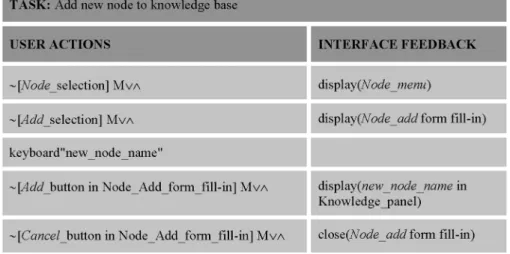
It can be noted that the above description con-sists of user actions along with interface feed-back information, which is the interface re-sponse to user actions. Since user actions are interleaved with interface feedback, there is no line-by-line association of feedback with the corresponding user actions 11]. The user action portion along with the interface feedback as de-scribed with an UAN specification offers a more precise correspondence between feedback and separate user actions in the sequence, as shown in Table 2. Consequently, the main advantage of such notation is its user-centered orientation, the possibility to write down the actions that the user will perform with theAdaptive Knowledge
Base Builder and respective system responses, but from the user’s point of view. The use of in-terface specific symbols and the incorporation of task and context considerations in the user interface makes a suitable apparatus forAKBB
interface specification.
4. Conclusion
Present day interactive applications make it an ever-increasing requirement to develop user in-terfaces that exhibit adaptivity, leading to the still open field for research intended to improve the respective interface design. This is even more important for computerized educational systems, which are not only to support a more efficient and effective interaction, but also to
change the provided interaction styles on the basis of users’ individual characteristics in or-der to address their changing knowledge and behaviour over time.
The above reasoning can be supported by con-sidering the case of the Adaptive Knowledge Base Builder, AKBB, an arbitrary domain know-ledge generator with adaptive interface, which provides the means for the development of spe-cialized intelligent tutoring systems for parti-cular domains of education. Adaptive Know-ledge Base Builder is an attempt to overcome problems due to both the increasing complexity and sophistication of human-computer interac-tion and individual end user needs in comput-erized educational systems in general. In or-der to specifyAKBB’s design and behaviour the User Action Notation is advocated as a suitable method because of its use of interface specific symbols and the incorporation of task and con-text considerations.
5. Acknowledgements
This work has been carried out within project 0036033 Semantic Web as Information Infra-structure Enabler, funded by the Ministry of Science and Technology of the Republic of Croatia.
References
1] BARTONM. Authoring Shells for Intelligent Tutor-ing Systems. 7th World Conference on Artificial Intelligence in Education, Washington, USA, Au-gust 16–19, 1995,http://www.pitt.edu/ al/ aied/barton.html
2] BENYOND.Employing Intelligence at the Interface. Handbook of UI chapter, draft 1, unpublished book chapter, 1998. www.dcs.napier.ac.uk/
dbenyon/IIT.pdf
3] BENYON D. Intelligent Interface Technology. In Howard S, Hammond J, Lindgaard G, editors. Human-Computer Interaction: INTERACT’97, Chapman & Hall, pp. 678–679, 1997.
4] BURNSH., CAPPSC. Foundations of Intelligent Tu-toring Systems: An Introduction. In Polson M, Richardson J, editors. Foundations of Intelligent Tutoring Systems, Lawrence Erlbaum Associates Publishers, Hillsdale, NJ, 1988, pp. 1–18.
5] CARROLL J., ROSSON M. Usability Specifications as a Tool in Iterative Development. In Harston R, editor. Advances in Human-Computer Interaction 1, Ablex, Northwood, NJ, 1985, pp. 1–28.
6] CHASEJ., SCHULMANR., HARTSONR., HIXD. De-velopment and Evaluation of a Taxonomical Model of Behavioral Representation Techniques. CHI’94 Conf. Proceedings, 1994, pp. 159–165.
7] EGAN D. Individual Differences in Human-Computer Interaction. In Helander M, editor. Hand-book of Human-Computer Interaction. Elsevier Sci-ence B.V. Publishers (North-Holland), 1988, pp. 543–568.
8] FLEISCHMANN A. The Electronic Teacher: The Social Impact of Intelligent Tutoring Systems in Education, 2000, http://www.student. informatik.tu-darmstadt.de/ andreasf/ inhalte/its.html
9] GRANIC´ A., GLAVINIC´ V. Adaptive Intelligent Tu-toring Systems in the Context of Usability Re-quirements.5thIEEE Int. Conference on Intelligent
Engineering Systems INES 2001, Helsinki, Finland, September 16–18, 2001, pp. 231–234.
10] GRANIC´A., GLAVINIC´V. Interface Redesign Issues for Intelligent Tutoring Systems.9th International
Conference on Human-Computer Interaction HCI International 2001, Poster Sessions: Abridged Pro-ceedings, New Orleans, Louisiana USA, August 5–10, 2001, pp. 133–135.
11] HARTSONR., SIOCHIA., HIXD. The UAN: A User-Oriented Representation for Direct Manipulation Interface Designs.ACM Trans on Information Sys-tems, Vol. 8, No. 3, 1990, pp. 181–203.
12] Intelligent Interfaces Special Interest Group, IISIG, 1998,http://www.dcs.napier.ac.uk/
dbenyon/iisig2.html
13] KARAGIANNIDIS C., STEPHANIDIS C. Run-Time Adaptation in Intelligent User Interfaces: Auto-matic, Iterative Decision Making with Feedback. 1998,http://www.dfki.de/etai/
articles/stephanidis-jan-98/paper.html 14] KOBSA A. User Modeling and User-Adapted
Interaction. CHI’94 Tutorial Notes, 1994, http://www.acm.org/sigc|hi/c|hivas/ kobsa.html
15] LETHBRIDGET. What Knowledge Is Important to a Software Professional? IEEE Computer, May, 2000, pp. 44–50.
16] MAYBURYM. Intelligent User Interfaces: An In-troduction. HCI’99 Tutorial,8th International Con-ference on Human-Computer Interaction HCI’99, Munich, Germany, August 22–27, 1999.
18] MURRAYT. Authoring Intelligent Tutoring Systems: An Analysis of the State of the Art.International Journal of Artificial Intelligence in Education, Vol. 10, 1999, pp. 98–129.
19] MYERSB., editor.Languages for Developing User Interfaces, Jones and Bartlett Publishers, Inc., 1992. 20] NORCIOA., STANLEYJ. Adaptive Human-Computer Interfaces: A Literature Survey and Perspective. IEEE Transactions on Systems, Man and Cybernet-ics, Vol. 19, No. 2, 1989, pp. 399–408.
21] NUTED. Knowledge Representation. In Shapiro S, editor.Encyclopedia of Artificial Intelligence, John Wiley & Sons, Inc, 1992, pp. 743–869.
22] PREECEJ., ROGERSY., SHARPH., BENYOND., HOL
-LANDS., CAREYT.Human-Computer Interaction,
Addison-Wesley, Wokingham, England, 1994. 23] SHERWOODR. Models of Computer Use in School
Settings. In Kinzer Ch, Sherwood R, Bransford J, editors.Computer Strategies for Education: Foun-dations and Content-Area Applications. Merrill Publishing Company, Columbus, Ohio, 1986, pp. 105–130.
24] SHNEIDERMAN B. Designing the User Interface. Strategies for Effective Human-Computer Interac-tion, 3rd Ed., Addison-Wesley, Reading, MA, 1998. 25] STANKOVS.Isomorphic model of the system as the basis of teaching control principles in the intelli-gent tutoring system. Ph.D. Faculty of Electrical Engineering, Mechanical Engineering and Naval Architecture, University of Split, 1997 (in Croa-tian).
Received:June, 2002
Accepted:September, 2002
Contact address:
Andrina Grani´c Faculty of Natural Sciences, Mathematics and Education University of Split Nikole Tesle 12, 21000 Split, Croatia Phone:(385)21-38 51 33/105
Fax:(385)21-38 54 31
e-mail:[email protected]
Vlado Glavini´c Faculty of Electrical Engineering and Computing University of Zagreb Unska 3, 10000 Zagreb, Croatia Phone:(385)1-612 99 55
Fax:(385)1-612 96 53
e-mail:[email protected]
ANDRINAGRANIC´is a research assistant at the Faculty of Natural
Sci-ences, Mathematics and Education, University of Split, Croatia, since 1990. She holds the Doctorate, M.Sc. and the Dipl.-Ing. degrees in Computer Science from the University of Zagreb, Croatia. Her main research interests are in the areas of computerized educational systems and human-computer interaction, including adaptive user interfaces and usability evaluation.
VLADOGLAVINIC´is an associate professor of computer engineering at the Faculty of Electrical Engineering and Computing, University of Za-greb, Croatia. He holds the Doctorate and M.Sc. degrees in Computer Science and the Dipl.-Ing. degree in Electrical Engineering, all from the University of Zagreb.