International Journal of Research in Engineering & Applied Sciences Email:- [email protected], http://www.euroasiapub.org
An open access scholarly, online, peer-reviewed, interdisciplinary, monthly, and fully refereed journal
31
PERFORMANCE ANALYSIS USING ARTIFICIAL INTELLIGENCE IN WIRELESSNETWORK SYSTEM AND ITS BENEFITS
M. Sagar1, Dr. Amit Jain2
Department of Electronics and Communication Engineering
1,2
OPJS University, Churu, Rajasthan (India)
Abstract
This research uses an observation method to identify performance analysis using artificial intelligence in wireless network system and their applications. Smart or Intelligent radios should play an important role in meeting the growing demand for wireless traffic. An intelligent radio node detects the environment, analyzes external parameters and then makes decisions for the dynamic allocation of resources and space-frequency-space management to improve the use of radio spectrum. For efficient real-time processing, smart radio is usually combined with artificial intelligence and machine learning techniques to achieve an adaptive and intelligent allocation. This document presents, first of all, intelligent radio networks, resources, objectives, limits and challenges. Therefore, it introduces artificial intelligence and machine learning techniques and emphasizes the role of learning in smart radios. Therefore, a survey is presented on the state of the art of machine learning techniques in smart radios. The literature survey is organized on the basis of different techniques of artificial intelligence and fuzzy logic, genetic algorithms, neural networks, game theory, reinforcement learning, Vector Machine support, case-based reasoning, entropy, Bayesian model, Markov, multi-agent systems and bee colonies algorithms. This research also analyzes the implementation of HetNetsand smart radio and the expected learning challenges in smart radio applications.
1. OVERVIEW
Due to the rapid improvement of the current
Internet and mobile communications
industry, the versatile series of movements has seen explosive growth in recent years.
Similarly, versatile network system
operators (MNOs) have been made and improved with more complex foundations,
wider variety of devices and related
resources and dynamic network
developments [1], and moves towards the promising future vision of the world of portable networks, heterogeneous networks (Hetnet).
International Journal of Research in Engineering & Applied Sciences Email:- [email protected], http://www.euroasiapub.org
An open access scholarly, online, peer-reviewed, interdisciplinary, monthly, and fully refereed journal
32
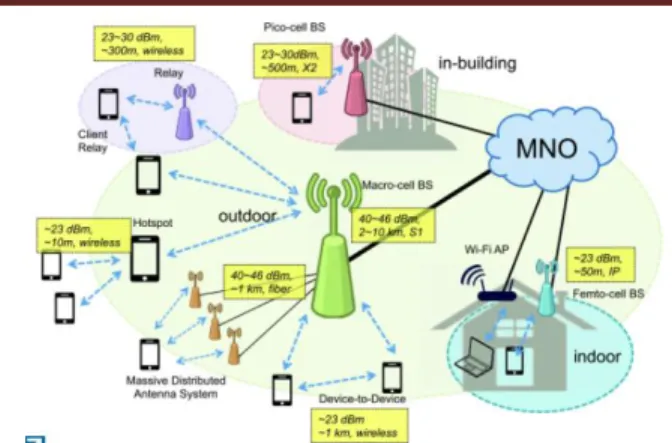
example, macrocell, base (BS) in the world-wide interoperability station for Microwave Access (WiMAX) and updated Bodes (eNB) in Long-Term Evolution (LTE), which has the highest transmission power and therefore flow (up to a few kilometers outside), picocell that generally has less space to focus mainly on smoothing covered range, moderately moderating femtocell undersized minimum effort customer low flow rate transmitted power approaches in offices and homes, transfer is an access point sent by the MNO which targets only large scale signals between end-users cells and in areas of reach weak and dead points. Therefore, the contorted network base seeks the drawbacks to organize, monitor and successfully carry out network resources, while the growing demand for versatile assets is producing more weight. Despite the fact that there have been numerous methods proposed to directly improve the performance of HetNets, how to automatically manage the complexity of the HetNets through other algorithms and evolutionary strategies becomes a hot topic of research.
Figure 1 Infrastructure of Heterogeneous Networks
This document presents, first of all,
intelligent radio networks, resources,
objectives, limits and challenges. Therefore, it introduces artificial intelligence and machine learning techniques and emphasizes the role of learning in smart radios. Therefore, a survey is presented on the state of the art of machine learning techniques in smart radios. The literature survey is organized on the basis of different techniques of artificial intelligence and fuzzy logic, genetic algorithms, neural
networks, game theory, reinforcement
International Journal of Research in Engineering & Applied Sciences Email:- [email protected], http://www.euroasiapub.org
An open access scholarly, online, peer-reviewed, interdisciplinary, monthly, and fully refereed journal
33
1.2 Historical OverviewAccording to the Cisco Visual Networking Index, global IP traffic will reach 168 exabytes per month in 2019 and the number of devices will triple the world's population. In addition, resources in terms of power and bandwidth are scarce. Therefore, new solutions are needed to minimize energy consumption and optimize the allocation of resources. Cognitive radio (CR) was introduced by Joseph Mitola III and Gerald Q. Maguire in 1999 for flexible access to the spectrum. Basically, they defined Intelligent radio as the integration of model-based reasoning with software radio technologies. In 2005, Simon Haykin conducted a review of the concept of Intelligent radio and was treated as authorized by wireless brain communications. Intelligent radio is a radio or system that detects the environment, analyzes transmission parameters and then makes decisions for the dynamic allocation and management of time-frequency space resources to improve the use of the radio-magnetic spectrum.
2ADVANCED FEATURES OF AI
TECHNIQUES
Self-Evolution in HetNets
In recent years, SONs technology has experienced explosive growth in its studio. SON must considerably reduce operating costs by reducing human participation. The
essential idea of SON is to integrate planning, configuration and optimization of the network into a single process, mostly automated, which requires minimal manual intervention; in particular, techniques based on artificial intelligence can offer effective solutions for SON in HetNets. SON's main
features in HetNets include
configuration, auto-optimization and self-repair, which HetNets designs with the "auto-evolution" capability. The functions of "self-financing" and "self-organization" are sometimes discussed separately from the automatic configuration, but in this article we consider it an essential pre-operational start-up phase. In the following subsections, we will present the related AI techniques for SON in HetNets with respect to the three characteristics mentioned above. And the features of SON for HetNets are illustrated in Fig. 2.
Figure 2 Illustration of AI-based
techniques for self-organization on
International Journal of Research in Engineering & Applied Sciences Email:- [email protected], http://www.euroasiapub.org
An open access scholarly, online, peer-reviewed, interdisciplinary, monthly, and fully refereed journal
34
From the aspect of reducing the operational and capital use (O/CAPEX) of MNOs, AI-based procedures can significantly lessen human inclusion in operational errands, and optimize network limit, coverage, and Quality of Service (QoS) in HetNets, as per the propelled features examined in
Self-Organizing Networks (SONs) along
following headings [2-4]:
1) Self-Configuration, where recently
conveyed high assortment of cells are automatically designed and refreshed before entering activity undertakings,
2) Self-Healing, where cells and networks
can automatically distinguish and recoup from disappointment and even execute remuneration components at whatever point disappointments happen, and
3) Self-Optimization, where cellular
systems can quantify the network conditions and optimize the settings to enhance the performance regarding
coverage, bandwidth, impedance
evasion, and QoS, while the comparing issues of system adaptability and energy protection are likewise considered. Be that as it may, for all intents and purposes applying real-time optimization is troublesome, in light of the fact that it commonly involves substantial work stack for thorough estimation, insights learning, optimization critical thinking,
and decision making over the
parameters.
Automatic coverage optimization
and load adjusting can be
accomplished by altering the
reception apparatus settings and along these lines forming the radio coverage, and by modifying the handover parameters to consistently change the cell size.
Mobility optimization: Mobility
optimization very depends on the
help of productive
neighborhoodupkeep, the users can
automatically invigorate and
reconfigures the area list for holding the base arrangement of cells vital for wandering in light of estimations.
Link quality estimation must be
constantly performed with a high unwavering quality to encourage a safe transmission with robustness in HetNets. Rather than regular static connection quality mindful routing metrics that embrace basic
moving-normal estimators, bio-inspired
estimator in view of the neural network worldview can be used to
enhance the effectiveness of
connection quality estimation.
Device-to-Device communications
International Journal of Research in Engineering & Applied Sciences Email:- [email protected], http://www.euroasiapub.org
An open access scholarly, online, peer-reviewed, interdisciplinary, monthly, and fully refereed journal
35
versatility and expansive limit, by using the composed device-to-device joins attributable to the viable
impedance administration. The
coveted resource allocation can profit much from the AI-based strategies.
Relay-based multi-bounce
transmission can viably broaden the service coverage and strengthen the
manageability of HetNets by
utilizing middle of the road transfer nodes, with the goal that the transmission can traverse various
jumps, while the connection
impedance and multi-bounce way arrangement turn out to be very testing.
Virtical Handoff (VHO) in HetNets
assumes an important part in satisfying consistent versatile service when users cross diverse cells with
various connection layer
advancements for RANs. Current
VHO algorithms fundamentally
centeraround when to trigger and what association QoS to enhance, however disregard the synthetically thought of all as of now accessible hopeful networks, where AI-based methods can get ideal decisions on parameters by general assessment of the entangled conditions.
3 CONCEPT OFINTELLIGENT OR
COGNITIVE RADIO
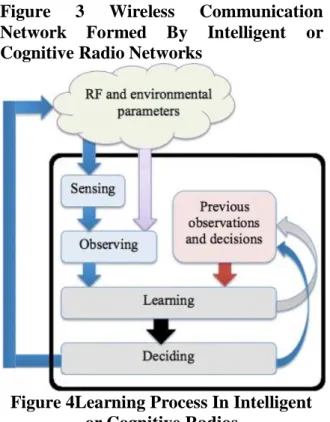
Cognitive or intelligent radio provides the radio system with an intelligence to maintain highly reliable communication with efficient use of the radio spectrum. We present the intelligent radio cycle, the corresponding tasks and challenges. The cognitive cycle As
shown in Figure 3, the wireless
communication system consists of base stations and radio networks in which some are primary users (PU ) or networks that have the spectrum and other secondary users (SU) that can use the spectrum when it is available and not occupied by other networks. As shown in Figure 4, the intelligent radio network follows the intelligent or cognitive cycle for better
resource management and network
performance. It starts by detecting the
environment, analyzing the external
International Journal of Research in Engineering & Applied Sciences Email:- [email protected], http://www.euroasiapub.org
An open access scholarly, online, peer-reviewed, interdisciplinary, monthly, and fully refereed journal
36
Figure 3 Wireless Communication
Network Formed By Intelligent or Cognitive Radio Networks
Figure 4Learning Process In Intelligent or Cognitive Radios
4PERFORMANCE OF ARTIFICIAL INTELLIGENCE TECHNIQUES
In this section, a cutting-edge research survey that considers CR learning is presented. They are grouped according to
artificial intelligence and learning
techniques.
Fuzzy Logic
The fuzzy set theory was proposed by Lotfi A. Zadeh in 1965 to solve and shape uncertainty, ambiguity, inaccuracy and vagueness using mathematical and empirical models. Variables in fuzzy logic are not limited to only two values (true or false)
because they are defined in classic and clear sets. A widespread element has a degree of belonging or compatibility with the whole and its negation. Fuzzy logic provides the system (1) with an approximate reasoning by taking widespread variables as input and producing a decision using se-then set of
rules, (2) decision-making ability in
conditions of uncertainty in prediction of consequences, (3) learning of old experience and (4) generalization to adapt to new situations. In general, the entries for the fuzzy inference system (FIS) must be blurred or classified in levels or degrees such as low, medium and high. FIS using if-then rules will allow to determine the output of the system.
Genetic Algorithms
The genetic algorithms (GA) originate in Friedberg's work (1958), which sought to
produce learning by mutating small
FORTRAN programs. Therefore, by
International Journal of Research in Engineering & Applied Sciences Email:- [email protected], http://www.euroasiapub.org
An open access scholarly, online, peer-reviewed, interdisciplinary, monthly, and fully refereed journal
37
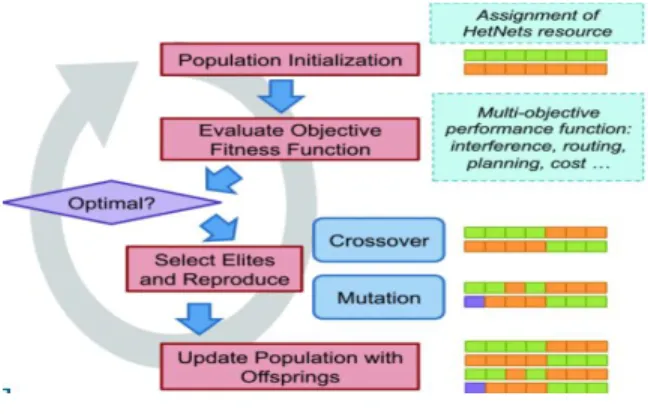
Among numerous prevalent evolutionary
algorithms found and intended for
improving complex systems, the Genetic Algorithm (GA) must be the delegate one. The GA embraces the quality advancement strategy, including two primary assignments, hybrid, which encourages the acquisition of ideal arrangement, and change, which anticipates tumbling to territorial ideal arrangements. Fig. 5 represents the method utilizing GA for HetNets.
Figure 5.Illustration of GA optimization
flow for HetNets.
Neural Networks
Neural networks were introduced by Warren McCulloch and Walter Pitts in 1943 and were inspired by the central nervous system. Similar to the biological neural network, the artificial neural network will be formed by nodes, also called neurons or processing elements, which are connected to form a
network. The artificial neural network obtains information from all neighboring neurons and provides an output based on its weight and activation functions. Adaptive weights can represent the strengths of the connection between neurons. To achieve the learning process, the weights must be adjusted until the output of the network is approximately equal to the desired output. Artificial neural networks have been used to make intelligent radios learn from the environment and make decisions in order to improve the quality of service of the communication system.
Game Theory
The first known discussion on game theory occurred in a letter written by James Waldegrave in 1713. Game theory is used as a decision-making technique in which several players must make decisions and thus influence the interests of other players. Each player decides his or her actions based on the chronology of actions selected by other players in the previous rounds of the game. In smart networks, CR networks are the players in the game. Actions are
configuring RF parameters, such as
International Journal of Research in Engineering & Applied Sciences Email:- [email protected], http://www.euroasiapub.org
An open access scholarly, online, peer-reviewed, interdisciplinary, monthly, and fully refereed journal
38
observe the actions of the other CR networks and modify its actions accordingly.
Reinforcement Learning
Reinforcement learning (RL) plays a key role in the multi-agent domain, as it allows agents to discover the situation and take measurements using evidence and errors to maximize the cumulative reward as shown
in Figure 6. The basic model of
reinforcement learning consists of (1) environmental states, (2) actions, (3) rules for transition between states, (4) immediate reward for transition rules and (5) rules for observing agents. In RL, an agent must
consider the immediate rewards and
consequences of his actions to maximize long-term system performance.
Figure 6The Agent-Environment
Interaction In Reinforcement Learning
Support Vector Machine
Vector support machines (SVMs) are supervised learning models that are used for regression analysis and classification. In the learning phase, SVM uses training data to reach the margins and separate the classes,
A new object or object is classified according to these margins and based on compatibility or the distance between the
object and the class.
The researcher used SVM to add a learning project to the CR engine.
Case-Based Reasoning
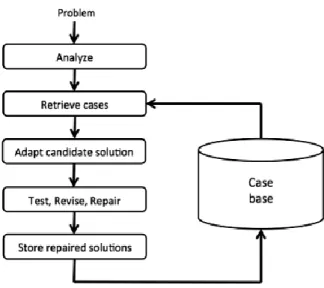
D. Xu introduced case-based reasoning (CBR) concept based on previous problems and solutions for Resolve similar current situations. CBR systems create a database of information on past situations, problems and their solutions and rewards, as shown in Figure 7. The new problems are solved later to find the closest case in memory and to infer the solution to the current situation.
Figure 7 Case-Based Reasoning Concept Illustration
International Journal of Research in Engineering & Applied Sciences Email:- [email protected], http://www.euroasiapub.org
An open access scholarly, online, peer-reviewed, interdisciplinary, monthly, and fully refereed journal
39
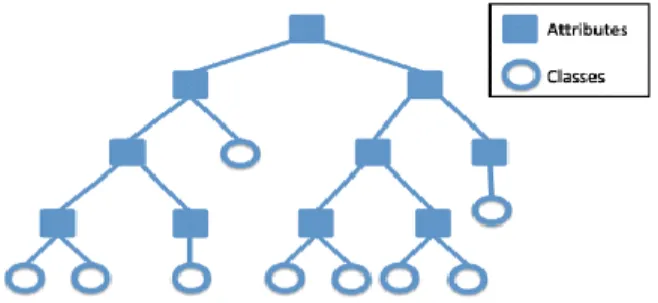
The decision tree uses a decision tree to create a model that predicts the value of a target class based on the various input variables. A decision tree has a structure similar to that of a flowchart, where each node is an attribute and the top node is the root node, as shown in Figure 8. Each branch represents the result of a test and each leaf node has a class label.
Figure 4.5 Decision Tree Chart Where Each Node Is An Attribute And Each Leaf Node Holds A Class Label
Entropy
In 1948, Claude E. Shannon introduced entropy in his article "A Mathematical Theory of Communication". Entropy is a measure of uncertainty in a random variable. It is also defined as a logarithmic measure of the rate of information transfer in a
particular message. The proposed
investigator (1) has an entropy detector based spectral power density that provides
better detection with less computational complexity and (2) a biphasic entropy detection system to improve the entropy density ratio power spectrum detector performance in the lower SNR. The researcher's entropy was used for spectrum detection.
Bayesian Approach
Bayesian networks are probabilistic graphic models based on the interaction between different nodes to obtain learning from and to each node involved in the process. Bayesian networks (BN) play a role in making decisions if they are combined with utility to form influence diagrams.The researcher proposed an interference engine for learning and decision-making based on
Bayesian networks. We used the
genealogical tree algorithm to model interference using probabilistic models obtained from BN. We developed their CR model to adapt their radio parameters to ensure the user's QoS.
Markov Model
International Journal of Research in Engineering & Applied Sciences Email:- [email protected], http://www.euroasiapub.org
An open access scholarly, online, peer-reviewed, interdisciplinary, monthly, and fully refereed journal
40
Multi Agent SystemsJacques Ferber has introduced multiple agent systems (MAS) as an intelligent entity aware of its environment, capable of acting and communicating independently. MAS contains the environment, objects, agents and the different relationships between these entities. MAS has its applications mainly to solve problems and create a virtual world. The researcher has introduced a new approach to address spectrum transfer within the CR domain. Its approach allows CR terminals to always switch to the spectrum band that offers the best conditions through the use of multi-agent system negotiation. They considered the mobile CR terminal and the main users as agents when they negotiated prices and bandwidth trying to maximize their profits.
Artificial Bee Colony
The concept of artificial bee colony (ABC) was introduced by DervisKaraboga in 2005, motivated by the intelligent behavior of honey bees. In ABC it is defined as a
heuristic approach that presents the
advantages of memory, more characters, local search and a mechanism to improve the solution. In the ABC model, the colony is composed of three groups of bees: employed, curious and exploratory bees. The goal is to determine the location of the
best food sources. The employed bees will look for food sources; If the amount of nectar from a new source is greater than the amount in memory, it will store the new position and forget the previous one.
Multiple Classes Of Machine Learning Algorithms
The machine learning algorithms learn to perform a T task based on a particular experience E, whose objective is to improve the performance of the activity measured by a specific performance metric P by exploiting the experience E. Based on how specifies T, E and P, the machine learning algorithms are generally divided into three
large categories. Supervised learning
performs tasks by learning from the
examples provided by an external
supervisor. Each training example consists of a pair of an input and an expected output / tag, and the goal is to learn a function that correctly predicts the output for each input.
5 SWARM INTELLIGENCE
International Journal of Research in Engineering & Applied Sciences Email:- [email protected], http://www.euroasiapub.org
An open access scholarly, online, peer-reviewed, interdisciplinary, monthly, and fully refereed journal
41
very complex tasks: this emerging
intelligent behavior derives mainly from two principles: self-organization and stigma.
6 CONCLUSION
The intelligence of radio Intelligent
technology and machine learning offers the potential to learn and adapt to wireless environments. Because the use of machine
learning techniques in wireless
communications is often combined with Intelligent radio technology, we have focused on both radio Intelligent technology and machine learning to provide a complete overview of their roles and relationships to achieve intelligent wireless communications We have considered spectrum efficiency and energy efficiency, both important features of intelligent wireless communications. We
have also presented some practical
applications of these techniques to existing and future wireless communication systems, such as heterogeneous networks and D2D communications. Furthermore, we have developed open research challenges in Intelligent radio and machine learning, and
suggest probable improvements in future wireless communication systems.
The author's researcher presented a survey on various learning techniques, such as reinforcement learning, game theory, neural networks, the support vector machine and the Markov model. They also discussed their strengths, their weaknesses and challenges in applying these techniques in their RC tasks. Consider game theory, reinforcement learning, and reasoning approaches, such as Bayesian networks, fuzzy logic, and case-based reasoning. In contrast to the literature, we present a comprehensive survey that takes into account all the learning techniques used in Intelligent networks.The survey is organized based on different artificial
intelligence approaches including the
following: (a) fuzzy logic, (b) genetic algorithms, (c) neural networks, (d) game theory, (e) reinforcement learning, (f) support vector machine, (g) case-based reasoning, (h) decision tree, (i) entropy, (j) Bayesian, (k) Markov model, (l) multi-agent systems, and (m) artificial bee colony algorithm.
REFERENCES
[1].Guo, W. Wang, S. Chu, X. Zhang, J.
Chen, J. Song, H. "Automated
Small-Cell Deployment For
Heterogeneous Cellular Networks", IEEE Commun. Mag., vol. 51, pp. 46-53, May 2013.
[2].M. Dorigo, V. Maniezzo, and A.
Colorni, “The ant system:
optimization by a colony of
cooperating agents,” IEEE
Transactions on Systems, Man, and Cybernetics, part B, vol. 26, no. 1, pp. 29-41, 1996.
[3].R. Schoonderwoerd, O. Holland, J.
International Journal of Research in Engineering & Applied Sciences Email:- [email protected], http://www.euroasiapub.org
An open access scholarly, online, peer-reviewed, interdisciplinary, monthly, and fully refereed journal
42
based Load Balancing in
Telecommunication Networks,”
Adaptive Behavior, vol. 5, pp. 169-207, 1996.
[4].S. Guerin, “Optimisation
multi-agents en environnementdynamique:
application au routagedans les