Noman Ahmed1
Department of Architecture and Planning
NED UNIVERSITY OF ENGINEERING AND TECHNOLOGY, KARACHI, PAKISTAN
Abstract
Regions affected by conflict and violence become difficult locations for undertaking routine management and rebuilding. However conditions often arise where input from various stakeholders for relief, rehabilitation and institutional re-vamping become unavoidable. Research and experiences from different contexts inform that outcomes of such interventions have varied results due to unpredictability of contextual conditions, approaches and methodologies adopted for planning and implementations, capacity of personnel involved, available resources and interests of concerned institutions. Awaran district in Balochistan has been impacted by conflict and violence for many years. The impoverished region, apart from social and political turbulence, is recovering from a devastating earthquake that struck the district in September 2013. This paper examines two development interventions in the region; one undertaken by the district administration to streamline the development work through a state sponsored housing reconstruction project and the other by Urban Resource Centre (URC) in collaboration with local communities. Field research for this paper was done during 2014-2015 and comprised review of records, informal discussions with government staff, military officers, community members and working staff of NGOs in the area. After analysing the key findings of these two initiatives, it was found that government sponsored housing reconstruction projects experienced limited success due to usual bureaucratic hurdles and political uncertainties. The community led initiatives were more effective, simple and easy to apply.
BACKGROUND
Awaran District is located in the south of Balochistan province, at a location of 1,095 km (aerial distance) south east (225 degrees bearing) of Pakistan’s Capital Islamabad. It is a sparsely populated district, with an estimated population of around 174,350, as found in 2014, scattered over an area of more than 29,510 square kilometres (UNICEF, 2011). It comprises three sub districts (Tehsils) namely Mashkai, Awaran and Jhal Jhao. It was created as a separate district on 11 November 1992 and is considered the poorest district in the province, in spite of being the fourth largest district in terms of area. The area features lowest on all development indicators, be it education, health, food, economy and especially security. The district, alongside other locations in the region, is gravely impacted by insurgency and conflict since several years. Factions of local insurgent groups – that demand greater political rights and autonomy – resort to violence upon opponents and law enforcement agencies. Since many years, para military troops and army contingents are deployed to maintain peace and prevent conflict (PIPS, 2010; The Nation, 2015).
EARTHQUAKE 2013 AND AFTER
Earthquake Damage
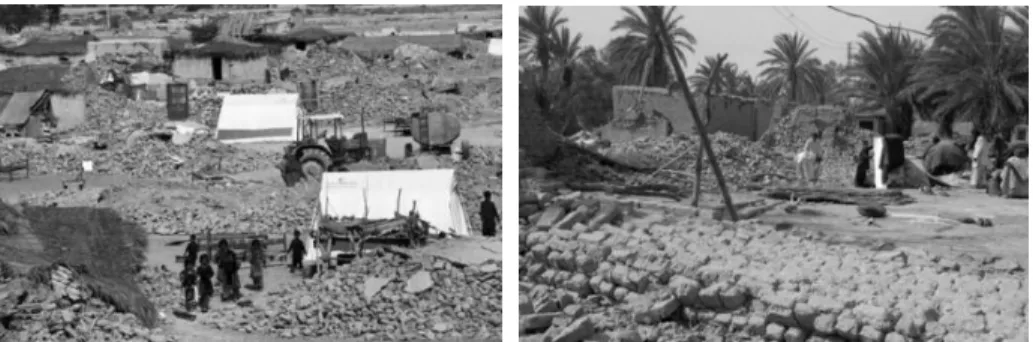
Figure 1 Earthquake damages in Awaran during September 2013
Many households took the decision of leaving Awaran and re-locating in Karachi and other parts of the country. Discussions with community members revealed that possible danger of more earthquakes in the near future was one key reason to move out to other locations. The people were also unhappy about the prevailing security situation. Frequent rounding up of the youth by law enforcing agencies and alleged use of torture to extract information about insurgents were commonly cited reasons to leave the area. The extreme state of underdevelopment and poor response from government was another shared observation by the people. They were of the view that while some responses to disaster were being facilitated, the district had been neglected by administration in respect to provision of essential infrastructure and services. For example, no road worth the name existed between Gajjar sub district and Awaran. People travelling for emergency health care assistance had to hire special vans or jeeps to transport the sick, including expecting mothers, to a health care facility to the nearby districts. Travelling during night time was absolutely impossible due to poor road condition and fear of insurgents’ attacks.
Planning and Development Initiatives by Government of Balochistan
The Balochistan government launched a rehabilitation and redevelopment project in Awaran in October 2013. The project comprised the redevelopment of the disaster stricken areas in the wake of the 2013 Earthquake, and was initiated after the then Deputy Commissioner of Awaran, Mr Aziz Ahmad Jamali approached NED University to take up the task of conducting research and contribute to rehabilitation works in the identified sites in the district. The partnership began in March 2014, when the Government of Balochistan invited the Earthquake Engineering Department of NED University and Provincial Disaster Management Authority Balochistan to venture into seismic resistant construction to avoid damages due to future earthquakes in the area.
and although reconstruction had already begun, the pace was extremely slow, and majority of the amenities and important structures are currently non-functional.
For an extensive survey of the area, NED University engaged a survey team that visited the area several times to accurately document all existing plots, constructions, building functions, damage assessment and conduct observational studies. A team from the Department of Architecture and Planning, NED University and Technical Training Resource Centre (TTRC) (a community oriented support organization) also joined in and visited the place to carry out photographic documentation, conducted interviews with the residents and other stakeholders to expand understanding about the current context and gain first-hand experience of the area. Analysis of these studies and surveys provided a basis for redevelopment plan of Gajjar area.
House Re-Construction in Awaran (HRA)
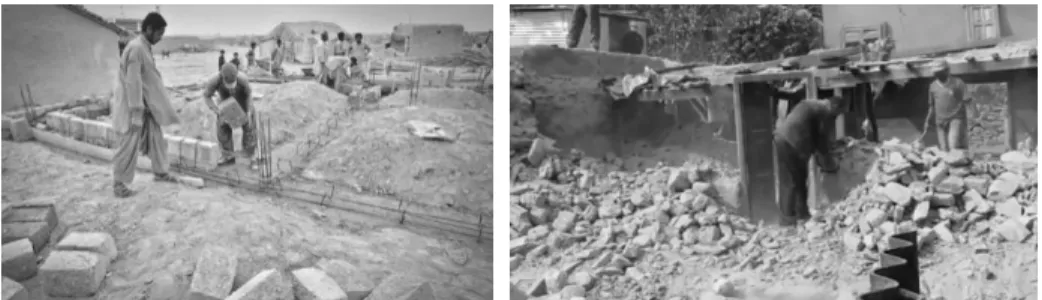
After the September 2013 earthquake in Awaran, efforts began to initiate housing reconstruction works in the affected parts of the district. Federal government and Balochistan administration jointly prepared a housing reconstruction project for the district. Rs. 4 billion (US$ 42,105,263) were allocated to reconstruct 16,000 houses at an estimated cost of Rs. 250,000 (US$ 2,631) per house. Federal government agreed to provide Rs. 2 billion (US$ 21,052,631) to the project. The project was designed to promote owner driven construction. It may be noted that owner driven housing reconstruction works were done earlier in the country after 2005 earthquake in Khyber Pakhtunkhwa province and Pakistani Administered Kashmir on similar patterns.
Figure 2:Housing Re-construction in Awaran
Figure 3Process diagram – housing reconstruction in Awaran (HRA Project by Government of Balochistan)
Awaran Earthquake Rehabilitation Support Project
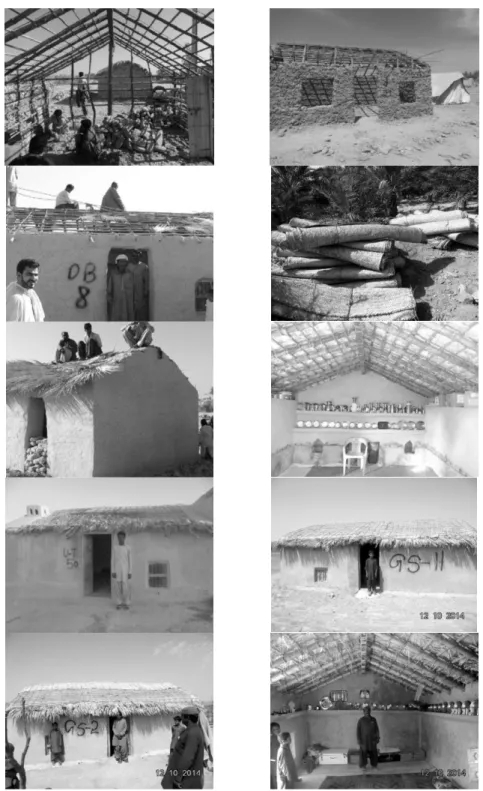
The Urban Resource Centre (URC), with the assistance of Asian Coalition of Housing Rights (ACHR) and Orangi Pilot Project (OPP) launched a rehabilitation project in the aftermath of September 2013 earthquake. Several visits were made by URC team to Awaran and meetings were held with the affected communities. An assessment of the damage was done with an objective to design an appropriate project to effectively benefit the impacted communities (URC,2015). From the situation reviews conducted by URC volunteers, it was found that basic construction material was in short supply. People possessed the willingness to contribute labour and needed basic training in construction trade. It was found that bulk of the damaged houses collapsed as there was neither a frame to support the roof nor a proper foundation. Mud, stone and palm leaves were abundantly available which were used as common construction material. The earthquake had also destroyed the water supply infrastructure that required instant rehabilitation (Figure 4).
Survey of affected areas and listing of potential beneficiaries
Preparation and notification of beneficiary lists – information provided to beneficiaries – verification of documents
Construction begins on site – periodic verification by project staff
Beneficiaries open bank accounts after receiving cheques of first installment
Second installment released after verifying the construction process
Third installment issued at roofing construction and finishing of walls
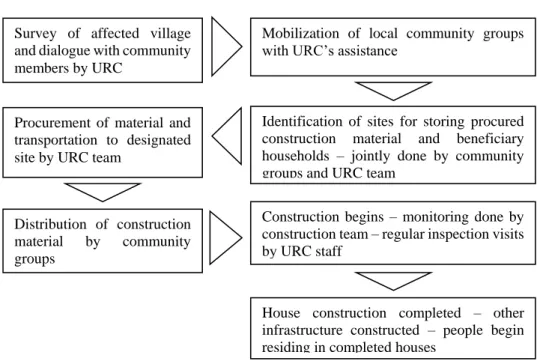
Figure 5 Process diagram – Awaran Earth Quake Rehabilitation Project by URC
ANALYSIS
Institutional Arrangements for Rehabilitation
The review of documents, feedback from community and members of civil and security administration revealed many important points. There was a feeling of mutual distrust among the three categories of stakeholders that caused suspicious around HRA design and delivery work. The security agencies were interested to strongly scan each and every potential beneficiary of the assistance before the project implementation could take off. They were of the view that many members of the community had clandestine links with the lurking insurgents. To maintain peace in the area and to enable them enforce the write of the state, such folks must not be entertained in the housing reconstruction work.
The district administration had the objective to complete the rehabilitation work in the stipulated time and in follow up of the general conditions. They were generally satisfied if and when the communities cooperated with them in swift facilitation of rehabilitation work. The district administration also attempted to resolve procedural problems such as loss of CNICs, quick opening of bank accounts and extending services of masons. It may be noted that for many locals, the interface with a bank was the first in lifetime experience. It caused problems when the people were not able to abide by the pre-requisites of banking procedures and documentation. The design and delivery of 16,000 houses in the allocated time, with measures of improved design and
site by URC team households – jointly done by community groups and URC team
Distribution of construction material by community groups
Construction begins – monitoring done by construction team – regular inspection visits by URC staff
construction, were the main focus of district administration. Some of their staff was of the view that it would be impossible to objectively ascertain the alleged connections of the community youth with the insurgents. Porous and spread out geographical terrains, intertwined social relationships and use of coercive power by insurgents to win over informers and sympathizers were some of the reasons in this regard.
The community members, especially those who were to receive relief through the project, were generally receptive to approaches of rehabilitation. However, they were concerned about the precarious law and order conditions that prevailed in the area. The people believed that conflicts between insurgents and security agencies needed a quick and effective resolution for the success and sustainability of the house reconstruction programme. Community blamed that since they are the only stakeholder who are permanently stationed in the territory, they receive undesirable treatment from both the conflicting parties. Many young people had gone missing, believed to be taken into custody by the security agencies or kidnapped by insurgents. The environment of unpredictability and fear was unsuitable for any rehabilitation effort to deliver sustainable results.
Technology of Re-building
The government led programme relied on the orthodox construction in cement concrete block with proper reinforcement added to make the structures seismically safe. The options generated by university staff also include reinforced mud construction, but the general inclination of government functionaries and field teams were more towards cement construction. This option was dependent upon material that was to be procured from outside Awaran, and required input of trained masons and supervisors for proper construction. Cement construction was also found to be not climate friendly. However, as believed by some community members, cement concrete house was perceived as a higher value social and economic asset compared to the mud houses.
considered ‘suspicious’ or ‘collaborators of insurgents’, left little room for a livable option. Despite the fact that Awaran was extremely underdeveloped, the pre requisite to any kind of physical development remained elusive in official debates of social and strategic issues.
A usual political process, capable of representing the views and voices of local people is a fundamental pre-requisite in sustaining the initiatives in rehabilitation. The people demand the presence of a ‘government’ that is able to listen to their day to day grievances and is able to devise a timely solution to their immediate problems. Functional absence of a capable and potent local government is also a major hurdle in the smooth management of the area affairs. People question whether Awaran will continue to benefit from any governmental input, once the execution of projects or other efforts related to earthquake rehabilitation were concluded.
Lessons Learnt
Awaran presents a complex case for initiating and sustaining rehabilitation and development efforts. There are a number of fundamental social, political and administrative issues that must be settled before any planning and development effort is launched by the government and other stakeholders. From the review of literature and dialogue with the people, it was evident that the concerns that caused insurgency and civil disobedience can be resolved through a constitutionally mandated political process. In the present situation, this initiative was found missing, replaced by a military option. It is believed that a valid political process has greater likelihood to restore peace and order that shall enable rehabilitation process to germinate firmly, since the ownership and responsibility of the same shall be proudly held by the people of the area.
to a near complete retardation of the project since mid-2015. Very little progress could be seen on the designated sites. The input of design innovation from the university professors and scholars made headway when there was an appreciation by the deputy commissioner. This very useful tie was instantly severed after the officer got transferred.
The URC driven effort was a useful effort of a non-governmental actor that understood the context and dynamics of the area well. The project was able to articulate the target group well due to deeper interaction with the community. The targets were successfully met as there was no red tape in the process. Procurement of material, imparting of essential training, management of construction process, quality control, reporting and record keeping were done due to constant vigilance of URC team and community activists. However the project was entirely dependent upon the received financial grant from URC’s donors. While the community was willing to extend the project to more households, the availability of funds, on the same terms and conditions, was not possible. Also the government is generally not willing to adopt and replicate such projects due to stark differences from bureaucratic norms. The absence of public tendering of works, lack of subscription to official designs and nonexistence of official oversight were some reasons that prevented this effort from being adopted by the government. But perhaps, this freedom exercised by the URC team, was the key to the successful planning and implementation of the project. The project may consider revisiting its own success to devise the ways and means to transform the project into a sustainable initiative in the area. A core lesson for similar contexts across the world is to rely on community led re-development processes – as demonstrated by URC – for greater outreach as well as time and resource efficient outputs.
ACKNOWLEDGEMENTS
The author extends his gratitude to Urban Resource Centre and Deputy Commissioner Awaran for sharing records and facilitating in field work.
REFERENCES
Nation (2015). Six suspected insurgents killed in Awaran in Maskhkay – one soldier died, March 25.
PIPS (2010) Conflict and insecurity in Balochistan: Assessing strategic policy options for place and security, Final report. Pakistan Institute of Peace Studies. UNOCHA (2013). Balochistanearthquake 2013: Findings and strategies.
UNICEF (2011). District development profile. United Nations Children Fund, Islamabad Office.