www.wjpls.org 63 Naveed et al. World Journal of Pharmaceutical and Life Sciences
EFFECT OF ACID AND BASE ON LOSARTAN BY UV
SPECTROSCOPY
*
Safila Naveed, Fatima Qamar and Syeda Zainab
Faculty of Pharmacy Jinnah University for Women, Karachi.
Article Received on 10/05/2015 Article Revised on 01/06/2015 Article Accepted on 24/06/2015
ABSTRACT
Chemically Losartan is {2-N
-butyl-4-chloro-5-hydroxymethyl-1-[(2′-(1H-tetrazol-5-yl)biphenyl-4-yl)methyl]imidazole}. it is a typical
angiotensin II (Ang II) type I receptor (AT1R) blocker that has been
used for regulation of blood pressure and fluid homeostasis. Forced
degradation studies are used to identify reactions which may occur to
degrade a processed product. Usually conducted before final
formulation, forced degradation uses external stresses to rapidly screen material stabilities.
The forced degradation studies on drug substance involves photo Acid/base Stress testing,
photo degradation, Temperature and or with humidity, Time, pH variation (low and high).In
our recent research we study degradation parameters on losartan 50mg tablets. When
Losartan subjected to 0.1 N HCl and 0.1N NaOH, Losartan showed decreased availability i.e.
99.59% in the presence of acid while it showed slight changes in terms of availability i.e.
99.91% in the presence of base. it shows decreased availability i.e. 99.75% in case of UV
light of 246nm.
KEYWORDS: Losartan, stress testing, U.V spectrophotometer, humidity.
INTRODUCTION
Chemically Losartan is {2-N-butyl-4-chloro-5-hydroxymethyl-1-[(2′-(1H
-tetrazol-5-yl)biphenyl-4-yl)methyl]imidazole}as shown in Figure 1. it is a typical angiotensin II (AngII)
type I receptor (AT1R) blocker that has been used for regulation of blood pressure and fluid
homeostasis.[1] Following oral administration, this drug is almost completely absorbed and
extensively metabolized mainly by the enzyme cytochrome P450 (CYP) 2C9 and 3A4 to
World Journal of Pharmaceutical and Life Sciences
WJPLS
www.wjpls.org
*Correspondence for
Author
Dr. Safila Naveed
Faculty of Pharmacy Jinnah
University for women,
Karachi.
www.wjpls.org 64
EXP-3174; a carboxylic acid derivative.[2] EXP-3174 is a major active metabolite in both
humans and rats and it is a more potent inhibitor of angiotensin II receptor than losartan,
having high-affinity receptor specificity. It has also been reported that Losartan is a substrate
of P-glycoprotein (P-gp). Considering that losartan is a substrate of both P-glycoprotein and
cytochrome P450 (CYP) enzymes, the modulation of P-glycoprotein and cytochrome P450
(CYP) enzymes activities may cause considerable changes in the Losatran and its active
metabolite, EXP-3174 pharmacokinetic profiles.[3] Losartan and other angiotensin-receptor
antagonists exhibit fetal toxicity and should be avoided during pregnancy, particularly in the
second and third trimester.[4] Literature survey shows a A high-performance liquid
chromatography (HPLC) method for quantification of losartan in plasma. The reported assay
enables the measurement of losartan for therapeutic drug monitoring.[5]
Spectrophotometry is a simple instrument having less equipment cost and economical
maintenance that is why preferred over other methods. This technique can also be use for
stress degradation testing. According to International Conference of Harmonization (ICH)
guideline forced degradation testing is performed on the active pharmaceutical ingredient and
final products. In this technique the active pharmaceutical ingredient and final products is
expressed to various conditions which are acidic, basic and light conditions.We have already
performed such type of work[6] During intermediary development procedure, forced
degradation activities should be performed to make sure that the method is selective to save
lot of effort, time, money and to detect the responsible conditions for degradation of
drug.Forced degradation is able to demonstrating that the chosen technique is stability
indicating that is the technique use to identify the increase in the degradation product and the
subsequent loss of active components.[7]
Parameters involve in Forced Degradation
Forced degradation studies are used to identify reactions which may occur to degrade a
processed product. Usually conducted before final formulation, forced degradation uses
external stresses to rapidly screen material stabilities.
Thermal and/or humidity stress testing
Thermal and/or humidity stress testing is performed by exposing the drug substance to
thermal/humidity conditions in due course which causes the substance to degrade forcefully
www.wjpls.org 65 Degradation by UV light
UV degradation is a main problem in numerous UV-unstable products which are made up of
natural and synthetic polymers as they break or disintegrate when exposed to continuous
sunlight. As the attack is dependent on the degree and degree of exposure, nonstop exposure
is a more serious problem than intermittent exposure.
Acid/base stress testing
Acid/base stress testing is used for the evaluation of forced degradation of a drug substance.
This test involves degradation of a drug substance by exposure to basic or acidic medium
over time to its primary degradation products.[7]
EXPERIMENTAL
Losartanfor the purpose of degradation studies. We took active of Losartan.
Material and reagents
Pyrex glass including measuring volumetric flask, cylinder, beakers, pipette, funnel and
stirrer were used. All glass wares were first washed with chromic acid then with water and
finally rinsed with freshly prepared double distilled water . Reagents were of Analytical grade
reagents 0.1N Sodium hydroxide, 0.1N Hydrochloric acid and de-ionized water or double
distilled water.
Instruments
Ultraviolet Lamp Power of 8N, Serial NO: N 045571, LF-204.LS ‘4W-254 and 365 nm’,
Spectrophotometer with a quartz cuvette T80 UV-VI spectrometer ‘PG Instrument’,
Weighing Balance Item PA214C: ‘Pioneer OHAIUS’ and Water Bath ‘HH-4’ having digital
and constant temperature tank.
Preparation of 0.1 N Hydrochloric acid and Sodium hydroxide
Take 4 grams of sodium hydroxide and transfer it in 100ml volumetric flask and dissolve it in
small quantity of water and finally make up the volume up to mark of the flask with
de-ionized water. Take 8.3ml analytical grade hydrochloric acid having 37% purity and 12N
normality in a volumetric flask and the make up the final volume upto the mark of flask with
www.wjpls.org 66 Preparation of Losartan solution
Weigh the active Losartan 0.020 gm then dissolve it in small quantity of water. Transfer this
solution in a 100 ml volumetric flask finally make up the volume with water. Absorbance was
determined at wavelength max 246 nm.
Procedure for Degradation Studies
For Acid and Base
To determine the effect of acid and base on Losartan, 5 ml of 200 ppm solution of Losartan
was transferred in to two separate test tubes then 5 ml of 0.1 N hydrochloric acid was added
in one test tube and 5 ml of 0.1 N sodium hydroxide was added in another test tube
respectively . Then the tubes were left for 30 minutes. the absorbance of the solution was
determined using spectrophotometer at wavelength max 230nm.
For UV light and heat
To determine the effect of UV light and heat on Losartan, 5 ml of 200 ppm solution of
Losartan was transferred in to two test tubes then 5 ml of de-ionized water was added in both
test tubes and one test tube was left in UV light for 30 minutes and the absorbance of the
solution was determined. Another test tube was kept in water bath at 50.C for 60 minutes. At
different intervals of times, determine the absorbance of the solution one by one by using
spectrophotometer at wavelength max 202nm.
RESULT AND DISCUSSION
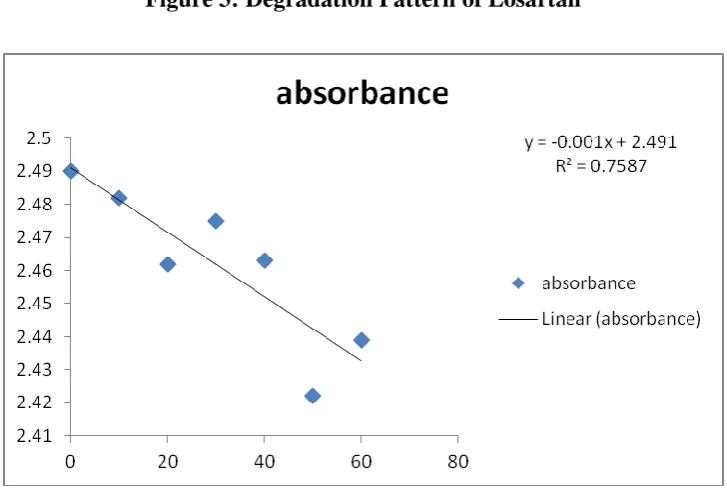
We study degradation parameters on active of Losartan (Table 2 Figure 3).the absorbance for
degradation parameters are given in (Table 1, figure 2). When Losartan subjected to 0.1 N
HCl and 0.1N NaOH, Losartan showed decreased availability i.e. 99.59% in the presence of
acid while it showed slight changes in terms of availability i.e. 99.91% in the presence of
base. It shows decreased availability i.e. 99.75% in case of UV light of 246nm. (Table 2&3
figure 3&4).
From our results we can conclude that Losartan when introduced in acidic medium i.e. 0.1N
HCl it degrade up to 99.59% but degrades to larger extend when subjected to basic medium
i.e. 0.1N NaOH i.e. 99.91%. When Losartan exposed to U.V light (246 nm) degradation was
www.wjpls.org 67 Fig-1 Structure of Losartan
Table 1: Absorbance of Losartan
Degradation
Parameters Losartan
1 2 3 Average
Before 2.45 2.45 2.45 2.45
After acid 2.44 2.44 2.44 2.44
After base 2.448 2.448 2.448 2.448
After U.V 2.444 2.444 2.444 2.444
Fig 2: Absorbance of Losartan
Table 2: Degradation Pattern in Percentage of Losartan
Degradation
Parameters Losartan
1 2 3 Average
Before 100.00% 100.00% 100.00% 100.00%
After acid 99.59% 99.59% 99.59% 99.59%
After base 99.91% 99.91% 99.91% 99.91%
www.wjpls.org 68 Table 3: Effect of Heat
Figure 3: Degradation Pattern of Losartan
Figure 4: Effect of Heat
CONCLUSION
According to WHO monographic specification, the official assay limit of the content should
not less than 95% and not more than 105% of the estimated potency. The conclusion of our
result is that Losartan degrades to a very little when exposed to basic medium whereas it also
degrades in the presence of acidic medium, heat and U.V light of 246nm.
Effect of Heat
Minutes 0 10 20 30 40 50 60
www.wjpls.org 69 REFRENCES
1. Eun-ji koh, seong-jin yoon, and sun-mee lee losartan protects liver against
ischaemia/reperfusion injury through ppar-γ activation and receptor for advanced
glycation end-products down-regulation.br j pharmacol. jul 2013; 169(6): 1404–1416.
2. Yasar U, Tybring G, Hidestrand M, Oscarson M, Ingelman-Sundberg M, Dahl ML, et al.
Role of CYP2C9 polymorphism in losartan oxidation. Drug Metab Dispos. 2001; 29:
1051–6. [PubMed]
3. Wong PC, Price WA, Jr, Chiu AT, Duncia JV, Carini DJ, Wexler RR, et al. Nonpeptide
angiotensin II receptor antagonists. XI. Pharmacology of EXP3174: an active metabolite
of DuP 753, an orally active antihypertensive agent. J Pharmacol Exp Ther.1990; 255:
211–7. [PubMed]
4. Sica DA, Gehr TW, Ghosh S. "Clinical pharmacokinetics of losartan." Clin
Pharmacokinet.2005; 44(8): 797-814.PMID: 16029066
5. Zarghi A, Foroutan SM, Shafaati A, Khoddam A. A rapid HPLC method for the
determination of losartan in human plasma using a monolithic column.
Arzneimittelforschung. 2005; 55(10): 569-72.
6. Safila Naveed, Nimra Waheed, Safeena Nazeer, Fatima Qamar. Degradation Study of
Gentamicin by UV Spectroscopy. American Journal of Chemistry and Applications.
2014; 1(4): 36-39.
7. ICH. Stability testing of new drug substances and products Q1A (R2), International