120
Copyright © 2018. IJEMR. All Rights Reserved.
Volume-8, Issue-3, June 2018
International Journal of Engineering and Management Research
Page Number: 120-128
DOI: doi.org/10.31033/ijemr.8.3.15
Differences Between Male and Female Entrepreneurs in The Kingdom of
Bahrain: Does Gender Matter?
Dr. Randolf Von N. Salindo
Dean, College of Administrative and Financial Sciences, AMA International University, BAHRAIN
Corresponding Author: [email protected]
ABSTRACT
The research was conducted to investigate the effect of gender on the composition of start-up capital among Bahraini entrepreneurs, particularly those belonging to the Small and Medium Enterprise (SME) sector. This research also wants to determine if there is any significant moderating effect of the time commitment (part-time or fulltime); financial management experience; business networking frequency; and, Bahraini women entrepreneurs’ attitude towards risk on the start-up capital requirements (debt and equity) of these entrepreneurs. A total of 89 SME owners participated in the study from September to November 2016. This research proved that there is a significant relationship between gender and financial capital in the case of Bahraini entrepreneurs suggesting that gender has a direct impact on the proportion of bank loans and equity in the total amount of financial start-up capital used. A significant relationship between risk attitude and financial capital was also determined and proved that female entrepreneurs have a lower propensity to take risk than their male counterparts. There was however no significant relationship to prove that time commitment (part-time or fulltime); financial management experience; and, business networking frequency have an impact on SME start-up capital structure. In light of these conclusions from the study, the researcher recommended that government and business agencies in Bahrain remove the barriers to entry for women entrepreneurs, especially in the area of access to capital, not only from banks but also from other financial institutions. He also recommended that the Bahrain Chamber of Commerce Inc. (BCCI), Bahrain Management Society and other like-minded business agencies and organizations take note of the result of this study to come up with trainings and workshops to empower Bahraini women entrepreneurs especially in the area of risk management.
Keywords--- Entrepreneurs, Financial Capital, Risk attitude, gender, Time Commitment, Business Networking Frequency
I.
INTRODUCTION
The Kingdom of Bahrain, in its Economic Vision 2030, emphasized the importance of entrepreneurs and the role they play in the economy. Entrepreneurship is seen to be a driving force in economic development of the country. The Kingdom sees a diversified, sustainable private sector as the key driver of long-term economic development – with entrepreneurship at its core [1].
However, one cannot expect that entrepreneurship alone should be the main engine of growth. Understanding its role requires the decomposition of the concept [2]. A broad variety of entrepreneurs should be allowed to enter the market, no matter the size. No potential entrepreneur should experience any barrier for starting his own business. It is worth noting that female entrepreneurs in Bahrain are considered to be relatively few in number and composition.
Female and male entrepreneurs differ in the way they finance their businesses. This can be attributed to the type of business female and male entrepreneurs start and their type of management experience. Female start-ups may also experience barriers with respect to the acquisition of start-up capital. The literature often refers to differences in start-up capital originating from discrimination of female entrepreneurs by financial institutions like banks. Bank loans in particular are said to be difficult to acquire for female entrepreneurs.
121
Copyright © 2018. IJEMR. All Rights Reserved.
funded than their female counterparts and men were 59% more likely to secure angel investment [3]. Apart from the amount of start-up capital, female and male entrepreneurs may differ with respect to the capital structure of their business.
This study investigated the impact of gender on financial capital among Bahraini entrepreneurs, particularly those belonging to the single-proprietorship, Small and Medium Enterprise (SME) sector. The study discriminated between the amount of capital and its
composition. The amount of financial capital refers to total investment in the start-up venture. With respect to the composition of capital, a distinction was made between equity and debt. This study focused on internal equity, which is equity provided for by the entrepreneur, as the researcher assumed that starting entrepreneurs are hardly in a position to acquire external equity through the stock market. It was also assumed that bank loans are an important source of debt capital for starting entrepreneurs, but debt capital may also be provided by suppliers, other business partners and family and friends.
Moreover, this study also investigated both the
direct and indirect effect of gender on financial capital. The indirect effect refers to differences between male and female entrepreneurs with respect to the type of business and their type of management and experience. The direct effect cannot be attributed to these differences and can be called as the gender effect, i.e. female and male entrepreneurs with the same characteristics differ with respect to the way in which they finance their business. To the author‟s knowledge, this paper represents the first discrimination between the direct and indirect effect of gender on the amount and composition of financial capital among Bahrain SMEs.
Hypothesis
The following hypotheses in null form will be tested at a 5% level of significance:
1) Hypotheses for the relationship between part-time entrepreneurship and financial capital:
a) Female entrepreneurs work on a part-time basis more often than their male counterparts;
b) Part-time entrepreneurship leads to a smaller amount of financial capital;
c) Part-time entrepreneurship leads to a higher proportion of equity in the total amount of financial capital; and, d) Part-time entrepreneurship leads to a smaller proportion of bank loans in the total amount of financial capital. 2) Hypotheses for the relationship between financial management experience and financial capital:
a) Female entrepreneurs have less experience with financial management than their male counterparts; b) Experience with financial management leads to a higher amount of financial capital;
c) Experience with financial management leads to a higher proportion of equity in the total amount of financial capital; and,
d) Experience with financial management leads to a higher proportion of bank loans in the total amount of financial capital.
3) Hypotheses for the relationship between risk attitude and financial capital:
a) Female entrepreneurs have a lower propensity to take risk than their male counterparts; b) the propensity to take risks leads to a higher amount of financial capital;
c) the propensity to take risks leads to a smaller proportion of equity in the total amount of financial capital; and, d) The propensity to take risks leads to a smaller proportion of bank loans in the total amount of financial capital.
4) Hypotheses for the relationship between networking frequency and financial capital:
a) Female entrepreneurs more often spend less time networking than their male counterparts;
b) Networking leads to a higher amount of financial capital;
c) No a priori hypothesis; and,
d) Networking leads to a higher proportion of bank loans in the total amount of financial capital.
5) Hypotheses for the relationship between gender and financial capital:
a) Gender has a negative direct impact on the amount of financial capital;
b) Gender has a negative direct impact on the proportion of equity in the total amount of financial capital used; and, c) Gender has a negative direct impact on the proportion of bank loans in the total amount of financial capital used
In terms of type of investigation, the study was both correlational and causal. It established the degree of relationship between gender and such factors that make up the female profile; as well as established a functional relationship between female profile and the amount and composition of start-up capital structure.
1.1 Scope and Limitation
The study focused on determining the impact of gender on the start-up capital of entrepreneurs in the Kingdom of Bahrain, considering the intervening influence of the “female profile”.
The data gathering employed a survey questionnaire that was distributed to the Bahraini SME owners who started in 2006 and later. As such, the results of the study was dependent upon their sincere cooperation and obviously, on their honest answers to the questions.
The respondents of the study were limited to SMEs with a minimum of 5 up to a maximum of 199 employees. The action part of the study was conducted from September 2016 to November 2016.
Conceptual Framework
122
Copyright © 2018. IJEMR. All Rights Reserved.
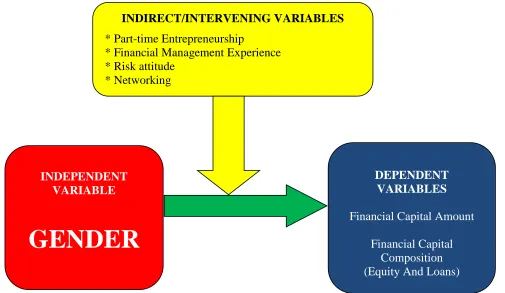
Figure 2. Conceptual Framework of the Research
The general question dealt with in this paper reads: 'What is the impact of gender on financial capital?'
The researcherdiscriminated between the amount
of capital and its composition. The amount of financial capital refers to total investment in the start-up venture. With respect to the composition of capital, a distinction was made between equity and debt. In this research, concentration was made on internal equity, which is equity provided for by the entrepreneur, assuming that starting entrepreneurs, who are the subject of this study, are hardly in a position to acquire external equity through stock market quotation. Moreover, focus was made on a particular type of debt, namely bank loans. As can be deducted from the literature bank loans are an important source of debt capital for starting entrepreneurs, bearing in mind that internal equity and bank loans together do not add up to the total amount of financial capital used to start a venture. Other types of finance include external equity and debt capital provided for by suppliers, other business partners and family and friends [4].
II.
RESEARCH METHODOLOGY
This study was a descriptive type of research. It described the direct impact of gender on the factors that make up the female profile of Bahraini entrepreneurs, and its indirect impact on the composition of their financial
capital. Furthermore, it described the factors that might influence the amount and composition of financial capital at start-up such as part-time entrepreneurship, services, financial management expertise, risk attitude, and networking.
This study employed a probability sampling technique known as cluster sampling. It is a sampling technique in which groups called clusters are randomly selected. When several groups with intragroup heterogeneity and intergroup homogeneity are found, a random sampling of the clusters or groups can ideally be done and information gathered from each of the members in the randomly chosen clusters.
In this study, the business clusters in Bahrain namely: Tourism and Travel, Food and Catering, Manufacturing, Construction and Related Industries, Health Services, Spa and Related Services, were considered as clusters. The researcher drew upon three clusters at random to represent the sample in the study. Complete enumeration of all the qualified SMEs of the randomly selected clusters was considered as the final sample.
Treatment of Data
The data collected from the survey using a questionnaire was tabulated, presented in tabular form and analyzed using the following statistical tools:
INDIRECT/INTERVENING VARIABLES
* Part-time Entrepreneurship
* Financial Management Experience
* Risk attitude
* Networking
INDEPENDENT
VARIABLE
GENDER
DEPENDENT
VARIABLES
Financial Capital Amount
123
Copyright © 2018. IJEMR. All Rights Reserved.
Pearson r was used to determine the level ofcorrelation between the explanatory variables. “The hypotheses formulated were tested using multiple regression analyses to determine the direct and indirect impact of gender on the amount and composition of start-up capital.”
“Single bilateral correlation was used to test whether there is a connection between gender and the other explanatory variables of start-up capital.
Regression analysis was used to determine the direct and indirect impact of gender on the proportion of equity and bank loans in the total amount of startup capital.”
III.
RESULTS AND DISCUSSION
Results of Multiple Regression Analysis on Moderating Variables
The following are the moderating variables associated with gender with respect to the equity-debt ratio in the start-up capital of entrepreneurs:
1. Time Commitment (TIMECOM)
2. Financial Management Experience (FINMANEX) 3. Risk attitude (RISKATT)
4. Business Networking (BUSNETWRK)
To determine the moderating effect or indirect impact of these variables on the equity-debt ratio, multiple linear regression was conducted to determine the significant effect of the above variables on the dependent variable: Capital Start-Up Ratio (FINCAP). The statistical software used was SPSS.
The following tables show the results of the multiple linear regression.
Table 11.a Descriptive Statistics
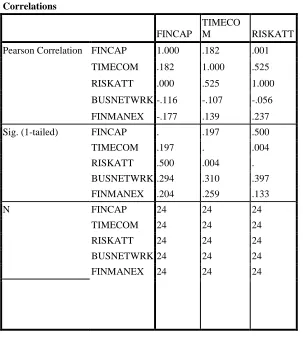
Table 11.b Correlations Correlations
FINCAP
TIMECO
M RISKATT Pearson Correlation FINCAP 1.000 .182 .001
TIMECOM .182 1.000 .525 RISKATT .000 .525 1.000 BUSNETWRK -.116 -.107 -.056 FINMANEX -.177 .139 .237 Sig. (1-tailed) FINCAP . .197 .500 TIMECOM .197 . .004 RISKATT .500 .004 . BUSNETWRK .294 .310 .397 FINMANEX .204 .259 .133
N FINCAP 24 24 24
124
Copyright © 2018. IJEMR. All Rights Reserved.
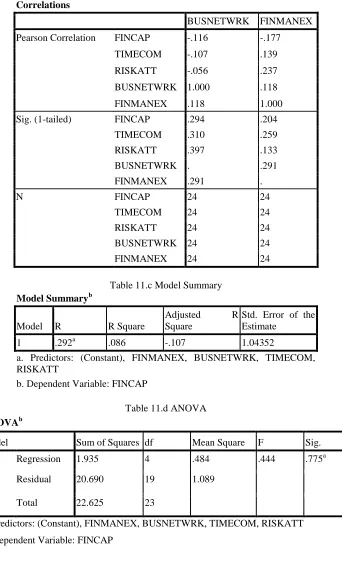
Correlations
BUSNETWRK FINMANEX Pearson Correlation FINCAP -.116 -.177
TIMECOM -.107 .139 RISKATT -.056 .237 BUSNETWRK 1.000 .118 FINMANEX .118 1.000 Sig. (1-tailed) FINCAP .294 .204
TIMECOM .310 .259 RISKATT .397 .133 BUSNETWRK . .291 FINMANEX .291 .
N FINCAP 24 24
TIMECOM 24 24
RISKATT 24 24
BUSNETWRK 24 24
FINMANEX 24 24
Table 11.c Model Summary Model Summaryb
Model R R Square
Adjusted R Square
Std. Error of the Estimate
1 .292a .086 -.107 1.04352
a. Predictors: (Constant), FINMANEX, BUSNETWRK, TIMECOM, RISKATT
b. Dependent Variable: FINCAP
Table 11.d ANOVA ANOVAb
Model Sum of Squares df Mean Square F Sig. 1 Regression 1.935 4 .484 .444 .775a
Residual 20.690 19 1.089
Total 22.625 23
125
Copyright © 2018. IJEMR. All Rights Reserved.
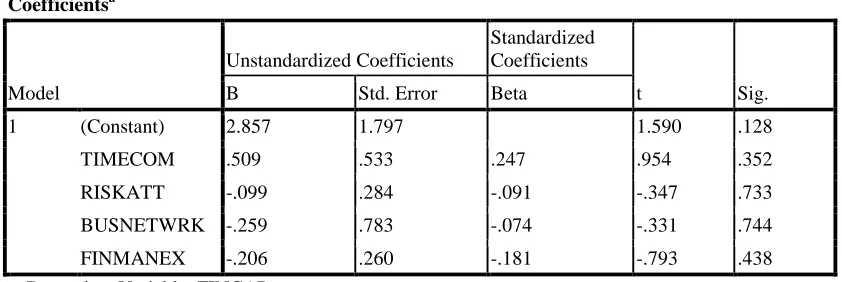
Table 11.d Coefficents Coefficientsa
Model
Unstandardized Coefficients
Standardized Coefficients
t Sig. B Std. Error Beta
1 (Constant) 2.857 1.797 1.590 .128
TIMECOM .509 .533 .247 .954 .352
RISKATT -.099 .284 -.091 -.347 .733 BUSNETWRK -.259 .783 -.074 -.331 .744 FINMANEX -.206 .260 -.181 -.793 .438 a. Dependent Variable: FINCAP
From the above data, there is no significant relationship (at a 0.05 level of significance) between the dependent variable of equity-debt ratio (FINCAP) with most of the moderating variables proposed in the study,
except for Risk Attitude (.001) which implies its significant impact on the start-up capital structure.
Results of Pearson R Correlation Analysis
To determine the impact of gender on the debt to equity ratio of the start-up capital of entrepreneurs in Bahrain, we analyzed the data collected from 89 respondents using SPSS and determined whether there is a significant effect of gender on the start-up capital structure.
Table 12 below shows the output of the analysis.
Table 12. Pearson r Correlation analysis on Effect of Gender on Debt-Equity Ratio Correlations
GENDER INTRNEQUI GENDER Pearson Correlation 1 .462**
Sig. (2-tailed) .000
N 89 89
INTRNEQUI Pearson Correlation .462** 1 Sig. (2-tailed) .000
N 89 89
**. Correlation is significant at the 0.01 level (2-tailed).
From the above data, there is a significant relationship (at a 0.01 level of significance) between the gender of the entrepreneur and the start-up capital structure (debt-equity) of the enterprise.
Based on the above data gathered and other forms of data analyzed by the researcher in this research, the findings are enumerated as follows:
1. In terms of the gender differences among the 89 respondents, 73% of them (65) are male entrepreneurs and 27% (24) are female entrepreneurs.
2. Among the eighty nine (89) respondents, 38.2% or 35 entrepreneurs are in the 31-44 age bracket, which means that they are in their middle age. 13.5% or majority of the female entrepreneurs have ages ranging from 18-30. Majority of the male entrepreneurs, on the other hand are in the 31-44 age bracket (29.21%).
3. As for the level of educational attainment, 44% of the entrepreneurs responded that they have finished college or have earned their Bachelor‟s degree. This is true for male entrepreneurs. On the other hand, a slight majority of the female entrepreneurs (11.2%) have not yet finished their baccalaureate degree, edging it out with those that have (10.1%).
126
Copyright © 2018. IJEMR. All Rights Reserved.
are in the service sector, which means that the profile of SMEs in Bahrain is dominated by the Service Industry. 5. With respect to the amount of start-up capital used, 37% of the respondents answered that they needed less than BD10,000.00. This amount of start-up capital is common among both male (23.6%) and female (13.48%) entrepreneurs.
6. As for time spent in the business, majority of both male (40.45%) and female (17.98%) claim to have fulltime commitment to their respective businesses.
7. In terms of the proportion of personal equity to bank loans as sources of start-up capital, majority of the respondents (32.58%) do not rely on bank loans as part of their start-up capital requirement. That means they rely 100% on their own equity considering the relatively small amount of capital required to start their business. This equity could be borrowed capital from friends or relatives. However, this holds true for majority of the females (21.35%). On the part of the male entrepreneurs, the majority (23.6%) rely on some amount of capital from bank loans with a proportion of 90% equity and 10% bank loans; seconded by a lesser majority of respondent males who use 80% equity and 20% bank loan as capital. This may be due to easier access for men than women to bank facilities; or women entrepreneurs do not want to leave themselves wide open to credit risk.
8. Being risk-averse is a common trait among women entrepreneurs in the Kingdom of Bahrain with majority of them (12.365) stating that they are moderate (neither weak nor strong) when facing risks; compared to the majority of male entrepreneurs (48.31%) who consider themselves strong when dealing with risks.
9. As for financial management experience, majority of the male respondents (38.20%) feel that they have enough financial management experience to be competent on managing their businesses. This also holds true for majority of the women entrepreneurs (13.48%).
10. In terms of time commitment, majority of both men (40.45%) and women (17.98%) entrepreneurs manage their enterprises full time.
11. As for business networking frequency, all the men entrepreneurs and majority of the women entrepreneurs (24.72%) do regular networking with potential clients and suppliers.
Multiple regression analysis with the use of SPSS was done on the moderating variables: Time commitment; financial management experience; Risk attitude; and Business Networking with respect to their impact on the financial capital structure of women entrepreneurs. The results show no significant effect of these moderating variables on financial capital structure, except on the variable Risk Attitude, wherein the relationship is significant (.001) implying its significant impact on the start-up capital structure of the respondent enterprises. 12. This research also tried to determine if there is a significant relationship between gender and financial
capital structure. Using Pearson R in SPSS, it was determined that there is a significant relationship between the two variables in the study. This shows that gender and financial capital structure has a direct effect on each other.
IV.
CONCLUSIONS
First, there is no significant relationship between
the time commitment (part-time or fulltime) of
entrepreneurs and financial capital. Therefore, there is insignificant basis to conclude that female entrepreneurs work on a part-time basis more often than their male counterparts; that part-time entrepreneurship leads to a smaller amount of financial capital; also that part-time entrepreneurship leads to a higher proportion of equity in the total amount of financial capital; and, that part-time entrepreneurship leads to a smaller proportion of bank loans in the total amount of financial capital.
Second, there is no significant relationship between financial management experience and financial capital. There is therefore very insignificant evidence to prove that female entrepreneurs have less experience with financial management than their male counterparts; experience with financial management leads to a higher amount of financial capital; also that experience with financial management leads to a higher proportion of equity in the total amount of financial capital; and, lastly that experience with financial management leads to a higher proportion of bank loans in the total amount of financial capital.
Third, there IS a significant relationship between
risk attitude and financial capital. This means that there is significant evidence to prove that female entrepreneurs have a lower propensity to take risk than their male counterparts; that the propensity to take risks leads to a higher amount of financial capital; also that the propensity to take risks leads to a smaller proportion of equity in the total amount of financial capital; and, lastly the propensity to take risks leads to a smaller proportion of bank loans in the total amount of financial capital.
Fourth, there is also no significant relationship between networking and financial capital. Therefore, there is very little evidence to suggest that female entrepreneurs more often spend less time networking than their male counterparts; that networking leads to a higher amount of financial capital; and, that networking leads to a higher proportion of bank loans in the total amount of financial capital.
127
Copyright © 2018. IJEMR. All Rights Reserved.
proportion of bank loans in the total amount of financial capital used.
RECOMMENDATIONS
Based on the stated conclusions, the following recommendations are given:
1. That the study expands in scope to include more respondents in the Kingdom of Bahrain in order to prove the robustness of this study‟s findings and conclusions. 2. That the government and business agencies in Bahrain remove the barriers to entry for women entrepreneurs, especially in the area of access to capital, not only from banks but also from other financial institutions.
3. That Bahrain Chamber of Commerce Inc. (BCCI), Bahrain Management Society and other like-minded business agencies and organizations take note of the result of this study to come up with trainings and workshops to empower Bahraini women entrepreneurs especially in the area of risk management.
REFERENCES
[1] Bregger & J. E. (1996). Measuring self-employment in the united states. Monthly Labor Review, 119 (1), 3–9. [2] Audretsch, D.B. & A.R. Thurik. (2000). Capitalism and democracy in the 21st century: From the managed to the entrepreneurial economy. Journal of Evolutionary Economics, 10(1), 17-34.
[3] Ingrid Verheul, Andre Van Stel, and Roy Thurik.(2006). Explaining female and male entrepreneurship at the country level
.
Entrepreneurship & regional development, 18, 151-183.Available at:https://personal.eur.nl/thurik/Research/Articles/Explaining %20female%20and%20male%20entrepreneurship%20at% 20the%20country%20level.pdf
[4] Brush & C. G. (1992). Research on women business owners: past trends, a new perspective and future directions. Entrepreneurship: Theory and Practice, 16(4), 5–30.
[5] Wells, B. L., Pfantz, T. J., & Byrne, J. L. (2003). Russian women business owners: Evidence of entrepreneurship in a transition economy. Journal of
Developmental Entrepreneurship, 8(1), 59–71.
[6] Suvi Salmenniemi, Pa¨ Ivi Karhunen, & Riitta Kosonen. (2011). Between business and byt: Experiences of women entrepreneurs in contemporary Russia. Europe-Asia Studies, 63(1), 77–98.
[7]Kate Bedford. (2009).Doing business with the Ladies: Gender, legal reform, and entrepreneurship in the international finance corporation. TRAVAIL, capital et
societe, 42, 1-2. Available at: http://www.lcs-tcs.com/PDFs/42_12/Abstracts/Bedford.pdf
[8] Arenius, P. & Kovalainen, A. (2006). Similarities and differences across the factors associated with women‟s self-employment preference in the nordic countries.
International Small Business Journal, 24(1), 31-57. [9] Baker T, Aldrich HE, & Liou N. (1997). Invisible entrepreneurs: The neglect of women business owners by mass media and scholarly journals in the united states.
Entrepreneurship and Regional Development, 9(3), 221-238.
[10] Bird, B. & Brush, C. (2002). A gendered perspective on organization creation‟. Entrepreneurship. Theory and Practice, 26(3), 41-65.
[11] Boden, R.J. & Nucci, A.R. (2000). On the survival prospects of men‟s and women‟s new business ventures.
Journal of Business Venturing, 15(4), 347-362.
[12] Fischer, E.M., A.R. Reuber, & L.S. Dyke. (1995). A theoretical overview and extension of research on sex, gender, and entrepreneurship. Journal of Business Venturing, 8, 151-168
[13] Lewis, P. (2006). The quest for Invisibility: Female entrepreneurs and the masculine norm of entrepreneurship gender. Work and Organization, 13(5), 453-469.
[14] Buttner, E. H. & Rosen, B. (1989). Funding new business ventures: are decision makers biased against women entrepreneurs? Journal of Business Venturing, 4(4), 249–261.