197
Copyright © 2011-15. Vandana Publications. All Rights Reserved.
Volume-5, Issue-6, December-2015
International Journal of Engineering and Management Research
Page Number: 197-205
Impact of Change Management on Staff Performance in Kaduna
Polytechinc, Kaduna, Nigeria
Yusuf Alhaji Hashim1, Patience Gaiya Dodo2 1
Research Scholar, Department of Business Administration, Federal University Gusau, Zamfara State, NIGERIA
2
Principal Lecturer, Department of Business Administration, Kaduna Polytechnic, Kaduna, NIGERIA
ABSTRACT
Each change has consequences and implications, and one of the most important results of every process of change is a making a positive change in performance. The role of management is to systematically change work to convince workers of the importance of the change process role to reach the desired goals. Kaduna Polytechnic have passed a series of changes in organizational structure, change in technology and in individuals. This study is carried out to assess the level of change management and its impact on staff performance in Kaduna Polytechnic. This study used primary data collected through structured questionnaire. The data for this study is analysed using inferential staistics (logistic regression). The results of this study indicate that the change process in Kaduna Polytechnic significantly influenced the performance of staff of Kaduna Polytechinc. This study conclude that change management significantly affect staff performance in Kaduna Polytechnic. This study recommend that the management of Kaduna Polytechnic should endeavour to continue to train their staff regularly to be able to carry out their duties in accordance with the changes desired by the management of Kaduna Polytechnic.
Keywords--- change, change management, performance, change intervention, change resistance
I.
INTRODUCTION
Change has become a fact of life in most organizations. With the current expansion of the global economy and the fast-changing evolution of technology and innovation, organizations are facing an ongoing need for change and development. This requires the breakage of the old habits and developing new behaviours and processes. The academic institutions in Nigeria is no exception. From the transforming the academic institution initiative that will have a far-reaching and long-range impact on the academic institution’s system, to regular changes at the department level, all staff need to navigate through change. Over the past decades
academic institutions in Nigeria have changed in the most fundamental ways, for example; introduction of technology in education, computer-based-examinations system, electronic admission applications system, electronic registration system, electronic registration payment system, electronic learning system, Univerasl Tertiary Matriculation Examination (UTME) system, post UTME examinations system, among others.
Similarly, there is raising demand for autonomy in academic institutions, which call for and lead to changes in these academic institutions. The changes were triggered by the growing awareness that in knowledge-societies, academic institutions would become key-actors in knowledge-production, in the preservation of knowledge as well as in the education of the generations of knowledge-workers. Thus innovation and economic competitiveness are seen as being linked to the academic institutions’ capacity to react quickly and efficiently to the demands placed on them by society. Many of these changes are the result of national and international developments, and technological advances and innovations which have an increasing impact on academic institutions. This needs special efforts in modernising the institutions and the way they are managed.
198
Copyright © 2011-15. Vandana Publications. All Rights Reserved.
leadership (headship) of academic departments,abrogation of Pre-ND programmes, introduction of evening/weekend programmes, abrogation of part-time programmes, introduction of new programmes (for example; National Diploma [ND] in Banking & Finance), establishment of Centre of Technology Entrepreneurship Education and Development (CTEED), establishhment of School of Preliminary & Remedial Studies (SPRS) among others. These changes are expected to enhance the delivery of knowledge and performance of employees in KPT. However, change management in KPT is facing challenges such as; dearth of skilled manpower to manage change, staff inertia attitude to accept change, obsolete facilities to facilitate and support change, limited funds to facilitate change, internationalisation and competitiveness. This causes not only individual frustrations but also redundancies and losses in effectiveness and, ultimately, quality for the institution.
Against the backdrop of these challenges, this study is carreid out to assess change management in Kaduna Polytechnic (KPT), Kaduna-Nigeria. The primary objective of this study is to examine the impact of change management on staff performance (both academic and non-academic staff) in Kaduna Polytechnic, Kaduna-Nigeria. This study assumes that change management is very important when trying to affect employees’ behaviour and performance. This paper is divided into five sections inclding this introduction. Section two reviews literature relevant to this study, section three provides the methodology, section four presents and discusses the results of the study, and section five provides conclusions and recommendations.
II.
LITERAUTRE REVIEW
2.1 Defining Change and Change Management
Change may be defined simply as making things different, but needs to make explicit mention of actual and perceived change(s). Change is a transition of
current state to a desire state, and management of that transition stage is called management of change. The Society for Human Resource Management (2013) defines change management as the systematic approach and application of knowledge, tools and resources to deal with change. Change management means defining and adopting corporate strategies, structures, procedures and technologies to deal with changes in external conditions and the business environment. Therefore, managing change or ‘change management’ is a form of management control through the application of systematic management interventions that involve people to achieve a desired future state with defined performance outcomes in line with the organisational strategy. From the definition offered by Society for Human Resources Management, it is clear that there is a strong and inextricable link between organisational change, performance and strategy.
Van da Ven and Poole (1995) described change as an empirical observation of difference in quality of state over time. The term change in business literature is used as upheaval and chaos (Pritchett, 1996) that compelled organizations to learn the process of managing and coping with change. Literature has proved the positive relation of change and organization development. This definition emphasise the need for resuls or output as a results of change in an organisation.
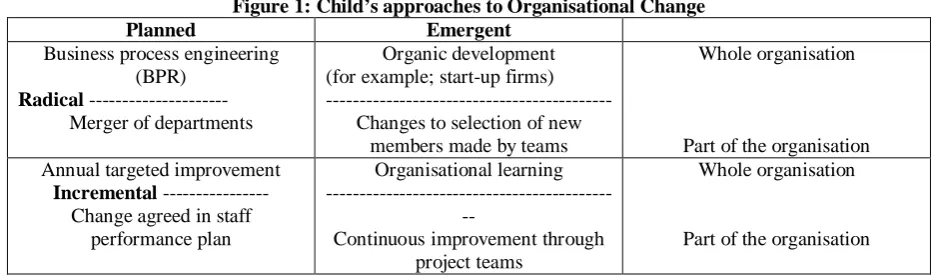
Dependent upon the perspective that has been adopted, a variety of models and concepts can be utilised in order to consider the types of organisational change. It is suggested that there are three levels of strategic change. Firstly, organisation specific changes, such as a new information system. Secondly, generic organisation-wide change programmes, such as business process engineering (BPR) and thirdly, generic multi-organisational change programmes, for example, mergers and acquisitions (Rees and French, 2013). Child (2005) in Rees and French (2013) provides a useful model on how to differentiate between the scope of change and type of change.
Figure 1: Child’s approaches to Organisational Change
Planned Emergent
Business process engineering (BPR)
Radical --- Merger of departments
Organic development (for example; start-up firms) ---
Changes to selection of new members made by teams
Whole organisation
Part of the organisation Annual targeted improvement
Incremental --- Change agreed in staff
performance plan
Organisational learning
---
Continuous improvement through project teams
Whole organisation
Part of the organisation
Source: Rees and French (2013)
It must be borne in mind that whilst radical and incremental change may be defined and measured, that often it is the perceived scale of change that may be more important than the ‘actual’ scale of change. Whilst
199
Copyright © 2011-15. Vandana Publications. All Rights Reserved.
argument is one of adopting an organic approach tochange versus an expected mechanistic approach. If it is assumed that change can emerge, then one approach by management may be to throw a metaphorical hand grenade into the organisation, and then see what emerges (Rees and French, 2013). For example, an organisation may deliberately set about rumour-mongering around restructuring and job cuts, then formally notify employees that all jobs have been red circled and that employees have to make applications for new posts. During this time, communication and consultation is deliberately kept to a minimum. Management then see what emerges after a period of time.
A less contentious scenario could also be envisaged, where the management of an organisation simply let things run, without obvious intervention. Change models tend to centre around planned change, which in itself will determine the various factors or characteristics that are then compared to, for example: strategic/tactical and operational change; radical, transformational and incremental change; the rate of change (change momentum); and hard versus soft change. However, complex large-scale change, usually driven by external factors and having a significant ‘soft’ change element, are planned and co-ordinated. The terms ‘managing change’ or ‘change management’ can be used to describe the application of systematic interventions to implement a planned change within organisations to achieve a desired future state (Rees and French, 2013).
The ‘hard’ elements of change are the tasks within change management, which are defined and measured. ‘Soft’ factors, such as culture and motivation, may be more difficult to assess. Emphasis may be placed upon managing task factors at the expense of soft factors during change interventions; however, Sirkin et al (2005) argue that four hard factors correlate to the outcome of change interventions, namely: duration (length of time); integrity (reliance on managers); commitment (of all involved in change); and effort (within the opportunity of time allowed). When characterising change, it important to consider the speed and magnitude of change, and relate this to the problem of complexity. The problems that change present to an organisation can be perceived by managers as ‘difficulties’, which are ‘bounded’ in that they can be well defined (specified) and can be dealt with without involving or impacting on the wider organisation. Another category of problems are those which cannot be well defined and are ‘unbounded’ in the sense that the wider organisation is implicated and needs to be involved in dealing with these types of problems.
2.2 Analysing the change context
The question as to why organisations change is often determined by a combination of push and pull factors. Organisations sometimes have choices as to whether they want to change, or are sometimes forced to change, because of legal or other reasons. The
importance of why organisations change is linked to the timing of change. Whilst there may be a range of comparators with which to analyse change dimensions, a potential metaphor is one which considers a combination of change interventions running concurrently (Rees and French, 2013). Whilst classic change models may posit a start, middle and end part of the change process, it is important to have to start at some point in terms of determining where the organisation is now and where it wants to arrive at in terms of change. Change models can either adopt a reactive approach (‘this is why we need to change’), or adopt a proactive approach (‘where do we want to get to as an organisation?’).
With strategic change, we may start with a strategic plan, or possibly a vision or mission statement, which leads to a strategic plan. When analysing why organisations change, there is often a trigger for change. The following factors as proposed by Rees and French (2013) are provided as triggers for change;challenges of growth (especially global markets), challenges of economic downturns and tougher trading conditions, changes in strategy, technological changes,competitive pressures, including mergers and acquisitions, customer pressure, particularly shifting markets,pressures to learn new organisation behaviour and skills, and government legislation/initiatives.
When it comes to analysing the strategic context, a range of models can be utilised. Both the internal and external context need to be analysed. Caldwell (2013) argues that change should be understood from a ‘changing organisation’ perspective, which places multiple, simultaneous adaptive demands upon individuals (employees) from many forces within the organisation, which in themselves may be planned or possibly unplanned.
2.2.1 Drivers of Change
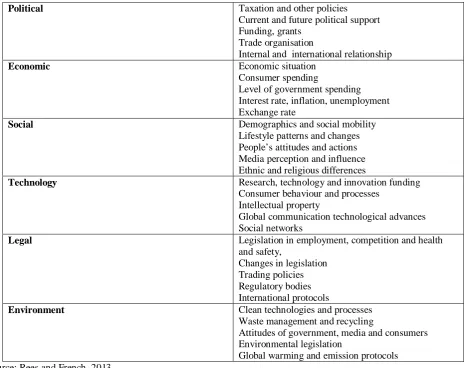
Change drivers can be external or internal. A useful tool to examine the external drivers of change involves the political, economic, social, technology, legal, and environmental factors, usually referred to as the PESTLE taxonomy. The PESTLE taxonomy provides a useful external environment scanning framework and a methodology for identifying and analysing factors that shape the external business environment. When combined with a SWOT (Strengths, Weaknesses, Opportunities and Threats) analysis, this evidence-based approach provides valuable information for strategic decision-making (Rees and French, 2013). The external environmental factors identified from a PESTLE are typically considered as opportunities or threats in a SWOT analysis. Strengths and weaknesses are usually regarded as internal organisational factors which can be considered against the external opportunities and threats. Rees and French (2013) provide a guide and typical consideration for PESTLE framework (external drivers of change) as can be seen in the Table 2 below.
Table 2: PESTLE framework
200
Copyright © 2011-15. Vandana Publications. All Rights Reserved.
Political Taxation and other policiesCurrent and future political support Funding, grants
Trade organisation
Internal and international relationship
Economic Economic situation
Consumer spending
Level of government spending Interest rate, inflation, unemployment Exchange rate
Social Demographics and social mobility Lifestyle patterns and changes People’s attitudes and actions Media perception and influence Ethnic and religious differences
Technology Research, technology and innovation funding Consumer behaviour and processes
Intellectual property
Global communication technological advances Social networks
Legal Legislation in employment, competition and health and safety,
Changes in legislation Trading policies Regulatory bodies International protocols
Environment Clean technologies and processes Waste management and recycling
Attitudes of government, media and consumers Environmental legislation
Global warming and emission protocols Source: Rees and French, 2013
Not all organisational change can be attributed to managers responding to a business environment comprising external factors. Internal drivers of change can also play a major role in initiating change and these include: new leadership, new strategy, new structures, new business model, organisation growth, redesign of jobs,redesign of business processes,outsourcing,change of location,installation of new technology and systems, changes to employees’ terms and conditions, being acquired or merged with another organisation, and redundancies. These changes can be and often are influenced by external factors but they can also be triggered by decisions which are not made as a response to changes in the business environment.
Pettigrew and Whipp (1993) in Rees and French (2013) argue that environmental assessment is only one of five factors that determine the success of managing change. The other four factors are leading change, linking strategic and operational change, considering human resources as both assets and liabilities, and a central factor in all of this – coherence – pulling together the other four factors. It is important to differentiate between external and internal factors when considering change, with the key difference being that organisations and managers may have little, if any,
control over the external factors. However, internal factors are typically management decisions which are designed to exert some form of control aimed at achieving certain performance outcomes.
2.3 Choice of change intervention
After the context has been analysed, the choice of change intervention needs to be considered. Some of the different change management tools and techniques are discussed here in order to provide an understanding of how the organisation can manage change.
2.3.1 TROPICS test
The Open University (1985) in Rees and French (2013) describes two types of problems as ‘difficulties’ and ‘messes’. This test provides a useful reference framework to help characterise and understand the parameters involved when facing change. It is important to recognise that this is a continuum, and many change programmes will combine elements of hard and soft change. When managers have knowledge and understanding of the issues involved in a change scenario, they are in a better position to be able to assess the situation and decide on an appropriate course of action to help control and manage the change process. The TROPICS test is depicted in Table 3 below.
201
Copyright © 2011-15. Vandana Publications. All Rights Reserved.
Hard Soft
Timescales clearly defined/short- to medium-term
Timescales ill-defined/medium- to longterm
Resources needed identified Resources uncertain
Objectives specified and quantified Objectives subjective and ambiguous Perceptions of the problem shared by all No consensus of problem
Interest in problem limited and defined Interest in problem is widespread and ill defined
Control within managing group Control is shared with people outside of managing group
Source of the problem lies within Organisation
Source of the problem is from outside the organisation
Source: Rees and French, 2013
2.3.2 Lewin’s three-phase change model
One of the earliest known models applied to managing change is a three-phase model by Kurt Lewin (1951) which focuses on the psychological aspects of behaviour modification: a. Unfreezing– lowering resistance to change by recognising and accepting the need for change; b. Movement– developing new attitudes to encourage behaviours necessary for change to occur; and c.Refreezing – stabilising, supporting and reinforcing the new change conditions. This model presents a systematic approach to change management, describing a sequence of well defined and interrelated processes. The premise for this model is that by identifying and understanding the key stages involved in the change process, the likelihood of effective change management is increased – by managers making better informed decisions about which interventions to use in managing change (Rees and French, 2013).
2.3.3 Kotter’s eight-stage change model
John Kotter (1996) described an eight-stage change process for managing change in large organisations following his research into US organisations who had failed to manage change effectively: a.establish a sense of urgency – the need to change; b. create a guiding coalition – with authority and credibility; c. develop a vision and strategy – a clear aim and way forward; d. communicate the change vision – promote understanding and commitment; e.empower broad-based action – enable people to act and overcome barriers; f. generate short-term wins – to motivate and ensure further support; g. consolidate gains and produce more change – maintain change momentum; and h. anchor new approaches in the culture – new values, attitudes and behaviours.
This model appears to be a linear and sequential set of processes, and has been criticised for these reasons. However, in the final two steps, researchers (for example; Kotter, 1996) have attempts to address the problem of the ‘refreezing’ stage in Lewin’s model by encouraging organisations and their employees to develop attitudes and values which help to promote the behaviours required to encourage and support further change. Developing an organisational culture that is proactive to change helps to create a feedback
mechanism which transforms a linear change model into a continuous process (Rees and French, 2013).
Many change management programmes applied in organisations are based on systematic change management models comprising sequential processes. However, a common modification to these models in practice is to introduce an additional process at the end, which provides a feedback step from the final to the initiating stage. With this modification, these models describe a cyclical and continuous change management system. A significant feature of Kotter’s model is the role of leadership, particularly in developing and communicating the vision for change, which is critical to effective transformational leadership, and management of change in large-scale organisations.
2.3.4 A systems approach to change
While there is a range of systems models available to the change agent, Mayon-White (1993) highlights the example of systems intervention strategy (SIS) as a useful tool for undertaking change. The diagnosis phase asks ‘Where are we now?’(the description), then ‘Where do we want to be?’, which evolves the identification of objectives and constraints. The question ‘How will you know when you get there?’ is addressed by the formulation of measures to achieve the objectives. In the design phase, we ask ‘How can we get there?’, in order to generate a range of options, then ask ‘What will it be like?’, where we can model options selectively. During the implementation phase, we consider whether we will like it, and then evaluate options against measures (Rees and French, 2013). 2.4 Resistance to change
A multitude of factors could contribute to resistance to change. Three primary reasons are usually cited for resistance to change in organisations. First, the logic of management actions and behaviours is not always obvious. Secondly, if change occurs, the accumulated intellectual experience of the players becomes devalued and change is taken as a personal threat (so a safety net is needed). Thirdly, managers need to have their hand held while they are learning (Rees and French, 2013). The need for managers to be constantly learning new skills is highly essential in this regard.
202
Copyright © 2011-15. Vandana Publications. All Rights Reserved.
specifically how it satisfies the following criteria: a.benefit; the change should have a clear relative advantage for the individuals being asked to change; that is, it should be perceived as ‘a better way’, b. compatibility; the change should be as compatible as possible with the existing values and experiences of the people being asked to change, c. complexity; the change should be no more complex than necessary, that is, it must be as easy as possible to understand and use, and d. Triability; the change should be something that people can try on a step-by-step basis and make adjustments throughout the process (Rees and French, 2013). It has been argued that one of the key aspects of creating strategic change is the receptivity of employees to organisational change. The arguement stem from the fact that organisational communication can significantly help alleviate problems often associated with change fatigue and change resistance.
2.5 Leading Change
The choice of change agent is critical to the success of any change intervention. While a universal definition of a change agent proves impossible to locate, characteristics, competences and skills can differentiate across change agents. For example; change agent can be defined as the individuals or groups of individuals whose task is to effect change. Similarly, the determination of choice of change agent will be determined by a range of factors (Rees and French, 2013).
In addition, a range of change agent characteristics as are proveded such as: a. professionalism, with an in-depth knowledge and experience in a particular field, and often with greater loyalty to your profession than to your organisation.; b. learn from change, by observing, conceptualising, experimenting and validating; c. accommodating through flexible communications; d. troubleshooter, rapidly identifying opportunities for change, and coming up with alternative courses of action to exploit them; e. adaptation to change, by mapping out the internal and external environment, and by creating systems and procedures for dealing with chang; f. experiment with change, by continually forming temporary project groupings and solving ongoing problems in interdisciplinary teams; g. plan for change, by constructing long-term plans with contingencies built in, monitoring changes and adapting plans accordingly; and h. embody the spirit of change (Rees and French, 2013).
Doz and Prahalad (1988) in Rees and French (2013) cite a range of tools that change agents can select from and use. Firstly, data management tools concern the manipulation of information, systems, resource allocation procedures, strategic planning and budgeting arrangements. These tools are used to guide decision-making. Secondly, management tools are a combination of hard and soft approaches. ‘Hard’ tools involve manipulation of key appointments, career planning and reward systems. ‘Soft’ tools include changes to management development and socialisation patterns. These tools dictate the rules of the game. Thirdly, conflict management tools involve relocation of decision
responsibility, formation of business teams, task forces and co-ordination committees, the appointment of ‘integrators’, and establishment of procedures to resolve issues.
These tools may be used more predominantly at different stages of a change intervention, where data management tools may prove most useful at the early stages of change, but conflict management tools may be used throughout some change interventions or perhaps during the ‘movement’ and ‘refreezing’ stages of a change process. Buchanan and Boddy (1992) identified 15 competences that change agents adopt, clustered into five areas, namely: goals, roles, communication, negotiation and managing up. These competences sit within a framework which emphasises the political dimension. The importance of both front stage and back stage activity emphasises how the change agent has to manage their position continuously so as ensure their tenure and sustainability through the change intervention. The choice of who leads the change is a critical one, and should not rely purely on technical expertise. Endemic to this change process may be the setting of a vision or visioning statement by key player(s).
2.6 Empirical Literature
In this section the study present some empirical literature on the subject matter. For example; Al-Jaradat, Nagresh, Al-Shegran, and Jadellah (2013) conducted a study on the impact of change management on the performance of employees in university libraries in Jordan. The study aimed to identify the impact of change management on employees performance, through a case study of university libraries in Jordan, three areas of change has been addressed, the change in organizational structure, technology change and change in individuals. Change in the organizational structure is not flexible, and therefore this organizational structure is not appropriate for the business requirements within the University Library, leading to overlapping powers and responsibilities. There is a positive relationship between the areas of change (organizational structure, technology, individuals) and the performance of workers at a level α = 0.05.
203
Copyright © 2011-15. Vandana Publications. All Rights Reserved.
a complete implementation, details of the change itself,and why it is occurring. The process should also include iterative feedback from employees to access the success of the change.
Lawrence (2012) conducted a study a descriptive research on the impact of change management in Nigerian Banking Industry, A study of United Bank for Africa (UBA) station Road, Enugu. The study use a sample size was 77 employees of the bank, and found out that among others change management results to quality services. The researcher recommended among others that management should ensure effective communication link between management and workers before any change process is embarked upon to attract co-operation from workers.
Similarly, Marzouq (2006), studied the effectiveness of organizational development and change management in Palestinian non-governmental institutions. Marzouk’s research deals with the analysis of the effectiveness requirements of organizational development and change management in non-governmentalinstitutions in the Gaza Strip. Marzouk’s study found out that there is a strong relationship between the clarity of the concept of change management to the staff and managers working in the Palestinian non-governmental institutions and the capacity of institutions to manage change, the clearer the concept is, the better the capacity of the Enterprise Manager to manage change, and the more the institution and its staff manage the development performance. Marzouk (2006) recommends that the organisations should adopt strategic planning approach and planned change style and monitoring internal and external environmental changes, and should exploit opportunities and possibilities and use them to achieve more success.
In addition, Teng Chu (2003) conducted a study entitled “The Study of Organizational Change Management for Semiconductor Company” with the aim to understand how to effectively managed organizations, negatively and positively affects the effectiveness of organizations’ internal control, helping advanced technology companies in the facing the change in the structure of the industry, enhance its competitive edge in the work efficiency. The study focused on the form of the Administrative Board and has studied organizational structure and change management. The main result of Teng Chu (2003) was that the organizational structure is highly complex and need to be changed to conform to the requirements of the work.
Darwazeh (2003) conducted a study aims to verify the extent to which school director in international relief agency have the ability to make developmental decisions and making change in four areas related to educational elements process, the school environment, student, teacher and curriculum. To achieve this goal questionnaire was used to identify the ability of the school's director to take developmental decisions in the Nablus area of Palestine using (26) a random sample of male and female Director out of (40). The study found that the years of experience in school administration and
education have a significant impact on the development decisions taken by the Director and giving the best change.
2.7 Kaduna Polytechnic (KPT)
The idea to start a Technical Institution in Northern Nigeria started as far back as 1951, which resulted into the establishment of Kaduna Technical Institute in 1956. The establishment of Technical Institute, Kaduna was as a result of the acceptance by the British Government on the recommendation of the Higher Education Commission, which suggested the upgrading of Yaba Higher College to Technical Institute and proposed Technical Institutes in Kaduna and Enugu. The Northern Nigeria Executive Council by at meeting of 17th August, 1962, Conclusion No.1, re-designated the Technical Institute, Kaduna as the Polytechnic, Kaduna. It became Kaduna Polytechnic in 1968 by the Federal Government Decree No. 20 of 1968, which was revised in 1979 by Decree .No. 79. In 1991, the institution was taken over by the Federal Government under Decree No. 40 of the same year (www.kadunapolytechnic.edu.ng).
The institution was established with the objective of providing diverse instruction, training and research in technology, the sciences, commerce, the humanities and programmes of in-service instruction for members of the public service in Nigeria. In 1968, it amalgamated two training centres, namely; the College of Science and Technology and Staff Development Centre, with Survey Unit joining later. These formed the nucleus of its four- college structure then. The Polytechnic is highly cosmopolitan with students from all over Nigeria and other countries. From a modest figure of 158 students in 1961, student enrolment increased to 894 by 1968. Currently, the polytechnic has over 15,000 students undertaking 138 programmes in 38 departments with staff strength of 2,963 (Academic and Non- Academic) (www.kadunapolytechnic.edu.ng).
204
Copyright © 2011-15. Vandana Publications. All Rights Reserved.
Polytechnic Librarian, the College Directors, Director ofMedical and Health Services, Director of Works, Director Physical Planning, Director Centre of Technology Entrepreneurship Education and Development (CTEED), Director Kadpoly Consult, Director Special Duties and Director Strategic Planning and Data Management. The monumental growth and achievements, physically and intellectually have proved that the institution has spread from Nigeria to Africa and beyond (www.kadunapolytechnic.edu.ng).
III.
METHODOLOGY
This study used survey research approach to gather data. A sample of 400 respondents was drawn from a population of 2,963 staff (Academic and Non- Academic) of the Kaduna Polytechnic (KPT), Kaduna-Nigeria. Respondents were randomly selected and interviewed using a structured questionnaire on a Likert’s scale. Section A of the research instrument sought to find the background information of the respondents such as department/unit, and number of years in the service of KPT. In section B of the research instrument, the respondents were provided with a four-point Likert’s scale ranging from strongly agree (4) to disagree (1). In addition, in section B, the respondents were interviewed based on their perception about level of change carried out by Kaduna Polytechnic, quality of change, and their satisfaction with the change management in Kaduna Polytechnic.
Data gathered for this study were analysed using inferential statistics specifically logistic regression. A logistic regression predicts the probability that an observation falls into one of two categories of a dichotomous dependent variable based on one or more independent variables that can be either continuous or categorical. Generally, logistic regression is well suited for describing and testing hypotheses about relationships between a categorical outcome variable and one or more categorical or continuous predictor variables. Logistic
regression solves problems by applying the logit transformation to the dependent variable. In essence, the logistic model predicts the logit of Y from X. The logit is the natural logarithm (Ln) of odds of Y, and odds are ratios of probabilities (Pi) of Y happening to probabilities (1−Pi) of Y not happening (Peng, Lee, and Ingersoll, 2002).
The simple logistic model has the form: logit (Y) = natural log(odds) = Li = (Pi ÷ 1- Pi
In this section, results from the data analysed for this study are presented as below.
) =α+ β
X……... ...1 Source: Peng, Lee, and Ingersoll (2002).
X can be categorical or continuous, but Y is always categorical. According to equation 1, the relationship between logit (Y) and X is linear. The value of the coefficient β determines the direction of the relationship between X and the logit of Y. When β is greater than zero, larger (or smaller) X values are associated with larger (or smaller) logits of Y. Conversely, if β is less than zero, larger (or smaller) X values are associated with smaller (or larger) logits of Y. Within the framework of inferential statistics, the null hypothesis states that β equals zero, or there is no linear relationship in the population under study. Rejecting such a null hypothesis implies that a linear relationship exists between X and the logit of Y (Peng, Lee, and Ingersoll, 2002). The null hypothesis underlying the overall model states that all βs equal zero. A rejection of this null hypothesis implies that at least one βdoes not
equal zero in the population, which means that the logistic regression equation predicts the probability of the outcome better than the mean of the dependent variable Y. On a-priori, Pi is < 1 and the expected pattern of the structural behaviours of the independent variables on the dependent variable is greater than zero.
IV.
RESULTS AND DISCUSSION
Table 4.1: Omnibus Tests of Model Coefficients Chi-square Df Sig.
Step 1 Step 152.127 57 .000
Block 152.127 57 .000
Model 152.127 57 .000
Source: Data analysis using field survey data, 2015
Table 4.2: Model Summary
Step -2 Log likelihood
Cox & Snell R Square
Nagelkerke R Square
1 161.104a .438 .630
a. Estimation terminated at iteration number 7 because parameter estimates changed by less than .001.
205
Copyright © 2011-15. Vandana Publications. All Rights Reserved.
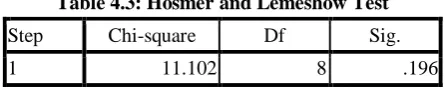
Table 4.3: Hosmer and Lemeshow TestStep Chi-square Df Sig.
1 11.102 8 .196
Source: Data analysis using field survey data, 2015
Tables 4.1-4.3 above depicts the results of the logistic regression using the field survey data for this study. Table 4.1 depict the Omnibus Test of Model Coefficients, which give the overall indication of how well the model performs (‘goodness of fit’ test). For this set of results, the requirement is a highly significant value (the Sig. value should be less than 0.05) (Pallant, 2007). In this study, the Sig. value is 0.000 (which really means p<0.005). Therefore, the set of variables in the analysis fits the model. Similarly, the chi-square value is 152.127 with 57 degrees of freedom. In addition, Table 4.3 shows Hosmer and Lemeshow Test. The results in Table 4.3 support the model of this study as being worthwhile. For the Hosmer-Lemeshow Goodness of Fit Test, poor fit is indicated by a significance value less than 0.05, so to show support for a model a value greater than 0.05 is required (Pallant, 2007). For this study the chi-square value is 11.102 with a significance level of 0.196. This value is larger than 0.05, therefore indicating a support for the model of this study.
Table 4.3 is the Model Summary and it contains the Cox and Snell R Square, and the Nagelkerke R Square values, which indicate the amount of variation in the dependent variable explained by the model (from a minimum value of 0 to a maximum value of approximately 1). These are described as pseudo R square statistics rather than true R square (Pallant, 2007). Therefore, the explained variation in the dependent variable based on the model of this study ranges from 43.8% to 63.0%, suggesting that between 43.8% and 63.0% of the variability in staff performance in Kaduna Polytechnic, was explained by change management in Kaduna Polytechnic.
V.
CONCLUSION AND
RECOMMENDATION
The results of this study indicate that the change process in Kaduna Polytechnic significantly and positively influenced the performance of staff of Kaduna Polytechinc. This study therefore, conclude that staff performance is positively and significantly affected by change management in Kaduna Polytechnic. This study recommend that the management of Kaduna Polytechnic should endeavour to continue to train their staff regularly to effectively be able to carry out duties and
responsibilites in accordance to changes desired by the management of Kaduna Polytechnic.
REFERENCES
[1] Al-Jaradat O., Nagresh, M., Al-Shegran, A., and Jadellah, N. (2013). Impact of change management on the performance of employees in university libraries in Jordan. European Journal of Business and Management, 5(2); 169-17
[2] Darwazeh, A. N. (2003). The extent to which the School Director on taking development decisions and changes, Journal of Arabic Universities Union, 41, p. 5-40.
[3] Kotter, J. P. (1996). Leading Change. Boston, MA: Harvard Business School Press.
[4] Lawrence, B. A. (2012). The impact of change management in nigerian banking industry a study of United Bank for Africa (UBA) Station oad, Enugu. Unpublished BSc project submitted to the Department of Business Administration, Faculty of Management and Social Science, Caritas University, Amorji Nike, Enugu State
[5] Marzouq, I. (2006). The effectiveness requirements of organizational development and change management – the Palestinian non-governmental organizations", Master thesis, Islamic University of Gaza
[6] Pritchett, P. (1996). Resistance: Moving Beyond the Barriers to Change, Pritchett and Associates, Dallas, TX. [7] Rees, G. and French, R. (2013). Leading, Managing and Developing People. Retrieved August, 2015 from www.cipd.co.uk/Bookstore
[8] Society for Human Resource Management. (2013). Retrieved 2015, from http://www.shrm.org
[9] Teng Chu, Chiu (2003). The Study of Organizational Change Management for Semiconductor Company in Al-Jaradat O., Nagresh, M., Al-Shegran, A., and Jadellah, N. (2013). Impact of change management on the performance of employees in university libraries in Jordan. European Journal of Business and Management, 5(2); 169-178