206
Volume-4, Issue-4, August-2014,
ISSN No.: 2250-0758
International Journal of Engineering and Management Research
Available at:
www.ijemr.net
Page Number: 206-213
Role of Employee Retention Practices in Indian Industry – A Study of
Select MNCs in Jamshedpur
Nafisa Shahin
Research Scholar, Vinoba Bhave University, Hazaribag, INDIA
ABSTRACT
Employee retention is most critical issue facing corporate leaders as a result of the shortage of skilled labour, economic growth and employee turnover. Retaining employees involves understanding the intrinsic motivators of them which many organizations unable to identify. The reason is "Individuals differ greatly in this regard’. Employee Retention has gained importance in recent years, particularly as part of talent management programs, and its relevance can be seen so much that the HR practitioner who integrates it into a talent program may grow bewildered by the huge volume of research about it. Employee retention is more than just keeping employees on the job. It is also about sustaining employees, primarily by enhancing their job satisfaction. This paper tries to document the practices followed by a select Indian MNCs in Jamshedpur, in retaining their employees and also highlights the opinions of the employees about such retention practices mass.
Keywords-- Retention, Competence, Productivity,
Satisfaction, Reward, Recognition.
I.
INTRODUCTION
Employee retention is an effort by a business to maintain a working environment which supports current staff in remaining with the company. Many employee retention policies are aimed at addressing the various needs of employees to enhance their job satisfaction and reduce the substantial costs involved in hiring and training new staff.
It is a process in which the employees are encouraged to remain with the organization for the maximum period of time or until the completion of the project. Retention Strategies helps organizations provide effective employee communication to improve commitment and enhance workforce support for key corporate initiatives.
II.
DEFINITION
According to Get Les McKeon, employee retention is defined as "A systematic effort by employers to create and foster an environment that encourages
current employees to remain employed by having policies and practices in place that address their diverse needs. The costs associated with turnover may include lost customers, business and damaged morale. In addition, there are the hard costs of time spent in screening, verifying credentials, references, interviewing, hiring and training the new employee just to get back to where you started.‖
Also of concern are the costs of employee turnover (including hiring costs& productivity loss). Replacement costs usually are 2.5 times the salary of the individual. Therefore, employee retention is effort by a business to maintain a working environment which supports current staff in remaining with the company.
III.
REVIEW OF LITERATURE
There are pertinent studies on how companies should retain their current manpower. Some excerpts from the review of literature are as follows:
Boxall, Macky and Rasmussen (2003) have conducted a study of retention variables for New Zealand employees in which they state that the variables are multidimensional.
These include interesting work, which was rated as the strongest factor in attracting and retaining employees in both public and private sector organisations. The research outcome showed that employees expect management to make personnel decisions based on merit and also demonstrated that extrinsic rewards (such as pay, promotion & job security) play a role in both employee retention and turnover management. The research further suggested that management lent support to the idea of good relationships with co-employees and supervisors.
207
important factors. Among retention strategies that were particularly successful in maintaining a low turnover rate, one of the solutions suggested was an increase in salary.
According to Samuel and Chipunza (2009), the main purpose of retention is to prevent the loss of competent employees from leaving the organisation as this could have adverse effect on productivity and profitability. However, retention practices have become a daunting andhighly challenging task for managers and Human Resources (HR) practitioners in a hostile economic environment. One of the traditional ways of managing employee retention and turnover is through organisational reward system.
William and Werther (1996) explain reward as what employees receive in exchange for their contributions to the organisation. This reward could come in form of salary, promotion, bonuses and other incentives. When the reward system is effectively managed, it helps in achieving organizations corporate objectives, and maintains and retains a productive workforce. If perceive that they are inadequately rewarded, it is often likely that they will leave and replacement can be costly and in most cases not readily available .A number of factors have been articulated in order to explain the reason employees leave one organisation for another, or in some cases, leave the country.
Empirical studies by Kinnear and Sutherland, (2001) and by Meudell and Rodham, (1998) and also studies by Maertz and Griffeth( 2004) have, revealed that extrinsic factors such as competitive salary, good interpersonal relationships, friendly working environment, and job-security were cited by employees as key motivational variables that influenced their retention in the organisations. The implication of this therefore is that management should not rely only on intrinsic variables to influence employee retention; rather, a combination of both intrinsic and extrinsic variables should be considered as an effective retention strategy.
Stauss etal (2001) have suggested a more detailed and recent definition for the concept of retention which is customer liking, identification, commitment, trust, readiness to recommend, and repurchase intentions, with the first four being emotional-cognitive retention constructs, and the last two being behavioural intentions.
A study done by Fitzenz (1990) has indicated that retention is driven by following key factors, which ought to be managed congruently: organizational culture strategy, pay and benefits philosophy, and career development systems.
According to Morgan and Hunt (1994), organizations often look beyond the concept of satisfaction to developing trust and ensure long term relationships with their employees. Further, this suggestion is based on the principle that once trust is built into a relationship, the
Probability of either party ending the relationship decreases because of high termination costs.
Numerous studies by Anderson and Sullivan (1993); Rucci et al (1998) Bansal explain the importance
of high employees involvement and how it could enhance their retention, As earlier studies indicated that young employees are more interested in payment, advancement opportunities and time off, such differences may reflect stages in the career plan or generation differences.
According to Gopinath and Becker (2000), effective communications improve employee identification with their agency and build openness and trust culture.
Increasingly, organizations provide information on values, mission, strategies, competitive performance, and changes that may affect employees‘ enthusiasm. Many companies are working to provide information that communication, through the most credible sources (e.g., CEO and top management strategies) on a timely and consistent basis.
The above mentioned studies explain many situations in contemporary corporate life in India wherein many employees are no longer having the sense of organization loyalty towards the organization. Increasing number of organizational mergers and acquisitions have left employees feeling displeased from the companies that they work and they are haunted by concerns of overall job security. As a result, employees are now making strategic career moves to guarantee employment that satisfy their need for security. On the other hand, employers have a need to keep their stuff from leaving or going to work for other companies. This is true because of the great expenses associated with hiring and retraining new employees.
The above review of literature suggests that there are gaps in the existing literature. This study attempts to fulfil the gaps by analysing the impact of three R‘s i.e. Respect, Recognition and Rewards on satisfaction level of the employees and by examining the various practices adopted by Indian MNCs in retaining their employees
IV.
OBJECTIVES
The broad objective of this study is to examine and analyse the employee retention practices adopted by Indian MNCs. The above broad objective is divided into the following sub objectives:
To examine the retention practices of Indian MNCs in the light of their impact on the organization
To examine and analyse the tools available for retaining employees
To examine the impact of three R‘s on the retention of the employee and development of the organization
NULL HYPOTHESES:
Recognition of the work done well does not lead to better performance and employee retention.
Employees do not plan their further career in the current organization.
Organizational efforts do not have any impact on the retention of their employees.
208
SCOPE
The study revolves round the analyses of employee retention practices of select organizations and how it impacts the development of these organizations. Therefore the tools which may lead to the development of the organization remain outside the purview of the study. Analysis is also done in the light of the responses generated from the employees of select organizations by using data analysis tools as discussed below
SAMPLE METHOD
Convenience sampling method is adopted to collect data from the selected organizations. 10 MNCs are selected for the purpose of the study and from each of these 10 companies 10 employees are selected at random from the middle level of management. Top and lower level management employees remain outside the purview of the study because retention applies more specifically to the employees at middle level of management. The ten companies (Jamshedpur) chosen are Tata Steel, Tata Motors, Tata Cummins, JAMIPOL , JUSCO ltd. , BOC Gases, National Metallurgical Laboratory Ltd., Timplate, Telco, and Uranium Corporation of India Ltd.
SOURCES OF DATA
Primary data has been collected by administering questionnaires to the employees of the selected companies and secondary data has been collected from books, journals, articles and websites. DATA COLLECTION INSTRUMENT
Data is collected by administering questionnaire that contains 22 questions of which 18 are closed end and 5 are open end questions.
DATA ANALYSIS AND TOOLS
Analysis of the data has been done by using the frequencies and ratios and Chi-Square and Anova test are used to test the hypothesis.
V.
MODELS ON EMPLOYEE
RETENTION
There are two important models on employee retention, one of them is
1) Zinger Model and the other is 2) ERC‘s Retention Model.
A brief explanation of these models is follows:
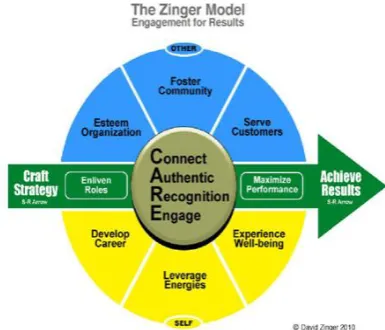
Fig 1.0 Zinger Model
According to the Zinger Model, employee retention is directed towards achieving results of the organization that the department, team, or individual wants to achieve. To achieve results, companies need to craft a strategy to get there .A central key of employee retention is connection.
In some cases connection is synonymous with engagement. Engagement is not a one time survey measure or a steady state. To engage is to fully experience and contribute to the dynamic elements of work. Employee retention must be authentic and retention of competent employee requires powerful recognitions. A role is a set of behaviours, rights and obligations at work companies must guard against too many roles or role overload while also fully being in the roles that contribute to results, relationships, and engagement. Thos model emphasizes that employee retention can contribute to effective performance management and performance demonstrates company‗s engagement while engagement and retention can help companies excel at performance.
Good employee retention should foster star performers. The employee should also align with the organization so as to build up the esteem of the organization and there should not be a disconnect between employee and organization. Companies want employees to serve their customers and this is a very strong relationships between employee engagement and employee retention. Effective Employee retention helps to serve customers a lot. The model comments that employees should experience both personal and professional development through work ranging from courses and learning to develop their own strengths, value, visibility, and engagement. Powerful retention involves mastery of physical, mental, emotional, spiritual, and organizational energy. Work should contribute to employee well-being. Employees need to both engage in and experience healthy well being. An organization‘s results are dependent upon the health and productivity of individual employees.
Zinger Model
Employee retention is the art and science of engaging people in authentic and recognized connections to strategy, roles, performance, organization, community, relationship, customers, development, energy, and well-being as companies leverage, sustain, and transform their work connections into results. ERC's Retention Model
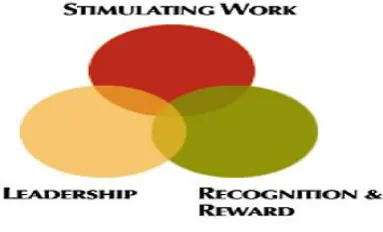
Employee Retention Connection's model concentrates on applied organizational experience indicating three primary drivers of employee retention.
Work can be made stimulating by giving variety of assignments, autonomy to make decisions, resources and support provided to do good work, opportunity to learn, feedback on result and understanding the significance of one's personal contributions.
209
Companies should recognize and reward a job that is done well and should reinforce desired behaviours and create an emphasis and focus on recognition. They should celebrate successes in order to build self esteem and enhance camaraderie and team work.
Integrated System for Retaining Employees
The Employee Retention Connection transforms the organization culture and enhances the competitive edge through the following five-phased approach:
ERC begins by analyzing the organization‘s motivation and retention culture through surveys and focus groups that is the motivating and de-motivating aspects of the culture. ERC concentrates on designing high-involvement job and work assignments and trains supervisors and managers in proven methods of motivational leadership.
VI.
DATA ANALYSIS AND
FINDINGS
100 employees are selected from 10 MNCs, 60% of who are in the age group of 26-35 years and out
of the total sample 60% are male and 48% of respondents have an annual income above Rs 100000. Respondent‘s opinion was sought regarding the workload given by the company 51% respondents opine that the workload is high while 45% respondents feel that the workload correspondents to the position and the responsibilities that are attached therein.
The survey revealed that 51% of the respondents‘ employees feel that the grievance handling system is efficient while 49% are of the opinion that the grievance handling system is inefficient. A grievance if not handled effectively becomes a barrier in employee retention. Stress generated at work place is managed by employees by resorting to the options such as change of location, taking career breaks, resorting to yoga and indulging in other recreational activities, one of the last resorts to managing stress is quitting the job.
Hypothesis1: Employees do not plan their further career in the current organization is tested using Chi-Square.
Table 1.0 Chi-Square Statistics for Hypothesis
1
NPAR TEST/CHISQUARE = VAR023.
Chi square for planning to stay in the company
VAR 023
Observed N Expected N Residual
1 66 50.00 16.00
2 34 50.00 -16.00
Total 100
Test Statistics
VAR 023
Chi-Square 10.24
Df 1
Asymp. Sig. .00
(Source: Compiled from primary data)
The calculated value of x2 is 10.24 as is seen in the table whereas the table value at Df=1 is 3.84. As the calculated value is greater than the table value (i.e.10.24 >3.84), the hypothesis is rejected and it can be concluded that the employees do plan their further career in the
current organization. This implies that the employees are satisfied in the organization and are willing to remain in the organization
210
tested using Chi-Square. The following analysis is made for testing this hypothesis.
Table 2.0 Chi-Square Statistics for Hypothesis
2
NPAR TEST/CHISQUARE = VAR010.
Chi square for Recognition of the work done well
VAR 023
Observed N Expected N Residual
1 65 50.00 15.00
2 35 50.00 -15.00
Total 100
Test Statistics
VAR 010
Chi-Square 9.00
Df 1
Asymp. Sig. .00
(Source: Compiled from primary data)
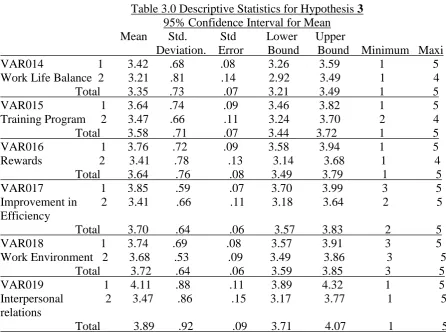
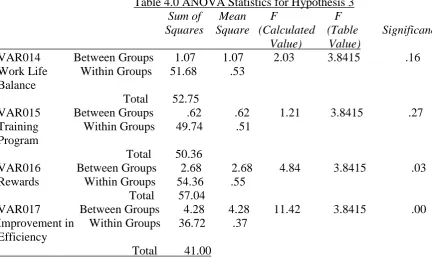
The calculated value of X2 is 9.00 as is seen in the table whereas the table value at Df=1 is 3.84. As the calculated value is greater than the table value (i.e. 9.00 >3.84), the hypothesis is rejected and it can be concluded that the MNCs in India recognize the efforts of their employees and work that is executed well by the employees is appreciated which leads to retention of the employees. Hypothesis 3: Organizational efforts do not have any impact on the retention of their employees is tested using ANOVA. Organisational efforts that have an impact on the retention of their employees are listed as i) Work-life balance supported by the organisation ii) Linkage of training programs with career growth iii) Rewards are given based on performance iv) Retention Strategies leads to improvement in efficiency v) Work Environment vi) Interpersonal Relations.Table 3.0 Descriptive Statistics for Hypothesis
3
95% Confidence Interval for Mean
Mean Std. Std Lower Upper
Deviation. Error Bound Bound Minimum Maxi
VAR014 1 3.42 .68 .08 3.26 3.59 1 5
Work Life Balance 2 3.21 .81 .14 2.92 3.49 1 4
Total 3.35 .73 .07 3.21 3.49 1 5
VAR015 1 3.64 .74 .09 3.46 3.82 1 5
Training Program 2 3.47 .66 .11 3.24 3.70 2 4
Total 3.58 .71 .07 3.44 3.72 1 5
VAR016 1 3.76 .72 .09 3.58 3.94 1 5
Rewards 2 3.41 .78 .13 3.14 3.68 1 4
Total 3.64 .76 .08 3.49 3.79 1 5
VAR017 1 3.85 .59 .07 3.70 3.99 3 5
Improvement in 2 3.41 .66 .11 3.18 3.64 2 5
Efficiency
Total 3.70 .64 .06 3.57 3.83 2 5
VAR018 1 3.74 .69 .08 3.57 3.91 3 5
Work Environment 2 3.68 .53 .09 3.49 3.86 3 5
Total 3.72 .64 .06 3.59 3.85 3 5
VAR019 1 4.11 .88 .11 3.89 4.32 1 5
Interpersonal 2 3.47 .86 .15 3.17 3.77 1 5
relations
Total 3.89 .92 .09 3.71 4.07 1 5
211
Table 4.0 ANOVA Statistics for Hypothesis 3
Sum of Mean F F
Squares Square (Calculated (Table Significance
Value) Value)
VAR014 Between Groups 1.07 1.07 2.03 3.8415 .16
Work Life Within Groups 51.68 .53
Balance
Total 52.75
VAR015 Between Groups .62 .62 1.21 3.8415 .27
Training Within Groups 49.74 .51
Program
Total 50.36
VAR016 Between Groups 2.68 2.68 4.84 3.8415 .03
Rewards Within Groups 54.36 .55
Total 57.04
VAR017 Between Groups 4.28 4.28 11.42 3.8415 .00
Improvement in Within Groups 36.72 .37
Efficiency
Total 41.00
Employee Retention Practices in Indian Corporate – A Study of Select MNCs
Sum of Mean F F
Squares Square (Calculated (Table Significance
Value) Value)
VAR018 Between Groups .10 .10 .24 3.8415 .63
Work Within Groups 40.06 .41
Environment
Total 40.16
VAR019 Between Groups 9.06 9.06 11.88 3.8415 .00
Interpersonal Within Groups 74.73 .76
relations
Total
83.79
(Source: Compiled from primary data)
Table 1.3 reveals that initiatives taken up by the organization to strike work-life balance for employees does not have an impact on retention of employees. ANOVA test is applied and the table value of F at Df =1 is 3.8415. F value is 2.03 while the table value is 3.8415, which implies that the null hypothesis is accepted and work life balance initiatives do not impact retention of employees. Similarly, it is observed that training programs that are linked with career growth also do not have an impact on retention of employees (calculated value of F 1.21 < 3.8415).
The third variable that is chosen under organizational efforts is rewards given based on performance and its impact on employee retention. It is seen that the calculated value of F for this variable is 4.84 which is greater than the table value 3.8415, the null hypothesis is rejected and it is concluded that
rewards given based on performance has an impact on retention of employees. The fourth variable chosen is initiatives by the company to improve the efficiency of employees that leads to retention of employees. Table 1.3 reveals the calculated value of F is 11.42 which are greater than the table value 3.8415.
212
retention of employees. This variable is also analysed using ANOVA.
The calculated value of F for this variable is 11.88 which is greater than the table value 3.8415, hence the null hypothesis is rejected and it is concluded the
good interpersonal relations do have an impact on retention of employees.
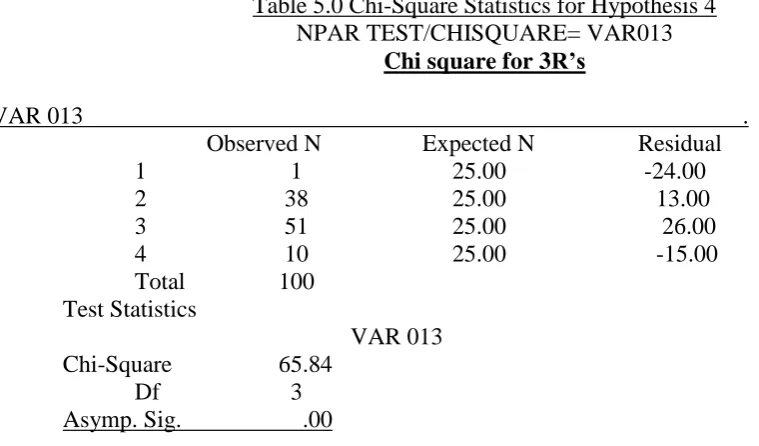
Hypothesis 4: The Three R‘s i.e. Respect, Recognition and Rewards do not have an impact on the retention of employees is tested using Chi-Square.
Table 5.0 Chi-Square Statistics for Hypothesis 4
NPAR TEST/CHISQUARE= VAR013
Chi square for 3R’s
VAR 013 .
Observed N
Expected N
Residual
1
1
25.00
-24.00
2
38
25.00
13.00
3
51
25.00
26.00
4
10
25.00
-15.00
Total
100
Test Statistics
VAR 013
Chi-Square
65.84
Df
3
Asymp. Sig. .00
(Source: Compiled from primary data)
The table value for Chi-Square at Df =3 is 7.815 while the calculated value is 65.84. As the calculated value is greater than the table value the null hypothesis is rejected and it can be concluded that the 3R‘s i.e. Respect, Recognition and Rewards has significant impact on employee retention. Amongst the 3R‘s, rewards have the maximum impact on retaining employees.
The Three Rs of Employee Retention
Employee retention consists of 3 R‘s which helps in retaining effective employees. To keep effective employees and keep satisfaction high, you need to implement each of the three Rs of employee retention: Respect, Recognition, and Rewards
Respect is esteem, special regard, or particular consideration given to people. As the pyramid shows, respect is the foundation of keeping your employees. Recognition and rewards will have little effect if you don‘t respect employees.
Recognition is defined as ―special notice or attention‖ and ―the act of perceiving clearly.‖ Many problems with retention and morale occur because management is not paying attention to people‘s needs and reactions.
Rewards are the extra perks that a company offers beyond the basics of respect and recognition that makes it worth people‘s while to work hard, to care, to go beyond the call of duty. While rewards represent the smallest portion of the retention equation, they are still an important one.
Table 6.0 Hypotheses Result Hypotheses Test Value Result Recognition of the work done well lead to better performance and employee retention 10.24 Accept Employees plan their further career in the current organization 9.00 Accept Organizational efforts do not
have any impact on the retention of their employees F Value (Refer Table 1.3) Accept for all variables and Reject for variables improvement in efficiency and interpersonal relations The three R‘s i.e. Respect, Recognition and Rewards have an impact on the retention of employees 65.84 Accept (Source: Compiled from primary data)
VII.
CONCLUSION
213
analysed the employee retention practices adopted by Indian MNCs.
REFERENCES
[1] Allen, N.J. and Meyer, J.P. (1990). The measurement and antecedent of affective, continuance and normative commitment to the Organization. Journal of Psychology, v63, pp. 1-18. Beck, S. (2001). ‗Why Associates leave and Strategies to Keep Them In. American Lawyer Media L.P., v5, i2, pp. 23-27.
[2] Clarke, K.F. (2001). What businesses are doing to attract and retain employee—becoming an employer of choice. Employee Benefits Journal, March, pp. 34-37. [3] Desai, K.K., and Mahajan, V. (1998) Strategic role of affect-based attitudes in the acquisition, development and retention of customers. Journal of Business Research, Vol.42, July, pp.309-24.
[4] Dibble, Suzanne. (1999). Keeping your valuable employees—Retention strategies for your organization‘s most important resource. John Wiley and Sons. Inc. New York
[5] Dyke TV, Strick S (1990). Recruitment, selection and retention of managers in the hotel and restaurant industry. FIU Hospitality Review. Pp.1-9.
[6] Eskildsen, J.K., Nussler, M.L. (2000). The managerial drivers of employee satisfaction and loyalty. Total Quality Management, Vol. 11 No.4 and 5.
[7] Herman, Roger E. (1999). Keeping good people— Strategies for solving the #1 problem facing business today. Oakhill Press. Winchester, VA Herzberg F, Mausner B, Snyderman B (1999). The motivation to work. New York: Wiley.
[8] Hewitt Associates (2006). Asia Countries to battle rising attrition rates. www.hewittassociates.com/mtl/ap. Retrieved, 08 Feb, 2014.
[9] Huselid, M. A. (1995). ‗The impact of human resource management practices on turnover, productivity, and corporate financial performance. Academy of Management Journal, v38, pp. 635-72. [10] Kay, Beverly and Jordan-Evans. (1999). Love ‗em or lose ‗em—Getting good people to stay. Berrett-Koehler Publishers, Inc. San Francisco
[11] Kinnear L, Sutherland M (2001). Money is fine, but what is the bottom -line? Journal of South African Institute of People Management. 19(1): pp 15-18. [12] Kreisman, Barbara J. (2002). Identification of the drivers of employee dissatisfaction and turnover.
Unpublished Doctoral Dissertation., TX: University of Texas. Austin Labov B (1997). Inspiring employees the easy way, Incentive, 171(10): pp 114-18.
[13] Maertz CP, Griffeth RW (2004). Eight motivational forces and voluntary: A theoretical synthesis with implications for research. Journal of Management. 30(5): pp 667-683.
[14] Meudel K, Rodham K (1998). Money isn‘t everything – or is it? A preliminary research study into money as a motivator in the licensed house sector. International Journal of Contemporary Hospitality Management. 10(4): pp 128- 132.
[15] McGovern, P. (1995). To retain or not to retain? Multinational firms and technical labour. Human Resource Management Journal, v5, n5, pp.46-53. [16] O‘Malley, Michael N. (2000). Creating Commitment— How to attract and retain talented employees by building relationships that last. John Wiley and Sons, Inc. New York
[17] Roger W. Griffeth and Peter W. Hom (2001). Retaining Valued Employees, Sage Publications, Inc., Thousand Oaks, CA. pp. 2.
[18] Sherman D, Alper W, Wolfson A (2006). Seven Things Companies can do to Reduce Attrition. Journal of South African Institute of People Management 24(3) : pp 8-11
[19] Thorpe, K (2008) Harnessing the Power: Recruiting, Engaging, and Retaining Mature Workers, Conference Board of Canada.
[20] "Engage Employees and Boost Performance". Hay Group. 2002. Archived from the original on 2006- pp.11-23.
[21] Robinson, D., S. Perryman, and S. Hayday (2004). "The Drivers of Employee Engagement". Institute for Employment Studies. http:// www.employment-studies.co.uk/ summary/summary.php? id=408. Retrieved 2014-02-07.
[22] Wasmuth WJ, Davis SW (1983). Managing employee turnover: why employees leave, The Cornell HRA Quarterly, pp. 11-18.
[23] What Is Engagement?, Ken Scarlett, (2008). Retrieved on 2014-02-06.
[24] Withers, P. (2001). Retention Strategies that respond to worker values. Workforce, July, v80, i7, pp. 37-44.
[25] William B, Werther J (1996). Human Resource and Personnel Management, 5th Edition, Mc Graw-Hill, New York