The Thirty-Third AAAI Conference on Artificial Intelligence (AAAI-19)
Learning Semantic Representations for
Novel Words: Leveraging Both Form and Context
Timo Schick
Sulzer GmbH Munich, Germany [email protected]Hinrich Sch ¨utze
Center for Information and Language Processing LMU Munich, Germany
Abstract
Word embeddings are a key component of high-performing natural language processing (NLP) systems, but it remains a challenge to learngood representations for novel wordson the fly, i.e., for words that did not occur in the training data. The general problem setting is that word embeddings are in-duced on an unlabeled training corpus and then a model is trained that embeds novel words into this induced embedding space. Currently, two approaches for learning embeddings of novel words exist: (i) learning an embedding from the novel word’ssurface-form(e.g., subwordn-grams) and (ii) learn-ing an embeddlearn-ing from thecontextin which it occurs. In this paper, we propose an architecture that leverages both sources of information – surface-form and context – and show that it results in large increases in embedding quality. Our architec-ture obtains state-of-the-art results on the Definitional Nonce and Contextual Rare Words datasets. As input, we only re-quire an embedding set and an unlabeled corpus for training our architecture to produce embeddings appropriate for the induced embedding space. Thus, our model can easily be in-tegrated into any existing NLP system and enhance its capa-bility to handle novel words.
1
Introduction
Distributed word representations (or embeddings) are a foundational aspect of many natural language processing systems; they have successfully been used for a wide vari-ety of different tasks (Goldberg 2016). The idea behind em-beddings is to assign to each word a low-dimensional, real-valued vector representing its meaning. In particular, neural network based approaches such as the skipgram and cbow models introduced by Mikolov et al. (2013) have gained in-creasing popularity over the last few years.
Despite their success, an important problem with current approaches to learning embeddings is that they require many observations of a word for its embedding to become reliable; as a consequence, they struggle with small corpora and in-frequent words (Ataman and Federico 2018). Furthermore, as models are typically trained with a fixed vocabulary, they lack the ability to assign vectors to novel, out-of-vocabulary (OOV) words once training is complete.
Copyright c2019, Association for the Advancement of Artificial Intelligence (www.aaai.org). All rights reserved.
In recent times, several ways have been proposed to over-come these limitations and to extend word embedding mod-els with the ability to obtain representations of previously unseen words on the fly. These approaches can roughly be divided into two directions: (i) the usage of subword in-formation, i.e., exploiting information that can be extracted from the surface-form of the word and (ii) the usage of
context information. The first direction aims to obtain good embeddings for novel words by looking at their characters (Pinter, Guthrie, and Eisenstein 2017), morphemes (Lazari-dou et al. 2013; Luong, Socher, and Manning 2013; Cot-terell, Sch¨utze, and Eisner 2016) orn-grams (Wieting et al. 2016; Bojanowski et al. 2017; Ataman and Federico 2018; Salle and Villavicencio 2018). Naturally, this direction is especially well-suited for languages with rich morphology (Gerz et al. 2018). The second, context-based direction tries to infer embeddings for novel words from the words surrounding them (Lazaridou, Marelli, and Baroni 2017; Herbelot and Baroni 2017; Khodak et al. 2018). Both direc-tions show promising results on various benchmarks. How-ever, for both purely surface-form-based and purely context-based approaches, there are many cases in which they are highly unlikely to succeed in obtaining meaningful embed-dings. As an example, suppose that we encounter the fol-lowing three words – highlighted in bold letters – as novel words in the given contexts:
(1) We should write no one off as beingunemployable. (2) Acardiganis a knitted jacket or sweater with buttons
up the front.
(3) Unlike the grapefruit, thepomelohas very little impor-tance in the marketplace.
may be strong enough on its own, their combination gives a pretty strong clue of the word’s meaning.
As all three of the above sentences demonstrate, for an approach to cover a wide range of novel words, it is essen-tial to make use of all available information. In this work, we therefore propose an architecture that, given a new word, captures both its subword structure and all available context information and combines them to obtain a high-quality em-bedding. To this end, we first infer two distinct embeddings, one incorporating the word’s inner structure and one captur-ing its context, and then combine them into a unified word embedding. Importantly, both embeddings and their compo-sition function are learned jointly, allowing each embedding to rely on its counterpart whenever its available informa-tion is not sufficient. In a similar fashion to work by Pinter, Guthrie, and Eisenstein (2017) and Khodak et al. (2018), our approach is not trained from scratch, but instead makes use of preexisting word embeddings and aims to reconstruct these embeddings. This allows for a much faster learning process and enables us to easily combine our approach with any existing word embedding model, regardless of its inter-nal structure.
Our approach is able to generate embeddings for OOV words even from only a single observation with high accu-racy in many cases and outperforms previous work on the Definitional Nonce dataset (Herbelot and Baroni 2017) and the Contextual Rare Words dataset (Khodak et al. 2018). To the best of our knowledge, this is the first work that jointly uses surface-form and context information to obtain repre-sentations for novel words.
In summary, our contributions are as follows:
• We propose a new model for learning embeddings for novel words that leverages both surface-form and context.
• We demonstrate that this model outperforms prior work – which only used one of these two sources of information – by a large margin.
• Our model is designed in a way which allows it to eas-ily be integrated into existing systems. It therefore has the potential to enhance the capability of any NLP sys-tem that uses distributed word representations to handle novel words.
2
Related Work
Over the last few years, many ways have been proposed to generate embeddings for novel words; we highlight here only the ones most relevant to our work.
As shown by Lazaridou, Marelli, and Baroni (2017), one of the simplest context-based methods to obtain embeddings for OOV words is through summation over all embeddings of words occurring in their contexts. Herbelot and Baroni (2017) show that with some careful tuning of its hyper-parameters, the skipgram model by Mikolov et al. (2013) can not only be used to assign vectors to frequent words, but also does a decent job for novel words; they refer to their tuned version of skipgram asNonce2Vec. Very recently, Khodak et al. (2018) introduced theA La Carteembedding method that, similar to the summation model by Lazaridou, Marelli, and Baroni (2017), averages over all context words.
Subsequently, a linear transformation is applied to the re-sulting embedding, noticeably improving results on several datasets.
In the area of subword-based approaches, Luong, Socher, and Manning (2013) make use of morphological structure and use a recurrent neural network to construct word em-beddings from emem-beddings assigned to each morpheme. Similarly, Lazaridou et al. (2013) try several simple com-position functions such as summation and multiplication to acquire word embeddings from morphemes. Both ap-proaches, however, rely on external tools to obtain a seg-mentation of each word into morphemes. For this reason, another direction chosen by several authors is to resort to n-grams instead of morphemes (Wieting et al. 2016; Ataman and Federico 2018). ThefastTextmodel introduced by Bojanowski et al. (2017) is basically an extension of the skipgram model by Mikolov et al. (2013) which, instead of directly learning vectors for words, assigns vectors to char-actern-grams and represents each word as the sum of itsn -grams. In a similar fashion, Salle and Villavicencio (2018) incorporaten-grams and morphemes into theLexVecmodel (Salle, Idiart, and Villavicencio 2016). A purely character-based approach was taken by Pinter, Guthrie, and Eisen-stein (2017) who, given a set of reliable word embeddings, train a character-level bidirectional LSTM (Hochreiter and Schmidhuber 1997) to reproduce these embeddings. As it learns to mimic a set of given embeddings, the authors call their modelMimick.
3
The Form-Context Model
As previously demonstrated, for both purely context-based approaches and approaches that rely entirely on surface-form insurface-formation, there are cases in which it is almost im-possible to infer a high-quality embedding for a novel word. We now show how this issue can be overcome by combining the two approaches into a unified model. To this end, letΣ denote an alphabet and letV ⊂Σ∗be a finite set of words.
We assume that for each word inV, we are already provided with a corresponding word embedding. That is, there is some functione :V →Rk wherek ∈Nis the dimension of the
embedding space and for each word w ∈ V,e(w)is the embedding assigned to w. This embedding function may, for example, be obtained using the skipgram algorithm of Mikolov et al. (2013).
Given the embedding functione, the aim of our model is to determine high-quality embeddings for new words
w∈Σ∗\ V, even if they are observed only in a single con-text. Letw = w1. . . wl,l > 0 (i.e., whas a length of l characters) and letC ={C1, . . . , Cm},m >0be the
con-text setofw, i.e., a set of contexts in whichwoccurs. That is, for alli∈ {1, . . . , m},
Ci={w1i, . . . ,w ki
i }
is a multiset of words overΣwithki∈Nand there is some
j∈ {1, . . . , ki}such thatw j
We first define the surface-form embedding that is ob-tained making use only of the word’s lettersw1, . . . , wland ignoring the context setC. To this end, we pad the word with special start and end tokensw0 =hsi,wl+1 =heiand de-fine the multiset
Sw=
nmax
[
n=nmin l+2−n
[
i=0
{wiwi+1. . . wi+n−1}
consisting of all n-grams contained within w for which nmin ≤n≤nmax. For example, givennmin = 2, nmax = 3, then-gram set for the wordpomelois
Spomelo={hsip,po,om,me,el,lo,ohei} ∪ {hsipo,pom,ome,mel,elo,lohei}.
To transform then-grams into our semantic space, we in-troduce ann-gram embedding functionengram : Σ∗ → Rk
which assigns an embedding to each n-gram. In a fash-ion similar to Bojanowski et al. (2017), we then define the surface-form embedding ofwto be the average of all itsn -gram embeddings:
v(formw,C)= 1 |Sw|
X
s∈Sw
engram(s).
Unlike the word-based embedding functione, we do not as-sumeengram to be given, but instead treat it as a learnable parameter of our model, implemented as a lookup table.
Complementary to this first embedding based solely on surface-form information, we also define acontext embed-ding. This embedding is constructed only from the context setCin whichw is observed, making no use of its charac-ters. Analogous to the surface-form embedding, we obtain this embedding by averaging over all context words:
vcontext(w,C) =1
c
X
C∈C X
w0∈C∩V
e(w0)
wherec=P
C∈C|C∩ V|is the total number of words inC
for which embeddings exist. In accordance with results re-ported by Khodak et al. (2018), we found it helpful to apply a linear transformation to the so-obtained embedding, result-ing in the final context embeddresult-ing
ˆ
v(contextw,C) =A·v(contextw,C)
withA∈Rk×kbeing a learnable parameter of our model. We finally combine both embeddings to obtain a joint em-beddingv(w,C)forw. The perhaps most intuitive way of do-ing so is to construct a linear combination
v(w,C)=α·vˆcontext(w,C) + (1−α)·v form (w,C).
In one configuration of our model, α ∈ [0,1] is a sin-gle learnable parameter. We call this version the single-parameter model.
However, it is highly unlikely that there is a single value of αthat works well for every pair(w,C)– after all, we wantα to be large wheneverChelps in determining the meaning of
wand, conversely, want it to be small wheneverSwis more helpful. We therefore also consider a second, more complex
. . .
engram(s1) engram(s|Sw|) e(w 1
1) . . . e(wkmm)
avg
A avg
α
v(w,C)
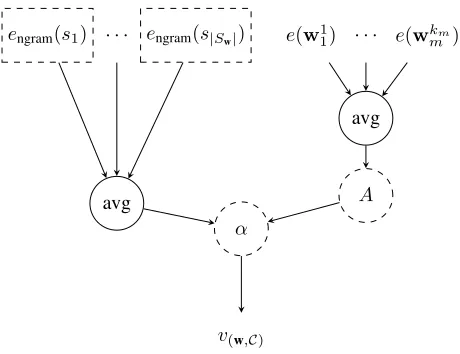
Figure 1: Schematic representation of the form-context word embedding architecture. Learnable parameters of the model are indicated by dashed lines.
architecture in which the value ofαdirectly depends on the two embedding candidates. This is achieved by setting
α=σ(w>[vcontext(w,C) ◦vform(w,C)] +b)
withw ∈ R2k,b ∈
R being learnable parameters of our
model,◦denoting vector concatenation andσdenoting the sigmoid function. We call this version of the model thegated modelsince we can viewαas a gate in this case.
In addition to the single-parameter and gated models, we also tried several more sophisticated composition functions, including a variant whereαis computed using a multi-layer neural network and another variant withα∈[0,1]kbeing a component-wise weighing parameter. Furthermore, we ex-perimented with an iterative procedure that refines the com-bined embedding over multiple iterations by adjusting the composition based on embeddings obtained from previous iterations. In our experiments, however, none of these modi-fications did consistently improve the model’s performance, so we do not investigate them in detail here.
As it combines context and surface-form embeddings, we refer to the final embeddingv(w,C)obtained using the com-position function (in both single-parameter and gated mod-els) as aform-context word embedding. The overall architec-ture of our model is shown schematically in Figure 1.
For training of our model and estimation of its learnable parameters, we require the embedding functioneand a train-ing corpusT, consisting of pairs(w,C)as above. Given a batchB ⊂ T of such training instances, we then aim to min-imize the function
LB=
1 |B|
X
(w,C)∈B
kv(w,C)−e(w)k2
4
Experimental Setup
Datasets
We evaluate our model on two different datasets: the Defini-tional Nonce (DN) dataset introduced by Herbelot and Ba-roni (2017) and the Contextual Rare Words (CRW) dataset of Khodak et al. (2018). The DN dataset consists of 300 test and 700 train words; for each word, a corresponding definitional sentence extracted from Wikipedia is provided. The authors also provide400-dimensional embedding vec-tors for a set of 259,376 words, including the test and train words. These embeddings were obtained using the skipgram algorithm of Mikolov et al. (2013). On the DN dataset, our model can be evaluated by training it with all given word vectors – except for the test set – and then comparing the inferred embeddings for the test words with their actual em-beddings.
Our second benchmark, the CRW dataset, is based on the Rare Words dataset by Luong, Socher, and Manning (2013) and contains562pairs of rare words along with human sim-ilarity judgments. For each rare word, 255 corresponding sentences are provided. In contrast to the sentences of the DN dataset, however, they are sampled randomly from the Westbury Wikipedia Corpus (WWC) (Shaoul and Westbury 2010) and, accordingly, do not have a definitional charac-ter in many cases. Khodak et al. (2018) also provide a set of300-dimensional word embeddings which, again, can be used to train our model. We may then compare the ities of the so-obtained embeddings with the given similar-ity scores. As the CRW dataset comes without development data on which hyperparameters might be optimized, we ex-tend the dataset by creating our own development set.1 To this end, we sample 550 random pairs of words from the Rare Words dataset, with the only restrictions that (i) the cor-responding rare words must not occur in any of the pairs of the CRW dataset and (ii) they occur in at least128sentences of the WWC. We then use the WWC to obtain randomly sampled contexts for each rare word in these pairs.
Model Setup and Training
For our evaluation on both datasets, we use the WWC to obtain the contexts required for training; the same corpus was also used by Herbelot and Baroni (2017) and Khodak et al. (2018) for training of their models.
To construct our set of training instances, we restrict our-selves to words occurring at least 100times in the WWC. We do so because embeddings of words occurring too infre-quently generally tend to be of rather low quality. We there-fore have no clear evaluation in these cases as our model may do a good job at constructing an embedding for an in-frequent word, but it may be far from the word’s original, low-quality embedding. Letw∈ V be a word and letc(w) denote the number of occurrences ofwin our corpus. For each iteration over our dataset, we createn(w)training in-stances{(w,C1), . . . ,(w,Cn(w))}from this word, where
n(w) = min(bc(w) 100c,5).
1Our development set is publicly available at https://github.
com/timoschick/form-context-model
The number n(w)is designed to put a bit more emphasis on very frequent words as we assume that, up to a certain point, the quality of a word’s embedding increases with its frequency. For eachi ∈ {1, . . . , n(w)}, the context setCi is constructed by sampling 20 random sentences from our corpus that containw.
For surface-form embeddings, we set nmin = 3 and
nmax = 5. We only considern-grams that occur in at least 3different words of our training corpus; every othern-gram is replaced by a specialhunkitoken. We initialize all param-eters as described by Glorot and Bengio (2010) and use a batch size of64examples per training step. Training is per-formed using the Adam optimizer (Kingma and Ba 2015) and a learning rate of0.01. For training of our model with the embeddings provided by Herbelot and Baroni (2017), both the learning rate and the number of training epochs is determined using the train part of the DN dataset, search-ing in the range{0.1,0.01,0.001}and{1, . . . ,10}, respec-tively. As we assume both the quality and the dimension of the original embeddings to have a huge influence on the opti-mal parameters for our model, we separately optimize these parameters for training on the embeddings by Khodak et al. (2018) using our newly constructed development set. In all of the experiments described below, we use the cosine dis-tance to measure the similarity between two embedding vec-tors.
5
Evaluation
To evaluate the quality of the representations obtained using our method, we train our model using the embeddings of Herbelot and Baroni (2017) and compare the inferred em-beddings for all words in the DN test set with their actual embeddings. For this comparison, we define the rank of a wordwto be the position of its actual embeddinge(w)in the list of nearest neighbors of our inferred embeddingv(w,C), sorted by similarity in descending order. That is, we simply count the number of words whose representations are more similar to the embedding assigned towby our model than its original representation. For our evaluation, we compute both the median rank and the mean reciprocal rank (MRR) over the entire test set.
Model Type Median Rank MRR
Mimick S 85573 0.00006
Skipgram C 111012 0.00007
Additive C 3381 0.00945
Nonce2Vec C 623 0.04907
A La Carte C 165.5 0.07058
surface-form S 404.5 0.12982
context C 184 0.06560
single-parameter S&C 55 0.16200
gated S&C 49 0.17537
Table 1: Results of various approaches on the DN dataset. The “Type” column indicates whether the model makes use of surface-form information (S) or context information (C). Results are shown forsingle-parameterandgated configu-rations of the form-context model.
As can be seen, using only surface-form information re-sults in a comparatively high MRR, but the obtained median rank is rather bad. This is due to the fact that the surface-form model assigns very good embeddings to words whose meaning can be inferred from a morphological analysis, but completely fails to do so for most other words. The con-text model, in contrast, works reasonably well for almost all words but only infrequently achieves single-digit ranks. The combined form-context model clearly outperforms not only the individual models, but also beats all previous ap-proaches. Interestingly, this is even the case for the single-parameter model, in whichαis constant across all words. The optimal value ofαlearned by this model is0.19, show-ing a clear preference towards surface-form embeddshow-ings.
The gated configuration further improves the model’s performance noticeably. Especially the median rank of 49 achieved using the gated model architecture is quite remark-able: Considering that the vocabulary consists of 259,376 words, this means that for 50% of the test set words, at most 0.019% of all words in the vocabulary are more similar to the inferred embedding than the actual embedding. Similar to the single-parameter model, the average value ofαover the entire test set for the gated model is0.20, with individual values ranging from0.07to0.41. While this shows how the gated model learns to assign different weights based on word form and context, the fact that it never assigns values above α= 0.41– i.e., it always relies on the surface-form embed-ding to a substantial extent – indicates that the model may even further be improved through a more elaborate compo-sition function.
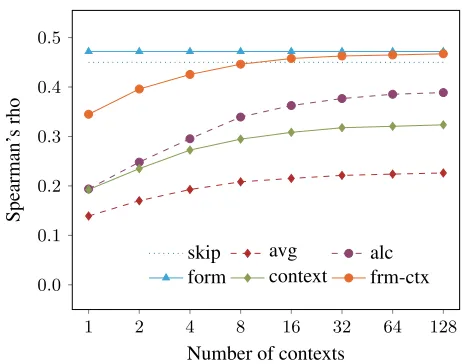
As a second evaluation, we turn to the CRW dataset for which results are shown in Figure 2.2 We use Spearman’s rho as a measure of agreement between the human similar-ity scores and the ones assigned by the model. As the CRW
2
Results reported in Figure 2 differ slightly from the ones by Khodak et al. (2018) because for each word pair(w1,w2)of the CRW corpus, the authors only estimate an embedding forw2and takee(w1)as the embedding forw1; ifw1 is not in the domain ofe, a zero vector is taken instead. In contrast, we simply infer an embedding forw1analogically tow2in the latter case.
1 2 4 8 16 32 64 128
0.0 0.1 0.2 0.3 0.4 0.5
Number of contexts
Spearman’
s
rho
skip avg alc
form context frm-ctx
Figure 2: Results on the CRW dataset by (Khodak et al. 2018) for the averaging baseline (avg), A La Carte (alc), the surface-form model (form), the context model (context) and the combined form-context model in its gated version (frm-ctx) as well as for the skipgram algorithm (skip) when trained on all 255 contexts
dataset provides multiple contexts per word, we can also an-alyze how modifying the number of available contexts influ-ences the model’s performance. As can be seen, our model again beats the averaging baseline and A La Carte by a large margin, regardless of the number of available contexts. In-terestingly, with as little as8contexts, our model is almost on par with the original skipgram embeddings – which were obtained using all255 contexts – and even improves upon them given 16 or more contexts. However, it can also be seen that the surface-form model actually outperforms the combined model. While this may at first seem surprising, it can be explained by looking at how the CRW dataset was constructed: Firstly, Luong, Socher, and Manning (2013) fo-cused explicitly on morphologically complex words when creating the original Rare Words dataset, so the CRW dataset contains many words such as “friendships”, “unannounced” or “satisfactory” that are particularly well-suited for an ex-clusively surface-form-based model. Secondly, the provided contexts for each word are sampled randomly, meaning that they are of much lower definitional quality than the single sentences provided in the DN dataset. Despite this bias of the dataset towards surface-form-based models, given32or more contexts, the combined model performs comparable to the surface-form embeddings. However, the results clearly indicate that our model may even further be improved upon by incorporating the number and quality of the available contexts into its composition function.
ρ = 0.496 – as compared to ρ = 0.471 for our surface-form model – a direct comparison to our method is not ap-propriate as our model’s performance is highly dependent on the embeddings it was trained from. We can, however, train our method on the embeddings provided by fastText to allow for a fair comparison. Doing so results in a score of ρ = 0.508 for the gated model when using 128contexts, showing that even for word embedding algorithms that al-ready make use of surface-form information, our method is helpful in obtaining high-quality embeddings for novel words. Noticeably, when trained on fastText embeddings, the form-context model even outperforms the surface-form model (ρ= 0.501).
We also evaluate the form-context model on seven super-vised sentence-level classification tasks using the SentEval toolkit (Conneau and Kiela 2018).3 To do so, we train a simple bag-of-words model using the skipgram embeddings provided by Khodak et al. (2018) and obtain embeddings for OOV words from either the form-context model, the A La Carte embedding method or the averaging baseline, us-ing as contexts all occurrences of these words in the WWC. While the form-context model outperforms all other mod-els, it does so by only a small margin with an average ac-curracy of75.34across all tasks, compared to accuracies of 74.98,74.90and75.27for skipgram without OOV words, A La Carte and the averaging baseline, respectively. Presum-ably, this is because novel and rare words have only a small impact on performance in these sentence-level classification tasks.
6
Analysis
For a qualitative analysis of our approach, we use the gated model trained with the embeddings provided by Herbelot and Baroni (2017), look at the nearest neighbors of some embeddings that it infers and investigate the factors that con-tribute most to these embeddings. We attempt to measure the contribution of a singlen-gram or context word to the em-bedding of a wordw by simply computing the cosine dis-tance between the inferred embedding v(w,C) and the em-bedding obtained when removing this specific n-gram or word.
For a quantitative analysis of our approach, we measure the influence of combining both models on the embedding quality of each word over the entire DN test set.
Qualitative analysis
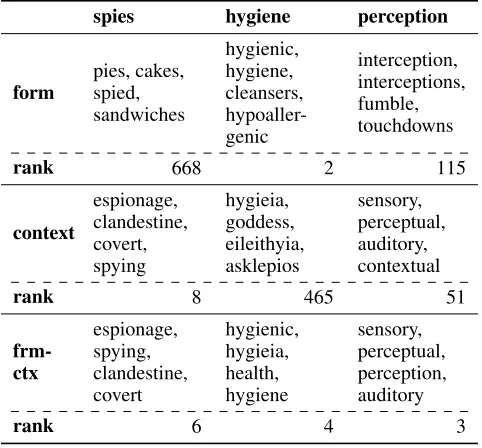
Table 2 lists the nearest neighbors of the inferred embed-dings for selected words from the DN dataset where the con-text setCsimply consists of the single definitional sentence provided. For each embedding v(w,C), Table 2 also shows
the rank of the actual wordw, i.e., the position of the ac-tual embeddinge(w)in the sorted list of nearest neighbors. It can be seen that the combined model is able to find high-quality embeddings even if one of the simpler models fails to do so. For example, consider the word “spies” for which the surface-form model fails to find a good embedding. The
3
We use the MRPC, MR, CR, SUBJ, MPQA, SST2 and SST5 tasks for this evaluation.
spies hygiene perception
form
pies, cakes, spied, sandwiches
hygienic, hygiene, cleansers, hypoaller-genic
interception, interceptions, fumble, touchdowns
rank 668 2 115
context
espionage, clandestine, covert, spying
hygieia, goddess, eileithyia, asklepios
sensory, perceptual, auditory, contextual
rank 8 465 51
frm-ctx
espionage, spying, clandestine, covert
hygienic, hygieia, health, hygiene
sensory, perceptual, perception, auditory
rank 6 4 3
Table 2: Nearest neighbors and ranks of selected words when using surface-form embeddings, context embeddings and gated form-context (frm-ctx) embeddings
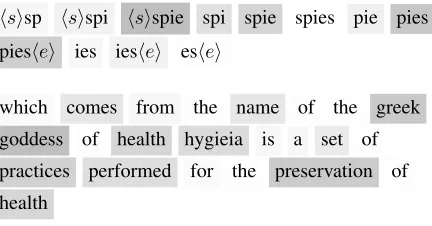
reason for this becomes obvious when analyzing the contri-bution of eachn-gram for the final embedding. This contri-bution is shown at the top of Figure 3, where a darker back-ground corresponds to higher contribution. It can be seen there that the high contribution ofn-grams also occurring in the word “pies” – which, while having a similar surface-form, is semantically completely different from “spies” –, is the primary reason for the low quality embedding. Despite this, the embeddings found by both the context model and the combined model are very close to its actual embedding.
In a similar fashion, the context model is not able to come up with a good embedding for the word “hygiene” from the provided definitional sentence. This sentence can be seen at the bottom of Figure 3 where, as before, words are high-lighted according to their importance. While the linear trans-formation applied to the context embeddings helps to filter out stop words such as “which”, “of” and “the” which do not contribute to the word’s meaning, the sentence is still too complex for our model to focus on the right words. This results in the context embedding being closer to words from Greek mythology than to words related to hygiene. Again, the combined model is able to alleviate the negative effect of the context model, although it performs slightly worse than the purely surface-form-based model. For the last example provided, “perception”, neither of the two simpler models performs particularly well: The surface-form model is only able to capture the word’s part of speech whereas the context model finds semantically related words with different parts of speech. Interestingly, the form-context model is still able to infer a high-quality embedding for the word, combining the advantages of both models it is composed of.
dis-hsisp hsispi hsispie spi spie spies pie pies
pieshei ies ieshei eshei
which comes from the name of the greek
goddess of health hygieia is a set of
practices performed for the preservation of
health
Figure 3: Importance ofn-grams for the surface-form em-bedding of “spies” (top) and of context words for the context embedding of “hygiene” (bottom)
tinguish between cases in which context is helpful and cases where it is better to rely on surface-form information: While the embedding for “hygiene” is composed with a value of α= 0.22, both the embeddings of “spies” and “perception” put more focus on the context (α = 0.32 andα = 0.33, respectively). To further analyze the weights learned by our model, Table 3 lists some exemplary words with both com-parably high and low values ofα. The words with the lowest values almost exclusively refer to localities that can easily be identified by their suffixes (e.g. “ham”, “bury”). Among the words with high values ofα, there are many abbreviations and words that can not easily be reduced to known lemmas.
Quantitative analysis
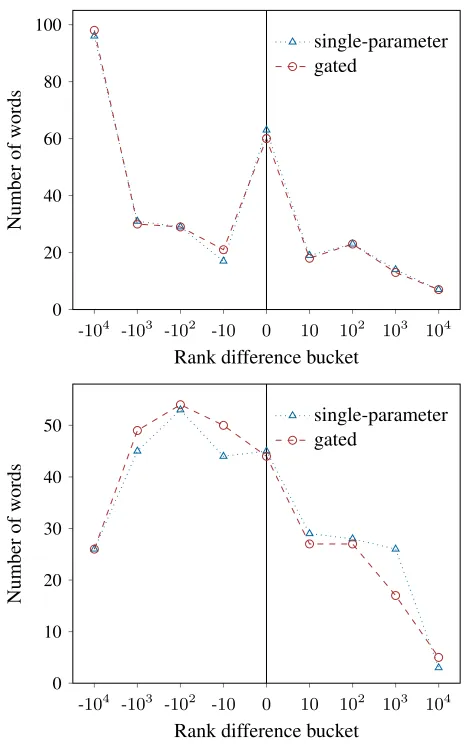
While the selected words in Table 2 demonstrate cases in which the representation’s quality does either improve or at least not substantially deteriorate through the combination of both embeddings, we also quantitatively analyze the effects of combining them to gain further insight into our model. To this end, letrform(w),rcontext(w)andrfrm-ctx(w)denote the rank of a wordwwhen the surface-form model, the context model and the form-context model is used, respectively. We measure the influence of combining both models by com-puting the differences
dm(w) =rfrm-ctx(w)−rm(w)
for each wordwof the DN test set andm∈ {context,form}. We then define a set ofrank difference buckets
B={±10i|i∈ {1, . . . ,4}} ∪ {0}
and assign each wordwto its closest bucket,
bw,m= arg min
b∈B|b−dm(w)|.
The number of words in each so-obtained bucket can be seen for both surface-form and context embeddings in Figure 4. To get an understanding of how different combination func-tions influence the resulting embeddings, rank differences are shown for both the single-parameter and gated configu-rations of the form-context model.
As can be seen in Figure 4 (top), the combined archi-tecture dramatically improves representations for approxi-mately one third of the test words, compared to the purely
Words with high form weight(α≤0.1)
cookstown, feltham, sydenham, wymondham, cleveland, banbury, highbury, shaftesbury
Words with high context weight(α >0.3)
poverty, hue, slang, flax, rca, bahia, atari, snooker, icq, bronze, esso
Table 3: Selection of words from the DN development set where the weight of the surface-form embedding (top) or context embedding (bottom) is especially high
surface-form-based model. These are almost exclusively words which can not or only with great difficulty be derived morphologically from any known words, including many abbreviations such as “BMX” and “DDT”, but also regular words such as “whey”, “bled”, and “wisdom”. While a more sophisticated model might actually be able to morphologi-cally analyze the latter two words, our simplen-gram based model fails to do so. For most other words, adding context information to the surface-form model only moderately af-fects the quality of the obtained representations.
As the context model assigns to most words represen-tations that at least broadly capture their semantics, only very few of its embeddings improve as much as for the surface-form model when adding surface-form information (Figure 4, bottom). However, it can be seen that many em-beddings can at least slightly be refined through this ad-ditional information. As one might expect, the words that profit most are those for which the provided definitions are hard to understand and a morphological analysis is compar-atively easy, including “parliamentarian”, “virtuosity” and “drowning”. We can also see the positive influence of de-signingαas a function of both embeddings, i.e., of the gated model: It does a better job at deciding when context-based embeddings may be improved by adding surface-form-based information. However, it can also be seen that the represen-tations of several words worsen when combining the two embeddings. In accordance with the observations made for the CRW dataset, this indicates that the model might further be improved by refining the composition function.
-104 -103 -102 -10 0 10 102 103 104 0
20 40 60 80 100
Rank difference bucket
Number
of
w
ords
single-parameter gated
-104 -103 -102 -10 0 10 102 103 104
0 10 20 30 40 50
Rank difference bucket
Number
of
w
ords
single-parameter gated
Figure 4: Effect of adding the context submodel (top) and the surface-form submodel (bottom). The rank difference buck-ets were created by applying the dform difference function (top) anddcontextdifference function (bottom) to the entire DN test set.
all categories. The largest difference between the single-parameter and the gated model can be observed for nouns whose lemma does not occur in other frequent words. This further indicates that the gated model is able to detect words which can not easily be reduced to known lemmas and, ac-cordingly, gives less weight to the surface-form embedding for those words.
7
Conclusion and Future Work
We have presented a model that is capable of inferring high-quality representations for novel words by processing both the word’s internal structure and words in its context. This is done by intelligently combining an embedding based on n-grams with an embedding obtained from averaging over all context words. Our algorithm can be trained from and combined with any preexisting word embedding model. On both the Definitional Nonce dataset and the Contextual
Model Proper nouns Common nouns (126) lem (79) oth (86)
surface-form 0.03 0.29 0.12
context 0.06 0.09 0.05
single-parameter 0.10 0.32 0.11
gated 0.11 0.32 0.15
Table 4: MRR of the embeddings inferred by the form-context model and its components for proper nouns and common nouns from the DN test set. Common nouns are di-vided into nouns with known lemmas (lem) and those with-out (oth). The number of words in each group is shown in parantheses.
Rare Words dataset, our model outperforms all previous ap-proaches to learning embeddings of rare words by a large margin, even beating the embedding algorithm it was trained from on the latter dataset. Careful analysis of our combined model showed that in many cases, it is able to effectively balance out the influences of both embeddings it is com-posed of, allowing it to greatly improve upon representations that are either purely surface-form-based or purely context-based. By providing a development set that complements the CRW dataset, we hope to further spur research in the area of “few-shot learning” for word embeddings.
While we showed that a context-dependent combination of surface-form and context embeddings substantially im-proves the model’s performance on the Definitional Nonce task, results on the Contextual Rare Words dataset indicate that there is still room for further enhancement. This could potentially be achieved by incorporating the number and in-formativeness of the available contexts into the composition function; i.e., the gate would not only be conditioned on the embeddings, but on richer information about the context sentences. It would also be interesting to investigate whether our model profits from using more complex ways than aver-aging to obtain surface-form and context embeddings, re-spectively. For example, one might introduce weights for n-grams and words depending on their contexts (i.e. the n-grams or words surrounding them). For scenarios in which not just one, but multiple contexts are available to infer a word’s embedding, a promising extension of our model is to weight the influence of each context based on its “defi-nitional quality”; a similar modification was also proposed by Herbelot and Baroni (2017) for their Nonce2Vec model. Yet another interesting approach would be to integrate rela-tive position information into our model. This could be done similar to Shaw, Uszkoreit, and Vaswani (2018) by addition-ally learning position embeddings and weighting the influ-ence of context words based on those embeddings.
Acknowledgments
References
Ataman, D., and Federico, M. 2018. Compositional repre-sentation of morphologically-rich input for neural machine translation. InProceedings of the 56th Annual Meeting of the Association for Computational Linguistics (Volume 2: Short Papers), 305–311. Association for Computational Linguistics.
Bojanowski, P.; Grave, E.; Joulin, A.; and Mikolov, T. 2017. Enriching word vectors with subword information. Trans-actions of the Association for Computational Linguistics
5:135–146.
Conneau, A., and Kiela, D. 2018. Senteval: An evaluation toolkit for universal sentence representations.arXiv preprint arXiv:1803.05449.
Cotterell, R.; Sch¨utze, H.; and Eisner, J. 2016. Morpho-logical smoothing and extrapolation of word embeddings. InProceedings of the 54th Annual Meeting of the Associa-tion for ComputaAssocia-tional Linguistics (Volume 1: Long Papers), 1651–1660. Association for Computational Linguistics. Gerz, D.; Vulic, I.; Ponti, E. M.; Naradowsky, J.; Reichart, R.; and Korhonen, A. 2018. Language modeling for mor-phologically rich languages: Character-aware modeling for word-level prediction.TACL6:451–465.
Glorot, X., and Bengio, Y. 2010. Understanding the diffi-culty of training deep feedforward neural networks. In Pro-ceedings of the Thirteenth International Conference on Ar-tificial Intelligence and Statistics, Proceedings of Machine Learning Research, 249–256. PMLR.
Goldberg, Y. 2016. A primer on neural network models for natural language processing.Journal of Artificial Intelli-gence Research57(1):345–420.
Herbelot, A., and Baroni, M. 2017. High-risk learning: ac-quiring new word vectors from tiny data. InProceedings of the 2017 Conference on Empirical Methods in Natural Lan-guage Processing, 304–309. Association for Computational Linguistics.
Hochreiter, S., and Schmidhuber, J. 1997. Long short-term memory.Neural Computation9(8):1735–1780.
Khodak, M.; Saunshi, N.; Liang, Y.; Ma, T.; Stewart, B.; and Arora, S. 2018. A la carte embedding: Cheap but effective induction of semantic feature vectors. InProceedings of the 56th Annual Meeting of the Association for Computational Linguistics (Volume 1: Long Papers), 12–22. Association for Computational Linguistics.
Kingma, D., and Ba, J. 2015. Adam: A method for stochas-tic optimization.The International Conference on Learning Representations (ICLR).
Lazaridou, A.; Marelli, M.; Zamparelli, R.; and Baroni, M. 2013. Compositional-ly derived representations of morpho-logically complex words in distributional semantics. In Pro-ceedings of the 51st Annual Meeting of the Association for Computational Linguistics (Volume 1: Long Papers), 1517– 1526. Association for Computational Linguistics.
Lazaridou, A.; Marelli, M.; and Baroni, M. 2017. Multi-modal word meaning induction from minimal exposure to natural text. Cognitive Science41:677–705.
Luong, T.; Socher, R.; and Manning, C. 2013. Better word representations with recursive neural networks for morphol-ogy. InProceedings of the Seventeenth Conference on Com-putational Natural Language Learning, 104–113.
Mikolov, T.; Chen, K.; Corrado, G.; and Dean, J. 2013. Ef-ficient estimation of word representations in vector space.
CoRRabs/1301.3781.
Pinter, Y.; Guthrie, R.; and Eisenstein, J. 2017. Mimicking word embeddings using subword RNNs. InProceedings of the 2017 Conference on Empirical Methods in Natural Lan-guage Processing, 102–112. Association for Computational Linguistics.
Salle, A., and Villavicencio, A. 2018. Incorporating sub-word information into matrix factorization sub-word embed-dings. In Proceedings of the Second Workshop on Sub-word/Character LEvel Models, 66–71. Association for Computational Linguistics.
Salle, A.; Idiart, M.; and Villavicencio, A. 2016. Matrix factorization using window sampling and negative sampling for improved word representations. InProceedings of the 54th Annual Meeting of the Assocation for Computational Linguistics (Volume 2: Short Papers). Association for Com-putational Linguistics.
Shaoul, C., and Westbury, C. 2010. The westbury lab wikipedia corpus.
Shaw, P.; Uszkoreit, J.; and Vaswani, A. 2018. Self-attention with relative position representations. InProceedings of the 2018 Conference of the North American Chapter of the As-sociation for Computational Linguistics: Human Language Technologies, Volume 2 (Short Papers), 464–468. Associa-tion for ComputaAssocia-tional Linguistics.