MURDOCH RESEARCH REPOSITORY
http://ieeexplore.ieee.org/xpl/articleDetails.jsp?arnumber=615755&contentType=C
onference+Publications
Morrison, M.W., Dingle, A.A. and Attikiouzel, Y. (1996) A new
approach to unsupervised Markov random field-based
segmentation of Mr images. In: Fourth International Symposium
on Signal Processing and Its Applications, ISSPA 96, 25 - 30
August, Gold Coast, Australia, pp. 357-360.
http://researchrepository.murdoch.edu.au/19933/
Copyright © 1996 IEEE
Personal use of this material is permitted. However, permission to reprint/republish
this material for advertising or promotional purposes or for creating new collective
International Symposium on Signal Processing and its Applications, ISSPA, Gold Coast, Australia, 25-30 August, 1996. Organized by the Signal Processing Research Centre,
&UT,
Brisbane, Australia.A
NEW APPROACH T O UNSUPERVISED MARKOV RANDOM FIELD-BASED
SEGMENTATION OF M R IMAGES
Mark
W. Morrison, Alison A. Dingle and Yianni Attilciouael
Centre
for
Intelligent Information Processing Systems
Department
of
Electrical and Electronic Engineering
The University
of
Western Australia
Nedlands, Perth, Western Australia
email: mark@ee. uwa.edu. au
IABSTRACT
This paper describes a new approach to the unsupervised segmentation of images. A Markov random field model is used for prior label field modelling. Unlike conventional stochastic model-based approaches, each image class is not characterised by a parametric model. The algorithm com- pares the data in local windows around each pixel with the global distribution of data in each class using appropriate distance metrics. A novel method for determining the num- ber of image classes is presented.
1. INTRODUCTION
There has been a large amount of research published on the application of statistical methods to the problem of MR im- age segmentation. In the most basic case, clustering tech- niques have been applied in both supervised and unsuper- vised contexts. In particular the EM algorithm has been applied to the task of unsupervised Gaussian mixture mod- elling [I, 2, 3, 41. Information theoretic (IT) measures, such as the Akaike Information criterion (AIC) [SI or minimum description length (MDL)
[SI
can then be used for cluster validation.More recently, improvements have resulted through the application of Markov random field (MRF’) image models (7, 8, 9, 101. In particular, MRFs allow prior contextual anatomical information, and our intuitive notions regarding the physical properties of images to be incorporated easily into the segmentation process.
Currently there are two major drawbacks that exist with these approaches. Firstly, in almost all cases, paramet- ric models are utilised to characterise the image formation process. That is, each tissue is assumed to give rise to a characteristic MR signature
-
Multidimensional Gaussian models are used almost exclusively. There is a need, there- fore, to estimate parameters for these models. Supervised methods, which rely on the collection of training data from exemplar images have been shown to be impractical for this task. Unsupervised methods are generally unreliable, and are in most cases very sensitive to the initial estimates used. In addition, there is no inherent reason to suggest a-priori that any particular parametric model is a “good” model for the data, and by imputing an incorrect model on the data, suboptimal segmentations m a y result.The second diaculty is in deciding how many tissues are present in the images
-
the cluster validation prob- lem. Once again, information theoretic criteria have been used. The use of Markov field models, however, introduces dependencies into the data, which tend to make the use of I T criteria both uncertain and computationally expensive (see, for example, [IO]).In this paper, we propose a new method of unsuper- vised MR image segmentation, based on the recent work of Kervrann and Heitz [ll] and Geman & Geman (121,
which
does
not rely on parametric approaches to data mod- elling. Furthermore, the number of tissues in the image is estimated as an integral part of the segmentation process, rather thanas
a
post-hoc “goodness of fit” measure as pro- vided by AIC orMDL.
2. PROBLEM FORMULATION
Let
L
be a rectangular array of sites,L
= { ( i , j ) ;
1 5 i5
N I , 1
5
j5
Nz}. Furthermore, for notational convenience, assume that the two-dimensional latticecan
be indexed by a single parameter in the manner described by [13], where each site is referenced by a single index, s. Associated with each site s EC
isa
label,zs,
that specifles the image class to which the site belongs. Thus,zs
= r,rE
{1,2,. ..
,
K } where K is the number of image classes’It is assumed that there is a true, but
unknown,
la- belling of sites,x’
= {z:; s E L } . In the context of un- supervised segmentation, the problem is to determine the number-of image classes,K ,
and to reconstruct an esti- mate,X,
of the true label field from the observed image data,Y
= {ys;sE
L};
where the image data consists ofM
observations at each site, ys = [y!”, y y ) ,. . . ,
yliM)]. In addition to the observed data, additional constraints may be imposed on the estimated labelling by the application‘Note that each site is considered to belong completely to one
class. In general, it may be the case that the true labelling of each site is composed of a mixture of classes
-
this is the case of so-called “fuzzy” segmentation. This type of model is quite appre
priate for MR image segmentation, where partial volume effects can have a significant impact on the performance of “hard” seg- mentation algorithms. The extension of the algorithm described
in this paper to “fuzzy” segmentation is being investigated, but
International Symposium on Signal Processing and its Applications, ISSPA, Gold Coast, Australia, 25-30 August, 1996. Organized b y the Signal Processing Research Centre, Q U T , Brisbane, Australia.
of predefined image models for the label field and through assumptions placed on the image formation process. In un- supervised segmentation, the parameters associated with these models either need to be estimated directly from the observed data, or are preset to default values independent of the image data.
3. STOCHASTIC MODEL-BASED IMAGE
SEG
MENTATI 0N
In terms of the so-called stochastic model-based approach to segmentation 18, 2, 3, 14, 15, lo], the above problem can be stated
as
where R is the sample space of all possible segmenta- tions. That is, choose the segmentation which has the high- est likelihood, given the data that was observed. By use of Bayes theorem, (1) can be reformulated as
=
argmaxP(YIX)P(X) (2)X € R
= arg rgax[log P ( Y
1x1
+
log P(X)]Therefore, to obtain an estimate of the label field, it
is necessary to specify an observation model, P(YlX), and a prior model, P ( X ) . This is known as the maxirnum a-
posteriori (MAP) estimate of X. Note that in the case of an assumption of a uniform prior on the label field2, (2) reduces to the maximum likelihood
(ML)
estimate(3)
3.1. Gaussian Mixture Models
The most widely employed assumption in image segmenta- tion is that the observation model can be described by a conditionally independent Gaussian mixture model [3, 16, 171. In this case, the observations at each site are assumed to be conditionally independent and to have the same con- dtional probability, p(yslzs), dependent only on zS. There- fore. the observation model can be written as
P(YIX)
=
~ P ( Y . 1 5 5 ) (4) JELand with the assumption of a multivariate Gaussian p.d.f.
(5) where pk and
Ak
are the mean and covariance matrix.3.2. Markov Random Fields
The use of the above model in ML image segmentation has been widely reported [l, 18, 41. The efficacy of the ML approach, however, has proved to be less than satisfactory. More recently, the MAP approach has become more preva- lent. In particular, the use of Markov random field models for the prior,
P(X),
has been widely reported.In very general terms, the use of Markov random field priors allows the introduction of a degree of spatial depen- dence between labels into the segmented image. In its sim- plest form, this implies a tendency for the label at any par- ticular site to be similar to labels at neighbouring sites. An equivalent formulation3 of
an MRF
is to describe the spa- tial dependency in terms of joint probabilities in the form of a Gibbs Distribution. In this case, the label field prior is of the following forme-LJ(x)
P ( X = x ) = - 2 (6)
where U ( x ) is called the energy function and 2 is a normal-
ising constant, known as the partition function.
A commonly used energy function is the multi-level lo- gistic
MRF [19]
s E L t€N.
where
p
is a predefine M R F strength constant,a(.)
is the usual dirac-delta function, andN,
is a suitably defined neighbourhood of sites about s.3.3. Current Status
The utility and application of the models described above constitutes a substantial portion of the current literature on statistically-based image segmentation. A number of limitations to this approach have been identified.
and covariance matrix) for the observation model is a very diificult problem. A c o m m o n way of tadding this is to it- eratively segment the image and then recalculate the pa- rameters, assuming that the segmentation is correct. This procedure can be shown t o converge to a partial optimal solution
(POS)
[20]. Simultaneous segmentation and pa- rameter estimation can be performed by using an approachakin
to the EM algorithm [16]. Zhanget
a1 describe suchan
approach [lo], where at each iteration, every site is par- tially assigned to all classes, with a "hard" segmentation being performed once the parameter values converge.This
approach yields significant segmentation improvements, but the EM algorithm is very sensitive to initial conditions, and there is no way to guarantee that a sensible solution will re- sult.The second problem with mixture modelling approaches
is that it is difficult to determine the correct number of im-
age classes. The number of classes is typically estimated by searching, over a range of K , for a value that minimises a Firstly, the determination of the model parameters (mean
2That is, all prior distributions are equally probably
-
gen- erally used in the case when no prior information is availableregarding the properties of the label field
International Symposium on Signal Processing and its Applications, ISSPA, Gold Coast, Australia, 25-30 August, 1996. Organized by the Signal Processing Research Centre, Q UT, Brisbane, Australia.
given model-fitting criterion, F ( K ) , such as Akaike’s infor- mation criterion (AIC) [5] or minimum description length (MDL) [6]. These measures are basically a trade-off be- tween the fit of the model to the data and the complexity of the model. Experimental results with synthetic images [21], however, clearly demonstrate that they are unable to consistently estimate the correct number of image classes.
4. A NEW A P P R O A C H
Kervrann and Heitz [ll] proposed an alternative method to estimate the number of image classes, whereby new image classes are created during the segmentation process. An outlier class, p, is introduced and pixels are assigned to this outlier class if they do not conform to any of the existing classes. In a general segmentation task, the distribution of data within each class may not be Gaussian. Rather than imposing a given model on the data, Kervrann and Heitz proposed comparing the local distribution of data around each pixel with the distribution of data within each image class. Their methods were specifically geared toward tex- ture segmentation, where a large number of features are calculated from the original image. The method described here is an extension of these concepts to the case of general image segmentation.
4.1.
The
Energy FunctionIn this approach, the
MAP
segmentation of (2) is restated as a problem of energy minimisation, and soX
=
argmax[logP(YIX) +logP(X)] XEflX E f l
=
argmin[-lOgP(YIX) -logP(X)] (8)= argxFfl [U(YIX)
+
V(X)lwhere U(YIX) and U(X) are energy functions. The second term, U ( X ) , is the energy in the Markov random field. A multi-level logistic
M R F
is used for this, so thats E L :€N.
The first term, U(YIX), measures the difference be- tween the local distribution of data near each site s and the distribution of data for the image class k to which s is assigned (z, = k). Thus, this term encourages each site s to be labelled zb
=
k so that the local distribution of data matches the regional distribution of data for image classk.
In order to define U(Y IX) mathematically, let
W ,
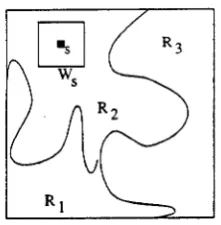
be a window centred on site s over which the local distribution of data is computed and let Yw, be the data associated with the subset of sites that lie within the window W,. Similarly, let Y R ~ be the data associated with sites assigned to image class k. This is illustrated in figure 1. The term U(YIX) can then be expressed as :Figure 1: Local and global region statistics
where f ( Y ) represents the distribution of the data Y , V[f, 91 is a measure of the difference between the two distributions
f
and 9 , and6(.)
is the Dirac-Delta function.The distribution of data within each image class
k
is used as a model of the conditional probability density func- tion p(yslzs=
k). Thus, ~ ( Y R ~ ) is simply the histogram of the data in image class k normalised to unit area and f (Yw, ) is the normalised histogram of data within windowW,. Note that if the data Y is made up of M observations at each site, then f ( Y ) is
an
M-dimensional distribution, that is, f ( Y ) :RM
+
R.
There are many methods available for quantifying the difference between two probability density functions, the most common of which are the L, distance, the Hellinger distance
(H,),
the Kullback-Leibler number, and the Kol- mogorov-Smirnov distance. An analysis of the relative mer- its of each of these measures can be found in [21]. For the remainder of this paper, it will be assumed that the total variation(L1)
metric has been used.The overall energy function U(YIX) + U(X) is min-
imised using the iterated conditional modes (ICM) algo- rithm [7], which selects the label 5, at each site s to min-
imise the local energy
is
=
arg min u(za=
klY,XN,) (11) kwhere the local energy u(zs = klY,X,u,), is given by :
u b = klY,XN,)
=
V[f(YW,),f(YRJ+Pc
[1-2b(k-i,)]:€N*
(12) The sites are updated using a partially synchronous scheme based on coding sets [7].
4.2. Region Formation
In order to allow region formation during the segmentation process,
an
outlier region is also included in the choice of possible image classes during the ICM process. The manner in which this manifests itself is that any site which has anenergy greater than some predetermined threshold4 with the d i gimage classes is labelled as an outlier, p.
41n the implementation of the algorithm, this threshold is
dynamically adjusted. Space limitations preclude a detailed de- scription in this paper.
International Symposium on Signal Processing and its Applications, ISSPA, Gold Coast, Australia, 25-30 August, 1996.
Organized b y the Signal Processing Research Centre, Q U T , Brisbane, Australia.
The segmentation procedure begins by assuming that the entire image can be represented by a single class. The probability distribution of the data is calculated from the image data, and each pixel is reassigned to the initial class, or to the outlier class, depending on how closely the data around it matches the global distribution of the initial class data. If a sufficiently large contiguous outlier region exists (typically 1-2% of the image is used), the pixels within that regon are assigned to a new class. The class probability distributions are re-estimated based on the current labelling and the segmentation-estimation process iterates until no outlier regions of a sufficient size exist.
5 .
RESULTS
We have applied this segmentation algorithm to a num- ber of synthetic images and MR images. Our results show significant improvements over other unsupervised methods for MR image segmentation. In particular, we have found that the estimation of the number of tissues present in MR images using this approach is more accurate than those that rely on information theoretic measures, such as AIC or MDL.
Due to space limitations, only the theoretical aspects of the algorithm are presented here. For a more detailed description and an extensive set of experimental results on a range of images, readers are referred to our technical report [21]. Alternatively, preprints of a
full
paper submitted to IEEE Bans. Image Processing may also be obtained by contacting the authors.6. REFERENCES
H.S. Choi, D.R. Haynor, and Y. Kim. Partial vol- ume tissue classification of multichannel magnetic res- onance images
-
a mixel model. IEEE !Z+ansactions on Medical Imaging, 10(3):395407, September 1991.T. Lei and W. Sewchand. Statistical approach to X- ray CT imaging and its applications in image analysis
-
part I1 : A new stochastic model-based image segmen- tation technique for X-ray CT image. IEEE " a c - tzons on Medical Imaging, 11(1):62-69, March 1992.W. Li, M.W. Morrison, and Y. Attikiouzel. Unsuper- vised segmentation of dual-echo MR images by a se-
quentially learned Gaussian mixture model. In Pro- ceedings of the ZEEE International Conference on Im- age Processing, page Accepted for publication, Wash- ington, USA, October 1995. IEEE.
M.W. Vannier, T.K. Pilgram, C.M. Speidel, L.R. Neu- mann,
D.L.
Rickman, and L.D. Schertz. Validation of magnetic resonance imaging (MlU) multispectral tis-sue classification. Computerized Medical Imaging and
H. Akaike. A Bayesian analysis of the minimum AIC procedure. Annals of the Institute of Statistical Math- ematics A , 309-14, 1978.
J. Rissanen. Modeling by shortest data description.
Automatica, 14:465-471, 1978. Graphics, 15(4):217-223, 1991.
[7]
J.E.
Besag.On
the statistical analysis of dirty pictures.Journal of the Royal Statistical Society B , 48(3):259-
302, 1986.
[8]
S.
Geman and D. Geman. Stochastic relaxation, Gibbs distributions, and the Bayesian restoration of images.IEEE Transactions on Pattern Analysis and Machine Intelligence, 6(6):721-741, November 1984.
Two-dimensional discrete Markovian fields. IEEE Transactions on Infomation Theo y,
[lo] J. Zhang, J.W. Modestino, and D.A. L a g a n . Maximum-likelihood parameter estimation for umu- pervised stochastic model-based image segmentation.
IEEE Transactions on Image Processing, 3(4):404-
419, July 1994.
[ll] C. Kervrann and F. Heitz. A Markov random field model-based approach to unsupervised texture seg- mentation using local and global spatial statistics.
IEEE "Yansactions on Image Processing, 4(6):856-
862, 1995.
[12] D. Geman,
S.
Geman, C. GrafEgne, and D. Pong. Boundary detection by constrained optimization.IEEE Thmsactions on Pattern Analysis and Machine Intelligence, 12(7):609-628, July 1990.
[13] R.C. Dubes and A.K. Jain. Random field models in im- age analysis. Journal of Applied Statistics, 16(2):131-
164, 1989.
[14] Z. Liang. Tissue classification and segmentation of MR images. IEEE Engineering in Medicine and Biology Magazine, pages 81-85, March 1993.
[15] C.W. Therrien,
T.F.
Quatieri, and D.E. Dudgeon. Statistical model-based algorithms for image analysis.Proceedings of the IEEE, 74(4):532-551, April 1986. [16] R.A. Redner and H.F. Walker. Mixture densities, max-
imum likelihood and the EM algorithm. SIAM Review,
26(2):195-239, April 1984.
[17] D.M. Titterington, A.F.M. Smith, and U.E. Makov.
Statistical Analysis of Finite Mizture Distributions.
Wiley Series in Probability and Mathematical Statis- tics. John Wiley & Sons, New York, 1985.
[18] K.M. Hanson. Introduction to Bayesian image analy- sis. In Proceedings of SPIE (Image Processing), volume 1898, pages 716-731. SPIE, 1993.
[19] H. Derin and
CS.
Won. A parallel image segmenta- tion algorithm using relaxation with varying neighbor- hoods and its mapping to array processors. ComputerGraphics and Image Processing, 40:54-78, 1987.
[20] R. E. Wendell and A. P. Hurter. Minimization of a non- separable objective function subject t o disjoint con-
straints. Operations Research, 24(4):643-657, 1976. [21] A. A. Dingle and M. W. Morrison. Unsupervised im-
age segmentation. Technical report, Department of Electrical and Electronic Engineering, The University of Western Australia, The University of Western Aus- tralia, Nedlands, Perth, WA, Australia, April 1996. [9] J.W. Woods.