
Volume 2, Issue 1, January 2013
Page 22
ABSTRACT
The present day Universe appears as if entering into an epoch of accelerated expansion. In this paper, the composition as well as the time and energy scales of the main events during the evolution of the Universe is first pointed out. The inflation of the observed Universe is then examined considering formation of different particles since its birth to the present time. Some dominant features of the visible Universe particularly the radius vs. age of the Universe since the Big Bang have been taken into consideration. Graphical representation of the possible three kinds of Universe as a function of time is presented with three situations of the cosmic background radiation and also an example of computer simulation illustrating the structure of the early Universe.
Keywords: Universe, Cosmology, Cosmic Inflation, Big Bang, Cosmic Background Radiation
1.
INTRODUCTION
The discovery of the expansion of the Universe by Hubble in 1929 heralded the dawn of observational cosmology [1]. The Universe was hotter and denser at the very early times. The temperature was so high that it took part for ionizing the material that filled the Universe. The Universe thus consisted of plasma of nuclei, electrons and photons. The number density of free electrons being very high the mean free path for the Thomson scattering of photons was extremely short. With the expansion of the Universe it cooled and the mean photon energy reduced. Eventually the Universe was matter dominated rather than radiation and at a temperature of about 3000 K, the photon energies became too low for keeping the Universe ionized. At this recombination time, the primordial plasma coalesced into neutral atoms and the mean free path of the photons increased nearly to the size of the observable Universe [2], [3]. The present day Universe appears as if entering into an epoch of accelerated expansion, with its energy density found to be dominated by the mysterious “dark energy" [4].
2.
COMPOSITION
AND
KEY
EVENTS
DURING
THE
EVOLUTION
OF
THE
UNIVERSE
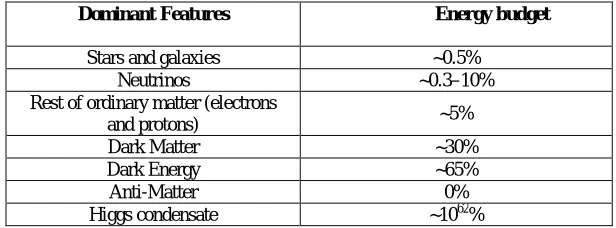
At the time when the temperature of the Universe was greater than about 3000K all atoms, particularly hydrogen and helium, were ionized. Once the temperature falls below 3000K, electrons are bound to atoms and photons travel freely. There was a fluctuation of density and atoms fall into gravitational potential due to this fluctuation. In Table 1 we have shown the dominant features of the Universe with their energy budget.
Table 1: The dominant features of the Universe with their energy budget
Dominant Features Energy budget
Stars and galaxies ~0.5%
Neutrinos ~0.3–10%
Rest of ordinary matter (electrons
and protons) ~5%
Dark Matter ~30%
Dark Energy ~65%
Anti-Matter 0%
Higgs condensate ~1062%
Inflation of the Observed Universe as a
Function of Time
Asit Baran Bhattacharya1 and Bipasa Raha2
1,2
Volume 2, Issue 1, January 2013
Page 23
During most of its history, the Universe can be described very well by the hot Big Bang theory, which was hot and dense in the past and has since cooled by expansion. The observational pillars underlying the Big Bang theory are based on (i) the Hubble diagram, (ii) Big Bang Nucleosynthesis (BBN) and (iii) the Cosmic Microwave Background (CMB). In this connection Table 2 is reproduced from Liddle and Lyth [5] to summarize the main events in the history of the Universe and the corresponding time and energy scales.Table 2: Time and energy scales of the main events of the Universe
t ρ1/4 Event
10-42 s 1018 GeV Inflation begins
10-32±6 s 1013±13 GeV Inflation ends, Cold Big Bang begins
10-18±6 s 106±3 GeV Hot Big Bang begins
10-10 s 100 GeV Electroweak phase transition
10-4 s 100 MeV Quark-hadron phase transition
10-2 s 10 MeV γ, ν, e, e, n and p in thermal
equilibrium
1 s 1 MeV ν decoupling, ee annihilation
100 s 0.1 MeV Nucleosynthesis (BBN)
104 yr 1 eV Matter-radiation equality
105 yr 0.1 eV Atom formation, photon decoupling
(CMB)
~ 109 yr 10-3 eV First bound structures form
Now 10-4 eV (2.73 K) The present
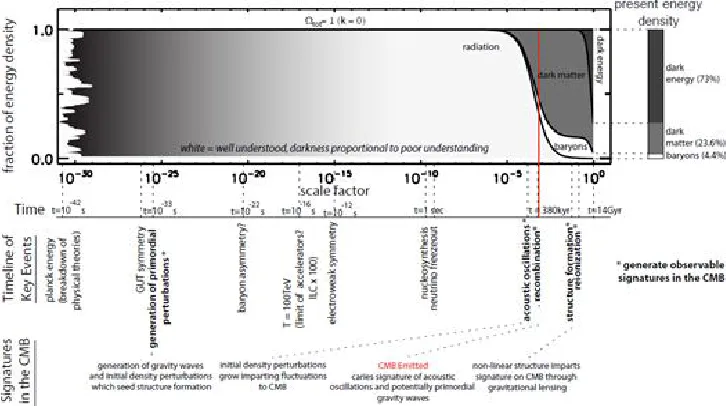
Cosmological observations have indicated some properties of the Universe which cannot be explained within the “standard model”. These are mainly related to dark matter, dark energy and anisotropies of the CMB. The key events during the evolution of the Universe are summarized in Figure 1 emphasizing the “known unknowns" in our understanding of its composition and evolution.
Figure 1 Composition and key events during the evolution of the Universe
[Figure credit: Jeff McMahon, cited by Hiranya V. Peiris in Cosmology Part I: The Homogeneous Universe]
3.
INFLATION OF THE OBSERVED UNIVERSE
The observed Universe has the following important properties: (i) topologically trivial (not periodic within 3000 Mpc) (ii) expanding (Hubble flow) (iii) hotter in the past, cooling (CMB) (iv) predominantly matter (vs. antimatter) (v) chemical composition (75% H, 25% He, trace \metals": hot Big Bang plus processing in stars) (vi) once it was homogeneous but now it is highly inhomogeneous. However, when averaged over the largest scales it becomes homogeneous and isotropic.
Volume 2, Issue 1, January 2013
Page 24
led to its beginning. These advances have made it possible to speculate the origin of the Universe and have allowed for establishing the Big Bang theory as the leading cosmological model.Given the cosmological principle, Hubble’s law proposed that the Universe was expanding [1]. Initially for a number of years the support for these theories was evenly divided but in due course the observational evidence started to support the idea that the Universe evolved from a hot dense state and also it is ever expanding. The discovery of the cosmic microwave background in 1965 and subsequent precise measurements of the cosmic microwave background by the Cosmic Background Explorer in the early 1990s lent strong support to the Big Bang model. Starting from Big Bang the inflation of the Universe is clearly presented in Figure 2 giving priority to time (t), temperature (T) and energy (E). In time scales the formation of different particles are indicated in the figure since its birth to the present time.
Figure 2 Formation of different particles since its birth Figure 3 Dominant features of the Universe since the to the present time Big Bang [6]
Dominant features of the Universe since the Big Bang are shown in Figure 3. Starting from the quantum fluctuation and inflation, the airglow light pattern and dark ages as produced in the subsequent period have shown. In course of the Big Bang expansion during 13.7 billion years the different characteristic features are reproduced in the figure. It is seen that the first stars started at about 400 million years ago, followed by development of galaxies, planets etc. The accelerated expansion accompanied by the dark energy is also exhibited.
It may, however, be pointed out that nobody knows what happened in the first 10-43 seconds of the Universe. This is because the physical scale during this time was so small and hot that there is every possibility for acting the known forces in a very different way. According to the prediction of the standard theory the inflation occurred in the first 10-43 seconds. This was a brief moment in time when there was repulsion by gravity rather than attraction and the Universe expanded by a factor of 1025 in this short period of time. This inflation may have been what was responsible for the Big Bang. Presently the Universe is expanding almost at the speed of light. The temperature and density being still very high, the energy is creating matter following Einstein's equation E = mc2, in the form of matter and anti-matter pairs i.e. quarks and anti-quarks. Occasionally, the quarks/anti-quarks annihilated back into pure energy. In Figure 4 we have plotted radius of the visible Universe against its age, showing that the first galaxies started after 1 billion years while the modern Universe was considered around 12-15 billion years from the Big Bang.
Volume 2, Issue 1, January 2013
Page 25
As the Universe continued to expand, it cooled and more quarks than anti-quarks had been formed. The energy of the Universe soon reduced considerably (below 1013 K) for creating anti-quarks/quarks pairs. But they continued to annihilate each other, leaving behind an excess of quarks, which went on to produce protons and neutrons. The expanding Universe which is made up of matter and radiation, continued to create electron-positron pairs for a time of nearly 5 seconds.4.
NUCLEAR COSMIC FUSION AND CBR
After a period of 3 minutes, the temperature and density of the Universe was similar to that inside stars. One quarter of the protons of the Universe was fused for forming Helium; trace amounts of Deuterium (heavy Hydrogen), Tritium (heavier Hydrogen) and a bit of Lithium were created. Very quickly the fusion processes came to an end, leaving the "cosmic abundances" of Hydrogen (71%), Helium (27%) and a few trace amounts of other elements. It would be a long time before any other atoms are fused. After the first 30 minutes, when the last atomic nuclei (Deuterium, He, Li) was formed, the Universe for the next million years time was always expanding producing hot atomic nuclei and electrons, bathed in a dense radiation field. During this time the photons and electrons were completely coupled [8]. After 1 million years, the temperature of the Universe came down to 3,000 K when electrons began to combine with protons and the photons no longer had the energy to break them apart. This happens when the Cosmic Background Radiation (CBR) was created. Nothing can alter the signature of this radiation which we now find at a temperature of 2.7 K. This is caused by cooling due 15 billion years of expansion.
5.
THE EXPANSION OF THE UNIVERSE AS A FUNCTION OF TIME
Graphical representation of the possible three kinds of Universe, depending on the density is presented in Figure 5. If the Universe is considered as open it does not have enough matter to ever slow the expansion down and it continues to get larger with time. This Universe will show a negative curvature as indicated in Figure 5(a). If the Universe is flat it has enough mass to slow the expansion down and bring it nearly to a stop but not exactly to collapse and consequently such a Universe is also expanding. This Universe will show zero curvature as indicated in Figure 5(b). If the Universe is considered as closed it has a lot of matter and the gravitational force of all that matter will slow the expansion down and it continues to get larger with time. The radius and hence the size of this Universe will reach a maximum at some point and then it will start to shrink back down until it crashes back into an infinitely small point. This Universe will show a positive curvature as indicated in Figure 5(c). This Universe has a possibility of bouncing back to make a new big bang and the Universe under that situation might be “re-born”.
Figure 5 Three kinds of Universe, depending on the density
Volume 2, Issue 1, January 2013
Page 26
fluctuations from point to point across the sky. Figure 6 reveals a computer simulation of the early structure of the Universe which collapsed out of the rather smooth initial Universe [9]. The filamentary like structures in the figure resemble “bubbles”. The purpose of the simulation was to match the kinds of structures observed in large scale galaxy surveys which recorded similar bubbles between large sheet-like structures of galaxies and galaxy clusters. In this simulation the brightest dots are known as galaxy seeds.Figure 6 Computer simulation of the early structure of the Universe [10]
6.
COSMIC BACKGROUND RADIATION
When the Universe was formed it was incredibly small, dense and hot. But its expansion cooled this hot bubble to a temperature of 2.7K above absolute zero today as the Cosmic Background Radiation (CBR). The CBR emits most strongly at millimeter wavelengths which has been mapped using several satellite telescopes designed specially to find the structure in the CMB. In Figure 7 we have shown three situations of the cosmic background radiation.
Figure 7 Three situations of the cosmic background radiation [11]
Volume 2, Issue 1, January 2013
Page 27
7.
DISCUSSION
Radiation from our Sun has a black body temperature which is equal to the surface temperature of the Sun (5800 K degrees). Similarly radiation coming from the recombination period has the black body temperature of the Universe at that time, when it was 300,000 years old and temperature 3,000 K. This Cosmic Background Radiation we still find, but the temperature has come down and has become cold, just 2.7 K degrees. This is due to the fact that the Universe has expanded and cooled over the past 15 billion years. Considering the wavelength (and also the wave number, ν) vs. intensity the situation of 2.7 K blackbody is presented in Figure 8 using Far Infra Red Absolute Spectrophotometer (FIRAS) data [12].
Figure 8 A plot of wavelength vs. intensity showing the 2.725 K blackbody
The shape of the Universe is another very important factor in this connection [13]. Einstein's theory for general relativity suggests the presence of mass curves space-time. Such an analogy has been considered to describe the environment around Black Holes for warping of space-time with an infinite 2-dimensional sheet. Similar analogy can be considered to show how space-time can be warped based on the mass contained in our Universe [14].
ACKNOWLEDGEMENTS
We are thankful to the Council of Scientific and Industrial Research for financial support in this work [Project No. 03(1153)/10/EMR-II, dated 26.04.2010]. One of us (B. Raha) is thankful to the CSIR for awarding her Net fellowship.
REFERENCES
[1] E. Hubble, “A Relation between Distance and Radial Velocity among Extra-Galactic Nebulae,” Proceedings of the National Academy of Sciences of the United States of America, 15, pp. 168–173, 1929.
[2] A. B. Bhattacharya, B. Raha, “On the Identification of the Building Blocks of the Universe through Particle Astrophysics,”International Journal of Physics, 5, pp. 141-150, 2012.
[3] A. B. Bhattacharya, B. Raha, “Detection of radio sources for astronomical studies,” International Journal of Advance in Communication Engineering, 4, pp. 83-88, 2012.
[4] A. B. Bhattacharya, B. Raha, “The ideas of 'dark matter' and 'dark energy' as a breakthrough for the unseen Universe,” New Advances in Physics, 6, pp. 87-98, 2012.
[5] A. Liddle, D. Lyth, Cosmological Inflation and Large-Scale Structure, Cambridge University Press, Cambridge, 2000.
[6] http://en.wikipedia.org/wiki/File:CMB_Timeline300_no_WMAP.jpg.
[7] http://www.physics.uc.edu/~hanson/ASTRO/LECTURENOTES/W03/Lec23/Page6.html. [8] http://www.physics.uc.edu/~hanson/ASTRO/LECTURENOTES/W03/Lec23/Page7.html. [9] http://www.physics.uc.edu/~hanson/ASTRO/LECTURENOTES/W03/Lec23/Page9.html. [10]http://www.physics.uc.edu/~hanson/ASTRO/LECTURENOTES/W03/Lec24/Page17.html. [11]http://www.physics.uc.edu/~hanson/ASTRO/LECTURENOTES/W03/Lec22/Page5.html
[12]D.J. Fixsen, E.S. Cheng, J.M. Gales, John C. Mather, R.A. Shafer (NASA, Goddard), E.L. Wright (UCLA), “The Cosmic Microwave Background spectrum from the full COBE FIRAS data set,” Astrophysics Journal, 473, pp. 576-608, 1996.
Volume 2, Issue 1, January 2013
Page 28
[14]A. B. Bhattacharya, B. Raha, A. Bhattacharya, “Losing the Quantum State of Microtubules to Soul: Possibilitiesand Challenges,” International Journal of Pharmaceutical Research and Bioscience, 1, pp. 315-328, 2012.
AUTHORS
Prof. A.B Bhattacharya has published more than 200 research papers and 13 text books of high repute. He has conducted many research projects and guided many Ph. D. students in the Department of Physics, Kalyani University. He is a reviewer of many scientific journals. His field of interest is Solar Radio Astronomy, Radio Wave Propagation and Extra Terrestrial Intelligence. He did his post doctoral work at the MIT, USA.
![Figure 4 Radius vs. age of the visible Universe [7]](https://thumb-us.123doks.com/thumbv2/123dok_us/9722826.1955753/3.595.150.455.626.748/figure-radius-vs-age-visible-universe.webp)

![Figure 6 Computer simulation of the early structure of the Universe [10]](https://thumb-us.123doks.com/thumbv2/123dok_us/9722826.1955753/5.595.209.390.367.650/figure-computer-simulation-early-structure-universe.webp)
![Figure 8 A plot of wavelength vs. intensity showing the 2.725 K blackbody The shape of the Universe is another very important factor in this connection [13]](https://thumb-us.123doks.com/thumbv2/123dok_us/9722826.1955753/6.595.198.402.190.355/figure-wavelength-intensity-showing-blackbody-universe-important-connection.webp)
