Technology Education:
From the University to
the Workplace
Glenn R. Lowry
United Arab Emirates University, UAE
Rodney L. Turner
Victoria University, Australia
Hershey • New York
Copy Editor: Holly Powell
Typesetter: Jennifer Neidig and Jeff Ash
Cover Design: Lisa Tosheff
Printed at: Yurchak Printing Inc.
Published in the United States of America by
Information Science Reference (an imprint of IGI Global) 701 E. Chocolate Avenue, Suite 200
Hershey PA 17033 Tel: 717-533-8845 Fax: 717-533-8661 E-mail: [email protected]
Web site: http://www.igi-pub.com/reference and in the United Kingdom by
Information Science Reference (an imprint of IGI Global) 3 Henrietta Street
Covent Garden London WC2E 8LU Tel: 44 20 7240 0856 Fax: 44 20 7379 0609
Web site: http://www.eurospanonline.com
Copyright © 2007 by IGI Global. All rights reserved. No part of this publication may be reproduced, stored or distributed in any form or by any means, electronic or mechanical, including photocopying, without written permission from the publisher.
Product or company names used in this set are for identification purposes only. Inclusion of the names of the products or companies does not indicate a claim of ownership by IGI Global of the trademark or registered trademark.
Library of Congress Cataloging-in-Publication Data
Information systems and technology education : from the university to the workplace / Glenn R. Lowry and Rodney L. Turner, editors. p. cm.
Summary: "This book presents a multifaceted, global view of the human dynamics of education, supply, demand, and career development in the information systems and technology industry. It provides a tool to meet the challenges of providing improved education and employing an optimal supply of information systems and technology graduates in the decades to come"--Provided by publisher. Includes bibliographical references and index.
ISBN 978-1-59904-114-8 (hardcover) -- ISBN 978-1-59904-116-2 (ebook)
1. Information technology--Vocational guidance. 2. Information technology--Educational aspects. I. Lowry, Glenn R. II. Turner, Rodney L.
T58.5.I528 2007 004.023--dc22
2007007278
British Cataloguing in Publication Data
A Cataloguing in Publication record for this book is available from the British Library.
Chapter VIII
Aligning Learning with
Industry Requirements
Jocelyn Armarego
Murdoch University, Australia
Copyright © 2008, IGI Global, distributing in print or electronic forms without written permission of IGI Global is prohibited.
AbstrAct
A review of studies of practitioners of software development reveals a depth of mismatch between their needs and formal education. The conclusion to be drawn is that industry has made a long-term shift in its requirements of graduates from technical subjects, laying emphasis on personal and affective at-tributes. Concern has been expressed that the underlying “socialisation” requirement for a graduate to achieve “working professional” status is very poorly addressed in formal education. After establish-ing a framework for comparison between information technology (IT) formal education and industry requirements, this chapter discusses an action research study based on applying nontraditional and innovative learning models to address mismatches identified. Results suggest that models which focus on independent learning and soft skills prepare students to enter industry with the ability to engage in the career-long, professional learning required for success in professional practice.
IntroductIon
Software development has been described as a “craft.” The negative connotations of this label include an inability to consistently guarantee a
quality product, fit for the purpose for which it was
developed, produced on time, and within budget. As an example, a mid-1990s study of over 8,000 projects (Standish, 1995) indicates only 16.2% of software was successful. These rates do not
sig-nificantly differ from those reported in the 1970s
and 1980s (Mann, 1996). The issues that underlie
this state-of-affairs (namely, intrinsic difficulty,
uniqueness of each system, multidisciplinary skills necessary, and a requirement for life-long learning in practitioners) are described later on.
0
practitioner studies indicate that the base case of content knowledge is covered in models used in university programmes, a closer look reveals the depth of the mismatch between practitioner needs and formal education in software develop-ment in general.
engineering software
Those involved in the development of software agree that one mechanism for dealing with the
intrinsic difficulties (e.g., complexity, visibility,
and changeability [Brooks, 1986]) of developing successful software was to embed its production within an applied science environment. Royce
(1970) was the first to note explicitly that an engi -neering approach was required, in the expectation
that adhering to a defined, repeatable process
would enhance software quality.
This interest in engineering is mirrored in the education of software developers, with an exponential growth in offerings of undergraduate software degrees within an engineering environ-ment. Increasingly, this education focuses on
process and repeatability, modelling scientific and
engineering methodologies. The underlying as-sumption of this approach is that “good” software
development is achieved by applying scientific investigative techniques (Pfleeger, 1999).
creating software
There are positive implications as well for the label “craft.” Each system is considered a unique synergy between the hardware, software, and organisational context in which it will be utilised. This approach suggests that the development process cannot be repeatable, as the forces at play will differ for each context; continually chang-ing as understandchang-ing of the characteristics of the developing system grows in all stakeholders.
From this perspective software is a collabora-tive invention. Its development is an exploratory
and self-correcting dialogue (Bach, 1999), based on insight-driven knowledge discovery (Guindon, 1989) facilitated by opportunistic behaviour (Guindon, 1990; Visser, 1992).
The risk is that strict adherence to engineering and science methodologies hampers the quintes-sential creativity of this process (Lubars, Potts, & Richer, 1993; Maiden & Gizikis, 2001; Maiden & Sutcliffe, 1992; Thomas, Lee, & Danis, 2002). These, potentially:
• Restrict essential characteristics such as opportunism (Guindon, 1989)
• Assist in adding accidental complexity through their attempts to control professional practice (by restricting natural problem solving, Sutcliffe & Maiden, 1992) • Impose a plan at odds to inherent cognitive
planning mechanisms and hence interfering with the management of knowledge (Visser & Hoc (1990) suggest that, in practice, a plan is followed only as long as it is cognitively cost-effective)
Practicing software
The skills and knowledge required to be active as competent professionals are multidisciplinary. For software development, Zucconi (1995) suggested the underlying disciplines of central importance are psychology, CS, and discrete mathematics, and suggests an IT professional needs to be well organised, able to work as a member of a mul-tidisciplinary team, and able to work within the scope of the employer’s policies and procedures and society’s tenets.
This equates well with the stated needs of practitioners. Practitioner-based studies (Lee, 2004; Lethbridge, 2000; Trauth, Farwell, & Lee, 1993) and in the Australian context (Scott & Yates, 2002; Snoke & Underwood, 1999; Turner
& Lowry, 2003) assist us in building a profile of
teaching software
Freed (1992) coined the term “relentless innova-tion” to describe the capacity to invent and imple-ment new ideas that will impact every facet of life. Oliver (2000) suggests the rate of innovation
is so prolific that most of the knowledge that will be used by the end of the first decade of the 21st century has yet to be invented. The speed with which technology evolves, the multiplicity of its
impact on society, and the ramifications of that
impact mean that metacognitive and knowledge construction skills as well as adaptability become vital. This relates to a fourth issue that needs to be addressed: the need to engage in life-long learning. Professional practitioners with such skills become agents of change (Garlan, Gluch, & Tomayko, 1997).
However, Patel, Kinshuk, and Russell (2000) argue that learners in a traditional setting pre-dominantly constitute students who focus on skills that will yield higher grades as an immedi-ate objective. Cognitive skills relimmedi-ated to “exam techniques” acquire importance, though they do not model real-life situations. The learning, in many cases, is reduced to assignment hopping with “just-in-time” and “just-enough” learning
to fulfill the assessment tasks. This defeats the
(academic) objective of providing a well-balanced learning experience.
reseArch/exPerIence
questIons
The aim of this chapter is to provide:
• An overview of the dominant pedagogy for formal education in IT disciplines
• An overview of practitioner studies un-dertaken over the last 15 years, in order to establish a base for comparison between IT formal education and industry requirements,
described in relation to the dominant cur-riculum models in IT
The chapter continues by discussing the po-tential of nontraditional and innovative learning
models to address any mismatch identified. The
need to engage with complexity, the holistic nature of the domain, and the focus on higher learning outcomes imply a commensurate need in teachers to apply to the learning environment the principles they are advocating in their students, namely,
flexibility, adaptability, and creativity.
The question:
How useful is the knowledge generally included in tertiary institution curricula for the practicalities of being an IT professional?
and based on the results of this:
Do alternate learning models address any mis-match identified?
Can these be applied successfully within a formal (tertiary) education environment?
are tackled from the perspective af an action research project conducted over several years within engineering at Murdoch University.
curriculum expectations
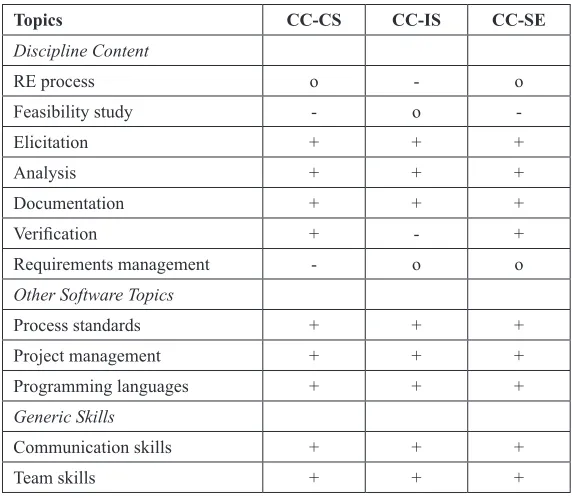
A comparison of the major model curricula un-dertaken as part of Minor’s (2004) study of re-quirements engineering (RE) practitioners shows that, in general terms, the base case of discipline
knowledge identified in practitioner studies is
covered in models used in universities. Table 1 provides a summary of this comparison. A look
at generic IT (as opposed to specific RE) suggests Minor’s conclusion can be extrapolated—most
However, nontechnical skills are usually addressed at a more abstract level and often in association with ethics, management, or social concerns. For example, while the Australian Computer Society’s core BOK for IT profes-sionals (Underwood, 1997) indicates coverage of group 1 is mandatory (group 1 material relates to interpersonal communications; ethics/social implications/professional practice; and project management and quality assurance), little assis-tance in addressing these within a programme of study is provided.
Some insight into the skills and knowledge required for software development activities is provided by the studies described next, albeit from many different perspectives. This closer look at practitioners reveals the depth of the mismatch between industry needs and formal education in software development in general.
Practitioner Perspective
Practitioners of Information Systems
Summarising his work of the previous 8 years on the knowledge requirements and professional development of young IS workers Lee (1999) found that:
• Significant gaps exist between what indus -try expects IS workers to know and what universities teach IS students.
• The knowledge and skills required change, so that that the ability to learn quickly on the job was critical to IS workers. A wide
range of nontechnical skills were identified
as important to IS professionals.
• IS workers need not have a technology-rel-evant degree.
• IS workers draw heavily from a “bi-polar”
knowledge structure—most current techni -Table 1. Minor: Curricula match to perceived industry needs
Topics CC-CS CC-IS CC-SE
Discipline Content
RE process o - o
Feasibility study - o
-Elicitation + + +
Analysis + + +
Documentation + + +
Verification + - +
Requirements management - o o
Other Software Topics
Process standards + + +
Project management + + +
Programming languages + + +
Generic Skills
Communication skills + + +
Team skills + + +
cal knowledge and localised team-centric project work, but are unable to exploit tacit organisational knowledge outside their
spe-cific project.
In a later work Lee suggests there is an under-lying socialisation requirement for a graduate to achieve working professional status. Lee found that one of the “reality shocks” involved in the socialisation of new graduates to work was the onus of teaching themselves what they needed to know in order to perform the task successfully.
He concluded:
... educators should also help students to develop their initiatives and abilities to deal with ill-struc-tured problems. This would require approaches which emphasize independent learning and col-laborative teamwork. (p.135)
Other studies of IS confirm a change in em -phasis to both generic attributes and managerial
knowledge—a long-term shift from programming
and other technical subjects to business analysis and people-oriented skills.
Practitioners of CS and Engineering
Fewer studies address the skills and knowledge needed in CS and SE. Lethbridge (2000) examined industry perception in a comprehensive study:
His aim was to gain a practitioner ranking of the
usefulness of specific topics compiled from the
curricula of (emerging) software and computer
engineering and CS programmes, the influence
of these on respondents’ career, and how much they had learned formally compared to what was required as a professional.
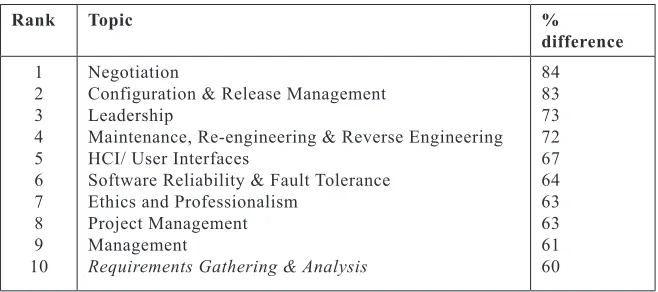
Although he found few surprises, an indica-tion of differing educaindica-tional focus is provided by pronounced bi-polar distribution in his data: Leadership and Negotiation ranked 3rd and 4th for industrial knowledge, while Technical Writing and Analysis & Design Methods rank as having the 5th and 6th most pronounced bi-polar distribution in education (Lethbridge, 1999).
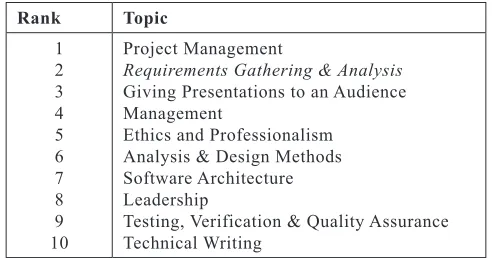
Of the long list of topics that managers con-sider more important than developers at large, the high ranking of both RE or analysis-related
topics and more generic skills is significant (see
Table 2). Unfortunately, many of these appear to have been learned on the job (see Table 3). At least in this case it can be seen that teaching does not
reflect the needs of the practice.
Lee (1986, 1992) also looked at the long-term professional development of young engineers as technologists, in studies reported in the late 1980s and early 1990s. What was found to have
significance was:
• Challenging work
Table 2. Lethbridge rankings: Most important for managers
Rank Topic
1 2 3 4 5 6 7 8 9 10
Project Management
Requirements Gathering & Analysis
Giving Presentations to an Audience Management
Ethics and Professionalism Analysis & Design Methods Software Architecture Leadership
• Approach to information seeking in order to keep up with the relevant changes in knowledge and information requirements • Success of the transition from an academic
environment and the formation of social ties with veteran colleagues
These results indicate that the effective prepa-ration of young technology workers involves far
more than just a fixed set of academic subjects.
The Australian Perspective
Other research looks at the situation in an Aus-tralian context. Snoke and Underwood’s (1999) study sampled a wide cross section of the IS academics in Australia, including representatives from all universities offering an undergraduate degree in IS or with a major in IS as of July 1998. It showed that personal and group attributes are consistently more highly valued than technical knowledge competencies.
The aim of the Turner and Lowry (1999) study
was to achieve a better fit between university
study and the professional practice of IS. Their survey found that employers lay heavy emphasis on personal attributes, though this may be because technical skills are generally addressed
compre-hensively within formal education. A follow-up survey to explore the “other skills” aspect of IS curriculum (Turner & Lowry, 2003) shows that, in general, respondents rate soft skills higher than “hard” academic skills.
Scott and Yates (2002) report on the experience with engineering graduates as one of the parallel series being undertaken in various professions across Australia and New Zealand. The study sought to identify:
• Capabilities that are seen to be most impor-tant for successful professional practice in
engineering during the first few years after
graduation
• Extent to which the universities at which the participating graduates had studied focused on these capabilities
Respondents noted that learning
profes-sion-specific content provides the “scaffold” for
the important task of career-long professional learning: The skills to undertake this are of great importance, with the ability to know when and when not to deploy technical expertise, and how to continuously update it, the keys to successful professional practice. The supervisors in the study acknowledged that a high level of technical exper-Table 3. Lethbridge rankings: Differencebetween formal learning and importance
Rank Topic %
difference 1
2 3 4 5 6 7 8 9 10
Negotiation
Configuration & Release Management Leadership
Maintenance, Re-engineering & Reverse Engineering HCI/ User Interfaces
Software Reliability & Fault Tolerance Ethics and Professionalism
Project Management Management
Requirements Gathering & Analysis
tise is necessary but not sufficient for successful practice, giving emphasis to the individual’s ability to diagnose what is really causing a problem and testing solutions in action.
In summary then, industry requires personable professionals who integrate into the organisational
structure, and, rather than cope specifically with
today’s perceived problems, have models, skills, and analytical techniques that allow them to learn, evaluate, and apply appropriate emerging technologies in a collaborative environment.
The implications of this include initiative, abil-ity to deal with complexabil-ity, and ill-structure and organisational (self, task and information) skills. The value of these softer, more personal attributes has been explored through several studies within our target disciplines.
exploring Affective Attributes
Bentley, Lowry, and Sandy (1999) suggest a de-velopmental process in which personal attributes,
which influence intellectual abilities and skills,
are applied to the acquisition of knowledge to enable the development of higher cognitive activi-ties. They note that at the end of the educational process, students must be able to apply knowledge to new situations and problems. This requires certain generic intellectual abilities and skills, which, although highly valued by employers, are sometimes given only “lip service” in tertiary education curricula. The personal attributes
iden-tified as important in the model proposed include
attributes like curiosity, risk taking, personal
discipline, and persistence. These can influence
in important ways the successful application of the intellectual skills and abilities to knowledge to support the higher orders of thinking.
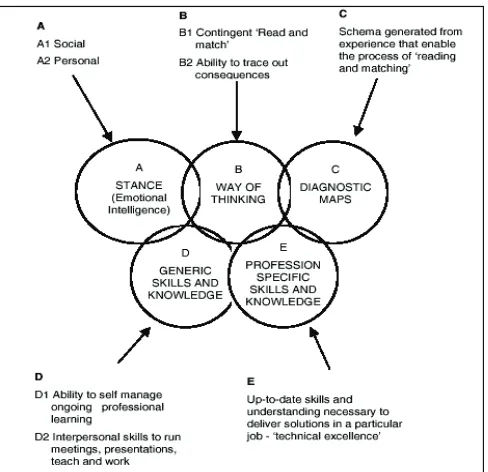
Scott and Wilson (2002) and Scott and Yates
(2002) confirm the value of these attributes. They discuss their findings in relation to a framework that identifies professional capability as five scales
consisting of:
• Emotional intelligence – Personal (EI-P)
• Emotional intelligence – Interpersonal
(EI-I)
• Intellectual capability (IC)
• Profession-specific skills and knowledge
(Prof)
• Generic skills and knowledge (Gen) • Educational quality (EQ) scale
In Scott and Wilson (2002) the Professional
Capability Framework is refined (see Figure 1):
Emotional Intelligence (personal and interperson-al (now sociinterperson-al)) becomes Stance and Intellectuinterperson-al Capability is now defined by two components, Way of Thinking (incorporating cognitive intelligence and creativity) and Diagnostic Maps (developed
through reflection on experience).
Respondents to their studies were asked to rate items from the capability scales on their importance for successful performance in their current professional work and then to rate the extent to which the university they attended focused on them. The results of these studies show that Emotional Intelligence ranks highest in importance, closely followed by Intellectual Capability, addressing generic issues such as ab-straction and contingency, while
profession-spe-cific knowledge ranks relatively low. The ability
to work in teams, particularly cross-disciplinary teams that are common in the IT workplace, is also considered vital.
Issues with traditional learning
A review of these studies indicates practitioners emphasise attributes additional to
profession-specific knowledge and skills. These latter are
generally addressed by the content of a BOK and applied within model curricula, as is initial competence (i.e., cognitive attributes Bloom, 1956), though whether at an appropriate level is a moot point.
Practitioner concerns have been addressed through interventions in the learning environment
and have taken several forms. In general, however, these have been attempted within the framework of traditional learning, and, according to practitio-ners, soft skills are still not emphasised enough. Lowry and Turner (2005) suggest that tradition and inertia act as some of the formidable barriers to substantive revisions to curricula in line with
the findings of practitioner-based studies.
Learning IT
Macauley and Mylopoulos (1995) acknowledge that a standard university lecture cannot achieve what industry requires. For them, activities
associ-ated with efficient software development “require a certain level of knowledge and maturity which can only be gained through experience in deal-ing with practical problems.” Others also note the inadequacy of formal education in training competent software professionals (Lethbridge, 2000; Robillard, 1999). Bach (1997) stated that one reason software engineering is not more seriously studied is the common industry belief that most of the books and classes that teach it are “impractical”: it does not address the inher-ent cognitive complexity (Robillard, 2005) of software development.
As exemplified by the model curricula, ap -proaches to learning IT tend to emphasise techni-cal knowledge. In general this education is based on traditional learning models and adheres to a normative professional education curriculum
(Waks, 2001). Students first study basic science,
then the relevant applied science, so that learn-ing may be viewed as a progression to expertise through task analysis, strategy selection, trial, and repetition (Winn & Snyder, 1996).
As Waks (2001) explains, in this normative model science provides “a rational foundation
placement, typically towards the completion of the
qualification, have been seen as a means of ad -dressing general practitioner concerns, providing opportunities for both authentic and experiential learning. Waks continues that the crisis of the professions arise because real-life problems do not present themselves neatly as cases to which
scientific generalisations apply.
This poor fit between the characteristics of
professional practice and those of the learning model produce an “incorrect” learning environ-ment, where the learner is not directed to the important features of the domain, where, as Bubenko (1995) notes:
• Complexity is added to rather than reduced with increased understanding of the initial problem
• Metacognitive strategies are fundamental to the process
• Poblem-solving needs a rich background of knowledge and intuition to operate ef-fectively
• A breadth of experience is necessary so that similarities and differences with past strate-gies are used to deal with new situations
Aligning learning with domain
characteristics
The nature of software development (complex, Nguyen & Swatman, 2000; cognitive, Robillard, 2005; opportunistic, Guindon, 1989; creative, Thomas et al., 2002; emergent, Budgen, 1995) implies a need to transcend traditional education
and focus on flexibility, productive thinking,
and creativity-enhancing activities. In this way, while students learn to use past experience on a general level, they are also able to deal with each new problem situation in its own terms. The implication of this is effort spent on higher (metacognitive) learning skills, including
abstrac-tion and reflecabstrac-tion.
Schön (1987) looked to an alternative episte-mology of practice when attacking the normative professional education curriculum discussed pre-viously. For him, practitioners apply tacit knowl-edge-in-action, and when their messy problems do
not yield to it, they “reflect-in-action,” and in the languages specific to their practices. This view
of professional practice as ill-structured design has implications:
• It is learnable but not didactically or discur-sively teachable: it can be learned only in and through practice.
• It is holistic: its parts cannot be learned in isolation. It must be learned as a whole because all components of a situation have meaning.
• It depends upon the ability to recognise desirable and undesirable qualities of the discovered world. But novice students do not possess this ability, and it cannot be conveyed to them by verbal descriptions, only in the operational context of the task.
For Schön (1987) the ideal site of education
for reflective practice is the design studio, under
the close supervision of a master practitioner serving as coach.
Others (Boud, 1985; Spiro, Feltovich, Jacob-son, & CoulJacob-son, 1991) also argue against tradi-tional learning:
• Learning based around constructivist prin-ciples is likely to be more suitable in domains involving ill-structured problems.
• Appropriate learning in ill-structured do-mains and/or dealing with ill-structured problems should itself be problem based. • Problem-based learning best provides an
Problem-based learning (PBL) is one example of learning environments that embrace these ideas. It integrates the learning of content and skills in a collaborative environment, and emphasises “learning to learn” by placing great responsibility for learning on the learner (Wilson & Cole, 1996). As an ideology, PBL is rooted in the experiential and action learning traditions advocated by Schön (1987) and others, but with a number of different
forms according to the nature of the field and goals
of the learning situation: for example, Schön’s design studios exemplify Savin-Baden’s (2000) PBL model for professional action. This focuses on know-how, which will allow students to gain competence to practice within given discipline frameworks and is seen to apply within curricula that have strong links with industry and are
in-fluenced by the community of practice.
Its supporters claim PBL results in increased motivation for learning, better integration of knowledge across disciplines, and greater com-mitment to continued professional learning (Boud,
1985). As well as offering the flexibility to cater to
a variety of learning styles, the emphasis moves from dealing with content and information in abstract ways to using information in ways that
reflect how practitioners might use it in real life
(Oliver & McLoughlin, 1999).
The purpose of the research described in the next sections was to apply and evaluate alternate learning models based on PBL in order to ascertain
their success in addressing the mismatch identified
between practitioner needs and formal tertiary education for software development.
reseArch desIgn
The contrasting philosophical and epistemological assumptions implicit in natural science and social science research approaches have been described and discussed at great length in a number of widely cited works (e.g., Bunge, 1984; Guba & Lincoln, 1994). The assumption, that cognition
and understanding is not a thing located within the individual thinker, but is a process that is distributed across the knower, the environment in which knowing occurs, and the activity in which the learner participates, is fundamental to how this research is conducted.
Research for Action
Action research is proposed as a means of meet-ing this need for contextual research for action. It combines theory and practice through an
it-erative process of change and reflection and has
been categorised into several types, based on the underlying assumptions and world views of the participants (Carr & Kemmis, 1986; Grundy, 1982).
Several models exist for undertaking action research in education, based on Lewin’s (1946) concept of a spiral that incorporates a cycle of
problem diagnosis, action intervention, and reflec -tive learning, all leading to continuous improve-ment of practice and an extension of personal and professional knowledge (Zuber-Skerritt, 1995). Action research places the teacher in the dual position of producer of education theory/policy and user of that theory through their practice. Within IT research, action research is celebrated as unique in the way it associates research and practice (Avison, Lau, Myers, & Nielsen, 1999). Although a survey of the literature shows that the IT academic community almost totally ig-nored action research (Avison et al., 1999 report only 29 articles on action research, spanning the years 1971 to 1995), by the end of the 1990s it began growing in popularity for use in scholarly investigations of IS, spurred by the relevance of research results.
A Framework for Action research in
It education
(1993). However, a model for the research design
is not sufficient: The context of the study suggests
that the action research be placed within a
con-ceptual framework that reflects the “culture” of
the organisation in which the study is conducted. The context of this study is an institution of (formal) tertiary education, therefore requiring an acknowledgement of theories of learning as fostering cognitive change through the construc-tion and organisaconstruc-tion of knowledge.
The learning that takes place is not confined
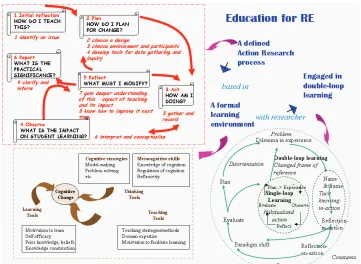
to the student participants in the research being undertaken. The value of action research is its ability to focus on the researcher’s learning as a fundamental component of the context under investigation. The framework for double-loop learning proposed by Hatten (1997) provides a basis for consideration of the researcher’s participation within each action research cycle. In
this model, single-loop learning is a characteristic of a stable context in which problem solving is patterned on proven solutions and previous experience (Argyris & Schön, 1974). Double-loop learning, in contrast, is seen as transformative: required by a context where change is inevitable but its direction unpredicted. In this environment
reflection becomes the basis for decision making
that relies on intuitive and tacit knowledge and critical analysis. Informed, directed, and
committed action (thus Praxis) requires reflective
activity in order to change the frames of reference by which action is taken.
The dominant characteristics of this study suggest that a conceptual framework for action research in IT education requires each of these components to be incorporated. The process is
a defined action research model, the context an
environment where the aim is learning (cognitive
0
change). The iterations explicit in the research design require double-loop learning on the part of the researcher at least, so that future action is
based on varied reflection. Figure 2 illustrates
this framework.
Data Acquisition and Evaluation
This research is undertaken with an acceptance of the view that not only is education a social discipline, but so is the (knowledge/discipline) domain into which the students expect to enter. The study adopts a mixed method approach as the most appropriate for the development of multiple interpretations, guided by the concept of
compli-mentarity, reflecting the intention to use the results
of one strand to elaborate, enhance, and illustrate the results from the other strand. The value of this nested concurrent approach (Creswell, 2003) is that it provides broader perspectives than by using the predominant method in isolation: Here the predominant approach is qualitative but contain-ing smaller quantitative data collection phases. And, since change is accepted as a fundamental goal of this research, an evaluation strategy that applies a qualitative approach to the collection and analysis of data is seen to have the potential to provide the information required.
Data Acquisition
Kember and Kelly (1993) divide observation tech-niques common to action research in education into three categories:
• Diagnostic: These devices include student assessment, learning inventories, interaction schedules, diagnosis of conception (e.g., mind maps).
• Records: Records include such items as diary/journal and supporting documents including syllabus, documents for course development and accreditation, student as-sessment planned
• Feedback: Formal and informal question-naires provide a mechanism for participants to address areas of interest to the researcher, while interviews allow for both general im-pressions to be uncovered and tight analysis to be undertaken.
These are applied in this study to provide mechanisms to validate the interpretations made through a process of triangulation (Denzin, 1970)
Data Evaluation
The action research strategy adopted utilises both formative and summative evaluation techniques but also allows for monitoring analysis to take a prominent position: The integration of data collec-tion/data analysis allows the research to be shaped and reshaped by the participants in the research,
based on the themes identified through examina -tion of the data. This thematic analysis aims to identify important elements, with the categories induced from the data itself. According to Orona (1990), the value is in the approach’s acceptance (though not reliance) on intuition and creativity, nuances and detail.
PresentAtIon oF reseArch
results/exPerIence
Since 1995, Murdoch University Engineering (MUE) has provided a suite of programmes in SE. The teaching objectives have focused on produc-ing graduates with a special skill in software: We
expect our graduates to find career opportunities
in both professional engineering industries that have a strong interest in software as well as in IT disciplines where the design and implementation of quality software is considered a priority.
education could be best addressed through less traditional approaches to learning, with a focus on advanced knowledge acquisition (Spiro et al., 1991). An education framework for software de-velopment should exploit the learning models that provide an appropriate environment for practice. It should: be based on constructivist theory with a focus on strategic knowledge; be placed within a situated experiential environment where authentic context is exploited; and provide learners with exposure to activities that allow students to act opportunistically and creatively.
Pursuing these objectives has meant a gradual shift from more traditional learning, resulting in the development of a studio learning model. Based on a PBL approach, integrating Schön’s (1987) ideas on design studios with creativity-enhanc-ing activities, this learncreativity-enhanc-ing model has been seen to provide students with a solid foundation in subject matter, while at the same time exposing them to real-world characteristics. Within the con-straints of professionally accredited curriculum, studio learning addresses the issues previously described:
• An increasing focus on scientific generali -sation as the education of choice for soft-ware
• Potential for misalignment with industry needs
• An acknowledged need for life-long learn-ing
The curriculum for the Bachelor of Engineer-ing, Software Engineering BE(SE) at Murdoch University originally integrated units1 in three primary components:
• Computer science: These cover fundamen-tal aspects and form the basis of technical knowledge and skills in software and hard-ware
• Software engineering: These focus on SE theory and practice and form the basis
of core knowledge and skill in software development and evolution
• Engineering: These offer knowledge and skills in engineering practice and principles and are common to all our engineering students. They include natural sciences, mathematics, management, and ethics, which provides the basis for:
• Engineering internship/thesis: This is also common to all engineering students, though the domain of applica-tion targets the appropriate discipline of study. The internship is wholly in-dustry-based in that the student is an “employee” of the organisation. The thesis may also be linked to workplace experiences, but the student is not employed during the duration of the project.
As can be appreciated from this brief descrip-tion, the learning environment adheres very closely to the traditional model described by Waks (2001).
The reduced opportunity for group-based projects due to the introduction of the semester-long internship/thesis was one trigger for the restructure of some of the core SE units. Other triggers included a need to provide students with a taste of the types of “messy” problems they would encounter during their internship. Exposure to the uncertainties, inconsistencies, and idiosyncrasies associated with real problems would enhance graduates’ potential to deal in their own turn with ill-structured problems within an organisational context.
cycle 1: engaging with Authentic
Practice
In this cycle, the focus is split between two
units—a final semester final year (Sem 2, Year
this environment of the prerequisite unit (G260), which treats students as apprentices.
Students as Novice Professionals
(G)
A design studio model was applied, anchored by a PBL process based on Koschman, Myers, Bar-rows, and Feltovich (1994) and in the context of the phased development of a software product. As described elsewhere (Armarego, 2002), student evaluation undertaken in weeks 4, 7, 11, and 13 highlighted student concerns:
• The need to learn new content as well as adapt previous knowledge
• Dependence on other members of the team (10+ students) both for achieving the tasks and for critical assessment components through peer and self assessment
• Lack of stability in teams and task (students were rotated into and out of teams, roles, and problem component) requiring a need to “come up to speed” very quickly at each change
However, benefits were identified:
James we learn so much “practical” stuff from this project, it would be good to get an-other chance to actually do it right
Chad learnt a lot about design skills and approaches for problems
Sam interesting group experience
Brad you need more practical application of the theory you teach ([this unit’s] style)
The restructured unit was seen to provide students with a number of opportunities (Ar-marego, 2002):
• To identify, analyse, and solve a number of issues, repetitively. This acts as preparation for professional employment.
• To practise the art as well as science of SE in a controlled setting.
• To test the understanding of theory, its connection with application, and develop theoretical insight.
• To deal with incompleteness and ambigu-ity.
• To think independently and work coop-eratively, fostering insight into individual strengths and weaknesses.
However, an unexpected problem was en-countered early in the semester. While students were accepting of the idea of directing their own learning in a capstone project and thesis environment, they felt (very strongly, at times) that within a formal unit they should be taught: They were comfortable with the concept of a “master” there to oversee their every action. This perception could be traced back to a reasonably high level of teacher direction in prerequisite
SE units, confirmed through analysis of teach -ing style and a review of the introductory unit (G260) based on Reeves (1997). The instrument developed by Reeves provides 14 dimensions for the evaluation of technology-assisted learning. This review indicated a transitional approach to teaching, which did not challenge students’ expectations of traditional learning. The initial student resistance to the environment provided in
the final unit showed that these expectations were
still evident 2 years later in their studies.
Students as Apprentices (G0)
The learning environment for the introductory SE unit (on RE) at this time was based on a cogni-tive apprenticeship model (Collins et al., 1989). In cognitive apprenticeship settings, the teacher models effective practices within professionally relevant contexts: the students are presented with tasks they would undertake as practicing
profes-sionals, requiring proficiency with notations and
which these must be applied. This requires an understanding of the underlying conceptual frameworks used in the domain. Because these skills are all new to students, the teacher closely coaches them, to apply a process for modelling each task as they reason about the issues being raised. Whenever the students reach an impasse and are unable to continue or complete the task independently or with assistance from group peers, the teacher can “take over” by once again modelling the appropriate approach, often in a protocol analysis environment, for all students. Gradually, students are required to complete
tasks more independently, with the final class
assessment item requiring the development of a complete model of a problem, with critique and
justification of the approach taken, with minimal
support from the teacher.
The curriculum for this unit was addressed as
a two-cycle spiral: The first part of the semester
(8-9 weeks) focused on learning the use of the tools, gaining an understanding of the conceptual framework (in this case object-orientation prin-ciples), and an appreciation for the context in which professionals practice (e.g., historical overview;
issues in RE theory and practice; organisational involvement; group dynamics). The second part of the semester focused on issues of group work
and knowledge transfer—students are involved
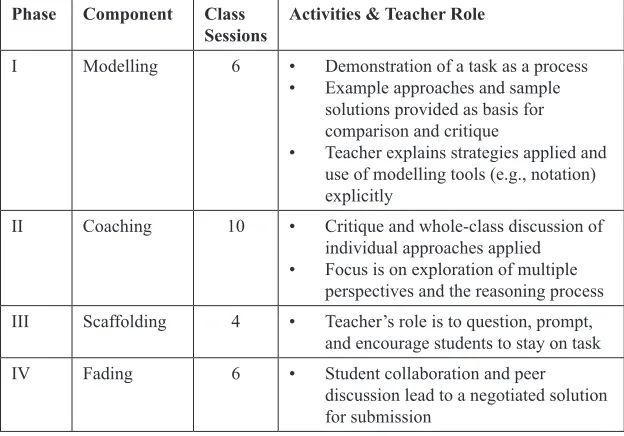
in a group project that requires them to apply the tools to model a complex problem. In broad terms, the phases (see Table 4) of the cognitive apprenticeship model are traversed throughout
the semester, though without a clean break—the
focus of the class sessions changes, but the ability to revisit any phase as required exists.
Evaluation of the model was based on ele-ments of assessment (which included mind maps to provide some information on conceptual un-derstanding, portfolios that provided information on student’s willingness to explore outside the boundaries provided within the unit, and hence transcend the unit material) and student feedback, both formal university-wide and school-based, open-question surveys.
Evaluation of the cognitive apprenticeship model in relation to practitioner characteristics indicated that although this model addressed
some components of industry needs, the fit be -tween characteristics of action in the discipline
Table 4. Phases of cognitive apprenticeship model as implemented
Phase Component Class
Sessions Activities & Teacher Role
I Modelling 6 • Demonstration of a task as a process • Example approaches and sample
solutions provided as basis for comparison and critique
• Teacher explains strategies applied and use of modelling tools (e.g., notation) explicitly
II Coaching 10 • Critique and whole-class discussion of individual approaches applied • Focus is on exploration of multiple
perspectives and the reasoning process III Scaffolding 4 • Teacher’s role is to question, prompt,
and encourage students to stay on task IV Fading 6 • Student collaboration and peer
and those of the learning model exhibited ele-ments of an “incorrect” learning environment. The environment exhibited some of the traits of
surface learning—students focused on learning
the tools and techniques of RE at the expense of a more expansive view of the discipline: They did not see themselves as acquiring the more generic skills valued by practitioners, with the majority of students focused on passing the unit. When the teacher “faded” early in the subsequent unit (G477), students were loathed to take ownership
of their learning—they insisted they had a “right
to be taught.”
The outcome of this initial phase was to
con-firm the need to build into the curriculum a focus
on generic skills as part of the outcomes of the unit, with the intentions of improving students’ learning ability, developing employability skills, and preparing for lifelong learning. To maximise effectiveness, these needed to be embedded into the knowledge base constructed by the student during the unit. This has the advantage of en-abling students to develop the requisite skills situated within the learning context but, of course, potentially required extensive adaptation of the existing material.
The conclusion reached was that the master/ apprentice relation needed to be down played so that students took early control of their own learning.
cycle 2: creative software
development
Reflection on the learning experience highlighted
a need to emphasise student-centred learning
earlier—the final year was too late. This led to
a review of prerequisite units, with a view to making pedagogical changes early in the SE cur-riculum. Opportunities to focus in greater depth on issues raised in the discussion of education
for software development were also identified.
One additional issue could also be tackled: IT education has historically been plagued by a lack
of integration—the methods, techniques, tools,
and so forth acquired within a few isolated units do not permeate the students’ approach to other software-related tasks within their programme of study. An attempt could now be made to present a more holistic approach within the SE curriculum.
This second cycle focused on the first SE
unit encountered (G260), at that time still early (Sem 1, Year 2) in the 4-year programme. The
core component—RE—provided an appropriate
environment for attacking student expectations of a learning environment.
Education for REs based on traditional learning models tends to emphasise technical knowledge and is based largely on notations and prescribed processes (Nguyen & Swatman, 2000). Although Budgen (2003) suggests this is a requirement of the software domain, it is at odds with the inherent characteristics associated with real RE problems, which imply a need to:
• incorporate creativity-enhancing activities within the curriculum,
• foster adaptability in students by providing for divergent as well as convergent thinking, and
• focus on metacognitive strategies and reflec -tion as an aid to transfer of the skills and knowledge learned.
The implication of this is the explicit develop-ment of metacognitive strategies and the ability
to reflect in as well as on action. The value of
metacognition is confirmed in the recurring find -ings from Scott’s work on applying a professional capability framework (previously discussed).A
focus on flexibility and productive thinking is
the procedural steps for problem solving but understands when to deploy them and why they work, in effect is wise in the use of them.
Glass (1995) suggests that discipline and cre-ativity are the “odd couple” of software
develop-ment—the discipline imposed by methodology,
for example, forms a frame for the opportunistic creativity of design. The educational dilemma becomes one of providing an educational base that enables software developers to both create and engineer the systems they build: to be adaptable to the changing environment that is inevitable in their chosen discipline. Cropley and Cropley (1998), however, suggest that the process of creativity and innovation is poorly understood in engineer-ing and not adequately fostered in undergraduate
teaching. This deficiency results in an engineering
culture that is frequently resistant to the factors that promote creativity and innovation.
The Place of Creativity
Albert (1996) notes that schooling at the age of starting formal education emphasises logical
rather than divergent thinking, with the value of
conventional behaviour, well-defined problems
and good grades emphasised. In addition, many cultures (here we may say discipline-based as well as social) encourage respect for the past and discourage disruptive innovations. Promoting widespread creativity raises expectations that may change employment patterns, educational systems, and community norms.
Amabile’s (1996) general theory of creativity suggests three components:
• Domain relevant skills: The more skills the better, and the ability to imagine/play out situations
• Creativity-relevant processes: Including breaking perceptual (the way you perceive a situation) and cognitive (the way you anal-yse) set and breaking out of performance “scripts,” suspending judgement, knowledge of heuristics, adopting a creativity induced work style (e.g., tolerance for ambiguity, high degree of autonomy, independence of judgement)
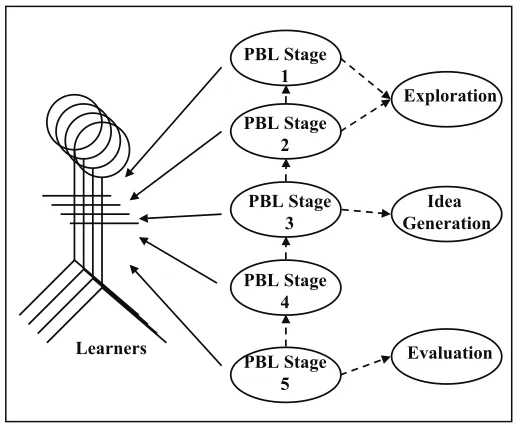
Figure 3. The CreativePBL model
Learners
PBL Stage 1
PBL Stage 2
PBL Stage 3
PBL Stage 4
PBL Stage 5
Exploration
Idea Generation
• Intrinsic task motivation, which are neces-sary for the enhancement of creative poten-tial
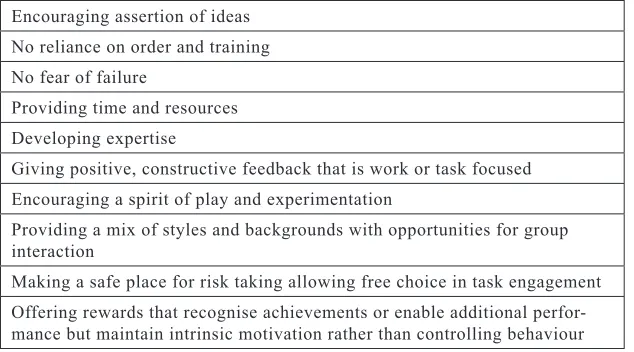
The PBL process applied in the design studio model in G477 provided an environment that could be adapted/enhanced for the development of creative potential. Table 5 lists some of these, based on Amabile’s (1996) work.
A CreativePBL model (Figure 3) was devel-oped to address the characteristics of software
development (specifically RE in G260) as a
domain and to provide a learning environment that enhances the opportunity for creative and divergent thinking. The prime motivation, there-fore, in changing the learning environment was
to address the issues identified previously as an “ill-fit” as early as feasible within the student’s
programme of study and to challenge the false expectations students had of learning through less traditional approaches.
The congruence between Edmonds and Candy’s (2002) elements of creativity (see Table 6) and the PBL stages of Koschmann et al. (1994) enabled creative activities to be embedded into the PBL process. In addition, other properties of
PBL were seen as relevant to the specific domain
(RE) tackled in the introductory SE unit:
• Its problem solving requires the mental
rep-resentation of problematic situations—the
problem space (Newell & Simon, 1972) must be constructed, either individually or (of more relevance in RE) socially through negotiation.
• Active manipulation of the problem space is required for PBL problem solving and involves information gathering, model build-ing, hypothesis generation, speculation, and solution testing, among others. This engages conscious activity, and in successful problem solvers, leads to more systematic manipula-tion of the problem space.
Within the CreativePBL framework the focus
is firmly on examining the problem at length
rather than quickly solving it.There is evidence that students who have been taught to explore
different ways to define problems engage in
more creative problem solving over the longer
term (Baer, 1988), addressing flexibility and
adaptability issues raised by practitioners. The Table 5. Positive influences for enhancing creative potential
Encouraging assertion of ideas No reliance on order and training No fear of failure
Providing time and resources Developing expertise
Giving positive, constructive feedback that is work or task focused Encouraging a spirit of play and experimentation
Providing a mix of styles and backgrounds with opportunities for group interaction
Table 6. Creativity activities (Edmonds & Candy, 2002)
Exploration of ideas, knowledge, and options is based on
• breaking with conventional expectations, whether visual, structural, or conceptual is a key characteristic of creative thought
• immersion—the complexity of the creative process is served well by
total immersion in the activity
• holistic view—the full scope of a design problem is only fully embraced
by taking a holistic or systems view. The designer needs to be able to
take an overview position at any point and, in particular, to find multiple
viewpoints of the data or emerging design important
• parallel channels—keeping a number of different approaches and
viewpoints active at the same time is a necessary part of generating new ideas.
Exploration involves accessing source data that may be examined, assessed, and interpreted in terms of the goals. This is an open process, possibly without observable directions, but the thoroughness and selectivity of the activity is critical. Having a comprehensive set of knowledge sources readily available is extremely advantageous. Knowing where to look and how to select the knowledge is even more important.
Idea generation—problem formulation, as distinct from problem solving, is critical to the effectiveness of the solution space that is defined. It draws upon a
wide range of analogous cases often outside the immediate domain. This has been characterised as an ability to make remote associations. Creativity is demonstrated by the generation of many potential solutions instead of gravitating quickly toward a single and (usually) familiar solution that is not necessarily the optimal one. The ability to consider parallel lines of thought and to select and transform the results to meet the demands of a different situation is a critically important aspect of solution generation.
Evaluation involves taking the results of the generative activity and testing the candidate solutions against a set of constraints. This leads to modifying, reformulating, or discarding solutions depending on the feedback. Selection of the optimal solution may involve a number of trade-offs against the constraints that are applied especially where, as is usually the case, the product is a complex one. The application of tight constraints may be considered conducive to creative solution
finding and thus evaluation is a vital part of the creative process. Evaluation may
be viewed as a pervasive activity that takes place from the exploration phase
onward. The use of expert knowledge in evaluation has been identified as an important aspect of successful solution finding.
model was developed to focus on creativity and divergent thinking, so that, instead of students
aimed at finding the single, best, “correct” an -swer to a standard problem in the shortest time
(convergent thinking), they aimed at redefining or
discovering problems and solving them by means of branching out, making unexpected associations, applying the known in unusual ways, or seeing unexpected implications.
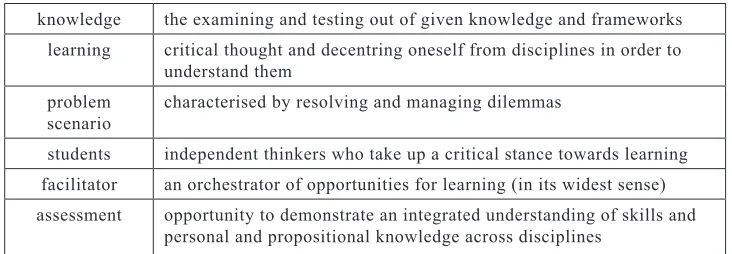
Within the context of education for software development, Savin-Badin’s (2000) model IV may provide an appropriate framework for learning. As Table 7 summarises, in this model students are encouraged to develop an autonomous position as individuals within the group, and as a group, and implies an evaluation of one’s own stance and openness towards the stance of others. Stu-dents take a critical position towards knowledge, themselves, and their peers and elect to use the group to resolve dilemmas. A learning environ-ment based on this model enables students to deal with problems within a metacognitive-rich framework that makes complexity apparent and lets students deal with it explicitly. The challenge for the teacher is to focus on quality of product and provide feedback to the group, as well as facilitate the process.
Although generally considered beyond
under-graduate learning, this model appears to reflect
more closely the skills required to undertake software development and therefore provides both a challenge and a goal in the context of undergraduate education for IT.
While much has been written regarding the value of PBL in learning, (e.g., Boud, 1985; Wil-son & Cole, 1996), undertaking such a project comes at a cost:
• Content: Guidelines for implementing PBL indicate that success is partly based on a reduction to the content covered: assum-ing too much content is a pitfall in a PBL environment (Albanese & Mitchell, 1993). • Time to develop project: Bridges (1992)
suggests that each PBL project requires
120 to 160 hours to construct, field-test, and revise. To this figure should be added techni -cal effort when the problem is developed in an online environment.
• Cost: PBL is economical for classes of less than 40 students (Albanese & Mitchell, 1993). It is considered not to scale well to large student numbers without a greater
increase in staffing resources.
• More time to teach less content: Albanese and Mitchell (1993) also suggest 22% more time is required to teach in PBL mode, despite the reduction in content usually ad-vocated. In their study, when academic staff consider the hours per week in preparation to teach problems in comparison to presenting lectures, instead of 8.6 hours/week primarily preparing lectures, staff spend 20.6 hours/ week primarily in groups with students. • Diffculty in transitioning, both for staff
and students: Bridges (1992) suggests aca-demic staff are uncomfortable withholding Table 7. Savin-Badin – Model IV: PBL for transdisciplinary learning
knowledge the examining and testing out of given knowledge and frameworks learning critical thought and decentring oneself from disciplines in order to
understand them problem
scenario characterised by resolving and managing dilemmas
students independent thinkers who take up a critical stance towards learning facilitator an orchestrator of opportunities for learning (in its widest sense) assessment opportunity to demonstrate an integrated understanding of skills and
information as they watch students struggle with problems and need training to develop facilitator skills or they may be unsuccess-ful in PBL. Students may be uncomfortable with the extensive collaboration required or with the lack of teacher direction given.
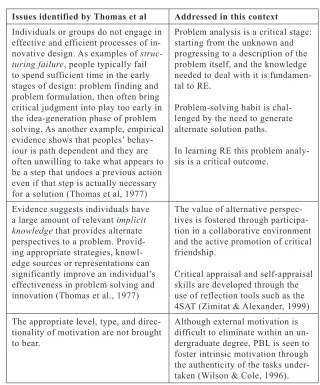
However, despite these costs, the Creative-PBL approach also had the value of addressing
issues identified by Thomas et al. (2002): They
suggest there is a widening gap between the
de-gree of flexibility and creativity needed to adapt
to a changing world and the capacity to do so. Table 8 summarises these issues and indicates the approach taken to address them within the framework developed.
Evaluation of this model indicated that student conceptions of the characteristics of the learning environments were related to their study orienta-tions and strategies. Meaning-oriented students Table 8. Thomas: Issues in flexibility and creativity
Issues identified by Thomas et al Addressed in this context Individuals or groups do not engage in
effective and efficient processes of in-novative design. As examples of struc-turing failure, people typically fail to spend sufficient time in the early stages of design: problem finding and problem formulation, then often bring critical judgment into play too early in the idea-generation phase of problem solving. As another example, empirical evidence shows that peoples’ behav-iour is path dependent and they are often unwilling to take what appears to be a step that undoes a previous action even if that step is actually necessary for a solution (Thomas et al, 1977)
Problem analysis is a critical stage: starting from the unknown and progressing to a description of the problem itself, and the knowledge needed to deal with it is fundamen-tal to RE.
Problem-solving habit is chal-lenged by the need to generate alternate solution paths.
In learning RE this problem analy-sis is a critical outcome.
Evidence suggests individuals have a large amount of relevant implicit knowledge that provides alternate perspectives to a problem. Provid-ing appropriate strategies, knowl-edge sources or representations can significantly improve an individual’s effectiveness in problem solving and innovation (Thomas et al., 1977)
The value of alternative perspec-tives is fostered through participa-tion in a collaborative environment and the active promotion of critical friendship.
Critical appraisal and self-appraisal skills are developed through the use of reflection tools such as the 4SAT (Zimitat & Alexander, 1999) The appropriate level, type, and
direc-tionality of motivation are not brought to bear.
0
were likely to see their learning environment with positive terms such as having good atmosphere and demanding deep learning, while reproduction orientation was associated with the view that the learning environment demands surface learning and requires students to be overworked.
These findings give support to the contextual
view of student learning: Study approaches or orientations are formed in the interaction between individuals and their environment. Figure 4 sum-marises student perception of their learning in
this environment and confirms results from other
evaluation instruments.
Although a great deal of effort went into developing the CreativePBL environment, stu-dents needed greater preparation in order to tackle a different learning model (e.g., a better understanding of the PBL process) and support structures (examples, guidelines), so that they have a clear indication of the appropriateness of their learning.
Therefore, while the CreativePBL model pro-vided some insights to student learning, ultimately it is a process-oriented approach, implying process is of greater importance than the product (Dahl-gren, 2000), and that problem solving is a smooth
process of sequential stages. To some extent, this was an inhibitor to student engagement with the
learning environment—so much effort was ex -pended in applying and monitoring the process rigidly (a novice characteristic) that students did not transcend characteristics of surface learning, nor, in particular, allow opportunism and heuristic insight the importance it was warranted.
The aim of the next cycle was to improve the proportion of students using aspects of deep learning approaches and to downplay the process of learning (to some extent), while still focusing on reflection on learning in order to balance the importance of both process and product on pro-fessional practice.
cycle 3: Agents of change
Studies of the design process indicate the im-portance of opportunistic approaches (Carroll & Swatman, 1999; Guindon, 1990; Khushalani & Smith, 1994), based on the catastrophe cycle illustrated in Figure 5 (Nguyen & Swatman, 2000) rather than a smoothly evolutionary prob-lem-solving model. The catastrophe cycle can be compared to classical Wallas’ (1926) model
Figure 4. Learning in a CreativePBL environment
learning this way (n = 23)
48%
9% 43%
of creative problem solving. He identified four
stages of invention: (1) preparation, (2) incubation,
(3) illumination (insight), and (4) the verification
and expression of insight.
Schön (1987) notes that in the ordinary form of practical knowledge practitioners do not think about what they are doing, except when puzzled or surprised. Schön named this reflecting-in-action and argued that it is central to the ability to act effectively in the unique, ambiguous, or divergent situations that become central to professional practice. Conceptually, this means being able to think outside the existing boxes altogether in order to invent new ones (Table 7 provides one framework that applies these concepts), which are critical in “messy” disciplines.
This relates to a further issue that needs to be addressed: the need to engage in life-long learn-ing. The speed with which technology evolves, the multiplicity of its impact on society, and the
ramifications of that impact mean that meta -cognitive and knowledge construction skills as well as adaptability become vital. Professional practitioners with such skills become agents of change (Garlan et al., 1997).
Bowden and Marton (1998) explore several
significant ways of engaging with the question
of preparing others for situations that are highly
variable and novel and that do not neatly match up
with the (artificial) boundaries between discipline
or knowledge areas. The CreativePBL environ-ment students experienced has gone some way to addressing these:
• Shifting the focus from teaching to learn-ing. The environment is student-centred and minimises “teaching.”
• Concentrating on developing (generic) capa-bilities and on student learning outcomes. It may be considered a creative environment that enhances divergent thinking and the creative potential of students.
• Moving from highly differentiated and fragmented curricula to integrated learning programmes. The approach is somewhat holistic.
Therefore, while the progressive development of design studios and CreativePBL models have had some measure of success, the learning diag-nostics (e.g., Approaches to Study, Entwistle & Ramsden, 1983) results indicated at least as strong a bias to surface learning as there is to deep learn-ing. The literature suggests this is an outcome of the (different) learning environments students are exposed to in (different) units. Ultimately, innova-Complexity
of RE model