Content developed from
State of the Apes:
Infrastructure Development and Ape Conservation
by Alona Rivord
State of the Apes
Infrastructure Development and
Ape Conservation
State of the Apes
Infrastructure Development and
Ape Conservation
Introduction
T
he State of the Apes series, commissioned by the Arcus Foundation, aims to raise awareness about the impacts of human activities on all non-human ape species. The series addresses the conservation of African and Asian apes, including the great apes, which are com-prised of gorillas, chimpanzees, bonobos and orangutans, as well as the small apes, or gibbons. The series also considers the status and welfare of captive apes in sanctuaries, zoos and research facilities around the world. The third biennial volume examines the impacts of fixed and linear infrastruc-ture development in ape habitats during the construction, use and decommissioning phases, with a particular focus on roads and dams. Previous volumes of State of the Apes dealt with the impacts of extractive industries on apes, including oil and gas exploitation, mining and logging (Volume 1), and the impacts of industrial agriculture on apes (Volume 2). Each volume contains a thematic section of chapters that discuss topical issues and present illustrative case studies from var-ious ape range countries. Each volume then continues with a second section on the status and welfare of ape populations in their natural habitats and in captivity. This policy briefing summarizes both sections of the recent volume, presents key findings and makes best practice recommendations for local, national and global-level stakeholders.As large, forest-dwelling mammals, apes can serve as indi-cator species for the broader health of the ecosystems they inhabit. The tropical forests that harbor apes are also critically important sources of food, water, medicine and shelter for indigenous people and other local communities. Furthermore, these forests maintain rich biodiversity and deliver ecosystem services, such as carbon sequestration, which are essential for the well-being of all humanity. This document is intended to help stakeholders who have influence over activities that impact apes to achieve the best possible balance between socioeconomic development and ape conservation.
Infrastructure Development
Global Drivers
A
s the planet’s population expands and human con-sumption levels increase, global demand for food, water, energy and other commodities is growing rap-idly. To meet these demands, people and industries are expanding farther and farther into locations that were once remote. Companies are intensifying their prospecting in pre-viously unexplored areas, many of which are protected or have high conservation value (McNeely, 2005). While new infrastructure is essential to achieve economic development, it is too often built without regard for the negative impacts that it can have on the environment and the people who rely on natural capital for their livelihoods and well-being.It is estimated that to meet the ambitions of the UN Sustain-able Development Goals and the Paris Agreement, US$90 trillion in infrastructure investments will be needed (Global
Com mission, 2016). For example, China’s ambitious Belt and Road Initiative, which will span 64 countries, is estimated to require more than US$8 trillion in investments (Ascensão
et al., 2018). New infrastructure is intended to support urban development, power generation and transportation in order to reduce poverty, provide access to energy, deliver safe drink-ing water and facilitate the movement of goods to markets.
Unfortunately, the development plans of many states rely dis-proportionately on exporting commodities, including fossil fuels, minerals, timber and agricultural products, such as palm oil, to emerging markets abroad. Under such a scenario, linear transportation and energy infrastructure is networked to fixed large-scale industrial projects, including plantations, dams and mines (Edwards et al., 2014). To transport commodities to mills, ports, processing plants, refineries and smelters, it is necessary to build roads, railways and waterways, but these may not facilitate sustainable and equitable economic devel-opment opportunities for the broader population.
Financing for infrastructure projects comes from multilateral development banks, emerging-market development banks, bilateral aid agencies, the governments of developing coun-tries, as well as private companies. Between these lenders, the robustness of social and environmental safeguard schemes varies greatly. Such safeguards experienced an initial period of strengthening beginning in 1980s following adoption by the World Bank (Currey, 2013). Some have asserted, however, that lenders have since weakened the social and environmental standards attached to financing in response to the entrance of China on the global stage during the 2000s (Kahler et al., 2016).
China’s overseas investments are growing rapidly, and the country’s financing is said to come with few social and envi-ronmental constraints attached (Edwards et al., 2014). In 2014, China’s outward direct investment was valued at more than US$123 billion, according to an International Institute for Sustainable Development analysis (IISD, 2016). The institute notes, however, that criticism of China’s approach to natural resource investments may be an unfair double standard. For example, the country has recently issued voluntary environ-mental guidelines that apply to operations abroad.
Lenders concerned about their ability to remain competitive must be aware of the financial, operational and reputational risks associated with being involved in projects that do not have sufficient safeguards. Such projects are often plagued by poor implementation, conflicts between stakeholders, cor-ruption, insufficient planning, lack of capacity or technical expertise and the exclusion of civil society. These factors can result in significant delays, increased or unplanned costs and negative publicity.
Infrastructure Expansion Trends in Ape
Range States
their forest habitats. All large-scale infrastructure develop-ment, including for agricultural operations, energy production, extractive industries and other purposes, have severe dele-terious impacts on ape habitats and populations. Linear infrastructure built to support these activities, such as roads, railways, pipelines and power transmission lines, also impact apes both directly and indirectly.
Many natural resources are located in remote regions with high conservation values, including critical habitats for apes. By 2030, it is estimated that industrial activities will disturb about 99% of Asian ape ranges, and more than 90% of African ape ranges (Junker et al., 2012; Nellemann and Newton, 2002). Alarmingly, the protected status of ape habitats is not sufficient to shield them from harm. A disturbing trend of protected area downgrading, downsizing and degazettement has been witnessed recently, particularly in Africa. Between 1993 and 2013, for example, at least 23 African protected areas were downsized or downgraded (Edwards et al., 2014). Further, fossil fuel exploitation has affected 30 UNESCO World Heritage Sites across 18 African countries (WWF, 2015).
Linear infrastructure
By 2050, 25 million km of new paved roads will be built, according to an estimate by the International Energy Agency (Dulac, 2013). Development agencies and governments are expected to invest US$33 trillion for road building globally. Almost 90% of the new road infrastructure is anticipated to occur in developing nations, including in areas that deliver vital ecosystem services and harbor exceptional biodiversity (Dulac, 2013; Global Road Map, n.d.). For example, Indonesia has planned a six-corridor scheme across the country’s islands. Similarly, Malaysia intends to build a pan-Borneo highway, which will cut through the forests of Malaysian Borneo.
In sub-Saharan Africa, a network of 35 “development corri-dors” are planned in order to connect cities, ports, airports, mines and hydropower plants. In total, 53,000 km of roads, railways and power transmission lines are envisioned (Laurance et al., 2015b; Weng et al., 2013). It is anticipated that 23 of the corridors will bisect protected areas with 3,600 km of linear infrastructure, and that one-third of Africa’s total
protected areas could be negatively impacted (Sloan, Bertzky and Laurance, 2017). Some of the 400 areas at risk include those with international treaty protections, including Ramsar Wetlands of International Importance, UNESCO World Heri-tage Sites and UNESCO Man and the Biosphere Reserves. Ape habitats that could be impacted include Uganda’s Bwindi Impenetrable National Park and Kahuzi-Biega National Park in the Democratic Republic of Congo (DRC), which are both World Heritage Sites, as well as Nigeria’s Cross River National Park.
Together with industrial agriculture, linear infrastructure pro-jects, including roads, are the leading cause of ape habitat loss and fragmentation. Often built to support larger fixed infrastructure projects, roads pose an enormous threat to biodiversity and ecosystems (Laurance et al., 2015a). For example, since 2000, more than 50,000 km of logging and other roads have been constructed across the Congo Basin. The roads have enabled people to enter into previously remote areas to cultivate crops, collect forest products, hunt and capture wildlife (Kleinschroth et al., 2015; Laporte et al., 2007). The World Bank forecasts that expanding roads and transportation infrastructure will be the biggest driver of deforestation in the Congo Basin through 2030 (Hourticq and Megevand, 2013).
Hydroelectric dams
Between 2014 and 2040, global capacity to generate hydro-power is expected to increase by 53%–77% (IEA, 2016, p. 249). Each year, hydropower attracts about US$50 billion in global investment (Frankfurt School-UNEP Centre/BNEF, 2017). Hydropower dams are considered desirable as reliable renew-able energy sources, and because they can help control flood-ing and provide water for agricultural irrigation. It is worryflood-ing, though, that areas with the planet’s greatest freshwater bio-diversity are slated for 70% of global hydropower expansion (Opperman, Grill and Hartmann, 2015). These areas are also home to wildlife and people, which rely on healthy ecosystems for their livelihoods and well-being. In ape ranges, hundreds of hydropower dams are being planned that will also require power transmission lines and road infrastructure. Six dams have already been installed in African great ape habitats, and another 64 are anticipated, along with 200 km of roads. In gibbon habitats across Asia, 55 dams are in operation, while 165 more are planned, along with 1,100 km of roads (IUCN 2016; Lehner et al., 2011; Zarfl et al., 2015).
According to an International Institute for Environment and Development review, international social standards and environmental safeguards only apply to about 10%–15% of new hydropower projects around the world (Skinner and Haas, 2014). This is concerning given that an estimated 40-80 million people have been displaced by dams, and because dams have impacts on fish migration and environmental flows (WCD, 2000). Furthermore, dam reservoirs flood agricultural land and forest resources, and release carbon into the atmos-phere from decaying matter. Additional carbon emissions are generated by the creation and transportation of dam construction materials, such as concrete. The infrastructure
associated with hydropower projects causes further deforesta-tion and facilitates the movement of people into previously remote areas. Increased human access to forests enables crop cultivation, hunting and other dangers to wildlife, which are discussed in detail below.
Some experts advocate that developing nations would be better served by “leapfrogging” large-scale expensive grid-based energy (IRENA, 2015). They argue that decentralized renewables, such as solar and micro-hydro structures, better provide access to energy for rural communities. Small-scale renewables have negligible environmental impacts, and sup-ply a more stable source of energy to rural people. Meanwhile, for investors, dams pose serious operational, financial and reputational risks. Large hydropower projects are often delayed, canceled or become more costly than anticipated. They can also infringe on the rights of indigenous peoples and cause irreparable environmental damage. (Kitzes and Shirley, 2016; Shirley and Kammen, 2015; Shirley, Kammen and Wynn, 2014).
A group of 12 large dams planned in Malaysia’s Sarawak state on the island of Borneo illustrates many of these risks. Rather than to provide energy access for Sarawak’s rural communi-ties, the dams were designed to service oil palm plantations and other energy-intensive industries, such as aluminum and steel production (Shirley and Kammen, 2015). The first dam of the group, the Bakun Dam, came online eight years late, and only operates at half capacity (Sarawak Report, 2014). The construction cost soared to as much as six-times the original budget estimate (Sovacool and Bulan, 2011). Ten thousand indigenous people were relocated for the Bakun Dam, and 1,500 for the second, the Murum Dam. The third, the Baram Dam, would have displaced 20,000 residents, but was canceled after years of protests and blockades by indigenous activists (Lee, Jalong and Wong, 2014). Pollution from the Bakun Dam also decimated fish stocks that were an essential protein source for communities. If all 12 Sarawak dams were to be constructed as planned, they would harm 68% of Borneo’s mammal species, including gibbons, as well as 57% of the island’s bird species. In total, an estimated 110 million individual mammals would be lost, along with 3.4 million birds, 900 million trees, and 34 billion arthropods (Kitzes and Shirley, 2016).
impact assessment (ESIA) predicted that 7,000-10,000 people would move into the area seeking employment (Goufan and Adeline, 2005). Such in-migration increases agricultural expan-sion, behavioral disturbance, hunting pressure, pollution and the risk of human-wildlife conflict. As gold is found in the area, artisanal mining can also be anticipated.
Ape Socioecology
F
our species of non-human great apes are found in Africa, and three species of great apes are found in Asia. All 20 species of small apes, or gibbons, are found in Asia (Mittermeier, Rylands and Wilson, 2013). Ape habitat is predominantly lowland tropical forest, and all species require large intact forest blocks, or reliable con-nectivity between smaller, isolated blocks, for their survival. Chimpanzees have the most flexible ranging behavior and some populations can be found in savannah-woodlandmosaic landscapes or at higher elevations (Maldonado et al., 2012). Some bonobos also use savannah-woodland mosaic landscapes, and some gorillas and orangutans also live at higher elevations.
Vulnerability Factors
Many ape populations have declined substantially in recent decades, and now exist only in small, fragmented groups. For example, the critically endangered Grauer’s gorilla, also known as the eastern lowland gorilla (Gorilla beringei graueri), which is endemic to the DRC, has declined by an estimated 77–90% in the last two decades (Plumptre et al., 2015). Apes are found in countries rich in biodiversity and natural resources, but many of these countries have weak institutions and are struggling to meet the resource demands of rapidly growing populations. As a result, ape habitats have suffered from anthropogenic pressures, such as infrastructure devel-opment, agricultural conversion, oil and gas exploitation,
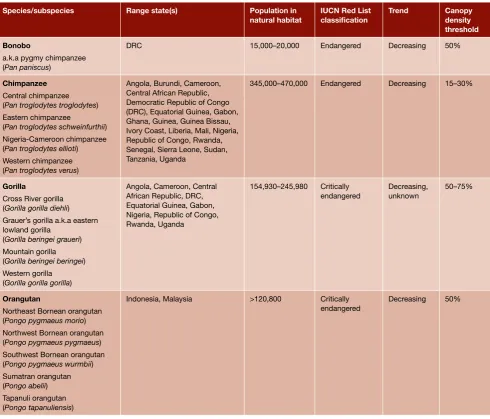
FIGURE 1
Great Apes
Species/subspecies Range state(s) Population in natural habitat
IUCN Red List classification
Trend Canopy density threshold Bonobo
a.k.a pygmy chimpanzee (Pan paniscus)
DRC 15,000–20,000 Endangered Decreasing 50%
Chimpanzee
Central chimpanzee (Pan troglodytes troglodytes) Eastern chimpanzee
(Pan troglodytes schweinfurthii) Nigeria-Cameroon chimpanzee (Pan troglodytes ellioti) Western chimpanzee (Pan troglodytes verus)
Angola, Burundi, Cameroon, Central African Republic, Democratic Republic of Congo (DRC), Equatorial Guinea, Gabon, Ghana, Guinea, Guinea Bissau, Ivory Coast, Liberia, Mali, Nigeria, Republic of Congo, Rwanda, Senegal, Sierra Leone, Sudan, Tanzania, Uganda
345,000–470,000 Endangered Decreasing 15–30%
Gorilla
Cross River gorilla (Gorilla gorilla diehli) Grauer’s gorilla a.k.a eastern lowland gorilla
(Gorilla beringei graueri) Mountain gorilla (Gorilla beringei beringei) Western gorilla (Gorilla gorillagorilla)
Angola, Cameroon, Central African Republic, DRC, Equatorial Guinea, Gabon, Nigeria, Republic of Congo, Rwanda, Uganda
154,930–245,980 Critically endangered
Decreasing, unknown
50–75%
Orangutan
Northeast Bornean orangutan (Pongo pygmaeus morio) Northwest Bornean orangutan (Pongo pygmaeus pygmaeus) Southwest Bornean orangutan (Pongo pygmaeus wurmbii) Sumatran orangutan (Pongo abelii) Tapanuli orangutan (Pongo tapanuliensis)
Indonesia, Malaysia >120,800 Critically endangered
Decreasing 50%
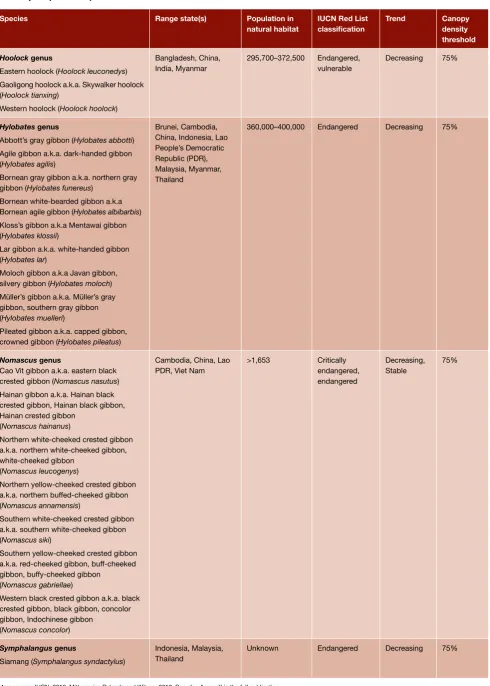
FIGURE 2
Small Apes (Gibbons)
Species Range state(s) Population in natural habitat
IUCN Red List classification
Trend Canopy density threshold
Hoolock genus
Eastern hoolock (Hoolock leuconedys) Gaoligong hoolock a.k.a. Skywalker hoolock (Hoolock tianxing)
Western hoolock(Hoolock hoolock)
Bangladesh, China, India, Myanmar
295,700–372,500 Endangered, vulnerable
Decreasing 75%
Hylobates genus
Abbott’s gray gibbon (Hylobates abbotti) Agile gibbon a.k.a. dark-handed gibbon (Hylobates agilis)
Bornean gray gibbon a.k.a. northern gray gibbon(Hylobates funereus)
Bornean white-bearded gibbon a.k.a Bornean agile gibbon (Hylobates albibarbis) Kloss’s gibbon a.k.a Mentawai gibbon (Hylobates klossii)
Lar gibbona.k.a. white-handed gibbon (Hylobates lar)
Moloch gibbon a.k.a Javan gibbon, silvery gibbon (Hylobates moloch) Müller’s gibbon a.k.a. Müller’s gray gibbon, southern gray gibbon (Hylobates muelleri)
Pileated gibbon a.k.a. capped gibbon, crowned gibbon (Hylobates pileatus)
Brunei, Cambodia, China, Indonesia, Lao People’s Democratic Republic (PDR), Malaysia, Myanmar, Thailand
360,000–400,000 Endangered Decreasing 75%
Nomascus genus
Cao Vit gibbon a.k.a. eastern black crested gibbon (Nomascus nasutus)
Hainan gibbon a.k.a. Hainan black crested gibbon, Hainan black gibbon, Hainan crested gibbon
(Nomascus hainanus)
Northern white-cheeked crested gibbon a.k.a. northern white-cheeked gibbon, white-cheeked gibbon
(Nomascus leucogenys)
Northern yellow-cheeked crested gibbon a.k.a. northern buffed-cheeked gibbon (Nomascus annamensis)
Southern white-cheeked crested gibbon a.k.a. southern white-cheeked gibbon (Nomascus siki)
Southern yellow-cheeked crested gibbon a.k.a. red-cheeked gibbon, buff-cheeked gibbon, buffy-cheeked gibbon (Nomascus gabriellae)
Western black crested gibbon a.k.a. black crested gibbon, black gibbon, concolor gibbon, Indochinese gibbon
(Nomascus concolor)
Cambodia, China, Lao PDR, Viet Nam
>1,653 Critically endangered, endangered
Decreasing, Stable
75%
Symphalangus genus
Siamang (Symphalangus syndactylus)
Indonesia, Malaysia, Thailand
Unknown Endangered Decreasing 75%
mining and logging. Complicating conservation measures is a lack of baseline data on species behavior, including sea-sonal variations.
A number of biological and behavioral factors make apes particularly vulnerable to decline as a result of encroachment into their habitats. Apes are dependent on natural forests to provide them with a sufficient quantity and quality of food and nesting resources. Using exceptional memory and men-tal mapping, they are capable of foraging in complex forest environments (Normand and Boesch, 2009). With their geo-graphic distribution already limited, any loss of habitat is detrimental to ape survival. Furthermore, only a small per-centage of ape habitats are afforded formal protected area status. In fact, as of 2000, protected areas covered only 26% of African ape ranges and 21% of Asian ape ranges. Only 25% of orangutans live within protected areas, which leaves 75% particularly vulnerable (Meijaard et al., 2010; Wich et al., 2012). It is important to note, however, that protected area status does not prevent all threats, and that encroachment occurs in many protected areas.
Ape species vary from entirely to partially arboreal, meaning that they spend some or all of their time in trees. Therefore, all require some degree of connected canopy cover (see Figures 1 and 2). Each group has a set home range, and many
species are strongly territorial. Deadly conflicts can occur when anthropogenic activities force groups to compress into overlapping areas of forest. In addition, exceeding the natu-ral carrying capacity of a forest can lead to stress, malnutri-tion or even starvamalnutri-tion. No non-human ape is capable of swimming, and all species are reluctant to cross large open spaces. As such, bodies of water and areas of deforestation create additional barriers that fragment ape habitat and pre-vent movement.
Apes must be in good health for successful reproduction and their reproductive rates are slow. Births are widely spaced, occurring on average every 4–7 years in African apes, every 6–8 years in Bornean orangutans and every 9 years in Sumatran orangutans. A mother usually gives birth to a single offspring, and remains heavily invested in the infant’s development until it matures. This makes it very difficult for a population to recover from losses, if it ever does (IUCN, 2014a). Given their genetic similarities to humans, apes are susceptible to human diseases, and they can also contract pathogens from domestic livestock or unsanitary conditions in settlements. Coming into more frequent contact with people and human-altered landscapes increases apes’ vulnerability. Humans, too, are placed at risk of contracting diseases from apes and other wildlife upon entering remote forest areas.
Impacts of Infrastructure
Development
A
ll ape range states have infrastructure projects planned or underway, and these projects have impacts on apes during all stages: construction, use and decommissioning. Direct impacts include behavior change, disturbance, habitat loss, injury and mortality. Furthermore, indirect impacts, such as disease and hunting, result from increased access for people and human settlement.Direct Impacts on Apes
Habitat loss
In order to survive, apes must have access to large or con-nected forest areas where they can feed, nest and repro-duce. Loss of habitat is a major factor contributing to the decline of ape populations (Geissmann, 2007; Hickey et al., 2013; Plumptre et al., 2016; Stokes et al., 2010; Wich et al., 2008). According to Global Forest Watch, a satellite monitor-ing service, more than 10% of the overall ape range was lost between 2000 and 2014. A large majority of that loss occurred across Asia. Asian ape habitat was reduced by 21%, while African ape habitat shrank by 4%. While losses occurred both inside and outside of protected areas, satellite data shows that areas with formal safeguards were impacted to a lesser extent. Protected African ape habitats lost a median of 1% of their forests, compared to a median 5% of protected Asian ape habitats. Meanwhile, unprotected ape range in Africa was reduced by a median 3%, compared with a median 10% for unprotected habitats in Asia.
If deforestation continues at the rate witnessed between 2000 and 2014, nine species of gibbons can be expected to lose the entirety of their habitats (Clements et al., 2014; Gaveau et al., 2009). Of the remaining forests where apes and other primates are found, 65% are fragments smaller than 1 km² (Harcourt and Doherty, 2005). These areas are not large enough to support great apes without connectivity to other suitable forests. Further illustrating the extent of the problem, Cross River gorillas have lost 60% of their forest habitat, while Grauer’s gorillas have lost half, and bonobos have lost 30% (Junker et al., 2012). Additionally, orangutan habitat, already greatly imperiled by oil palm plantations, is predicted to shrink by another 16% through 2030.
Deforestation of ape habitats has been caused by the expan-sion of large-scale agricultural plantations, and by both legal and illegal extractive operations, such as oil and gas exploi-tation, mining and logging. For example, the ranges of 15 ape subspecies are overlapped partially by timber, oil palm or rubber plantations. In 12 of those areas, land clearing for plantations is responsible for more than half of documented forest loss. Where illegal logging occurs, it not only threatens forest ecosystems, but also undermines national economies through loss of revenue. Globally, timber prices are deflated by 7–16% as a consequence of the trade in illegal wood (Seneca Creek Associates and Wood Resources International, 2004).
For further information about the threats posed by extractive industries and industrial agriculture, see State of the Apes, Volumes 1 and 2, respectively.
The infrastructure built to support industrial and other eco-nomic development activities, and the influx of people drawn by them, further contribute to the decline of ape habitats. Deforested areas and hydroelectric dam reservoirs create barriers to ape movement and reduce their access to food, shelter, water and other gene pools. As apes are reluctant to cross large open spaces, they can become isolated in frag-mented and degraded areas of forest (Tutin, White, and Mackanga-Missandzou, 1997). This can lead to malnutrition, illness and eventual population declines as a result of mor-talities and reduced reproductive success (Das et al., 2009). If all 12 proposed Sarawak dams, discussed above, were to go forward as initially planned, nearly 2,500 km² of Malaysian rainforest would be destroyed for construction sites, resettle-ment sites and reservoirs (Kitzes and Shirley, 2016). Similarly, a proposed geothermal project in Indonesia’s Gunung Leuser National Park would further denigrate the endangered Tropical Rainforest Heritage of Sumatra World Heritage Site, which is the only remaining place where orangutans, tigers, elephants and rhinos coexist. In preparation for the project, the company and Aceh’s governor have requested that a 50 km² area be rezoned to accommodate construction activities, equipment and worker settlements (HAkA et al., 2016; Modus Aceh, 2016). Additional forest would be cut down to facilitate human access to the remote area, which is more than 10 km from the nearest road (Baabud et al., 2016). Additionally, transmission lines would be built in order to reach the near-est power substation, which is more than 150 km away.
A large percentage of new transportation infrastructure planned through 2050 will traverse the tropical forests of Southeast Asia and Central Africa. These same forests host exceptional biodiversity, including apes (Dulac, 2013). Millions of kilometers of new roads and railways will trigger extensive deforesta-tion as areas are opened to human settlement and activities, such as agriculture and artisanal mining (Dulac, 2013; Quintero
et al., 2010). Forest loss is highly contagious regardless of an area’s protected status. It expands along new roads and leads to a web of secondary and tertiary roads, which also experience deforestation (Boakes et al., 2010). For example, in the DRC, when a palm oil company began redeveloping three abandoned colonial era plantations, the number of access roads increased by 34% in fewer than three years (Feronia, 2014). Also in the DRC, the Pro-Routes transporta-tion network improvement project, funded by the World Bank, is expected to result in a 10-20% increase in habitat loss within 2 km of upgraded roads (Damania et al., 2016). Similarly, when a road in Aceh, Sumatra, Indonesia was improved in 2009, canopy loss 5-10 km from the road multiplied six-fold, according to 2014 Global Forest Watch data. Satellite imag-ing taken the same year also revealed forest loss as far as 25–30 km from two newly built roads in Tanzania.
shown to decline in proximity to roads and settlements due to the associated hunting pressure that results from increased human access to ape habitats (Fa, Ryan, and Bell, 2005; Kuehl et al., 2009; Laporte et al., 2007; Marshall et al., 2009; Poulsen et al., 2009; Poulsen, Clark and Bolker, 2011); Wilkie
et al., 2001). Other linear infrastructure can have similar effects, as demonstrated by the Chad-Cameroon oil pipeline, which facilitated forest access for poachers and illegal log-gers. Power transmission lines linked to hydroelectric dams can also fragment ape habitat (Andrews, 1990; White and Fa, 2014). Additionally, when constructing dams and filling their reservoirs, habitat is destroyed and natural river processes are halted (O’Connor, Duda and Grant, 2015).
Disturbance and behavior change
Infrastructure development activities can make loud noises, cause vibrations or otherwise disturb apes. Seismic blasts used to detect subterranean oil and gas deposits are par-ticularly disruptive to wildlife. Apes tend to move away from noise and other anthropogenic disturbances while they occur, and sometimes for many months after they have ended (Rabanal et al. 2010). A group is likely to flee to a neighbor-ing range to feed or nest while its home range is disrupted. With territorial ape species, range compression can result in
stress, illness, conflict and even mortalities (Arnhem et al., 2008; Hashimoto, 1995; Matthews and Matthews, 2004). Competition for food can increase aggression or result in stress, injury or starvation (Mitani, Watts and Amsler, 2010; Watts et al., 2006). Female orangutans and their offspring are particularly vulnerable to starvation when forced out of their home ranges (Wich et al., 2012). Even within a group’s home range, construction equipment, activities and infrastructure can create artificial barriers that disrupt apes’ use of their habitat. These barriers could prevent apes from reaching essential food or nesting trees (Bortolamiol et al., 2016). As apes only reproduce when they are in good health, food scarcity and stress can reduce their reproductive success or result in illness. Further, isolation from other groups due to arti-ficial barriers can restrict gene pools and genetic diversity.
Injury and mortality
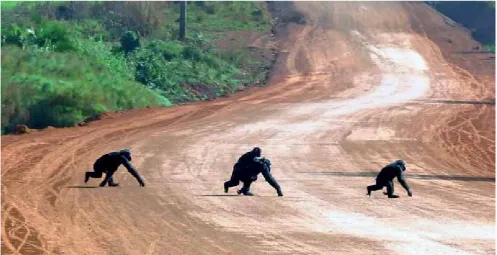
Closed-canopy forests provide the most suitable ape habi-tats. As previously discussed, many ape species are very reluctant to cross non-forested areas, such as roads. When they do, severe injuries and mortalities can occur from colli-sions with vehicles (McLennan and Asiimwe, 2016). Similarly, accidents involving vehicles threaten the safety of passen-gers. Hydropower dam construction can also pose physical
danger to apes. As no ape specie can swim, individuals can drown or get trapped on islands and succumb to starvation (GVC, BIC and IRN, 2006). Furthermore, due to their arboreal nature, apes may use power transmission lines to traverse forest clearings. As apes cannot differentiate between natural vines and man-made wires, severe injuries and mortalities from electrocution have been documented (Ampuero and Sá Lilian, 2012; Chetry et al., 2010; Kumar and Kumar, 2015; Rodrigues and Martinez, 2014; Slade, 2016). To reduce the risk of ape electrocution, transmission lines and transformers should be insulated (Printes, 1999; Refuge for Wildlife, n.d.). This also helps to avoid costly infrastructure damage, service outages and potential criminal liability (Printes et al.,2010). It can also be helpful to prune nearby trees so that apes can-not easily transfer from the canopy to power lines (Lokschin
et al., 2007). In order to maintain habitat connectivity, aerial bridges can be effective, although these must be monitored to guard against poaching (Jacobs, 2015; Lokschin et al., 2007).
Indirect Impacts on Apes
Increased access and human settlement
Infrastructure facilitates easier and more frequent human access to previously remote and undisturbed areas (Laurance, Goosem and Laurance, 2009). New roads are responsible for the largest increases in access (Clements et al., 2014). The first cut through an undisturbed area spurs a conta-gion of secondary and tertiary roads deeper into the forest. Furthermore, people who settle in newly-accessible areas are likely to deforest land for cultivation, grazing or artisanal mining. This further reduces the area available for wildlife and native vegetation and creates competition for natural resources (Asner et al., 2009; Laurance et al., 2009).
In the DRC’s Kahuzi-Biéga National Park, for example, thou-sands of artisanal miners attracted by gold, coltan, tantalum and tin deposits have cleared newly-accessible land for subsistence agriculture and felled trees for fuel wood (UNEP and McGinley, 2009; Conservation International, 2010). Pollution from human waste and mercury has also been documented there, as well as ivory poaching (Mazina and Masumbuko, 2004). Kahuzi-Biéga is a World Heritage Site home to Grauer’s gorillas, chimpanzees and many other imperiled species. In the Central African Republic’s Dzanga-Sangha landscape, which is another World Heritage Site with gorillas and chimpanzees, the closing of a sawmill supporting a timber concession led to an increase in subsistence cultiva-tion. The percentage of households engaged in smallholder agriculture increased from 39% to 76% after the sawmill closed (Sandker et al., 2011). At Cameroon’s Lom Pangar dam, an estimated 2,000 workers were recruited for construc-tion activities, and as many as five-times that amount were expected to move into satellite communities (Agence Ecofin, 2012; Goufan and Adeline, 2005). Additional people may be attracted to the dam area once the reservoir is fully impounded, as commercial fishing will be allowed (EDC, n.d.).
Following deforestation, the second greatest peril apes face from in-migration is illegal killing and capture (IUCN, 2014b;
Vanthomme et al., 2013). Hunting, discussed in further detail below, has the potential to decimate ape populations faster than direct threats related to habitat loss (Hicks et al., 2010; Ripple et al., 2016). Once access is established, subsistence hunters, small-scale commercial hunters, poachers and traf-fickers can capture or kill wildlife very effectively, using indis-criminate snares or targeted weapons (Blake et al., 2007; Poulsen et al., 2009; Robinson, Redford and Bennett, 1999). For instance, in Gunung Leuser National Park, in Indonesia, a road expansion project first fragmented the habitats of orangutans and gibbons, then enabled people from nearby settlements to enter the park illegally to extract timber and to poach wildlife (McCarthy, 2002; Singleton et al., 2004).
Infrastructure projects attract an influx of workers, people hoping for work, and others providing products and services to workers. Forests are cleared and converted into accom-modation and recreation compounds for workers and satel-lite communities, as well as for forest groups that have been displaced by industrial operations, such as hydropower res-ervoirs. Human settlement leads to the further destruction and degradation of ape habitats as a result of illegal logging, smallholder agriculture, livestock grazing, fuel wood collec-tion, charcoal production and artisanal mining (Cuaron, 2000; Trombulak and Frissell, 2000; van Vliet et al., 2012). Settlements near protected areas often encroach upon their boundaries over time (Laurance et al., 2012). In Indonesia’s Gunung Leuser National Park, for example, illegal loggers have clear-cut river banks and expanded their settlements into the park’s protected forest (McCarthy, 2002; Singleton et al., 2004). As protected areas can be negatively impacted by environmental changes that occur in their immediate surroundings, buffer zones should be implemented to keep human activities at an appropriate distance.
Human settlements in or near ape habitats also increase the risk of mortalities from hunting and human-ape conflict (Poulsen et al., 2009). Apes are able to incorporate new food sources into their diets, such as crops cultivated by small-holders. The presence of apes can cause conflicts due to crop raiding, or out of fear for human safety (Abram et al., 2015). In Uganda, chimpanzee attacks on children have been reported, including some resulting in fatalities (McLennan, 2008; Reynolds, 2005; Reynolds, Wallis and Kyamanywa, 2003). People have responded to the destruction of crops and safety concerns by killing apes in retaliation (Ancrenaz, Dabek and O’Neil, 2007; Bryson-Morrison et al., 2017; Campbell-Smith et al., 2011; Humle, 2015; McLennan and Hill, 2012; McLennan and Hockings, 2016).
Killing and capture
et al., 2008; Maisels et al., 2013; Stokes et al., 2010; WCS, 2015). Routes cleared for the construction of roads, pipelines and transmission lines provide forest access for hunters to kill wildlife with guns and bows and to set and check snares. Entry by vehicle allows hunters to kill or capture a higher vol-ume of wildlife, and then to make a speedy and inconspicuous escape (Fimbel, Grajal, and Robinson, 2001). For instance, one Republic of Congo logging concession saw 3,000 km of tree inventory transects established in a single year. These transects reduced travel time through the area from four days to one (Wilkie et al., 2001).
Examples of increases in hunting and poaching in once iso-lated areas have been well documented (Auzel and Wilkie, 2000; Poulsen et al., 2009; Wilkie et al., 2001). Illegal killing of apes has caused populations to decline, and ape densities to decrease as human presence increases (Espinosa, Branch and Cueva, 2014; Clements et al., 2014; Geissmann, 2007; Hickey et al., 2013; Laurance et al., 2009; Plumptre et al., 2016; Quintero et al., 2010; Stokes et al., 2010; Wich et al., 2008). Hunting intensity has been found to be greatest within 10 km of roads, and examples show that chimpanzees, bon-obos and elephants have declined as a result (Laurance et al., 2009).
As all apes are protected, killing or capturing them is illegal regardless of the motivation, which can include hunting for
food, in retaliation for crop damage or to supply the illegal wild-life trade (Nijman, 2005; Meijaard et al., 2011). A study on wild meat consumption patterns by the Zoological Society of London (ZSL) found that incentives were both financial and nutritional (White and Fa, 2014). Regardless of the motive, the impact on wildlife around the two logging concessions ZSL assessed was severe, with an estimated 20,000 animals killed or captured each year. Additionally, monitoring of large-scale industrial plantations in the DRC, Gabon, Ivory Coast, Nigeria and Republic of Congo has also documented the severe impact of hunting on apes (Campbell et al., 2008; FAO, 2014; USAID, 2008; Walsh et al., 2003). Furthermore, in Indonesia, records show between 2,383 and 3,882 orangutans are killed in plantations annually (Meijaard et al., 2012).
Apes are known to sometimes raid agricultural crops when planted in or near their ranges (Hockings and Humle, 2009; Hockings and McLennan, 2012). A group of 2,000 chimpan-zees monitored in Sierra Leone, for example, was witnessed moving between unprotected primary forest fragments, sec-ondary forests and farms (Brncic, Amarasekaran and McKenna, 2010). In that degraded environment, the chimpanzees relied heavily on crops. As apes are reluctant to venture far from tree cover, most raiding occurs within a half kilometer of forest edges (Ancrenaz et al., 2015; Naughton-Treves, 1997, 1998). As mentioned previously, crop raiding can lead to serious con-flicts between apes and humans, including retaliatory killing.
Disease
The threat of disease is closely associated with the influx of people to previously uninhabited areas. This is due to the fact that apes are susceptible to pathogens from humans and livestock. As remote areas lack sanitation services, waste and pollution can result in apes catching infectious diseases (Laurance et al., 2006; Leendertz et al., 2006). Disruption to the forest canopy can force arboreal apes to travel on the ground, which increases their potential exposure to patho-gens and parasites that have been brought into ape habitat by people and their domesticated animals (Das et al., 2009). Humans are also susceptible to diseases that emerge from previously-inaccessible areas, which have caused serious out-breaks in the past.
Best Practice Principles
Good Governance
T
he term governance encompasses all elements of societal functioning. These elements include institu-tions, laws, mechanisms, policies, processes and regulations. In order for good quality governance to thrive, a strong political commitment is necessary to foster the appro-priate enabling conditions. Achieving good governance can be a complex, difficult and lengthy process considering the many pressures placed upon leaders in developing countries. At the most basic level, a culture of accountability,open-ness and transparency must be established. This includes
zero tolerance for corruption, which undermines the function-ing of governmental systems.
With regard to management of natural resources, support from the highest level of state must be secured in order for all necessary agencies to unify around conservation. Without buy-in from senior government officials across all relevant ministries, precious resources will be unsustainably exploited to the detriment of society. To prevent this, existing laws and regulations must be implemented robustly, and
compli-ance strictly enforced. Iflegal regimes are weak in regard to
social and environmental safeguards for infrastructure pro-jects, they should be strengthened.
Adaptive management should be used to monitor and evaluate approaches, and to adjust as contexts change
and new threats emerge. In developing economies, the
allo-cation of appropriate resources can be a challenge. Adaptive management requires both financial resources and technical expertise. For example, in Cameroon’s Deng Deng National Park there are only 17 rangers permanently assigned to pro-tect 680 km² of forest, but the park’s management plan calls for 70 ecoguards (EDC, 2011; MINFOF, 2015). Worldwide it is common for rangers to be inadequately equipped or trained for the numerous and varied requirements of their challenging, and sometimes dangerous, profession.
National and Landscape Level
Strategic Planning
In order to maintain large blocks of intact forest and con-nectivity between forest patches that are essential for ape survival, system-scale approaches are necessary. Land use planning must be conducted at the national and land-scape levels in order to determine the least harmful spa-tial configuration of large-scale industrial projects and the
linear infrastructures that support them (Sayer et al., 2013).
National plans should incorporate economic, environmental and social considerations, and ensure equitable and sus-tainable management of land and resources. Decisions should be evidence-based and inclusive, and implementation processes should be monitored and evaluated to minimize negative impacts on forest communities and biodiversity. Areas of high conservation value, and those that are essen-tial for the well-being of forest peoples, should be identified and protected.
BOX 1
Avoiding Impacts on People
Indigenous groups and other forest communities depend on forests for food, medicinal plants, shelter and water, as well as for their social and cultural identities. Infrastructure projects can displace forest people, restrict their access to land, and reduce their livelihood opportunities. For example, in January 2016, a superhighway project in Nigeria’s Cross River State dispos-sessed 185 communities of their land rights (Abutu and Charles, 2016; MLUD, 2016). In Cameroon, an oil pipeline threatened the sacred sites of an indigenous group and displaced their camps (Nelson, 2007). In Aceh, Sumatra, Indonesia, a road expansion project cut off the water supply to lowland commu-nities, and threatened the water security of several million other residents. The road also posed fire suppression, erosion and flood control risks (van Beukering, Cesar and Janssen, 2003; Wich et al., 2011).
To uphold the civil liberties of indigenous groups, it is essential that community land tenure is secure, and that customary ownership is recognized. National legal systems should guar-antee the rights of indigenous people to self-determination and self-governance. Their participation in decision-making pro-cesses should be guided by the internationally recognized prin-ciples of free, prior and informed consent (FPIC) as enshrined in the 2007 United NationsDeclaration on the Rights of Indige nous Peoples. Infrastructure planning at the national, sub-national regional and local levels should begin with assessments of the natural capital, biodiversity and ecosystem services upon which indigenous groups depend. Also, the boundaries, key resources and sacred sites of customary territories should be mapped using georeferencing technology.
Engaging lenders early in the strategic planning process can help guide funding to the least damaging projects
(Laurance et al., 2015a). Governments may seek to explore potential methods for funding sustainable choices, such as entry or impact fees, payment for ecosystem services schemes, public-private partnerships and sale of certified premium-priced goods. For example, in 2014, Norway and Liberia struck a deal to conserve the West African country’s forests, which are home to chimpanzees. Under the agreement, Liberia will receive US$150 million to: address drivers of deforesta-tion, issue a moratorium on new logging contracts, make payments to communities that are sustainably managing for-ests, place 30% of forests under formal protection and report on forest carbon emissions (Norway and Liberia, 2014). Similarly, Nigeria has received a total of US$16 million under the REDD+ scheme to combat climate change and improve forest governance (Uwaegbulam, 2016). When considering tenders and evaluating financing options, parties can include contractual requirements, such as minimum contributions to biodiversity conservation and local development. For instance, as a condition of World Bank funding for the Lom Pangar hydropower dam in Cameroon, a portion of the tariffs are allocated to sustaining nearby Deng Deng National Park (World Bank, 2012).
Pursuing certification regimes and other global standards can help ensure that development is sustainable and equi-table. Some well-known certification examples include Fair Trade, Fairmined, Forest Stewardship Council, Rainforest Alliance, Roundtable on Sustainable Palm Oil and UTZ. Although no global certification system yet exists for infrastruc-ture projects, the Leadership in Energy and Environmental Design (LEED) Green Building Rating System provides a potential model for creating one. LEED is active in 167 countries and territories, and has certified 1.6 million residences, 39,000
commercial projects, more than 6,000 schools, and nearly 4,000 government buildings (United States Green Build ing Council, 2016). Furthermore, helpful guidance can be found in relevant elements of other existing certification schemes that include requirements for associated infrastructure.
When producing national and landscape level strategies for infrastructure development, governments should con-vene all necessary experts and stakeholders, including
representatives from local and indigenous communities.
Together, they can determine the best way to optimize eco-nomic development, while limiting social and environmental costs. The groups should explore options including boost-ing agricultural yields, buildboost-ing roads in higher density areas, using already degraded land and developing small scale-renewable energy systems that do not require large scale infrastructure or networks of roads, railways and power trans-mission lines.
Furthermore, reducing the number, length and width of
roads can reduce their impacts on apes. Reusing existing
roads, rather than opening up new networks, can help keep deforestation to a minimum. In Aceh, Sumatra, Indonesia, for example, rather than building a road through Gunung Leuser National Park, a better alternative could have been improving coastal roads through degraded areas that are closer to agri-culture plantations and human settlements. This option would have benefitted more residents and had fewer environmental costs (CIFOR, 2015; Laurance and Balmford, 2013).
Before any decisions are taken about a landscape, a strategic environmental assessment (SEA) should be conducted that integrates the area’s environmental and
social values. It cannot be stressed enough that SEAs
should be undertaken at the very earliest stages of planning
and decision-making. That way their overarching policies can best enhance development effectiveness and sustain-ability. Waiting until the project-specific environmental and social impact assessment (ESIA) stage is too late. It is criti-cal that SEAs consider not only direct impacts to the immediate vicinity of each proposed project, but also the indirect impacts of projects, and the cumulative impacts
of all economic activities taking place in a landscape.
The Inter national Finance Corporation (IFC) defines cumu-lative impacts as the incremental impacts of one project, combined with the past, present and foreseeable impacts arising from other developments within the same geographic and connected area (IFC, 2012). To minimize cumulative impacts, governments can facilitate collaboration between neighboring projects. In order to reduce their combined footprint, for example, developers can take actions such as sharing transportation infrastructure.
Protection of Ape Habitat
To successfully feed, nest and reproduce, apes must have sufficient, connected forest habitat. Yet to meet resource demands, industrial activities are encroaching deeper into primary forests. As a result, apes are increasingly taking ref-uge in areas that are under formal protection (Geissmann, 2007; Tranquilli et al., 2012; Wich et al., 2008). These include areas with different types of safeguards and management approaches, such as national parks, nature reserves and community conservancies. As indigenous groups also rely on healthy ecosystems for their well-being, it can be valuable to integrate nearby residents in community-based natural resource management projects, including ape conservation. For example, indigenous trackers can be excellent resources for obtaining baseline data on ape food trees, paths and trails used. This information can be deployed during land use and infrastructure planning to help projects avoid areas that are critical for ape survival.
All remaining areas of high conservation value in ape habitats, such as ape feeding, dispersal and migratory routes, biodiversity hot spots and primary forests should
be placed under formal legal protection. Establishing large
reserves is favorable to creating smaller ones, which could leave apes isolated from other groups. However, in areas that have experienced high levels of forest loss or degradation, small reserves are essential to protect the remaining forest patches. To allow for adequate access to food, ranging and dispersal, these small reserves must be linked together with natural or man-made corridors.
Once established, the territorial integrity of protected areas must be maintained to ensure that they can serve as refuges for apes and other wildlife. Large-scale industrial activities should be prohibited in or near reserves, and core areas
of parks should remain free of roads. A precautionary
approach should be taken at all times due to the lack of data on the severity and duration of impacts that infrastructure projects can have on apes. See Chapter 2 for suggested research that could help to reduce these knowledge gaps.
Finally, because human activities taking place immediately outside protected areas often expand inside their boundaries, appropriate buffer zones should be delineated (Laurance et al., 2012). Buffer zones can help ensure that community use of natural resources is done sustainably.
Responsible Financing
Apes are rare and iconic mammals that serve as flagship indicator species for broader environmental health. As such, they attract high levels of global interest and scrutiny. Historically, economic development projects in ape range states have suffered from challenges including corruption, environmental damage, human rights issues, poor quality existing transportation networks, insufficient regulatory frame-works, labor disputes, political instability, poor communication networks and weak compliance (von Maltitz and Stafford, 2011). Until these issues are addressed in a sustainable manner, developers may experience cost overruns, delays, stranded assets or even legal liability. Investors, therefore, should be aware of the many financial, institutional and repu-tational risks associated with funding large-scale infrastruc-ture projects in ape ranges. To avoid these risks, lenders should take a triple bottom line approach that equally
considers economy, equality and ecology. Under current
international norms, a government’s invitation is no longer considered sufficient justification for infringing on the uni-versal human rights of indigenous peoples or destroying the environment.
Instead, lenders should offer technical support to govern-ments to enable long-term, system-level planning, which would boost investor confidence and attract capital. Ideally, this sup-port should include multinational and trans-boundary plans and approaches. Lenders should attach strict
environ-mental and social conditions to funding, and ensure that
safeguards are in place at the system and landscape levels, not just at project scale. They should also take responsibility for ensuring borrowers’ compliance with policies. Noting that governments may need guidance and assistance with implementation, investors should solicit support from experts, including conservationists from non-governmental organi-zations and relevant certification regimes (BIC, 2016).
Responsible investing should take a precautionary approach to natural resource management, and ensure that economic development does not harm biodiversity or disrupt the pro-vision of essential ecosystem services to society. Decision-making processes should be inclusive and integrate local
communities into project planning and implementation.
Further, projects should protect customary land rights, and maintain forest access for traditional uses. Projects should also avoid encroachment on critical areas of forest in order to conserve habitats and biodiversity.
consideration should be given to great apes (i.e., family Hominidae) given their anthropological and evolutionary sig-nificance in addition to ethical considerations.” (IFC, 2012, p. 24). The World Bank was an early leader on environmen-tal and social safeguards, and in October 2018 is launching an expanded framework that will apply to all new lending initi-ated after that date. The new framework broadens existing standards and procedural guidance related to environmental and social risks, and includes specific guidance on project monitoring and reporting. All lenders should continue to strengthen safeguards and their enforcement through effec-tive implementation that is monitored and evaluated to ensure adequate and meaningful social and environmental protection.
In recent years, as China’s overseas investments have grown, government agencies have issued a number of so-called green guidelines. These include Measures for Overseas Invest-ment ManageInvest-ment, Guidelines for EnvironInvest-mental Protection in Foreign Investment and Cooperation, Green Credit Guide-lines, and a Guide for Chinese Enterprises on Sustainable Silviculture Overseas. The documents urge best practices that are consistent with international standards. They also require Chinese companies to abide by the laws and regula-tions of the countries in which they operate, including envi-ronmental obligations and social responsibilities. However, China’s green guidelines remain voluntary and do not provide for compliance monitoring.
Management of environmental and social risks is also of concern to lenders in the private sector. In response, 92 finan-cial institutions across 37 countries have adopted the Equator Principles, and committed to implementing them through their internal policies and procedures (Equator Principles, n.d.). The principles draw heavily on the IFC Performance Standards. As of 2016, the group adhering to Equators Prin-ciples represented more than 70% of international project finance debt in emerging markets (BankTrack, 2018).
Tools and resources are readily available to help lenders and developers assess the risks that infrastructure projects may pose to apes, such as the Open Standards for the Practice of Conservation. Furthermore, databases including the A.P.E.S. Portal, the Digital Observatory for Protected Areas, and the Integrated Biodiversity Assessment Tool contain geographic information about ape ranges and high conservation value areas. Also, to track deforestation in ape habitats, Global Forest Watch offers free weekly satellite monitoring. Those considering new large-scale dam projects should consult the Hydropower Sustainability Assessment Protocol, and con-sider using the “Hydropower by Design” approach developed by The Nature Conservancy. These tools provide valuable resources for use during the planning process. It is essential, however, that appropriate and qualified technical expertise is brought in to contribute throughout the project lifespan. Finally, all projects in ape habitat should employ the
mit-igation hierarchy, described in detail below, and draw upon
the assistance of ape and biodiversity experts from academia and NGOs.
Environmental and Social Impact
Assessments (ESIAs)
Although common, not all infrastructure projects are required by law or under lending conditions to conduct environmental and social impact assessments (ESIAs). Additionally, many assessments are carried out too late to be effective at pre-venting critical habitat loss, environmental degradation and social impacts. In practice, rather than focusing on preven-tion, which is key, ESIAs often target mitigation. In Nigeria’s Cross River State, for instance, land clearing for construc-tion of the Cross River superhighway began long before approval of an impact assessment. In fact, that assessment remains in dispute despite its fourth iteration. As an illus-tration of the internal conflicts that can plague projects, the federal environment ministry has placed a stop order on the highway, which is a priority project of the state governor (Ihua-Maduenyi, 2016).
When done properly, an ESIA allows sufficient time to con-duct and incorporate a thorough baseline scoping. In ape habitats, this means at least 12 months of data collection
in order to document seasonal changes. In addition, time
for thorough analysis is required to fully understand the potential impacts of proposed activities. To facilitate knowl-edge sharing and to help close data gaps, baseline and ongoing monitoring data should be made public. Further,
assessments should be conducted in collaboration with
all relevant stakeholders. External support and advice
from conservationists, academics and park authorities can add valuable knowledge and credibility to a project. Community representatives must also be incorporated fully into all pro-ject stages in accordance with the concepts of free, prior and informed consent (FPIC).
In order to avoid fragmentation that can isolate ape popula-tions, ESIAs should put forward ways to minimize forest destruction and retain connectivity corridors between
ape habitats. Where linear infrastructure bisects ape ranges,
well-designed and well-located wildlife crossings should be incorporated, and the width of forest destruction kept to the strict minimum necessary. In Myanmar, for instance, aca-demics using advanced computer modeling have helped developers determine the best locations for wildlife cross-ings on the Dawei road link (Tang and Kelly, 2016). For road projects, speed bumps and cautionary signage should also be employed. Further, developers of revenue-generating projects should consider dedicating a portion of profits to conservation efforts and local development projects in nearby communities. This can help ensure sustainability, encourage local support and minimize reputational risk.
Industrial activities within protected areas should remain a safe distance from core ape habitat areas and locations
with high densities of fruiting trees. Outside of reserves,
vegetables and grains (McNeely, 2005). Subsistence hunt-ing should be tightly controlled, includhunt-ing a strict ban on the hunting, sale and possession of wild meat from endangered species. Further, indiscriminate hunting methods, such as snares that may harm or kill apes unintentionally, should be prohibited. Also, access points should be controlled and vehicles searched for contraband upon entry and exit.
Useful lessons can be learned from examples of best prac-tice. For instance, when developing its National Chimpanzee Management Plan, Tanzania applied principles from the Open Standards for the Practice of Conservation to evaluate the potential threats posed by road expansion. Stakeholders evaluated the potential scope of damage, the expected severity of damage and the likelihood that damage could be reversed and habitat restored (TAWIRI, 2017). In the Indonesian state of Kalimantan on the island of Borneo, a gold exploration company established a foundation to ensure that community members could fully exercise their rights to free, prior and informed consent (FPIC). The foundation facilitated a tripartite collaboration with civil society and local government for planning, information sharing, institu-tion building and capacity building. Further, in a different Kalimantan gold concession, all materials, goods and per-sonnel are transported in and out by helicopter rather than by linear infrastructure networks, thereby reducing deforesta-tion (White and Fa, 2014).
Mitigation Hierarchy
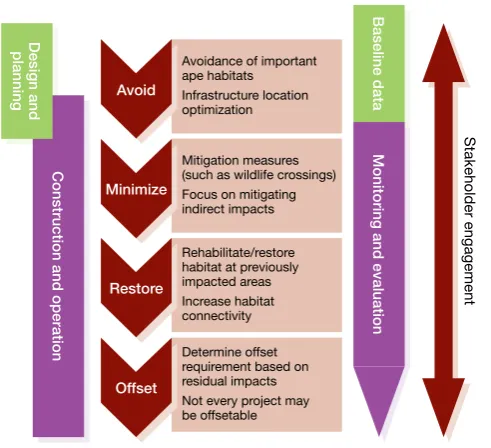
The mitigation hierarchy is a best practice approach to manag-ing biodiversity risk (Quintero et al. 2010). First and foremost, the approach advocates for avoiding or preventing adverse impacts to biodiversity whenever possible (see Figure 3).
Avoidance is most effective when applied early in the devel-opment process, such as at the national strategic planning stage, or during landscape-level strategic environmental assessments. Although avoidance should also be prioritized during project-specific ESIAs, stakeholders should not wait until that time to begin considering how to prevent biodiversity impacts. The second step in the hierarchy is minimizing and reducing any impacts that cannot be avoided. Third, impacts that cannot be avoided should be rehabilitated, repaired or restored following completion or decommissioning of the project. Finally, biodiversity impacts that cannot be avoided and repaired should be offset. The steps in the mitigation hier-archy are described in greater detail below.
Avoidance and Prevention of Impacts
All stakeholders should strive to achieve economic develop-ment that has a net-positive impact on biodiversity or that results in zero net loss of biodiversity. Unfortunately, such development is rarely a reality. At the international and national levels, companies, governments and lenders should solicit and incorporate technical support to help establish sustain-able development policies, regulatory frameworks and vol-untary standards that seek to avoid and prevent deleterious impacts on biodiversity. Avoidance and minimization are always more effective and less costly than rehabilitation, repair, restoration and offset.
Specific avoidance techniques include data collection, analy-sis and mapping, as well as advance planning for alternatives. It is essential to fully understand the project area’s natural and social environment, including boundaries, cultivation sta-tus, customary ownership, land tenure, resource potential and user rights. Additionally, a forest management inventory should be conducted to quantify biodiversity values and the ecologi-cal and behavioral requirements of resident apes, including seasonal variations. These requirements include food, shelter, space and social dynamics. Once potential biodiversity risks from all project phases are identified, including potential threats to apes, spatial planning tools can be used to deter-mine prevention, avoidance and minimization measures, such as re-routing linear infrastructure to avoid critical habitats.
Minimization of Unavoidable Impacts
Negative impacts that cannot be avoided should be mini-mized by reducing their extent and intensity. This should be coupled with effective and targeted social and behavior change programs to raise awareness and influence people’s behavior in areas near ape habitat. For example, to reduce the risk of collisions between apes and vehicles on new roads, wildlife crossings and canopy bridges should be constructed and paired with cautionary road signage and speed bumps. Canopy bridges can also be used to provide apes with safe passage through forest gaps or across power transmission lines and transformers, which should be insulated to prevent electrocution (Das et al., 2009). It is important that canopy bridges are maintained to prevent falls and patrolled to pre-vent poaching.
FIGURE 3
The Mitigation Hierarchy Applied to Infrastructure
Projects within Ape Habitats
Source: © TBC, 2017
Avoidance of important ape habitats
Infrastructure location optimization
Mitigation measures (such as wildlife crossings) Focus on mitigating indirect impacts
Rehabilitate/restore habitat at previously impacted areas Increase habitat connectivity
Determine offset requirement based on residual impacts Not every project may be offsetable
Construction and operation
Design and
planning
Baseline data
Monitoring and evaluation
Avoid
Minimize
Restore
Offset
To minimize the impacts of human settlements, protocols should be put in place to reduce human-wildlife conflict, as well as to prevent hunting of endangered species and their capture as pets or for the illegal wildlife trade. Access points should be restricted and vehicles searched upon entering and leaving sites. Closing roads and access points at night should also be explored. Workers should be prohibited from clearing land and required to control their domestic animals. Also, environmental education efforts should be undertaken to raise the level of awareness among communities. NGOs and local civil society groups can be helpful in this regard.
Deforestation tracking tools, such as the Global Forest Watch mobile app, should be used to monitor ape habitats near infrastructure and human settlements. Weekly tree cover change data, based on satellite imaging, is available gratis for most ape ranges. Finally, sanitation facilities and waste management must be provided to workers and satellite com-munities to avoid the outbreak of illnesses and the transmis-sion of pathogens between apes and humans.
Rehabilitation, Repair and Restoration
Biodiversity impacts that have occurred during the course of infrastructure development should be addressed immediately once construction activities and use cease. Equipment and temporary infrastructure should be dismantled and removed, and human access should be closed off. Invasive plants should be extracted, and deforested or degraded areas reforested with native vegetation. It is critical, in particular, to restore connectivity between fragmented ape habitats to reestablish migration corridors. Ape experts can advise on the most appropriate food and nesting tree species to plant.
Offsets
Developers should make compensation for all social and environmental damage that could not be avoided or fully rehabilitated, repaired or restored. In the case of biodiversity offsets, the goal should be a net increase or, at minimum, no