The Thirty-Third AAAI Conference on Artificial Intelligence (AAAI-19)
Tensor Decomposition for Multilayer Networks Clustering
Zitai Chen,
1,2Chuan Chen,
1,2∗Zibin Zheng,
1,2Yi Zhu
31School of Data and Computer Science, Sun Yat-sen University, Guangzhou, China 2National Engineering Research Center of Digital Life, Sun Yat-sen University, Guangzhou, China
3MTdata, Meitu
[email protected],{chenchuan, zhzibin}@mail.sysu.edu.cn, [email protected]
Abstract
Clustering on multilayer networks has been shown to be a promising approach to enhance the accuracy. Various multi-layer networks clustering algorithms assume all networks de-rive from a latent clustering structure, and jointly learn the compatible and complementary information from different networks to excavate one shared underlying structure. How-ever, such an assumption is in conflict with many emerging real-life applications due to the existence of noisy/irrelevant networks. To address this issue, we propose Centroid-based Multilayer Network Clustering (CMNC), a novel approach which can divide irrelevant relationships into different net-work groups and uncover the cluster structure in each group simultaneously. The multilayer networks is represented within a unified tensor framework for simultaneously captur-ing multiple types of relationships between a set of entities. By imposing the rank-(Lr, Lr,1)block term decomposition with nonnegativity, we are able to have well interpretations on the multiple clustering results based on graph cut theory. Nu-merically, we transform this tensor decomposition problem to an unconstrained optimization, thus can solve it efficiently under the nonlinear least squares (NLS) framework. Exten-sive experimental results on synthetic and real-world datasets show the effectiveness and robustness of our method against noise and irrelevant data.
1
Introduction
Many real-world networks and complex system are repre-sented as a set of entities interacting with each other via multiple types of relationships (Wasserman and Faust 1994; Kivel¨a et al. 2014). Since different networks have different data distributions, it is reasonable to separate them into sev-eral homogeneous networks to utilize the traditional tools in graph (Cai et al. 2005). For example, in aeronautical flight system (Cardillo et al. 2013), different airports (cities) are connected by flight routes constituted by diverse airlines net-works; in gene co-expression networks (Ficklin and Feltus 2011), genes often play different roles in different tissues. From the viewpoint of each individual network, they respec-tively contain a partial description of the whole system and might be no sufficient to accomplish a learning task alone for its incompleteness and noise. Thus, mining on multilayer
∗
Corresponding author
Copyright c2019, Association for the Advancement of Artificial Intelligence (www.aaai.org). All rights reserved.
1 2
3 4 5
6
7 8
9 Layer D
1 2
3 4 5
6
7 8
9 Layer C
1 2
3 4 5
6
7 8
9 Layer B
1 2
3 4 5
6
7 8
9 Layer A
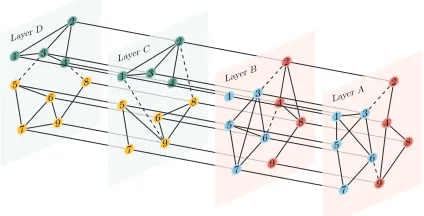
Figure 1: An example of Multilayer Networks: the network system is comprised by 4 networks {A, B, C, D} and 9
nodes. The informative edges are represented in solid line while noisy edges in dashed line. There are 2network groups
CN et
1 ={A, B}andC2N et ={C, D}, each of which has 2
node clusterswith same color:CN ode
1 = {CBlueN ode, C N ode Red }
andC2N ode={CGreenN ode, CY ellowN ode }. The unobserved nodev1 in{B} is not linked by any of other nodes, which raises a challenge of incompleteness.
networks becomes a crucial task to improve our understand-ing of the integral system.
As a typical unsupervised learning problem, clustering aims to find a set of samples closed to each other in the same cluster and far away from different clusters. It has been widely studied on both feature-based and graph-based learning. One of the most adopted feature-based methods is K-means algorithm (Lloyd 1982), which groups a given dataset intokclusters by optimizing the cost function of the total distance from points to cluster centroids. On network cluster learning, spectral clustering (von Luxburg 2007) has attracted much attention for the good performance. How-ever, it also suffers from the sensitiveness, post-processing and difficulty in interpretation. The symmetric nonnega-tive matrix factorization (Kuang, Park, and Ding 2012) has been shown to be a promising approach giving well inter-pretable and comparative results. It approximates the ad-jacency matrixX with a nonnegative low-rank factor, i.e.
For multilayer networks clustering problem, the key as-sumption of the existing multilayer networks algorithms is that all networks share one underlying clustering structure (Dunlavy, Kolda, and Kegelmeyer 2011; Kolda, Bader, and Kenny 2005). By leveraging the dependency, coherence and complementarity of networks, multilayer networks cluster-ing is able to provide better performance. As an illustration, in Figure 1, although the two-layer networks{A, B}has dif-ferent linkages between the same set of nodes, it can learn a unique clustering structure from the compatible information. With the complementary information from network{A}, the unobserved node v1 ∈ {B} has higher probability to be clustered toCN ode
Blue rather thanCRedN ode. And the distraction
from noisy edges could also be alleviated.
However, this assumption does not always hold in real life, and a noisy/irrelevant network can dramatically devi-ate the result from the real one. A widely used solution is to lower the importance of the noisy networks in learning pro-cedure, which needs a time-consuming parameter tuning. As shown in Figure 1, the tuning on importance face a dilemma when another group of networks{C, D} exists. Moreover, excluding networks mistakenly might miss an opportunity to uncover another valuable data distribution covered in the multilayer networks. Taking the user networks as an exam-ple of multilayer networks, different functional applications have their meaningful relationship across users respectively, such asYelpsuggesting the flavor preference, whileYoutube
andNetflixrevealing the entertainment inclination. The
var-ious networks could follow completely different underlying cliques, while the similar functional networks could provide complementary information like social networksFacebook
andTwitter. That is key knowledge manifested in 4 networks
of Figure 1.
Thus, it is necessary and realistic to obtain a macroscopic view by grouping networks, and learn a micro-structure by clustering nodes in each network group. In this paper, we propose a tensor decomposition based clustering algorithm CMNC to succeed in clustering networks and nodes simul-taneously. Our contributions are summarized as follows: • We propose a realistic clustering problem: clustering
intra-layer networks and inter-layer network. A compre-hensive description of the node can be acquired by the various clusterings among different networks.
• We develop an interpretable and well-performed cluster-ing model: Centroid-based Multilayer Network Cluster-ing. Within the tensor framework, the multilayer networks could be modeled across networks.
• CMNC is hyperparameter free, which is a major advan-tage in unsupervised learning. Numerically, by introduc-ing 2 operators, the constrained optimization problem can be efficiently solved in an unconstrained NLS framework. • Extensive experiments are conducted to verify the
effec-tiveness and robustness of the proposed method.
The rest of the paper is organized as follows: A brief overview of clustering methods is provided, followed by some preliminaries, the proposed CMNC model and opti-mization; Then experimental results are presented; Finally conclusion and future works are discussed.
2
Related work
Single source data clustering The clustering method can be mainly classified into three scenarios: feature-based, graph-based, and hybrid clustering method. The well-known feature-based clustering methods include the K-means al-gorithm, hierarchical clustering (Newman 2004) and NMF (Paatero and Tapper 1994) methods. By transforming to a similarity graph cut problem, many graph clustering algo-rithms have been proposed, such as spectral clustering (von Luxburg 2007), SymNMF (Kuang, Park, and Ding 2012) and modularity maximization (Newman 2006). For the hy-brid clustering method, (Cai et al. 2011) proposes an NMF with graph regularization and (Du, Drake, and Park 2017) proposes a joint NMF and SymNMF clustering framework .
Multilayer networks clustering The prior research on node-aligned multilayer networks clustering is mostly pro-posed for multi-view clustering and multilayer graphs. These methods can be regarded as the extension of the single source clustering method, such as the extension of NMF (Liu et al. 2013a; Li, Jiang, and Zhou 2014), spec-tral clustering (Kumar and III 2011) and modularity max-imization (Didier, Brun, and Baudot 2015). For instance, (Tang, Lu, and Dhillon 2009) proposes linked matrix factor-ization(LMF) to link adjacency matrices by a shared factor
H:X(m)≈HΛ(m)HT. Similarly, (Dong et al. 2012) pro-poses an eigen-decomposition method to approximate the graph Laplacian:L(m) ≈PΛ(m)P(−1). (Kumar, Rai, and Daume 2011) proposes a joint-spectral clustering with a co-regularized term. Similarly, (Liu et al. 2013a) proposed a joint-NMF framework with a common consensus regular-ization.
Nevertheless, multiple matrices representation interrupt the analysis of a node across different views, which is non-negligible in learning both the networks and the clusterings. To preserve the view factor and take the multilayer net-works as a whole, tensor representation gives a helpful reso-lution. The adjacency tensor can preserve the network struc-ture as well as provide a lot of tensor-decomposition tools for analysis (Kolda and Bader 2009; Cichocki et al. 2015; Vervliet, Debals, and Lathauwer 2016; Chen et al. 2018). (Liu et al. 2013b) develops a tensor-based framework of multi-view spectral clustering by MLSVD. (Dunlavy, Kolda, and Kegelmeyer 2011) utilizes the CP decomposition to an-alyze the multi-link graphs.
However, all these methods assume various networks share one underlying clustering structure, and it is not easy for them to accommodate the multi-structure tasks. Re-cently, some works on multiple structure clustering have been proposed in a related field multi-domain clustering, which models the inner- and cross-domain linkages in clus-ters (Ni et al. 2015). These methods need an additional re-lationship between networks in the analysis, which is a kind of guidance on network clustering.
3
Preliminaries
Problem Definition A multilayer networks is defined as G = hV,Ei, whereV = {vi}n
E = {Ei}N
i=1 is a set of relationships. The multilayer net-works can be separated intoNrelatively independent of net-works{Gi}Ni=1, whereGi=hV, Eii, and represented by the
adjacency matrices{Xi}Ni=1.
Formally, multilayer networks clustering aims to partition
N networks into R network groups CN et = {CiN et}R i=1, whereCrN et={Gr1,· · ·, Grlr}is ther
thgroup containing
lr graphs. Meanwhile, it learns node clusteringsCN ode
r =
{Cr,N ode1 ,· · ·, Cr,LN oder } from the r
th network group, where
CN ode
r,i is theithnode cluster inCrN etandLris the number
of node clusters inrthnetwork cluster. We suppose that the
cluster numberRandLr,(r= 1,· · ·, R)are given.
Notation and Preliminaries Tensor is a multidimensional array. LetX be anm-order tensor of sizeI1×I2× · · · ×Im.
Rank-one tensor can be written as the outer product ofm
vectors, i.e.X =x(1)◦· · ·◦x(m). Themode-pmatricization ofX is denoted as anIp×(I1· · ·Ip−1Ip+1· · ·Im)matrix
X(p), which is obtained by the rearrangement of element. The vectorization ofX is denoted asvec(X). The Frobe-nius normkXkFis the sum of the squares of all its elements ai1i2...im:vec(X)
Tvec(X). TheKhatri-Raoproduct is
de-noted as. Then×nidentity matrix is denoted byInand
the all-one vector by1n×1or1nfor short. Matrix is denoted
as bold uppercase letterAand its elements in lowercaseaij.
Ai:andA:jdenote theithrow andjthcolumn ofA.
The multilinear rank-(Lr, Lr,1) terms decomposition (Lathauwer 2008), a tensor decomposition format, is ap-plied as a foundational model in this paper. It writes a third-order tensor as a sum ofRlow multilinear rank terms, each of which can be written as the outer product of a
rank-Lr matrix and a vector, i.e. X = PR
r=1(ArBTr)◦ cr.,
whereX ∈ RI×J×K, and A
r ∈ RI×Lr Br ∈ RJ×Lr
andcr ∈ RK×1. We denote this form of decomposition as
MLL1(A,B,C), whereAis the concatenation of matrix
[A1· · ·AR] ∈ RI×R
0
withR0 = PR
r=1Lr, so doB and
C. Solving the exact decomposition is NP-hard (Kolda and Bader 2009), and it resorts to the approximation as follow:
min
A,B,C kX −MLL1(A,B,C)k 2
F. (1)
4
The Proposed Method
In this section, we focus on multilayer networks clustering and describe the proposed model (i.e. CMNC). We start with model details, followed by discussion and analysis.
Centroid-based Multilayer Networks Clustering
In this problem setting, there exists two aspects of cluster-ing, the networks and the nodes, both of which are of im-portance. A good network grouping provides fertile ground for node clustering, and the better clustering results of each network group can be found. Inspired by multi-view meth-ods, the initial idea is to apply a two-step strategy: grouping networks first and then learn a multi-view task. We explain the key idea in the following simplified case under the tensor representation framework.
The Simplified Case SupposeXi ∈ Rn×n is the
adja-cency matrix of theithnetworkGiwithnnodes. To
main-tain the structure of multilayer networks,N adjacency ma-trices are aligned and compacted along the third mode of a third-order tensor, namelyX:,:,i=Xi, i= 1,· · · , N.
With the tensor representation, seeking a partition of the networks is equivalent to finding a sum of source compo-nent tensors to restore the adjacency tensor, and networks in such component share the same underlying node structure. As aforementioned, the rank-(Lr, Lr,1)terms decomposi-tion meets the need of partidecomposi-tion, which recovers the com-ponent tensors by duplicating the basic matrix(ArBTr)by
multiplying different weights. It can also be interpreted as generating the same structure networks of various weights. We suppose that each network only belongs to a unique component tensor, so-called hard clustering on networks. It is natural to set the component’s weight vectors cr in
MLL1(A,B,C)as an indicator to partition networks into different component tensors, namely
cr= [0,· · ·,0,1,· · · ,1,0,· · ·,0]T (2)
pointing out the tied networks with1and ignoring the irrel-evant networks with0in therthcomponent. And each
net-work ought to be indicated only once. Formally, each row of the concatenated matrix of indicatorsC = [c1,· · · ,cR]
is the one-hot vector. We can adjust the decomposition with the indicatorCas follow:
min kX−MLL1(A,B,C)k2F
s.t. C ∈ {0,1}, C1R=1N.
(3)
Owing to the nonnegative and symmetric adjacency ma-tricesXi, we adopt the SymNMF (Kuang, Park, and Ding
2012) as the decomposition format by imposingAr =Br
to the basic matrix. To sum up, we can formulate the objec-tive function of the simplified case as follow:
min kX −MLL1(A,A,C)k2F
s.t. A>0, C∈ {0,1}, C1R=1N.
(4)
The networks cluster is obtained by the indicator C
while the nodes cluster is obtained by the largest entry in the corresponding row of Ai. In other word, if k =
arg maxj{(Ai)lj}, then nodevl ∈ CiN et belongs to kth
node cluster:vl∈Ci,kN ode.
The General Case As we can see, the assumption of hard clustering is too strict to hold in general. A multi-layer networks system usually evolved out of mixing mul-tiple weighted network components together. Dropping out the assumption made before, it is easy to extend the simpli-fied case to this general case by relaxing the discrete value constraint to positive continuous value onC, so-called fuzzy clustering. So we present CMNC as:
min kX −MLL1(A,A,C)k2F
s.t. A>0, C >0, C1R=1N.
(5)
The networks group is also obtained by the largest entry in the corresponding row ofC, namelyGi ∈CkN etif and only
ifk= arg maxj{cij}. Now, the assignment of the network
Discussion We claim that CMNC can be seen as a struc-tured K-means algorithm, and that’s why it is named as centroid-based. Indeed, the resulting basic network of each component is the centroid of all the networks contained. The resulting basic network of each component does guide the node clustering by setting itself as the target network.
With mode-3 matricization of tensor X −MLL1, it is more clear to explicate the essence of CMNC under the ma-trix framework:
min kX(3)−CSk2F
s.t. A,C >0, C1R=1N,
S= [vec(E1)· · ·vec(ER)]T,
Er=ArATr, r= 1,· · ·, R,
(6)
whereX(3) ∈ RN×(n
2)
,S ∈ RR×(n
2)
. Note that the K-means method has the following matrix form:
min kX−ZMk2F
s.t. Z∈ {0,1}, Z1R=1N,
(7)
whereM is the clustering centroid andZis the cluster in-dicator. Compared to Eq. (7), Eq. (6) is entirely the matrix form of K-means with additional constraints on the centroid matrixS, the vectorized adjacency matrices. In the simpli-fied case, each network group’s centroid is the means of the networks in the same cluster, where the objective function can be formulated as
min
R
X
r=1 kX
i∈cr
Xi− kcrk ·vec(AiATi )k
2
F, (8)
which is K-means with non-negative positive definite sym-metric constraint on factor (centroid) matrix. It is also estab-lished in general case with more complicated explanation and the stronger ability of expressions.
Since K-means assumes that the data points in each clus-ter follow a spherical Gaussian distribution, it is also as-sumed that the networks in the same network group are gen-erated from an underlying structure with additive noise fol-lowing the same distribution, which vitalizes centroid net-work representation in CMNC. We also normalize the adja-cency matrices (Xi := D−1/2XiD−1/2, whereD is the
degree matrix) to avoid the side effect of the scaling of ad-jacency matrix in weighted case. This normalization proce-dure is also important in the proof of graph cut problem.
The difference between the 2 step clustering of K-means with SymNMF and CMNC is mainly in twofold: on the one hand, the vectorized adjacency matrix is in an extremely high dimension which will suffer from the so-called “curse of dimensionality”; on the other hand, the few network sam-ples in K-means will be unstable in cluster, while the ten-sor decomposition iteratively updating the twofold cluster-ing could mostly avoid the mistake from one shot decision.
Extension for Incomplete Network In multilayer net-works, that a node disappeared in some layers is a universal phenomenon. To tackle this issue, we need a so-called obser-vation tensorW of the same size with ones in the positions
corresponding to known entries of the dataset and zeros else-where. That’s to say when nodeidisappeared in networkj, thenW(i,:, j)andW(:, i, j)will be all zeros. Remaining the constraints unchanged, the objective is:
min kW
∗
(X −MLL1(A,A,C))k.Relationship with Graph Cut
In this section, we prove that CMNC is a relaxation of the normalized multilayer networks cut problem. The normal-ized graph cut (Shi and Malik 2000) on a network Gis to minimize the loss: Cut(X), and the solution is addressed by:
A= arg min
ATA=I,A>0kX−AA
T
k2, (9)
whereX is normalized adjacency matrix. Owning to mul-tiple structures contained multilayer networks clustering, multiple graph cut patterns{Cuti(Gj)}Ri=1are needed. The multilayer networks normalized cut is to find the minimum cut pattern for each networkGjinRavailable cut patterns:
min
Cuti
n
X
j=1
min{Cut1(Gj),· · · ,CutR(Gj)}
= min
Cuti,C
n
X
j=1
R
X
i=1
cijCuti(Gj)
= min
AT
iAi=I,Ai≥0,C
n
X
j=1 kXj−
R
X
i=1
cijAiATik2.
(10)
whereC ∈ {0,1}andcij = 1only when the Cutiis
mini-mum among all Cut on graphGj.
In short, CMNC is the multilayer networks normalized cut on relaxing the orthogonal constraints onAi.
5
Optimization
In this section, we develop our constrained problem to an equivalent unconstrained optimization problem which can be efficiently solved with nonlinear least squares approach.
Problem Transformation
We remark the problem with new notations:
minf(z) =1 2kFk
2
F,
s.t. A˜,C˜ >0, C˜1R=1N.
(11)
where the residual tensorF˜ =MLL1( ˜A,A˜,C˜)−X and variablesz= [vec( ˜A)T;vec( ˜C)T]T.
We introduce two continuously differentiable operators to avoid the constraints on variables A˜ and C˜. They are element-wise square operator[·]2and the row-wise normal-ization operator[·]rn:
[ ˜A]2= ˜A
∗
A˜, [ ˜C]rn= [ ˜Ci:/kC˜i:k]Ni=1. (12) In this way, we can rewrite problem (11) as followminf(z) = 1 2kFk
2
F, (13)
where F = MLL1(A,A,C) −X,A = [ ˜A]2,C =
[[ ˜C]rn]2, the variablesA˜ andC˜ are unconstrained and the
Algorithm 1:Framework of the trust region method.
Input:z0,∆>0, >0, k,0;
whilenot Convergentdo
Solve problem (15) withAlgorithm 2forp∗k;
γk= f(zk)−f(zk+p∗k)
mfk(0)−mfk(p∗
k)
;
Update
∆k+1 ,
( 2∆
k γk >0.75&kp∗kk= ∆k,
∆k/4 γk <0.25,
∆k otherwise;
;
Updatezk+1,
zk, γk60,
zk+p∗k, otherwise;
;
k,k+ 1; end
returnzk.
Optimization Framework
Trust Region Method To optimize the unconstrained nonlinear least squares (NLS) problem (13), we adopt the trust region method (Wright and Nocedal 2006) which is presented in Algorithm 1. We iteratively improve an ini-tial solutionz0with additive updatesp∗k obtained by
mini-mizing a second-order approximation of objective function based solely on first-order derivatives. Thus, the solution of NLS problem (13) can be replaced by the solution of a se-quence of the trust region subproblem of updating stepp∗
k.
In detail, given an objectivef and a current solutionzk,
by linearizing the residual tensorF(zk+p)withmFk, the
NLS is approximated by the linear least squares problem:
min
p m
f k(p),
1 2km
F
k (p)k
2, (14)
where mFk(p) , F(zk) + Jkp, mfk(p) is kind of
second-order approximation off(zk)and Jacobian Jk = ∂vec(F)/∂zT can be computed by chain rule with the dif-ferentiable operators. Thus the trust region subproblem is:
min
p m
f k(p),
1
2kF(zk) +Jkpk
2
s.t. kpkk6∆k,∆k >0,
(15)
where∆k is the trust region radius. After solving the
ap-proximated updating step problem within the trust region, we evaluate the approximation’s validity withγk, the ratio of actual reduction and predicted reduction. Then the trust region radius∆kis updated according to how good the
ap-proximation is. The thresholds0.75and0.25forγkare
com-mon settings. Finally, the next iteration pointzk+1will be updated if a descending step is given. Until now, the remain-ing problem is how to solve the subproblem (15) effectively.
Dogleg Approach In trust region method, the Dogleg al-gorithm (Wright and Nocedal 2006) is widely adopted to compute the updating subproblem (15) of search step p∗k
combining with the Gauss-Newton steppGN
k and the
steep-est descent steppSD
k . The framework of Dogleg approach
is presented inAlgorithm 2. The gradient isg(z) =df /dz.
Algorithm 2:Framework of Dogleg approach. Input:∆k >0, JacobianJk, ResidualF(zk)
CalculatepSDk =−g(zk);
CalculatepGNk =−(JTkJk)−1g(zk);
Solvep∗k
,
pGN
k kpGNk k6∆k,
∆k
kpSD
k k
pSD
k αkkpSDk k>∆k,
(1−β)αkpSDk +βp GN
k otherwise,
whereαk =
kpSD
k k2
kJkpSDk k2
andβs.t.kp∗
kk= ∆k;
returnp∗k.
After calculating the steepest descent directionpSD k and the
Gauss-Newton steppGN
k , we try to find a trade-off between
them within the trust region∆k.
6
Experiment
In this section, we conduct experiments to validate the ro-bustness and effectiveness of CMNC against noise and mul-tiple structures. We evaluate CMNC with 6 baseline methods on synthetic dataset, 20 Newsgroups and Digits dataset.
Comparison Methods
In this part, we introduce the baseline methods in three cat-egories: pure network clustering, multi-view clustering and multilayer networks with multiple structures. In particular,
SymNMF(Kuang, Park, and Ding 2012) performs a non-negative symmetric factorization on each similarity matrix, which captures the cluster structure in the representation.
SC(von Luxburg 2007) analyzes the graph spectrum and learns eigenvector-based solutions. We adopted K-means as the post-processing method.
CTSC(Kumar and III 2011) incorporate spectral cluster-ing with the co-traincluster-ing strategy, which is widely used in semi-supervised learning.
PairCRSC & CentCRSC (Kumar, Rai, and Daume 2011) adopts co-regularization framework to SC. The views’ importance hyperparameters are set as suggested.
NONCLUS (Ni et al. 2015) is a multi-domain method clustering on domains’ network and nodes’ network. We construct the domain network with a clear clustering struc-ture, in which edges only exist inside the group of networks. SymNMF and SC are pure network clustering method for evaluating the clustering property of each network. They run the experiments network by network. CTSC, PairCRSC and CentCRSC are baseline multi-view methods. They run the experiments on the network groups separately to evaluate how rich information the complementary networks contains. Some of these methods offer an individual result for each network, while CMNC can learn complementary networks into a unique result.
Synthetic Dataset
0 150 300 0
150
300
(a)G1∈Comp
0 150 300
0
150
300
(b)G3 ∈Comp
0 150 300 0
150
300
(c)G6∈Comp
0 150 300
0
150
300
(d)G1∈Incomp
0 1000 2000
0
1000
2000
(e) Pixel
0 1000 2000 0
1000
2000
(f) Histogram
Figure 2: Examples of adjacency matrix, 2a, 2b and 2c are inComp, 2d is inIncomp, 2e and 2f are inDigits.
Table 1: Average NMI on synthetic networksComp.
Method C
N et
1 C2N et C3N et
G1 G2 G3 G4 G5 G6 G7 G8 G9
SymNMF 0.7393 0.6611 0.3846 0.3763 0.2659 0.1518 0.0703 0.0849 0.0496 SC 0.7537 0.6985 0.4034 0.3589 0.2611 0.1109 0.0602 0.0738 0.0647 CTSC 0.9169 0.9246 0.9329 0.9293 0.8943 0.4898 0.4201 0.5644 0.4823 PairCRSC 0.9327 0.9272 0.9320 0.9410 0.8728 0.3989 0.3655 0.4223 0.3764 CentCRSC 0.8970 0.8876 0.8868 0.8241 0.8041 0.2675 0.2495 0.2660 0.2259 NoNCLUS 0.8381 0.7661 0.7432 0.7208 0.6818 0.1649 0.0926 0.1211 0.0793
CMNC 0.9712 0.9684 0.6588
same group are derived from the same structure and the dif-ference are randomly built. To simulate different structures, we reshuffle nodes order in adjacency matrix.
Comp: We construct the R = 3 groups of networks with n = 300 nodes, where each group has 2, 3, 4 net-works respectively and each underlying structure hasLr = 5 nodes’ clusters. For generating networks, we randomly sample edges with probabilityαwithin each cluster, while with probabilityβ from all the network to simulate noisy edges. The adjacency matrix set to 1 if edge exists, other-wise 0. Keeping the sparsity around5%, we sample edges with ascending signal-noise ratio by tuning pair(α, β)from (0.1,0.03), (0.08,0.034) to (0.05,0.04). And the adjacency matrices before reshuffling are shown in Figure 2.
Incomp: We generate the adjacency tensor with the same setting asCompexcept for the networks number with 5, 6, 7. To simulate the unobserved points in the networks, we randomly set the corresponding row and column of obser-vation tensorW to all zeros. The percentage of unobserved node follows aN(0.3,0.05)Gaussian distribution.
In experiments, we run 100 times for each method and the average Normalized Mutual Information(NMI), the higher the better, is adopted to evaluate the performance. The re-sults ofCompare shown in Table 1. Compared to the sin-gle network method, the multi-view, multi-domain and our method benefit from the complementary networks. The sta-ble performances in different structures show the robustness of our method. Moreover, our method is not only produc-ing a better performance than the other baseline methods but also capable of automatically grouping the relevant networks together rather than separate them with the prior knowledge. The unique clustering assignment in our model gives a clear instruction in real life application.
The result of Incomp is shown in Table 2. Since the
Table 2: Average NMI on synthetic networksIncomp.
Method C
N et
1 C2N et C3N et
G1∼G5 G6∼G11 G12∼G18
SymNMF 0.2858 0.1213 0.0378
CMNC 0.9344 0.9292 0.6020
spectral methods can not deal with the incomplete network and NoNCLUS ignore the unobserved node in its result, we compare our method to NMF only. With the same set of parameter, networks losing30%information extremely de-crease the performance of NMF from about 0.73to 0.28. While our method can still maintain the performance with more networks, even none of them can provided the com-plete information of the network’s structure.
20 Newsgroups (20-NG)
We further evaluate the effectiveness of our methods us-ing 20-Newsgroups dataset (term ×document frequency), which is organized into 20 different topics. The similarity of two documents is computed by the cosine similarity of their tf-idf, which reflect the importance of each term to a docu-ment. We construct the weighted graphs by the 10-nearest-neighborhood according to the similarity.
We use 12 news group of three categories including
adja-Table 3: Average NMI of 20-NG.
Method Comp Rec Talk
G1∼G5 G6∼G10 G11∼G15
SymNMF 0.2251 0.2513 0.2473
SC 0.2680 0.2946 0.3333
CTSC 0.5809 0.6232 0.8219
PairCRSC 0.3440 0.3928 0.4108 CentCRSC 0.3005 0.3401 0.3704 NoNCLUS 0.3675 0.4150 0.3975 CMNC 0.5918 0.6090 0.9039
cency tensor is of size200×200×15containing 3 groups of network and 4 document clusters for each group.
Table 3 shows the average NMI over 100 trials for the 20-NG’ adjacency tensor. As shown in the table, our methods have a better performance than the other methods inComp
andTalk. On the other side, without prior network knowl-edge, our methods reach a comparable level to the state-of-the-art multi-view method, meanwhile group different net-works precisely. And it is obvious that the multi-view meth-ods will have a loss when gathering these 15 networks to-gether. We will prove this statement in the next dataset.
Digits
In plenty of scenarios, dataset can be extracted lots of simi-larity networks by feature engineering. Without prior knowl-edge to choosing valuable network, we want to separate these networks into two groups: one can provide the de-sired cluster information while the other is noise. To simu-late this case, we have the digits handwritten dataset with six hand-picked Feats: Fourier, profile, Karhunen-Love, pixel, Zernike and morphological. As a helpful feature in image retrieval application, the histogram (Hist) is also extracted from the pixel feature. To construct 5-nearest-neighborhood adjacency matrices, six Feats similarity are measured by Gaussian distance while the Hist one is by four mea-surements: histogram correlation, Chi-square statistics, his-togram intersection and Bhattacharyya distance. These bin-by-bin distances measurements are defined by different the-ories and have individual characteristics. The adjacency ma-trices of pixel and histogram correlation are shown in Figure 2e and 2f. Since the noise networks (Hists) are always in a high frequency or high rank, we setR= 2andL= [10,20]
in which20is a random number for grouping the noise ma-trices only.
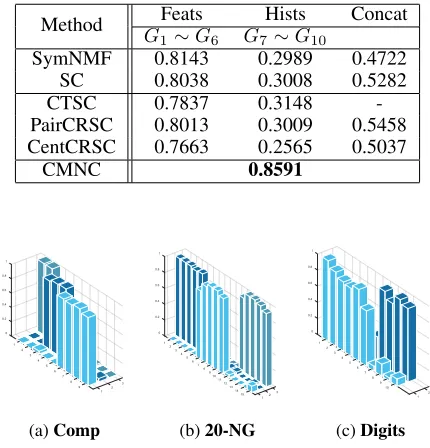
Table 4 shows the 10 runs results of the network groups: hand-picked features (Feats), histogram similarities (Hists) and their concatenation result (Concat). Compared with SymNMF and SC, the multi-view methods’ results of Feats are lower, even though they can learn complementary infor-mation from 6 Feats network. On the other hand, from the result of SC, the Hists can still provide some information but very limited, mostly are hindering the performance of multi-view methods. On the contrary, separating noise network in other networks groups and carry out the clustering task on structured networks, CMNC can fully utilize the comple-mentary knowledge without distraction. Thus, CMNC
out-Table 4: Average NMI of different methods onDigit.
Method Feats Hists Concat
G1∼G6 G7∼G10
SymNMF 0.8143 0.2989 0.4722
SC 0.8038 0.3008 0.5282
CTSC 0.7837 0.3148
-PairCRSC 0.8013 0.3009 0.5458 CentCRSC 0.7663 0.2565 0.5037
CMNC 0.8591
0 0.2
1 0.4
2 0.6 0.8
3 1
4 5
6 7
8 3
9 2
1
(a)Comp
0 0.2
1 0.4
2 3 0.6
4 0.8
5 6 1
78 9
10 1112
13 1415 123
(b)20-NG 0 0.2
1 0.4
2 0.6
3 0.8
4 1
5 6
7 8
9 10
2 1
(c)Digits
Figure 3: MatrixCof CMNC in different dataset.
performs the other baseline methods. More importantly, our method not only picks out the constructive networks but also provide an initial result for further processing.
Indicators Analysis
Figure 3 shows the result factor matrixCobtained in differ-ent dataset. The clear gap between the correct and the wrong assignment indicating that our method is able to utilize the networks in the same category while filter the graphs of ir-relevant categories. Thus, node clustering task can be done individually and the significant improvements are promised.
7
Conclusion
In this paper, we propose a novel tensor decomposition based approach CMNC to solve the multilayer networks clustering with multiple structures. With the tensor repre-sentation, CMNC can effectively differentiate irrelevant net-works into different groups and captures the underlying clus-terings structure from the correlated networks in each group simultaneously. We conduct a thorough discussion and anal-ysis our model theoretically. The effectiveness has been ver-ified by sound experiments.
8
Acknowledgments
References
Cai, D.; Shao, Z.; He, X.; Yan, X.; and Han, J. 2005. Com-munity mining from multi-relational networks. In PKDD 2005, volume 3721 ofLecture Notes in Computer Science, 445–452. Springer.
Cai, D.; He, X.; Han, J.; and Huang, T. S. 2011. Graph reg-ularized nonnegative matrix factorization for data represen-tation.IEEE Transactions on Pattern Analysis and Machine
Intelligence33(8):1548–1560.
Cardillo, A.; G´omez-Gardenes, J.; Zanin, M.; Romance, M.; Papo, D.; Del Pozo, F.; and Boccaletti, S. 2013. Emer-gence of network features from multiplexity. Scientific
re-ports3:1344.
Chen, C.; Xin, J.; Wang, Y.; Chen, L.; and Ng, M. K. 2018. A semisupervised classification approach for multidomain networks with domain selection.IEEE Transactions on
Neu-ral Networks and Learning Systems(99):1–15.
Cichocki, A.; Mandic, D. P.; Lathauwer, L. D.; Zhou, G.; Zhao, Q.; Caiafa, C. F.; and Phan, A. H. 2015. Tensor de-compositions for signal processing applications: From two-way to multitwo-way component analysis.IEEE Signal
Process-ing Magazine32(2):145–163.
Didier, G.; Brun, C.; and Baudot, A. 2015. Identifying communities from multiplex biological networks. PeerJ
3:e1525.
Dong, X.; Frossard, P.; Vandergheynst, P.; and Nefedov, N. 2012. Clustering with multi-layer graphs: A spec-tral perspective. IEEE Transactions on Signal Processing
60(11):5820–5831.
Du, R.; Drake, B.; and Park, H. 2017. Hybrid clustering based on content and connection structure using joint non-negative matrix factorization. Journal of Global
Optimiza-tion.
Dunlavy, D. M.; Kolda, T. G.; and Kegelmeyer, W. P. 2011. Multilinear algebra for analyzing data with multiple link-ages. InGraph Algorithms in the Language of Linear
Al-gebra. Society for Industrial and Applied Mathematics. 85–
114.
Ficklin, S. P., and Feltus, F. A. 2011. Gene coexpression net-work alignment and conservation of gene modules between two grass species: maize and rice. PLANT PHYSIOLOGY
156(3):1244–1256.
Kivel¨a, M.; Arenas, A.; Barthelemy, M.; Gleeson, J. P.; Moreno, Y.; and Porter, M. A. 2014. Multilayer networks.
Journal of Complex Networks2(3):203–271.
Kolda, T. G., and Bader, B. W. 2009. Tensor decompositions and applications. SIAM Review51(3):455–500.
Kolda, T. G.; Bader, B. W.; and Kenny, J. P. 2005. Higher-order web link analysis using multilinear algebra. InICDM 05. IEEE.
Kuang, D.; Park, H.; and Ding, C. H. Q. 2012. Symmet-ric nonnegative matrix factorization for graph clustering. In
SDM 2012, 106–117. SIAM.
Kumar, A., and III, H. D. 2011. A co-training approach for multi-view spectral clustering. InICML 2011, ICML 2011, 393–400. USA: Omnipress.
Kumar, A.; Rai, P.; and Daume, H. 2011. Co-regularized multi-view spectral clustering. In NIPS 24. Curran Asso-ciates, Inc. 1413–1421.
Lathauwer, L. D. 2008. Decompositions of a higher-order tensor in block terms—part II: Definitions and unique-ness. SIAM Journal on Matrix Analysis and Applications
30(3):1033–1066.
Li, S.; Jiang, Y.; and Zhou, Z. 2014. Partial multi-view clustering. InAAAI 2014, 1968–1974. AAAI Press. Liu, J.; Wang, C.; Gao, J.; and Han, J. 2013a. Multi-view clustering via joint nonnegative matrix factorization.
InSDM 2013, 252–260. SIAM.
Liu, X.; Ji, S.; Gl¨anzel, W.; and Moor, B. D. 2013b. Multi-view partitioning via tensor methods.IEEE Transactions on
Knowledge and Data Engineering25(5):1056–1069.
Lloyd, S. 1982. Least squares quantization in PCM. IEEE
Transactions on Information Theory28(2):129–137.
Newman, M. E. J. 2004. Detecting community structure in networks.The European Physical Journal B38(2):321–330. Newman, M. E. J. 2006. Modularity and community struc-ture in networks. Proceedings of the National Academy of
Sciences103(23):8577–8582.
Ni, J.; Tong, H.; Fan, W.; and Zhang, X. 2015. Flexible and robust multi-network clustering. InKDD 15. ACM Press. Paatero, P., and Tapper, U. 1994. Positive matrix factoriza-tion: A non-negative factor model with optimal utilization of error estimates of data values.Environmetrics5(2):111–126. Shi, J., and Malik, J. 2000. Normalized cuts and image segmentation. IEEE Transactions on Pattern Analysis and
Machine Intelligence22(8):888–905.
Tang, W.; Lu, Z.; and Dhillon, I. S. 2009. Clustering with multiple graphs. InICDM 2009, 1016–1021. IEEE. Vervliet, N.; Debals, O.; and Lathauwer, L. D. 2016. Tensor-lab 3.0 — numerical optimization strategies for large-scale constrained and coupled matrix/tensor factorization. In2016 50th Asilomar Conference on Signals, Systems and Comput-ers. IEEE.
von Luxburg, U. 2007. A tutorial on spectral clustering.
Statistics and Computing17(4):395–416.
Wasserman, S., and Faust, K. 1994. Social Network Analy-sis, volume 8. Cambridge university press.