i
tif c n
e C
i o
c n
S f
l e
a r
n e
o n
i c
t e
a 2
nr 0
et 1
1
n I
ISC 2011
Proceeding of the International Conference on Advanced Science,
Engineering and Information Technology 2011
Hotel Equatorial Bangi-Putrajaya, Malaysia, 14 - 15 January 2011
ISBN 978-983-42366-4-9
ISC 2011
International Conference on Advanced Science, Engineering and Information Technology ICASEIT 2011
Cutting Edge Sciences for Future Sustainability
Hotel Equatorial Bangi-Putrajaya, Malaysia, 14 - 15 January 2011
SR IE AUNVIIT
NI
ES E
D K
O B
IN N
R AG
JA A
L S
A A
E N
P M
N A
A L
U A
T Y
A S
S A I
REP
N I
NOI TAI COSSA STNEDUTS NA ISENOD
Organized by Indonesian Students Association Universiti Kebangsaan Malaysia
Proceeding of the
A New Pre-authentication Scheme for
IEEE 802.11i Wireless LAN Network
Rahmalia Syahputri#+, King Sun Chan*
#*
Department of Electrical &Computer Engineering, Curtin University Perth, Western Australia, Australia
E-mail: [email protected]
+Faculty of Computer Science, IBI Darmajaya Bandar Lampung, Lampung, Indonesia
E-mail: [email protected]
Abstract— As 802.11 Wireless LAN network is vulnerable to many security attacks, a complicated authentication mechanism was developed in IEEE 802.11i to enhance the WLAN network security. Unfortunately, the original 802.11i authentication procedure takes some time to complete and it will significantly affect the quality of service offered to mobile users who may handover between several access points. The existing pre-authentication scheme can shorten the authentication time remarkably, but it suffers from the unnecessary signalling overhead which may be a heavy burden to the network. In this paper, we propose to improve the pre-authentication mechanism via reducing the signalling overhead. In our scheme, the mobile user will initiate the pre-pre-authentication with a neighbouring access point only when he is really approaching that particular access point. Therefore, many unnecessary pre-authentication signalling overheads can be avoided. Preliminary simulation results show that signalling overhead can be reduced by 50% while still maintaining short authentication delay.
Keywords— Pre-authentication, handover, delay, cost, signal overlapping.
I. INTRODUCTION
Security and handover are two key issues in wireless local area network (LAN) network. Security is about securely delivering data over the open wireless medium, and handover is to maintain connection while the mobile users are moving from one access point’s coverage area to another access point’s.
With regard to security, problems arise because wireless LAN (WLAN) networks use radio wave as the medium to exchange data and network traffic can be easily snooped by an attacker by simply launching warchalking and wardriving attacks. When an attacker can easily capture and modify the data, wireless LAN networks will lose their confidentiality, integrity and access control and the communication is no longer secure. The handover issue arises from limited coverage area of access point (AP) which is up to 300 meters [1]. This has forced users to handover to keep the connection on when moving out of the current AP’s coverage area to a
new one in the extended service set network, whereby the network consists of more than one AP.
In order to enable secure communication in WLAN, IEEE ratified IEEE 802.11i standard in 2004 [2]. This standard allows wireless LAN network to have secure communication through validation process applied to both the user and the device. Validation is conducted through an authentication phase and it is expected to be able to provide protection against illegal actions carried out by an unauthorized person, such as the release of a rogue AP, masquerading, man-in-the middle attack (MIMA), message modification, and Denial of Service (DoS).
The keys are generated one by one, based on the previously generated keys. The first key is a master key which is created by AS and user or mobile node (MN) separately as a result of the completion of authentication message exchange between them. The master key is used to generate Pairwise Master Key (PMK) that will be shared between AS, MN, and AP [4]. PMK is a root key to generate other keys used to secure communications between user and AP [3]. The successful PMK is then used to derive the next key, called Pair Temporary Key (PTK). Immediately after PTK is generated, it is divided into four keys that will be used to protect the data from being tampering and protects the communication between MN and AP from MIMA attack [5].
Each time a user wishes to participate in communication in network and use its resources such as database and internet, user needs to prove that they are the person that they claim to be (an authorised person) through authentication mechanism. When an enterprise implements IEEE 80211i as its authentication mechanism, it requires a number of keys to be created and distributed. As a result, the authentication phase during handover requires a considerable amount of time. In other words, fast handover is not
supported[6] and multimedia applications suffer due to the
long delay [7] [8].
As mentioned in [9], efficient authentication mechanisms are required to support seamless handovers across access network boundaries. Therefore, a strong authentication mechanism is needed to provide appropriate protection against security attack. But the authentication delay should be limited to avoid degrading the quality of service offered to mobile users performing handover. At the same time, the signalling overhead introduced by authentication should also be limited. In this paper, we introduce our pre-authentication scheme which can achieve all these objectives.
The remaining of this paper is organized as follows. Section II presents a related work in this area. In Section III we explain our proposed scheme. In Section IV we present our simulation results. We conclude our paper in Section V.
II. RELATEDWORK
A number of researches have been conducted in order to shorten authentication time to enable fast handoff. Pack, et al, proposed pre-authentication technique in [10] to overcome long delay in authentication processes. The basic idea is to allow MN and AAA server to exchange some authentication messages in advance, and hence some keys can be derived and then distributed to neighboring APs before MN handovers (make-before-break). The neighboring APs are a set of adjacent APs which is determined by several factors such as location of AP and users’ movement pattern. The adjacent APs are named the frequent handoff region (FHR).
Link weight was introduced in [10] to determine which APs are most likely to be the next AP. The weight between APs was determined by the handoff ratio. For example, the weight of the link from AP1 and AP2 is the number of
handoffs from AP1 to AP2 over the time spent by the MN
with AP1 before handovers to AP2.
A particular parameter, Weight bound value (D), is used
to limit the size of FHR. The total link weight of the APs
included in the FHR should not be greater than D. The main issue in this scheme is how to choose D. When the value of D is high, the mobile user must perform the pre-authentication with a number of APs as the FHR will be big and hence signaling overhead will be heavy; however, if D is chosen to small, the next AP may not be included in the FHR and then the full authentication must be conducted when the mobile user handoffs which leads to long authentication delay.
The other pre-authentication scheme is introduced by Mishra, et al in [11]. They proposed Proactive Key Distribution (PKD) to distribute Pairwise Master Key (PMK) in advance to the nominated AP(s) listed in Neighbour Graph (NG). This method successfully reduced the average authentication delay from 1.1 sec to 50 ms.
There are two ways to generate the NG: it can be generated through a re-association request from MN to new AP which specifies the previous AP; or, it can be generated through move-notify message from current AP to the previous AP using Inter Access Point Protocol (IAAP).
PKD scheme modified the derivation of PMK, which was originally using the following equation:
= − ( ," "|
. | . ) (1)
The PMK was modified into:
= − ( , | _ | _ ) (2)
Where,
n = nth re-association
-1 = previous PMK distribution
When AS sends request to the candidate APs about a particular MN that launches a request to communicate with them, the neighbor APs can ignore or accept the request by sending a notification response. If the APs choose to grant the request, AS will send an access accept packet containing PMKn to target AP. Then the AS notifies MN by sending it the list of APs that have granted the request.
Consider topology in fig. 1, where the MN is currently
associated with AP1. In PKD scheme, AS immediately sends
PMK to AP1’s neighbors (AP2, AP3, AP4, and AP5). When
MN does handoff to one of the APs, say AP2, MN only
needs to perform re-association procedure. Immediately after re-association to the new AP is executed, PMK stored in
AP1’s other neighbours - AP4 and AP5 - will be deleted and
AS will automatically send new PMKs to AP2’s neighbours
(AP1, AP6, and AP8) to facilitate seamless handover.
In fig.1, the mobile user has just done one handover from AP1 to AP2. However, many PMKs are automatically generated and distributed to many neighbouring APs like the
ones distributed to AP3, AP4 and AP5 which are not really
overhead and hence improve the overall network performance.
Fig. 1 Network topology and user’s trajectory
III. PROPOSEDSCHEME
The proposed scheme allows AS to send the PMK to target AP(s) in advance if and only if MN is approaching the
target AP(s). We adopt 802.11i’s EAP-TLS for
authentication as it is considered as one of the strongest authentication mechanisms [4], [12] with strong mutual cryptography authentication between two end points (MN and AS) that can prevent major attack against security.
When MS approaches boundary of overlapping area between neighbouring APs which is called grey area, current AP will notify AS by sending accounting notification. Upon receiving notification from current AP, AS sends PMK in advance to APs related to the overlapping area. The AS will first send a request to the targeting AP(s). When AP(s) receives this request from the AS, it will reply by sending a notify response packet. Then the AS will send an accept packet containing PMK to the AP. If MN is static or not approaching the overlapping area, pre-authentication procedure will be not initiated.
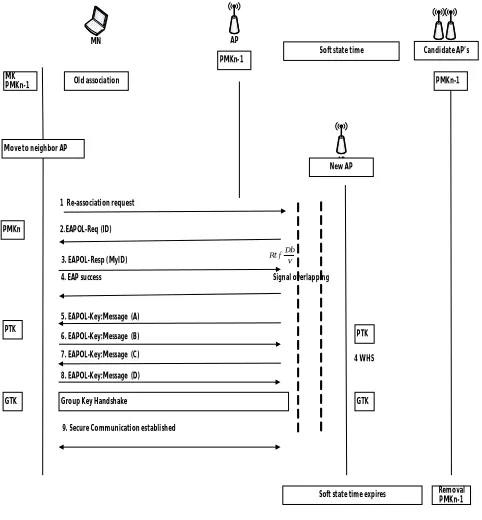
The PMK keys will be kept for specific period (soft state time) by potential AP(s) to allow MN to move to re-association phase. When the time is over without any handover performed by MN to candidate AP, the PMK will expire and be deleted by candidate AP. This modification to initial EAP mechanism is required in order to allow pre-authentication to take place. The detail of proposed scheme is shown in fig.2.
v c
t
Fig. 2 Mechanism of pre-authentication
The PMK generation is modified as follows:
= – ( , | _ | _ ) (3)
Where:
j = potential AP n = nth re-association
PMK = previous PMK distribution at APj
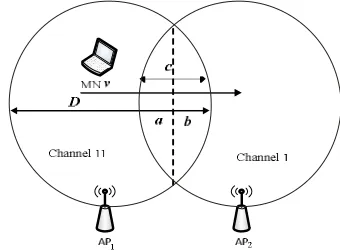
When MN is approaching the boundary signal overlapping
with speed (v) and the coverage overlap between AP1 and
AP2 is c, AS sends the key before MN cross area of c at
diameter a (fig. 3) then the time to do pre-authentication (∆ )
- sends the PMK - can be expressed as:
∆ = (4)
Consider the example we used before in fig. 1, the possible PMKs which may be distributed to AP1’s neighbouring APs are:
AP3:
= – ( , | _ | _ )
AP2:
= – ( , | _ | _ )
AP4:
= – ( , | _ | _ )
AP5:
= – ( , | _ | _ )
After the new AP (nAP) is identified, the MN will conduct re-association with the new AP. In this step, MN only needs to tell nAP its identity to enable EAP communication to take place and to create other keys such as group temporal key (GTK) (fig. 4). MN starts re-association to the nAP immediately when the signal from the potential AP is stronger than the one from the current AP and should be completed before MN leaves the coverage area of previous AP to prevent the connection loss (fig 3).
Fig.3 Time to do pre-authentication and Re-association
Hence, time to do re-association (rt) should be less than or
equal to diameter of coverage area b (Db) divided by speed
movement of MN (v) (fig.3).
∆
=
(5)
steal the PMK. Fig. 3 shows the scheme of re-association between MN and nAP.
MN AP
AP Old association
MK PMKn-1
PMKn-1
Move to neighbor AP
PMKn
Group Key Handshake 5. EAPOL-Key:Message (A)
6. EAPOL-Key:Message (B)
7. EAPOL-Key:Message (C)
8. EAPOL-Key:Message (D) PTK
GTK
PTK
GTK 2.EAPOL-Req (ID)
3. EAPOL-Resp (MyID)
4. EAP success
New AP
1 Re-association request
4 WHS
AP AP Candidate AP’s Soft state time
Removal PMKn-1 Soft state time expires
PMKn-1
9. Secure Communication established
Signal overlapping
v Db Rt
Fig. 4 Mechanism of re-association
IV. SIMULATION,RESULT, AND ANALYSIS
We use ns-2 to evaluate the performance of our scheme. IEEE 802.11g is chosen as our network model as it supports IEEE 802.11i for security. Each of AP’s coverage area is 300 meters, overlapping area between APs is 100 meters, and 3 channels reusing model is adopted (fig.5). The general parameters of simulation are shown as follows:
Table 1 General parameter setting
Parameter Value
Number of nodes 2 users, 9 APs
Radio coverage area 300 m
Topography 600 x 600 m
User Movement Speed 10 ms
Power at transmitter 0.281838
RTS threshold 1000 bytes
AP’s beacon interval 0.2
MAC address Auto
Fig.5 Channels re-use model
Topology below shows the APs’ physical position and its overlapping area and MN’s physical movement from first movement until fifth. However, in our simulation, eleven movements are conducted to get more accurate evaluation.
Fig. 6 Network topology and MN’s trajectory
Current position of MN 1 is attached to AP0 and sends
UDP packets to a correspondent. The doted circle is the first AP that MN is connected to. The red dot color is the location where pre-authentication started to take place, because at
this point the MN can hear both AP0 and AP1. The green dot
indicates when pre-authentication should be completed and
re-association to AP2 should be initiated. After a random
delay, the MN starts to move through all the areas from
position 0 (P0) until position 11 (P11) without pause until the
simulation time is over.
Based on simulation, MN experiences 16 handovers within 11 movements. It happened because for some movements, the MN may experience two handovers, due to the distance from current positions to the next position which is far enough. Consequently, to maintain the connection, MN needs to handoff to the closet AP before it reaches the designated AP.
Based on number of handovers, the cost to pre-authenticate and re-associate can be calculated. The term of cost in this paper refers to number of message exchanges between network entities: MN, AP, and AS during the
movements. For each message sent, it has a cost of t. The
signaling flowchart in our scheme is almost the same as the one described in the PKD scheme; the difference is about when the signaling is sent and who are involved in the signaling.
We give an example to explain how the total cost is calculated. We consider the movement of the MN from position P0 to position P1, where the MN handovers from
AP0 to AP1. At position P0, MN1 is attached to AP0 and
starts to send UDP packets to its correspondent. At time (t0),
MN starts to move to position P1, which leads to
approaching the overlapping area between AP0 and AP1.
When the MN hears the signal from AP1, AS sends the
appropriate PMK to AP1 with cost 7t. When the MN finds
the signal from AP1 is stronger than the one from AP0, the
0 10 20 30 40 50 60 70
1 2 3 4 5 6 7 8 9 10
PS PKD
No. of Movements Cost
0 10 20 30 40
1
PS PKD Cost
No. of Movements
is the first association, the cost will be added with full
authentication which requires 16t. The total cost is 31t. Full
authentication is only needed when the MN is associated with the network first time. The subsequent authentication with other APs is achieved via pre-authentication.
The total cost of each movement for our scheme and for PKD scheme is shown in fig. 7. In Fig. 8, we show the difference of signaling cost from our scheme and from PKD, when the MN is static.
Fig. 7 Cost of PMK distribution and re-association at random movement
Fig. 8 Cost of PMK distribution and re-association at Null movement
From fig. 7, it can be seen that the cost of PKD scheme is higher than our proposed scheme. This is because each time new re-association is executed, the new AP or AS sends the PMK immediately to the neighbor APs, for instance a
movement from P0 to P1. At position 0 – or known as initial
connection – MN performs full authentication, then AS
immediately sends the key to AP1 and AP3 which is
considered as AP0’s neighbor. When MN moves to P1, MN
is able to re-associate directly to AP1. When re-association
done, AS sends PMK to AP1’s neighbor (AP0, AP2, and
AP4). In our proposed scheme, the AS sends the PMK in
advance only when the key distribution is triggered. Thus, this act will save cost and does not keep the AS busy.
For each movement of 6, 7, 8, and 9, multiple handovers
occur. Consider The MN movement from P5 to P6, MN first
pre-authenticates and re-associates with AP5 before finally it
pre-authenticates and re-associates with AP2. Cost for the
proposed scheme is only half of the PKD scheme.
Fig.8 shows the cost when MN does not do any
movement and keeps its connection to the current AP (AP0).
The proposed scheme shows that the cost occurs only at the initial authentication, the PKD scheme cost is higher because AS sends the PMK to NG though MN is static.
V. CONCLUSION
The 802.11 wireless LAN network is vulnerable to many security attacks. Authentication is a promising mechanism to enhance security for wireless LAN network. Unfortunately,
the standardized 802.11i authentication mechanism
introduces a long delay which may degrade the quality of service received by mobile users. Pre-authentication scheme like PKD can shorten the authentication delay significantly but suffers from heavy unnecessary signalling overhead as it requires to pre-authenticate with all neighbouring access points. In this paper, we propose to initiate the pre-authentication only when it is necessary and therefore reducing the signalling overhead and still maintains short authentication delay. Simulation results show that our scheme can reduce the signalling overhead by almost 50%.
REFERENCES
[1] Cisco Networking Academy Program. (2004).“Fundamental of
Wireless LANs Companion Guide”. Cisco Press.
[2] He, Changhua., Mitchell., John C . (2005) "Security Analysis and
Improvements for IEEE 802.11i". Proceedings of the 12th Annual Network and Distributed System Security Symposium.
[3] Frankel, Sheila., Eydt, Bernard., Owens, Les., Scarfone, Karen.
(2007). "Establishing Wireless Robust Secure Network: A Guide to IEEE 802.11i". National Institute of Standards and Technology, Technology administrations U.S, Department of Commerce, Special Publication 800 - 97.
[4] Aboba, Bernard D, Simon. (1999).” PPP EAP TLS Authentication
Protocol”. RFC 2176. http://www.ietf.org/rfc/rfc2716.txt
[5] Edney, Jon., Arbaugh, A.William. (2004). " Real 802.11 Security:
Wi-Fi Protected Access and 802.11i". Addison Wesley.
[6] Marques, Rodolphe., Zuquete, Andre. (2008). "Fast, Secure
Handovers in 802.11: Back to the Basis". Proceedings of the 4th ACM symposium on QoS and security for wireless and mobile networks , pp 27 - 34.
[7] Pack, Sangheon., Choi, Jaeyoung., Kwon, Taekyoung., and Choi,
Yanghee. (2007). Fast Handoff Support in 802.11 Wireless Network". IEEE Communication Survey and Tutorial.
[8] Lopez, R., Dutta, A., Ohba, Y., Schulzrinne, H., and A. Skarmeta.
(2007). "Network-layer Assisted Mechanism to Optimize
Authentication Delay During Handoff in 802.11 Networks". The 4th Annual International Conference on Mobile and Ubiquitous Systems: Computing, Networking and Services.
[9] Wienzek, Ralf., Persaud, Rajendra, (2006). Fast Re-authentication for
Handovers in Wireless Communication Networks". Networking 2006, LNCS 3976, pp. 556–567.
[10] Pack, Sangheon., Choi, Yanghee. (2002). "Fast Handoff Scheme
Based on Mobility Prediction in Public Wireless LAN System". in
Proc. IEEE Networks 2002 (Joint ICN 2002 and ICWLHN 2002), Atlanta, USA.
[11] Mishra, Arunesh., Shin, Minho., and Arbaugh, William.,(2004).
"Pro-active Key Distribution using Neighbor Graphs". IEEE Wireless Communications February 2004.
[12] Earle, Aaron E. (2006). "Wireless Security Handbook". Auerbach