Fall 2018
Continuous User Authentication via Random Forest
Continuous User Authentication via Random Forest
Ting-wei Chang
Iowa State University, [email protected]
Follow this and additional works at: https://lib.dr.iastate.edu/creativecomponents
Part of the Other Computer Engineering Commons
Recommended Citation Recommended Citation
Chang, Ting-wei, "Continuous User Authentication via Random Forest" (2018). Creative Components. 49. https://lib.dr.iastate.edu/creativecomponents/49
Ting-Wei Chang
A thesis submitted to the graduate faculty
in partial fulfillment of the requirements for the degree of
MASTER OF SCIENCE
Major: Computer Engineering
Program of Study Committee: Daji Qiao, Major Professor
The student author, whose presentation of the scholarship herein was approved by the program of study committee, is solely responsible for the content of this dissertation/thesis. The Graduate College will ensure this dissertation/thesis is globally accessible and will not permit alterations
after a degree is conferred.
Iowa State University
Ames, Iowa
2018
DEDICATION
I would like to dedicate this thesis to my parents, without their support I would not have been
able to complete this work. I would also like to thank my major professor Dr. Qiao for his patient
TABLE OF CONTENTS
Page
LIST OF TABLES . . . v
LIST OF FIGURES . . . vi
ACKNOWLEDGMENTS . . . vii
ABSTRACT . . . viii
CHAPTER 1. Introduction . . . 1
CHAPTER 2. Background . . . 3
2.1 Random Forest . . . 3
2.1.1 Decision tree . . . 3
2.1.2 Bagging . . . 4
2.1.3 Algorithm of random forest . . . 4
2.1.4 Others properties of random forest . . . 5
2.2 Principle Component Analysis(PCA) . . . 6
2.3 Synthetic Minority Oversampling Technique(SMOTE) . . . 6
CHAPTER 3. Application of Random Forest . . . 8
3.1 Threat model . . . 8
3.2 System model and definition . . . 9
3.3 Design goal . . . 10
3.4 Methodology . . . 11
3.4.1 Data preprocessing . . . 12
3.5 Behavior Feature Extraction . . . 13
3.6 Random Forest for Learning and Classification . . . 15
3.6.1 Behavior Feature Classifier . . . 15
CHAPTER 4. Evaluation . . . 17
4.1 System performance . . . 18
4.1.1 Parameter Setup . . . 18
4.1.2 Performance Metrics . . . 18
4.1.3 Accuracy . . . 19
4.1.4 Delay of Detection . . . 20
4.2 Effect of Models and Parameters . . . 21
4.2.1 Effect of Size ofn-action-gram . . . 21
4.2.2 Effect of Feature Reduction and SMOTE . . . 22
4.3 Discussion . . . 23
4.3.1 Scalability of User Pool . . . 23
4.3.2 Comparison with other machine learning techniques . . . 24
LIST OF TABLES
Page
4.1 Area under curve(AUC) and equal-error rate (EER). The values are the
mean of 50 users . . . 19
4.2 Equal-error rate (EER) for differentnin n-gram. The values are ”mean(standard
deviation)” . . . 22
4.3 Dimensions ofn-action-gram behavior feature vectors before and after
fea-ture reduction. . . 22
LIST OF FIGURES
Page
2.1 Overview of random forest. . . 4
3.1 An example snapshot of a system log. . . 9
3.2 A generic model of user interactions with a software system. . . 10
3.3 Two-step user authentication with our proposed monitoring engine. . . 11
3.4 Overview of the proposed behavior and context monitoring engine. . . 12
3.5 An example global 2-action-gram feature space G under the activity se-quence model. In this example, d= 15 unique 2-action-grams are present in the training data. . . 15
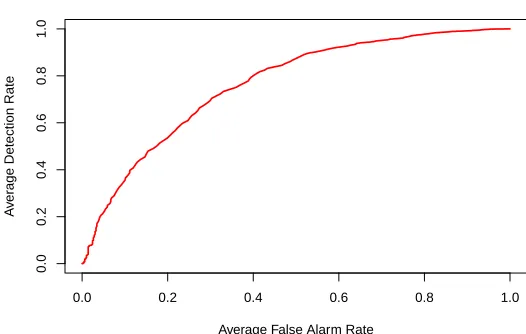
4.1 Average ROC curve of 50 users. . . 20
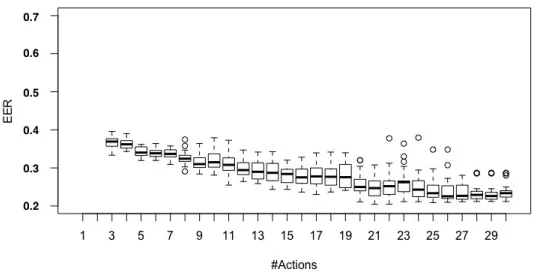
4.2 EER of all users versus the number of observed actions. Upper line is maximum, upper bound of the box is 75% quantile, line in middle is median, lower bound of the box is 25% quantile, lower line is minimum, and the circles are outlier. . . 21
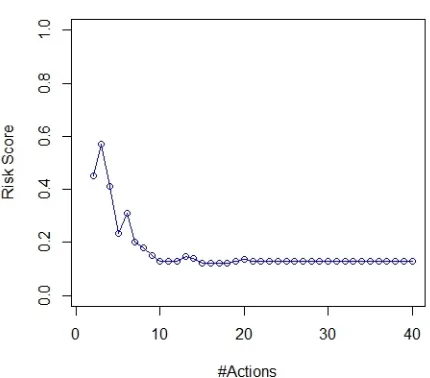
4.3 Example of legitimate user. . . 22
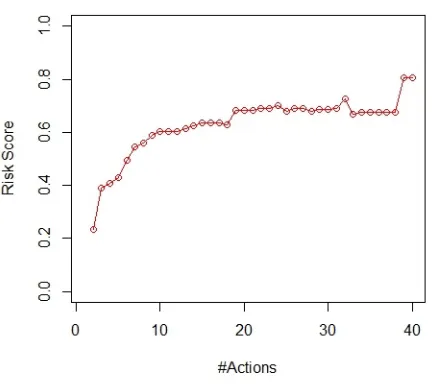
4.4 Example of imposter. . . 23
ACKNOWLEDGMENTS
I would like to take this opportunity to express my thanks to those who helped me with various
aspects of conducting research and the writing of this thesis. First and foremost, Dr. Daji Qiao for
his guidance, patience and support throughout this research and the writing of this thesis. I would
also like to thank Shen Fu for his help during this work, he gave many advise which inspire me to
ABSTRACT
Random forest is an important technique in modern machine learning. It was first proposed in
1995, and with the increasing of the compute power, it became a popular method in this decade.
In this paper, we present the background knowledge of random forest and also have comparison
with other machine learning methods. We also have some discussion of data preprocessing and
feature extraction. Then we study the application of random forest to a real world problem - an
authentication system which for continuous user authentication approach for web services based on
the user’s behavior. The dataset we used for evaluate is given by Workiva company, and the result
CHAPTER 1. Introduction
There has been plenteous interest in ensemble learning in recent year methods which has been
study by using multiple learning algorithms and aggregate their results to obtain better predictive
performance. Two most popular methods are bagging [1] and boosting [8] of classification trees.
Bagging stands for bootstrap aggregation, which reduce the variance of an estimate is to average
together multiple estimates. This can be implied that trees do not depend on earlier trees, each
bootstrap sample of the data set is independently constructed. The main principle of boosting is to
fit the decision trees to weighted versions of the data that are able to convert to stronger learner.
Then the predictions combined through a weighted majority vote to produce the final prediction.
[6] had first proposed the random decision forests using the random subspace method, which
implement the stochastic discrimination approach to classification. [1] introduced an extension of
the algorithm, it combines the idea of bagging and random selection of features. Random forest is
constructed by each tree using a different bootstrap sample of the data, which is only a subset of
the predictor variables is used. In each tree, nodes are split using the best split among all variables.
Then random forest using the best split among a subset of predictors to split the node. This
strategy gives random forest an outstanding performance even if compare to other classifiers, such
as support vector machine(SVM), nave bayes and K-nearest neighbor. Moreover, random forest
is flexible, easy to use machine learning algorithm that has only two hyper-parameter tuning (1)
Number of trees in the forest. (2) Number of variable in the random subset at each node. The
simplicity and the fact that it can be used for both classification and regression tasks makes the
random forest become one of the most used algorithms. The advantage of RF compare to other
classifiers are listed as follows:
• Runs efficiently on large data
• Give in formation about the relation between the variable and the classification.
• Little influence by the outlier and bad feature
The rest of this paper is organized as follows. In the chapter 2, we introduce the background of
random forest and compare it with other classifiers. Furthermore, we also introduce two methods for
data prepossessing which we have used in this paper. We discuss our main objectives, methodology
and the application of random forest in a real world problem is proposed in chapter 3. In chapter
4, we show the evaluation and discussion for our result. In chapter 5, we conclude the result and
CHAPTER 2. Background
2.1 Random Forest
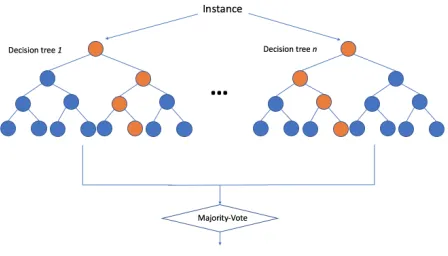
Random Forest is a supervised learning algorithm. The main idea of random forest is ensemble
many of decision tree to make a better prediction.
2.1.1 Decision tree
Decision tree is a decision support tool that uses a top-down tree-like model. Each internal
node in the tree represents a verification on an attribute, each branch represents the outcome of
the verification, and each leaf node represents a class or label. Generally, the decision trees are
used in operation research and calculating conditional probabilities, it should be paralleled by a
probability model as a best choice model.
There are 3 kinds method that we commonly used for decision tree, ID4, C4.5, CART. When
we building the tree, we need to extract the features from data as decision nodes. The principle
of choosing the features is that the features we chose can separate the different classes as much as
possible, this can be estimated by information gain, Gini coefficient, etc.
Pruning Optimal size of the final tree is one of the critical questions in the decision tree
algorithm. If the decision tree is too small, it might not capture the important information about
the data space. On the other hand, if the decision tree is too large, there might cause a problem
of overfitting on the training data and poorly generalizing to new samples. Nonetheless, it is
difficult to tell when to stop when growing a tree because it is impossible to tell if the addition
of a single extra node will significantly decrease error. This kind of issue is known as the horizon
contains a small number of instances, then use pruning to remove those nodes which do not provide
[image:13.612.196.420.157.285.2]sufficient information.
Figure 2.1 Overview of random forest.
2.1.2 Bagging
Bagging, also called bootstrap aggregating is a technique for ensemble learning. The main
purpose of this method is to reduce variance and helps to avoid over-fitting problem. Here we use
bagging to the tree learner, given a training dataX =x1, , x2 and corresponding labelY =y1, , yn,
bagging repeatedly selectskrandom sample with replacement and fits trees to these samples. After
training, predictions for testing sample x can be made by taking the majority vote in the case of
classification trees.
Simply training many trees on a training data would give strong correlated trees. Bootstrap
sampling is a way to de-correlating the trees, which means even though the prediction of single tree
is sensitive to outliner or noise, the average of the forest is not. The procedure of bagging leads to
a better performance because it reduces the variance of the model without increase the bias.
2.1.3 Algorithm of random forest
The algorithm of random forest is quite easy to understand and simple as follows:
the best split among all predictors, we randomly sample mtry of the predictors and choose
the best split from among those variables.
3. Predict testing data by aggregating the predictions ofntree trees. (majority vote)
2.1.4 Others properties of random forest
Out of bag(OOB) In the training process, each tree is bootstrap from data which allow the
rest of the data consider as the testing set, this is called out-of-bag(OOB) sample. The excluded
OOB sample is used to evaluate the performance of the random forest in training by estimate the
mean square error(MSEOOB):
M SEOOB=n−1 n X
i=1
(yi−yˆiOOB)2 (2.1)
Where ˆyOOB is the average of the OOB predictions for the ith observation. The result of a
random forest is one single prediction which is of the average over all aggregations. The evaluation
of OOB has been proved is quite accurate, given that enough trees have been grown. (Bylander
2002)
Variable importance Random forest can be used to rank the importance of variables in
classification problem. The following methods has been described in Breimans paper. First, we
fit random forest to the training data, then the OOB error for each data point is recorded and
averaged over the forest during the fitting process. Then the importance score for the features are
computed by averaging the difference in OOB error before and after the permutation over all trees.
The score is normalized by the standard deviation of these differences. Features which has higher
score are ranked as more important than the features which has smaller value. However, there
are some drawbacks of determine the variable importance. For those data including categorical
variables with different number of levels, random forest are biased in favor of those attributes with
2.2 Principle Component Analysis(PCA)
The curse of dimensionality is one of an important is- sue in the data processing. One of the
solution is data extraction, mapping the data into a lower dimension. Extracting the data from a
higher dimension to a lower dimension not only can improve the performance of the classifier, but
also can reduce the data size. In this paper, principle component analysis(PCA)[7] is used to convert
our data into a set of values of linearly uncorrelated variables. PCA is mathematically defined as
an orthogonal linear transformation, it transform the largest variance of feature in the data comes
to lie on the first coordinate, also called the first component, and so on. For a p-dimensional data,
the transformation is defined as a set of weights vector, wk= (w1, w2, ..., wp)k that map each row
vectorx(i) of X to a new vector of principle component scorest(i)= (t1, t2, ..., tm)
tk(i) =x(i)·w(k)f or i= 1to n, k = 1to m (2.2)
To maximize the variance, the first vector
wi = argmax X
i
(t1)2(i), (2.3)
sincew(1) has been defined as a unit vector
wi = argmax
wTXTXw
wTw , (2.4)
After we find the w(1), the first principle component of a data vector x(i)can be given as t1(i) =
x(i) ·w(1)in the transformed co-ordinates. The further components can be found in the same
method.
2.3 Synthetic Minority Oversampling Technique(SMOTE)
Learning from the imbalanced data can cause suboptimal classification performance. In the
previous works, a number of solutions to the imbalance problem were proposed. The simplest
dataset, solution includes adjusting the threshold of various classes, adjusting the costs of different
classes. The synthetic minority oversampling technique(SMOTE) [2] is one of the solution to the
imbalance data. SMOTE oversampling the minority by creating synthetic example along the line
segments in feature space, then joining any of the n nearest neighbors which is also minority class.
The amount of oversampling is influence by the number of randomly selected neighbors from the n
nearest neighbors. For the majority class, it is undersampled by randomly removing samples until
CHAPTER 3. Application of Random Forest
In this paper, we propose a method to implement random forest to a continuous authentication
software systems. The framework features a monitoring engine that supplements and enhances
the standard two-step authentication architecture used by companies such as Google, Facebook,
Twitter, etc.
The goal in this section is to indicate a) what kind of problem and scenarios our authentication
framework mainly focus on b)Introduce all the definitions in this system c) Define what kind of
dataset can be used for training in our framework, and d) the design goals we expect our approaches
to achieve.
3.1 Threat model
In practice, most software systems only perform user authentication when a user logs in to the
system. Once an attacker passes the initial authentication, the attacker has complete control and
access to the user’s account. Clearly, password authentication is not sufficient for our threat model,
and another layer of protection is needed to deal with these impostor attacks.
The software system discussed above may experience various types of attacks. In this work,
we focus onimpostor attacks, with impostor defined as an illegitimate user who accesses a system
by pretending to be a legitimate user. In our threat model, an impostor may attack in one of the
following ways:
Obtaining credentials (software level) The impostor obtains the password or other login
device, such as a workstation, that is already logged into the system by a legitimate user.
3.2 System model and definition
In this work, we consider a generic software system as follows.
• Each user account in the system has a username as its unique identifier and a password
needed to log into the account.
• After users log in, they interact with the software system by performing a stream of operations,
such as read, write, change, and more.
• Each user’s operation stream is recorded in a system log as a sequence of tuples consisting
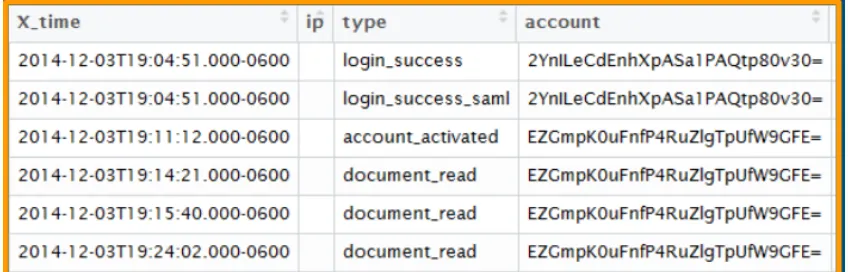
of system time, operation type, and additional information. Figure 3.1 shows part of a real
[image:18.612.94.519.446.582.2]system log provided by Workiva.
Figure 3.1 An example snapshot of a system log.
Action: Theaction of a user’s operation is a categorical variable clearly describing the
oper-ation type. The action is the major feature representing the user behavior in an operoper-ation stream.
”doc-ument read” in Figure 3.1. In some systems, the action is not explicit and needs to be extracted
from the operation stream as part of data preprocessing.
Session: A session is a section of an operation stream. In our approach, session is a general
concept, not a specific application term. We partition the operation stream into sessions based on
either explicit login/logout operation, or long idle-time intervals (timeouts). We classify users based
on sessions, instead of considering the entire operation stream, to make computations manageable.
Our target software system could be hosted locally or remotely. Figure 3.2 shows a generic
model of interactions with such a software system, whereai denotes the action of theithoperation
of a session andti denotes the time interval between operations iand i+ 1.
Time
login
read
browse
write
logout
a
1a
2a
3a
L-1a
Lt
1t
2idle
login
[image:19.612.82.533.339.408.2]t
L-1Figure 3.2 A generic model of user interactions with a software system.
3.3 Design goal
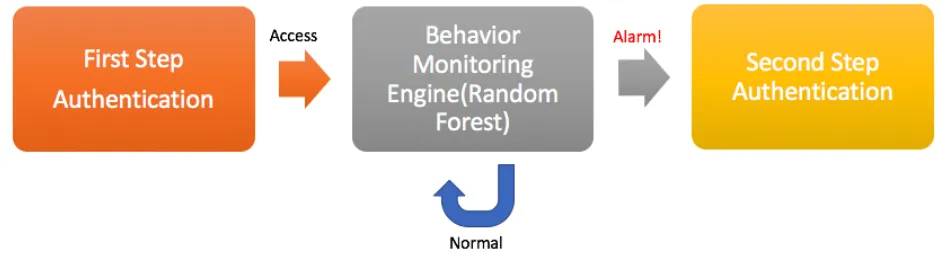
To deal with impostor attacks, we introduce an monitoring engine into the common two-step
user authentication framework. As shown in Figure 3.3, our monitoring engine sits between the
first authentication and the second authentication. The engine monitors the user’s behavior
con-tinuously, comparing it with a pre-established user profile. If the user’s behavior or context differs
from normal, our monitoring engine raises an alarm, triggering the second step of authentication.
The design goals for our monitoring engine are to:
• Provide continuous user authentication to defend against impostor attacks.
• Detect impostors quickly after the intrusion occurs.
(FRR) and false-acceptance rate (FAR).
Figure 3.3 Two-step user authentication with our proposed monitoring engine.
3.4 Methodology
Figure3.4shows an overview of our behavior monitoring engine. The engine is broken down into
four modules: thedata preprocessing module, thefeature extraction module, thelearning
module, and the classification module. The data preprocessing module adapts the users’ raw
data (operation stream) for our engine and partitions it into sessions. In the training process, the
feature extraction module determines the behavior information features of each user and passes
them to the random forest training for profile establishment. In the testing process, the feature
extraction module passes the features of operations to the classification module in real-time, which
assigns a risk score that estimates the probability that the current session belongs to an impostor.
The risk score is converted into a binary result (impostor or not) by comparing it to a discrimination
threshold. In the remainder of this section, we describe our preprocessing, feature extraction, and
Figure 3.4 Overview of the proposed behavior and context monitoring engine.
3.4.1 Data preprocessing
Real-world data is often incomplete, inconsistent, and noisy. Good data preprocessing not only
makes the data usable, but also increases the performance of the system. The details of data
preprocessing are usually data-dependent, so here we only discuss general data preprocessing that
is appropriate for a typical dataset used in our approach. We outline two main steps: preprocessing
the operation stream, and extracting sessions.
The raw data of users in our system is expected to be a stream of categorical variable tuples,
usually including timestamp, operation type, user identification, and more. In this step, we remove
tuples which are meaningless operations or are not generated by the user. For example, consider
a tuple with operation type ”logout−timeout,” generated by the system automatically after the
user does not perform any operations for an amount of time. This tuple does not provide useful
the following ”logout” operation. However, in our experience, many users of software systems such
as web services do not logout manually. These users either let the system automatically logout due
to timeout, or perform operations regularly enough to remain logged in indefinitely. Therefore, we
use time-stamps as a supplemental method for extracting sessions. In this method, if a user does
not perform any operations for a certain length of time, we consider the previous operation tuple to
be the end of the session and consider the next operation tuple to be the start of a new session. Our
behavior feature extraction procedure consists of two steps: construction of a categorical variable
sequence for each session, and generation of a numeric feature vector representing each of the
sequences.
3.5 Behavior Feature Extraction
In this step, we transform the tuples from preprocessing into a sequence of categorical variables.
We propose two different models for this transformation: an activity sequence model, and a ”hybrid”
model that utilizes both activity sequences and time intervals.
Activity Sequence Model: In the activity sequence model, a session is represented as a
sequence of actions sorted by order of arrival. This model can distinguish legitimate users and
impostors if they focus on different activities and have different activity transition patterns.
For-mally, given the set of allrpossible operation typesO={type1, type2, ..., typer}, using the activity
sequence model, the sequence S of one session with L actions is S = (a1, a2, a3, ..., aL), where
ai ∈ O is the ith action of the user in the session. For example, if the operation stream in
Fig-ure 3.1 is a complete session, the behavior sequence of this session using the activity sequence
model is S = (login success, login success saml, account activated, document read, document read,
document read).
Hybrid Model: In the hybrid model, we consider both the order of actions in a session and
except between each pair of consecutive actions, we insert an additional entry that represents the
time between the actions. Formally, the sequence is S = (a1, t1, a2, t2, ..., aL−1, tL−1, aL), where
ai∈O is as before, andti is the time between ai andai+1. To apply this model in our framework,
ti must be a category value. We obtain category values from integer time values (e.g. seconds) by
placing the integer time values into log-scale buckets and mapping each bucket to a category index
number. Specifically, we map an integer time valuet to the categorytdiscrete as follows:
tdiscrete= [log10(t)], f or t >0, (3.1)
and tdiscrete = 0 for t= 0. With this method, the sequence S contains only categorical variables,
as in the activity behavior model. Again using the operation stream in Figure 3.1 as an example
session, the behavior sequence using the hybrid model isS = (login success, 0, login success saml,
3, account activated, 3, document read, 2, document read, 3, document read).
3.5.1 Generating a Numeric Feature Vector
In the second step of behavior feature extraction, n-action-gram representation is used to
gener-ate a numeric feature vector from each sequence. To do this, we first need to determine the globaln
-action-gram feature space. Given a sequence under the activity sequence modelS= (a1, a2, ..., aL),
the set of all types of n-action-grams (consecutive action subsequences of length n) appearing in
the sequence is denoted A(S). For the hybrid modelS = (a1, t1, a2, t2, ..., aL), eachn-action-gram
also includes the n−1 time intervals between the actions, for a total length of 2n−1 for each
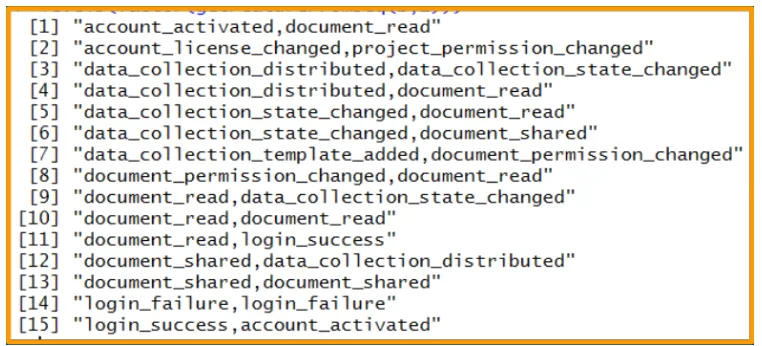
subsequence. Suppose that duniquen-action-gram subsequences are present in the training data,
and assume that these d subsequences are all of the subsequences that will occur in practice.
Then, given the data sequences S1,S2, ..., SM, the global n-action-gram feature space is defined
as G = MS i=1
A(Si) = {b1, b2, ..., bd}, where bj is one type of n-action-gram. An example global
n-action-gram feature space is shown in Figure3.5.
Finally, for each sequence, we use a numeric vector~vof fixed lengthdto represent the sequence,
vi =
q(bi)
Pd
j=1q(bj)
, (3.2)
where q(bi) is the count of n-action-gram types bi in the sequence. Note that, after representing
each behavior sequence as a vector, the distance between two sequences can be computed as the
[image:24.612.116.497.225.398.2]Euclidean distance of their feature vectors.
Figure 3.5 An example global 2-action-gram feature spaceG under the activity sequence model. In this example, d = 15 unique 2-action-grams are present in the training data.
3.6 Random Forest for Learning and Classification
This section describes how random forest learning and make the real-time classification. The
random forest use behavior information features defined above.
3.6.1 Behavior Feature Classifier
The monitoring engine is based on random forest classifier which use behavior feature as training
data. The training process can be divided in to 3 steps:
Step 1. Before learning, we bind the behavior feature vectors of all sessions of training data
lower-dimensional approximation of the data. PCA converts data into a set of scores corresponding
to different linearly uncorrelated variables (principal components). After PCA, we recreate the
feature space while ignoring all principal directions with a standard deviation of corresponding
principal scores less than 1% of the top principal direction. In this way, the number of feature
dimensions is greatly reduced. For example, in our evaluation, feature dimensions were reduced
from 1,214 to 540 when using the 2-action-gram hybrid sequence model.
Step 2. Training datasets for our monitoring engine can be greatly unbalanced. Usually, much
more of the data is from legitimate users than impostors, though in some situations, the opposite can
be true. Either way, learning from this unbalanced data can lead to poor classification performance.
We use the Synthetic Minority Oversampling Technique (SMOTE) [2] to deal with this issue. The
SMOTE algorithm generates a new, balanced dataset. SMOTE over-samples each minority class
sample by creating synthetic examples along the line segments joining all of the sample’skminority
class nearest neighbors. At the same time, SMOTE under-samples the majority class data.
Step 3. The balanced data generated by SMOTE is passed to random forest classifier then
starts training. The training result for each user will save as an”user profile”.
In the testing process, given the input session of a particular user into his user profile, the
classifier returns a behavior-based risk score. The risk score is computed as the fraction of decision
trees that classify the input session as belonging to an impostor.
If an impostor successfully logs into the system and starts performing operations, the monitoring
engine should raise an alarm as soon as possible. Therefore, in practice, the behavior risk score is
computed based on all operations in the current session and is updated whenever a new operation
CHAPTER 4. Evaluation
In this work, we want to evaluate how random forest perform for our approach on a real dataset
given by a Workiva which provides a cloud platform for reporting, compliance and data management
services. For each user in the dataset, his/her operation stream over the course of a month has been
recorded in the form of tuples with six categories: ”time”, ”IP”, ”operation type”, ”account
ID”, ”user ID”, and ”document.” We extract the n-action-gram behavior features from the
sequence of ”operation type,” while ”time” and ”IP” are used as context features in our approach.
Each day is divided into 4 intervals.
Insufficient of history data from some of the users has been found from our observation, which
can lead to an inaccurate prediction. Therefore, we chose the users who participated over 15 days
in a month, and contributed a variety of actions among the dataset. That is roughly 50 users match
the condition. In each scenario, we assume there is only one legitimate user, the other 49 users
are consider as impostors. One of the significant distinction between this work and most of the
previous work is that our dataset does not contain any data from real impostors. Therefore, we
evaluate our authentication system for each user by using the data of other users as impostors (i.e.
1 versus 49). This is a challenge for us, because the behavior from legitimate users can be very
similar. For each user in the dataset, we select 30% of the user’s sessions as testing data, resulting
in 70% of the sessions being used for training.
Since the data of each user is a operation stream through the whole month and it’s obviously
not reasonable to make a classification based on the entire stream, we first divide the stream into
many meanful pieces in data pre-processing, called session. Then our classification can be based
on sessions. The simplest way to define session is consider the interval between ”login success” and
”logout success”. However, according to our experience, most of the user don’t logout manually.
the time stamp as the condition to define the session of actions is more reasonable. Thus we use
60 minutesas the idle to separate sessions, as shown in Figure3.2.
4.1 System performance
4.1.1 Parameter Setup
For our evaluation, we implemented our proposed framework in the R language. In the data
preprocessing module, we use 60 minutes as the idle interval to separate sessions. In the
behavior-based classifier, by default we use the 2-action-gram hybrid model. In this work, we use random
forest (RF) as our behavior-based classifier.
There are 2 parameter that we need to tune for the random forest: number of trees(ntree) and
number of features for splitting at each tree node(mtry). Large number of trees produce more
stable models and co-variate importance estimates. However, it will require more memory and
longer running time. It has been discussed by [10] and proved that 500 trees is sufficient for a large
dataset, so we set ntree to 501. There is some discussion in the literature about the influence of
mtry. (Cutler 2008) claimed that different values of mtry did not affect the correct classification
rates of their model and other performance metrics such as AUC, ROC, etc., were stable under
different values of mtry. On the other hand, [10] reported that mtry has a strong influence on
predictor variable importance estimates. Generally, people tends to avoid the correlation of each
features, which recommend using less number of features in each tree such as 3/mor√m. In this
paper, we use √mas our mtry.
4.1.2 Performance Metrics
ROC Curve and AUC The receiver operating characteristic (ROC) curve [5] is a universal
metric for classifiers that output a probability score, making it a good choice for evaluation. The
ROC plots the true positive rate (TPR) against the false positive rate (FPR) of a binary classifier
approaching 1.0 indicates perfect performance of a classifier.
EER The error rate of a classifier characterizes how often the classifier correctly classifies
testing samples, making it more intuitive and easier to understand than the ROC curve and AUC.
We use equal-error rate (EER) [9] as our system metric instead of (ordinary) error rate, due to the
fact that our dataset is heavily unbalanced for two-class classification (one legitimate user versus
49 impostors). EER provides a better measure of our framework’s performance; for example, if the
classifier predicts all the testing samples to be majority class, the (ordinary) error rate can be very
low, but for our unbalanced dataset, this does not mean the classifier has good performance. EER
can be easily computed from the ROC curve by finding the point at which FPR is equal to the
false-negative rate (FNR).
Delay of Attack Detection For a real-time authentication system, another important metric
is the delay before an attack is detected, meaning the time between an impostor’s login and the
alarm raised by the system. The delay of attack detection can be represented as EER versus the
number of observed actions.
4.1.3 Accuracy
Figure 4.1 shows the average ROC curves of all users. The details of the ROC curves can be
found in Table 4.1. Most of the user in this work has achieved 0.7751 in AUC, however, some of
the users are difficult to classify, this kind of the users will be discuss later in this chapter.
Average Standard Deviation
Area Under Curve 0.7751 0.0238
Equal-Error Rate(%) 25.76 10.97
Average False Alarm Rate
A
v
er
age Detection Rate
0.0 0.2 0.4 0.6 0.8 1.0
[image:29.612.166.429.132.299.2]0.0 0.2 0.4 0.6 0.8 1.0
Figure 4.1 Average ROC curve of 50 users.
4.1.4 Delay of Detection
To make our system more practically useful, our monitoring engine should be able to quickly
detect an impostor. In this section, we evaluate how many actions are required to accurately classify
legitimate users and impostors. We expect the EER to decrease quickly at the beginning, as the
number of observed actions increases, and eventually become stable.
To evaluate the delay of detection, we use testing data to simulate real-time users. Given a
testing session as described in Section 3.5.1, we first consider only the first two actions of the
sequence and the time interval between them for behavior feature extraction. This simulates the
situation where the user has only finished two actions in the session. Then we repeat this process
using the first three actions and corresponding time intervals, and so on. In each iteration, the
results of the context classifiers do not change, but the behavior classifier does, influencing the final
risk score. With this evaluation method, the output of a testing session can be represented by a
sequence of risk scores versus the number of actions which the user has finished.
Figure 4.2 shows the EER of all users as the number of observed actions increases. As can
be seen in the figure, the EER stabilizes at around 20 actions, meaning after a user logs in and
the number of actions in a session of a legitimate user, and the risk score decreases quickly as more
actions are observed. For comparison, Figure4.4shows an impostor session. With a discrimination
threshold of 0.5, this particular impostor can only perform around seven actions before the system
[image:30.612.166.435.249.386.2]raises an alarm, demonstrating the short detection delay of our system.
Figure 4.2 EER of all users versus the number of observed actions. Upper line is maximum, upper bound of the box is 75% quantile, line in middle is median, lower bound of the box is 25% quantile, lower line is minimum, and the circles are outlier.
4.2 Effect of Models and Parameters
4.2.1 Effect of Size of n-action-gram
To show the effect of the parameter nin then-action-gram representation method, we present
the performance of 2, 3, 4 and 5-gram methods in Table 4.2. The overall performance of 2-gram
and 3-gram is close, while 4-gram and 5-gram have worse performance, specifically, higher FRRs
and lower FARs. This indicates the system tends to become unbalanced and predict more users as
impostors whennbecomes larger. This is because when the length of the sequence becomes longer,
the probability that the exact same sequence happens again for a user becomes smaller. Thus, at
Figure 4.3 Example of legitimate user.
and be correctly accepted by the system. Therefore, in practice, we choose 2-gram or 3-gram for
behavior feature extraction.
n-action-gram 2 3 4 5
EER (%) 25.76 (10.97) 29.53 (11.45) 32.95 (15.21) 45.05(18.75)
Table 4.2 Equal-error rate (EER) for different n in n-gram. The values are ”mean(standard deviation)”
4.2.2 Effect of Feature Reduction and SMOTE
n-action-gram 2 3 4 5
[image:31.612.158.456.561.606.2]# dimensions (original) 1214 5265 12377 19954 # dimensions (after PCA) 540 1242 1438 1375
Table 4.3 Dimensions of n-action-gram behavior feature vectors before and after feature reduction.
To demonstrate the effectiveness of feature reduction in our system, we present the number of
dimensions of the n-action-gram features before and after PCA in Table 4.3. As can be seen, PCA
Figure 4.4 Example of imposter.
FRR (%) FAR (%)
without SMOTE 74.49 10.19
[image:32.612.197.415.377.421.2]with SMOTE 33.72 18.71
Table 4.4 Effect of the SMOTE algorithm
behavior classifier. Additionally, PCA has little effect on the classification results. The results in
Table4.2include PCA, and the results without PCA are not significantly different.
The SMOTE algorithm is also very important for our dataset. Without SMOTE, there are
approximately 50 times as many imposter (other user) sessions as legitimate user sessions. This
serious imbalance causes most sessions in our testing data to be classified as impostors, making
FRR very large while FAR is very small (see Table 4.4).
4.3 Discussion
4.3.1 Scalability of User Pool
In practice, we prefer to use data from real impostors for training rather than data from other
of the number of users in the system. However, since we use data from other users as impostors in
our evaluation, the size of the user pool may influence the results. Generally, when the user pool
becomes larger, the probability that some users are similar will increase, which may result in worse
classification accuracy. Therefore, in this section, we evaluate the scalability of the user pool in our
experiments.
To do so, we vary the size of user pool, u, between 2 to 50 with a step size of two. Given a
specific size of the user poolu =uk, we randomly sample uk users from all 50 users and compute
the average EER over these uk users. We repeat the process of sampling uk users 50 times, and
compute EER. Figure 4.5 indicates that as u increases, the mean EER first fluctuates some and
then gradually stabilizes, with u having only a slight effect on the performance when u is large.
Overall, these results indicate that the size of the user pool has only a slight effect on performance
[image:33.612.166.437.387.550.2]above a certain size, and it has little effect on our experiments.
Figure 4.5 EER versus number of users.
4.3.2 Comparison with other machine learning techniques
In this work, we successfully implement random forest into a authentication system and give a
fair result. Other classifiers such as KNN or SVM are also suitable for our system, but we gives
method based on statistics theory. It is a theory that established on a set of finite samples. The
main idea of SVM is try to maximizes the margin for classes, thus it relies on the concept of
”distance” between different points. General problems such as linear analysis, small sample, local
minimum points, can be solved by SVM. However, SVM is less interpretable, it is difficult to explain
how the features effect the result. Random forest has better interpretability because we can look
into each node in the decision tree. Furthermore, the training for SVM takes more time and process.
For example, if the data has n points, than the SVM is constructing an n×n matrix. Therefore
SVM is hardly handle a large set of data.
K-nearest neighbors(KNN) K-nearest neighbors(KNN)[4] is a method that classify the
point by looking at its neighbors, and find the majority group. The number of neighbors is a
ad-hoc problem. KNN has some nice properties, it is non-linear by defult, and it tends to perform
well with a large among of data points. Nonetheless, KNN is highly sensitive to bad features and
outliers, thus KNN highly rely on the data prepossessing to make a better prediction. For the RF,
the features are randomly selected in each decision tree, hence the classification will not generate
a result which has affected by the outliers or bad features. Another drawback of KNN is that it
needs to calculate the distance between every each two data points, which means it calculaten2 if
the data has n points, that makes the training process not very efficient.
Neural network Neural network is one of the most popular technique and has been studied
and applied successfully in many problem. The reason why neural network is so popular is because
a)it has the ability to learn and model non-linear and complex relationships. b)it is very flexible,
neural net work does not impose any restrictions on the input variables. c)it can be used for a
time series input. However, the training time for the neural network can be extremely long once
the neural network has a large number of neural and layers. Another drawback for neural network
dataset is too small. On the other hand, random forest can be trained with a small dataset and
CHAPTER 5. Conclusion and Future Work
We dealt the primarily with adversarial model with impostors in this experiment. Even so,
impostors detection is still a difficult problem. Our approach did not achieve very high detection
rate with a low alarm rate for every each user. This is partly because all of the users we used in
this experiment are legitimate user, most of them have a similar pattern of behavior, which can be
a handicap to the classifier. Another reason is the effect of diverse behavior. We believe that the
higher diversity of behavior will also have a higher accuracy. However, the users in our dataset are
concentrate in only 20 kinds of action even if the variety of the action in our dataset is 87.
One possible work in the future is gathering more data and evaluating on an expanded dataset.
We believe the performance of our authentication approach would benefit from an expanded dataset,
both in terms of length of user histories , and in terms of variety of users. In particular, we believe
data from real impostors would be highly beneficial.
A second possibility for future work is implement different classifier such as recurrent neural
networks(RNN), which have become more and more popular in recent years. RNN has been used for
solve the time sequence problem, that we can fit our action sequence in. However, neural networks
usually require a very large dataset to train, so our one-month dataset may be too small.
To draw a conclusion, we propose a generic framework of two-step user authentication approach
for general remote software systems. In the framework, we use multiple factors for authentication,
including password, behavior, and context information, and we also design a mechanism to
au-tomatically tell which users are applicable. Our approach has been evaluated on real users data
and our results show that the behavior and context monitoring engine achieves high accuracy of
classification and short detection delay. Furthermore, the mechanism to distinguish non-applicable
Since this approach is only based on user’s behavior, we can apply our work to generic web
ser-vice. The framework expands on the multi-factor authentication approach by integrating behavior
into authentication. We have proposed various mechanisms to make our framework more feasible
in practice, including dimensionality reduction and handling of imbalanced data. Our approach has
been evaluated on real user data and our results show that our behavior and context monitoring
Bibliography
[1] Breiman, L. (1996). Bagging predictors. Machine learning, 24(2):123–140.
[2] Chawla, N. V., Bowyer, K. W., Hall, L. O., and Kegelmeyer, W. P. (2002). Smote: synthetic
minority over-sampling technique. Journal of artificial intelligence research, 16:321–357.
[3] Cortes, C. and Vapnik, V. (1995). Support-vector networks. Machine learning, 20(3):273–297.
[4] Cover, T. and Hart, P. (1967). Nearest neighbor pattern classification. IEEE transactions on
information theory, 13(1):21–27.
[5] Fawcett, T. (2006). An introduction to roc analysis. Pattern recognition letters, 27(8):861–874.
[6] Ho, T. K. (1995). Random decision forests. In Document analysis and recognition, 1995.,
proceedings of the third international conference on, volume 1, pages 278–282. IEEE.
[7] Jolliffe, I. (2011). Principal component analysis. In International encyclopedia of statistical
science, pages 1094–1096. Springer.
[8] Schapire, R. E. and Freund, Y. (2012). Boosting: Foundations and algorithms. MIT press.
[9] Schuckers, M. E. (2010). Receiver operating characteristic curve and equal error rate. In
Computational Methods in Biometric Authentication, pages 155–204. Springer.
[10] Strobl, C., Boulesteix, A.-L., Kneib, T., Augustin, T., and Zeileis, A. (2008). Conditional