Please cite this article as: H. Azami, H. Hassanpour, S. M. Anisheh, An Improved Automatic EEG Signal Segmentation Method based on Generalized Likelihood Ratio. International Journal of Engineering (IJE) Transactions A: Basics, Vol. 27, No. 7, (2014): 1015-1022
International Journal of Engineering
J o u r n a l H o m e p a g e : w w w . i j e . i rAn Improved Automatic EEG Signal Segmentation Method based on Generalized
Likelihood Ratio
H. Azamia,*, H. Hassanpourb, S. M. Anishehc
aDepartment of Electrical Engineering, Iran University of Science and Technology, Tehran, Iran, b School of Information Technology and Computer Engineering, Shahrood University, Iran
c Department of Computer and Electrical Engineering, Khaje Nasir Toosi University of Technology, Tehran, Iran,
P A P E R I N F O
Paper history:
Received 27August 2013
Received in revised form 03December 2013 Accepted 21January2014
Keywords:
AdaptiveSignal Segmentation Generalized Likelihood Ratio Time-varying Autoregressive Model Integral
New Particle Swarm Optimization
A B S T R A C T
It is often needed to label electroencephalogram(EEG) signals by segments of similar characteristics that are particularly meaningful to clinicians and for assessment by neurophysiologists. Within each segment, the signals are considered statistically stationary, usually with similar characteristics such as amplitude and/or frequency. In order to detect the segment boundaries of a signal, we propose an improved method using time-varying autoregressive (TVAR) model, integral, basic generalized likelihood ratio (GLR) and new particle swarm optimization (NPSO) which is a powerful intelligent optimizer. Since autoregressive (AR) model for the GLR method is valid for only stationary signals, the TVAR as a valuable and powerful tool for non-stationary signals is suggested. Moreover, to improve the performance of the basic GLR and increase the speed of that, we propose to use moving steps formore than one sample for successive windows in the basic GLR method. The purpose of using NPSO is finding two parameters used in this approach. By using synthetic and real EEG data, the proposed method is compared with the conventional ones, i.e. the GLR and wavelet GLR (WGLR). The simulation results indicate the absolute advantages of the proposed method.
doi:10.5829/idosi.ije.2014.27.07a.02
1. INTRODUCTION1
The neural activity of the human brain, namely electroencephalogram (EEG), represents not only the brain function but also the status of the whole body [1].
Understanding of neuronal functions and
neurophysiological properties of the brain together with the mechanisms underlying the generation of signals and their recordings is critical for those who deal with these signals for detection, diagnosis, and treatment of brain disorders and the related diseases [1].
A great automatic EEG analysis during long-term monitoring consists of four basic steps: (1) segmentation; (2) feature extraction; (3) classification; and (4) presentation [2]. Dividing a signal into parts that in each part, statistical characteristics such as amplitude
1*Corresponding Author Email: [email protected] (H. Azami)
and frequency do not change, namely segmentation, plays a significant role in these steps. Today, segmenting a signal has variety and great applications in many engineering and clinical fields [3-7].
Generally, there are two main approaches for signal segmentation, namely, constant or fixed size segmentation and adaptive segmentation [8]. In the first approach, constant segmentation, a signal is divided into equal parts. Although constant segmentation is fast, easy and simple to implement, it is not reliable at all. In the second approach, adaptive segmentation, a signal regarding to statistical characteristics such as amplitude, frequency and phase is automatically broken down into parts that each part has similar statistical properties [8]. In addition to references [3-7], there are many adaptive segmentation methods suggested by researchers inthe literature [9-17].
Azami et al. have proposed a method to segment a signal in general and real EEG signal in particular using standard deviation, integral operation, discrete wavelet transform (DWT), and variable threshold [17]. In that work, they have illustrated that the standard deviation can indicate changes in the amplitude and/or frequency. To remove the effect of shifting and smooth the signal, the integral operation has been used as a pre-processing step [17]. However, the performance of the method is dependent on the noise components. Moreover, in this method, the length of the window must be selected empirically.
In order to detect the anomalies in the traffic signal of computer networks, a new method called generalized likelihood ratio (GLR) is proposed [15]. To enhance the GLR method, it has been suggested to use wavelet as a post-processing stage. This new method was named wavelet GLR (WGLR) method [15].
There are three shortages in basic GLR and WGLR methods: 1) in these methods, autoregressive (AR) model was used and this model can only consider stationary signals. This is a very important shortage in biomedical signals that are often non-stationary; 2) several parameters such as window length and overlapping percentage of the successive windows must experimentally be adjusted in these methodsand3) moving one sample in successive windows for GLR method causes the method to become slow and unreliable for signal segmentation especially for biomedical signals.
In order to overcome these problems, in this paper, we propose to use the time-varying AR (TVAR) model that can be employed for non-stationary signals as well as stationary ones [18]. Integral, as a pre-processing step, is applied to increase the performance of the method. In addition, we propose that the successive windows are moved more than one sample that this technique not only enhances the CPU time, but also increases the performance of the basic GLR method considerably. Finally, in order to select the acceptable parameters, the new particle swarm optimization (NPSO) is employed.
This article is organized as follows: in the next part, GLR and NPSO are explained briefly. Section 3 clarifies the proposed method in four steps. The performance evaluation of the proposed method and comparison ofresults are provided in Section 4. Finally, the conclusions are given in Section 5.
2. AN OVERVIEW OF THE TECHNIQUES USED IN OUR ADAPTIVE EEG SEGMENTATION
2. 1. Generalized Likelihood Ratio In order to detect the anomalies in the traffic signal of computer networks, a new method called GLR is proposed. In this
method two sliding windows move alongside the entire signal. Each window of this method is modeled by an AR model. If the sliding windows fall within a segment, since both windows have the same statistical properties, the modeling error between the two windows is low. However, if both sliding windows aren’t placed in the same segments, the modeling error rises. With defining a suitable threshold level, if the local maximum of modeling error is above this level, a segment boundary point is detected [15].
2. 2. New Particle Swarm Optimization The idea of PSO was first raised by J. Kennedy and R. Eberhart in 1995 [19]. PSO is an evolutionary computing algorithm inspired from nature and is based on repetition. The social behavioral of animals like birds and fish when they are together has been the inspiration source for this algorithm [20, 21]. PSO, same as other evolutionary algorithms, begins with a random matrix as an initial population. Unlike genetic algorithms (GA), normal PSO doesn’t have evolutionary operators like mutation and breeding. Each member of the population is called a particle. In fact, in the PSO algorithm a certain number of particles that are formed randomly make the initial values. There are two parameters for each particle, namely, position and velocity of the particle, which are defined by a space vector and a velocity vector, respectively. These particles form a pattern in an n-dimensional space and move to the desired value. The best position of each particle in the past and the best position among all particles are stored separately. According to the experience from the previous moves, the particles decide how to make the next move. In every iteration, all particles in the n -dimensional problem space move to an optimum point. In iteration, the position and velocity of each particle can be modified according to the following equations:
(
)
(
)
1 1
2 2
( 1) ( ) ( ) ( )
( ) ( ) i
i
i i best i
best i
v t wv t C r p t x t
C r g t x t
+ = + - +
- (1)
( 1) ( ) ( 1)
i i i
x t+ =x t +v t+ (2)
where n represents the dimension (1≤ n ≤ N), C1 and C2 are positive constants, generally considered 2.0. r1 and r2 are random numbers uniformly between 0 and 1andw
is inertia weight that can be constant or defined by an equation [20, 21].
best global solution is the best solution of the entire particles until current execution time (gbest).
Since PSO stays in local minima of fitness function we use NPSO. In iteration, as was said in PSO, global best particle and local best particle are computed. NPSO strategy uses the global best particle and local “worst”
particle; the particle with the worst fitness value of the particle until current execution time [22]. It can be defined as:
(
)
(
)
1 1
2 2
( 1) ( ) ( ) ( )
( ) ( )
i
i
i i worst i
best i
v t wv t C r p t x t
C r g t x t
+ = +
-+ - (3)
3.PROPOSED ADAPTIVE SEGMENTATION
This proposed method consists of four steps as briefly described below:
1. First, in order to smooth or filter the signal we use integral as a pre-processing step. In addition, using the integral causes that the frequency is shown in the amplitude. If we assumef x( )=acos(wx), the
integral of f(x) becomesf x( ) a sin(wx)
w
= . In other
words, it causes the frequency is shown in amplitude (term 1
w ). This subject helps that the proposed
method gets better than the previous version (basic GLR).
2. In this method two sliding windows move alongside the entire signal. The signal in each window of this method is modelled by a TVAR model instead of the conventional AR which is only applicable for stationary signals. In the standard AR structure, a discretely sampled signal is modelled by representing the voltage level at time e as a linear combination of voltage levels at times e-1, e-2, …,
e-p for p>0 an addition a random (driving noise) component. The relationship is supposed to be fixed over time in that the regression parameters defining the linear combination are constant for the whole period of recording. While in the TVAR model these parameters differ over time, adapting to changes evidenced in the signals, and therefore, potentially provide the kinds of time-evolving structure evident in many non-stationary signals. Such models can specially answer to and adequately capture the forms of change in the frequency structure of oscillations in EEG data [18]. Therefore, because EEG is considered as a non-stationary signal, this model improves the performance of the basic GLR considerably. If the sliding windows fall within a segment, since both windows have the same statistical properties, the modelling error between
the two windows is low. However, if both sliding windows are not placed in the same segments, the modelling error rises.
3. As noted before, there are two parameters that affect the segmentation 1) length of the window and 2) percentage of overlap. If these parameters aren’t chosen correctly, the boundaries of segments may be inaccurate. To tackle this subject, in this part we use NPSO. NPSO can minimize the following fitness function over k shifts of the sliding window:
2 0 ( ( )) k t t t ceil mean E N l l l =
-=
å
(4)where
l
, named the joint likelihood ratio, demonstrates the difference between those two numbers attained by TVAR model of the two sliding windows. In addition, N shows the number of samples inl
, and ceil stands for ceiling. In the previous work[8] we have proposed to use El as Equation (5). There are two advantages to use the new fitness function (i.e. Equation (4)): 1) in Equation (5) used in the previous paper, mean value ofl
was not considered that in some applications it makes a shortage and 2) in the new proposed function, we use ceil to increase the difference between lt and mean( )lt . These two advantages boost the performance of the proposed method. Moreover, as we mentioned before, NPSO can minimizeE
l much better than that PSO used previously [8]. 2 0 k t t E N l l ==
å
(5)It should be mentioned that generally, window length and overlapping percentage of the successive windows are the major concern for the conventional methods. In other words, empirically adjusting these parameters is the main problem in these methods. Hence, we have suggested the use of NPSO to overcome this problem.
2 0 ( ( )) k t t t ceil mean E N l l l =
-=
å
depends onl
tautomatically choose the best parameters. It should be noted that to increase the effect of the difference, we have used ceil (using ceil enhances only a bit the performance of the function).
4. Determining a threshold is one of the important problems in segmentation of the signal. In many researches, the mean value or the mean value added to standard deviation or something like those are proposed as a threshold. If the defined threshold is large, several boundaries of segments may not be indicated. While the threshold value is low, several boundaries of segments may be selected inaccurately. In this paper, the mean value of l ( )l
is defined as the threshold. When the local maximum is bigger than the threshold, the current time is selected as a boundary of the segment.
4. SIMULATION DATA AND RESULTS
The following methods were implemented using MATLAB R2009a from Math Works. The performance and efficiency of all the proposed and existing methods were evaluated using 50 synthetic multi-component and real EEG signals.
In order to evaluate the performance of the suggested method, these algorithms are applied on a set of synthetic multi-component signals which each epoch is selected as a stationary signal. One piece of these signals includes the following seven epochs:
Epoch 1: 0.5cos (πt) + 1.5cos (4πt) + 4cos (5πt), Epoch 2: 0.7cos (πt) + 2.1cos (4πt) + 5.6cos (5πt), Epoch 3: 1.5cos (2πt) + 4cos (8πt),
Epoch 4: 1.5cos (πt) + 4cos (4πt),
Epoch 5: 0.5cos (πt) + 1.7cos (2πt) + 3.7cos (5πt), Epoch 6: 2.3cos (3πt) + 7.8cos (8πt),
Epoch 7: 0.8cos (πt) + cos (3πt) + 3cos (5πt).
It is worthy to note that the mentioned signal is a general and comprehensive signal because Epochs 1 and 2 are different only in terms of amplitude, Epochs 3 and 4 are different only in terms of frequency, and the other adjacent epochs have different amplitude and frequency characteristics at the same time. Thus, we have all possible states in only one signal.
Figures 1(a) and 1(b) show 50 seconds of the mentioned signal and the result of applying the basic GLR, respectively. Figure 1(b) depicts that this algorithm cannot detect some segments boundaries of the signal. These undetected boundaries are named miss boundaries (MBs). Also, obtained output shows that this method has many false boundaries (FBs).
The signal in Figure 1(a) is also segmented using the WGLR in Figure 2. Although Figure 2 shows that the WGLR method can detect segments boundaries better
than the GLR, the WGLR is still not reliable and there are some FBs and MBs.
As mentioned before, in order to increase the speed and boundaries detection accuracy of the GLR method, we propose to use a step more than one sample for moving successive windows. In Figure 3 we use this idea. By comparing Figures 1, 2 and 3, we can realize that it is much better than the WGLR and basic GLR methods. However, the method still cannot detect one boundary correctly.
To improve the performance of the GLR method, integral is applied as a pre-processing step. The output of the method is shown in Figure 4. As can be seen in Figure 4(c), the boundaries for all seven segments can be perfectly detected.
To increase the reliability of the performance of the proposed methods, in this paper 50 synthetic multi-component signals are used. Also, in order to make the signals more similar to real signals, Gaussian noise with SNRs=5, 10, and 15 dBs are added to each 50 original signals and then, the performance of the proposed methods are assessed. Three parameters are used to assess the performance of the proposed methods: true positive (TP) miss or false negative (FN) and false alarm or false positive (FP) ratios. These parameters are shown below:
t N
TP= çæè Nö÷ø , FN Nm N
æ ö
= çè ÷ø and FP Nf . N
æ ö
= çè ÷ø
where Nt, Nm and Nf represent the number of true,
missed, and falsely detected and N shows actual number of segment boundaries.
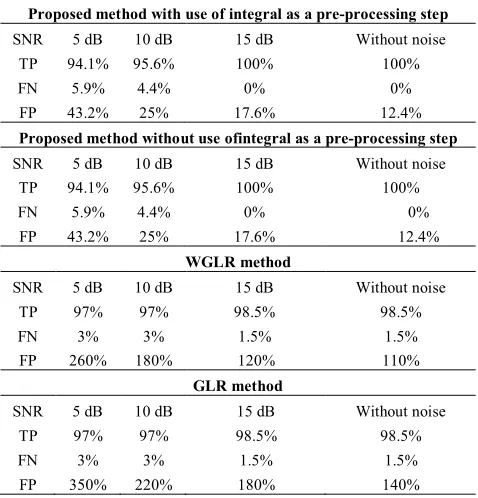
TABLE 1. Effect of applying the proposed methods and conventional methods on set of synthetic data.
Proposed method with use of integral as a pre-processing step
SNR 5 dB 10 dB 15 dB Without noise
TP 94.1% 95.6% 100% 100%
FN 5.9% 4.4% 0% 0%
FP 43.2% 25% 17.6% 12.4%
Proposed method without use ofintegral as a pre-processing step
SNR 5 dB 10 dB 15 dB Without noise
TP 94.1% 95.6% 100% 100%
FN 5.9% 4.4% 0% 0%
FP 43.2% 25% 17.6% 12.4%
WGLR method
SNR 5 dB 10 dB 15 dB Without noise
TP 97% 97% 98.5% 98.5%
FN 3% 3% 1.5% 1.5%
FP 260% 180% 120% 110%
GLR method
SNR 5 dB 10 dB 15 dB Without noise
TP 97% 97% 98.5% 98.5%
FN 3% 3% 1.5% 1.5%
In Table 1, the results of segmentation for 50 synthetic data using the proposed methods without using NPSO are shown compared to the results of conventional methods, namely, GLR and WGLR method. The parameters used for the proposed methods and existing methods are completely equal and are selected by trials and errors. As can be seen in the table, TPs and FNs are approximately equivalent. However, FP for proposed method using integral is much better than GLR and WGLR that are known as conventional methods. Moreover, an important reason for the significantly improved performance of the proposed method is that we use the TVAR model instead of the AR model employed in the basic GLR and WGLR.
It should be mentioned that generally, window length and overlapping percentage of the successive windows are two major deficiencies for GLR and WGLR methods. Therefore, adjusting acceptable empirical parameters is the main problem in such methods. As mentioned before, in order to overcome this problem, we use NPSO. The result of using NPSO is the same as Figure 4.
Length of the window and the percentage of overlap for NPSO are selected between 2% and 10% of the signal length. In the proposed method, the parameters of NPSO method, like all evolutionary algorithms, were chosen by trial and error and are defined as: population size=30; C1=C2=2; Dimension=2; Iteration=50; w=1.
Figure 1. Signal segmentation for synthetic signal: (a) original signal and (b) output of the basic GLR
Figure 2. Signal segmentation in synthetic signal: (a) original signal and (b) output of the WGLR method
Figure 3. Signal segmentation in synthetic signal: (a) original signal and (b) output of proposed method
Figure 4. Signal segmentation in synthetic signal: (a) original signal, (b) filtered signal by integral and (c) output of proposed method
Figure 6. Signal segmentation in real EEG data: (a) original signal, (b) filtered signal by integral and (c) output of the GLR method.
5. CONCLUSION
In this paper an approach using the GLR, integral and NPSO has been proposed. After smoothing the signal using integral, we have used the TVAR as a non-stationary model for EEG signals comparing the AR used only for stationary signals. Integral also could detect the effect of frequency of the signal on amplitude. To improve the performance of the basic GLR and increase the speed of that, we have proposed to use moving steps more than one sample for successive windows in the basic GLR method. In order to select the acceptable parameters, NPSO as a powerful and intelligence optimization algorithm has been used. The proposed algorithm has been applied on both synthetic data and real EEG signal. The proposed method could improve segmentation accuracy levels to 94.1%, 95.6%, 100%, and 100% for synthetic data with SNRs equal to dB, 10 dB, 15 dB, and without noise, respectively. The results have indicated the superiority of the proposed method for segmenting the signals compared toconventional methods, namely, GLR and WGLR.
6.REFERENCES
1. Sanei, S. and Chambers, J.A., "Eeg signal processing, John Wiley & Sons, (2008).
2. Agarwal, R., Gotman, J., Flanagan, D. and Rosenblatt, B., "Automatic eeg analysis during long-term monitoring in the icu", Electroencephalography and Clinical Neurophysiology, Vol. 107, No. 1, (1998), 44-58.
3. Jellema, R.H., Krishnan, S., Hendriks, M.M., Muilwijk, B. and Vogels, J.T., "Deconvolution using signal segmentation",
Chemometrics and Intelligent Laboratory Systems, Vol. 104,
No. 1, (2010), 132-139.
4. Alba, A., Marroquín, J.L., Arce-Santana, E. and Harmony, T., "Classification and interactive segmentation of eeg synchrony
patterns", Pattern Recognition, Vol. 43, No. 2, (2010), 530-544.
5. Micó, P., Mora, M., Cuesta-Frau, D. and Aboy, M., "Automatic segmentation of long-term ecg signals corrupted with broadband noise based on sample entropy", Computer Methods and
Programs in Biomedicine, Vol. 98, No. 2, (2010), 118-129.
6. Homaeinezhad, M., Ghaffari, A., Najjaran Toosi, H., Rahmani, R., Tahmasebi, M. and Daevaeiha, M., "Ambulatory holter ecg individual events delineation via segmentation of a wavelet-based information-optimized 1-d feature", Scientia Iranica, Vol. 18, No. 1, (2011), 86-104.
7. Lee, J., Steele, C.M. and Chau, T., "Swallow segmentation with artificial neural networks and multi-sensor fusion", Medical
Engineering & Physics, Vol. 31, No. 9, (2009), 1049-1055.
8. Anisheh, S. and Hassanpour, H., "Designing an adaptive approach for segmenting non-stationary signals", International
Journal of Electronics, Vol. 98, No. 8, (2011), 1091-1102.
9. Azami, H. and Sanei, S., "Automatic signal segmentation based on singular spectrum analysis and imperialist competitive algorithm", in Computer and Knowledge Engineering (ICCKE), 2nd International eConference on, IEEE. (2012), 50-55. 10. Azami, H., Sanei, S., Mohammadi, K. and Hassanpour, H., "A
hybrid evolutionary approach to segmentation of non-stationary signals", Digital Signal Processing, Vol. 23, No. 4, (2013), 1103-1114.
11. Azami, H., Mohammadi, K. and Bozorgtabar, B., "An improved signal segmentation using moving average and savitzky-golay filter", Journal of Signal & Information Processing, Vol. 3, No. 1, (2012).
12. Hassanpour, H. and Anisheh, S.M., "An improved adaptive signal segmentation method using fractal dimension", in Information Sciences Signal Processing and their Applications (ISSPA), 10th International Conference on, IEEE., (2010), 720-723.
13. Lv, J., Li, X. and Li, T., "Web-based application for traffic anomaly detection algorithm", in Internet and Web Applications and Services, 2007. ICIW'07. Second International Conference on, IEEE. Vol., No. Issue, (2007), 44-44.
14. Kirlangic, M., Perez, D., Kudryavtseva, S., Griessbach, G., Henning, G. and Ivanova, G., "Fractal dimension as a feature for adaptive electroencephalogram segmentation in epilepsy", in Engineering in Medicine and Biology Society, Proceedings of the 23rd Annual International Conference of the IEEE, IEEE. Vol. 2, (2001), 1573-1576.
15. Wang, D., Vogt, R., Mason, M. and Sridharan, S., "Automatic audio segmentation using the generalized likelihood ratio", in Signal Processing and Communication Systems,. ICSPCS 2008. 2nd International Conference on, IEEE., (2008), 1-5.
16. Azami, H., Khosravi, A., Malekzadeh, M. and Sanei, S., A new adaptive signal segmentation approach based on hiaguchi’s fractal dimension, in Emerging intelligent computing technology and applications., Springer, (2012), 152-159.
17. Azami, H., Sanei, S. and Mohammadi, K., "A novel signal segmentation method based on standard deviation and variable threshold", International Journal of Computer Applications, Vol. 34, (2011).
18. Krystal, A.D., Prado, R. and West, M., "New methods of time series analysis of non-stationary eeg data: Eigenstructure decompositions of time varying autoregressions", Clinical
Neurophysiology, Vol. 110, No. 12, (1999), 2197-2206.
20. Azami, H., Malekzadeh, M., Sanei, S. and Khosravi, A., "Optimization of orthogonal polyphase coding waveform for mimo radar based on evolutionary algorithms", Journal of
mathematics and Computer Science, Vol. 6, No. 2, (2012),
146-153.
21. Rafiee, Z., Ganjefar, S. and Fattahi, A., "A new pss tuning technique using ica and pso methods with the fourier transform",
in Electrical Engineering (ICEE), 2010 18th Iranian Conference on, IEEE. (2010), 806-811.
22. Yang, C. and Simon, D., "A new particle swarm optimization technique", in Systems Engineering, ICSEng. 18th International Conference on, IEEE. (2005), 164-169.
An Improved Automatic EEG Signal Segmentation Method based on Generalized
Likelihood Ratio
H. Azamia, H. Hassanpourb, S. M. Anishehc
aDepartment of Electrical Engineering, Iran University of Science and Technology, Tehran, Iran, b School of Information Technology and Computer Engineering, Shahrood University, Iran
c Department of Computer and Electrical Engineering, Khaje Nasir Toosi University of Technology, Tehran, Iran,
P A P E R I N F O
Paper history:
Received 27August 2013
Received in revised form 03December 2013 Accepted 21January 2014
Keywords:
AdaptiveSignal Segmentation Generalized Likelihood Ratio Time-varying Autoregressive Model Integral
New Particle Swarm Optimization
هﺪﯿﮑﭼ
لﺎﻨﮕﯿﺳ ندﺮﮐ ﺖﻨﻤﮕﺳ دﻮﺒﻬﺑ ياﺮﺑ ﯽﺷور ﯽﺳرﺮﺑ ﻪﺑ ﻪﻟﺎﻘﻣ ﻦﯾا شور ﮏﻤﮐ ﻪﺑ ﺎﻫ
GLR
ﺖﺳا ﻪﺘﺧادﺮﭘ .
شور دﻮﺒﻬﺑ ياﺮﺑ اﺪﺘﺑا
GLR
لاﺮﮕﺘﻧا زا ﺖﺳا هﺪﺷ هدﺎﻔﺘﺳا ﺮﯿﮔ .
ﺖﻨﻤﮕﺳ ياﺮﺑ ﺖﯾﺰﻣ ﻪﺳ ﺖﻋﺮﺳ و ﯽﮔدﺎﺳ ﻦﯿﻋ رد ﯽﻠﺻا لﺎﻨﮕﯿﺳ زا ﻦﺘﻓﺮﮔ لاﺮﮕﺘﻧا
دراد ندﺮﮐ : ﻒﻟا ( ﯽﻣ ﺚﻋﺎﺑ ب دﻮﺷ هداد نﺎﺸﻧ ﻪﻨﻣاد رد ﺲﻧﺎﮐﺮﻓ ﺮﺛا دﻮﺷ (
ﯽﻣ لاﺮﮕﺘﻧا رﺎﮐ ﻪﺑ لﺎﻨﮕﯿﺳ هﺪﻨﻨﮐراﻮﻤﻫ ناﻮﻨﻋ ﻪﺑ ﺪﻧاﻮﺗ
ج و دور ( دراﺪﻧ ﻪﯿﻟوا يﺎﻫﺮﺘﻣارﺎﭘ و ﺎﻫﺮﯿﻐﺘﻣ ﻢﯿﻈﻨﺗ ﻪﺑ يزﺎﯿﻧ شور ﻦﯾا ،مﻮﺳﺮﻣ يﺎﻫﺮﺘﻠﯿﻓ فﻼﺧ ﺮﺑ .
رد ﻪﮑﻨﯾا ﻪﺑ ﻪﺟﻮﺗ ﺎﺑ ﻦﯿﻨﭽﻤﻫ
شور زا هﺪﻣآ ﺖﺳد ﻪﺑ يﺎﻫزﺮﻣ فاﺮﻃا
GLR
هﺪﺷ هداد دﻮﺒﻬﺑ شور ﯽﺘﺣ و ﯽﻨﻌﯾ نآ ي
WGLR
ترﻮﺼﺑ يدﺎﯾز يﺎﻫزﺮﻣ
ﯽﻣ ﻪﺘﻓﺮﮔ ﺮﻈﻧ رد ﯽﻠﺻا زﺮﻣ ناﻮﻨﻋ ﻪﺑ ﺖﺳردﺎﻧ زا ﺶﯿﺑ هزاﺪﻧا ﻪﺑ ﯽﻣﺎﮔ لﻮﻃ زا ،دﻮﺷ
1 ﺖﺳا هﺪﺷ هدﺎﻔﺘﺳا ﻪﻧﻮﻤﻧ .
زا ،ﺎﻬﺘﻧا رد و
د كﺮﺤﺘﻣ يﺎﻫ هﺮﺠﻨﭘ ﺖﮐﺮﺣ رد هدﺎﻔﺘﺳا درﻮﻣ يﺎﻫﺮﯿﻐﺘﻣ ندﺮﮐ اﺪﯿﭘ ياﺮﺑ نﺎﮔﺪﻧﺮﭘ ﻢﺘﯾرﻮﮕﻟا ﺖﺳا هﺪﺷ هدﺎﻔﺘﺳا لﺎﻨﮕﯿﺳ لﻮﻃ ر
.
لﺎﻨﮕﯿﺳ ياﺮﺑ ﺪﻧاﻮﺗ ﯽﻣ يدﺎﻬﻨﺸﯿﭘ شور راﺪﻘﻣ ﯽﮕﺘﺧﺎﺳ يﺎﻫ
FP
دوﺪﺣ ار 9 ﺪﻫد دﻮﺒﻬﺑ ﺮﺑاﺮﺑ .
يدﺎﻬﻨﺸﯿﭘ شور ﺖﻋﺮﺳ ﻦﯿﻨﭽﻤﻫ
مﺎﮔ زا هدﺎﻔﺘﺳا ﻞﯿﻟد ﻪﺑ شور زا ﺮﺗﻻﺎﺑ رﺎﯿﺴﺑ ﯽﺘﻋﺮﺳ ياراد ،ﻪﻧﻮﻤﻧ ﮏﯾ زا ﺮﺘﺸﯿﺑ يﺎﻫ
GLR
ﺖﺳا هدﺎﺳ .