*Corresponding author: Jimit Panchal ISSN: 0976-3031
Research Article
DEVELOPMENT AND VALIDATION OF RP-HPLC METHOD FOR ESTIMATION OF
FEBUXOSTAT IN TABLET DOSAGE FORM ON A KANAK COLUMN
Jimit Panchal
2*., VinalPardhi
1., Gaganjyot Kaur
1and Srushti Sanghavi-Shah
21
National Facility for Biopharmaceutical, Road number 32, Matunga, Mumbai, Maharashtra 400019, India
2Nanghavi chromatography solutions Pvt Ltd, M1 Kalpita Enclave, Sahar Road, Andheri East
Mumbai - 400069 Maharashtra, India
DOI: http://dx.doi.org/10.24327/ijrsr.2019.1007.3741
ARTICLE INFO ABSTRACT
An accurate, precise, robust, sensitive and simple Reverse-Phase HPLC (RP-HPLC) isocratic method was developed and validated for analysis of Febuxostat Standard. The chromatographic conditions of Febuxostat (pure) standard was performed on Kanak C-18 (250 x 4.6mm, 5.0μm) column that was performed at 25°C temperature when10μl volume was injected into the system.The mobile phase used was Phosphate buffer (pH 2.5): Methanol, 20: 80 (v/v) at flow rate of 1.0ml/min and detection was carried out at 316nm. The retention time obtained was 5.6min (± 0.5min) that was found to be linear in the range of 10-50 ppm. Limit of Detection (LOD) and Limit of Quantification (LOQ) obtained was 0.024 and 0.078ppm respectively. The %RSD for reproducibility, precision and robustness parameters were within the specified limits according to ICH guidelines. The analytical investigation of Febuxostat drug on Inertsil column showed peak with wide fronting and tailing as compared to the peak shape obtained on KanakTM column.
INTRODUCTION
Febuxostat is a white crystalline powder(Spandana R*, Pushpa Latha E 2015)which is chemically known as 2-(3-cyano4-isobutoxy phenyl)-4-methyl-1,3-thiazole-5-carboxylic acid (Ponnuveetil Gopi Sunitha; Kaliappan Ilango 2014; Derasari 2017; Ranjith et al. 2017; Ravisankar et al. 2015; Gide et al. 2014).It is non-hygroscopic in nature having melting point between 205°C to 208°C(Challa Sudheer*1, S. Alekhya1, P. Lavanya1, E. Mounika1, T. Mahalakshmi1, A. Sireesha1 2017).It is classified as a non-purine xanthine oxidase inhibitor (Anuradha. S* 2017; Reddy Musirike, Reddy K, and Mallu 2015; Derasari 2017) used in the treatment of hyperuricemia and chronic gout (Mukthinuthalapati et al. 2013; Derasari 2017; Challa Sudheer*1, S. Alekhya1, P. Lavanya1, E. Mounika1, T. Mahalakshmi1, A. Sireesha1 2017; Ravisankar et al. 2015; Gide et al. 2014). Febuxostat is administered to people who are intolerant of allopurinol (Younes, El-Kady, and Elzanfaly 2016). The drug is soluble in dimethylformamide; soluble in dimethyl sulfoxide; sparingly soluble in ethanol; slightly soluble in methanol and acetonitrile; and practically insoluble in water (Sudheer Subrahmanya Muvvala et al. 2012; Challa Sudheer*1, S. Alekhya1, P. Lavanya1, E. Mounika1, T.
Mahalakshmi1, A. Sireesha1 2017; Mukthinuthalapati et al. 2013).
Structure: Febuxostat(PubChem CID: 134018)(Sudhir S. Muvvala, Ratnakaram, and Nadendla 2012; N and Sultana 2016; Anuradha. S* 2017)
Empirical formula: C16H16N2O3S. (PubChem CID: 134018)
Molecular weight: 316.38g/mol(R. S. Kumar and Kumar 2012)
International Journal of
Recent Scientific
Research
International Journal of Recent Scientific Research
Vol. 10, Issue, 07(G), pp. 33751-33755, July, 2019
Copyright © Jimit Panchal et al, 2019, this is an open-access article distributed under the terms of the Creative Commons Attribution License, which permits unrestricted use, distribution and reproduction in any medium, provided the original work is properly cited.
DOI: 10.24327/IJRSR CODEN: IJRSFP (USA)
Article History:
Received 13th April, 2019
Received in revised form 11th May, 2019 Accepted 8th June, 2019
Published online 28th July, 2019
Key Words:
There are few methods reported for analysis of Febuxostat drug in the pure form using UV Spectrophotometer,(Pg and Ilango 2014) RP-HPLC, UPLC, LC/MS and MS/MS techniques(Vetrichelvan 2016) and HPTLC (Ch, Suthakaran, and B 2018; Anuradha. S* 2017). Febuxostat has been better determined in pharmaceutical dosage forms by reversed-phase HPLC (Harde, Wankhede, and Chaudhari 2014; Younes, El-Kady, and Elzanfaly 2016; Mukthinuthalapati et al. 2013).Thus, majority of the papers focus on method development from different samples or in combination with other drugs and in formulations (Jansen et al. 2010). However, several studies which are available focus on evaluation of the drug or determination of Febuxostat from urine and plasma samples. Literature review also shows that few HPLC methods focus on simultaneous determination of Febuxostat along with other drugs and in formulations.
Studies performed for this drug on HPLC have showed better results on BDS column as compared to ODS column. Inthe BDS column, residual silanols aredeacivated and silanol activity is reduced, it is end-capped column and it is good for basic compound (Ltd, n.d.). One of theBDS column named Kanak(Kanak column) has shown better results with all other factors in the range of its maximum limits(Anuradha. S* 2017)due to its high carbon load which aims at better resolution (Ltd, n.d.).Method development involves optimizing the sample in the given conditions and checking its multiple parameters with known standard. Thus, new method development on Kanak column for Febuxostat is proven better for validation. However, method validation of pure API form is also important with respect to the drug discovery and development stage.
The parameters used for method validation are Retention time, Peak Area, Theoretical plates, Relative Standard deviation, Linearity, Accuracy, Specificity, Precision, Repeatability, Carry over and Limit of detection (LOD) and Limit of quantification (LOQ)(Ravisankar et al. 2015).
MATERIALS AND METHOD
Reagents and chemicals
An analytically pure sample of Febuxostat API was procured from National Facility for Biopharmaceutical (Mumbai, India).The label claim was 80mg. Acetonitrile (HPLC grade), Methanol (HPLC grade), Orthophosphoric acid, Sodium Hydroxide (NaOH) and Water (HPLC grade) were purchased from Merck Life Science Pvt Ltd (India). All chemicals were of HPLC analytical grade and used as received.
Instrumentation
The analysis of drug is carried out on AGILENT 1260 Infinity II Quad pump series HPLC system equipped with an autosampler and Variable Wavelength Detector (VWD). A Kanak C-18 column (250x4.6mm, 5μm particle size) was used for separation at 25°C. The obtained data was compiled and computed using ChemStation software.
Chromatographic Conditions
The Reversed Phase High Pressure Liquid Chromatography (RP-HPLC) analysis was carried out using Isocratic mode. Separation was achieved at 25˚C on KanakC-18 column
and 0.01M Phosphate buffer (80:20 v/v) adjusted with NaOH (pH 2.5±0.2) was used as mobile phase. The flow rate was 1.0ml/min and the run time was 10 minutes. The injection volume was 10µl. The quantification of Febuxostat was recorded at 316 nm by VWD detector.
Preparation of Standard stock solution
Standard stock solution was prepared by accurately weighing 10mg of Febuxostat API in 100ml (100ppm) of diluent (mobile phase). For linearity, 100ppm of Febuxostat was diluted over a range of concentration from 10ppm to 50ppm. Specificity was also performed at concentration of 100ppm. The repeatability, inter-day and intra-day precision was carried out using 30 ppm of Febuxostat API (3 injections, n=3) and Carry Over was performed using blank solution containing the mobile phase and finally linearity was checked for 5 different concentrations. (10, 20, 30, 40 and 50 ppm)To validate the above method, the collected data was analyzed and compared with USP chromatographic criteria.
System suitability
The System Suitability parameters were checked by injecting three injections of 30 ppm into chromatographic system prepared from 100 ppm Standard Febuxostat stock solution. To ensure system suitability, a standard solution was injected on to the system. Tailing factor (T) and Column efficiency (N) were calculated for Febuxostat standard and its formulation.
Method Validation
Specificity: Specificity of the method was performed by diluting the sample and the standard with mobile phase and injecting the standard and sample at same concentration in triplicate to measure the analyte response.
Accuracy: The percentage recovery was calculated by injecting six individual series of diluted sample with standard solution to a level such that % RSD was not more than 5% at LOQ level.
Linearity: Linearity of the method was demonstrated over the concentration range of 10-50 ppm Febuxostat. Each concentration was prepared in triplicates, 10µl of each standard solution was injected at the optimized chromatographic conditions and the chromatograms were recorded. The retention time, average peak areas and the number of plates were recorded. Calibration curves were constructed by plotting peak area on Y-axis against concentration on X-axis and regression equation was calculated by the method of least squares. The correlation coefficient, y-intercept, slope of the regression line were submitted.
Precision: Precision of the method was reported by injecting six replicates of standard solution consecutively under the same analytical conditions. The %RSD of individual peaks was calculated.
Intra-day and Inter-day
For intra-day and inter-day, a total of three injections of 30ppm of sample Febuxostat were injected in triplicates on same day at different intervals and on 3 different consecutive daysin the chromatographic system.
and test preparation were injected thrice separately into the column and the chromatograms were recorded. Peak area response of analyte peak was measured.
Repeatability
The repeatability was carried out using 30 ppm of standard solution of Febuxostat (6 injections i.e. n =6)
Carry over
The carry over was performed using blank solution (mobile phase) in between the standard solution of Febuxostat.
Robustness and Ruggedness
In order to demonstrate the robustness of the method, system suitability parameters were verified by making deliberate changes in the chromatographic conditions, viz. change in flow rate by 1.0 ± 0.2 ml / min and change in the ratio of mobile phase (80± 2% absolute).(Vaibhav, Mohit, and Sadhana 2013) Ruggedness was determined by the varying the analyst, instrument and different column of varied grades. The relative standard deviation of the results obtained from different analyst’s instruments is < 1.0 %. To ascertain the system suitability for the proposed method, a number of statistical values such as theoretical plates, peak asymmetry, have been calculated with the observed readings and the results complies within the specified limits.
RESULTS
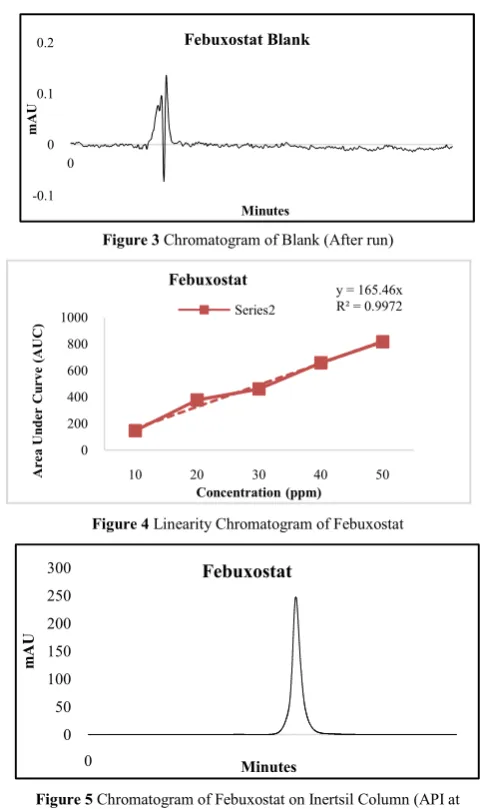
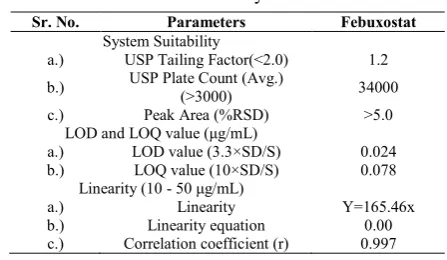
The aim of the proposed study was to develop method for Febuxostat drug in its pure form and to validate the method. The wavelength of detection was selected at 316 nm as Febuxostat showed maximum absorbance at given wavelength. Resolution and peak symmetry were found to be as shown in figure 2 and results in table 1 on Kanak C18 column. The obtained results were calculated in %RSD form and are NMT 2% as concise in table 1. The parameters such as Specificity, Accuracy, Precision, Intraday and Interday, Repeatability, Robustness and Ruggedness resulted in NMT 2% of its maximum limit. The results are summarized in table 1 and 2.
Table 1 Results of reproducibility, Interday and Intraday and Robustness
Sr. No. Validation SD %RSD
Parameters Peak
Area
USP Plate Number
Peak Area
USP Plate Number
1 Specificity 1.665 324.378 0.1 0.89 2 Reproducibility 0.578 141.563 0.125 0.004 3 Interday 0.591 116.573 0.128 0.341 4 Intraday
(Morning) 0.565 100.955 0.122 0.294 Intraday
(Evening) 4.193 262.298 0.85 0.77 5. Flow
Rate
1.2ml/min 0.211 46.716 0.04 0.133 1.0ml/min 1.057 421.357 0.212 1.216 0.8ml/min 0.167 146.661 0.036 0.432
6. Mobile Phase 20:80
- (Buffer: MeOH)
(v/v)
18:82 - (Buffer:
MeOH) (v/v) 2.32 27.465 0.52 0.08 20:80 - (Buffer:
MeOH) (v/v) 1.08 49.153 2.132 0.144
22:82 - (Buffer:
MeOH) (v/v) 4.032 269.52 0.87 0.779 7. On
Inertsil Column
Specificity 6.694 52.205 0.15 0.42
Figure 1 Chromatogram of Blank (Before Run)
Figure 2 Chromatogram of Febuxostat API (100ppm) showing Specificity
-0.1 0 0.1 0.2
0
m
AU
Minutes
Febuxostat Blank
0 50 100 150 200
0
mAU
Minutes
Febuxostat API
Figure 3 Chromatogram of Blank (After run)
Figure 4 Linearity Chromatogram of Febuxostat
Figure 5 Chromatogram of Febuxostat on Inertsil Column (API at
100PPM)
-0.1 0 0.1 0.2
0
mAU
Minutes
Febuxostat Blank
y = 165.46x R² = 0.9972
0 200 400 600 800 1000
10 20 30 40 50
Are
a
Un
der
Cu
rve
(AUC)
Concentration (ppm)
Febuxostat
Series2
0 50 100 150 200 250 300
0
m
AU
Minutes
Table 2 Results of System suitability, LOD, LOQ and Linearity
Sr. No. Parameters Febuxostat
System Suitability
a.) USP Tailing Factor(˂2.0) 1.2 b.) USP Plate Count (Avg.)
(˃3000) 34000 c.) Peak Area (%RSD) ˃5.0
LOD and LOQ value (μg/mL)
a.) LOD value (3.3×SD/S) 0.024 b.) LOQ value (10×SD/S) 0.078
Linearity (10 - 50 μg/mL)
a.) Linearity Y=165.46x b.) Linearity equation 0.00 c.) Correlation coefficient (r) 0.997
DISCUSSION
Method Validation
The defined method was validated for Febuxostat drug and the validation parameters were assayed. As shown in Fig. 4.0, Linearity for Febuxostat drug was obtained between 10 ppm to 50 ppm which signifies the method is sensitive enough to perform the RP-HPLC based assay for detection and quantitation of Febuxostat from the matrix component. The acceptance criteria of correlation coefficient for the method to be linear is 0.99 and the linear regression value was obtained for Febuxostatwas 0.997 (G. V. Kumar and Shashikala 2016). The current method proves to be linear and was assessed by the least square regression method(Derasari 2017) even though the make of column packing material is variable.The comparative data showed that the column used in the study resulted in faster elution of Febuxostat drug with the developed method. KanakTM columns comprising of higher carbon loading (19%)and surface area (300m2/g) provided better peak shape of Febuxostat as compared to the other columns used in this study (Ltd, n.d.).
The method was found to be specific for Febuxostat, showing %RSD as 0.89 for both standard as well as formulation which is NMT 1% as per ICH guidelines as given in figure 2.The accuracy and precision of the method was affirmed by standard and samples injected in replicate that showed in % RSD as 0.004. Limit of Detection (LOD) and Limit of Quantification (LOQ) were calculated as 3.3×SD/S and 10×SD/S respectively as per ICH guidelines, where SD is the standard deviation of the response (Y-intercept) and S is the slope of the calibration curve (Reddy 2015, 2018).The Limit of Detection (LOD) and Limit of Quantification (LOQ) were found to be 0.023 ppm and 0.078 ppm respectively by the described method(Rao 2013).The criteria was compared withthe guidelines which are falling within the specified limit(Vaibhav, Mohit, and Sadhana 2013).The following method was found to be precise for the Febuxostat drug and showed results in %RSD form that was found to be less than 2%.
The resultsturned out well for reproducibility that was ascribed in %RSD manner as Peak area, Tailing factor and Plate number were 0.125, 0.006 and 0.004 respectively (Vaibhav, Mohit, and Sadhana 2013).A blank was injected between the standard injection and it revealedno carryover on the chromatogram.To verify the system suitability parameters of HPLC grade, few variations were made inchromatographic conditions such as flow rate and mobile phase and %RSD results showed less than
robust over an acceptable working range of its HPLC operational parameters. Ruggedness of the method was determined by carrying out the method on different columns of similar types, which concluded that the developed method was rugged(Rao 2013).
CONCLUSION
The proposed method of RP-HPLC for Febuxostat standard was found to be accurate, precise, robust, linear, sensitive and rapid for routine analysis of the drug in its pure form and can be further usedfor the study of the drug. The following method was reliable and can be adopted as a reference to study the Febuxostat standard as well as its formulations on KanakTMcolumn. In spite of difference in silica of stationary phase, the obtained results were not exceeding beyond its thresholds limits. Being loaded with high carbon, KanakTMcolumn prove to be beneficial for early elution of the molecule with no traces on column. Due to the rapid and better resolution of the peak obtained with appropriate peak height and resolution KanakTM column can be preferredmore as compared to other columns.
References
Anuradha. S*, Jagadeesh. B and Vinod. G. 2017. “Development and Validation of Rp-Hplc Method for Estimation of Febuxostat in Tablet Dosage Form.” International Journal of Pharmacy and Biological Sciences 7 (4): 1-8.
Ch, Shankar, R Suthakaran, and Prem Kumar B. 2018. “A New RP-HPLC Method Development and Validation for the Simultaneous Estimation of Febuxostat And Ketorolac in Bulk and Tablet Dosage Form.” International Journal of Biomedical Investigation 1 (2): 1-9. https://doi.org/10.31531/2581-4745.1000113. Challa Sudheer*1, S. Alekhya1, P. Lavanya1, E. Mounika1,
T. Mahalakshmi1, A. Sireesha1, B. Tirumaleswara rao1. 2017. “Method Development and Validation for the Estimation of Febuxostat in Drug Substance by Rp-Hplc Method.” International Journal of Research in Pharmaceutical and Nano Sciences 6 (2): 55-60. Derasari, J.M. and Patel V.B. 2017. “Development and
Validation of Stability Indicating LC-PDA Method for Simultaneous Assessment of Febuxostat and Ketorolac Tromethamine in Tablet Dosage Form.” Asian Journal
of Chemistry 29 (1): 69-75.
https://doi.org/10.14233/ajchem.2017.20134.
Gide, Monita, Pankaj Sharma, Ravindra Saudagar, and Birendra Shrivastava. 2014. “Method Development and Validation for Determination of Febuxostat from Spiked Human Plasma Using RP-HPLC with UV Detection.” Chromatography Research International 2014: 1-5. https://doi.org/10.1155/2014/307430.
Harde, Minal T, Sagar B Wankhede, and Pravin D Chaudhari. 2014. “Development and Validation of RP-HPLC Method For Estimation of Pamabrom in Bulk And Marketed Formulation.” Minal T. Harde et Al. / Journal of Pharmacy Research 8 (10): 1515-19.
Paper on Febuxostat.” Research Gate, no. April: 835-40. https://doi.org/10.1007/s10067-010-1442-2.
Kumar, Gampa Vijaya, and P Shashikala. 2016. “Analytical Method Development and Validation by RP-HPLC for Simultaneous Estimation of Ketorolac and Febuxostat in Combined Tablet Dosage Form.” Journal of Pharmaceutical and Biomedical Analysis Letters 4 (1): 32-40.
Kumar, Raul Saroj, and Patnaik Ajaya Kumar. 2012. “An Rp-Hplc Method Development and Validation for the Estimation of Febuxostat in Bulk and Pharmaceutical Dosage Forms.” INTERNATIONAL RESEARCH JOURNAL OF PHARMACY 3 (11): 205-8.
Ltd, Nanghavi Chromatography solutions Pvt. n.d. “Swedish Excellence in Chromatography Kanak HPLC and UHPLC Columns.” http://nanghavi.com/.
Mukthinuthalapati, Mathrusri Annapurna, Sai Pavan Kumar Bandaru, Venkatesh Bukkapatnam, and Chitaranjan Mohapatro. 2013. “Development and Validation of a Stability-Indicating RP-HPLC Method for the Determination of Febuxostat (a Xanthine Oxidase Inhibitor).” Journal of Chromatographic Science 51 (10): 931-38. https://doi.org/10.1093/chromsci/bms192. Muvvala, Sudheer Subrahmanya, Sri Subbaraya, Ratnakaram
Venkata Nadh, and Rama Rao Nadendla. 2012. “A Validated RP-HPLC Method for the Estimation of Febuxostat in Bulk Drugs.” International Journal of PharmTech Research 4 (4): 1358-66.
Muvvala, Sudhir S., Venkata Nadh Ratnakaram, and Rama Rao Nadendla. 2012. “A Validated RP-HPLC Method for the Estimation of Febuxostat in Bulk Drugs.” International Journal of PharmTech Research 4 (4): 1358-66.
N, Balaji, and Sayeeda Sultana. 2016. “Ultra-High Performance Liquid Chromatographic Determination of Genotoxic Impurities in Febuxostat Drug Substance and Products.” Asian Journal of Pharmaceutical and
Clinical Research 10 (1): 324.
https://doi.org/10.22159/ajpcr.2017.v10i1.15381. Pg, Sunitha, and K Ilango. 2014. “Validated First-Order
Derivative Spectrophotonetry for Simultaneous Determination of Febuxostat And Diclofenac In Pharmaceutical Dosage Form.” Research Journal Od Pharmaceutical, Biological and Chemical Sciences 5 (3): 1675-81.
Ponnuveetil Gopi Sunitha; Kaliappan Ilango. 2014. “Validated RP HPLC and HPTLC Methods for Simultaneous Estimation of Febuxostat and Diclofenac Sodium in Pharmaceutical Dosage Form.” European Journal of Chemistry 5 (3): 545-49. https://doi.org/10.5155/eurjchem.5.3.545.
Ranjith, K, M V Basaveswara Rao, D Rama Sekhara Reddy, and T E G K Murthy. 2017. “Development and Validation of Related Substances Method for Febuxostat Tablets by RP-HPLC.” Indian Journal of Research in Pharmacy and Biotechnology 5 (3): 229-34.
Rao, B. Raja and A. Lakshmana. 2013. “Analytical Method Development and Validation for the Simultaneous Estimation of Febuxostat and Ketorolac in Tablet Dosage Forms by Rp-Hplc.” International Journal of Pharmaceutical, Chemical And Biological Sciences 3 (3): 571-76.
Ravisankar, P, Anusha Rani K, Venkata Ramana K, and S Gowthami. 2015. “Development and Validation of Rapid Rp- Hplc Method for the Determination of Febuxostat (a Non-Purine Selective Xanthine-Oxidase / Xanthine-Dehydrogenase Inhibitor) in Bulk and Pharmaceutical Dosage Form.” World Journal of Pharmacy And Pharmaceutical Sciences 4 (09): 1046-61.
Reddy Musirike, Maheswara, Hussain Reddy K, and Useni Reddy Mallu. 2015. “Development and Validation of Reverse Phase-Ultra Performance Liquid Chromatographic Method for Estimation of Related Substances in Febuxostat Drug Substance.” Pharmaceutica Analytica Acta 6 (10): 1-6. https://doi.org/10.4172/2153-2435.1000431.
Reddy, Uttam Prasad Panigrahy and A. Sunil Kumar. 2015. “Development and Validation of Stability Indicating Method for Simultaneous Estimation of Febuxostat and Diclofenac Potassium in Bulk and Tablet Dosage Form Using Rp-Hplc.” International Journal of Pharmaceutical Sciences and Research 6 (2): 798-807. https://doi.org/10.13040/IJPSR.0975-8232.6(2).798-07. .2018. “Development and Validation of Stability Indicating
Method for Simultaneous Estimation of Febuxostat and Diclofenac Potassium in Bulk and Tablet Dosage Form Using Rp-Hplc.” International Journal of Pharmaceutical Sciences And Research, 798-807. https://doi.org/http://dx.doi.org/10.13040/IJPSR.0975-8232.6(2).798-07.
Spandana R*, Pushpa Latha E, Jenny susmitha. 2015. “Method Development and Validation of Spectrophotometric Method for the Estimation of Febuxostat in Pure and Tablet Dosage Form.” International Journal of Pharmacy & Pharmacaeutical Research 3 (4): 39-46.
Vaibhav, Sanghvi, Mahajan Mohit, and Rajput Sadhana. 2013. “Validation of Rp-Hplc Method for Simultaneous Estimation of Febuxostat and Diclofenac Potassium in Bulk Drug and in Bi Layer Tablet Formulation.” International Research Journal of Pharmacy 4 (9): 103-6. https://doi.org/10.7897/2230-8407.04921.
Vetrichelvan, Dr. G. Abirami* and Dr. T. 2016. “Development and Validation of Rp-Hplc Method for the Estimation Febuxostat Related Substances in Bulk and Formulations.” World Journal of Pharmaceutical
Research 5 (4): 1967-77.
https://doi.org/10.20959/wjpr20164-6035.
Younes, Kareem M., Ehab F. El-Kady, and Eman S. Elzanfaly. 2016. “Determination of Febuxostat in Human Plasma Using RP-LC-UV Method.” Journal of Chromatographic Science 54 (6): 1022-27. https://doi.org/10.1093/chromsci/bmw040.