VOLUME 39, ARTICLE 19, PAGES 561
,
592
PUBLISHED 19 SEPTEMBER 2018
https://www.demographic-research.org/Volumes/Vol39/19/ DOI: 10.4054/DemRes.2018.39.19
Research Article
Family policies, childbearing, and economic
crisis: The case of Iceland
Ari Klængur Jónsson
© 2018 Ari Klængur Jónsson.
This open-access work is published under the terms of the Creative Commons Attribution 3.0 Germany (CC BY 3.0 DE), which permits use, reproduction, and distribution in any medium, provided the original author(s) and source are given credit.
1 Introduction 562
2 Background 563
2.1 Parental leave and day-care provisions in a Nordic context 565 2.2 A few words on the interplay of family policies and economic
trends
567
2.3 Increased support to the dual-earner model in Iceland 569 2.3.1 Formal childcare provisions – playschools 569
2.3.2 The parental leave program 571
2.3.3 Use of leave and the emergence of the economic crisis 572
3 Methodological approach 573
3.1 Data 574
3.2 Method 574
4 Results 575
4.1 Annual indices of first, second, and third births 575 4.2 Developments in the timing of births and birth spacing by parity 576
4.3 Realized fertility 580
5 Discussion and limitations 582
6 Acknowledgements 585
Family policies, childbearing, and economic crisis:
The case of Iceland
Ari Klængur Jónsson1
Abstract
BACKGROUND
In the early 2000s, Iceland implemented one of the most gender-equal parental leave systems in the world, and at the same time increased the volume of public childcare. A few years later, in 2008, Iceland experienced a major economic crises that, among other things, lead to cutbacks in governmental spending and decreased support to families with children.
OBJECTIVE
The objective of this study is to provide insight into recent childbearing dynamics in Iceland and how they may be linked to recent social-policy reforms and the intervention of the economic crisis in 2008.
METHODS
We use official individual longitudinal register data covering the total female population born in Iceland between 1953 and 1997. We analyse the data by means of event history techniques.
RESULTS
We find that changes in the standardized birth rates coincide with the emergence of the reformed family-policy package: A declining trend in the age-standardized first-birth rate came to a halt, and the propensity to have a second and a third child increased. After the onset of the crisis, a trend of decreasing first-birth intensities reemerged and, in 2011, a turnaround to declining second- and third-birth rates.
CONCLUSIONS
The development in the post-2008 period indicates that even in the most gender-equal settings, the gender balance in family care is still vulnerable, and that family policies cannot compensate in full for the impact of economic crisis on fertility.
CONTRIBUTION
The study highlights the interdependency of factors related to both social policy and the business cycle in relation to childbearing developments.
1. Introduction
In a European context, Iceland has relatively high fertility. It is also among the most gender-equal countries in the world; few countries have a higher female employment rate than Iceland. With its population of around 350,000, Iceland is often grouped together with the other Nordic countries – Denmark, Finland, Norway, and Sweden – as belonging to the same welfare-state regime which, to a large extent, socializes the costs of family life and has strong egalitarian emphasis (Esping-Andersen 1990). Unlike the other Nordic countries, however, whose institutional settings have been catalysts for recent theoretical frameworks to explain changes in childbearing trends and other family-related affairs (McDonald 2000, 2013; Goldscheider, Bernhardt, and Lappegård 2015; Esping-Andersen and Billari 2015), the context of fertility in Iceland has received much less attention.
The aim of this study is to provide an overview of the developments in fertility and family policies in Iceland at the turn of the 21st century, which will give us a more
comprehensive picture of the interplay of fertility and family policies in the Nordic countries. In 1997, the Icelandic parliament passed a resolution on formulating the first official policy on the family in the country, and in the same time agreed to take measures to enhance social support to families with children (Alþingistíðindi 1996– 1997; Eydal and Ólafsson 2008). In the following years the parental leave program was reformed, and the supply of formal childcare provision was increased. With these two changes a reformed battery of formal support to (dual-earner) families came into effect, which further enabled parents to combine childrearing and employment. Then, in 2008, Iceland was hit by the most severe economic crisis in the country’s modern history. Considering the magnitude of the crisis and the associated cutbacks in social spending, we take the crisis into consideration when discussing the context and subsequent outcomes.
In what follows, we treat the increase in formal childcare provisions and the reformed parental leave program as one comprehensive reform: They were to a large extent implemented at the same time; they share the same underlying logic, which entails promoting gender equality and helping parents to combine work and family life; and the two policies complement each other and form a succession of childcare provisions available to parents after childbirth.
continued childbearing. These limitations of the TFR can lead to false conclusions about the effectiveness of family policies (Sobotka and Lutz 2010).
To the extent possible, we take into consideration a research strategy proposed by Neyer and Andersson (2008) on how to best design studies that address the potential association between family policies and fertility, both conceptually and methodologically. In terms of theoretical considerations, they argue that any assessment of a relationship between family policies and fertility needs to be based on the broader social context, including a comprehensive understanding of the constellations and configurations of family policies, their contents, and their histories.
With regard to the method and data, we follow their suggestions as far as our data allows us. We apply event history analysis to longitudinal individual register data, covering the childbearing history of the total female population born in Iceland and of childbearing age (15–45 years). We present our findings as parity-specific relative risks of giving birth during 1998–2013, standardized for age of mother and age of youngest child (where applicable). This approach allows us to detect period effects in fertility by birth order and in relationship to the timing of births, and thus to investigate any potential changes in childbearing dynamics around the time of implementation of the reforms and during the economic crisis.
We begin our story with a discussion of theoretical considerations that accompany demographic studies of family policies, highlighting why the interaction between the broader social context, the business cycle, and policy objectives matters for potential outcomes. Subsequently, we describe the context in which the study takes place and provide an overview of the development in formal childcare during our study period and the main points of the parental leave legislation. After providing an overview of the data and methods, we conclude with the results and a discussion.
2. Background
Skrede 2008; Esping-Andersen and Billari 2015; Goldscheider, Bernhardt, and Lappegård 2015).
Figure 1: Total fertility rate in the Nordic countries, 1998–2013
Source: Statistics Norway (2016), Statistics Finland (2016), Statistics Sweden (2016), Statistics Denmark (2016), Statistics Iceland (2018).
McDonald (2000, 2013) argues that modern fertility outcomes are the product of how individuals perceive their opportunities and the actual possibilities mothers have to combine work and family life; therefore, family-oriented institutions need to support mothers so that they can take advantage of opportunities offered to them by individually oriented institutions (e.g., education and employment) (McDonald 2013: 983). Likewise, Goldscheider and her colleagues (2015) argue that the gap in the family-care responsibilities of mothers and fathers needs to level out for fertility to increase. The constellation and design of childcare policies may thus be instrumental for fertility outcomes. Arriving from a similar standpoint, Esping-Andersen and Billari (2015) argue for a framework that considers the importance of gender roles in society and how changes in norms related to gender affect the family. When gender egalitarian norms become a dominant normative status in a society, the social institutions need to reconcile with women’s opportunity to combine work and family for fertility to increase.
Drawing on these theoretical perspectives, we can assume that policies that offer support to the dual-earner family form and motivate gender equality encourage women’s employment, reduce unpaid care-work responsibilities of mothers, and address parents at an individual level (individual right) rather than as a couple (Neyer 2006). We can also assume that such policies may be influential in supporting fertility in the context of high female labour force participation and gender egalitarian attitudes. This assumption may be especially relevant in the Icelandic context, where female labour force participation is almost as high as that of males, and the ‘dual earner family model’ is the social norm. The relevant reforms, implemented at the turn of the 21st
century in Iceland, were a response to ongoing social development and public demand. At the time of implementation, the parental leave legislation was met with almost universal acceptance both in Parliament and in society (Eydal and Gíslason 2008a, 2014). As “the effects of a given policy may be strongly dependent upon the social context in which it is implemented” (Hoem 2008: 255), this acceptance may be interpreted as an indication that the public was willing and able to conform to the behaviour supported by these policies.
2.1 Parental leave and day-care provisions in a Nordic context
intensities, especially if the father uses part of the leave (Duvander, Lappegård, and Andersson 2010; Lappegård 2010); Duvander and her colleagues (2016) found the same for Iceland. It is not always certain whether these findings relate to earlier arrival of a next child or to quantum changes, as model estimates capture both timing and number of births. Several studies have shown how a policy intervention in the parental leave (‘the speed premium’) lead to a higher tempo of childbearing in Sweden (Hoem 1993; Andersson 2004), and thus an increase in the period fertility.
The interplay of parental leave use, father’s family involvement, and continued childbearing appears complex. The duration of the fathers’ leave use has been found to matter, but how and to what extent depends on parity. In a comparative study of Norway and Sweden, the authors found that one- and two-child mothers in both countries had a higher risk of subsequent birth if the father used parental leave with the previous child (Duvander, Lappegård, and Andersson 2010). Similarly, Duvander and Andersson (2006) found that fathers that took long parental leave with their second child had the highest third-birth risk, compared to other groups, but the effects disappeared when they controlled for socioeconomic variables. Other definitions of variables and study designs may produce partly different results (Lappegård 2010; Duvander et al. 2016).
Findings on the potential association between day-care provisions and fertility are even more ambiguous. In low day-care coverage areas in Norway, Kravdal (1996) found evidence that indicates that the volume of day care may have elevating effects on third births, but first and second birth probabilities decline with increasing provision of day care. A study on Sweden found no or counterintuitive effects of day-care provision on continued childbearing (Andersson, Duvander, and Hank 2004). Another study on Norway by Rindfuss and colleagues (2007) with stronger research design more clearly shows positive effects of childcare provisions on fertility outcomes.
Thus, while several studies have shown an association between family policies and childbearing behaviour, others have found only weak associations, controversial ones, or none at all. (For an overview see Neyer 2003; Gauthier 2007; Hoem 2008.) Hence, there is still controversy over the effectiveness of family policies to influence fertility, and in cases where association has been found, some have argued that the effects of policies tend to be small, that they affect the timing of births rather than completed fertility, and that policies are thus hard to justify given their high costs relative to their success (e.g., Gauthier 2007).
people differently (Lappegård 2010). Findings could be determined by norms and attitudes or selection effects (Duvander and Andersson 2006; Lappegård 2010), socioeconomic status (Duvander and Andersson 2006), or migration background (Andersson, Hoem, and Duvander 2006; Andersson and Scott 2005). The constellation, configuration, and generosity of policies – the complete package (the total coverage and whether policies support or counteract one another) – may matter for potential relationships as well, which could explain some of the controversial findings on potential association between volume of day care and the propensity to have another child (Hank and Kreyenfeld 2003; Andersson, Duvander, and Hank 2004). A potential connection between two-child norms and the norm of fathers being engaged in childrearing has been suggested to foster the link between fathers’ parental leave use and second birth intensities in the Nordic countries (Duvander and Andersson 2006; Duvander et al. 2016).
2.2 A few words on the interplay of family policies and economic trends
Before turning to the characteristics of the reform in the 2000s, a few words on the potential interaction between economic trends, family policies, and fertility outcomes are appropriate – especially considering that a major economic crisis hit Iceland in late 2008, which is likely to have had an impact in the final years of our study period.
Figure 2: Total fertility rate, unemployment rate, and gross domestic product growth rate in Iceland, 1998–2013
Source: Statistics Iceland (2018), Directorate of Labor (2015).
If we accept that “institutional factors and policies intervene at every step in the link between economic downturn and fertility behavior” (Sobotka, Skirbekk, and Philipov 2011: 293), the same is true for economic downturn and the link between family policies and fertility. This connection is especially relevant when parental leave benefits are income related and full eligibility is to a large extent dependent on labour market participation (Andersson 2000; Hoem 2005), as is the case with the Icelandic parental leave program after the reform in the early 2000s.
recession. The economic crisis provokes questions that we are unable to address in the present study, in part due to data limitations.
2.3 Increased support to the dual-earner model in Iceland
The employment rate for Icelandic men and women of childbearing age is, and has been, very high in an international comparison. According to a Statistics Iceland Labour Market Survey, around 90% in the age group 25–54 are active on the labour market: The employment ratio ranged from 85–88% among women during the 1990s and 2000s, and 92–97% among men. On average, women work around 37 hours per week, and men work around 49; however, during the course of the study period, more variation in the ranges occurred (Statistics Iceland 2018). Nevertheless, in the latter part of the 1990s, when the Icelandic parliament passed a resolution on formulating the first official family policy in the country, expenditure on welfare-related issues was relatively low, even by European standards, and the country offered less support to families with children than the other Nordic countries (Eydal and Ólafsson 2008; Eydal 2008). Iceland spent 2.4% of the annual GDP on children and families, compared to around 3.5–4% spent by its Scandinavian neighbours. In 2004, the share of the GDP devoted to family-related issues increased to 3.6%. This increase in expenditure was, to a large extent, a consequence of new parental leave legislation and an increase in the availability of publicly provided childcare (Eydal and Ólafsson 2008) – our events of interest.
2.3.1 Formal childcare provisions – playschools
care acquired (Alþingi 2008; Eydal and Ólafsson 2008). Parents pay only a fraction of the costs of publicly run day care.
The high employment rate among people of childbearing age has not been entirely reflected in the volume of public day care offered to parents with young children (Eydal and Ólafsson 2008). Nevertheless, significant ameliorations were made to the formal childcare system in the early 2000s. In 1994, the number of playschools was 178 (Broddadóttir et al. 1997), but ten years later it had increased to 262; during the same time the number of full-time equivalent working staff units in formal childcare increased by roughly 60% (Statistics Iceland 2018). In 2000, around 68% of 1–5 year-old children were enrolled in playschools: 10% of one-year-year-olds and 54% of two-year-olds (Figure 3). In 2003, the figure had increased to 80%: 25% of one-year-two-year-olds and 90% of two-year-olds (Statistics Iceland 2018). Parents were thus relieved much of the unpaid care work, especially as the coverage for two-year-old children increased by 35 percentage points during a period of just three years, during which time the coverage for one-year-old children also increased from one-in-ten to one-in-four.
Figure 3: Percentage of children attending playschools in Iceland by age, and length of the parental leave, 1998–2013
As is discussed below, the parental leave was extended from six to nine months between 2001 and 2003. The ‘childcare gap,’ the period from the end of the parental leave until the beginning of public day care, has thus not yet been eliminated (at least for majority of parents), but nevertheless, it was greatly reduced during the early to mid-2000s. In order to bridge the remaining gap between parental leave and formal childcare, roughly half of parents take advantage of home-care facilities, privately run care centres at higher costs than the heavily subsidised playschools. Others rely on various means of unofficial support, including grandparents and other relatives, or resort to lower or more flexible working hours – the majority of which are women (Eydal and Gíslason 2014).
2.3.2 The parental leave program
In the year 2000, the legislation from 1981 on a universal right for all mothers to paid parental leave was revised, and a new Act was passed, fundamentally transforming the parental leave scheme in Iceland. The new legislation was explicitly aimed at enabling mothers as well as fathers to be active participants in childrearing and offering them equal opportunities to coordinate family and working life. The purpose of the legislation was not pronatalist, or simply to compensate parents economically after childbirth and facilitate a balance between family and work – but rather to promote gender equality and to encourage fathers to contribute more to the domesticity (Alþingi 2000; Eydal and Gíslason 2008a, 2008b).
Under the previous parental leave regime, the total leave length was six months, of which two weeks were allotted to the father (from 1998 and onwards). The benefits were usually paid at a low flat rate and thus not income related (Eydal and Gíslason 2014). The main points of the reformed legislation were that parental leave was extended in steps from six months to nine – with the father’s entitlements gradually increased over a period of three years through the addition of one month per year during 2001–2003. Iceland thus tied as large a part of the leave to the father as to the mother (an inalienable individual right of either parent) – a total of one third each of the leave (Alþingi 2000). The entitlements to fathers were manifested as an increase in the parental leave benefits, as the mother’s entitlements were not affected by the reform. Parents had up to 18 months from the childbirth to utilize the leave,2 and both could be on leave at the same time if they so wished. The benefits available to parents active in the labour market were 80% of their prebirth average salaries, and initially there was no ceiling on these benefits. A birth grant, a considerably lower amount, was paid to those
2 During the economic crisis, parents were allowed to take advantage of the parental leave for up to 36 months
not active in the labour market (as defined by the Act) and to students. The Act provided increased labour market security for pregnant women, parents could not be fired (unless under specific circumstances), and they maintained all occupational rights while on leave (Alþingi 2000; Eydal and Gíslason 2008b). After the implementation, Iceland had the shortest parental leave among the Nordic countries, but the longest untransferable leave time for either parent (Moss and O’Brien 2006; Eydal and Gíslason 2014).
The parental leave scheme, after it was reformed, provided financial incentives for men to contribute more to the childrearing – an inducement that had commonly been lacking (Goldscheider, Bernhardt, and Lappegård 2015). As the Nordic parental leave model in general, the reformed policy in Iceland thus addresses two aspects of parenting – ‘practical parenting’ and ‘economic parenting,’ to use the terminology of Lappegård and her colleagues (2011). The first term relates to childrearing and the availability to take care of one’s child (leave length and parent’s quota), while the second relates to the parents’ financial obligations to the family (manifested in generous income-related parental leave benefits).
2.3.3 Use of leave and the emergence of the economic crisis
The parent’s quota appears to have been successful in increasing the fathers’ use of the parental leave. In 2000, fathers used only 3% of the total leave days – the lowest among the Nordic countries (Nordic Statistics 2016). Three years later, in 2003, fathers used around one-third of the leave – the highest in the world to our knowledge – and around 90% of fathers took parental leave (Statistics Iceland 2018; Gíslason 2007). There is no available information about the proportion of mothers who use the leave, but aggregate figures indicate that the coverage is close to 100%, and around 85% of leave-users were active in the labour market before taking leave (Statistics Iceland 2018). Table 1 contains year-by-year information on mothers’ and fathers’ use of parental leave.
Table 1: Average number of parental leave days used by fathers and mothers and benefit ceiling by year in Iceland 2000–2013 by birth year of child
Year Fathers Mothers Maximum benefits (EUR/month)**
2000 5* 156* Low flat rate
2001 39 186 None
2002 67 187 None
2003 95 183 None
2004 96 182 None
2005 101 187 2,780
2006 100 185 2,919
2007 100 181 3,000
2008 102 178 3,102
2009 99 178 2,316 / 2,027
2010 93 179 1,737
2011 90 180 1,737
2012 88 180 1,737
2013 88 182 2,027
Note: *Estimated number of days. **We used the 2009 average exchange rate between ISK and EUR in our calculations.
Source: Statistics Iceland (2018) and Ministry of Welfare (2016).
Combined with a drop in income and increased insecurity in the labour market in general, the decrements in benefits seem to have had negative effects on fathers’ use of parental leave (Sigurðardóttir and Garðarsdóttir 2018). In Table 1 we can see that the absolute number of parental leave days used by fathers, for children born in the respective years, fell by 14% between 2008 and 2013 – from 102 to 88 days, after a period of constant increase in fathers’ uptake before the crisis. Mothers, on the other hand, still used the same levels of parental leave days for children born in 2013 as in 2008. At the same time, several municipalities decreased the length of daytime care available to children and/or increased their fees (Eydal and Gíslason 2014). Combined, the measures taken during the economic crisis thus had deteriorating effects on the overall support to families and appear to have increased the gender gap in parental leave use (Sigurðardóttir and Garðarsdóttir 2018).
3. Methodological approach
reform in relation to prior behaviour, which minimizes the role of endogeneity (Neyer and Andersson 2008; Blossfeld, Golsch, and Rohwer 2007).
In the analysis we approach the childbearing dynamics from three directions: First, we produce standardized parity-specific birth intensities and present them as annual indices of first, second, and third birth rates. This presentation gives us a comprehensive overview of the underlying childbearing behaviour during the study period (1998– 2013). Second, as the standardized rates do not distinguish adequately between timing and quantum of births, we analyse first-birth risks by age of women, and second- and third-birth risks by the age of the youngest child. In addition to providing us with information about developments in the timing of births and birth intervals over time, the findings indicate whether changes in fertility are related to tempo or quantum changes. Third, we follow real cohorts of women who gave birth to their first or second child in 1998–2005, and present Kaplan–Meier nonparametric estimates to see what the actual outcomes are in terms of second and third births.
3.1 Data
We used official longitudinal register data from the Icelandic National Registry in the analyses. We have access to the full childbearing history of the total female population born in Iceland between 1953 and 1997, the birth order of every child born to these women and, where appropriate, their complete migration history and the time of any death with monthly precision. The study thus draws its strength from its population-based time-series format, and accuracy of information: Hence, statistical power is of little concern; sampling biases and errors are irrelevant. One of the limitations that often accompany the use of population register data in research entails a restriction in the number of available explanatory variables. In our case, we do not have access to micro-level socioeconomic data that we might have employed in our analysis if not for data protection stipulations.
3.2 Method
intensities, women become exposed at age 15 and stay exposed until they give birth, or are censored, or reach the end of the study period on 31 December 2013, whichever comes first. For second- and third-birth intensities, the ‘exposure clock’ starts running at the time of the previous birth and stops when women give birth the second or third time, when they are censored, or at the end of the study period, as before. When analysing first-birth intensities, women are precensored if they gave birth before 1998, before turning 15, or on the grounds of international migration if they did not return before their 15th birthday. With regard to second and third births, mothers are
precensored if they had multiple births the first or second time, gave birth to a second or third child before 1998, emigrated before having their first or second child, or if they gave birth to their first or second child after age 46. In all the parity-specific analyses, women are right-censored at time of death or emigration, or when they turn 46. Observational spells that refer to periods before 1998 are excluded from the analysis (left-truncated).
4. Results
4.1 Annual indices of first, second, and third births
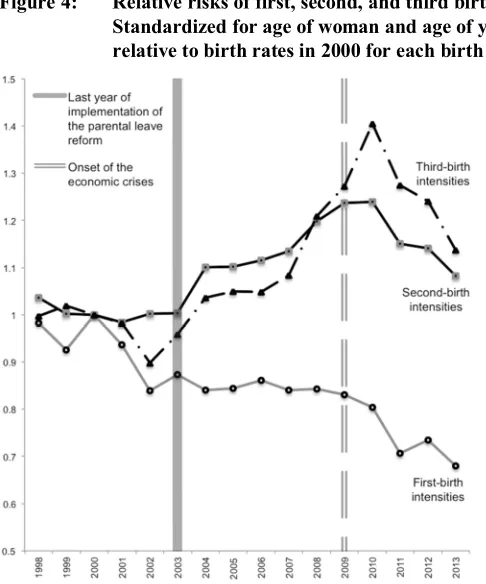
Figure 4 features the standardized annual indices of first-, second-, and third-birth rates between 1998 and 2013. The relative risks are comparable within each specific birth order but offer no information on the absolute differences between the propensity to give birth to a first, second, and third child. (For an overview of standardized second-and third-birth rates relative to higher order births, see Jónsson 2017.)
Albeit with some random variation from one year to the next, the first-birth intensities declined between 1998 and 2002, when they were approximately 85% of what they had been in 2000. After this, a period of stability took over. Almost nothing happened in the first-birth rate between 2004 and 2009; in 2009 the propensity to become a mother was 17% lower than in 2000, compared to 16% lower in 2004. However, in 2010 the birth intensities again began to decline, and in 2013 they were around 30% lower than in 2000 and almost 20% lower than in 2009.
third child was almost 40% stronger in 2010, after continuous intensification from 2002 onward. The rise in both rates conforms to the timing of the reform, and they continue to climb until 2010. In 2011 the second- and third-birth rates begin to decline and continue to do so until the end of the study period in 2013, when the rates are 8% and 14% higher than in 2000, respectively, but 13% and 19% lower than in 2010.
Figure 4: Relative risks of first, second, and third births in Iceland 1998–2013. Standardized for age of woman and age of youngest child. Rates are relative to birth rates in 2000 for each birth order (separate models)
Source: Icelandic register data, author’s calculations.
4.2 Developments in the timing of births and birth spacing by parity
these years. In 2010–2013 there is a drop in the age-specific birth risk among women under the age of 32, indicating a renewed state of postponement of parenthood.
Figure 5a: First-birth rates in Iceland by age of woman 1998–2013. Rates are relative to first-birth rates of 25–26-year-olds in 1998–2000
Source: Icelandic register data, author’s calculations.
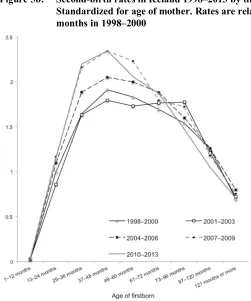
Figure 5b: Second-birth rates in Iceland 1998–2013 by time since previous birth. Standardized for age of mother. Rates are relative to duration 13–24 months in 1998–2000
Source: Icelandic register data, author’s calculations.
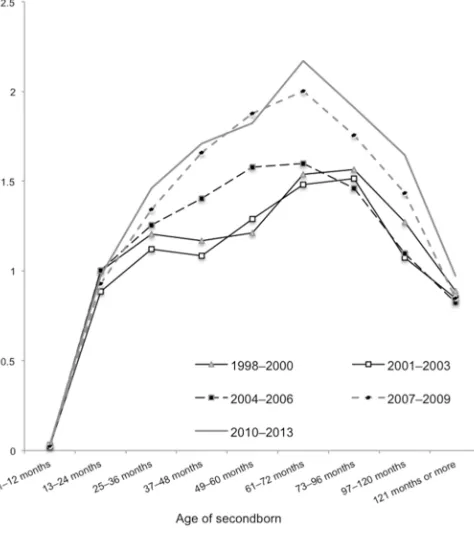
Figure 5c: Third-birth rates in Iceland 1998–2013 by time since previous birth. Standardized for age of mother. Rates are relative to duration 13–24 months in 1998–2000
Source: Icelandic register data, author’s calculations.
When it comes to both parities, the hazard is lowest during the implementation of the reform (2001–2003). The difference between 1998–2000 and 2001–2003 is only marginal. In contrast, subsequent patterns are very different, and they intensify over time. This difference can be taken as an indication that the reforms are, at least in part, associated with the new patterns – especially considering that the old childbearing patterns had been relatively homogeneous from the 1980s until the turn of the century (Jónsson 2017). The slight decrease in first- and third-birth rates between 2001 and 2003 (Figure 4) may indicate that some of the women waited with having (another) child until full benefits’ rights came into effect.
parenthood, or potential recuperation effects stemming from previously delayed parenthood are the main driving forces behind the elevated (aggregate) fertility after the reform. Fertility changes in the 2000s, as depicted in Figure 1, appear to be mostly related to the developments in higher order births. We thus proceed to present Kaplan– Meier estimates for these birth orders.
4.3 Realized fertility
The Kaplan–Meier nonparametric estimates (Figures 6a and 6b) coincide with our previous observation regarding changes in the birth intervals (Figures 5b and 5c). Developments over time in second births appear to be closely related to fertility timing (i.e., a faster progression to parity two), while the developments in third births appear to be associated with both tempo and quantum effects in fertility.
Figure 6a: Second-birth Kaplan–Meier cumulative probability estimates in Iceland by age and birth year of firstborn
The estimates indicate that changes in the timing of second births materialize with mothers who gave birth to their first child in 2002. Mothers who gave (first) birth in 2002–2005 progress faster to parity two than mothers who had their first child in 1998– 2001. The estimates suggest that it took 56 months for half of the mothers of the 2000 birth cohort to proceed to parity two, compared to 49 months for women who became mothers in 2003.
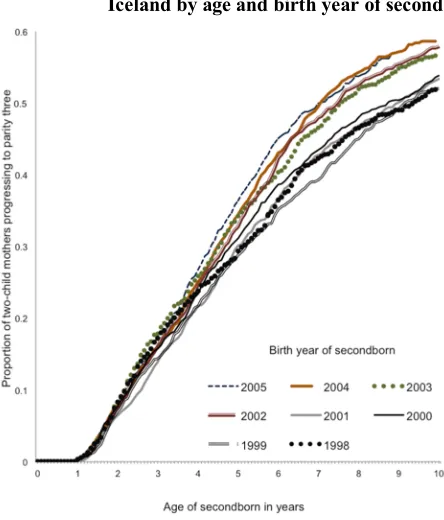
Figure 6b: Third-birth Kaplan–Meier cumulative probability estimates in Iceland by age and birth year of second born
Source:Icelandic register data, author’s calculations.
previous birth, 57–59% of mothers whose second child was born after 2001 had given birth to a third child, compared to 52–54% of mothers who gave birth to their second-born before 2002. Furthermore, it took 105 months for half of the women who gave birth to their second child in 2000 to proceed to parity three, compared to 91 months for mothers who gave birth to their second child in 2003.
5. Discussion and limitations
At the turn of the century, the Icelandic authorities enforced a double strategy – consisting of a reformed parental leave program and an increase in the volume of public day care – to support the dual-earner family model in Iceland. The reforms shared the same underlying principle, they were implemented stepwise around the same time, and together they form a holistic (improved) childcare-package available to parents in Iceland, making it hard to disentangle one policy from the other.
After the implementation of the parental leave reform, around one-third of the total leave days were used by fathers – as compared to just 3% in 2000. Hence, the changes appear to have succeeded in increasing fathers’ participation in early childrearing and thus fulfilling one of the main aims of the reform. Arguably, the changes also may have led to higher levels of gender equality in family-oriented institutions. Around the same time, the portion of year-old children admitted to playschools increased from one-in-ten to one-in-four, and the coverage for two-year-old children increased by 35 percentage points between 2000 and 2003 – presumably relieving parents of much of their previous family-care responsibilities.
We should keep in mind that, even though the timeline of family policy changes corresponds fairly well to changes in the birth rates, our data does not allow us to distinguish between the influence that the reforms may have had on childbearing dynamics and the effect of other potential influences such as the economy – or any other unobserved determinants, for that matter. Almost parallel to the reforms in the parental leave and childcare system, there was an upswing in the economy, which presumably worked as another possible positive influence. The TFR in the other Nordic countries rose at the same time, and most of Europe experienced increased fertility during this period of economic upswing. It has been proposed that a positive economic situation and family policies worked together in elevating the TFR in Sweden in the 1980s (Hoem 2005) and, given the similarities of the Nordic countries and the design of their childcare policies, the findings here suggest that a similar development may have taken place in Iceland.
We observed that the average number of parental leave days used by fathers began to decrease around the same time as the crisis hit: Fathers used 14% fewer days for children born in 2013 than for those born in 2008. This difference could be related to ‘breadwinner sensitivity,’ a reaction to economic hardship triggered by the crisis, and perhaps an indication that more couples decided to postpone or discontinue their childbearing, and fathers, especially, could not afford the cut in income that the use of leave would entail. This reaction may suggest that the monetary part of the benefits is no less important than the quota given to fathers in terms of benefit days, and that the former also influences the number of days fathers will exploit (see e.g., Eydal and Gíslason 2014; Sigurðardóttir and Garðarsdóttir 2018). Furthermore, this reaction could be seen as an indication that policies that exclusively go in the direction of practical parenting (of fathers) but neglect the part of economic parenting may prove less successful.
Albeit our data does not allow for detailed analysis, the overall decline in birth intensities after 2010 implies that the economic crisis did more than trigger a decline in the use of parental leave by fathers: It may also have played a decisive part in reversing the previous fertility trend that started in 2003. All the parity-specific birth rates began to drop stepwise around the same time and continued to do so until the end of the study period in 2013. The most profound decline was in the third-birth rate, but the first- and second-birth rates fell sharply as well.
We cannot with full conviction explain why the turnaround occurred when it did (i.e., in 2011 but not in, for instance, 2010). Economic crises can influence childbearing behaviour through various ways,3 for instance, through a loss of income and increased
3 The impact of economic recessions may depend to some extent upon parity, gender, the individual’s
financial hardship; less secure working environment and scarcer employment opportunities; cuts in government-sponsored social policies; and a decrease in affordable housing – or to put it a bit more vaguely, simply through people’s perception of their present possibilities and future risks. Social policies – components of the Nordic welfare system – including the design of the parental leave scheme and unemployment benefits, may have acted as a cushion at the beginning of the crisis. Figure 1 shows that the total fertility rates in the other Nordic countries declined together with those of Iceland (even though the recession was much less severe in Scandinavia). Another possibility is that it took some three years for the impact of the crisis to materialize, step by step, through increased unemployment, financial insecurity, and sceptical views about the future in 2009; time to react to the changes in 2010; and, finally, nine months of pregnancy ending in 2011.
The development during the last years of observation indicates that family policies cannot compensate in full for the impact of economic crisis on fertility. It also implies that the family-care gender balance, and its correlates, is still fragile in one of the most gender-equal countries in the world during economic turbulence. However, considering the magnitude of the crisis in Iceland and the complex relationship between economic trends, family policies and fertility, both at the micro- and macro-level, as well as any potential individual effects of both family policies and economic cycles on fertility, our data is limited and reveals only the very tip of the iceberg – full-scale fertility decline, irrespective of parity, leaving us with speculative assumptions at best.
With regard to the childbearing trends after the crisis hit and the persistent fertility decline in Iceland despite a subsequent turnaround to renewed booming economy4,
more research with richer data is required to gain better insight into the mechanisms at play. We leave it to future research to investigate whether there are social differentials in the childbearing behaviour in Iceland and to study the interplay of socioeconomic status and childbearing context. Little is known about the dynamics behind education and childbearing in Iceland and, considering the large increase in university education during the initial years of crisis, future research should consider whether this development may have had an impact on fertility outcomes – both during and in the aftermath of the economic crisis.
Sobotka, Skirbekk, and Philipov 2011; Kreyenfeld, Andersson, and Pailhé 2012; Kreyenfeld and Andersson 2014).
4 In the aftermath of the crisis, the Icelandic TFR fell below 1.9 for the first time in history. In 2016, it fell
6. Acknowledgements
References
Adserà, A. (2004). Changing fertility rates in developed countries: The impact of labor market institutions.Journal of Population Economics 17(1): 17–43.doi:10.1007/ s00148-003-0166-x.
Alþingi (2000). Act no. 95/2000: Lög um fæðingar- og foreldraorlof nr. 95/2000 [Act on maternity/paternity and parental leave no. 95/2000, with subsequent changes]. Reykjavík: Icelandic Parliament.
Alþingi (2008). Act no. 90/2008: Lög um leikskóla nr. 90/2008 [Act on playschools no. 90/2008]. Reykjavík: Icelandic Parliament.
Alþingistíðindi (1996–1997). Opinber fjölskyldustefna, ályktun 14/121, 1996–1997 [Official policy on the family 14/121, 1996–1997]. Reykjavík: Icelandic Parliament.
Andersson, G. (2000). The impact of labour-force participation on childbearing behaviour: Pro-cyclical fertility in Sweden during the 1980s and the 1990s. European Journal of Population 16(4): 293–333. doi:10.1023/A:10064549 09642.
Andersson, G. (2004). Childbearing developments in Denmark, Norway, and Sweden from the 1970s to the 1990s: A comparison. Demographic Research Special Collection 3(7): 155–176.doi:10.4054/DemRes.2004.S3.7.
Andersson, G. (2008). A review of policies and practices related to the ‘highest-low’ fertility of Sweden. Vienna Yearbook of Population Research 6: 89–102.
doi:10.1553/populationyearbook2008s89.
Andersson, G. and Scott, K. (2005). Labour-market status and first-time parenthood: The experience of immigrant women in Sweden, 1981–1997.Population Studies 61(1): 21–38.doi:10.1080/0032472052000332683.
Andersson, G., Duvander, A.-Z., and Hank, K. (2004). Do child-care characteristics influence continued childbearing in Sweden? An investigation of the quantity, quality, and price dimension.Journal of European Social Policy 14(4): 407–418.
doi:10.1177/0958928704046881.
Blossfeld, H.-P., Golsch, K., and Rohwer, G. (2007).Event history analysis with Stata. New York: Taylor & Francis.
Broddadóttir, I., Eydal, G.B., Hrafnsdóttir, S., and Sigurðardóttir, S.H. (1997). The development of local authority social services in Iceland. In: Sipilä, J. (ed.). Social care services the key to the Scandinavian model. Aldershot: Avebury: 51– 76.
Directorate of Labour (2015). The statistical database of the Directorate of Labour. Reykjavík: Directorate of Labour.
Duvander, A.-Z. and Andersson, G. (2006). Gender equality and fertility in Sweden: A study on the impact of the father’s uptake of parental leave on continued childbearing. Marriage and Family Review 39(1–2): 121–142. doi:10.1300/ J002v39n01_07.
Duvander, A.-Z., Lappegård, T., and Andersson, G. (2010). Family policy and fertility: Fathers’ and mothers’ use of parental leave and continued childbearing in Norway and Sweden. Journal of European Social Policy 20(1): 45–57.
doi:10.1177/0958928709352541.
Duvander, A.-Z., Lappegård, T., Andersen, S.N., Garðarsdóttir, Ó., Neyer, G., and Viklund, I. (2016). Gender equal family policy and continued childbearing in Iceland, Norway and Sweden. Stockholm: Stockholm University, Department of Sociology (Stockholm Research Reports in Demography 2016: 02).
Einarsson, B.G., Gunnlaugsson, K., Ólafsson, T.T., and Pétursson, T.G. (2015). The long history of financial boom-bust cycles in Iceland: Part I: Financial crises. Reykjavík: Central Bank of Iceland (Working Paper No. 68).
Esping-Andersen, G. (1990).The three worlds of welfare capitalism. Cambridge: Polity Press.
Esping-Andersen, G. and Billari, F.C. (2015). Re-theorizing family demographics. Population and Development Review 41(1): 1–31. doi:10.1111/j.1728-4457. 2015.00024.x.
Eydal, G.B. (2008). Policies promoting care from both parents: The case of Iceland. In: Eydal, G.B. and Gíslason, I.V. (eds.). Equal rights to earn and care: Parental leave in Iceland. Reykjavík: Félagsvísindastofnun Íslands: 111–148.
Eydal, G.B. and Gíslason, I.V. (2008b). Paid parental leave in Iceland: History and context. In: Eydal, G.B. and Gíslason, I.V. (eds.).Equal rights to earn and care: Parental leave in Iceland. Reykjavík: Félagsvísindastofnun Íslands: 45–63. Eydal, G.B. and Gíslason, I.V. (2014). Hrunið og fæðingaorlof: Áhrif á foreldra og
löggjöf [The economic crisis and parental leave: The impact on parents and legislation].Íslenska þjóðfélagið 5(2): 77–93.
Eydal, G.B. and Ólafsson, S. (2008). Family policy in Iceland: An overview. In: Ostner, I. and Schmitt, C. (eds.). Family policies in the context of family change. Wiesbaden: VS Verlag für Sozialwissenschaften: 109–127. doi:10.1007/978-3-531-90895-3_6.
Garðarsdóttir, Ó. (2008). Fertility trends in Iceland in a Nordic comparative perspective. In: Eydal, G.B. and Gíslason, I.V. (eds.).Equal rights to earn and care: Parental leave in Iceland. Reykjavík: Félagsvísindastofnun Íslands: 15– 44.
Gauthier, A. (2007). The impact of family policies on fertility in industrialized countries: A review of the literature. Population Research and Policy Review 26(3): 323–346.doi:10.1007/s11113-007-9033-x.
Gíslason, I.V. (2007).Parental leave in Iceland bringing the fathers in: Developments in the wake of new legislation in 2000. Akureyri: Jafnréttisstofa.
Goldscheider, F., Bernhardt, E., and Lappegård, T. (2015). The gender revolution: A framework for understanding changing family and demographic behaviour. Population and Development Review 41(2): 207–239.doi:10.1111/j.1728-4457. 2015.00045.x.
Hank, K. and Kreyenfeld, M. (2003). A multilevel analysis of child care and women’s fertility decisions in Western Germany. Journal of Marriage and Family 65(3): 584–596.doi:10.1111/j.1741-3737.2003.00584.x.
Hoem, J.M. (1993). Public policy as fuel of fertility: Effects of a policy reform on the pace of childbearing in Sweden in the 1980s. Acta Sociologica 36: 19– 31.doi:10.1177/000169939303600102.
Hoem, J.M. (2005). Why does Sweden have such high fertility?Demographic Research 13(22): 559–572.doi:10.4054/DemRes.2005.13.22.
Jónsson, A.K. (2017). Childbearing trends in Iceland, 1982–2013: Fertility timing, quantum, and gender preferences for children in a Nordic context.Demographic Research 37(7): 147–188.doi:10.4054/DemRes.2017.37.7.
Korpi, W. (2000). Faces of inequality: Gender, class, and patterns of inequalities in different types of welfare states. Social Politics 7(2): 127–189. doi:10.1093/ sp/7.2.127.
Kravdal, Ø. (1996). How the local supply of day-care centers influences fertility in Norway: A parity-specific approach. Population Research and Policy Review 15(3): 201–218.doi:10.1007/BF00127049.
Kreyenfeld, M. and Andersson, G. (2014). Socioeconomic differences in the unemployment and fertility nexus: Evidence from Denmark and Germany. Advances in Life Course Research 21: 59–73.doi:10.1016/j.alcr.2014.01.007. Kreyenfeld, M., Andersson, G., and Pailhé, A. (2012). Economic uncertainty and family
dynamics in Europe: Introduction. Demographic Research 27(28): 835–852.
doi:10.4054/DemRes.2012.27.28.
Lappegård, T. (2010). Family policies and fertility in Norway. European Journal of Population 26(1): 99–116.doi:10.1007/s10680-009-9190-1.
Lappegård, T., Rønsen, M., and Skrede, K. (2011). Fatherhood and fertility.Fathering 9(1): 103–120.doi:10.3149/fth.0901.103.
Luci, A. and Thévenon, O. (2012). The impact of family policy packages on fertility trends in developed countries. Paris: OECD (Documents de travail 174).
McDonald, P. (2000). Gender equity in theories of fertility transition. Population and Development Review 26(3): 427–439.doi:10.1111/j.1728-4457.2000.00427.x. McDonald, P. (2013). Social foundations for explaining low fertility: Gender equity.
Demographic Research 28(34): 981–994.doi:10.4054/DemRes.2013.28.34. Ministry of Welfare (2016). Framtíðarstefna í fæðingarorlofsmálum mars 2016.
Reykjavík: Velferðarráðuneytið.
Moss, P. and O’Brien, M. (2006). Introduction. In: Moss, P. and O’Brien, M. (eds.). International review of leave policies and related research. London: Department of Trade and Industry: 9–14.
Neyer, G. (2006). Family policies and fertility in Europe: Fertility policies at the intersection of gender policies, employment policies and care policies. Rostock: Max Planck Institute for Demographic Research (MPIDR Working Paper WP 2006-010).
Neyer, G. (2013). Welfare States, family policies and fertility in Europe. In: Neyer, G., Andersson, G., Kulu, H., Bernardi, L., and Bühler, C. (eds.).The demography of Europe. Dordrecht: Springer: 29–54.doi:10.1007/978-90-481-8978-6_3. Neyer, G. and Andersson, G. (2008). Consequences of family policies on childbearing
behavior: Effects or artifacts?Population and Development Review 34(4): 699– 724.doi:10.1111/j.1728-4457.2008.00246.x.
Nordic Statistics (2016). The statistical database of the Nordic Council [electronic resource]. Copenhagen: The Nordic Council. http://91.208.143.100/pxweb/ norden/pxweb/en/Nordic%20Statistics.
Rindfuss, R.R., Guilkey, D., Morgan, S.P., Kravdal, Ø., and Guzzo, K.B. (2007). Child care availability and first-birth timing in Norway.Demography 44(2): 345–372.
doi:10.1353/dem.2007.0017.
Rønsen, M. and Skrede, K. (2008). Fertility trends and differentials in the Nordic countries: Footprints of welfare policies and challenges on the road ahead.
Vienna Yearbook of Population Research 6: 103–123. doi:10.1553/
populationyearbook2008s103.
Sigurðardóttir, H.M. and Garðarsdóttir, Ó. (2018). Backlash in gender equality? Fathers’ parental leave during a time of economic crisis. Journal of European Social Policy: 1–15.doi:10.1177/0958928717739243.
Sobotka, T. and Lutz, W. (2010). Misleading policy messages derived from the period TFR: Should we stop using it?Comparative Population Studies 35(3): 637–664. Sobotka, T., Skirbekk, V., and Philipov, D. (2011). Economic recession and fertility in
the developed world. Population and Development Review 37(2): 267–306.
doi:10.1111/j.1728-4457.2011.00411.x.
Statistics Denmark (2016). StatBank Denmark [electronic resource]. Copenhagen: Statistics Denmark.http://www.statbank.dk.
Statistics Finland (2016). Statistics Finland [electronic resource]. Helsinki: Statistics Finland.http://tilastokeskus.fi.
Statistics Norway (2016). Statistisk sentralbyå [electronic resource]. Oslo: Statistics Norway.https://www.ssb.no.