R E S E A R C H
Open Access
Vertex maps on graphs-trace theorems
Chris Bernhardt
Correspondence: [email protected] Fairfield University, Fairfield, CT 06824, USA,
Abstract
The paper proves two theorems concerning the traces of Oriented Markov Matrices of vertex maps on graphs. These are then used to give a Sharkoksky-type result for maps that are homotopic to the identity and that flip at least one edge.
2000 Mathematics Subject Classification
37E15, 37E25
Keywords:Graphs, Vertex maps, Periodic orbits, Sharkovsky’s theorem, Trace
1. Introduction
A vertex map on a graph is a continuous map that permutes the vertices. Given a ver-tex map, the periods of the periodic orbits can be computed; giving a subset of the positive integers. One of the basic questions of combinatorial dynamics for vertex maps is to determine which subsets of the positive integers can be obtained in this way. Sharkovsky’s theorem [1] is a well-known result that answers the question when the underlying graph is topologically an interval and the vertices all belong to the same periodic orbit. In [2,3] a Sharkovsky-type theorem was proved for trees.
In the vertex map papers, a standard method is to construct a matrix, called the Oriented Markov Matrix. The entries along main diagonal of the matrix give informa-tion about periodic orbits. In particular, the diagonal entries of the matrix raised to the nth power give information about the periodic orbits with periodn. Thus the trace of powers of the matrix becomes important.
In this paper, two results concerning the trace of powers of the Oriented Markov Matrix are proved. The first shows that the trace is a homotopical invariant. The sec-ond shows how the trace can be calculated from the number of edges in the graph and the number of vertices that are not fixed by the vertex map. These results follow from Hopf’s proof of the Lefschetz Fixed Point Theorem. However, since graphs are homologically very simple, it is possible to give elementary proofs, which we do.
The trace theorems are then used to prove the following theorem.
Theorem 1. Let G be a graph with v vertices. Let f be a vertex map on G that is
homotopic to the identity and such that the vertices form one periodic orbit. Suppose f flips an edge.
(1)If v is not a divisor of2kthen f has a periodic point with period2k.
(2)If v= 2pq, where q> 1is odd and p ≥0, then f has a periodic point with period 2pr for any r≥q.
(Throughout the paper we will say that the period of a periodic point is the number of distinct points in its orbit. This is often referred to as theminimalorleast period.)
It should be noted that all maps on trees are homotopic to the identity. Indeed, the proof of this theorem should be compared to the proofs of Sharkovsky Theorem in [4] and the theorem on trees in [3].
In this paper we study maps for which the vertices are permuted by the map. Maps on trees and graphs can be studied without this restriction. For general maps on trees see [5]. For general maps on graphs see [6,7].
2. Graphs
An edgeis a space homeomorphic to the closed interval [0, 1]. The boundary points of the edges are vertices. An edge is not allowed to have a vertex as an interior point. The intersection of two distinct edges is empty, consists of one vertex or of two ver-tices. We assume that we have a finite numbereof edges and vof vertices. Thegraph is the union of vertices and edges. We assume that graphs are connected and closed. We allow the possibility that there is more than one edge between the same two ver-tices. We also allow the possibility that an edge connects a vertex to itself (in this case the edge is homeomorphic to a circle).
We will label the verticesV1toVv; in diagrams we will just label them with the
inte-gers 1 to v. IfVkandVlare vertices and there is an edge between them we will choose anorientationor direction on the edge and consider it as a directed edge from one ver-tex to the other. We will label the positively oriented edges asE1, ...,Ee. IfEpis an edge
fromVktoVlthen the same edge, but with the opposite (negative) orientation that goes fromVltoVkwill be denoted by -Ep. We will callVkthe first vertex ofEpandVlthe
sec-ond vertex. (So the first vertex ofEpequals the second vertex of -Epand vice versa.) Given any two vertices,VrandVs, apathfromVrto Vsis a sequence of edgesE1 ...
Eqwhere the first vertex ofE1isVr, the second vertex of Eq isVsand the second
ver-tex of Elequals the first vertex ofEl+1for 1≤l≤q - 1. IfEpand -Epare two
consecu-tive edges in a path we can obtain a shorter path by omitting these two edges. We will call this acontractionof the path. Given any path from vertexVrto vertex Vswe can form a sequence of contractions resulting in a unique path that cannot be contracted further. We call this resulting path fully contracted. Given a path Pin the graph we will let FC(P) denote the fully contracted path that is obtained fromP.
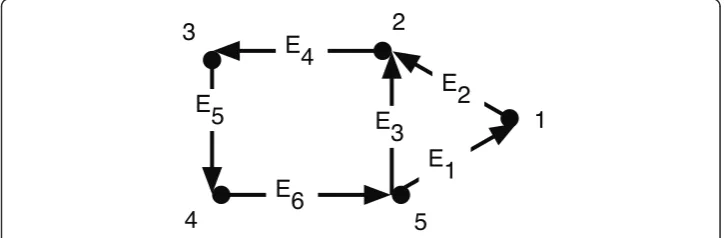
We define acirclein graphGto be a closed path that has no repeated vertices. Thus in Figure 1,E1E2- E3andE3E4E5E6are circles.
E
4
E
3
E
6
E
5
E
2
E
1
1
2
3
4
5
3. Linearization of vertex maps
A vertex mapof a graphGis a continuous map fromGto itself with the property that the vertices of Gare permuted by f. In this section we will define the linearization of a vertex map.
Supposeθis a permutation on 1, ...,vand thatfis a map from graphGto itself with the property thatf(Vi) =Vθ(i)for 1≤i≤ v. Then we defineLf, thelinearizationoff, to
be the continuous map fromGto itself given by Lfmaps the edgeE with first vertex Vkand second vertex Vllinearly onto the fully contracted path fromVθ(k)toVθ(l)that
is homotopic to f(E), where f(E) is considered a path parameterized by E and the homotopy fixes both Vθ (k)and Vθ(l). This is done for each edgeE in the graph. We
make the observation that it is possible for a fully contracted path to contain positive or negative multiples of circles, but the loop based at Vθ(k)obtained by going toVθ(l)
along the path given by Lf (parameterized by E) and then back toVθ(k) by the path
given by f(parameterized by -E) will be contractable to a point.
For maps of the interval or of trees this linearized map is often called the connect-the-dot map associated to θ. For trees (and intervals) f is always homotopic to the identity and so there is a unique linearization associated toθ. However, for graphs in general, the linearization depends on both θand the homotopy type of the mapf on the edges.
Example 1. Figure 1 shows a graphG. In this case the mapf:G®Gpermutes the
vertices by f(Vi) = Vθ(i)whereθÎ Snis given byθ= (13)(245), andf(E1) = E3E1E2E4, f
(E2) =E5,f(E3) =E4E5,f(E4) =E6E1, f(E5) =E1 andf(E6) =E3.
It is straightforward to check that
f3(E1) =E1−E1−E6−E5−E4−E3E1E2E4E5E6E1−E1E3−E3E1E2E4
and
Lf3(E1) =−E6−E5−E4−E3E1E2E4E5E6E1E2E4.
4. Oriented Markov graphs
We now define the Oriented Markov Graphassociated to the graphGandLf. This is a directed graph on evertices. Each of the directed edges also has either a positive or negative sign attached. It is defined as follows: the vertices of the Markov graph corre-spond to the edges of the graph (we will abuse notation and also denote these vertices by E1, ...,Ee, the context should make it clear whether Ekrefers to the edge in the
ori-ginal graph Gor the corresponding vertex in the Markov graph); we draw a positive directed edge from vertex Eito vertexEjfor each occurrence ofEjinLf(Ei); we draw a negative directed edge from vertex Eito vertexEjfor each occurrence of -Ej inLf(Ei). We will denote this Oriented Markov Graph byOMG(f).
Sometimes we will not need to use the fact that the directed edges inOMG(f) have a positive or negative sign attached. We will use the notation Ek® Ej to indicate that there is a directed edge from EktoEj.
Lemma 1.Let f be a vertex map on G. Suppose thatEk1 →Ek2 →. . .Ekmis a path in
OMG(f). Then Ekm⊆L
m
f (Ek1). If the path Ek1 →Ek2 →. . .Ekmin OMG(f) has positive
orientation then Ekmappears in the path (in G) Lmf(Ek1). If the path
Ek1 →Ek2 →. . .Ekmin OMG(f) has negative orientation then−Ekmappears in the path
(in G) Lm f (Ek1).
Conversely, ifEkmappears in the path (in G)Lmf (Ek1)then there is a positively oriented
path (in OMG(f)) of length m fromEk1to Ekm; and if−Ekmappears in the path (in G)
Lm
f (Ek1)then there is a positively oriented path (in OMG(f)) of length m from Ek1toEkm.
The following results are standard (see [8] or [9], for example, for a formal proof).
Lemma 2.Let f be a vertex map on G. Suppose that Ek0→Ek1 → · · ·Ekm→Ek0is a
loop in OMG(f). Then there exists a periodic point x of Lfwith Lm+1
f (x) =xsuch that
Lrf(x)∈Ekrfor r= 0, 1, ...,m. Conversely, if x is a periodic point in Lf of period m+ 1
and if x is not a vertex then there exists a loop Ek0 →Ek1 → · · ·Ekm →Ek0in OMG(f)
such thatLrf(x)∈Ekrfor r= 0, 1, ...,m.
As in [3] we can change Lftof in the first half of the above lemma to obtain the following.
Lemma 3.Let f be a vertex map on G. Suppose that Ek0→Ek1 → · · ·Ekm→Ek0is a
loop in OMG(f). Then there exists a periodic point x of f with fm+1(x) = x such that
fr(x)∈E
krfor r = 0, 1, ...,m.
If the loopEk0 →Ek1→ · · ·Ekm→Ek0in the above statement is not a repetition of a
shorter loop then we will say that it is a non-repetitiveloop of lengthm+ 1.
The importance of non-repetitive loops in the Oriented Markov Graph is the follow-ing extension of Lemma 2.
Lemma 4.Let f be a vertex map on G. Suppose that Ek0→Ek1 → · · ·Ekm→Ek0is a
non-repetitive loop in OMG(f). Then there exists a periodic point x of f with fm+1(x) =x such that fr(x)∈Ekrfor r= 0, 1, ...,m. If x is not a vertex of G, then x has minimum period of m + 1.
Note that if the non-repetitive loop in the statement above has negative orientation, then there must be a closed subinterval of Ek0that gets mapped with negative
orienta-tion onto Ek0underf
m+1
. This means that the periodic pointxcan be chosen to lie in the interiorEk0and so it definitely is not a vertex ofG.
5. Oriented Markov matrices
Suppose thatfis a vertex map onG. Then we define theOriented Markov Matrixoff, denoted M(f), to be thee×ematrix withM(f)i,jequal to the number of positive direc-ted edges fromEjtoEiminus the number of the negative edges fromEj toEi. This is equivalent to saying that M(f)i,jis equal to the number of times thatEi appears in the pathLf(Ej) minus the number of times that -Eiappears in the pathLf(Ej).
Induction gives:
Theorem 2. Let f be a vertex map on G. Then((M(f))n)i,j is the number of positively oriented paths (in OMG(f)) from Ejto Eiminus the sum of negatively oriented paths (in OMG(f)) from Ejto Ei.
Observe that to obtain LLn
f from L
n
f we contract pathsLnf(Ei)toFC(Lnf(Ei))and that
negative orientation, so for eachjthe number of timesEjappears minus the number of times that -Ejappears is the same in both Lnf(Ei)andFC(Lnf(Ei)). SoM(LLnf) =M(L
n f).
Theorem 3.Let f be a vertex map on G. Then(M(f))n=M(Ln
f) =M(LLnf)for any posi-tive integer n.
Example 1 continued. In Example 1 the oriented Markov matrix is
M(f) =
⎛ ⎜ ⎜ ⎜ ⎜ ⎜ ⎜ ⎝
1 0 0 1−1 0 1 0 0 0 0 0
−1 0 0 0 0 1 1 0 1 0 0 0 0 1 1 0 0 0 0 0 0 1 0 0
⎞ ⎟ ⎟ ⎟ ⎟ ⎟ ⎟ ⎠ and
M3(f) =
⎛ ⎜ ⎜ ⎜ ⎜ ⎜ ⎜ ⎝
2 −1 0 2 −2 0 2 −1 0 1 −1 0
−1 1 1−1 1 0
1 −1 0 1 0 0
0 0 0 1 0 0
0 0 0 1 −1 1
⎞ ⎟ ⎟ ⎟ ⎟ ⎟ ⎟ ⎠
The first columns of these matrices give information about Lf (E1) and L3f(E1),
respectively.
6. Homotopic maps and the trace
In this paper we have used language that is typically used in one-dimensional dynamics. However, many of these ideas also belong to algebraic topology and can be expressed in that language. In particular, the underlying space is a one-dimensional simplicial complex; the map Lfis essentially a simplicial transformation; and M(f) is the matrix representation of the induced map on one-chains.
The goal of the next two sections is to prove results concerning the trace of M(f). These results follow simply from Hopf’s trace formula which states that the alternating sum of traces in homology is equal to the alternating sum of traces on the chains. However, homological arguments are simple in the one-dimensional case, and we give short elementary proofs. (The change of basis in Section 7:2 comes from Hopf’s proof of the Lefschetz Fixed Point Theorem given in [10].)
Theorem 4. Let f be a vertex map on G. If f is homotopic to g then Trace(M(f)) =
Trace(M(g)).
then we have to make changes to the fully contracted paths that are the images of the other edges in the circle so that they now, in total, add -n copies of the circle. The only way that this can be done is by changing the image of other edges in the circle by adding complete copies of the circle. Notice that though the diagonal entries in the Markov matrix corresponding to a circle may change the sum of these entries must be constant if we wish to preserve the homotopy type of the map. This means that the trace ofM(f) equals the trace ofM(g) wheneverfandgare homotopic. □
7. Maps homotopic to the identity–the trace theorem
Suppose that f:G® Gis a map with the property thatffixes exactlyr vertices, i.e., there are exactlyr vertices with the property thatf(V) =V. This means that there are exactlyv-rvertices that areunfixed. We will letU(f,G) denote the number of unfixed vertices of Gunderf. In this section we show that iff: G® Gis homotopic to the identity then the trace ofM(Lf) equalse-U(f,G).
Theorem (trace theorem). Let f be a vertex map on G. Suppose that f is homotopic
to the identity map on G. Then Trace(M(f)) =e-U(f,G).
The proof is given below. The outline is to first prove it for trees, which is straight-forward. Then we need to calculate the trace of M(f) for general graphs. This is done by introducing the chain group and seeing that the matrix induces a homomorphism. Then a new basis is chosen for the chain group. The induced map on chains gives a new matrix that is similar to M(f), but such that it is simple to calculate its trace.
7.1. Proof of the Trace theorem whenGis a tree
First the case whenGis a tree. (This is a slight generalization of a result in [2], where it was proved for the case when none of the vertices are fixed byf.)
Proof. For each unfixed vertex,Vithere is a fully contracted path fromVitof(Vi) that will be denotedP(Vi). The initial vertex in this path isVi. At Vidraw an arrow (direc-tion arrow) pointing along the first edge of P(Vi). We repeat this process for each of the unfixed vertices in G. If a vertexVis fixed then no direction arrows are drawn at V.
Observe that an edge Eicontains two direction arrows if and only if -Eiis inLf(Ei). Also observe that Eicontains no direction arrows if and only ifEiis inLf(Ei). Finally, an edge contains one direction arrow if and only if Lf(Ei) does not contain eitherEior - Ei. Notice that the number of arrows on the edgeEiis exactly 1 - M(f)i,i. So the total
number of arrows ise1(1−M(f)i,i) =e−Trace(M(f)). However, there are exactly U
(f,G) arrows inG, one for each unfixed vertex, soU(f,G) =e- Trace(M(f)).
7.2. Chain groups
An integral 1-chain is a formal sume1aiEi, whereaiare integers. Addition of chains
is defined by
e
1
aiEi+ e
1
biEi= e
1
(ai+bi)Ei.
The Oriented Markov Matrix, M(f), defines a homomorphism from the chain group to itself by sending the 1-chain with coordinate vector vtoM(f)v. Notice that this is entirely consistent with the previous interpretation of M(f), in that for any pathPinG we can find the coordinate vectorv; the coordinate vector of the image ofP underLf is M(f)v.
7.3. Spanning trees-change of basis
Let T denote a spanning tree forG. This containsv- 1 edges, we will denote them
E1,. . .,Ev−1. There are then e+ 1 - vedges inG that do not appear inT. For each edge, E, that is inG, but notT choose a circle inGthat consists ofEplus edges in T. In this way e+ 1 -vcircles are obtained, denotedC1, ...,Ce+1-v.
Notice that ifEiis the edge inCithat does not belong toT, then there exist pathsP1
and P2 inTsuch that Ei= FC(P1CiP2). This means that any fully contracted path inG
can be expressed as the contraction of a path that is written only using
C1,. . .,Ce+1−v,E1,. . .,Ev−1.
We now consider the matrix, N, that represents the homomorphism on 1-chains with respect to the ordered basis
(C1,. . .,Ce+1−v,E1,. . .,Ev−1).
Since f is homotopic to the identity andCi is a circle, we have Lf (Ci) =Ci. This means that
N=
I A
0B
,
whereIis the (e+ 1 -v) × (e+ 1 -v) identity matrix and 0 is the (v- 1) × (e+v- 1) zero matrix.
The matricesM(f) andNare similar, because they represent the same homomorph-ism with respect to different bases. This means
Trace(M(f)) =Trace(N),
but
Trace(N) =Trace(I) +Trace(B) =e+ 1−v+Trace(B).
To complete the proof we must calculateTrace(B).
7.4. Completion of the proof
For each edge Ei in T we know that Lf(Ei) can be written as a path using
(C1,. . .,Ce+1−v,E1,. . .,Ev−1).. Since circles both begin and end at the same vertex,
notice that if we delete all the circles in this path we obtain a new path that lies entirely inT and has the same endpoints as Lf(Ei). We definef’to be the map onT defined in this way. Note thatf’is a vertex map onTwith vertex permutation given by θ. Also note thatM(f’) =B. Thus by the proof for trees we know thatTrace(B) =v -1 - U(f,G).
In the previous section it was shown that
So we obtain
Trace(M(f) =e−U(f,G),
which completes the proof.
7.5. Example 1 continued
In this subsection we illustrate the construction using Example 1.
We take as the spanning tree the tree formed by the edgesE1, E3, E5 andE6. Then
there are two circles. We let C1 =E3E4E5E6and C2 =E1E2 -E3. The new ordered basis
for the chain group is (C1, C2, E1, E3, E5, E6). Notice that E2 = - E1C2E3 and E4 =
-E3C1E-6-E5. So Lf(E1) = -E3E1E2E4 = -E3E1 - E1C2E3 - E3C1 - E6 - E5 which can be
contracted to -E3C2C1 -E6 -E5. In this way we obtain
N=
⎛ ⎜ ⎜ ⎜ ⎜ ⎜ ⎜ ⎝
1 0 1 1 0 0
0 1 1 0 0 0
0 0 0 0 −1 0
0 0−1−1 0 1
0 0−1 0 0 0
0 0−1−1 0 0
⎞ ⎟ ⎟ ⎟ ⎟ ⎟ ⎟ ⎠
.
The mapf’on the spanning tree permutes the vertices in exactly the same way as f but maps the edges in the following way:f’(E1) = -E3- E6- E5, f’(E3) = -E3 -E6,f’(E5) =
- E1and f’(E6) =E3.
8. Vertices form one periodic orbit
In this section we study vertex maps where the vertices of Gconsist of one periodic orbit.
First, we state some basic results concerning the trace of the Oriented Markov Matrix. This is followed by some results for maps that are homotopic to the identity. Finally, we look at maps that are homotopic to the identity and that have at least one edge flipped, and show that we can obtain some results that are connected to the Shar-kovsky ordering in this case.
Given a vertex mapf, we will letθdenote the permutation onvelements defined by f(Vi) =Vθ(i)fori= 1, ...,v.
8.1. Basic trace results for maps that are homotopic to the identity
Suppose that the vertices of Gconsist of one periodic orbit. Then in this case, if kis not an integer multiple of v, thenθk(i)≠i fori = 1, ...v; and that if kis an integer multiple ofvthenθkis the identity. This fact, along with the fact thatfnis homotopic to the identity for any positive integer n, gives us the following corollary to the Trace theorem.
Corollary 5.Let G be a graph with e edges and v vertices. Suppose that f: G® G is
homotopic to the identity. Suppose that the vertices of G form one periodic orbit. Then:
(1)Trace(M(f)k) =e - v if k is not an integer multiple of v. (2)Trace(M(f)k) =e if k is an integer multiple of v.
Theorem 6.Let G be a graph with e edges and v vertices. Suppose that f:G®G is homotopic to the identity. Suppose that the vertices of G form one periodic orbit. Then M(f)v=I, where I is the e ×e identity matrix.
8.2. Edge flipping and the proof of Theorem 1
We say a vertex mapfon a graphflipsan edge Eif -Eappears inLf(E).
First we make the observation that if the underlying graph is a tree and that none of the vertices are fixed by the vertex map, then it must have this edge flipping property.
Lemma 5.If f is a vertex map on a tree that does not fix any vertices, then f flips an edge.
Proof. By Corollary 5, the trace ofM(f) = -1. Thus M(f) must have an entry along the main diagonal that is a negative integer. □
The following two lemmas plus Lemma 4 complete the proof of Theorem 1.
Lemma 6.Let G be a graph and f a vertex map from G to itself that is homotopic to
the identity. Suppose that the vertices form one periodic orbit. Suppose f flips an edge. If v is not a divisor of 2k, then OMG(f)has a non-repetitive loop of length2kwith negative orientation.
Proof. Sincef flips an edge, there must be at least one loop in the Markov graph that has length 1 and has negative orientation. SinceTrace(M (f)) = e - v, there must be at least e - v+ 1 loops of length 1 that have positive orientation. By going around each of these loops in the Markov graph twice we can see that there must be at least e - v+ 2 loops of length 2 that have positive orientation. SinceTrace(M(f)2) = e - v, there must be at least one loop of length 2 with negative orientation. Since it has negative orienta-tion, it cannot be the repetition of a shorter loop. So the Markov graph of fhas a non-repetitive loop of length 2 with negative orientation.
Now, for any positive integerk, consider loops of length 2kin the Markov graph. If j < k, and the Markov graph has a non-repetitiveloop of length 2j, then this gives a loop of length 2k by going around it 2k-j times. Since 2k-j is even, this repetitive loop of length 2kmust have positive orientation. From the argument above, we know there are at least e - v+ 2 loops of length 2. This means that there must be at least e - v+ 2 loops of length 2kwith positive orientation. SinceTrace(M(f)2k
) =e−v, there must be a loop of length 2k with negative orientation. This must be a non-repetitive loop because any repetitive loop of length 2kconsists of an even number of repetitions of the shorter loop and so must have positive orientation. □
Lemma 7. Let G be a graph and f a map from G to itself that is homotopic to the
identity. Suppose that the vertices form one periodic orbit. Suppose f flips an edge. If v = 2pq, where q >1is odd and p ≥0, then M(f)has a non-repetitive loop of length2pr for any r ≥q.
Proof. Letr - q= 2st, wheretis odd. The previous lemma tells us that there must be a non-repetitive loop of length 2p+swith negative orientation. LetEidenote an edge in this loop. Then Theorem 6 tells us that M2pq
and then going around the loop of length 2pqonce. Sincetis odd, the resulting non-repetitive loop has negative orientation. □
9. Concluding comments
In the first subsection we show that the edge flipping property is essential to the con-clusion of Theorem 1. Then in the next subsection we compare the partial ordering given by Theorem 1 to the orderings given when the underlying graphs are restricted to trees.
9.1. Edge flipping
Given a graph G, we let the Euler Characteristic be the number of vertices minus the number of edges. Vertex maps of trees (and the interval) that do not fix any of the ver-tices have the edge flipping property. The graphs in these cases have Euler characteris-tic of 1. However, if the Euler characterischaracteris-tic is less than 1, then vertex maps need not flip edges and the set of periods of periodic points can consist of one or two numbers.
By considering rotations, it is clear that for maps of a circle, for any positive integer nit is possible to construct a map from the circle to itself that only has periodic points with periodnand no other periods.
Lemma 8. Let G be a graph and f:G® G a map that is homotopic to the identity
and permutes the vertices. Then we can construct a graph G’by doubling one edge in G and a map f’: G’ ® G’ such that f’ is homotopic to the identity and such that f’ restricted to G equals f and such that f’has only one other periodic point-a fixed point.
Proof. LetEk be an edge in the graphGwith verticesVk1andVk2LetPbe a path in
the graph from Vk1to f(Vk1). Then -Ekfollowed by Pfollowed by f(Ek), which we will
denote by - EkPf (Ek) gives a path from Vk2to f(Vk2). We form G’ by adding a new
edge, Ee+1that goes fromVk1toVk2. We definef’restricted toGto equalfand letf’(Ee
+1) =PEe+1 - EkPf (Ek). We define f’to be linear on the subinterval of Ee+1that gets
mapped onto Ee+1. Notice that this new map is homotopic to the identity and that the
only new periodic point introduced is the fixed point inEe+1.
The lemma above gives the second part of the next result. The first part follows from the Trace theorem which tells us that the trace of M(f) is non-zero and hence by Lemma 3, fmust have a fixed point.
Theorem 7. Let G be a graph with v vertices. Suppose that f:G® G is homotopic to
the identity and has the property that the vertices form one periodic orbit. If v≠e, then f must have a fixed point.
Given any negative integer n we can construct a graph G with v vertices and e edges with v - e =n and a map f:G® G homotopic to the identity with the property that the vertices form one periodic orbit and such that f has periodic orbits with period v and1and no other periods.
9.2. Orderings of the natural numbers
relations are added, only relations are deleted. So the graph ordering is weaker than the tree ordering, and the tree ordering is weaker than Sharkovsky’s ordering. Given a positive integern, consider the set of natural numbers that are forced byn, {mÎN|m ⊲n}, for each of the three orderings. Ifm ⊲nfor the Sharkovsky ordering andm ⋪n for the graph ordering, then m < n. This means that for each n, the three sets {mÎ N|m⊲n} only differ by a finite number of elements.
In both Sharkovsky’s Theorem and the theorem on trees there is a result that is sometimes called the converse. This is the result that given anynin the ordering one can find an example of a vertex map that does not have a periodic point of period m for anym ⋪n. It is an open question as to whether the converse result holds for the graph ordering. We conjecture that it does, but this is little more than a guess.
Another natural question is to ask what happens in the case when the vertices of a vertex map form more than one periodic orbit. This is, of course, a harder question. For maps of the circle this leads to the study of rotation intervals. The beginnings of the generalization of this idea to graphs can be found in [11].
Acknowledgements
The author would like to thank the referee for many corrections and improvements to this paper.
Competing interests
The author declares that they have no competing interests.
Received: 2 December 2010 Accepted: 23 June 2011 Published: 23 June 2011
References
1. Sharkovsky, AN: Co-existence of the cycles of a continuous mapping of the line onto itself. Ukrain Math Zh.16(1), 61–71 (1964)
2. Bernhardt, C: Vertex maps for trees: algebra and periods of periodic orbits. Disc Cts Dyn Sys.14(3), 399–408
3. Bernhardt, C: A Sharkovsky theorem for vertex maps on trees. J Diff Equations Appl.17(1), 103–113 (2011). doi:10.1080/ 10236190902919327
4. Bernhardt, C: A proof of Sharkovsky’s theorem. J Differ Equations Appl.9(3-4), 373–379 (2003)
5. Alsedà, L, Juher, D, Mumbrú, P: Periodic behavior on trees. Ergodic Theory Dyn Syst.25(5), 1373–1400 (2005). doi:10.1017/S0143385704000896
6. Leseduarte, MC, Llibre, J: On the set of periods forσmaps. Trans Am Math Soc.347(12), 4899–4942 (1995). doi:10.2307/ 2155068
7. Llibre, J, Paraños, J, Rodríguez, JA: Periods for continuous self-maps of the figure-eight space. Dynamical systems and functional equations (Murcia, 2000). Int J Bifur Chaos Appl Sci Eng.13(7), 1743–1754 (2003). doi:10.1142/
S0218127403007606
8. Block, LS, Coppel, WA: Dynamics in One Dimension. Lecture Notes in Mathematical 1513. Springer, Berlin (1992) 9. Alsedà, L, Llibre, J, Misiurewicz, M: Combinatorial dynamics and Entropy in Dimension One. Advanced Series in
Nonlinear Dynamics, World Scientific, Singapore.5(2000)
10. Henle, M: A Combinatorial Introduction to Topology. pp. x+310. Dover Publications, Inc., New York (1994) ISBN: 0-486-67966-7
11. Bernhardt, C: Rotation matrices for vertex maps on graphs. J Differ Equations Appl. (2011, in press)
doi:10.1186/1687-1812-2011-8
Cite this article as:Bernhardt:Vertex maps on graphs-trace theorems.Fixed Point Theory and Applications2011