P R O T O C O L
Open Access
Post-operative outcomes after cleft palate
repair in syndromic and non-syndromic
children: a systematic review protocol
Zach Zhang
1*, Michael Stein
2, Nigel Mercer
3and Claudia Malic
2Abstract
Background:There is a lack of high-level evidence on the surgical management of cleft palate. An appreciation of the differences in the complication rates between different surgical techniques and timing of repair is essential in optimizing cleft palate management.
Method:A comprehensive electronic database search will be conducted on the complication rates associated with cleft palate repair using MEDLINE, EMBASE, and the Cochrane Central Register of Controlled Trials. Two
independent reviewers with expertise in cleft pathology will screen all appropriate titles, abstracts, and full-text publications prior to deciding whether each meet the predetermined inclusion criteria. The study findings will be tabulated and summarized. The primary outcomes will be the rate of palatal fistula, the incidence and severity of velopharyngeal insufficiency, and the rate of maxillary hypoplasia with different techniques and also the timing of the repair. A meta-analysis will be conducted using a random effects model.
Discussion:The evidence behind the optimal surgical approach to cleft palate repair is minimal, with no gold standard technique identified to date for a certain type of cleft palate. It is essential to appreciate how the complication rates differ between each surgical technique and each time point of repair, in order to optimize the management of these patients. A more critical evaluation of the outcomes of different cleft palate repair methods may also provide insight into more effective surgical approaches for different types of cleft palates.
Keywords:Cleft palate, Post-operative complication, Palatal fistula, Velopharyngeal insufficiency, Midface hypoplasia, Facial growth
Background
Cleft palate is the most common craniofacial birth de-fect, occurring in 1 in 2000 live births [1]. The manage-ment of patients with cleft palate pathology is complex and requires a multidisciplinary approach, which in-cludes plastic surgeons, maxillofacial surgeons (cleft sur-geons), otolaryngologists, speech/language pathologists, audiologists, dentists, orthodontists, psychologists, ge-neticists, and social workers. Over the last two decades, significant efforts have been made to both standardize and streamline the perioperative management of patients with cleft palate worldwide with different degrees of suc-cess in Europe, the UK, and North America. Despite
these efforts, both the surgical repair and perioperative management of these patients vary considerably between centers and ultimately are decided upon by the surgeon’s knowledge, training, and expertise.
The extent of the defect and the complexity of associ-ated factors are as highly variable as the timing of sur-gery. As a consequence, there is a paucity of high-level evidence [2] outlining a gold standard for the ideal surgi-cal approach to cleft palate repair.
The techniques used for cleft palate repair vary de-pending on the specific type of cleft palate. In terms of defining the extent of a cleft palate, several classifications are available in the literature. The most frequent one used in both clinical work and research is the Veau clas-sification, which scores cleft palates by the anatomic dis-ruption of the primary and secondary palates (Fig. 1). Veau classes I and II denote clefts of the secondary
* Correspondence:[email protected]
1Faculty of Medicine, University of Ottawa, Ottawa, Canada
Full list of author information is available at the end of the article
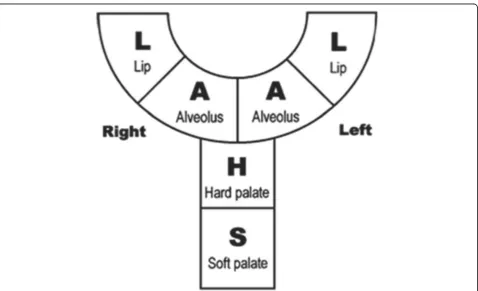
palate with class I being incomplete and limited to the soft palate and class II involving both the hard and soft palates. Veau classes III and IV denote complete clefts including both the lip and palates with class III being unilateral and class IV being bilateral [3]. In the UK, the LAHSAL code is used because it is much easier to use in practice (Fig. 2) [4, 5].
Surgical repair of cleft palate is associated with three major long-term complications: palatal fistula, velopharyn-geal insufficiency (VPI), and midface hypoplasia—which could be considered also as metrics and quality indicators [6, 7]. A 2012 systematic review on protocols in cleft lip and palate treatment found a paucity of literature outlining surgical repair techniques. Furthermore, no post-operative complications were reviewed in this review [8]. It is clear that the lack of evidence-based medicine in cleft palate management warrants further investigation.
In addition to the array of surgical approaches, there is also variability on the optimal timing to perform palate repair [9]. As transverse facial growth is not completed until 5 years of age, some have advocated a later cleft palate repair, even as late as age 8–10, to reduce the risk of midface hypoplasia. There is also evidence to support an earlier repair before the age of 2, as it is argued it im-proves speech development and results in better integra-tion in society with less psychosocial impact for children and families [10]. Furthermore, some surgeons manage Fig. 1a–dVeau classification system of cleft lip and palate
cleft palate repair in two stages (with soft palate repair at 3–6 months and hard palate repair at 15–18 months), while others advocate a single-stage repair with both the soft and hard palates being repaired simultaneously. To date, there are only a few small, cohort, long-term stud-ies on the incidence of midface hypoplasia with each method of cleft palate repair [9]. Furthermore, there is a variety of techniques, as well as adaptations, in order to repair cleft palate in a single stage. Some of these tech-niques are push-back techtech-niques, unipedicle or bipedicle palatal mucosa flaps, hybrids, or double-opposing Z-plasty for the soft palate. Lastly, intravelar veloZ-plasty (IVVP) was introduced in the 1970s by Kriens and in-tends to repair the velar muscles across the midline, after careful dissection for its abnormal insertion on the cleft edge [11]. While making intellectual sense, there is little evidence of its efficacy compared with no IVVP.
The objective of this systematic review is to evaluate and appraise the evidence of various cleft palate repair techniques and their timing in both syndromic and non-syndromic patients, with particular attention to compli-cation rates of palatal fistula formation, velopharyngeal insufficiency, and midface growth retardation as indica-tors of the success/failure of the chosen technique.
Methods
Study criteria
Participants
Studies to be included will examine patients with Veau class I–IV cleft palates who underwent cleft palate repair surgery and were followed up long enough to appreciate the repair outcome and complication rates. Children with syndromic and non-syndromic clefts will be sepa-rated and studied independently.
Intervention
The type of surgical cleft palate repair intervention and the timing of the cleft palate repair will be the primary focus of the review. The type of surgical cleft palate re-pair will include but not be limited to the following: intravelar veloplasty and Furlow double-opposing Z-plasty of the soft palate, Von Langenbeck palate repair, push-back palate repair, Veau-Wardill-Kilner palato-plasty, Bardach two-flap palatopalato-plasty, and the use of vomer flap. The types of intervention will be categorized based on the use of muscle reposition, the vascularity of the mucosal palatal flaps, the method of nasal layer clos-ure, and the timing of the repair.
Comparators
Given the broad perspective for interventions of interest, several comparisons will be relevant to include. Some will come from observational designs and others from experimental studies.
Cleft palate repair techniques:
– Intravelar veloplasty
– Furlow double-opposing Z-plasty – Von Langenbeck palate repair – Push-back palate repair
– Veau-Wardill-Kilner palatoplasty – Bardach two-flap palatoplasty – Vomer flap
Categorization of cleft palate repair techniques: Muscle reposition is an additional step in the surgical repair of cleft palate. In the Furlow double-opposing Z-plasty, the muscle is part of the flap design. In the other techniques, an intravelar veloplasty is required.
Vascularity of the mucosal palatal flaps:
– Bipedicle
○Von Langenbeck repair
○Furlow double-opposing Z-plasty + Von Langenbeck repair
– Unipedicle
○Veau-Wardill-Kilner palatoplasty
○Bardach two-flap palatoplasty
○Push-back palate repair – Hybrid
○Half Von Langenbeck + half Veau-Wardill-Kilner palatoplasty
Nasal layer closure:
– Nasal palatal mucosa and addition of vomer flap if the cleft is too wide for direct repair of the nasal mucosa
Cleft palate repair timing:
– Before age of 2 with the following subsets:
○Simultaneous repair: both the soft and hard palates between 9 and 12 months
○Two-stage repair
▪Soft palate repair at 3–6 months ▪Hard palate repair at 15–18 months – After the age of 2
Outcome measures
do not. Within the subgroup which did not require sur-gery, we will look into the degree of the VPI if the data is available. The success of the procedures is defined by the normalization of speech, no or minimal midface hy-poplasia, and no palatal fistula.
Follow-up length
Studies will be selected for inclusion based on the length of follow-up. A minimum of 6 months is required for the evaluation of fistula as an outcome, and at least 2 years is required to determine the incidence of VPI if the repair is performed in the first year of life. With re-gard to midface hypoplasia, long-term follow-up till ado-lescence and adulthood is required. In addition, the incidence of any orthognathic surgery will be included in the scope of this study if the data is available.
Study design
We will include randomized controlled trials (RCTs), cluster RCTs, non-randomized controlled clinical trials, interrupted time series, and prospective and retrospect-ive comparatretrospect-ive cohort studies. Case series and case re-ports will be excluded.
Setting
There will be no restriction by type of setting.
Language
We will include articles reported in English and French.
Search strategy
A comprehensive electronic database search will be con-ducted using MEDLINE (OVID interface, 1948 onwards), EMBASE (OVID interface, 1980 onwards), and the Cochrane Central Register of Controlled Trials (Wiley interface, current issue) from inception to 2016 by collabor-ating with healthcare librarians. Key search terms will in-clude“cleft palate,” “palatoplasty,” “fistula,” “velopharyngeal incompetence,”and“facial growth.”The search will be lim-ited to studies in English and French and human studies, and there will be no experimental studies. The search strat-egy will be peer-reviewed with several librarians. A sample search strategy is shown in Additional file 1.
Screening
The search results will be uploaded to RefWorks soft-ware and de-duplicated. The updated results will then be uploaded to Covidence software for primary screen-ing. Two reviewers will independently screen all titles and abstracts. We will obtain full articles for all titles that appear to meet the inclusion criteria or where there is any uncertainty. The two reviewers will then screen all full-text articles independently, and any areas of dis-agreement will be resolved by consensus. Neither of the
review authors will be blinded to the journal titles or to the study authors or institutions.
Data extraction
The authors will collect the data independently using a data collection form without duplication. The following data will be collected and added to a standardized data collection form:
Study design
Eligibility and exclusion criteria for study participation
Syndromic vs. non-syndromic
Cleft palate Veau classification status
Type of surgical intervention technique
Timing of the repair
Procedure complications
○Rate of palatal fistula
○Rate of VPI requiring surgical intervention
○Rate of midface hypoplasia
○“Normalization”of speech
Methods of statistical analysis
Data analysis
The study findings will be tabulated and summarized using the statistical software RevMan 5.1, according to the guideline referenced in the Cochrane Handbook for
Systematic Reviews of Interventions. The primary
relationship and findings both within and between the included studies, in line with the guidance from the Centre for Reviews and Dissemination.
To facilitate the assessment of possible risk of bias for each study, we will collect information using the
Cochrane Collaboration Tool for Assessing Risk of Bias,
which covers both study- and outcome-level bias in the domains of selection bias, performance bias, detection bias, attrition bias, reporting bias, and any other we may come across during our review. For selection bias, we will be reviewing the adequate generation of two or more groups of cleft palate patients with similar charac-teristics. For performance bias, we will be reviewing if the patients and study personnel were blinded to the intervention; however, this is unlikely given the interven-tion involves surgery. We will be assessing detecinterven-tion bias based on whether the assessor for the outcome was blinded to the knowledge of the type and timing of the repair the cleft patient received. For attrition and exclu-sion bias, we will assess for the completeness of outcome data for each outcome. If there are missing data, we will state the number of outcome assessed compared with the total number of participants that received interventions and if any reason of attrition/exclusion was reported. These judgments will be made independently by two re-view authors based on the criteria for judging the risk of bias (Table 8.5.c in the Cochrane Handbook) [12]. Dis-agreements will be resolved by discussion.
Data synthesis
If studies are sufficiently homogeneous in terms of de-sign and comparator, we will conduct meta-analyses using a random effects model. We will test the clinical heterogeneity by considering the variability in partici-pant factors among trials (for example, age) and trial fac-tors (randomization concealment, blinding of outcome assessment, losses to follow-up, treatment type, co-interventions). Statistical heterogeneity will be tested using the χ2 test (significance level, 0.1) and I2statistic (0 to 40%, might not be important; 30 to 60%, may rep-resent moderate heterogeneity; 50 to 90%, may reprep-resent substantial heterogeneity; 75 to 100%, considerable het-erogeneity). If high levels of heterogeneity among the tri-als exist (I2≥50% or P< 0.1), the study design and characteristics in the included studies will be analyzed. We will try to explain the source of heterogeneity by subgroup analysis or sensitivity analysis. Subgroup ana-lysis will consist of patient characteristics (sex, age, syn-dromic vs. non-synsyn-dromic, Veau classification, and geographic location of the repair), study design, and length of follow-up. Sensitivity analysis will be per-formed in categories of quality components (full-text publications vs. abstracts, preliminary results vs. mature results, published vs. unpublished data) and risk of bias.
For dichotomous data (occurrence of palatal fistula, VPI requiring surgical intervention, maxillary hypopla-sia), measurement of treatment effect will be determined by using risk ratio (RR) with 95% confidence interval (CI). None of the studied outcome data is continuous. Skewed data and non-quantitative data will be presented descriptively.
The primary analysis will be per individual randomized; however, all included trials will be assessed in order to de-termine the unit of randomization. The level at which randomization occurred and the match between the num-ber of observations and randomized units will be evalu-ated. Special issues in the analysis of studies with non-standard design, like cluster randomized trials, crossover trials, and studies with multiple treatment groups, will be addressed. For cluster randomized trials, we will extract an interclass correlation co-efficient to modify the results according to the methods described in the Cochrane
Handbook for Systematic Reviews of Interventions[12]. For
crossover trials, a major concern is the carry-over effect. We will only use the data from the first phase, guided by the Cochrane Heart Group. When a study has more than two treatment groups, we will present the additional treat-ment arms. Where the additional treattreat-ment arms are not relevant, they will not be taken into account.
When there are missing data, we will attempt to con-tact the original authors of the study to obtain the rele-vant missing data. Important numerical data will be carefully evaluated. If missing data cannot be obtained, an imputation method will be used. We will use sensitiv-ity analysis to assess the impact on the overall treatment effects of inclusion of trials which do not report an intention-to-treat analysis, have high rates of participant attrition, or have other missing data.
Each outcome will be combined and calculated using the statistical software RevMan 5.1, according to the statistical guidelines referenced in the current version of
the Cochrane Handbook for Systematic Reviews of
Inter-ventions[12]. The Mantel-Haenszel method will be used
for the fixed effects model if tests of heterogeneity are not significant. If statistical heterogeneity is observed (I2≥50% or P< 0.1), the random effects model will be chosen. If heterogeneity is substantial, a systematic nar-rative synthesis will be provided with information pre-sented in the text and tables to summarize and explain the characteristics and findings of the included studies. The narrative synthesis will explore the relationship and findings both within and between the included studies, in line with the guidance from the Centre for Reviews and Dissemination.
Meta-bias
published before recruitment of patients of the study was started. We will evaluate whether selective reporting of outcomes is present (outcome reporting bias). We will compare the fixed effects estimate against the random effects model to assess the possible presence of small-sample bias in the published literature (i.e., in which the intervention effect is more beneficial in smaller studies). In the presence of small-sample bias, the random effects estimate of the intervention is more beneficial than the fixed effects estimate. The potential for reporting bias will be further explored by funnel plots if ≥10 studies are available.
Reporting
The quality of evidence will be reported according to the Grading of Recommendations Assessment, Development and Evaluation working group methodology (GRADE). The quality of evidence will be assessed across the do-mains of risk of bias, consistency, directness, precision, and publication bias. This will include the impact of any ongoing registered clinical trial on the results of our re-view. Quality will be adjudicated as high (further research is very unlikely to change our confidence in the estimate of effect), moderate (further research is likely to have an important impact on our confidence in the estimate of ef-fect and may change the estimate), low (further research is very likely to have an important impact on our confidence in the estimate of effect and is likely to change the esti-mate), or very low (very uncertain about the estimate of effect). Furthermore, we will discuss the general impact and implications of the review findings on the current trend and guidelines for cleft palate repair management.
Registration
Our systematic review protocol has not been registered with the International Prospective Register of Systematic Reviews (PROSPERO).
Discussion
Evidence regarding the optimal surgical technique and tim-ing of cleft palate surgery is lacktim-ing, with no gold standard management to date [2]. A critical appreciation of how complication rates differ between different surgical proce-dures and with different time points of repair is critical to optimize the management of these patients. The method-ology of this systematic review follows the Preferred Reporting Items for Systematic Reviews and Meta-Analysis Protocols (PRISMA-P) guideline in order to strengthen the comprehensiveness, reliability, and quality of the review [13]. It allows for greater transparency and offers the ability to compare protocols between different systematic reviews. Additional file 2 shows the PRISMA-P guideline used to create the protocol. Knowledge gained from this systematic review will be disseminated through presentation at
conferences and publication in a peer-reviewed journal. The objective of this review will be to provide the cleft geon with an evidence-based approach for cleft palate sur-gery, with the end goal of improving patient care.
Additional files
Additional file 1:Search strategy. Search strategy used to generate review articles. (DOCX 18 kb)
Additional file 2:PRISMA-P checklist. PRISMA-P checklist guideline used to create protocol for this systematic review. (DOCX 28 kb)
Abbreviations
IVVP:Intravelar veloplasty; PRISMA-P: Preferred Reporting Items for Systematic Reviews and Meta-Analysis Protocols; RCT: Randomized controlled trials; VPI: Velopharyngeal insufficiency
Acknowledgements
We would like to acknowledge Risa Shorr, Health Care Librarian, The Ottawa Hospital, for her help with creating the search strategy.
Funding
Not applicable
Availability of data and materials
The datasets generated during and/or analyzed during the current study are available in the following databases: EMBASE Classic + EMBASE (1947 to 5 May 2016) and Ovid MEDLINE® In-Process and Other Non-Indexed Citations and Ovid MEDLINE® (1946 to present).
Authors’contributions
Dr. NM contributed to the project idea and editing of manuscript. Dr. CM is the guarantor and also contributed to project idea, study design, data interpretation, supervision of manuscript writing, and revision. Dr. CM and Dr. NM provided expertise on various cleft palate repair methods and outcome complications. All authors contributed to the development of the selection criteria, the risk of bias assessment strategy, and data extraction criteria. ZZ and Dr. MS drafted the manuscript. ZZ developed the search strategy with help from Dr. MS. ZZ and Dr. CM will contribute towards reviewing the articles. All authors read, provided feedback, and approved the final manuscript.
Competing interests
The authors declare that they have no competing interests.
Consent for publication
Not applicable
Ethics approval and consent to participate
Not applicable
Author details
1
Faculty of Medicine, University of Ottawa, Ottawa, Canada.2Division of Plastic Surgery, University of Ottawa, Ottawa, Canada.3Cleft Unit, Frenchay
Hospital, Bristol BS16 1LE, UK.
Received: 12 November 2016 Accepted: 17 February 2017
References
1. Biavati MJ, Rocha-Worley G. Palatopharyngeal incompetence. E-Medicine from WebMD. 2006. http://emedicine.medscape.com/article/994975-overview#showall. Accessed 28 Mar 2011.
2. Katzel EB, Basile P, Koltz PF, Marcus JR, Girotto JA. Current surgical practices in cleft care: cleft palate repair techniques and postoperative care. Plast Reconstr Surg. 2009;124(3):899–906.
4. Kriens O. LAHSHAL. A concise documentation system for cleft lip, alveolus, and palate diagnoses. What is a cleft lip and palate. 1989:32–3.
5. McBride WA, Mossey PA, McIntyre GT. Reliability, completeness and accuracy of cleft subphenotyping as recorded on the CLEFTSiS (Cleft Service in Scotland) electronic patient record. Surgeon. 2013;11(6):313–8. 6. Phua YS, de Chalain T. Incidence of oronasal fistulae and velopharyngeal
insufficiency after cleft palate repair: an audit of 211 children born between 1990 and 2004. Cleft Palate Craniofac J. 2008;45(2):172–8.
7. Mars M, Houston WJ. A preliminary study of facial growth and morphology in unoperated male unilateral cleft lip and palate subjects over 13 years of age. The Cleft Palate-Craniofacial Journal. 1990;27(1):7–10.
8. de Ladeira PR, Alonso N. Protocols in cleft lip and palate treatment: systematic review. Plast Surg Int. 2012;1:2012.
9. Rohrich RJ, Love EJ, Byrd HS, Johns DF. Optimal timing of cleft palate closure. Plast Reconstr Surg. 2000;106(2):413–22.
10. Dorf DS, Curtin JW. Early cleft palate repair and speech outcome. Plast Reconstr Surg. 1982;70(1):74–9.
11. Kriens OB. Fundamental anatomic findings for an intravelar veloplasty. The Cleft Palate J. 1970;7:27.
12. Higgins JP, Green S, editors. Cochrane handbook for systematic reviews of interventions. John Wiley & Sons. 2011.
13. Moher D, Shamseer L, Clarke M, Ghersi D, Liberati A, Petticrew M, Shekelle P, Stewart LA. Preferred reporting items for systematic review and meta-analysis protocols (PRISMA-P) 2015 statement. Systematic reviews. 2015;4(1):1.
• We accept pre-submission inquiries
• Our selector tool helps you to find the most relevant journal
• We provide round the clock customer support
• Convenient online submission
• Thorough peer review
• Inclusion in PubMed and all major indexing services
• Maximum visibility for your research
Submit your manuscript at www.biomedcentral.com/submit