111115TEFi COPY
communications in
soil science
COMMUN. SOIL SCI. PLANT ANAL., 32(7&8), 1203-1220 (2001)
POLYACRYLAMIDE FOR SURFACE
IRRIGATION TO INCREASE NUTRIENT-USE
EFFICIENCY AND PROTECT WATER QUALITY
Rodrick D. Lentz, Robert E. Sojka, Charles W. Robbins, Dennis C. Kincaid, and Dale T. Westermann
USDA-ARS Northwest Irrigation and Soils Research Lab., Kimberly, ID 83341-5076
ABSTRACT
Furrow irrigation systems have a greater application capacity, are less costly, and use less energy than sprinkler systems but furrow irrigation produces greater runoff, erosion, and deep percolation losses. Phosphorus (P) and nitrogen (N) losses are associated with runoff sediment, and can be minimized by eliminating irrigation-induced erosion. Excessive leaching of inorganic and organic sol-utes commonly occurs at the inflow region of furrow irrigated fields where infiltration opportunity times are longer. In one con-servation practice, a high molecular weight, anionic polyacryla-mide (PAM) is applied to advancing furrow stream flows at a con-centration of 10 mg L. Because PAM stabilizes furrow soil and flocculates suspended sediment, we hypothesized that this treat-ment would reduce runoff losses of seditreat-ment, molybdate reactive P (MRP), total P, NO 3-N, and chemical oxygen demand (COD). Polyacrylamide treatment may increase furrow infiltration in some soils. However, we hypothesized that because it permits higher ini-tial inflows, PAM would not increase NO 3-N or Cl leaching
rela-1203
tive to conventional, constant inflow irrigation. To test the first hy-pothesis, all treatments had the same inflow regime. For hypothesis two, control inflows were a constant 15 L min - I ; PAM treated in-flows were cut back from 45 to 15 L min - I after furrow advance. Irrigation runoff and percolation waters were sampled and ana-lyzed. Polyacrylamide increased infiltration and decreased runoff, particularly early in the irrigations. Mean cumulative runoff sedi-ment loss over 12 h was 11.86 kg for each control furrow vs 1.15 kg for PAM-treated furrows. The PAM reduced 12-h cumu-lative sediment losses in runoff by 90%, MRP by 87%, total P by 92%, and COD by 85%, relative to control furrows. Polyacryla-mide had no field-wide, season-long effect on cumulative amounts of water, NO3-N or Cl leached. The PAM-technology effectively prevented soil nutrient losses, increased nutrient-use efficiency, and decreased N and P loads in irrigation return flows and receiv-ing surface waters.
INTRODUCTION
Irrigated agriculture stabilizes world food and fiber production by increas-ing yields relative to rainfed agriculture and reducincreas-ing risks associated with crop production (Bucks et al., 1990). Mineralized or applied nutrients must remain in the root zone to be effectively utilized by plants. Soluble nutrients displaced from the root zone by lateral and downward moving water can enter groundwater. Nu-trients dissolved or desorbed from surface soil particles and those that remain attached to soil can enter the furrow stream and be transported via irrigation return flows to surface waters. Public concern over irrigation impacts on surface and groundwater quality recently has focused on sediments, nutrients, dissolved salts, and toxic organic compounds (Bucks et al., 1990).
patho-POI.) %CR\ I. FOR SURFACE IRRIGATION 1205
gen ittlestation associated with Darrow irrigation (Bishop et al., 1%7), it is com-monly used in the U.S. and other nations.
Furrow irrigated soils in the northwestern U.S. are highly erosive (Berg and Carter, 1980). They have low organic matter content and exhibit mineral charac-teristics which tend to inhibit aggregate stability, especially under the rapid wet-ting and shear forces present in irrigation furrow streams (Kemper et al., 1985). Thirty to sixty percent of the water applied leaves furrow irrigated fields as runoff (Lentz et al., 1992). Irrigation runoff has negatively impacted surface streams in southern Idaho through contributions of sediment, nutrient, and pesticides (IDHW-DEQ, 1994).
Nutrient Fluxes into Irrigation Runoff and Drainage Waters
Furrow irrigation moves soluble or particulate organic matter, N, and P from soil to drainage and runoff, which increase nutrient loading in surface waters (Carter et al., 1971; Fitzsimmons et al., 1972; Mackenzie and Viets, 1974; Heath-waite and Johnes, 1996). Subsurface drainage losses of nitrogen under irrigation tracts in southern Idaho are significant, although some of this nitrogen may origi-nate from nonagricultural sources, such as residential septic systems (Carter et al.,
1971). Nitrate-N is the main form of N lost in drainage water (Carter et al., 1971; Fitzsimmons et al., 1972), although organic-N losses may be an important com-ponent (Mackenzie and Viets, 1974). Nitrate-, NH,- and organic-N can be dis-solved or entrained in furrow runoff (Fitzsimmons et al., 1972). Large increases in runoff inorganic-N concentrations occur when fertilizers are applied to fields in irrigation water, but not all high N-loss events are associated with such operations (Fitzsimmons et al., 1972).
Carter et al. (1971, 1974) reported that south-central Idaho surface irrigated tracts were a net sink for total P and ortho-P loads entering the tracts in irrigation source water. Irrigation runoff had higher P concentrations than source water but return flow volumes were a small fraction (14%) of the total source water volume diverted from the Snake River, and P concentrations in the groundwater-derived return flow contributions (13% of tract supply flow volume) were lower than that of the source water. Carter concluded that ortho-P was being removed from irri-gation water as it drained through, and reacted with, the calcareous soils. In con-trast, Fitzsimmons et al. (1972) reported that groundwater ortho-P and total P concentrations increased relative to source water in a southwestern Idaho irrigated tract. Carter sampled groundwater discharged from drainage tunnels cut into ba-salt bedrock in addition to tile drains, whereas, Fitzsimmons collected only tile drain water.
and organic-N forms are largely associated with transported sediment and organic particles or colloids in furrow runoff (Carter et al., 1974; Carter and Bondurant, 1976). Furrow erosion and transport processes and runoff sediment load substan-tially determine the concentrations of these nutrient components in runoff (Carter et al., 1974; Brown, 1985; Bjorneberg et al., 1999). Clay and organic matter ad-sorb more P than other soil materials. The stream sediment clay : soil ratio, also called the enrichment ratio, and the total sediment load largely determine the total Pin runoff (Carter et al., 1974). The P enrichment ratio increases as the proportion of clay and organic matter in the sediment load increases, and declines as sediment increases, owing to the decrease in the proportion of fine to coarse particles in sediments produced from escalating erosion regimes (Logan, 1982).
Dissolved nutrient concentrations, ortho-P, NO 3-N and NH 4-N in furrow runoff and subsurface drainage water result from the reaction of water with the soil surface and decaying crop residues, including dispersed and detached parti-cles that become suspended in the flow (Logan, 1982). Water soluble nutrients dissolve in the water and desorb (eg. ortho-P, NH 4-N) from soil surfaces and dif-fusion/advection processes move dissolved materials from soil/sediment pores into the furrow stream or drainage flow (Logan, 1982). In furrows, the quantity of nutrient ions made available via this process decreases with increasing time of exposure to the stream (Oloya and Logan, 1980). The quantity of ortho-P de-sorbed was correlated with the soil test P concentration (Westermann et al., 1999). Once it enters the furrow stream, a fraction of the dissolved ortho-P and NH 4-N may adsorb to sediment present in the flow. The dissolved ions eventually reach an equilibrium concentration in the runoff (Logan, 1982). During an irrigation, erosional processes such as channel abrasion, sidewall collapse, and migrating headcuts expose fresh soil surfaces to the stream flow. This soil contributes addi-tional nutrients to the flow.
Polyacrylamide Technology in Furrow Irrigation
POLYACRYLAMIDE FOR SURFACE IRRIGATION 1207
and untreated inflows are used for the remainder of the irrigation set. Polyacryla-mide dissolved in the inflow water is adsorbed and irreversibly bound to soil par-ticle and aggregate surfaces in the furrow wetted perimeter (Mitchell, 1986; Malik and Letey, 1991; Lentz et al., 1992; Letey, 1994).
The PAM commonly used is a water soluble, linear anionic polyacrylamide copolymer (Barvenik, 1994) which was found to be most effective for furrow erosion control (Lentz and Sojka, 2000a). The PAM has a molecular weight of 12-15 Mg mol - 1 and charge-density of 8-35% . This material has demonstrated a remarkable ability to stabilize dry soil aggregates under rapid inundation and flow shear, flocculate fine soil particles suspended in flows, and coarsen aggregate size characteristics in the furrow system. These PAM-induced impacts result in reduced furrow erosion and increased infiltration (Terry and Nelson, 1986; Lentz, 1995; Sojka et al., 1998b). Barvenik (1994) concluded that anionic PAM appli-cations in irrigation furrows posed little threat to organisms or the environment. A detailed description of PAM field application and general technical and practical guidelines have been discussed elsewhere (Lentz, 1995; Lentz et al., 1995; Sojka and Lentz, 1997). Research has investigated field efficacies of differ-ent PAM application rates (Ldiffer-entz and Sojka, 1994) and strategies (Ldiffer-entz and Sojka, 2000b). Lentz et al. (2000a) studied the effects of polymer molecular weight, charge type and density characteristics on field erosion and infiltration results. Other studies have focused on PAM's impacts on furrow infiltration (Trout et al., 1995; Sojka et al., 1998a,b), multiple treated irrigations (Sojka et al., 1998b), and surge irrigation applications (Yonts et al., 1998).
Two field studies were conducted to test the hypothesis that a PAM-based furrow irrigation management approach could reduce sediment, soil organic mat-ter (estimated by COD), and nutrient losses from soils in furrow irrigated fields without increasing leaching losses of soluble nutrients. The PAM irrigation man-agement strategy can take advantage of PAM's erosion control capabilities, i.e. higher initial inflows can be turned into PAM-treated furrows than to untreated furrows. One study examined the effect of PAM treatment on soil and nutrient field losses. Another study determined PAM management effects on field leaching losses relative to conventional furrow irrigation.
MATERIALS AND METHODS
capacity was 190 mmolc kg - 1 , saturated-paste-extract electrical conductivity (EC) was 0.7 dS m- 1 , ESP was 1.5, pH was 7.7, and calcium carbonate equivalent was 5%. Furrows were approximately 175 m long, with a 1.6% slope. Furrows were shaped with a weighted wedge-shaped forming tool. To avoid infiltration differ-ences between wheel-tracked and nonwheel-tracked furrows, only trafficked fur-rows were irrigated and monitored.
Irrigation water diverted from the Snake River contained 0.10 mg L- 1 total P; 0.03 mg L- 1 molybdate reactive P; 11.8 mg L- 1 COD, and <0.02 mg L- 1 NO3-N, and had an EC of 0.5 dS m- 1 and SAR of 0.5. A gated pipe conveyed water to the each furrow and adjustable spigots controlled inflow rates. Plots were irrigated five times during each irrigation season. Furrow inflows and outflows were monitored, and runoff sediment concentrations were measured throughout each irrigation. Measurements were made at one-half hour intervals early in the irrigation, and every hour or every several hours in the latter half of the irrigation after outflows and sediment loads had stabilized. Inflows were measured by filling a known volume per unit time, and outflows were measured with v-notch flumes (Trout and Mackey, 1988). Sediment was measured using Imhoff cones (Sojka et al., 1992). Details of the flow and sediment monitoring procedure were given by Lentz et al. (1992). The experimental design was a complete randomized block, with three replications. Furrow runoff, component loads, and infiltration were computed with the computer program, WASHOUT (Lentz and Sojka, 1995). Net infiltration was calculated as the difference between total inflow and total outflow. The water soluble, anionic PAM copolymer employed had a molecular weight of 12-15 Mg mo1- 1 and charge-density of 18%. Granular PAM was used to prepare a 1200 or 2400 mg L- 1 (1200 or 2400 ppm) aqueous stock solution. Stock solutions were prepared by slowly sprinkling (over a 20 –30 min period) PAM into tap water that was vigorously and continuously agitated with a rotating bladed stirrer. Positive displacement pumps injected the stock solution into the inflow end of PAM-treated furrow streams at an appropriate rate to meet the PAM concentration target.
Runoff Nutrient Loss Study
POLYACRYLAMIDE FOR SURFACE IRRIGATION 1209
04;
cutback irrigation strategy was used for all treatments. Initial irrigation inflows were set to 23 L min-' to move water across the field quickly, then flows were manually cut back to 15 L min - 1 to reduce runoff. Irrigations were 8 to 24 hours in duration.
Irrigation inflows and three irrigation runoff samples from each furrow were collected for nutrient analysis. Runoff samples were taken from outflow monitor-ing flumes. Runoff nutrient content was not determined for the last irrigation of the season. Since 97% of the field's sediment losses occurred in the first four irrigations, we believed nutrient losses produced by the final irrigation were also very small. The first runoff sample was collected after all PAM furrows had com-pleted their advance but before PAM application was stopped. The second was taken 0.5 h after PAM application had ceased, and the third was taken 4.5 h later. Thus, sampling times differed with each irrigation, but all were collected during the periods:1 to 3.5 h; 4.5 to 7 h; and 7.5 to 10 h into the irrigation. Runoff samples were stored at 2°C. for <8 days before being analyzed. Unfiltered samples were analyzed for total P (Greenberg et al., 1992), molybdate-reactive-P or MRP (Wa-tanabe and Olsen, 1965), and chemical oxygen demand, COD (American Public Health Association et al., 1971). Nitrate-N was determined on filtered samples (Whatman 42 filter, 2.0 mM potassium benzoate eluent and liquid ion chro-matography).
Irrigation treatment comparisons and duration graphs were based on a 12-h irrigation length. WASHOUT (Lentz and Sojka, 1995) computed runoff and pol-lutant loads using outflow and sediment records (12 measurements per irrigation) and runoff nutrient concentrations (3 per irrigation). Runoff nutrient loads were computed under assumption that runoff component concentrations were constant between sampling intervals. The 12-h values for the first irrigation (an 8-h irriga-tion) were computed assuming that no change in flow and constituent concen-trations occurred after 8 h. Previous experience indicated that this was a valid premise. Duration graph values are means from the four monitored irrigations. Confidence limits (P = 0.05) for duration treatment means were based on the Student's t distribution (Snedecor and Cochran, 1980).
Field Leaching Study
upper and lower portion of the plot (30 and 150 m along 180-m-long furrows). Soil water percolation losses were measured throughout the irrigation season. Length of irrigation sets were the same for both treatments in the abbreviated 1996 irrigation season. However, in 1997 and 1998, irrigation set times were varied between treatments, to ensure that average net infiltration for both treatments was equal for any given irrigation.
We installed 36 vacuum extraction soil water percolation samplers, three at each monitored site (Lentz et al., 1998a). Instruments were installed in the vertical face of a backhoe trench dug beside the monitored furrow. The vacuum extraction system designed for this experiment was discussed in detail by Lentz et al. (1998a) and Kincaid and Lentz (1999). A field deployed precision vacuum pump and tank were connected via a gas dryer to a polyethylene tube main line that ran the length of the field. Branch lines off the mainline supplied upper and lower field positions via manifolds at each site. Each manifold supplied 1-L vacuum flasks connected to individual samplers. In 1997, a Bourdon-tube pressure switch and Hg U-tube manometer regulated system vacuum in main and branch lines. For 1998, we de-signed an electronic vacuum controller and data logger program that set extraction vacuum independently for each site according to local soil water conditions. The line extractor-soil suction ratio was 1.4 to 1.5 (Lentz et al., 1998a).
Instrument installation was completed by late August, 1996. Prior to irri-gation in 1996, CaC12 (112 kg ha-') was applied to the surface of fallow plots as a drainage marker. Two irrigations were monitored during September 1996. In 1997, 168 kg ha- 1 urea was applied and plots were planted to a short-season corn. Five irrigations were monitored beginning 16 July. Water sample volumes were measured and collected every 1-2 days, treated with boric acid to curtail biologic activity, and stored at 2°C. for later chemical analysis. Sample NO 3-N, and Cl were determined with standard flow injection analysis (HA) procedures. The mean constituent percolation and mass loss measurements at each site were summed over the season and an ANOVA with Tukey test (SAS Institute Inc., 1988) was employed to compute treatment mean separations (P = 0.05). Field wide losses were computed as the mean of upper and lower field values.
RESULTS AND DISCUSSION
Runoff Nutrient Losses
1211 l'OL1ACIZVIAN111)1.: FOR SI .10,M !ZIG VI'll
Std PAM10 Cont PAM1
Control
12
6 9
Duration (h)
0- ) O O
CI) CI) (I) 0 -J
0.3
0.2
0.1
3
Irrigation
rn
0
E
0
12 10 8
6 4
2
0 0
Infiltration&
Runoff
E E
O
!F.
0
• 50
•E 40
42 30
E 20
10
0
0 3 6 9 12
Irrigation Duration (h)
Figure 1. Infiltration and runoff (on left), and sediment concentrations and losses (on
PAM-treated furrows (Fig. 1). Infiltration rates followed runoff in a similar but reversed pattern. No significant differences between treatments were indicated for runoff and infiltration after furrow streams flowed for 6 h, though the mean treat-ment values from later in the irrigation were only slightly different from the 6-h values. Thus PAM's infiltration effects continued but became less consistent with time. This suggested that the PAM-stabilized soil structure in the furrow surface may have begun to break down over time, and/or that the depositional seal formed under PAM may have begun to clog late in the irrigation set, reducing seal per-meability (Sojka et al., 1998a).
During the irrigations, sediment concentration and mass losses for control furrows were 4 to 100X greater than those for Std PAM10 furrows, and 2.5 to 10 X greater than that of Cont PAM1 furrows (Fig. 1). Mean 12-h cumulative sediment loss for controls was 10X greater than that of Std PAM10 and 7X greater than that of Cont PAM 1 furrows. The 12-h cumulative sediment loss per control furrow was 11.86 kg vs 1.15 kg for Std PAM I 0 furrows, i.e. 609 kg ha-' vs 59 kg ha-'.
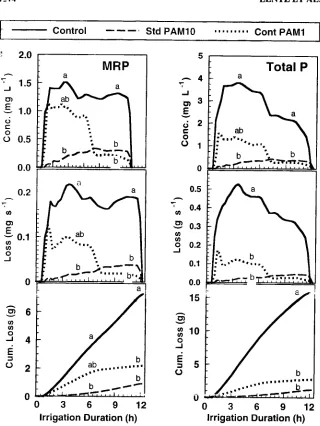
Changes in runoff concentration and mass loss for control and PAM treat-ments followed a similar pattern for all components except NO3-N. Concentration and mass loss values for nutrients (except NO 3-N) paralleled that for sediment (Figs. 1, 2 and 3). At any given time during the irrigation, runoff concentrations and mass losses of these components were about 4 to 10X greater in control fur-rows than in Std PAM 10 and Cont PAM 1 furfur-rows. The exception to this pattern came for Cont PAM1 furrows during the first 7 h of each irrigation. During that period, control values were 1.2 to 3 X that of Cont PAM ] furrows, and the differ-ences between control and Cont PAM 1 values, in most cases, were not significant. The similarity in duration patterns suggests that COD, MRP, and total P compo-nents were closely associated with sediment.
Mean 12-h cumulative losses of MRP, total P, and COD were significantly greater for controls than either PAM treatment. Cumulative mass losses of con-trols were 7 to 14X the Std PAM10, and 3 to 6X the Cont PAM1 values (Figs. 1, 2 and 3). Thus, compared to controls, Std PAM10 reduced 12-h cumulative mass losses of sediment by 90%, COD by 85%, MRP by 87%, and total P by 92%. These values were similar to those reported for 24-h irrigations (Lentz et al.,
1998b).
1213
POLYACRYLAMIDE FOR SURFACE IRRIGATION
u) a) E Cl) Cs) 0 —I 25 20 15 10 5 , 200 ..--. 150 _, a) E 100 c.i C 0 U 50
0
0 700 600 500 400300 b
... 200
. 0.... b
100 . • . 0
o
0 3 6 9 12
Irrigation Duration (h) 0) cn u) 0 _i m (..)
Figure 2. Chemical oxygen demand (COD on left) and NO 3-N (on right) concentrations
and losses per furrow. Treatments included a control, 10 mg L- 1 PAM applied during ad-vance only (Std PAM10), and PAM applied continuously at 1 mg L- 1 (Cont PAM1). Simi-lar letters indicate nonsignificant differences (P = 0.05) between treatment values.
1 1
0 3 6 9 12
Irrigation Duration (h)
)
Control Std PAM10 Cont PAM1
U
0 3 6 9 12
Irrigation Duration (h)
Figure 3. Molybdate-reactive-P (on left) and Total P (on right) concentrations and losses
per furrow. Treatments included a control, 10 mg L- 1 PAM applied during advance only (Std PAM10), and PAM applied continuously at I mg L- 1 (Cont PAM1). Similar letters indicate nonsignificant differences (P = 0.05) between treatment values.
o
0 3 6 9 12
POLYACRYLAMIDE FOR SURFACE IRRIGATION 1215
1998b). Note that runoff MRP concentrations responded slightly differently to sediment concentration depending on treatment. In control furrows, MRP concen-trations decreased only slightly during the irrigation even though sediment con-centrations had decreased by one half (Figs. 1 and 3). The change in PAM-furrow MRP relative to sediment concentrations was more proportionate. Control furrows carried more than twice as much sediment as PAM furrows. Hence, the relatively larger P enrichment ratios present in PAM furrow streams probably heightened the impact of sediment on runoff MRP, compared to control furrows.
The Std PAM 10 treatment reduced runoff losses of P, and COD (organic materials) by 80 to 90%, compared to untreated furrows. Polyacrylamide-induced reductions in runoff MRP and total P concentrations and mass loss reported here were similar to those observed for a southern Idaho demonstration project (Bahr and Stieber, 1996), which found that PAM reduced total N lost in runoff by 69 to 95%.
Field Leaching
Presented here is a preliminary analysis of a field-data set that included one partial irrigation season and two full irrigation seasons (Table 1). These data in-dicated no significant differences in cumulative field-wide deep percolation or NO3-N and chloride mass losses between conventional and PAM-managed irri-gation furrows. Not even in 1996, when mean net infiltration of PAM furrows was permitted to exceed that of controls, did we observe significant treatment effects. Cumulative NO 3-N percolation losses increased in 1997 relative to 1996 in re-sponse to the spring, 1997, urea application. Deep percolation at lower field po-sitions was 9% of that at upper popo-sitions (data not shown).
CONCLUSIONS
Water
Applied Infiltration
(mm) (mm)
Year
(# Irrs.) Treatment
Runoff Soil Water Nitrate-N Chloride (mm) (mm) (kg ha- ') (kg ha- 1 ) Irrigation
Percolation Losses
1996t Control 162 65 97 47.5a t 5a 26a
(2) PAM 171 75 96 99a 11a 27a
1997 Control 305 182 123 166a 121a 154a
(5) PAM 325 185 140 164a 132a 160a
1998 Control 494 233 261 138a 118a 146a
(5) PAM 494 244 250 133a 83a 88a
t In 1996, irrigation set times were the same for both treatments. Hence, the PAM-induce infiltration in-crease was more evident than for years 1997-98. In later years, irrigation length was adjusted to give iden-tical net infiltration for both treatments.
POLYACRYLAMIDE FOR SURFACE IRRIGATION 1217
field-wide percolation losses of water or soluble nutrients such as NO 3-N. Polya-crylamide provides an opportunity for increasing irrigation uniformity by increas-ing initial furrow inflows (without attendant erosion increases). This option is not always available for other infiltration-enhancing practices, such as straw-mulch-ing. Increasing inflows in straw-mulched furrows can result in the washing out of straw and formation of straw and sediment dams in furrows; with the latter caus-ing floodcaus-ing (Berg, 1984). Polyacrylamide-managed furrow irrigation in some Idaho soils can help increase crop nutrient-use efficiency by preventing field nu-trient losses, and simultaneously protect surface water quality by reducing N, P, and organic matter concentrations in furrow runoff and return flows.
ACKNOWLEDGMENTS
This work was supported in part by a grant from CYTEC Industries, through a Cooperative Research and Development Agreement (contract 58-3K95-4-216). Comments by Drs. Mandi Al-Kaisi, Jan Boll, and Robert Mahler on an early draft of the manuscript were greatly appreciated. We thank Dr. Anita Koehn, Mr. Ron Peckenpaugh, Mr. Jim Foerster, and Mr. Andrew Mutziger for their valuable tech-nical assistance, and Ms. Kristen Swafford, Ms. Jamie Ward, Ms. Riqui Heinemann, and Mr. Seth Oliver for their help in the lab and field.
REFERENCES
American Public Health Association, American Water Works Association, and Water Pollution Control Federation. 1971. Oxygen demand (chemical). p. 495-499. In Anon. (ed.) Standard Methods for the Examination of Water and Wastewater. 13th ed. American Public Health Association, New York. Bahr, G.L., and T.D. Stieber. 1996. Reduction of nutrient and pesticide losses through the application of polyacrylamide in surface irrigated crops. p. 41-48. In R.E. Sojka and R.D. Lentz (ed.) Managing Irrigation-Induced Ero-sion and Infiltration with Polyacrylamide. Proc. Workshop, Twin Falls, ID. 6 –8 May, 1996. Univ. of Idaho Misc. Publ. No 101-96. Univ. of ID, Mos-cow, ID.
Barvenik, F.W. 1994. Polyacrylamide characteristics related to soil applications. Soil. Sci. 158: 235-243.
Berg, R.D., and D.L. Carter. 1980. Furrow erosion and sediment losses on irri-gated cropland. J. Soil and Water Cons. 35 : 267-270.
Bishop, A.A., M.E. Jensen, and WA. Hall. 1967. Surface irrigation systems. p. 865 –884. In R.M. Hagan, H.R. Howard and T.W. Edminster (ed.) Irri-gation of Agricultural Lands. Agron. Monogr. No. 11, ASA, Madison, WI. Bjorneberg, D.L., D.T. Westermann, and J.K. AAse. 1999. Phosphorus dynamics in furrow irrigation water. p. 351 In 1999 Agronomy abstracts. ASA, Mad-ison, WI.
Brown, M.J. 1985. Within-furrow erosion and deposition of sediment and phos-phorous. p. . In S.A. El-Swaify, W.C. Moldenhauer and A. Low (ed.) Soil Erosion and Conservation. Soil Cons. Soc. Am., Ankeny, IA (146;
113-118).
Bucks, D.A., T.W. Sammis, and G.L. Dickey. 1990. Irrigation for arid areas. p. 499-548. In G.J. Hoffman, T.A. Howell and K.H. Solomon (ed.) Man-agement of Farm Irrigation Systems. American Society of Agricultural En-gineers, St. Joseph, MI.
Carter, D.L., and J.A. Bondurant. 1976. Control of sediments, nutrients, and ad-sorbed biocides in surface irrigation return flows. USEPA Rep. EPA-600/2-76-237 (EPA-IAG-D5-F648). U.S. Gov. Print. Office, Washington,DC. Carter, D.L., J.A. Bondurant, and C.W. Robbins. 1971. Water-soluble
NO3-nitro-gen, PO4-phosphorus, and total salt balances on a large irrigation tract. Soil Sci. Soc. Amer. Proc. 35 : 331-335.
Carter, D.L., M.L. Brown, C.W. Robbins, and J.A. Bondurant. 1974. Phosphorus associated with sediments in irrigation and drainage waters for two large tracts in southern Idaho. J. Environ. Qual. 3:287-291.
Childs, J.L, W.W. Wallender, and J.W. Hopmans. 1993. Spatial and seasonal varia-tion of furrow infiltravaria-tion. J. Irr. Drain. Eng. 119 : 74 –90.
Fitzsimmons, D.W., G.C. Lewis, D.V. Naylor, and J.R. Busch. 1972. Nitrogen, phosphorus and other inorganic materials in waters in a gravity-irrigated area. Trans. ASAE 15 :292-295.
Greenberg, A.E., L.S. Clesceri, and A.D. Eaton. 1992. Standard Methods For The Examination Of Water And Wastewater. American Public Health Associa-tion, American Water Works AssociaAssocia-tion, and Water Environment Federa-tion, Washington, DC.
Idaho Department of Health and Welfare, Division of Enviironmental Quality (IDHW-DEQ). 1994. The 1994 Idaho Water Quality Status Report. Octo-ber, 1994. pp. 141.
Heathwaite, A.L., and P.J. Johnes. 1996. Contribution of nitrogen species and phosphorus fractions to stream water quality in agricultural catchments. Hy-drological Processes 10 : 971-983.
Kemper, W.D., R. Rosenau, and S. Nelson. 1985. Gas displacement and aggregate stability of soils. Soil Sci. Soc. Am. J. 49 : 25-28.
POLYACRYLAMIDE FOR SURFACE IRRIGATION 1219
Koluvek, P.K., K.K. Tanji, and T.J. Trout. 1993. Overview of soil erosion from irrigation. Journal of Irrigation and Drainage Engineering (ASCE) 119: 929-946.
Lentz, R.D. 1995. Irrigation (Agriculture): Using polyacrylamide to control fur-row-irrigation induced erosion. p. 162-165. In S.P. Parker (ed.) 1996
Year-book of Science and Technology. McGraw-Hill, Inc., New York.
Lentz, R.D., and R.E. Sojka. 1994. Field results using polyacrylamide to manage furrow erosion and infiltration. Soil. Sci. 158: 274 –282.
Lentz, R.D., and R.E. Sojka. 1995. Monitoring software for pollutant components in furrow irrigation runoff. p. 123-127. In L. Ahuja, J. Leppert, K. Rojas
and E. Seely (ed.) Computer Applications in Water Management, Proc. Workshop, 23-25 May, 1995. Colorado State University Water Resources Research Institute Info. Series No. 79. Colorado State University, Fort Col-lins, CO.
Lentz, R.D., and R.E. Sojka. 2000a. Polymer charge and molecular weight effects on treated irrigation furrow processes. Int. J. Sed. Res. (In Press)
Lentz, R.D., and R.E. Sojka. 2000b. Applying polymers to irrigation water: evalu-ating strategies for furrow erosion control. Trans. ASAE (Submitted). Lentz, R.D., I. Shainberg, R.E. Sojka, and D.L. Carter. 1992. Preventing irrigation
furrow erosion with small applications of polymers. Soil Sci. Soc. Am. J. 56 : 1926 –1932.
Lentz, R.D., T.D. Stieber, and R.E. Sojka. 1995. Applying polyacrylamide (PAM) to reduce erosion and increase infiltration under furrow irrigation. p. 79-92.
In L.D. Robertson, P. Nolte, B. Vodraska, B. King, T. Tindall, J. Romanko
and J. Gallian (ed.) Proc. Winter Commodity Schools-1995. Vol. 27. Uni-versity of Idaho Cooperative Extension, Moscow, ID.
Lentz, R.D., R.E. Sojka, and D.C. Kincaid. 1998a. Design and calibration of per-colation samplers for measuring polyacrylamide-amended furrow-irrigation effects on drainage water quality. p. 267-276. In L.C. Brown (ed.) Proc.
Seventh International Drainage Symposium, Orlando, FL 8-10 March 1998. ASAE, St Joseph, MI.
Lentz, R.D., R.E. Sojka, and C.W. Robbins. 1998b. Reducing phosphorus losses from surface-irrigated fields: emerging polyacrylamide technology. J. En-viron. Qual. 27 : 305-312.
Letey, J. 1994. Adsorption and desorption of polymers on soil. Soil. Sci. 158: 244 –248.
Logan, T.J. 1982. Mechanisms for release of sediment-bound phosphate to water and the effects of agricultural management on fluvial transport of particulate and dissolved phosphate. Hydrobiologia 92:519-530.
Mackenzie, A.J., and F.G.J.R. Viets. 1974. Nutrients and other chemicals in agri-cultural drainage waters. p. . In J. Van Schilfgaarde (ed.) Drainage For
Malik, M., and J. Letey. 1991. Adsorption of polyacrylamide and polysaccharide polymers on soil materials. Soil Sci. Soc. Am. J. 55:380-383.
Mitchell, A.R. 1986. Polyacrylamide application in irrigation water to increase infiltration. Soil. Sci. 141 :353-358.
Oloya, T.O., and T.J. Logan. 1980. Phosphate desorption from soils and sediments with varying levels of extractable phosphate. J. Environ. Qual. 9 :525 –531. SAS Institue Inc. 1988. SAS/STAT User's Guide, Release 6.03 Edition. SAS
In-stitute Inc., Cary, NC.
Snedecor, G.W., and W.G. Cochran. 1980. Statistical Methods. 7th ed. Iowa State University Press, Ames, IA.
Sojka, R.E., and R.D. Lentz. 1997. Reducing furrow irrigation erosion with poly-acrylamide (PAM). J Prod. Agric. 10:1-2,47-51.
Sojka, R.E., D.L. Carter, and M.J. Brown. 1992. Imhoff Cone determination of sediment in irrigation runnoff. Soil Sci. Soc. Am. J. 56: 884 –890.
Sojka, R.E., R.D. Lentz, C.W. Ross, T.J. Trout, D.L. Bjorneberg, and J.K. Aase. 1998a. Polyacrylamide effects on infiltration in irrigated agriculture. J. Soil and Water Cons. 53 :325-331.
Sojka, R.E., R.D. Lentz, and D.T. Westermann. 1998b. Water and erosion man-agement with multiple applications of polyacrylamide in furrow irrigation. Soil Sci. Soc. Am. J. 62 : 1672-1680.
Terry, R.E., and S.D. Nelson. 1986. Effects of polyacrylamide and irrigation method on soil physical-properties. Soil. Sci. 141 :317-320.
Trout, T.J., and B.E. Mackey. 1988. Inflow-outflow infiltration measurement accuracy. Journal of Irrigation and Drainage Engineering (ASCE) 114: 256 –265.
Trout, T.J., R.E. Sojka, and R.D. Lentz. 1995. Polyacrylamide effect on furrow erosion and infiltration. Trans. ASAE 38:761-765.
Watanabe, F.S., and S.R. Olsen. 1965. Test of an ascorbic acid method for deter-mining phosphorus in water and NaHCO 3 extracts from soils. Soil Sci. Soc. Amer. Proc. 29 : 677-678.
Westermann, D.T., D.L. Bjomeberg, J.K. Aase, and C.W. Robbins. 1999. Soil phosphorus (P) effects on P losses during furrow irrigation. p. 351 In 1999 Agronomy abstracts. ASA, Madison, Wi.