Fiction and Scientific Representation
Roman Frigg
1In: Roman Frigg and Matthew Hunter (ed.): Beyond Mimesis and Nominalism: Representation in Art and Science, Berlin and New York: Springer, 2010, 97-138.
1. Introduction
Scientific discourse is rife with passages that appear to be ordinary descriptions of systems of interest in a particular discipline. Equally, the pages of textbooks and journals are filled with discussions of the properties and the behaviour of those systems. Students of mechanics investigate at length the dynamical properties of a system consisting of two or three spinning spheres with homogenous mass distributions gravitationally interacting only with each other. Population biologists study the evolution of one species procreating at a constant rate in an isolated ecosystem. And when studying the exchange of goods, economists consider a situation in which there are only two goods, two perfectly rational agents, no restrictions on available information, no transaction costs, no money, and dealings are done immediately. Their surface structure notwithstanding, no competent scientist would mistake descriptions of such systems as descriptions of an actual system: we know very well that there are no such systems. These descriptions are descriptions of a system, and scientists use model-systems to represent parts or aspects of the world they are interested in. Following common practice, I refer to those parts or aspects as target-systems.
What are we to make of this? Is discourse about such models merely a picturesque and ultimately dispensable façon de parler? This was the view of some early twentieth century philosophers. Duhem (1906) famously guarded against confusing model building with scientific theorising and argued that model building has no real place in science,beyond a minor heuristic role. The aim of science was, instead, to construct theories with theories understood as classificatory or representative structures systematically presented and
formulated in precise symbolic language. With some modifications this view also become dominant among the logical positivists of the Vienna Circle and the Berlin Group; see, for instance, Carnap (1938) and Hempel (1965).
Early resistance against this understanding of science came from Campbell (1920) and Hesse (1963), who emphasised the importance of models to scientific theorising. The tides changed in the 1970s and 1980s. On the one hand the positivist view that theories were partially interpreted logical calculi (now referred to as the ‘syntactic view of theories’) was replaced by the so-called semantic view of theories, according to which a theory simply is a collection of models; see Suppe (1977). Parallel, but by and large unrelated to the rise of the semantic view, a tradition of philosophy of science arose that emphasises the importance of scientific practice to philosophical analysis, and so places models again at the heart of a philosophical account of science; see the essays collected in Morgan and Morrison (1999). Hence, current philosophies of science of all stripes agree with a characterisation of science as an activity aiming at representing parts of the world with the aid of scientific models.
For this reason the questions of what scientific modes are and how they represent have become central to the concerns of philosophers of science. This chapter proposes a novel approach to the issue of models and representation, one that draws essentially on the analogy between models and literary fiction. But before we can sketch the outlines of this account, some setting up is needed.
As the above examples show, when presenting a model scientists offer us the description of a hypothetical system, one that does not actually exist in nature, which they proffer as an object of study.2 Scientists sometimes express this fact by saying that they talk about ‘model-‐land’; see for instance Smith (2007, 135). The rationale for doing so is that this hypothetical system has two desirable properties. First, it is chosen such that it is easier to study than the target-system and therefore allows us to derive results. Second, it is assumed to represent its target system, and representation is something like a ‘licence to draw inferences’. Representation allows us to ‘carry over’ results obtained in the model to the target-system and hence it enables us to learn something about that system by studying the model.
2 Some scientific models are material objects (for instance the wood models of care that we put into a wind
Thus, scientists actually perform two acts when they propose a model: they introduce a hypothetical system as the object of study, and they claim that this system is a representation of a target-system of interest. This is reflected in the promiscuous usage of the term ‘model’ in the sciences. On the one hand ‘model’ is often used to denote the hypothetical system we study (e.g. when we say that the model consists of two spheres). On the other hand it is employed to indicate that a certain system represents, or stands for, another system (e.g. when we observe that the Newtonian model of the solar system misrepresents its target in various ways). In practice, however, these two acts are often carried out in tandem and scientists therefore rarely, if ever, clearly distinguish the two.
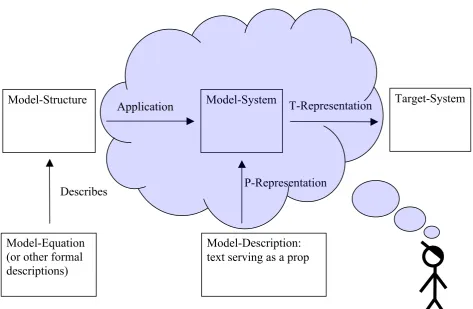
While this may well be a legitimate way of proceeding efficiently in the heat of battle, it is detrimental to philosophical analysis where it is germane that these two acts be kept separate. In this chapter I endeavour to clearly separate these two acts and to present an analysis of each. To this end, let me first introduce some terminology. I use the term ‘model-system’ to denote the hypothetical system proffered as an object of study. I call those descriptions that are used to introduce the model-system as ‘model-descriptions’. Representation then is the relation between a model-system and its target-system. The term ‘model’ could refer to either the model-system or representation, or the combination of the two, or yet other things; I will therefore avoid it in what follows. I use the term ‘modelling’ to refer to the practice of devising, describing and using a model-system. In this more regimented language, the two acts performed in utterances of the kind mentioned above are, first, presenting a model-system and specifying some of its essential properties, and, second, endowing this model-system with representational power.
This separation may do some violence to common sense, which regards representational power as an intrinsic to things that are models and sees this dissociation of model-systems from representation as artificial at best. Common sense is wrong. It has been pointed out variously – and in my view correctly – that, in principle, anything can be a representation of anything else.3 Representations are not a distinctive ontological category and it is wrong to believe that some objects are, intrinsically, representations and other are not. It is one question to ask what an object is in itself; but it is quite a different one to ask what, if anything, an
3 The point is Goodman’s (1976); in recent years Teller (2001), Giere (2004) and Callender and Cohen (2006)
object represents and in what way. Taking model-systems to be intrinsically representational is a fundamental mistake. Model-systems, first and foremost are objects of sorts, which can, and de facto often are, used as representations of a target-system. But the intrinsic nature of a model-system does not depend on whether or not it is so used: representation is extrinsic to the medium doing the representing.
Hence, understanding scientific modelling can be divided into two sub-projects: analysing what model-systems are, and understanding how they are used to represent something beyond themselves. The first is a prerequisite for the second: we can only start analysing how representation works once we understand the intrinsic character of the vehicle that does the representing. Coming to terms with this issue is the project of the first half of this chapter. My central contention is that models are akin to places and characters of literary fictions, and that therefore theories of fiction play an essential role in explaining the nature of model-systems. This sets the agenda. Section 2 provides a statement of this view, which I label the fiction view of model-systems, and argues for its prima facie plausibility. Section 3 presents a defence of this view against its main rival, the structuralist conception of models. In Section 4 I develop an account of model-systems as imagined objects on the basis of the so-called pretence theory of fiction. This theory needs to be discussed in great detail for two reasons. First, developing an acceptable account of imagined objects is mandatory to make the fiction view acceptable, and I will show that the pretence theory has the resources to achieve this goal. Second, the term ‘representation’ is ambiguous; in fact, there are two very different relations that are commonly called ‘representation’ and a conflation between the two is the root of some of the problems that (allegedly) beset scientific representation. Pretence theory provides us with the conceptual resources to articulate these two different forms of representation, which I call p-representation and t-representation respectively. Putting these elements together provides us with a coherent overall picture of scientific modelling, which I develop in Section 5.
target along the lines of how maps represent their targets. In Section 7 I use this view to analyse the Newtonian model of the solar system and show that it not only gives a plausible understanding of what happens in this model, but even makes important features of it visible that are usually concealed. Far from being an idle philosophical pastime, the fiction view of models, I claim in conclusion, can actually help us to better understand what is involved in the representational activities essential to scientific models.
2. Model-Systems and Fiction
What kind of things are model-systems? Referring to them as ‘model-systems’ has a homely ring to it which obscures the fact that we don’t know what they are. As we have seen, the descriptions in question are not descriptions of any actual system. So what, if anything, are they descriptions of? What sense can we make of the common practice to qualify claims about such systems as true or false? And how do we find out about the truth and falsity of such claims?
My answers to these questions take as their starting point the realisation that model-systems share important aspects in common with literary fiction. This is more than just an interesting but eventually inconsequential observation. My claim is that thinking about model-systems as being akin to characters and places in literary fiction provides essential clues to solving pressing problems in the philosophy of science. In other words, drawing an analogy between scientific modelling and literary fiction is not idle musing; it is the driving force behind an approach to scientific modelling that aims to provide an understanding of a central aspect of scientific practice.
Although hardly at the centre of attention, the parallels between certain aspects of science and literary fiction have not gone unnoticed. It has been mentioned by Maxwell, and occupied centre stage in Vaihinger’s (1911) philosophy of the ‘as if’. In more recent years, the parallel has also been drawn specifically between models and fiction. Cartwright observes that ‘a model is a work of fiction’ (1983, 153) and later suggests an analysis of models as fables (1999, Ch. 2). McCloskey (1990) regards economists as ‘tellers of stories and makers of poems’. Fine notes that modelling natural phenomena in every area of science involves fictions in Vaihinger’s sense (1993, 16), and Sklar highlights that describing system “as if” they were systems of some other kind is a royal route to success (2000, 71). Elgin (1996, Ch. 6) argues that science shares important epistemic practices with artistic fiction. Hartmann (1999) and Morgan (2001) emphasise that stories and narratives play an important role in models, and Morgan (2004) stresses the importance of imagination in model building. Sugden (2000) points out that economic models describe ‘counterfactual worlds’ constructed by the modeller. I have defended the view that models are imaginary objects in my (2003) and my (2009), and Grüne-Yanoff and Schweinzer (2008) emphasise the importance of stories in the application of game theory.4 Moreover, Godfrey-Smith (2006) has recently set out what amounts to the most explicit and forceful statement of the fiction view of model-systems now available.
What we have to recognise, though, is that the analogy between model-systems and fiction is only a starting point. If put forward without further qualifications, explaining model-systems in terms of fictional characters amounts to explaining the unclear by the obscure. In fact, fictional entities are beset with philosophical problems that are so severe that avoiding fictional entities altogether would appear to be a better strategy. Fictional entities do not exist: there is no woman called Emma Bovary and there is no detective Sherlock Holmes. Yet they have some kind of reality: we think about them, we talk about them, and they are objects of our emotions. Fictional entities are the subject matter of discussions, and claims about them can be true or false: we say that it is true that Holmes is a detective but false that he is a ballet dancer. How can this be if there is no Holmes? And how can sentences containing the name ‘Holmes’ even be meaningful if Holmes does not exist? It seems that the sentence would then
4 Giere (1988, Ch. 3) argues that models are ‘abstract entities’, which could be also interpreted as a fiction based
be about nothing, and yet we qualify such sentences as true or false. On what grounds do we do this?
These and other related concerns have led many philosophers to dismiss fictional entities. So how is appeal to something as problematic and obscure as fictional entities going to help us work through the thorny problem of scientific representation? Before turning to the details of the account that I favour (Section 4), I want to mention four reasons for believing that thinking about modelling in this way is helpful.
First, works of fiction characteristically do not portray actual states of affairs. The names of persons and objects in literary fiction characteristically do not denote real persons or objects, and there is nothing in the world of which the text of a novel is a true description.5 Nevertheless, fictional discourse is genuinely meaningful: readers neither make a mistake, nor are they under an illusion when they believe that they understand the contents of a novel. Yet, at the same time they are fully aware that the sentences they read when engaging with a work of fiction do not describe anything in the actual world. The same is true of modelling discourse in science. As we have seen above, scientific discourse abounds with descriptions that are meaningful yet fail to be plain descriptions of physical systems from the domain of enquiry of the scientific discipline in question.
Second, we can truly say that in David Lodge’s Changing Places Morris Zapp is a professor of English literature at the State University of Euphoria. We can also truly say that in the novel he has a heart and a liver, but we cannot truly say that he is a ballet dancer or a violin player. Only the first of these claims is part of the explicit content of the novel, yet there is a matter of the fact about what is the case ‘in the world of the story’ even when claims go beyond what is explicitly stated. Whether or not claims about a story’s content are correct is – somehow – determined by the text without being part of its explicit content. Such determinations are not merely decided by each reader on a whim. The situation with model-systems is the same. Model-descriptions usually only specify a handful of essential properties, but it is understood that the model-system has properties other than the ones mentioned in the description. Model-systems are interesting exactly because more is true of them than what the initial description specifies; no one would spend time studying model-systems if all there was
5 This is not meant to be a definition of fiction. A failure of reference, although typical for fiction, is neither
to know about them was the explicit content of the initial description. It is, for instance, true that the Newtonian system representing the solar system is stable and that the earths move in elliptical orbits; but none of this is part of the explicit content of the model-system’s original specification.
Third, a fictional story not only has content that goes beyond what is explicitly stated, we also have the means to learn about this ‘extra content’ by using certain (usually implicit) rules of inference. It is an integral part of our response to fiction that we supplement the explicit content and fill in facts about the plot even where the text is silent. In fact, a good part of the intellectual pleasure we get from reading a novel derives from this imaginative ‘filling in’ of the ‘missing content’. The same goes for systems. Finding out what is true in a model-system beyond what is explicitly specified in the relevant description is a crucial aspect of our engagement with the system. In fact the bulk of the work that is done with a model-system is usually expended on establishing whether or not certain claims about it hold true. Is the solar system stable? Do the populations of predators and prey reach some equilibrium? Do prices stabilise? These are questions we want to answer given what we know about the model and certain other rules we regard as valid in the context in which the model-system is discussed.
Fourth, sometimes we read just for pleasure, but in particular when we read serious literature we often engage in comparisons between the characters and situations in the fiction and real situations and characters with which we are familiar. We recognise aspects of the protagonist’s behaviour in someone we know and suddenly begin to understand some of his behavioural patterns: we learn about the world by reading fiction. Again, this has parallels in the context of modelling, where we learn from models about the world. Once we think about models as fictions this parallel becomes salient and urges us to think about how ‘knowledge transfer’ from a fictional scenario to the real world takes place.
In the next section I defend this conception of model-systems against its structuralist rival. Those already convinced by the fiction view can skip this section without loss and continue with Section 4 where I present a detailed formulation of the fiction view of models.
3. Strictures on Structures
Stop and rewind. Many will think that this discussion has taken a wrong turn right at the beginning and has gotten onto a path leading straight into a thicket of confusions. The wrong turn is to take talk about nonexistent systems seriously. Worse, trying to make good on this idea by working out a theory of fiction is a pilgrimage to the devil. Those whom I expect to issue such a verdict are those who hold the view that models are set theoretical structures. This view originates with Suppes (1960) and is now held by many, among them van Fraassen (1980; 1997; 2002), Da Costa and French (1990), and French and Ladyman (1997).
At the core of this approach to models lies the notion that models are structures. A structure (sometimes ‘mathematical structure’ or ‘set-theoretic structure’) S is a composite entity consisting of a non-empty set U of individuals called the domain (or universe) of the structure S and a non-empty indexed set R of relations on U. Often it is convenient to write these as an ordered triple: S=[U, R].6
For what follows it is important to be clear on what we mean by ‘individual’ and ‘relation’ in this context. To define the domain of a structure it does not matter what the individuals are – they may be whatever. The only thing that matters from a structural point of view is that there are so and so many of them. Or to put it another way, all we need is dummies or placeholders. Relations are understood in a similarly ‘deflationary’ way. It is not important what the relation ‘in itself’ is; all that matters is between which objects it holds. For this reason, a relation is specified purely extensionally, that is, as class of ordered n-tuples and the relation is assumed to be nothing over and above this class of ordered tuples. Thus understood, relations have no properties other than those that derive from this extensional characterisation, such as
6 Sometimes structures are defined so that they also include operations. Although convenient in some contexts,
transitivity, reflexivity, symmetry, etc. This leaves us with a notion of structure containing dummy-objects between which purely extensionally defined relations hold.7
Let us illustrate this with a simple example. Consider St = [U=(a, b, c), R=(〈a, b〉, 〈b, c〉, 〈a,
c〉)], a structure consisting of a three object domain (with the objects a, b, and c) endowed with a transitive relation R, (where ‘〈a, b〉’ is an ordered tuple expressing that R holds between a and b).8 In fact, the formula in the previous sentence is all we need in order to completely define the structure. It does not matter what they objects are: their materiality is immaterial. It doesn’t matter whether they are books, railway bridges, or supernovae – all that is needed is that they are objects. In the same way it does not matter whether the relation R is ‘greater than’ or ‘older than’ or ‘more appreciated than’ – all that matters is that R holds between a and b, and b and c, and a and c, no matter what R ‘in itself’ is.
A view that takes model-systems in science to be structures in this sense is too austere to serve as a basis for an account of scientific modelling. Although structures do play an important role in scientific modelling, model-systems cannot be identified with structures. What is missing in the structuralist conception is an analysis of the ‘material’ character of model-systems: even perfectly spherical planets are taken to have mass, populations are taken to consist of rabbits and foxes, etc. The view of systems that I advocate regards model-systems as imagined physical model-systems, i.e. as hypothetical entities that, as a matter of fact, do not exist spatio-temporally but nevertheless have non-structural properties in the same way in which literary characters do. I will explain below in detail how to understand this claim and address the problems that it faces. The aim of this section is to argue that this is the right way of thinking about model-systems.
There are several reasons to prefer this take on model-systems over the structuralist account. The first is the evidence from scientific practice: scientists often talk about model-systems as if they were physical things. Young and Freedman, when presenting their model of the baseball in the above quote, do not say that they present a mathematical structure. Rather they
7 See Russell (1919, 60) for clear account of this feature of structures.
8 A relation is transitive iff it is true that whenever the relation holds between objects a and b, and between b and
describe a hypothetical situation in which a rigid ball moves without air resistance and in the absence of other confounding factors. This way of thinking about model-systems is typical in mechanics as well as many branches of physics. And the same is true in biology. Godfrey-‐ Smith (2006, 736-‐8) points out that Levins’ work on population biology – as well as the models of Maynard Smith and Szathmáry’s in evolutionary theory, and hence most of the work in their respective fields – is best understood as describing imagined concrete populations. Further, Godfrey-‐Smith adds that this way of looking at model-‐systems in these fields is integral to the discovery of novel phenomena and to making sense of the treatment of certain issues (e.g. the discussion of robustness in Levins), as well as to the communication of the results in books and papers, even where the models make essential use of mathematical techniques.
Closely related to this point is the fact that the fictional scenario plays a crucial role in understanding how a model relates to reality. This is best illustrated with a simple example from population dynamics.9 Imagine you have a newborn pair of rabbits, one
male the other female, and you also have a large garden which is their habitat. You then want to know how many pairs of rabbits you will have at some later time, and so you turn to a text on population dynamics where you find a simple model (going back to Leonardo of Pisa, also known by his nickname ‘Fibonacci’). The model tells you that the population at time tn equals the population at time tn-‐1 plus the population at time tn-‐2.
According to the model, then, we have P(tn)=P(tn-‐1)+P(tn-‐2), where P(tn) is the population
at time tn and where the distance between two instants of time is the time rabbits need
to mature and breed (the numbers P(tn) are known as ‘Fibonacci numbers’).10 Let us
assume this time is one month. Thus, the model tells us that if we start with one young pair, we have five pairs after five months, eight pairs after six months, thirteen pairs after seven months, and so on.
If you are now getting excited because you figure that your rabbit population will grow really fast (after ten months you already have fifty-‐five pairs according to the model),
9 For a discussion of this example see Smith (2007, 24-29).
10 Strictly speaking this is not a structural formulation of the model, but a structural version could easily be
you will be disappointed. Quite soon the real number of rabbit pairs will start diverging dramatically from the value the model predicts. This may take you by surprise, but it should not if you understand the entire model. The above equation is not about rabbits
per se; it is about rabbits that never die, a garden that is infinitely large and contains
enough food for any number of rabbits, and rabbits that procreate at a constant rate at constant speed. This is not by any standards an accurate description of the real situation; it is a fictional scenario and P(tn)=P(tn-‐1)+P(tn-‐2) is true of this scenario. It is
crucial to appreciate this fact if we want to know under what circumstances and to what extent conclusions derived in the model can be expected to bear out in the real system. Real rabbits don’t live forever, but they live for some years; the garden is not infinite but large enough to provide food and shelter for about one hundred pairs; etc. So we come to the conclusion that model is probably good for about the first nine or ten months and then starts breaking down. This is important to know when using the model, but – and this is the crucial point – there is nothing in the mathematics that tells you any of this! What makes you understand the how the model relates to the world and when and where you can reasonably use it is a comparison between the fictional scenario and the real world. So the fictional scenario is an integral component of the model, and one that cannot be eliminated and replaced by structures.
Some might now reply that the fictional scenario merely plays a pragmatic role in our use of the model (whatever that means) and can therefore be eliminated in a final formulation of the model. I disagree because, as I have just outlined, the fictional scenario is essential to the functioning of the model. But irrespective of how this issue is resolved, the structuralist conception of models faces further difficulties when we think about how a model comes to be a representation of a target-system.
A structure per se is not about anything at all, let alone about a particular target-system; they are pieces of pure mathematics, devoid of empirical content. But a representation must posses ‘semantic content’ or ‘aboutness’; that is, it must stand for something else. Those who take model-systems to be structures suggest connecting structures to target-systems by setting up an isomorphism between model-system and target.11 Two structures S=[U, R] and S
T=[UT, RT]
are isomorphic iff there exists an isomorphism between them. An isomorphism is a mapping f:
11 Other suggestions include partial isomorphism, homomorphism, and embedding – nothing in what follows
UT → U such that f is one-to-one (bijective) and it preserves the system of relations in the
following sense: the elements a1, ..., an of ST satisfy the relation RT iff the corresponding
elements b1=f(a1), ..., bn=f(an) in S satisfy R, where Ris the relation in S corresponding to RT.
This definition of isomorphism brings a predicament to the fore: a morphism holds between two structures and not between a structure and a part of the world per se. In order to make sense of the notion that there is an isomorphism between a model-system and its target-system, we have to assume that the target exemplifies a particular structure. The problem is that this cannot be had without bringing non-structural features into play.
The argument for this claim proceeds in two steps (Frigg 2006, 55-56). The first is to realise that possessing structure S (where S is some particular structure) is a concept that does not apply unless some more concrete concepts apply as well. Hence we cannot say that a target-system has structure S unless we also say that it has certain more concrete properties as well. Let us make this more precise with the notion of one concept being more abstract than another concept.
Concept a is more abstract than concept b iff b belongs to a class B of concepts (and a ∉ B) such that12
(i) for a to apply it is necessary that at least one b’∈ B applies, and,
(ii) on any given occasion, the fact that b’∈ B applies is what the applying of a on that occasion consists in.
In other words, the concepts in B are use to ‘fit out’ the abstract concept a on any given occasion. Working, for instance, is more abstract in this sense than writing a letter or attending a meeting. Condition (i) says that for it to be the case that I am working, I either have to write a letter, attend a meeting, or …; if I don’t do any of these, then I am not working. Condition (ii) says that my working on a given occasion consists in, say, writing a letter. If I complain to someone that I have been writing letters all day, and he then replies ‘OK, but when did you work?’ he is either making a joke or does not get the point (namely that writing letters is working). In other words, the two conditions say that there is no such thing as working and only working.
Having structure S is like working in that it needs fitting out on every occasion in which it applies. It follows from the definition of a structure that for something to have structure S it has to be the case that being an object must apply to some of its parts, and standing in a relation R (where R is one of the relations of S) must apply to these. These concepts are abstract relative to more concrete concepts. Let us take relations first. Recall that relations are defined purely extensionally and hence have nothing but logico-mathematical properties such as transitivity. Consider, then, standing in a transitive relation. There are many transitive relations: taller than, older than, hotter than, heavier than, stronger than, more expensive than, more recent than (and their respective converses: smaller than, younger than, etc.), and with a little ingenuity one can extend this list ad libitum. By itself, there is nothing worrying about that. However, what we have to realise is that standing in a transitive relation applies to two objects only if either greater than, or older than, or … applies to them as well. We cannot have the former without the latter: something cannot be a transitive relation without also being one of the above listed relations. Being taller than, say, is what being a transitive relation consists in on a particular occasion. So standing in a transitive relation is abstract relative to more concrete concepts like being hotter than and, hence there simply is no such thing in the physical world as a relation that is nothing but transitive.
Similarly for objects. What is needed for something to be an object is not an easy question, and an answer depends on the relevant context as well as the kinds of things we are dealing with (medium size physical objects like tables, social entities such as families, etc.). But nothing in the world is such that the only property it possesses is ‘objectness’; whatever the circumstances, some other concepts must apply to it for it to be the case that it is an object. For instance, a medium size physical object has an identifiable shape which sets it off from the environment, which implies that it is coloured, has a certain texture, etc. If none of this was the case, we just would not have a medium size physical object.
This by itself would not have to worry the structuralist who claims that model-‐systems are structures. He could point out that although, as the above argument shows, structures are grounded in something else (which is non-‐structural), it is the structural features of reality that models relate to and that therefore models are structures. The problem with this response – and this is the second step of the argument – becomes apparent when we realise that the descriptions we choose to fit out abstract structural claims almost never are true descriptions of the target systems. The above examples make this sufficiently clear. The structure on which the formal treatment of the solar system is based is not fitted out by a realistic description of the solar system, but by a description that takes planets to be ideal spheres with homogenous mass distributions gravitationally interacting only with each other and nothing else. Similarly, the structure on which the calculations of the population sizes is based does not attach to a realistic description of animal life and so on. So the structural claims that give rise to the equations that we study when dealing with a problem at hand (at least in the overwhelming majority of cases) are not true descriptions of the target system, and hence the target does not have the structure at stake.13
Hence, taken literally, descriptions that ground structural claims (almost always) fail to be descriptions of the intended target system. Instead, they describe a hypothetical system which is distinct from the target system. This has unfortunate consequences for the structuralist.
If the descriptions employed to attribute a structure to a target system were just plain descriptions of that system, then the claim that model-systems are just structures would appear at least prima facie plausible. But once we acknowledge that these descriptions describe hypothetical systems rather than real target systems, we also have to acknowledge that hypothetical systems are an important part of the theoretical apparatus we employ, and that they therefore have to be included in our analysis of how scientific modelling works. This can, of course, be done in different ways. My suggestion is that these hypothetical systems in fact are the models-systems. I therefore I reserve the term ‘model-system’ for the hypothetical physical entities described by the descriptions we use to ground structural claims; I refer to
13 This is what Downes has in mind when he says that there is no empirical system corresponding to the equation
the relevant structures as ‘model structures’. This facilitates the analysis in what follows, but ultimately nothing hangs on this choice; one could just as well say that model-systems are composite entities consisting of a hypothetical and a structural system. What does matter, however, is that we acknowledge that scientific modelling indeed involves such hypothetical systems.14
At least some proponents of structuralist conception will reject this argument.15 The bone of contention is what model-systems represent. So far I have assumed that a model-system represents a piece of the real world, for instance the solar system or a population of rabbits. This, so the objection goes, is the wrong point of departure since models don’t represent systems in this sense. What a model-system ultimately represents is a data model, not an object of some sort. Data are what gather in experiments. When observing the motion of the moon, we take choose a coordinate system and observe the position of the moon in this coordinate system at consecutive instants of time. We then write down these observations. This can be done in different ways. We can simply write a list with the coordinates of the moon at certain instants of time; we can draw a graph consisting of various points standing for the position of the moon at different times; or we can choose yet another form of taking down the data. The data thus gathered are called the raw data. The raw data then undergo a process of cleansing, rectification and regimentation: we throw away data points that are obviously faulty, take into consideration what the measurement errors are, take averages, etc. Often (but not always) the aim of this process is to fit a smooth curve through the various data points so that the curve satisfies certain theoretical desiderata (having minimal least-square-distance from the actual data points). The end result of this process is a so-called data model.
14 One could try to avoid the commitment to hypothetical systems by renouncing a literal understanding of the
relevant descriptions and arguing that it does not follow from the fact that descriptions are poor or highly idealised that they are not descriptions of the target at all; it just means that they are idealised descriptions. This move is of no avail. Being an idealised description is not a primitive concept and it calls for analysis. On the most plausible analysis, D is an approximate description of object O iff what D literally describes is in some relevant sense an idealisation of O. But what D literally describes is a hypothetical system, and so we find ourselves back where we started.
15 The German structuralists explicitly acknowledge the need for a concrete description of the target-system
The claim then is that model-systems do not represent parts of the world (like the earth and the sun), but rather data-models that have been constructed from observations made on these parts of the world. So what a model of the motion of planet earth is about is not the earth itself, but the smooth curve that we have fitted through the data gained when observing the motion of the earth. In this vein van Frassen declares that ‘[...] the theoretical models (proffered [...] as candidates for the representation of the phenomena) are confronted by the data models. [...] to fit those data models is ultimately the bottom line.’ (2002, 164).16 In brief, the suggestion is that representation be explicated in terms of setting up an isomorphism between the model-system (on this view a structure) and the data model. This move indeed renders the above argument obsolete since data models are mathematical entities and as such can be considered to have a well-defined structure.17
This suggestion is wrong because it is descriptively inadequate: it is not the case that models represent data. This point is not new. It has been argued by Bogen and Woodward (1988) and Woodward (1989), and has recently been reiterated in different guise by Teller (2001).18 In essence I agree with these authors; however, my focus differs slightly from theirs and I present the subject matter in a way that suits my needs.
In nuce, Bogen’s and Woodward’s point is that science is not about data; it is about phenomena. A theory about the melting point of lead is not about the data we gather when we find out at what temperature lead melts; it is about the melting of lead itself. This carries over to models: models do not represent data. In fact, most models do not per se contain anything that could be directly compared to data we gather; or more specifically, they do not involve structures that could plausibly be thought of as being isomorphic to a data model.
Let me illustrate this with an example from Bogen and Woodward: the discovery of weak neutral currents (ibid., 315-18). What the model at stake consists of is particles: neutrinos,
16 See also van Fraassen (1980, 64; 1989, 229; 1997, 524) and French (French 1999, 191-192).
17 There is an exegetic question here. Although structuralists certainly suggest that representation is data
matching, they never explicitly say so. I here explore the stronger version of the view on which representation indeed consists in data matching since the weaker version, on which data matching is distinct from representation, does not provide a viable criticism of the above argument from abstractness.
18 McAllister (1997) presents and antirealist critique of Bogen and Woodward. But his concern is orthogonal to
nucleons, the Z0, and so on, along with the reactions that take place between them.19 Nothing of that, however, shows in the relevant data. What was produced at CERN in Geneva were 290000 bubble chamber photographs of which roughly one hundred were considered to provide evidence for the existence of neutral currents. The notable point in this story is that there is no part of the model (which quantum field theory provides us with) that could be claimed to be isomorphic to these photographs (or any data model one might want to construct on the basis of these). It is weak neutral currents that occur in the model, but not any sort of data we gather in an experiment.
This is not to say that these data have nothing to do with the model. The model posits a certain number of particles and informs us about the way in which they interact both with each other and with their environment. Using this we can place them in a certain experimental context. The data we then gather in an experiment are the product of the elements of the model and of the way in which they operate in a given context. Characteristically this context is one which we are able to control and about which we have reliable knowledge (e.g. knowledge about detectors, accelerators, photographic plates and so on). Using this and the model we can derive predictions about what the outcomes of an experiment will be. But, and this is the salient point, these predictions involve the entire experimental set-up and not only the model and there is nothing in the model itself with which one could compare the data. Hence, data are highly contextual and there is a gap between observable outcomes of experiments and anything one might call a substructure of a model of neutral currents.20
19 The model I am talking about here is not the so-called standard model of elementary particles as a whole.
Rather, what I have in mind is one specific model about the interaction of certain particles of the kind one would find in a theoretical paper on this experiment.
20 To underwrite this claim consider the following example. Parallel to the research at CERN, the NAL in
But what, then, is the significance of data, if they are not the kind of things that models represent? The answer to this question is that data perform an evidential function. That is, data play the role of evidence for the presence of certain phenomena. The fact that we find a certain pattern in a bubble chamber photograph is evidence for the existence of neutral currents, and for the fact that the model is a (more or less) faithful representation of what is happening in the world. Thus construed, we do not denigrate the importance of data to science, but we do not have to require that data have to be isomorphically embeddable into the model at stake.
In sum, understanding the fictional scenario of which the formal apparatus of a model is literally true is essential to understanding and using a model. Furthermore, one has to recognise that structures cannot be connected to anything in the world without the mediation of non-structural concepts, and attempts to bypass this conclusion by appeal to data models fails.
4. Model-Systems and Imagination
So far, I have argued that model-systems are best understood as akin to characters and objects of literary fiction. However, as I have indicated above, fictional entities are beset with philosophical problems (see Friend (2007) for a discussion of these) and hence explaining models in terms of fiction hardly seems to be progress. Hence the burden of proof is on the side of the proponent of the fiction view, who has to show that there is a workable conception of fiction that serves the needs of a theory of scientific modelling. Developing such a view is the aim of this section.21 This involves a lengthy discussion of philosophical subtleties that at first may seem peripheral to the concerns of scientific modelling. I appeal to the forbearance of the reader and promise that this effort is not in vain. For one, without a tenable conception of fiction, the fictions view is without foundation, and the only way to prove that it stands firm is to explicitly formulate a tenable account of fiction. For another, one of the results of this excursion into the philosophical jungles of fiction is the distinction it allows us to draw between two different conceptions of representation, p-representation and t-representation. This distinction, I think, is crucial to understanding how scientific modelling works, and a failure to keep the two separate has led to considerable confusion.
What do we expect from an account of fiction in order for it to be able to serve as the foundation of the fiction view of model-systems? I think it has to provide responses to five questions (Q1-Q5) and to satisfy two meta-theoretical criteria (C1-C2). These questions and criteria are as follows:
(Q1) Identity conditions. When are two model-systems identical? This question is pressing because unlike in the context of literature, where we can point to canonical texts and authors’ intentions, model-systems in science are often presented by different authors (in different papers or textbooks) in different ways. Nevertheless, many different descriptions are actually meant to describe the same model-system. Under what circumstances is that the case? That is, when are the model-systems specified by different descriptions identical?
(Q2) Attribution of properties. In the previous section I have argued that model-systems have ‘physical’, ‘concrete’, or ‘material’ properties. As the scare-quotes indicate, there is something problematic about this claim. In fact, it has even been claimed that such statements are outright contradictory because abstract objects like the ideal pendulum cannot have the same properties as concrete physical systems (Hughes 1997, 330). How is it possible for a model-system to have ‘material’ properties if model-systems do not exist in space and time? What sense can we make of statements like ‘the ball is charged’ or ‘the population is isolated from its environment’ if there are no balls and populations?
(Q3) Comparative statements. As we have seen above, comparing a model and its target-system is essential to many aspects of modelling, and it plays a crucial role in the account of representation developed below. We customarily say things like ‘real agents do not behave like the agents in the model’ and ‘the surface of the real sun is unlike the surface of the model sun’. How can we compare something that does not exist with something that does? Likewise, how are we to analyse statements that compare features of two model-systems with each other like ‘the agents in the first model are more rational than the agents in the second model’?
description of the system remains silent? What we need is an account of truth in model-systems, which, first, explains what it means for a claim about a model-system to be true or false and which, second, draws the line between true and false statements at the right place (for instance, an account on which all statements about a model-systems come out false would be unacceptable).
(Q5) Epistemology. We do investigate model-systems and find out about them; truths about the model-system are not forever concealed from us. In fact, we engage with model-systems because we want to explore their properties. How do we do this? How do we find out about these truths and how do we justify our claims?
(C1) Naturalism. The account we offer in response to the above issues should be able to make sense of scientific practice. That is, it should be able to explain how scientists build models and how they reason about them.
(C2) Metaphysical commitments. The metaphysics of fictional entities is an issue fraught with controversy. For this reason we need to know what kind of commitments we incur when we understand model-systems along the lines of fiction, and how these commitments, if any, can be justified. However, it is not, in my view, a condition of adequacy that the account we propose be metaphysically parsimonious. As a matter of fact, the account I develop below eschews commitment to fictional entities, but this is accidental, as it were. To say it a different way, it just so happens that the theory that provides the most convincing answers to the above questions is also metaphysically parsimonious; but if it had turned out that a metaphysically substantial theory (i.e. one that is committed to fictional entities) had provided the best answers, then we should have chosen that theory. In other words, I think that accounts of fictional entities should not be dismissed merely on the grounds of being metaphysically ‘thick’. That I dismiss such accounts has to do only with their failure to answer other questions in a satisfactory way.22
22 For want of space I cannot discuss competing approaches. In a nutshell, their problems seem to be the
That said, it is the contention of this chapter that Kendall Walton’s (1990) pretence theory of fiction best fits this bill.23 The next section provides a brief introduction to this theory, and Section 5 outlines the responses that we get from this theory to (Q1) – (Q5) and (C1)-(C2). The point of departure of this view is the capacity of humans to imagine things.24 Sometimes we imagine something without a particular reason. But there are cases in which our imagining something is prompted by the presence of a particular object, in which case this object is referred to as a ‘prop’. ‘Object’ has to be understood in the widest sense possible; anything capable of affecting our senses can serve as a prop. An object becomes a prop due to the imposition of a rule or ‘principle of generation’ (p. 38), prescribing what is to be imagined as a function of the presence of the object. If someone imagines something because he is encouraged to do so by the presence of a prop he is engaged in a game of make-believe. Someone who is involved in a game of make-believe is pretending; so ‘pretence’ is just a shorthand way of describing participation in such a game (p. 391) and has (in this context) nothing to do with deception (p. 392). The simplest examples of games of make-believe are cases of child's play (p. 11). In one such case, stumps may be regarded as bears and a rope put around the stump may mean that the bear has been lassoed; or pointing the index finger at someone and saying ‘bang’ may mean that the person has been shot.
A prop becomes a prompter if some notices the prop and as a result starts engaging in a rule-guided imaginative activity. The set of prompters and the set of props overlap, but neither is a subset of the other. For one, a prop that is never perceived by anybody and hence never causes anybody to imagine something is not a prompter (but still a prop). For another, an object can prompt imaginations without being part of a game of make-believe (i.e. in the absence of rules of generation), for instance when we see faces in the clouds and imagine how these faces talk to each other. Even within a game we can make errors (e.g. mistakenly take a mole heap for a stump and then say that it is a bear), in which case the mole heap is a prompter (because it prompts imaginings) but it is not a prop (because there is not a rule).
23 Strictly speaking, Walton (1990) restricts the use of ‘pretence’ to verbal (or more generally behavioural)
participation, which does not include the activity of someone reading on his own. However, it has become customary to use ‘pretence’ as synonymous with ‘make-believe’ and I stick to this wider use in what follows. 24 I here discuss pretence theory as it is presented by Walton (1990); Currie (1990) and Evans (1982, Ch. 10)
Pretence theory considers a vast variety of different props ranging from novels to movies, from paintings to plays, and from music to children’s games. In the present context I only discuss the case of literature. Works of literary fiction are, on the current account, regarded as props as they prompt the reader to imagine certain things. By doing so a fiction generates its own game of make-believe. This game can be played by a single player when reading the work, or by a group when someone tells the story to the others.
Some rules of generation are ad hoc, for instance when a group of children spontaneously imposes the rule that stumps are bears and play the game ‘catch the bear’. Other rules are publicly agreed on and hence (at least relatively) stable. Games based on public rules are ‘authorized’; games involving ad hoc rules are ‘unauthorized’.
By definition, a prop is a representation if it is a prop in an authorised game. On this view, then, stumps are not representations of bears because the rule to regard stumps as bears is an ad hoc rule that is neither shared by others in the society nor stable over time (stumps may not be props to other people and even the children playing the game now may regarded them as elephants on the next walk). However, Hamlet is a representation because everybody who understands English is invited to imagine its content, and this has been so since the work came into existence. Within pretence theory ‘representation’ is used as a technical term. Representations are not, as is customary, explained in terms of their relation (e.g. resemblance or denotation) to something beyond themselves; representations are things that possess the social function of serving as props in authorised games of make-believe (I will come back to this point below).
inferred because it does not follow from the basic laws of the game that stumps are bears, but from the additional principle that bears in the game have the same properties as real bears.
The distinction between primary and inferred truths is also operative in literary fiction. The reader of Changing Places reads that Zapp ‘embarked […] on an ambitious critical project: a series of commentaries on Jane Austen which would work through the whole canon, one novel at a time, saying absolutely everything that could possibly be said about them.’ The reader is thereby invited to imagine the direct truth that Morris Zapp is working on such a project. She is also invited to imagine that Zapp is overconfident, arrogant in an amusing way, and pursues a project that is impossible to complete. None of this is explicitly stated in the novel. These are inferred truths, which the reader deduces from common knowledge about academic projects and the psyche of people pursuing them.25 What rules can legitimately be used to reach conclusions of this sort is a difficult issue fraught with controversy. I will return briefly to it below; for the time being all that matters is that there are such rules, no matter what they are.
This framework, has the resources to explain the nature of systems. Typically, model-systems are presented to us by way of descriptions, and these descriptions should be understood as props in games of make-believe., These descriptions usually begin with expressions like ‘consider’ or ‘assume’ and thereby make it clear that they are not descriptions of fact, but an invitation to ponder – in the present idiom, imagine – a particular situation. Although it is often understood that this situation is such that it does not occur anywhere in reality, this is not a prerequisite; models, like literary fictions, are not defined in contrast to truth. In elementary particle physics, for instance, a scenario is often proposed simply as a suggestion worth considering. Only later, when all the details are worked out, the question is asked whether this scenario bears an interesting relation to what happens in nature, and if so what the relation is.26
25 The distinction between primary and inferred truths is not always easy to draw, in particular when dealing with
complex literary fiction. Walton also guards against simply associating primary truth with what is explicitly stated in the text and inferred ones with what follows from them (see Walton (1990, Ch. 4) for a discussion). For the purpose of the present discussion these subtleties are inconsequential.
26 For an accessible account of particle physics that makes this aspect explicit see Smolin (2007), in particular
The ‘working out’ of the details usually consists in deriving conclusions from the primary assumptions of the model and some general principles or laws that are taken for granted. For instance, we derive that the earth moves in an elliptical orbit from the basic assumptions of the Newtonian model and the laws of classical mechanics. This is explained naturally in the idiom of pretence theory. What is explicitly stated in a model description (that the model-earth is spherical, etc.) are the primary truths of the model, and what follows from them via laws or general principles are the implied truths; the principles of direct generation are the linguistic conventions that allow us to understand the relevant description, and the principles of indirect generation are the laws that are used to derive further results from the primary truths.
We can now address the above questions. The attribution of certain concrete properties to models (Q2) is explained as it being fictional that the model-system possesses these properties. To say that the model-population is isolated from its environment is just like saying that Zapp drives a convertible. Both claims follow from a prop together with rules of generation. In other words, saying that a hypothetical entity possesses certain properties involves nothing over and above saying that within a certain game of make-believe we are entitled to imagine the entity as having these properties. For this reason there is nothing mysterious about ascribing concrete properties to nonexistent things, nor is it a category mistake to do so.
Let us now discuss the issue of truth in model-systems (Q4), which will also provide us with solutions to the other open questions. The question is: what exactly do we assert when we qualify ‘Zapp drives a convertible’ as true in the fiction while ‘Zapp drives a Mini Cooper’ as false?27 To begin with, it is crucial to realise that there are three different kinds of statement in connection with fiction, and that these require a different treatment when it comes to the questions of truth; I refer to these as intrafictional, metafictional, and transfictional statements.28 For someone sitting in an armchair reading Changing Places ‘Morris jumped into the paternoster on the downside’ is an intrafictional statement because the reader is
27 There is controversy over this issue even within pretence theory. It is beyond the scope of this paper to discuss
the different proposals and compare them to one another. In what follows I develop an account of truth in fiction that is based on elements from different theories and that is tailored towards the needs of a theory of model-systems.
28 All theories of fiction acknowledge this distinction. My terminology is adapted from Currie (1990, Ch. 4) who
involved in playing the game defined by the novel and imagines that the sentence’s content is the case. Someone who read the novel a while ago and asserts in discussion with a friend that Zapp jumped into a paternoster makes a metafictional statement because he is talking about the fiction. If he then also asserts that Zapp, his quirks notwithstanding, is more likeable than any literature teacher he ever had or that Zapp is smarter than Candide, he makes transfictional statements as he is comparing Zapp to a real person and a character in another fiction.29
Intraficational propositions are made within the fiction and we are not meant to believe them, nor are we meant to take them as reports of fact; we are meant to imagine them. Although some statements are true in the fiction as well as true tout court (‘1968 was the year of student revolts’ is true and true in Changing Places), we often qualify false statements as true in the fiction (‘Zapp is a literary theorist’ is false because there is no Zapp) and true statements as false in the fiction (‘white light is composed of light of other colours’ is false in Goethe’s Faust). So truth and truth in fiction are distinct; in fact, truth in fiction is not a species of truth at all (p. 41). For this reason it has become customary when talking about what is the case in a fiction to replace locutions like ‘true in the fiction’ or ‘true in a fictional world’ by the term of art ‘being fictional’; henceforth ‘Fw(p)’ is used as an abbreviation for ‘it is fictional in work w
that p’, where p is a placeholder for an intrafictional proposition like ‘Zapp pursues an impossible project’.30
The question now becomes: when is p fictional in w? Let the w-game of make-believe be the game of make-believe based on work w, and similarly for ‘w-prop’ and ‘w-principles of generation’. Then, p is fictional in w iff p is to be imagined in the w-game of make-believe (p. 39). In more detail:
29 Notice that while transfictional statements are recognisable by the presence of terms that are foreign to the
work under discussion, intrafictional and metafictional statements are recognisable as such only as a function of the context in which they appear. There are also statements that are difficult to classify. As these typically involve emotional reactions on the part of the reader to the novel (halfway through the book a reader exclaims ‘I fear the worst for Zapp’), they need not occupy us here.
30 I here follow Currie (1990, Ch. 2) and assume that sentences like ‘Zapp drives a convertible’ express
p is fictional in work w iff the w-prop together with the w-principles of generation prescribes p to be imagined
This analysis alleviates worries about the (alleged) subjectivity of imaginings. In common parlance, ‘imagination’ has subjective overtones, which might suggest that an understanding of models as imagined entities makes them subjective because every person imagines something different. This is not so. In pretence theory, imaginations in an authorised game of make-believe are sanctioned by the prop itself and the rules of generation, both of which are public and shared by the relevant community. Therefore, someone’s imaginings are governed by intersubjective rules, which guarantee that, as long as the rules are respected, everybody involved in the game has the same imaginings. So, not only do all participants in the game de facto imagine the same things (which could also be the result of happenstance), but they do so because they participate in a rule-governed activity. What is more, participants know that they do; they know that they are participants in an authorised game and as long as they trust that the others play by the rules they can trust that other have the same imaginings.
Furthermore, for a proposition to be fictional in work w it is not necessary that it is actually imagined by anyone: fictional propositions are ones for which there is a prescription to the effect that they have to be imagined (p. 39), and whether a proposition is to be imagined is determined by the prop and the rules of generation. Hence, props, via the rules of generation, make propositions fictional independently of people’s actual imaginings (p. 38), and for this reason there can be fictional truths that no one knows of. If there is a stump hidden behind a bush, unknown to those playing the game, it is still fictional that there is a bear behind the bush; the prop itself and the rules of generation are sufficient to generate this fictional truth.
With this in place we can now also render concept of a ‘fictional world’ or ‘world of a fiction’ precise: the world of work w is the set of all propositions that are fictional in w.31
This analysis of truth in fiction carries over to model-systems one to one simply by replacing p by a claim about the model, w by the description of the model-system, and w-principles of generation by the laws and principles assumed be at work in the model. For instance, ‘the
31 Fictional worlds thus defined are rather different from possible worlds as used in modal logic, the most
solar system is stable’ is true in the Newtonian model of the solar system systems iff the description of the system together with the laws and principles assumed to hold in the system (the laws of classical mechanics, the law of gravity, and some general assumptions about physical objects) imply that this is the case. This gives us a straightforward answer to the question about identity conditions (Q1): two models are identical iff the worlds of the two models – the set of all propositions that are fictional in the two models – are identical.32
Metafictional propositions make genuine claims that can be true or false in the same way in which claims about chairs and tables can be true or false. But how can such statements be true if the singular terms that occur in them have no referents? A solution emerges when we realise that statements like ‘Zapp is a professor’ are ellipses for ‘in Changing Places, Zapp is a professor’. So when we metafictionally assert p, what we really assert is ‘in work w, p’ (p. 397). Asserting that something is the case in a work of fiction is tantamount to asserting that it is fictional in that work. Hence asserting ‘in work w, p’ amounts to asserting ‘p is fictional in work w’, which in turn in is equivalent to ‘it is fictional in work w that p’. The last sentence is, of course, just Fw(p). Hence metafictionally asserting p amounts to asserting Fw(p). The truth
condition for this assertion follows from what has been said above:
Fw(p) is true iff p is fictional in w, which in turn is the case iff the w-prop and together
with the w-principles of generation prescribes p to be imagined.
Derivatively, p, when uttered as a metafictional claim, is true iff p is fictional when uttered as an intrafictional claim.33 In sum, once we understand that a metafictional claim has to be prefixed by ‘In fiction w’, and hence has the structure Fw(p), the truth of the claim is
determined by appeal to the w-game of make-believe. Again, this analysis translates to scientific statements without further ado.
Transfictional propositions pose a particular problem because they – apparently – involve comparisons with a nonexistent objects, which does not seem to make sense: we cannot
32 An interesting consequence of this identity condition is that not all models with the same prop are identical,
because they can operate with different rules of indirect generation. This is the case, for instance, when the ‘same model’ is treated first classically and then quantum mechanically; on the current view, the classical and the quantum model are not identical.
33 In some places Walton ties the truth of such statements to authorised games (e.g., p. 397-8). This restriction