R E S E A R C H A R T I C L E
Open Access
Exploring the reliability and acceptability of
cognitive tests for Indigenous Australians:
a pilot study
Kylie M. Dingwall
1*†, Allison O. Gray
1†, Annette R. McCarthy
1, Jennifer F. Delima
2and Stephen C. Bowden
3Abstract
Background:Reliable cognitive assessment for Indigenous Australians is difficult given that mainstream tests typically rely on Western concepts, content and values. A test’s psychometric properties should therefore be assessed prior to use in other cultures. The aim of this pilot study was to examine the reliability and acceptability of four cognitive tests for Australian Aboriginal people.
Methods:Participants were 40 male and 44 female (N= 84) Aboriginal patients from Alice Springs Hospital. Four tests were assessed for reliability and acceptability–Rowland Universal Dementia Assessment Screen (RUDAS) (n= 19), PEBL Corsi Blocks (Corsi) (n= 19), Story Memory Recall Test (SMRT) (n= 17) and a CogState battery (n= 18). Participants performed one to three of the tests with repeated assessment to determine test-retest reliability. Qualitative interviews were conducted and analysed based on an adapted phenomenological approach to explore test acceptability. An Indigenous Reference Group gave advice and guidance.
Results:Intra-class correlations (ICC) for test retest reliability ranged fromr= 0.58 (CogState One Back accuracy) to 0.86 (RUDAS). Themes emerged relating to general impressions, impacts on understanding and performance, appropriateness, task preferences and suggested improvements.
Conclusions:RUDAS, CogState Identification task, and SMRT showed the highest reliabilities. Overall the tests were viewed as a positive challenge and an opportunity to learn about the brain despite provoking some anxiety in the patients. Caveats for test acceptability included issues related to language, impacts of convalescence and cultural relevance.
Keywords:Indigenous, Aboriginal, Cognitive testing, Cognition, Cross-cultural
Background
Cognitive dysfunction may be prevalent among some Indigenous Australians due to the high rates of sub-stance abuse, domestic violence, chronic illness, psycho-logical stress or trauma, and malnutrition reported in this group [1]. Impairments in cognition including psychomotor, memory, attention, learning and executive functions have been reported for Indigenous Australians with chronic substance misuse [2, 3]. Limited access to healthy foods in remote regions leads to inadequate
nutrition for some remote dwelling Indigenous people [4] and thiamine deficiency in particular results in the neurological condition Wernicke-Korsakoff’s Syndrome (WKS) [5, 6]. Wernicke’s encephalopathy, is an acute component of WKS characterised by mental confusion, ataxia, ophthalmoplegia and memory loss [5, 7, 8]. The chronic component, Korsakoff’s syndrome can occur if the acute deficiency is left untreated and manifests as chronic anterograde and retrograde amnesia, dementia-like impairment and less frequently disorientation, con-fabulation and lack of insight in severe cases [8–10].
Cognitive assessment enables the measurement of changes in brain function. In conditions such as WKS, repeated cognitive assessments may be required to monitor response to treatment and results can inform * Correspondence:[email protected]
†Equal contributors
1Menzies School of Health Research, Institute of Advanced Studies, Charles
Darwin University, PO Box 4066, Alice Springs, NT 0871, Australia Full list of author information is available at the end of the article
options for further clinical management. Test-retest reli-ability is important when monitoring cognitive progres-sion to ensure that test results are consistent over time [11]. Learning effects or practice effects can occur where repeated exposure to the test improves subsequent per-formance due to practice or familiarity with test content [11]. It is therefore important to examine these psycho-metric properties when using cognitive tests to monitor change to ensure clinical decisions or research conclu-sions are based on reliable data.
Measuring cognition cross-culturally poses unique challenges when tests are based on Western cultural concepts [12, 13]. Existing cognitive tests can rely heavily on the use of the English language, require written re-sponses and resemble mainstream educational processes [14]. Poor English literacy, a lack of formal education, as well as differing concepts of numbers, time and space can mean that Indigenous Australians may have limited ex-perience with the knowledge base from which such tests are derived [1, 13, 15–19]. To address these issues, care should be taken to minimize cultural bias and the psycho-metric properties of the tests should be assessed within the population in which it is to be used.
Recent studies have proposed a number of priorities for selecting and designing appropriate tests for Indigenous Australians [20]. Such priorities include using tests with content, stimuli and formats that are relevant, familiar and engaging; with a decreased reli-ance on language, literacy and numeracy; have simple instructions; utilise prompts and feedback; are perform-ance based where demonstrations and practice trials are used; and are portable and brief among other con-siderations [20]. Indigenous people themselves are best placed to determine relevance and acceptability of cognitive tests. Face validity refers to a participant’s perception of the test and whether, in their subjective opinion, it is a good test of what it purports to measure. If face validity and the acceptability of a test are low, a participant’s motivation to complete the test may be low, contributing to unreliable test scores [11].
The restricted aim of this pilot study was to examine the reliability and acceptability of four cognitive tests for monitoring change over time for Aboriginal people. Results from this study will inform test selection for a randomised controlled trial (RCT), monitoring cognitive outcomes following treatment for WKS.
Methods
Participants
Participants were a convenience sample of 40 male and 44 female (N = 84) Aboriginal patients from Alice Springs Hospital, recruited prospectively. Data collection occurred from March 2014 to December 2014. Partici-pants originated from Alice Springs, Tennant Creek and
remote communities across Central Australia, Western Australia and South Australia, representing 30 language groups. Inclusion criteria were expected admission for at least 48 h, 18 years or older, Aboriginal or Torres Strait Islander, able to communicate in English. Patients were excluded if they were pregnant. These criteria were used as the sample was intended to reflect the proposed sample for the subsequent RCT. Other exclusions for this study included identified pre-existing cognitive im-pairments, acute neurological conditions, under 18 years old, or unable to freely give informed consent. Seventy three follow up assessments were conducted. Some participants performed two (n= 12 participants) or three (n= 3 participants) cognitive tests during their admission due to their expressed interest to do so and to gain infor-mation on acceptability comparatively between tests. Five participants were lost to follow up for CogState (21.7%), three were discharged and two declined to continue. Four participants were lost to follow up for RUDAS (17.4%), two were discharged, one declined to continue and an-other was simultaneously recruited to a conflicting study.
Eight participants were lost to follow up for Corsi (29.6%), five were discharged and three declined further participation. Thirteen participants were lost to follow up for SMRT (43.3%), ten were discharged, two declined to continue and two had technical equipment failures.
Materials/apparatus
The tests were selected based on assessment of cognitive domains affected in WKS and previous use in this popu-lation with use of culturally appropriate methodology. Testing was conducted in English as the tests were de-veloped in this language, with the intention that the most suitable would be translated into key Aboriginal languages of the region for the RCT.
CogState (CogState)
CogState is a computerised test comprised of subtests that can be tailored to a specific research situation (www.cogstate.com) [2, 21, 22]. Minimal literacy is re-quired to complete the test, and it has been used to assess cognition for Indigenous Australians in previous research [2, 23–27]. The battery used in this study consisted of 4 subtests (described below) and took approximately 20 min to administer [28]. The tests were fully supervised with brief on screen instructions also provided. Responses were recorded using the keyboard “D” and “K” keys for “no” and“yes”respectively. If a participant was left-handed the keys were reversed. The participant was allowed a short practice before each sub-task. This CogState battery as-sesses psychomotor speed function, visual attention, work-ing memory and visual learnwork-ing [28].
The participant is required to press“yes” as soon as the card has turned face-up. This task measures visual atten-tion and psychomotor funcatten-tion.
The Identification task (IDN) uses the same format as the Detection task to measure choice reaction time. Once the card turns over the participant is required to press “yes” if the suit is red or“no” if the suit is black. The identification task assesses visual attention.
The One Card Learning task (OCL) uses the same format and asks “Have you seen this card before?” The participant is required to attend to the cards as they ap-pear and maintain each card in their working memory. When the card turns over, the participant decides whether it has been seen before in the current task. This task measures visual learning and memory.
The One Back task (OBK) asks“Is this card the same as the previous card?”. When the card turns over, the participant needs to determine whether it is the same as the last. This task measures attention (working memory).
Scores are provided in the form of log10 transformed mean reaction time (in milliseconds) for the detection and identification tasks and arcsine transformed accur-acy (defined by number of correct responses divided by the total number of trials attempted) for the one card learning and the one back task.
PEBL Corsi block-tapping task (Corsi)
The original Corsi Block-Tapping test is a classic visuo-spatial working memory test used as a visuo-visuo-spatial ver-sion of digit span. A computerised verver-sion - Psychology Experiment Building Language (PEBL) of the Corsi was used in this study (see http://pebl.sourceforge.net/ battery.html). Three practice attempts precede the scored testing. A flashing sequence of coloured squares is pre-sented onscreen and the participant is required to repli-cate the pattern by touching the squares on the touch screen. The initial sequence begins with three squares and increases by one after each correct sequence. Participants are allowed only one incorrect attempt on each number of ‘blocks’. If two incorrect attempts are made for the same number of blocks, the test ceases. Total score is used for analyses.
Rowland Universal Dementia Assessment Scale (RUDAS)
The RUDAS is a short cognitive screening instrument designed to minimise the effects of cultural learning and language diversity. It was developed and validated for a culturally and linguistically diverse (CALD) population and has been translated into several languages [29–31]. RUDAS also assesses a broad range of cognitive func-tions, [29] and is valuable for assessing substance misuse related impairments [6, 32]. It generates an overall cogni-tive score based on measures of memory, body orienta-tion, praxis, drawing, judgement, recall and language [30].
The RUDAS has been used extensively by the Addiction medicine team at Alice Springs Hospital and is considered the best available and a well-accepted cognitive mental status test for alcohol-related conditions in this clinical setting. RUDAS was administered and scored by a trained researcher according to the original administration guide-lines. The first item, a memory recall task, requires learning and delayed recall of a four item grocery list. The body orientation task requires the participant to follow verbal instruction and point to specific body parts. The praxis item requires the participant to copy and continue an alternating hand movement. The visuo-constructional drawing item requires the participant to copy a picture of a cube. The judgement item asks what one does to get across the road safely. The final item requires the partici-pant to state the names of as many different animals as they can within 1 min.
Story memory recall test (SMRT)
The SMRT is a modified version of the Wechsler Logical Memory Test. It requires participants to memorise a fictional passage that includes an accident or negative event and immediately recall the details [33, 34]. The test was chosen given the oral traditions and use of storytelling in many Aboriginal and Torres Strait Islander cultures [35]. An Aboriginal Project Officer de-veloped the two locally relevant stories in English, in consultation with hospital Aboriginal Liaison Officers (ALOs) and the project’s Indigenous Reference Group. There were several revisions of the stories and their scoring guidelines to minimise repetition and to account for nuances in local vernacular.
With the participant’s consent, recall of the stories was audio recorded to ensure accurate scoring. Audio files were transcribed and scored as per the developed scoring guidelines where one point was allocated for each correct component recalled. The stories were scored by two raters and averaged with a total possible score of 24 for Story One and 21 for Story Two.
Procedure
The Central Australian Human Research Ethics Com-mittee (CAHREC) and the Human Research Ethics Committee of the Northern Territory Department of Health and the Menzies School of Health and Research (including the Aboriginal Ethics Sub-Committee) ap-proved the study. Specifically trained researchers gained written informed consent prior to conducting the study.
This also reflects changing needs in assessment practice, where decreased time and resources has increased de-mand for efficient clinical decision-making and average length of hospital stays have decreased [36]. While lon-ger retest intervals may be desirable, we were primarily interested in alternative ranking of tests, evaluated in terms of short-term test retest reliability. Ranking of tests is not likely to change with longer retest intervals. Other researchers have demonstrated use of the Cog-State Battery at 10 min, 1 week and 1 month test-retest intervals where ICC results between assessments for OBK, DET and IDN tests (3–5) maintained reason-able reliabilities above 0.60 and raw difference values below 3% [37]. If participants were discharged or un-willing to complete the retest their quantitative results were excluded but interview data were retained in analyses.
Participants’ medical files were reviewed to record any relevant medical history, medication administra-tion, length of hospital admission, pathology results, presenting diagnoses, and any recorded history of sub-stance use or neurological impairment. Three partici-pants did not consent to having their medical files reviewed.
Statistical analysis
An alpha level of 0.05 was used for all statistical tests. Continuous variables are expressed as means and SDs and categorical variables are reported as percentages. Statistical analyses were conducted using IBM SPSS Statistics 22 [38].
ANOVA and Chi square statistics were used to assess for any demographic differences between the groups performing each test. To investigate retest reliability, ICCs for agreement and consistency were calculated.
Paired sample t-tests were used to examine any learning effects. To ensure that the pattern of statis-tical findings was not affected by distributional violations in small samples, a Wilcoxon signed rank test was con-ducted. The same pattern of results were achieved hence only the parametric analyses are reported.
The SMRT was scored by two raters (KD and AG) and results were used to calculate the ICC to ine inter-rater reliability. Inter-rater reliability exam-ines how well scorers provide similar ratings and was calculated using a two way mixed, absolute, average measures ICC [39].
Acceptability interview analysis
A simple transcendental phenomenological approach was utilised in developing interviews to explore the ex-perience of Aboriginal Australian participants perform-ing English-based cognitive tests. Initial discussions were held to bring awareness to the researchers’
preconceived assumptions, judgements, beliefs, percep-tions and experiences [40] about the topic. These ideas were suspended during the process of bracketing [41, 42] before formulating interview questions for the study. Interviews were transcribed verbatim and analysed using NVivo 10 [43]. Four researchers initially evalu-ated the interview data independently for recurring themes (i.e. significant statements raised by more than one participant) for individual tests and to identify common themes across all the tests. The researchers discussed initial findings and agreed on a preliminary set of themes which were presented to the Indigenous Reference group for discussion. Data were then restruc-tured and re-coded in order to answer the following underlying research questions in relation to partici-pants’experiences:
What were the general impressions of the assessments?
What impacted on understanding and performance? How appropriate were the tasks’format and
content?
What would improve understanding and acceptability?
Which tasks were preferred?
Some participant responses presented were edited for grammatical clarity. The first two authors partici-pated in a secondary discussion about the revised structure and revised themes were agreed upon by consensus.
Results
Quantitative results
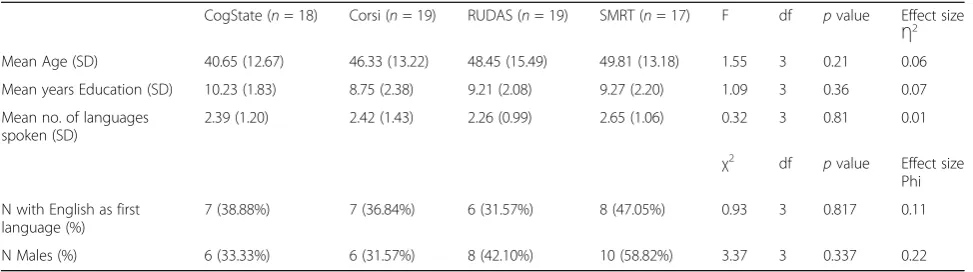
Demographic information for participants who performed both baseline and retest assessments are described in Table 1. There were no significant demographic dif-ferences between the groups performing each of the different tests.
Primary and secondary diagnoses were recorded from the file audit using ICD-10 coding and are presented in Table 2.
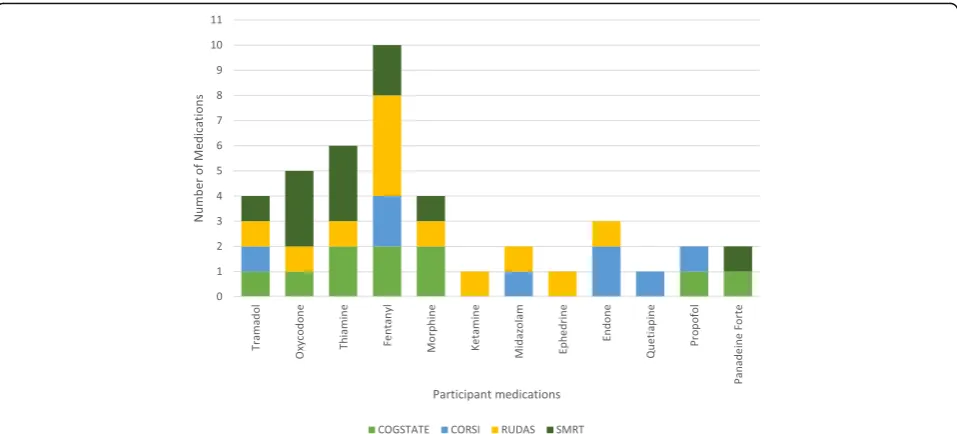
All participant medications were recorded and sum-marised into classes and are described in Fig. 1.
Table 3 presents the means and standard deviations for each task at baseline and retest and results of the paired samples t-test. There were no significant dif-ferences between baseline and retest scores except for Story One on the SMRT which demonstrated sig-nificant improvement from baseline to retest with a moderate effect size.
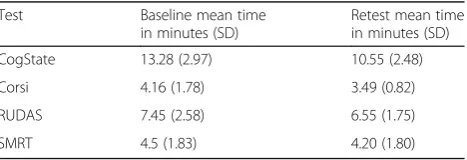
(0.58) to RUDAS total score (0.86). ICCs are presented for inter-rater reliability in Table 5 for the SMRT and indicate excellent agreement between the two raters with all ICCs above 0.98. Average time taken for each test is presented in Table 6.
Observations: interruptions and distractions
Some Interruptions and distractions were also ob-served to occur during testing and are inevitable in this acute clinical setting. The hospital environment was often loud with high potential for distractions including: other patients, nursing checks, visitors, machine alarms, television volume, phone calls and medication administration. Test administrators used their professional judgment at the time of testing to determine whether the test session had been compro-mised and if a test needed to be re-taken. More of these issues were recorded for the computerised as-sessments. The non-computerised tests had nine in-stances of interruptions and distractions (i.e. noise) whereas the computerised tests had 19 observations noting these. RUDAS had five recorded interruptions or distractions, the SMRT had four. Corsi had seven and CogState had 12 interruptions/distractions noted.
Acceptability interview results
General impressions
A good challenge Most participants were generally open to performing the assessments and some identified them as‘fun’and a good way of exercising the mind. All assessments were described by participants as challen-ging, but this was often seen in a positive light.
“Liked that it gave me a bit of a muddle in my brains.” P9 Corsi
Some tasks, particularly the computerised tasks, were perceived to be easy at first, but then increased in diffi-culty causing confusion, or feelings of frustration. Some
did not like the length or speed of the tests as this was perceived to increase difficulty. Nevertheless the tasks appeared to provoke the desired response of motivating people to do well.
“Not bad, like playing a game but it got too hard.” P17 Corsi
“Easy test. Started out easy, and then got hard. Was a good challenge.”P12 Corsi
“I did not like that I got some wrong as I enjoy challenging mind games.”P20 CogState
Performance Anxiety Many people felt concerned that they may not perform well on the test and were worried what might happen if they did get a wrong answer or press the wrong button. They also suggested others might feel shy when asked to perform the test and some commented on feelings of being ‘judged’ or as if their ‘intelligence was being questioned’. Some participants therefore required constant reassurance to continue per-forming the test despite good performance.
“It is important that we explain to people that they don’t have to get the right answer all the time. Aboriginal people may think if I push the wrong button am I going to get in trouble? Explaining that it’s just a game will put people at ease.” P22 CogState
“Some people would be shy if asked to do the test on their own and would perform better if we get a few of them together.”P25 RUDAS
Others suggested it was easier to recall the story with friends and family later, than with the researcher. One participant acknowledged that“it is a test and we all get frustrated and nervous…Being nervous is a natural part
Table 1Comparison of retest study participants’demographics by cognitive assessment
CogState (n= 18) Corsi (n= 19) RUDAS (n= 19) SMRT (n= 17) F df pvalue Effect size
Ƞ2
Mean Age (SD) 40.65 (12.67) 46.33 (13.22) 48.45 (15.49) 49.81 (13.18) 1.55 3 0.21 0.06
Mean years Education (SD) 10.23 (1.83) 8.75 (2.38) 9.21 (2.08) 9.27 (2.20) 1.09 3 0.36 0.07
Mean no. of languages spoken (SD)
2.39 (1.20) 2.42 (1.43) 2.26 (0.99) 2.65 (1.06) 0.32 3 0.81 0.01
χ2
df pvalue Effect size Phi
N with English as first language (%)
7 (38.88%) 7 (36.84%) 6 (31.57%) 8 (47.05%) 0.93 3 0.817 0.11
Table 2Study participants’primary and secondary diagnoses defined by International Classification of Disease–10 coding system
ICD-10 chapter ICD-10 categories Primary code Secondary code
I Certain infectious and parasitic diseases A00-A09 Intestinal infectious diseases 1 1
B35-B49 Mycoses 1
A50-A64 Infections with a predominantly sexual mode of transmission
1
B15-B19 Viral hepatitis 2
B65-B83 Helminthiases 1
B85-B89 Pediculosis, acariasis and other infestations 1
B95-B98 Bacterial, viral and other infectious agents 10
II Neoplasms C00-C97 Malignant neoplasms 1 1
D10-D36 Benign neoplasms 1
III Diseases of the blood and blood-forming organs and certain disorders involving the immune mechanism
D60-D64 Aplastic and other anaemias 3
D65-D69 Coagulation defects, purpura and other haemorrhagic conditions
3
IV Endocrine, nutritional and metabolic diseases E00-E07 Disorders of thyroid gland 1
E10-E14 Diabetes mellitus 1 49
E20-E35 Disorders of other endocrine glands 1
E65-E68 Obesity and other hyperalimentation 2
E70-E90 Metabolic disorders 3 13
V Mental and behavioural disorders F10-F19 Mental and behavioural disorders due to psychoactive substance use
3
VI Diseases of the nervous system G40-G47 Episodic and paroxysmal disorders 1
VII Diseases of the eye and adnexa H00-H06 Disorders of eyelid, lacrimal system and orbit 1
IX Diseases of the circulatory system I00-I02 Acute rheumatic fever 1
I05-I09 Chronic rheumatic heart diseases 2
I10-I15 Hypertensive diseases 15
I20-I25 Ischaemic heart diseases 1
I26-I28 Pulmonary heart disease and diseases of pulmonary circulation
1 1
I30-I52 Other forms of heart disease 5 2
I80-I89 Diseases of veins, lymphatic vessels and lymph nodes, not elsewhere classified
2
I95-I99 Other and unspecified disorders of the circulatory system
3
X Diseases of the respiratory system J09-J18 Influenza and pneumonia 1
J20-J22 Other acute lower respiratory infections 1
J95-J99 Other diseases of the respiratory system 1
J40-J47 Chronic lower respiratory diseases 1
XI Diseases of the digestive system K00-K14 Diseases of oral cavity, salivary glands and jaws 1
K55-K64 Other diseases of intestines 1 1
K70-K77 Diseases of liver 1
K80-K87 Disorders of gallbladder, biliary tract and pancreas 1
K90-K93 Other diseases of the digestive system 1 1
XII Diseases of the skin and subcutaneous tissue L00-L08 Infections of the skin and subcutaneous tissue 5 3
L60-L75 Disorders of skin appendages 1
of life and this anxiety is channelled into test
perform-ance” P4 CogState. Others, despite feeling anxious also
felt“determined”P38 SMRT.
Memory and an opportunity to learn or improve Memory was a topic frequently mentioned during the interviews. It was perceived that assessments would help
improve memory and performing the test provoked memories for several participants, some of whom related the tasks to daily activities.
[The visuospatial orientation task is] “like a small child learning their left and right.” P28 RUDAS
Table 2Study participants’primary and secondary diagnoses defined by International Classification of Disease–10 coding system
(Continued)
XIII Diseases of the musculoskeletal system and connective tissue
M00-M25 Arthropathies 2 3
M40-M54 Dorsopathies 3
M60-M79 Soft tissue disorders 1 3
M80-M94 Osteopathies and chondropathies 1 2
XIV Diseases of the genitourinary system N00-N08 Glomerular diseases 2
N10-N16 Renal tubulo-interstitial diseases 1
N17-N19 Renal failure 1 21
N80-N98 Noninflammatory disorders of female genital tract 3
XVIII Symptoms, signs and abnormal clinical and laboratory findings, not elsewhere classified
R00-R09 Symptoms and signs involving the circulatory and respiratory systems
2
R10-R19 Symptoms and signs involving the digestive system and abdomen
1 5
R25-R29 Symptoms and signs involving the nervous and musculoskeletal systems
1
R30-R39 Symptoms and signs involving the urinary system 1
R50-R69 General symptoms and signs 2 7
R70-R79 Abnormal findings on examination of blood, without diagnosis
1
R90-R94 Abnormal findings on diagnostic imaging and in function studies, without diagnosis
2
XIX Injury, poisoning and certain other consequences of external causes
S70-S79 Injuries to the hip and thigh 2
S80-S89 Injuries to the knee and lower leg 1
T20-T32 Burns and corrosions 1 1
T80-T88 Complications of surgical and medical care, not elsewhere classified
3 2
XX External causes of morbidity and mortality V01-X59 Accidents 5
Y40-Y84 Complications of medical and surgical care 5
XXI Factors influencing health status and contact with health services
Z30-Z39 Persons encountering health services in circumstances related to reproduction
1
Z40-Z54 Persons encountering health services for specific procedures and health care
4
Z55-Z65 Persons with potential health hazards related to socioeconomic and psychosocial circumstances
1 1
Z70-Z76 Persons encountering health services in other circumstances
16
Z80-Z99 Persons with potential health hazards related to family and personal history and certain conditions influencing health status
19
ZZ Not Listed 5 7
“I might buy these things [in the shopping list task]. I cook all those at home.”P57 RUDAS
“Test made me frustrated. It made me think back to when I used to drink…The test improves my mind and brings back memories from years ago. This could help heal people’s minds and help bring memories back.”P29 CogState
Participants therefore viewed the assessments as an op-portunity to learn about their minds, a means to keep busy, to learn about computers and increase awareness of brain function. Some thought it was good to test their
brains due to situations such as substance use, being a victim of violence and forgetfulness.
“An activity like this is good; it keeps you tuned into what your brain does.”P4 SMRT
“This activity will teach people about their minds which will help people understand the damage alcohol does to the brain.”P29 CogState
The tests therefore made participants reflect upon their own situations and performance, particularly for the SMRT, seemingly because it made poor performance
Fig. 1File audit of number of participant medications across each cognitive test. CogState participants had 10 notations of medication administration, Corsi participants had eight, RUDAS had 12 and SMRT had 11 medication administrations
Table 3Baseline and retest means, standard deviations and paired sample t-test results
Test Baseline Retest Paired t-test Effect Size
Mean SD Mean SD Ƞ2
CogState
DET RT 2.69 0.21 2.63 0.17 t(17) = 1.52,p= 0.15 0.08
IDN RT 2.80 0.12 2.78 0.14 t(17) = 0.71,p= 0.49 0.04
OCL ACC 0.90 0.12 0.94 0.17 t(17) =−1.17,p= 0.26 0.06
OBK ACC 1.10 0.30 1.20 0.26 t(17) =−1.69,p= 0.11 0.09
Corsi 37.44 14.57 41.33 14.98 t(17) =−1.34,p= 0.20 0.07
RUDAS 24.95 3.97 25.68 4.21 t(18) =−1.49,p= 0.15 0.08
SMRT
Story 1 8.62 4.48 11.00 4.54 t(16) =−2.98,p= 0.01 0.16
Story 2 9.44 3.52 9.82 4.30 t(16) =−0.51,p= 0.62 0.03
Total 18.06 7.04 20.82 8.01 t(16) =−2.15,p= 0.05 0.23
explicit to participant themselves. As a result some participants felt a need to justify or explain their performance.
“Hard to remember the exact words. I got mixed up and blank.”P40 SMRT
“I felt like a failure. I couldn’t say the same sentence precisely, but I knew what the story was about.” P45 SMRT
Impacts on understanding and performance
When asked how other Aboriginal people would per-form on these assessments, most respondents felt that they would perform reasonably well. A few participants were concerned that older Aboriginal people or those with English as a second language would struggle with the assessments due to lack of familiarity with the testing process and certain language concepts.
“Older people would struggle using the computer and understanding the test in English.”P26 CogState
Language Unsurprisingly language was overwhelmingly cited by participants as a factor that may influence un-derstanding of the test. Despite using plain English, some items were met with silence and some participants required prompting, repetition or clarification of instruc-tions. A number of participants were also concerned
about word usage and pronunciation affecting their un-derstanding and performance.
“If people know English they will do well in the test.” P32 CogState
“I only know plain English. A bit hard to pronounce.” P67 SMRT
“Get someone from community to talk and liaison explain it. Cause he won't understand yous two.” P9 Corsi
Some suggested that there may not be words for certain things in language, which might contribute to confusion and lack of clarity in instructions.
“Not sure if there is a word for left hand side, right hand side in language. I never tried it.” P25 RUDAS
Others, some of whom admitted that they spoke English well, found the instructions clear and easy to follow, and others found the use of picture prompts to be useful.
“My husband was a white fella and I understand English.”P25 RUDAS
Table 5Inter-rater reliability analysis based on Intra-class correlations between scorers for SMRT at baseline and retest
Test Baseline ICC Retest ICC
SMRT Story 1 0.98 0.99
SMRT Story 2 0.99 0.99
SMRT Total (Story 1+ Story 2) 0.99 0.99
Table 6Mean (SD) total time to complete each of the cognitive tests
Test Baseline mean time in minutes (SD)
Retest mean time in minutes (SD)
CogState 13.28 (2.97) 10.55 (2.48)
Corsi 4.16 (1.78) 3.49 (0.82)
RUDAS 7.45 (2.58) 6.55 (1.75)
SMRT 4.5 (1.83) 4.20 (1.80)
Table 4Test retest reliability based on two-way random, intra-class correlation coefficients for consistency and agreement between baseline and retest
Test ICC consistency 95% CI ICC agreement 95% CI
CogState DET RT (n= 18) .64* .26–.85 .63* .23–.84
CogState IDN RT (n= 18) .83** .61–.93 .84** .62–.94
CogState OCL ACC (n= 18) .63* .41–.91 .63* .26–.84
CogState OBK ACC (n= 18) .60* .31–.90 .58* .19–.82
Corsi Total Score (n= 18) .65** .28–.85 .64** .28–.85
RUDAS Total Score (n= 19) .86** .68–.94 .85** .66–.94
SMRT Story 1 (n= 17) .72** .38–.90 .70** .30–.87
SMRT Story 2 (n= 17) .77** .47–.91 .74** .40–.90
SMRT Total Story 1+ Story 2 (n= 17) .75** .44–.90 .72** .36–.89
*p
< .05;**p
“Easy to understand when you say blocks go yellow then point it out with the piece of paper”[screenshot]. P9 Corsi
Education Similarly, some participants believed that a lack of education made the activity challenging and those with more education would find the activity easier.
“Just those numbers, make sure he knows his numbers... If he don’t know his numbers he’ll miscount.”P9 Corsi
“Lack of schooling made this activity hard.”P11 Corsi
“Young ones with mainstream learning would be ok.” P16 Corsi
Illness Participants expressed concern about their con-valescence and its potential impacts on their perform-ance. Their capacity to think and concentrate was monopolised by their illness or social situations. Partici-pants discussed substance abuse, stroke episodes and revealed head injuries due to domestic violence as con-cerns for their memory.
“…I am thinking about other things…I followed your words, but I picked up others. I like it but not really too good at it because I am sick at the moment.” P8 SMRT
“Testing the memory, refreshing yourself, but the hospital is not a good place to do it because patients are sick.”P39 SMRT
One participant was concerned that his “mind goes blank”due to his use of marijuana.“I’m not in my right mind. If I was in my right mind I would be able to remember the whole story.” P46 SMRT. There were physical impediments such as limbs in casts or traction, medical equipment and intravenous fluid lines that may have influenced participant performance on physical as-pects. For example, IV cannulation and being connected to dialysis impacted on the ability to form an upright fist on the RUDAS praxis task for a couple of participants and IV lines and plaster casts impacted on using ‘yes’ and ‘no’ keys in Cogstate (which required both hands) for other participants. A few participants also expressed concern for others with vision or hearing problems.
“Other Aboriginals would find this test hard,
especially those with hearing impairment.”P8 RUDAS
[Make]“the pictures bigger. Some people probably can’t see properly much.”P76 CogState
Appropriateness of the task format and content
Computerised format Some participants seemed com-fortable using the computerised tests despite varying levels of education and exposure to technology and likened the experience to games on their mobile phones.
“Not a lot of Aboriginals have access to computers. Make a smart phone app instead of a computer because people are more familiar with phones.” P22 CogState.
Some participants who performed multiple tests stated they preferred the computer-based assessments as opposed to the verbal tests. Participant P22 (CogState) also men-tioned that“some Aboriginal people may not want to do testing person-to-person because they don’t trust their in-formation will be used appropriately…with the computer you know it’s not going to be flung back in your face.”
Familiarity It was noted that perceptions of task ap-propriateness may change in accordance with content familiarity, location and diversity of different popula-tion groups. SMRT stories appeared most relevant to people who reside in or have knowledge of remote areas. CogState appeared most relevant to people who actively played card games. Overall, the computer-based assessments seemed more relevant to those who had used computers.
“…Not sure if Aboriginal people from other places will relate to the stories.”P39 SMRT
“I didn't learn cards…The ones that play cards would like this game.”P79 CogState
“Some people would find this confusing and hard to understand the instructions due to language barrier, low level of education and also elderly people who are not used to computers.” P17 Corsi
Cultural relevance Cultural relevance and relatability influenced perceived appropriateness of the task. The SMRT stories, describing aspects of remote community life, were generally considered relevant. Their content invoked memories and comparisons to everyday life. The process of reciting stories is common practice in Aboriginal culture however a number of participants appeared not to enjoy being tested on this skill.
“What the stories say, our people, that's what we do. We go out hunting and all those things, you know. It's good.”P67 SMRT
“Good. We listen to a whole lot of stories all the time and we can remember them pretty good.”P38 SMRT
Conversely, three participants questioned the authenti-city of the content and format.
“The team would fix the tyre‘blackfella style’by tying their shirts around the wheel because they would not have missed the game.”P41 SMRT
“Stories ok. Made me laugh a bit. Was chased by the dingoes. Must be different community. Because we always go hunting and the dingoes run away from us but he was chased by the dingoes.”P51 SMRT
Participants were sometimes frustrated with the repetitive nature of some of the assessments. There were particular concerns with repeating the shopping list task of the RUDAS up to five times. Another participant was con-cerned about repeating words of the SMRT verbatim as it wasn’t a process routinely performed in Aboriginal culture.
“I don't like talking the same thing over and over. Some people would get angry if asked to repeat over and over. People would remember the shopping list, even if they didn't repeat it a few times.”P25 RUDAS
“Most Aboriginals paraphrase and leave out details that aren't important, even if they actually know those minor details…Older Aboriginal people can't
remember names and modern things but they are unbelievable at remembering landmarks and traditional things.”P33 SMRT
“The tasks were not easier and still repetitive this time round…”P4 CogState
In discussion about specific tasks it was apparent that context and worldview influences how a question is interpreted and answered. Participants made compari-sons to personal experience and suggestions to improve the delivery.
“Most people do not buy eggs. This is hard to remember. Everyone buys flour, tea, sugar, milk and bread.”P9 RUDAS
A number of participants asked for the stories to be re-read as cultural practices are often guided by repetition in storytelling.
“…In corroboree people follow from one point to a second point but they may repeat that in a song up to three times. That is why a lot of older people will memorise it that way.”P43 SMRT
A few participants mentioned that they would prefer to do the testing in a different environment.
“Would be better outside or out bush.”P81 RUDAS
Length and Speed The length of some of the tests was a problem for a number of participants who thought that some of the stories were too long and that CogState felt like it was “dragging on” P32. This contributed to some boredom and loss of concentration, particularly for the CogState test. One person however suggested that the stories should be made “a bit longer, so it can sink in” P82 SMRT. A few participants also commen-ted on the speed of some of the tests being too fast to keep up.
“It was quick and you need to be alert so that you can remember. I got to the point where I was guessing because the cards were coming too quick and too fast to retain. Feelings of frustration.” P4 CogState
Suggested Improvements
Introduction process Aspects of the introduction process were mentioned as potential influences on un-derstanding the test. Participants described the import-ance of introducing and explaining the assessments appropriately. It was observed that participants wanted to be prepared or relaxed, and gain a true understanding of the task to be performed. Suggestions for improve-ment in explaining the tasks to others therefore included providing enough warning to mentally prepare, use of pictures and physical cues (e.g. hand signals, actual cards) and ensuring a comprehensive explanation deliv-ered in plain English or language. Providing opportun-ities for practice or ‘warm ups’ and repetition of the story scripts were other suggestions raised.
“A really big story like that, you need to relax first. Because if you’ve got a lot of things in your mind, going round and round you know, you can’t really think about what happened…”P88 SMRT
“If I had to explain it, show picture first, test-run, and explain it step by step.”P12 Corsi
Interpreters Language was mentioned as an obvious factor to consider ensuring appropriate communication and understanding. The general consensus was that in-structions in their first language, use of an interpreter and ALOs would assist understanding and improve performance.
“Some sort of interpreter and all that. So that they would know. So they can understand properly. Some are misunderstanding.”P95 CogState
“Use ALOs to help. The introduction to this activity is important and that people should understand why they are doing the test.”P17 Corsi
Conversely, a few participants noted that the adapted plain English instructions were sufficient.
“Not hard, easy sentences.”P37 SMRT
“I think they could follow it quite easily without too many problems [the practice] is simple and clear.” P13 Corsi
Format and content changesThere were a number of proposals for altering the format or content of tasks. Participants made suggestions such as use of physical objects (playing cards) to make the task more concrete or relevant.
“Actually sit down and play the game with them using cards.”P32 CogState
Other suggestions included to incorporate content such as football and other sports, group testing so the person didn’t feel singled out and have other options to record answers (apart from audio on SMRT). Several partici-pants confirmed that the pictorial resources provided (flipchart and screenshot of testing platforms) were help-ful in gaining understanding of the task.
“The flip chart is good. Pictures are better (than words)…People feel scared to consent to audio because they don’t know what they are going to say. Give them the option to write or record their answers.”P12 Corsi
“You could put pictures behind the blocks
(shapes and animals) so that people can remember what’s behind it.”P19 Corsi
Task preferences
Participants were questioned about individual subtasks of the SMRT, CogState and RUDAS to see if there were
any favoured tasks. Those that performed multiple tests were also asked if they preferred one of the assessments over another. A few participants stated that they did not have preference for any of the assessments performed. Generally, if a participant performed both a verbal and a computerised test, they preferred the computer-based testing. The SMRT appeared to be the least popular amongst participants, seemingly because it was more difficult and made any impairment explicit to patients themselves.
“Hard to remember the exact words. I got mixed up and blank.”P40 SMRT
“I felt like a failure. I couldn’t say the same sentence precisely, but I knew what the story was about.” P45 SMRT
Once the procedure was described there was some re-luctance at the idea of the SMRT or refusal to proceed. Participants were given the option of another cognitive test or to withdraw from the study. One third of partici-pants in the study declined to have their voice recorded on the consent form suggesting this format was not ac-ceptable to some. Participant P12 (Corsi) suggested that
“people feel scared to consent to audio because they don’t know what they are going to say. ” Another, Par-ticipant P79 (SMRT) was willing to complete the SMRT but not have their voice recorded. Their recollection of the story was instead transcribed onto paper. One par-ticipant seemed to feel the need to defend their perform-ance on the story recall, but seemed happier with the CogState performance.
It was observed that some participants appeared to lose concentration, become tired and exhibited signs of boredom whilst conducting the CogState test. Whereas others preferred CogState or Corsi over the other tasks performed.
“The card one easier for most people.”P15 CogState and Corsi
“Prefer Corsi Block test over CogState because it is easier to remember.”P20 CogState and Corsi
“CogState over the story because I like to learn about computer. The story game was harder than the CogState.”P28 CogState and SMRT
“I liked the game on the computer better.” P72 CogState and RUDAS
patronising. For example, participants generally seemed to enjoy the animal task of RUDAS but not repeating the shopping list. The judgement task was also seen as con-fusing for some.
“I liked the animal part.”P1 RUDAS
“The road question would be a bit funny for other Aboriginals.”P24 RUDAS
[I didn't like]“repeating the shopping list. I don’t like talking the same thing over and over. Some people would get angry if asked to repeat over and over.” P25 RUDAS
Discussion
This study is one of very few to explore the psychomet-ric properties and acceptability of cognitive tests in an Aboriginal adult population. Results demonstrated rea-sonable retest reliabilities ranging from 0.58 to 0.86, good inter-rater reliability at 0.98 to 0.99 for the SMRT and minimal learning effects. Test-retest reliability of 0.70 is thought to be adequate for early stages of re-search, while reliability for experimental group research should be above 0.80 and the standard for individual as-sessment and clinical decision making should be at least 0.90 [44]. Interview data suggested that the tests demon-strated face validity as they were seen as an opportunity to “teach people about their minds” and “a good chal-lenge.” However, as in other populations, the tests also provoked anxiety and uncertainty about the purpose, despite the use of detailed explanations and introduc-tions. Participants discussed content, format and process familiarity as influences on task appropriateness. As an-ticipated, language, social situations and convalescence were potential impacts on participants’ understanding and performance. Use of Aboriginal languages, pictures or hand signals during instruction was proposed to im-prove understanding.
Generally the computerised tests (Corsi and CogState) demonstrated lower retest reliabilities than the non-computer based tests (RUDAS and SMRT), although they were not statistically significantly different. Low re-liabilities for computerised tests is somewhat unusual given the purported increased reliability of computerised tests due to their standardised administration, ability to record many responses in a short period, multiple alter-nate forms and automatic standardised scoring [21, 45]. The modest reliabilities for Corsi and CogState subtasks (DET, OCL and OBK) may be attributable to the lack of familiarity with computers within this group as other studies have demonstrated an effect of computer familiarity on task performance [24]. This interpretation was sup-ported by the interview data. In addition, the computerised
tests had increased potential for interruptions as they were slightly longer than the non-computerised tests and main-tained a predetermined, fixed administration pace which could not be paused. The average administration for the four CogState subtasks was 13 min - the longest test, and subsequently exhibited the most number of interruptions. To avoid these issues in the future, signage could be used requesting staff to avoid interruptions, a dedicated assess-ment room might be sought, testing could occur at nomi-nated ‘quiet’ times or the number of subtasks might be reduced.
The Identification subtask of CogState demonstrated higher reliability than the other computerised tasks and one of the highest retest reliabilities overall (r = 0.84). This task is relatively easy to comprehend, compared to other CogState tasks, and it was second in the battery so it is possible that participants had time to become familiar with the testing platform, develop a strategy and also ex-perience a decrease in test anxiety [46]. The third task, One Card Learning, was mentioned by participants as diffi-cult and lengthy. Increased complexity may have contrib-uted to reduced reliability in the latter tasks. The length of time taken to complete the test might also have impacted participants’motivation. Boredom and a decline in concen-tration were suspected in some participants particularly for the one card learning task as it appeared to take the great-est length of time. Of course, as interpreters were not avail-able and English was generally not a first language for participants, there is also a chance that participants did not fully comprehend these latter, slightly more complex tasks despite their apparent capacity to communicate in English.
The SMRT was selected for its relevance to the oral tra-ditions and use of storytelling in Indigenous cultures. However, the strict and unfamiliar test requirements and associated performance anxiety, along with inability to ac-cess interpreters may have produced the more modest re-liability compared to similar logical memory tests in other studies (e.g.r= 0.98) [47]. A practice effect was observed for Story One but was not observed for Story Two and was no longer significant when the total of Story One and Story Two was used. This effect may suggest that any un-familiarity with task requirements, that might impact per-formance, diminishes by the second story. The inter-rater reliability coefficients indicated that any variance due to different raters is trivial. High inter-rater reliability sug-gests the comprehensive descriptions within the scoring guidelines led to objective and consistent rating of ele-ments across raters. While the reliabilities achieved in this study were acceptable for use of the test in a research set-ting, the test’s validity to rule in or rule out disease states has not yet been demonstrated in this population. Further research is needed to confirm this.
originally obtained by the test developers (r= 0.98). This result may have occurred due to demographic charac-teristics and geographical differences in the sample of participants, (i.e. rural Aboriginal participants com-pared to urban participants of varied cultural back-ground). Additionally despite a lack of alternate forms, no practice effects were observed for this test suggesting in-creased exposure to the same test stimuli did not impact on test performance, making this an appropriate test for repeated assessment in this setting.
Factors related to test delivery, format, and content identified in previous research were also identified as factors that impacted on acceptability of the cognitive tests in this study. As expected, language was an import-ant factor impacting on understanding and use of inter-preters was a proposed solution. However, use of an interpreter can introduce subtle variations to test adminis-tration and scoring. According to RUDAS developers [31] a briefing should occur with interpreters before conducting the assessment, highlighting the importance of precise in-terpretation of instructions and participant responses and requesting the interpreter note occasions where participant performance may have been affected by changes to the test due to language or cultural factors.
Attempts to engage translators in preparation for this study and later attempts to translate the tests into Abo-riginal languages highlighted the difficulties with this process in maintaining test integrity. Even when trained interpreters are used, ensuring equivalent meaning where particular words may not exist is difficult and has the potential to equally impact on test reliability. Study inclusion criteria included ability to communicate in English, however this was based on nursing staff opinion rather than more objective measures. The lack of assess-ment of language ability and understanding, subjective measures to determine interruption impact during testing and absence of interpreter use are considered limitations in this study. A small sample size has contributed to wide confidence intervals obtained and can also be considered a limitation. Nevertheless, this situation potentially reflects ‘real world’conditions as qualified interpreters are not al-ways utilised, especially where English comprehension is perceived as adequate. To increase cultural safety, ALOs or the Aboriginal Interpreter Service could be consulted for participant introductions and to aid in building rap-port. Regardless, the issue of availability of trained, ad-equately qualified interpreters remains a challenge in this context but it is somewhat encouraging that reasonable reliabilities can be observed without the use of interpreters in this study. Future research could examine whether reli-ability increases with appropriate language modifications or translations.
A preference for concrete explanations was apparent in participant suggestions for improving instructions. Harris
and Harris [48] discuss views on Aboriginal learning styles and suggest a preference for knowledge based on a tan-gible context as opposed to abstract principles and to ob-serve rather than be guided by oral or written instruction. This is reflected in participants’suggestion to use pictures, then practice and then explanation of the instructions and that physical cues be used where appropriate (e.g. show the computer or actual cards). They also suggested an in-creased use of pictures or hand signals. These suggestions have previously been used as a means to reduce effects of language and cultural differences [49].
While test anxiety is potentially common across cul-tures, anxieties identified in our group may have been amplified by a historical misuse of assessment as a process of social and cultural control, leading to suspi-cion and mistrust of the process among many Indigenous Australians [50]. Interestingly, some participants felt less threatened when completing assessments on the com-puter, suggesting it was less likely to be“flung back in your face”. They also stressed the importance of putting people at ease, and suggested letting people know that they will not get in trouble and that it is ok if they make a mistake. Establishing rapport with participants and fully explaining the test and its purpose prior to testing are advised by the Australian Psychological Society to improve acceptability and cultural safety [51]. Nevertheless, cognitive testing in Australia is still typically based on Western concepts and values. It is therefore important to have a sound under-standing of the test, including its limits when used with Indigenous people [51].
Conclusion
This study indicated that the RUDAS, CogState identifi-cation task and the SMRT demonstrated the most ad-equate retest reliabilities for research purposes [44]. These tests will be employed in the upcoming RCT. Overall the tests were viewed as a positive challenge, an opportunity to learn about the brain and reflect on one’s own situation. Considerations for test acceptability in-cluded the use of interpreters, impacts of convales-cence and cultural relevance. Results reflected previous studies recommending use of tests with: (1) content, stim-uli and formats that are relevant, familiar and engaging, (2) a decreased reliance on language, literacy and numer-acy, (3) simple instructions, (4) prompts and feedback, (5) are performance based where demonstrations and practice trials are used, and (6) are portable and brief [20].
Abbreviations
Acknowledgements
The authors would like to express our deep gratitude to the generous participants while they were patients in Alice Springs Hospital and who and shared their experiences at a vulnerable time. We would like to thank the staff at Alice Springs Hospital for their generous support for this project. We acknowledge research nurse Katie Kingshott who assisted with data collection for this project.
Funding
This paper was supported by a project grant from the National Health and Medical Research Council of Australia (Grant No: 1057968). The funding source had no input into the preparation of this manuscript and the views expressed in this publication are those of the authors and do not reflect the views of NHMRC.
Availability of data and materials
The datasets generated during and/or analysed during the current study are not publicly available due to the initial conditions agreed upon in the ethics application but are available from the corresponding author on reasonable request.
Authors’contributions
KD designed the study, contributed to data analyses and was a major contributor in writing the manuscript. AG collected data, analysed data, wrote sections of the manuscript and edited the manuscript. AM conducted cognitive tests and interviews and provided cultural guidance for the study. SB and JD provided clinical and strategic advice for the project and edited the manuscript. All authors read and approved the final manuscript.
Authors’information Not applicable.
Ethics approval and consent to participate
Ethics approval was sought and granted from Central Australian Human Research Ethics Committee (CAHREC) and the Human Research Ethics Committee of the Northern Territory Department of Health and the Menzies School of Health and Research (including the Aboriginal Ethics Sub-Committee). Individual participants provided their consent to participate in the study.
Consent for publication Not applicable.
Competing interests
The authors declare that they have no competing interests.
Publisher’s Note
Springer Nature remains neutral with regard to jurisdictional claims in published maps and institutional affiliations.
Author details
1Menzies School of Health Research, Institute of Advanced Studies, Charles
Darwin University, PO Box 4066, Alice Springs, NT 0871, Australia.2Alice Springs Hospital, PO Box 2234, Alice Springs, NT 0871, Australia.3University of
Melbourne, Melbourne, VIC 3010, Australia.
Received: 21 July 2016 Accepted: 20 July 2017
References
1. Pollitt PA. The problem of dementia in Australian Aboriginal and Torres Strait islander communities: an overview. Int J Geriatric Psychiatr. 1997;12: 155–63.
2. Cairney S, Clough AR, Jaragba MJ, Maruff P. Cognitive impairment in Aboriginal people with heavy episodic patterns of alcohol use. Addiction. 2007;102:909–15.
3. Cairney S, Maruff P, Burns CB, Currie BJ. The neurobehavioural consequences of petrol (gasoline) sniffing. Neurosci Biobehav Rev. 2002;26:81–9.
4. Brimblecombe JK, Ferguson MM, Liberato SC, O'Dea K. Characteristics of the community-level diet of Aboriginal people in remote northern Australia. Med J Aust. 2013;198(7):380–4.
5. Thomson AD, Marshall EJ. The natural history and pathophysiology of Wernicke's encephalopathy and Korsakoff's psychosis. Alcohol Alcohol. 2006;41(2):151–8. 6. Scalzo SJ, Bowden SC, Hillbom M: Wernicke-Korsakoff syndrome. In: Alcohol
and the adult brain.Svanberg J, A. W, Draper B, Bowden SC. London: Taylor and Francis; 2014.
7. Day E, Bentham PW, Callaghan R, Kuruvilla T, George S. Thiamine for prevention and treatment of Wernicke-Korsakoff syndrome in people who abuse alcohol. Cochrane Database Syst Rev. 2013;(7):CD004033. 8. Isenberg-Grzeda E, Kutner HE, Nicholson SE. Wernicke-Korsakoff-syndrome:
under-recognized and under-treated. Psychosomatics. 2012;53:507–16. 9. Thomson AD, Guerrini I, Marshall EJ. The evolution and treatment of Korsakoff's
syndrome: out of sight, out of mind? Neuropsychol Rev. 2012;22:81–92. 10. Torvik A. Wernicke’s encephalopathy–prevalence and clinical spectrum.
Alcohol Alcohol. 1991;1:381–4.
11. Gregory RJ. Psychological testing: history, principles, and applications. 3rd ed. Needham Heights: Allyn & Bacon; 2000.
12. Davidson G. Cognitive assessment of Indigenous Australians: towards a multiaxial model. Aust Psychol. 1995;30(1):30–4.
13. Drew N. Psychological testing with Indigenous people in Australia. In: Dudgeon P, Garvey D, Pickett H, editors. Working with Indigenous Australians: a handbook for psychologists. Perth: Gunada Press; 2000. p. 325–32. 14. Dingwall KM, Cairney S. Psychological and cognitive assessment of
Indigenous Australians. Aust N Z J Psychiatry. 2010;44(1):20–30.
15. Kearins JM. Cultural elements in testing: the test, the tester and the tested. In: Davidson, G, editor. Ethnicity and cognitive assessment: Australian perspectives. Darwin: Darwin Institute of Technology Press; 1988. p. 60–70. 16. Westerman T, Wettinger MF. Psychological assessment of Aboriginal
people. In: Psychologically speaking. Perth: Western Australian Psychological Society; 1997.
17. Westerman T. Engagement of Indigenous clients in mental health services: what role do cultural differences play? Aus e-J Advanc Mental Health (AeJAMH). 2004;3(3):1–7.
18. LoGiudice D, Smith K, Thomas J, Lautenschlager NT, Almeida OP, Atkinson D, Flicker L. Kimberley Indigenous cognitive assessment tool (KICA): development of a cognitive assessment tool for older Indigenous Australians. Int Psychogeriatr. 2006;18(02):269–80.
19. Janca A, Bullen C. The Aboriginal concept of time and its mental health implications. Australas Psychiatry. 2003;11(s1):S40–4.
20. Dingwall KM, Lindeman MA, Cairney S.“You’ve got to make it relevant”: barriers and ways forward for assessing cognition in Aboriginal clients. BMC Psychology. 2014;2:13.
21. Collie A, Maruff P, Makdissi M, McCrory P, McStephen M, Darby DG. CogSport: reliability and correlation with conventional cognitive tests used in postconcussion medical evaluations. Clin J Sport Med. 2003;13(1):28–32. 22. Falleti MG, Darby D, Maruff P, Collie A, Darby DG, Mc Stephen M. Qualitative
similarities in cognitive impairment associated with 24 h of sustained wakefulness and a blood alcohol concentration of 0.05%. J Sleep Res. 2003;12:265–74. 23. Dingwall KM, Lewis MS, Maruff P, Cairney S. Reliability of repeated cognitive
assessment in healthy Indigenous Australian adolescents. Aust Psychol. 2009;44(1):224–34.
24. Dingwall KM, Lewis MS, Maruff P, Cairney S. Assessing cognition following petrol sniffing for Indigenous Australians. Aust N Z J Psychiatry. 2010;44(7):631–9. 25. Dingwall KM, Maruff P, Cairney S. Similar profile of cognitive impairment
and recovery for Aboriginal Australians in treatment for episodic or chronic alcohol use. Addiction. 2011;106(8):1419–26.
26. Dingwall KM, Maruff P, Fredrickson A, Cairney S. Cognitive recovery during and after treatment for volatile solvent abuse. Drug Alcohol Depend. 2011; 118:180–5.
27. Lewis MS, Dingwall KM, Sawyers S, Berkhout N, Cairney S. The assessment of cognition in an adolescent Indigenous population. Aust Psychol. 2010; 45(2):123–31.
28. Maruff P, Lim Y, Darby D, Ellis K, Pietrzak R, Snyder P, Bush A, Szoeke C, Schembri A, Ames D, et al. Clinical utility of the cogstate brief battery in identifying cognitive impairment in mild cognitive impairment and Alzheimer's disease. BMC Psychology. 2013;1(1):30.
30. Storey J, Rowland J, Basic D, Conforti D, Dickson H. The Rowland universal dementia assessment scale (RUDAS): a multicultural cognitive assessment scale. Int Psychogeriatr. 2004;16(1):13–31.
31. Storey J, Rowland J, Basic D, Conforti D, Dickson H. Rowland universal dementia assessment scale administration and scoring guide. NSW: NSW Health Department; 2004.
32. Bowden SC. Alcohol related dementia and Wernicke-Korsakoff syndrome. In: Ames A, Burns A, O'Brien J, editors. Dementia. 4th ed. London: Edward Arnold; 2010.
33. Baek MJ, Kim HJ, Ryu HJ, Lee SH, Han SH, Na HR, Chang Y, Chey JY, Kim S. The usefulness of the story recall test in patients with mild cognitive impairment and Alzheimer's disease. Aging Neuropsychol Cogn. 2011;18(2): 214–29.
34. Wechsler D. A standardized memory scale for clinical use. Aust J Psychol. 1945;19(1):87–95.
35. van den Berg R. Aboriginal storytelling and writing. In: Altitude, vol. 6; 2005. p. 6. 36. Milman LH, Holland A, Kaszniak AW, D’Agostino J, Garrett M, Rapcsak S.
Initial validity and reliability of the SCCAN: using tailored testing to assess adult cognition and communication. J Speech Lang Hear Res. 2008;51(1):49–69. 37. Falleti MG, Maruff P, Collie A, Darby DG. Practice effects associated with the
repeated assessment of cognitive function using the CogState battery at 10-minute, one week and one month test-retest intervals. J Clin Exp Neuropsychol. 2006;28(7):1095–112.
38. Corporation IBM. IBM SPSS statistics for windows. 22.0 ed. Armonk: IBM Corporation; 2013.
39. Hallgren KA. Computing inter-rater reliability for observational data: an overview and tutorial. Tutor Quant Methods Psychol. 2012;8(1):23–34. 40. Hamill C, Sinclair HAH. Bracketing–practical considerations in Husserlian
phenomenological research. Nurs Res. 2010;17(2):16–24.
41. Gearing RE. Bracketing in research: a typology. Qual Health Res. 2004;14(10): 1429–52.
42. Mayoh J, Onwuegbuzie AJ. Toward a conceptualization of mixed methods phenomenological research. J Mixed Methods Res. 2015;9(1):91–107. 43. QSR International Pty Ltd. NVivo qualitative data analysis software.
10th ed; 2012.
44. Nunnally JC, Bernstein IH. Psychometric theory. 3rd ed. New York: McGraw-Hill; 1994.
45. Westerman R, Darby DG, Maruff P, Collie A. Computer-assisted cognitive function assessment of pilots. J ADF Health. 2001;2:29–36.
46. Goldberg TE, Keefe RSE, Goldman RS, Robinson DG, Harvey PD.
Circumstances under which practice does not make perfect: a review of the practice effect literature in schizophrenia and its relevance to clinical treatment studies. Neuropsychopharmacology. 2010;35(5):1053–62. 47. Sullivan K. Alternate forms of prose passages for the assessment of auditory–verbal memory. Arch Clin Neuropsychol. 2005;20(6):745–53. 48. Harris S, Harris J. Aboriginal communication styles, assessment and
socialchange. In: Davidson, G, editor. Ethnicity and cognitive assessment: Australian perspectives. Darwin: Charles Darwin University Press; 1988. p. 71–80. 49. Kearney GE. Some aspects of the general cognitive ability of various groups
of Aboriginal Australians as assessed by the Queensland test. Brisbane: University of Queensland; 1966.
50. Drew N, Adams Y, Walker R. Issues in mental health assessment with Indigenous Australians. In: Purdie N, Dudgeon P, Walker R, editors. Working together: Aboriginal and Torres Strait Islander mental health and wellbeing principles and practice. Canberra: Commonwealth of Australia; 2010. p. 191–210. 51. Australian Psychological Society. Guidelines for the provision of
psychological services for and the conduct of psychological research with Aboriginal and Torres Strait islander people of Australia. Melbourne; 1996.
• We accept pre-submission inquiries
• Our selector tool helps you to find the most relevant journal
• We provide round the clock customer support
• Convenient online submission
• Thorough peer review
• Inclusion in PubMed and all major indexing services
• Maximum visibility for your research
Submit your manuscript at www.biomedcentral.com/submit