SEMG signal compression based
on two‑dimensional techniques
Wheidima Carneiro de Melo
1*†, Eddie Batista de Lima Filho
2†and Waldir Sabino da Silva Júnior
2†Abstract
Background: Recently, two-dimensional techniques have been successfully employed for compressing surface electromyographic (SEMG) records as images, through the use of image and video encoders. Such schemes usually provide specific compressors, which are tuned for SEMG data, or employ preprocessing techniques, before the two-dimensional encoding procedure, in order to provide a suitable data organization, whose correlations can be better exploited by off-the-shelf encoders. Besides preprocessing input matrices, one may also depart from those approaches and employ an adaptive framework, which is able to directly tackle SEMG signals reassem-bled as images.
Methods: This paper proposes a new two-dimensional approach for SEMG signal compression, which is based on a recurrent pattern matching algorithm called multidi-mensional multiscale parser (MMP). The mentioned encoder was modified, in order to efficiently work with SEMG signals and exploit their inherent redundancies. Moreover, a new preprocessing technique, named as segmentation by similarity (SbS), which has the potential to enhance the exploitation of intra- and intersegment correlations, is introduced, the percentage difference sorting (PDS) algorithm is employed, with different image compressors, and results with the high efficiency video coding (HEVC), H.264/AVC, and JPEG2000 encoders are presented.
Results: Experiments were carried out with real isometric and dynamic records, acquired in laboratory. Dynamic signals compressed with H.264/AVC and HEVC, when combined with preprocessing techniques, resulted in good percent root-mean-square difference × compression factor figures, for low and high compression factors, respectively. Besides, regarding isometric signals, the modified two-dimensional MMP algorithm outperformed state-of-the-art schemes, for low compression factors, the combination between SbS and HEVC proved to be competitive, for high compres-sion factors, and JPEG2000, combined with PDS, provided good performance allied to low computational complexity, all in terms of percent root-mean-square difference × compression factor.
Conclusion: The proposed schemes are effective and, specifically, the modified MMP algorithm can be considered as an interesting alternative for isometric signals, regard-ing traditional SEMG encoders. Besides, the approach based on off-the-shelf image encoders has the potential of fast implementation and dissemination, given that many embedded systems may already have such encoders available, in the underlying hard-ware/software architecture.
Keywords: SEMG, Multidimensional multiscale parser, Preprocessing technique, HEVC
Open Access
© 2016 de Melo et al. This article is distributed under the terms of the Creative Commons Attribution 4.0 International License (http://creativecommons.org/licenses/by/4.0/), which permits unrestricted use, distribution, and reproduction in any medium, provided you give appropriate credit to the original author(s) and the source, provide a link to the Creative Commons license, and indicate if changes were made. The Creative Commons Public Domain Dedication waiver ( http://creativecommons.org/publicdo-main/zero/1.0/) applies to the data made available in this article, unless otherwise stated.
RESEARCH
Background
The biological signal processing area has received extensive attention from the scien-tific and industrial communities, mainly due to demands for quality improvement, fea-ture extraction, signal classification, and signal compression. Indeed, current medical diagnostic systems, such as computed tomography devices, are heavily based on signal
processing techniques, regarding data reconstruction and analysis [1]. Besides, there are
many other possible applications, in addition to diagnostic imaging: noise removal from
electrocardiographic (ECG) records [2], electromyographic (EMG) feature extraction
[3], using wavelet decomposition, and automated diagnosis of epilepsy through
electro-encephalographic (EEG) signals, based on complex classifiers [4], are some examples.
Specifically, EMG signals, which measure the electrical activity related to the
contrac-tion of muscles in human bodies [5], are of paramount importance, given that they are
fundamental for clinical applications, such as muscle fatigue assessment [6], diagnosis of
neurological disorders [5], and biomechanical assessment [7]. In addition, they can be
used for controlling interfaces [8], which enables the use of bionic prostheses [9] and can
provide computer access for disabled persons [10], or even be employed in human
emo-tion classificaemo-tion schemes [11].
There are two known methods for acquiring EMG records: the intramuscular elec-tromyography (I-EMG), which is invasive and uses needles or wires inserted into mus-cles, and the surface electromyography (SEMG), which employs noninvasive electrodes applied to skin surface. Although the I-EMG technique normally presents higher quality, the SEMG approach is more interesting and popular, since it does not cause any injury to the patient’s body. Regarding their probability density function, isometric SEMG sig-nals can be considered as near Laplacian, for constant-force, constant-angle, and maxi-mal voluntary compression (MVC) levels below 30 % (light force), and tend to Gaussian
for higher force levels [12, 13].
In applications developed for comparing signal parameters and analyzing disorder development, signal databases become necessary and wireless transmission is also pos-sible, where the EMG interface has a receiver and signals are transmitted after being
captured by associated sensors [14]. In addition, EMG records are normally acquired by
multiple electrodes and present long duration. This way, based on what was presented and given the need for storage and/or transmission, there have been many recent studies focused on efficient compression methods. However, besides providing compact repre-sentations, such schemes should also preserve the clinical information available in EMG
records [15].
Traditional approaches to EMG signal compression generally employ one-dimensional techniques, given that the original signal itself is one-dimensional (unless multiple
elec-trodes are handled as a multidimensional source [16]). In one of such studies, which is
available in the related literature, Norris and Lovely [17] employed adaptive differential
pulse code modulation, for EMG coding. In summary, the current sample is predicted by a combination of past ones and an error signal is transmitted, after being adaptively quantized. Some algorithms also attempt to extract features from EMG signals, which
are then used during the encoding process. For instance, Carotti et al. [18] proposed a
the input signal, and worked on a scheme capable of producing acceptable distortions in
signal waveforms [19], which is based on algebraic code excited linear prediction.
Transform-based schemes usually perform better than other methods [15].
Specifi-cally, the wavelet transform has shown good results, when compared with other options,
such as the discrete cosine transform (DCT) [20]. For instance, Wellig et al. [21]
pro-posed two algorithms, based on the wavelet transform, for encoding I-EMG signals: the single-tree algorithm, which finds the best tree-structured wavelet packet bases, and the embedded zero-tree wavelet (EZW), which optimizes the encoding procedure for
a target bitrate. Norris, Englehart, and Lovely [22], in turn, employed the same EZW
algorithm, but for SEMG encoding. Another scheme for SEMG compression, which uses adaptive bit-allocation for wavelet transform coefficients, through an artificial neural
network, was presented by Berger et al. [23]. Finally, an approach similar to the latter,
but based on spectral shape models, was proposed by Trabuco, Costa, and de Oliveira
Nascimento [24].
Another approach for achieving competitive results, which is based on pattern match-ing techniques, is known as the multidimensional multiscale parser (MMP) algorithm. In its one-dimensional version, which was proposed by Filho, da Silva and de
Car-valho [25], the input EMG signal is split into segments with 64 samples, which are then
approximated by elements retrieved from an adaptive dictionary.
Although the majority of available schemes for EMG compression are one-dimen-sional and rely on some king of transformation or parameter extraction procedure, some recent studies have proposed frameworks that depart from traditional approaches:
encoding EMG signals as two-dimensional arrays, that is, images. Chaffim et al. [26]
proposed the rearrangement of the input signal as a two-dimensional matrix, by splitting the original EMG record into segments that are later reassembled as image columns, which then go through a preprocessing step, in order to increase intersegment
correla-tions. That scheme allows the use of off-the-shelf image encoders, such as JPEG2000 [27]
and H.264/AVC [28], and thus rely on the compressor capability of exploiting intra- and
intersegment redundancies. Melo, Filho, and Júnior et al. [29] also employed a similar
scheme, but with two different preprocessing algorithms for improving intersegment dependencies: the relative complexity sorting, which reorganizes segments based on their complexities, and the percentage difference sorting (PDS), which rearranges seg-ments based on their similarities. The mentioned schemes presented good performance, when encoding SEMG signals, by enhancing signal correlations, which consequently result in a more effective use of the available image compression tools.
Normally, image encoders applied to SEMG signal compression are based on the transform-quantization-coding paradigm, which is very efficient for smooth images
[30]. However, images created from SEMG signal segments are similar to noise [26, 29],
which consequently decreases the performance of the chosen encoder, due to the energy
spread across a wide frequency range [31].
and predictive coding techniques. It is worth noticing that MMP is a good candidate for
SEMG signal coding, due to its good performance with Gaussian sources [30].
Some optimizations to the MMP structure are also introduced, with the goals of pro-viding adaptation regarding SEMG records and increasing coding efficiency: its predic-tion framework was replaced by that used in the high efficiency video coding (HEVC) algorithm, the initial dictionary construction and update procedures were revised, and the block number limit, in each dictionary, was changed. Besides, in order to further improve the exploitation of intra- and intersegment dependencies, a new preprocessing technique for SEMG records, rearranged as images, is presented, which is called
seg-mentation by similarity (SbS), and the performance of the PDS algorithm [29] is also
evaluated, along with three different back ends (image encoders), which were used in their commercial configurations, that is, without any modification in compression algo-rithms: H.264/AVC, JPEG2000, and HEVC. In summary, regarding two-dimensional commercial encoders, the main contributions are: the compression methodology, the SbS technique, and the results with HEVC.
Methods
Two‑dimensional SEMG encoding
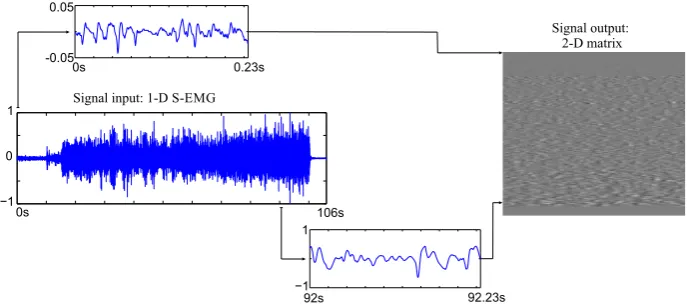
In order to compress SEMG records using image encoders, one of the simplest approaches is to split the one-dimensional input signal into segments, of fixed or vari-able length, and then insert each one into a row or a column of a two-dimensional array. Later, given that the SEMG matrix was suitably assembled, an image compressor shall explore inter and intrasegment dependencies, with its available coding tools. The
com-plete procedure is shown in Fig. 1.
Normally, image compressors used for encoding SEMG signals are based on the
trans-form-quantization-coding paradigm [26, 29]. Indeed, that technique employs transforms
for exploiting intra- and intersegment redundancies, which is followed by data quanti-zation and, finally, entropy coding. In the quantiquanti-zation step, transform coefficients are quantized, which results in a smaller number of bits, and entropy coding provides an
0s
92s −1
1
Signal output: 2-D matrix
Signal input: 1-D S-EMG
0s 106s
−1 0 1
0.05
0.23s .
0 50
-92.23s
even more compact representation, by exploiting statistical dependencies regarding resulting symbols.
Such methods present good performance for natural images [30], which are normally
smooth and then concentrate most of their energy at low frequencies. However, images generated from SEMG signals tend to behave as noise, since their energy is more evenly
distributed throughout the signal frequency range, as can be seen in Fig. 2, which tends
to decrease the performance of two-dimensional encoders. In order to overcome that,
two main approaches can be employed: rearranging the SEMG matrix [26], that is,
adding a additional preprocessing step, with the goal of helping image encoders to bet-ter exploit signal redundancies, or choosing a two-dimensional encoder that does not
expect large low-frequency content or is able to adapt to the input data [30].
Regarding the first approach, some recent studies [26, 29, 32] have proposed
pre-processing techniques, which, in general, attempt to increase correlation among signal segments (columns or rows) or make them more evident, in such a way that two-dimen-sional coding tools can provide good performance. For instance, preprocessing
tech-niques may rely on segment reordering [26, 29], which is based on some metric, length
equalization [33], DC component removal [32], or even some kind of signal
decomposi-tion [34]. Here, two preprocessing techniques will be tackled: the newly proposed SbS,
which splits the input signal adaptively, by altering the number of samples within seg-ments, and the PDS algorithm, which rearranges segments of the input signal, based on their similarities.
The second approach may be implemented through the use of an alternative paradigm
for data compression, known as pattern matching [35, 36], which is easily identified in
the available image literature. The related algorithms can operate in spatial domain, where the input image is divided into blocks that are approximated by patterns avail-able in a dictionary. In summary, those schemes can be developed without assuming any signal behavior and perform encoding in an adaptive way, which is interesting for SEMG compression.
A viable two-dimensional option is the MMP algorithm, which is based on recur-rent pattern matching, uses adaptive dictionaries, and presents competitive results,
for both smooth and nonsmooth images [30]. Besides, MMP has been already used for
compressing ECG signals [15], stereoscopic images [37], speech signals [38], and video
[39], which reinforces its universal behavior. It is worth noticing that MMP also presents
good performance when used for compressing Gaussian signals [30], which, along with
its universal behavior, makes MMP a good option for SEMG image encoding.
This work explores the two mentioned approaches for SEMG signal compression, in order to produce new schemes that are able to better exploit signal redundancies and provide good performance, as explained in the following sections.
The MMP algorithm
The MMP is a data compression algorithm based on recurrent pattern matching, which
was introduced by de Carvalho, da Silva e Finamore [40], in 2002, and has been updated
over the years; its most recent version was named as MMP-II [30]. In the present work,
the most relevant features of MMP are presented, which include its basic operation and main coding techniques.
MMP is an algorithm able to approximate image blocks at a given scale l, using
ele-ments from an adaptive dictionary D. Actually, the latter consists of subdictionaries Dl,
in order to address each scale l. MMP starts by searching, for every block Xl of the input
image, an element Sli, from dictionary Dl , that minimizes the Lagrangian cost function
J, defined by
where D(Xl,Sil) is the sum of squared differences, is a Lagrangian multiplier [41], and
R(Sli) is the rate necessary for encoding the dictionary element.
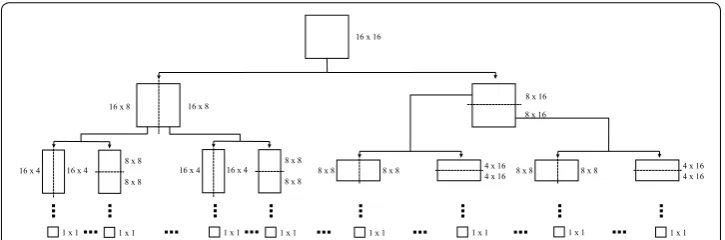
After selecting the element with smallest cost, the original block is segmented across
the vertical and horizontal directions [42], as shown in Fig. 3. The vertical
segmenta-tion generates two new subblocks, Xl−1
0 and X1l−1, each with half size, considering the
original block. Then, the algorithm will look for the elements Sl−1
i0 and Sli1−1, in Dl−1,
that minimize the Lagrangian costs regarding Xl−1
0 and X1l−1, respectively. Subblocks
Xl−2
2 and X3l−2 are generated through the horizontal segmentation and the same
cod-ing procedure is applied. Indeed, the mentioned segmentation procedure is recursively
performed: MMP operates with an initial block size of 16×16, which corresponds to the
highest scale (l=25), and segments down until the lowest possible level (l=1), that is,
blocks of size 1×1. The result of such a procedure is shown in Fig. 3.
(1)
J(Xl)=D(Xl,Sli)+R(Sil),
16 x 16
16 x 8
16 x 8 8 x 16
8 x 16
8 x 8
8 x 8
16 x 4 16 x 4 8 x 8
8 x 8
16 x 4 16 x 4 8 x 8 8 x 8 4 x 164 x 16 8 x 8 8 x 8 4 x 164 x 16
1 x 1
...
1 x 1...
1 x 1...
1 x 1...
1 x 1 1 x 1 1 x 1 1 x 1...
...
...
...
...
...
...
...
...
...
...
Fig. 3 Example regarding the MMP segmentation scheme, for a block of size 16×16, which is repeated until
Given that block dimensions are equal to 2m×2n, with m,n= {0, 1, 2, 3, 4}, and
con-sidering an input block of 16×16, the MMP dictionary is composed by 25
subdiction-aries, at different scales. The relationship between scale and blocks, of size M×N, is
provided by
The next procedure performed by the MMP algorithm is the optimization of the seg-mentation tree, where it analyzes the Lagrangian cost, for each possible partition, and decides whether subblocks, at some scale, are segmented or not. For instance, if the
cod-ing cost of a parent block, at level l, is lower than the overall cost of its two children
blocks, at level l−1, the parent block will not be segmented. The cost function for a
block that is not segmented is defined by
where R(flag) is the rate needed for encoding an element flag, which informs that the
associated block was not segmented. The Lagrangian cost regarding children blocks (subblocks) is defined by
where R(flag) is the rate needed for encoding the segmentation direction.
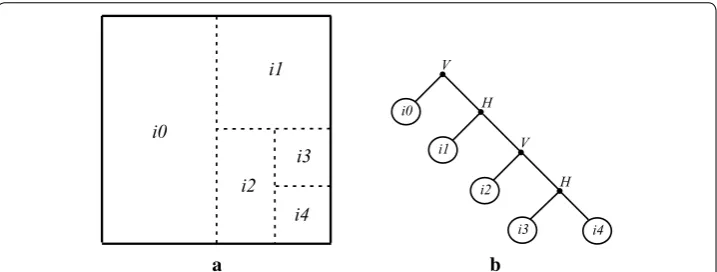
The result of the presented optimization process is the best possible representation, for the original input block, and can be represented by an optimal tree, which is obtained
after pruning the full segmentation one. In the example shown in Fig. 4, every leaf of the
optimal tree corresponds to a nonsegmented block, which was approximated by a single dictionary element, and every node corresponds to a segmented block, which is approxi-mated by the concatenation of two elements available in a given dictionary.
(2)
Scale=
(log2M+1)(log2N+1), ifM=N
(log2M+1)(log
2N+1)+(log2M−1)
�
log2MN�, ifM>N
(log2M+1)(log
2N+1)+(log2N−1)
�
log2MN�+1, ifM<N
(3)
Jns(Xl)=J(Xl)+R(flag),
(4)
Js(Xl)=J(Xjl−1)+J(Xjl+1−1)+R(flag),
i0
i1
i2 i3
i4
i0
i1
i2
i3 i4
V
H
V
H
b a
Combining MMP and predictive coding
Rodrigues et al. [43] presented a new image coding algorithm called MMP-Intra, whose
goal was to improve the performance of the original MMP algorithm, when compressing smooth images. Such an approach employs predictive coding techniques for exploiting spatial correlations, within input images, in the same fashion as done in H.264/MPEG-4
advanced video coding (AVC) [28]. As a result, MMP ultimately encodes residue
sig-nals with highly peaked probability distributions, which favors its block approximation
procedure [30]. The same prediction modes used in the H.264/AVC standard [28] are
adopted by MMP-Intra; however, the DC mode is replaced by the most frequent value
(MFV) [30].
In order to generate residue blocks, MMP-Intra uses previously encoded neighboring
samples for creating prediction blocks PMl , which are then subtracted from the current
block Xl. Such a procedure is modeled by
where PMl is the prediction block, at scale l, and M is the chosen prediction mode for
generating the residue block RlPM.
Each prediction mode has a Lagrangian cost regarding residue reconstruction, which
is given by the coding cost imposed by MMP, according to (3) and (4), and the rate
required to transmit the prediction mode, that is,
The MMP-Intra algorithm employs prediction techniques across the segmentation tree, in a hierarchical way. It tests each available prediction mode for every block, whose scale rages from 25 to 9, in order to find the best possible approximation. Thus, the segmenta-tion procedure can be associated with the predicsegmenta-tion and optimizasegmenta-tion processes.
The final result of that procedure is represented by a segmentation tree, which is then
optimized. In Fig. 5, the original block is vertically segmented and prediction procedures
are performed in both halves, which generates residue blocks through prediction modes
M1 and M2. The right half is also further segmented by MMP, in order to achieve an
optimal representation.
(5)
RlPM =Xl−PMl ,
(6)
JPM(Xl)=J(RlPM)+R(M).
i0
i1
i2
i3
M1 M2
The dictionary update procedure
The dictionary update procedure is one of the most important tasks performed by MMP, given that it is responsible for generating new matching patterns and increasing its rep-resentation power. It can be regarded as an adaptive module and is the main responsible
for the universal behavior of MMP [30].
The MMP dictionary does not require any knowledge of the input signal, although that can be done, in order to improve its coding efficiency. The initial elements, of each
sub-dictionary, are homogeneous blocks obtained within the range [−255, 255], in a
nonu-niform fashion, except for the dictionary at scale 1 (1×1), which includes all possible
values. When a block Xl is segmented, a new dictionary pattern is created, by
concat-enating the dictionary blocks, at scale l−1, used for representing the resulting children
blocks. Indeed, that new element updates every possible scale, through a separable scale
transformation Tls [40].
Every time a new element is added to the multiscale dictionary, a new index is cre-ated and, consequently, the average entropy of existing dictionary indexes increases,
which reduces the MMP coding performance. Rodrigues et al. [30] introduced an
effi-cient redundancy control scheme that limits the dictionary increase, given that a new element is added only if its relative distance, regarding existing blocks, is superior to a given threshold. Therefore, it avoids the creation of new elements that contribute little to coding.
Rodrigues et al. [30] also added geometric transforms and the additive symmetric, to
the dictionary update procedure, rearranged dictionary elements within partitions with different probability contexts, according to the original element scale, and employed a norm-equalization procedure.
The MMP bitstream
In order to encode an optimal tree, the original MMP algorithm represents tree nodes through flags; however, due to the addition of hierarchical prediction techniques, the current tree also contains nodes for identifying segmentation procedures. In summary, a node may be created by hierarchical prediction techniques or provided by the resi-due segmentation process. Accordingly, five different flags should be used for identifying nodes:
• Flag “0” represents a tree leaf, which is followed by a dictionary index; however, if a
prediction mode is sent for this block, it is also followed by a prediction mode flag;
• Flag “1” represents a tree node with vertical segmentation;
• Flag “2” represents a tree node with horizontal segmentation;
• Flag “3” represents a tree with vertical segmentation, through the hierarchical
pre-diction process;
• Flag “4” represents a tree with horizontal segmentation, through the hierarchical
pre-diction process.
the right or lower branch subtree. In the example of Fig. 5, MMP-II would generate the following symbol string:
The generated symbols are then fed to an adaptive arithmetic encoder [30], which use
distinct probabilistic models. In order to code dictionary indexes, the MMP algorithm takes into account the block scale and the element that gave rise to a respective pattern. It is done this way because the adaptive dictionary of MMP, at a given scale, is parti-tioned according to the scale of the block that gave rise to a given pattern.
Optimizing MMP for SEMG signals
In this section, the contributions of the present work to the base MMP algorithm, with the goal of improving compression performance regarding SEMG signals, will be clarified.
In order to use the MMP algorithm for encoding SEMG signals and improve the asso-ciated performance, an adaptation for that kind of signal and an investigation of differ-ent predictive schemes are presdiffer-ented. The new prediction approach is similar to what is
done in the HEVC standard [44], whose goal is to improve the exploitation of intra- and
intersegment correlations.
Adaptation of the current MMP version (MMP‑II)
MMP was developed to work with portable grayscale map images, which present 8 bits per pixel and positive dynamic range. Considering that prediction techniques may pro-duce negative amplitudes, even when derived from grayscale levels, the dictionary is
built with blocks composed by elements within [−X,X]. Besides, images generated from
SEMG signals present a bit depth greater than 8, that is, the necessary dynamic range is different. In order to overcome those problems, MMP was adapted to handle larger dynamic ranges and thus build its dictionary according to that.
The initial dictionary elements are determined nonuniformly, as in the original MMP, but with a slight difference: specifically, the first block is the largest image value
multi-plied by −1; then, the next one is determined by the value of the previous block plus step
p, which is defined according to
As one may notice, the range of intensity values near zero is the most explored, due to the fact that the sample distribution regarding residue signals tends to be clustered around zero.
The MMP redundancy control scheme introduced a minimum distortion value d,
among blocks of a given dictionary scale. Indeed, d must be carefully determined,
because it will influence the resulting coding performance. For example, when it is too
3 0 M1 i0 2 M2 0 i1 2 0 i2 0 i3.
(7)
p=1, if|f(S0li)| ≤10
p=4, if 10<|f(S0li)| ≤22
p=8, if 22<|f(S0li)| ≤86
large, patterns can not be accurately matched, because there will be a lower number of blocks with great variation among them, which is an interesting approach for low rates.
However, for high rates, lower values of d must be used, given that a larger number of
blocks will be added to the multiscale adaptive dictionary, with small variations among them, which then allows a more accurate block matching. As the bitrate is a consequence
of the numerical value chosen for , the function relating and d is defined by
The relation between d and was determined in a heuristic way, in order to optimize
val-ues for d and provide a good dictionary composition, for a given bitrate. In each
experi-mental test, distinct pairs, composed of values for d and , were employed. As a result,
(8) is capable of generating pairs that achieve the best results, for the entire SEMG test
database, in average.
Improved prediction techniques
Intraframe prediction techniques have been successfully used in MMP, given that the related experimental results showed an increase in performance, for smooth and non-smooth images. The main reason behind such an improvement is that prediction tech-niques change the data to be encoded, with the goal of making residue samples present
highly peaked probability distributions, centered around zero [30]. Due to that, the
dic-tionary adaptation procedure was favored, which resulted in a more efficient encoding, regarding rate-distortion figures.
Prediction algorithms basically create an estimation of image blocks, through predic-tion direcpredic-tions, which results in a difference signal that may be encoded at lower rates. Generally, prediction schemes with more prediction directions may lead to better block estimation, as long as the necessary coding rate (increased by new symbols) is compen-sated by the distortion gain.
Based on that, the adoption of more angular predictions, as done in HEVC, is pro-posed in this work. In summary, the new scheme replaces the eight original directional
modes, used in MMP-Intra/MMP-II, by 33 new directional modes, as shown in Fig. 6.
Moreover, while the current MMP approach uses neighboring samples from previously
left, above, and upper-right coded blocks, in order to perform intra prediction [30], the
proposed scheme also includes lower-left coded blocks.
The MMP-II algorithm performs angular predictions based on an extrapolation regarding reconstructed samples, from previously encoded blocks, through a given direction. However, such samples may be obtained, during prediction procedures, from blocks with different scales. In order to optimize this process, two reference vectors are created, during the intra prediction procedure, which are used in all scales. The first ref-erence, called vertical vector, contains all necessary samples to carry out angular modes
(8)
d()=
20, if≤4
40, if 4<≤22
60, if 22<≤50
2 to 17, while the second one, called horizontal vector, contains all necessary samples to carry out angular modes 18 to 34.
In addition to angular predictions, the proposed scheme employs the planar and MFV modes, as nonangular predictions, which are commonly used for smooth regions. The MFV mode uses the most frequent value in the reference vectors, in order to compute a prediction, while the planar mode performs two linear interpolations, one using the horizontal vector and other using the vertical one; the average of those interpolations results is the predicted value.
Typically, some prediction directions may produce similar values, when used for small blocks. Due to that, it is interesting not to use prediction modes for some blocks, with small scales, in order to improve coding performance (entropy coding). Nonetheless, as SEMG images are similar to noise, small variations in prediction data may produce dis-torted representations. Consequently, the proposed scheme adopts the use of all possi-ble angular prediction modes, regarding blocks at scales higher than 3; in the remaining scales, no prediction mode is used. Furthermore, the planar mode is used only in scales 4, 9, 16, and 25, because this mode has similar results regarding the MFV one, for other scales.
Since the same prediction techniques available in HEVC are used in the proposed
scheme, and HEVC employs blocks of size 32×32, it may be worthwhile to investigate
the use of input blocks with the same dimensions. The first consequence is the
inclu-sion of eleven more scales (e.g., 32×16, 16×32, etc.), which would result in a coding
procedure with 35 scales. Indeed, HEVC uses larger blocks, due to the need for han-dling high definition, which normally presents larger smooth areas. However, this is not the case with images generated from SEMG signals, since, as already mentioned, they tend to present a behavior that is still similar to noise, no matter the chosen segment size. As a consequence, matching larger blocks is still difficult, which results in further
18
17 16 15 14 13 12 11 10 9 8
7
7 6 5 4 3 2
19 20 21 22 23 24 25 26 27 28 29 30 31 32 33 34
0: Planar 1: MFV
block partitioning (more segmentation and prediction mode flags) that consequently decreases the expected coding efficiency.
Another important issue regarding the use of larger blocks is the resulting coding complexity. More scales result in more dictionaries and consequently greater number of operations, since the selection of a dictionary element involves a search for the block that causes the lowest distortion. Furthermore, for each block segmentation, prediction is performed for the new children blocks, which involves operations with 33 angular and 2 nonangular prediction modes.
Based on what was presented, one can easily conclude that larger blocks would result in higher computational complexity and, for images generated from SEMG signals, the resulting coding efficiency is expected to decrease. Indeed, such conclusions were con-firmed by experimental results, which were performed during the development of this work. Consequently, the largest scale for encoding SEMG signals remained as 25, that is,
input blocks of 16×16.
The final result of the modifications performed in MMP-II is a new encoder, which is able to quickly adapt to nonsmooth-signal characteristics and has the potential to effi-ciently exploit the similarities present in SEMG images.
Preprocessing techniques
SEMG signals may present nonstationary behavior [45], which means that the initial
segmentation procedure, employed for creating image columns, may produce a two-dimensional signal with low correlation among samples from different segments, or even regarding the same segment.
However, preprocessing techniques can reshape or reorganize signals, in order to increase intra- and intersegment correlations. For instance, reordering signal segments may lead to more homogeneous areas within a SEMG image, which contributes to an increase in intersegment dependencies. In addition, preprocessing techniques can also segment input signals, according to the correlation among neighboring samples, which would directly increase intrasegment dependencies. Therefore, preprocessing tech-niques have the potential to improve the exploitation of signal redundancies, when tak-ing into account image encoders.
The percentage difference sorting algorithm
Since images are generated from one-dimensional SEMG signals, adjacent signal seg-ments may present low correlation, which tends to decrease the performance of image encoders. Nonetheless, each SEMG segment can be treated as an independent unit, which means that segments can be rearranged, in order to increase correlations associ-ated with two-dimensional signals.
Given that, this paper employs a technique that reorders segments based on their
sim-ilarities, known as the PDS algorithm [29], which computes similarities through
(9)
PD(x,m)=
N−1
n=0(x[n] −m[n])
2
N−1 n=0 x2[n]
where PD(x, m) represents the percentage difference regarding x and m segments, x[n]
is the last sorted segment, m[n] is the segment under analysis, and N is the number of
samples in each segment.
The PDS procedure begins by finding the segment with smallest variance, which is inserted into the first column of the SEMG matrix; the next columns are then rear-ranged, according to their percentage difference relative to the last sorted element. An
SEMG image rearranged through PDS is shown in Fig. 7. It is possible to notice that the
new representation presents a more organized texture, whose complexity increases from left to right.
It is worth noticing that when PDS is used, it is necessary to transmit the original seg-ment positions within an SEMG image, in order to rebuild the original one-dimensional signal, during the decoding process.
The adaptive segmentation procedure
As mentioned earlier, in order to compress SEMG signals with image coders, one needs to split the input signal, so that the resulting segments are inserted into matrix columns. However, the way segments are chosen and also the number of samples, in each seg-ment, usually influence the resulting intra- and intersegment dependencies, which may compromise the exploitation of signal correlations.
Another important aspect is the need for transmitting side information. Although reordering techniques have the potential to improve the efficiency of two-dimensional compressors, the requirement of transmitting original segment positions may decrease the obtained coding gains, which arose by better exploiting signal correlations. In other words, the influence of the added side information lies on the need for making the sum between the new compressed-file size (whose original SEMG matrix was rearranged) and the side-information amount lower than the original compressed-file size, for the same quality. Thus, if the amount of side information is high, the achieved coding gains, due to the increase in signal correlations, may not compensate the transmission loss regarding side information, which makes a given preprocessing procedure too expensive.
In this context, if the segmentation procedure is adaptively performed, the need for segment reordering may be reduced. Therefore, the next proposed preprocessing tech-nique seeks the optimal number of samples within a signal segment, in order to improve both intra- and intersegment correlations, which is called segmentation by similarity.
Here, (9) (the same used for the PDS technique) is used to compute similarities
between adjacent segments. The proposed procedure begins with a segment of N
sam-ples, which is used for computing the percentage difference between adjacent segments. Then, the average value, regarding percentage differences among segments, is obtained and stored.
The explained procedure is recursively performed, where the number of samples
within a segment is given by N=16n, with n= {2, 3,. . ., 64}. Then, the segment size N,
employed for creating SEMG images, that provides the lowest average percentage differ-ence value is chosen.
One may notice that such a procedure may encounter difficulties when applied to real-time SEMG compression, due to the need for computing many possible configura-tions. However, if the target SEMG records already exist, an offline encoding is feasible and may lead to good results, given that the proposed technique improves the genera-tion process of two-dimensional SEMG matrices, which produces a representagenera-tion that enhances the exploitation of signal dependencies, without the need for sending addi-tional side information.
The compression architecture
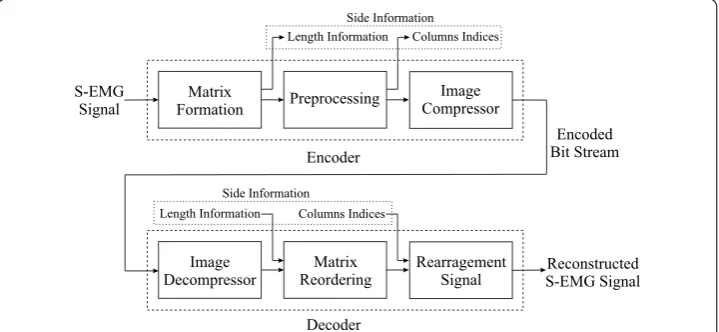
In the proposed methodology, the SEMG encoding is performed in three stages: matrix
formation, preprocessing, and image compressor, as shown in Fig. 8. The matrix
forma-tion stage splits an input one-dimensional SEMG signal, in such a way that a matrix with
K rows and L columns is built and each segment occupies one of its columns. The
num-ber of samples in the input SEMG record is then sent as side information, in order to allow the decoder to correctly reconstruct the original signal. Next, the resulting matrix is preprocessed (e.g., reordering, length equalization, etc.), with the goal of increas-ing signal correlations, which will probably result in a good performance regardincreas-ing the
Preprocessing Matrix
Formation CompressorImage
Encoder S-EMG
Signal
Matrix Reordering Image
Decompressor RearragementSignal
Decoder
Encoded Bit Stream
Reconstructed S-EMG Signal
Length Information Columns Indices Side Information
Length Information Columns Indices Side Information
two-dimensional coding step. Finally, the resulting matrix signal is encoded by an image compressor. At the decoder end, the mentioned steps are just performed in reverse
order, according to what was done during encoding (see Fig. 8).
It is worth noticing that if the PDS algorithm is used, which happens in the preproc-essing step, a segment size is firstly defined in the matrix formation step, in order to gen-erate a square matrix, and a list with original column indexes is created, arithmetically coded, and then added to the file header. Besides, if the SbS technique is employed, the first two stages are performed in only one step, given that the matrix is already created with a column length (and consequently number of rows) adapted to the current signal features. As a result, no further preprocessing is required. Finally, if MMP is employed, no preprocessing is performed.
Although it was developed for SEMG signals, the proposed compression scheme is able to encode other biological signals, by employing different preprocessing techniques and image compressors. Besides, different biological signals may benefit from specific tools for their compression. For instance, ECG signals may be segmented, based on their QRS complexes, and then inserted into matrix rows, through a length equalization
pro-cedure [46].
Database
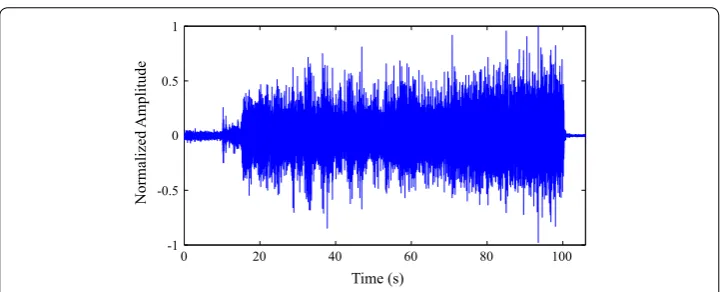
The evaluation of the proposed method was carried out by experiments with real iso-metric and dynamic SEMG signals, acquired in laboratory. A sample SEMG signal,
retrieved from the ones used in the experiments, is shown in Fig. 9.
The isometric records were collected from the biceps brachii muscle of 13 volunteers, during isometric contractions. The volunteers were sat, with their forearm parallel to their torso and sustaining an MVC of 60 %. The resulting signals were sampled at 2000 Hz, quantized with 12 bits, and present durations ranging from 1.3 to 3.0 minutes.
The dynamic records, in turn, were collected from the vastus lateralis of 13 volunteers,
when performing knee-joint controlled exercises in the isokinetic concentric mode [47],
through an isokinetic dynamometer, as described by Schwartz et al. [48, 49]. The
result-ing signals were sampled at 2048 Hz, quantized with 12 bits, bandpass filtered in the range 10–500 Hz, and present durations about 4 min.
0 20 40 60 80 100 -1
-0.5 0 0.5 1
Time (s)
Normalized
Amplitude
Performance metrics
The distortion level of reconstructed signals, after decoding, is measured through the percent root-mean-square difference (PRD) and compression factor (CF) metrics, which are commonly adopted in the related literature. The equations that define the PRD and CF figures are, respectively,
where x[i] is the original signal, xˆ[i] is the reconstructed one, and N is the number of
samples, and
where the Bo is the total number of bits, in the original signal, and Bc is the total
num-ber of bits, in the compressed format. For every SEMG signal used in the performed
experiments, Bo=12n, which represents 12 bits resolution and n samples, for each
signal.
Results and discussion
In this work, the JPEG2000, H.264/AVC (intra mode), HEVC (intra mode), and the pro-posed modified two-dimensional MMP encoders were used in the image compression
block. The JPEG2000 encoder was retrieved from Kakadu software [50] and employs
a quantization step of 0.000025 and 16 bits per sample. The JM 18.2 reference
soft-ware [51] of the H.264/AVC standard was used to encode signals in FRExt High
Pro-file 100, with deblocking filter, rate-distortion optimization, and context-adaptive binary
arithmetic coding enabled. The HM 9.1 reference software [52] of the HEVC encoder
is employed in high efficiency mode, with rate-distortion optimized quantization and deblocking filter enabled. Finally, both SbS and PDS are employed in the preprocessing step, unless MMP is used.
Results for the isometric protocol
Results regarding the mentioned database (13 isometric SEMG signals), which was compressed with the proposed schemes, by employing the modified two-dimensional MMP alone and also combinations between the chosen commercial image encoders (JPEG2000, H.264/AVC, and HEVC) and the presented preprocessing techniques,
are shown in Figs. 10 and 11, along with average values in Table 1. As from now,
each combination will be represented by the following rule: encoder+preprocessing
technique.
The modified two-dimensional MMP achieved PRDs below 7 %, for CFs smaller than
85.4 % (see Fig. 10), which generally does not affect the diagnosis information
con-tained in biological signals [25]. MMP also overcame HEVC, in average, even with the
proposed preprocessing techniques added to the latter, for CFs lower than or equal to
80 % (see Table 1), and all other schemes, for the entire CF range (see Table 1). Although
(10)
PRD=
N−1
i=0 (x[i] − ˆx[i])2
N−1 i=0 x2[i]
×100,
(11)
CF = Bo−Bc Bo ×
MMP and HEVC present similar prediction and input signal segmentation procedures, the fundamental difference is in the residue signal coding step, given that MMP is more successful in approximating noncoarse image blocks, that is, when low CFs are chosen.
Regarding JPEG2000, H.264/AVC, and HEVC, HEVC + SbS provided the best results,
with PRD values below 7 %, for CFs below 85.5 % (see Fig. 11). The use of such an encoder
and PDS produced PRD values below 85.45 %, for CFs below 85.45 %, however, one may notice that the SbS technique resulted in curves that are clustered at lower rates. Indeed, the SbS technique is more suitable to the prediction tools available in HEVC, given that a high overall correlation is obtained and the increased amount of available prediction directions is able to better exploit that feature. Besides, the difference in performance
between PDS and SbS increases with higher CFs (see Fig. 11; Table 1).
JPEG2000 is competitive, however, when it is combined with SbS, there is a decrease in performance, given that the obtained results are worse than the ones provided by
JPEG2000 alone (see Fig. 11; Table 1). Indeed, the SbS technique creates SEMG images
that are difficult to encode, when processed by JPEG2000, mainly due to the shape of resulting homogeneous regions, which does not favor its algorithm (e.g., wavelet
Table 1 Average PRD (%) results for the proposed methodology, regarding isometric sig-nals
Compression factor
75 % 80 % 85 % 90 %
JPEG2000 1.53 2.38 4.05 8.27
JPEG2000 + PDS 1.46 2.26 3.81 7.65
JPEG2000 + SbS 1.88 2.86 4.95 10.09
H.264/AVC 2.93 4.03 5.99 10.21
H.264/AVC + PDS 2.79 3.83 5.73 9.79
H.264/AVC + SbS 2.89 3.95 5.78 9.87
HEVC 1.71 2.33 3.56 6.47
HEVC + PDS 1.67 2.32 3.55 6.49
HEVC + SbS 1.65 2.23 3.38 6.14
Mod. 2-D MMP 1.38 2.13 3.62 7.00
75 80 85 90
0 2 4 6 8 10 12
CF(%)
PRD(%)
Average
decomposition, etc.). Besides, although an advanced coefficient-coding scheme is used in JPEG2000, wavelet transforms generally present high performance for energy con-tent clustered at low frequencies, which is not possible with SEMG images, as already explained.
JPEG2000 achieved PRD values lower than 7 %, for CFs below 84.6 %, when combined with PDS, and the same performance for CFs below 82.9 %, when combined with the
SbS technique (see Fig. 11). The superior performance provided by PDS is again closely
related to the resulting signal shape: there are large and approximately square homoge-neous regions.
H.264/AVC presented the worst results for almost the entire CF range, with or without preprocessing techniques. Indeed, it may seem strange, given that there are some simi-larities with HEVC and what was integrated to the modified version of MMP. Although H.264/AVC, HEVC, and MMP present, in their schemes, input signal segmentation and
75 80 85 90
0 2 4 6 8 10 12 CF(%) ) %( D RP Average
75 80 85 90
0 2 4 6 8 10 12 CF(%) ) %( D RP Average
75 80 85 90
0 2 4 6 8 10 12 14 16 CF(%) ) %( D RP Average
75 80 85 90
0 2 4 6 8 10 12 14 16 18 CF(%) ) %( D RP Average
75 80 85 90
0 2 4 6 8 10 12 14 CF(%) ) %( D RP Average
75 80 85 90
0 2 4 6 8 10 12 14 16 CF(%) ) %( D RP Average a b c d e f
Fig. 11 Performance of the proposed scheme regarding isometric signals, for a PDS and HEVC, b SbS and
prediction steps, H.264/AVC employs more restricted segmentation and prediction schemes, which was of paramount importance to the obtained performance.
H.264/AVC + SbS resulted in PRD values lower than 7 %, for CFs below 80.6 %,
whereas the PDS technique provided such PRD values with CFs below 81 % (see Fig. 11).
The slightly better performance provided by PDS is due to the restricted partitioning scheme provided H.264/AVC, which benefited from the resulting homogeneous regions.
The results obtained with PDS and JPEG2000 reveal an enhanced performance, when compared with the original encoder alone, which is also true for H.264/AVC (see
Table 1). Regarding HEVC, the PDS technique provides enhanced performance for CFs
lower than 90 % (see Table 1), when compared with HEVC alone. Indeed, for high
com-pression factors (≥90 %), the increase in signal correlations did not compensate the
dis-advantage of sending side information.
Based on what was presented and the associated results, one may argue that the SbS technique has the potential to favor compressors that perform a flexible segmentation/ prediction of the input image, as done in HEVC, while PDS is more suitable to
compres-sors that rely on large homogeneous regions. Nonetheless, it is clear that HEVC + SbS
is the best choice for high CFs and the modified MMP is more suitable to low CFs;
how-ever, the JPEG2000 + PDS is still competitive. Indeed, given that JPEG2000 presents
low computational complexity, when compared with HEVC, it may be an interesting approach for low power or restricted devices.
Finally, one can argue that the modified two-dimensional MMP is very competitive and is even able to outperform transform-quantization-coding based approaches, when low CFs are chosen.
Table 2 provides results regarding MMP, H.264/AVC, JPEG2000, HEVC + SbS,
JPEG2000 + PDS, H.264/AVC + PDS, and other schemes present in the available
lit-erature. Some of them employ wavelet transform and a processing step for coding trans-form coefficients.
Table 2 Average PRD (%) results for isometric SEMG signal compression, with different schemes
Compression factor
75 % 80 % 85 % 90 %
Norris et al. [22] 3.8 5 7.8 13
Berger et al. [23] 2.5 3.3 6.5 13
Filho et al. [25] 1.61 2.51 4.13 7.36
Chaffim et al. (JPEG2000) [26] 3.50 4.48 6.92 13.44
Chaffim et al. (H.264/AVC) [26] 5.37 6.90 9.93 16.62
Trabuco et al. [24] 2.22 2.52 3.31 6.88
JPEG2000 1.53 2.38 4.05 8.27
JPEG2000 + PDS 1.46 2.26 3.81 7.65
H.264/AVC 2.93 4.03 5.99 10.21
H.264/AVC + PDS 2.79 3.83 5.73 9.79
HEVC + SbS 1.65 2.23 3.38 6.14
The one proposed by Norris, Englehart, and Lovely [22] encodes wavelet transform coefficients through the EZW algorithm, which exploits correlations between subbands and encodes coefficients according to their order of importance. The scheme proposed
by Berger et al. [23] quantizes transform coefficients through a Kohonen layer, in order
to determine the coefficient bit allocation. Likewise, Trabuco, Costa, and de Oliveira
Nascimento [24] use a dynamic bit allocation scheme based on mathematical models
for spectral shapes, where one is the rotated hyperbolic tangent. A scheme similar to
what is proposed here was developed by Chaffim et al. [26] and employs a
preprocess-ing technique called correlation sortpreprocess-ing, which is combined with the H.264/AVC and JPEG2000 encoders. Actually, their main differences lie on the developed preprocessing
techniques and encoder configurations. Finally, Filho et al. [25] proposes a
one-dimen-sional approach of MMP, which uses an adaptive dictionary that is updated by concat-enations, expansions and contractions of previously encoded blocks.
The test signals used in the other evaluated methods present similar acquisition proto-cols, regarding what was employed in the present work. Besides, almost all signals were acquired during isometric contractions of the biceps brachii muscle, with 2 kHz samples per second and 12-bit resolution, except for the one presented by Trabuco et al. which uses 16-bit resolution. As a result, such facts indicate that the performance comparison performed here is valid and, regarding Trabuco et al., at least a rough analysis may be carried out.
The proposed modified two-dimensional MMP achieved the best performance for CFs of 75 and 80 %, overcoming transform-quantization-coding schemes with wavelets and DCT, and also a one-dimensional version of MMP. Indeed, the latter was already expected, since the proposed modified two-dimensional MMP encoder has a lot of addi-tional tools, such as prediction techniques, norm-equalization procedure, and diction-ary-redundancy control, and is more successful in exploiting intra- and intersegment
correlations. In that same low-CF range, JPEG2000 + PDS overcame the
one-dimen-sional MMP and HEVC + SbS presented competitive results.
Regarding CFs of 85 and 90 %, the proposed schemes provided competitive results,
however, even HEVC + SbS was outperformed, at a CF of 85 %, by the method
pro-posed by Trabuco, Costa, and de Oliveira Nascimento [24]. The main reason is that the
redundancy exploitation regarding transform coefficients, by the dynamic bit allocation employed in the latter, was more effective. Particularly, the mathematical quantization model of that method approximates the spectral shape of the signal, which, for that CR, was more efficient than the adaptive dictionary of the proposed MMP version.
Finally, the performance of JPEG2000 and H.264/AVC, with and without the proposed
preprocessing techniques, overcame the method proposed by Chaffim et al. [26], which
uses the same encoders, but with different preprocessing techniques. Indeed, it seems that even the conversion from one-dimensional SEMG records to SEMG images and the basic compression framework, presented here, were more carefully performed and are somehow superior, or the chosen image encoders were not properly configured.
Moreo-ver, it is important to note that the results achieved by HEVC + SbS were superior to all
In order to illustrate the quality of reconstructed isometric SEMG signals, after com-pression processes with MMP, original and reconstructed signal segments are shown in
Fig. 12, as well as the associated error signal. As one can notice, the visual differences
between the original and reconstructed signals are not meaningful, that is, the error-signal energy is low. Thus, in that case, it can be stated that the spatial domain approach performed by the proposed MMP algorithm has the potential to preserve the input sig-nal waveform and, consequently, its clinical information.
The same conclusions presented in the last paragraph can be used for Fig. 13, whose
reconstructed and error signals are related to the proposed image encoders and preproc-essing techniques, with the same input signal and CF. Moreover, as the performance of each association between preprocessing technique and encoder is different, the resulting error signals are also distinct, although they present a scale that is ten times smaller.
Results for the dynamic protocol
Results regarding the dynamic database (13 dynamic SEMG signals), concerning the
proposed image encoders and preprocessing techniques, are shown in Figs. 14 and 15,
along with average values in Table 3.
Firstly, PRD figures lower than 7 % are only achieved for CFs lower than 75 %, as
shown in Figs. 14 and 15. Besides, there are no large differences between the proposed
preprocessing techniques, except for some records compressed with JPEG2000.
77 77.2 77.4 77.6 77.8 78 -1
-0.5 0 0.5 1
Time (s)
de
zil
a
mr
o
N
ed
util
p
m
A
77 77.2 77.4 77.6 77.8 78 -1
-0.5 0 0.5 1
Time (s)
de
zil
a
mr
o
N
ed
util
p
m
A
77 77.2 77.4 77.6 77.8 78 -0.1
-0.05 0 0.05 0.1
Time (s)
de
zil
a
mr
o
N
ed
util
p
m
A
a
b
c
Fig. 12 Compression result for a segment from one of the test isometric SEMG signals, at a CF of 87.3 %: a
The following discussion refers to Table 3. At a first glance, it is clear that the modified two-dimensional MMP is not as successful as in the isometric scenario. MMP overcame H.264/AVC for high CFs (85 and 90 %) and HEVC for a CF of 75 %, even when they
77 77.2 77.4 77.6 77.8 78 -1 -0.5 0 0.5 1 Time (s) de zil a mr o N ed util p m A
77 77.2 77.4 77.6 77.8 78 -0.1 -0.05 0 0.05 0.1 Time (s) de zil a mr o N ed util p m A
77 77.2 77.4 77.6 77.8 78 -1
-0.5 0 0.5 1
Time (s)
ed util p m Ad ezil a mro
N -0.177 77.2 77.4 77.6 77.8 78
-0.05 0 0.05 0.1 Time (s) ed util p m A dez ila mro N
77 77.2 77.4 77.6 77.8 78 -1 -0.5 0 0.5 1 Time (s) ed util p m A dez ila mro
N -0.177 77.2 77.4 77.6 77.8 78
-0.05 0 0.05 0.1 Time (s) ed util p m A dez ila mro N
77 77.2 77.4 77.6 77.8 78 -1 -0.5 0 0.5 1 Time (s) ed util p m A dez ila mro
N -0.177 77.2 77.4 77.6 77.8 78
-0.05 0 0.05 0.1 Time (s) ed util p m A dez ila mro N
77 77.2 77.4 77.6 77.8 78 -1 -0.5 0 0.5 1 Time (s) ed util p m A dez ila mro
N -0.177 77.2 77.4 77.6 77.8 78
-0.05 0 0.05 0.1 Time (s) ed util p m A dez ila mro N
77 77.2 77.4 77.6 77.8 78 -1 -0.5 0 0.5 1 Time (s) ed util p m A dez ila mro
N -0.177 77.2 77.4 77.6 77.8 78
-0.05 0 0.05 0.1 Time (s) ed util p m A dez ila mro N a b c d e f g h i j k l
Fig. 13 Compression result for a segment from one of the test isometric SEMG signals, at a CF of 87.3 %:
a signal reconstruction with SbS + HEVC, and b error signal, c signal reconstruction with PDS + HEVC and
d error signal, e signal reconstruction with SbS + H.264/AVC and f error signal, g signal reconstruction with
PDS + H.264/AVC, and h error signal, i signal reconstruction with SbS + JPEG2000, and j error signal, and
used preprocessing techniques, and the base H.264/AVC, for the entire test CF range. Regarding the base HEVC algorithm, MMP is competitive and even provides better per-formance for CFs of 75, 85, and 90 %, but it is outperformed when preprocessing tech-niques are employed, at CFs of 80, 85 and 90 %.
With respect to JPEG2000, H.264/AVC, and HEVC, H.264/AVC + PDS provided the
best results for CFs of 75 and 80 %, while HEVC + PDS overcame all other options for
CFs of 85 and 90 %, as can be seen in Table 3. It seems that the relatively high-peaks
existent in dynamic signals are better handled by H.264/AVC, since there are fewer pre-diction directions, which require fewer bits to be encoded, and PRD results tend to be reduced (since it is a relative measure), due to high sample values (peaks). As already happened, during the previous simulations, the performance of HEVC, in relation to H.264/AVC, tends to improve with higher CFs. The performance difference between the proposed preprocessing techniques was much smaller, when compared with what was
Table 3 Average PRD (%) results for the proposed methodology, regarding dynamic sig-nals
Compression factor
75 % 80 % 85 % 90 %
JPEG2000 4.997 7.326 10.357 13.769
JPEG2000 + PDS 4.743 6.834 9.927 13.025
JPEG2000 + SbS 4.996 7.312 10.314 13.552
H.264/AVC 4.510 6.564 9.630 13.486
H.264/AVC + PDS 4.256 6.214 9.236 13.056
H.264/AVC + SbS 4.270 6.262 9.194 13.043
HEVC 4.784 6.410 9.220 12.871
HEVC + PDS 4.707 6.248 8.909 12.603
HEVC + SbS 4.709 6.233 8.929 12.605
Mod. 2-D MMP 4.296 6.474 9.069 12.788
75 80 85 90
0 5 10 15 20 25
CF(%)
PRD(%)
Average
obtained in the isometric scenario. In summary, the proposed schemes provided good results, even when JPEG2000 is combined with SbS, which had not happened during simulations with isometric signals.
JPEG2000 is not as competitive as in the isometric scenario and, in the present case,
the combination with SbS presented a slight performance increase (see Fig. 15; Table 3).
As in the previous scenario, the best results were obtained with the PDS technique. It is
worth noticing that JPEG2000 + PDS outperformed H.264/AVC, even with
preprocess-ing techniques, for a CF of 90 %, as shown in Table 3.
H.264/AVC presented the its best performance with PDS, for CFs of 75, 85, and 90 %, whereas, for a CF of 80 %, the combination with SbS produced the best result. Besides,
its performance degrades for high CFs (see Fig. 15), in comparison with the other
schemes.
75 80 85 90
0 5 10 15 20 25 CF(%) ) %( D RP Average
75 80 85 90
0 5 10 15 20 25 CF(%) ) %( D RP Average
75 80 85 90
0 5 10 15 20 25 CF(%) ) %( D RP Average
75 80 85 90
0 5 10 15 20 25 CF(%) ) %( D RP Average
75 80 85 90
0 5 10 15 20 25 CF(%) ) %( D RP Average
75 80 85 90
0 5 10 15 20 25 CF(%) ) %( D RP Average a b c d e f
Fig. 15 Performance of the proposed scheme regarding dynamic signals, for, a PDS and HEVC, b SbS and
HEVC provided competitive results, mainly for CFs greater than 80 %; however, at low CFs, it was overcome by H.264/AVC. This is an interesting result, given what was obtained with isometric signals.
As a general comment, preprocessed dynamic SEMG matrices are not as homogene-ous as isometric ones, which is closely related to the original signals. Indeed, in dynamic contractions, there may be variations in speed, strength, and joint angle, which modify the signal behavior during tests. As a consequence, even the SbS technique is not able to create a high-correlated arrangement, as in the isometric case, which has an impact on the flexible prediction scheme of HEVC. In addition, this same behavior compromises the convergence of the adaptive dictionary module in MMP.
Differently from the previous simulations, no combination with preprocessing tech-nique presented decrease in performance, when compared with the respective base algorithm. It indicates that representations created with the proposed preprocessing techniques present high correlation and compensate the additional side information. Finally, both SbS and PDS have the potential to favor the adopted compressors.
Table 4 presents a brief comparison among the proposed compression methodology
and some schemes available in the literature. The ones proposed by Norris et al. [22],
Berger et al. [23], and Chaffim et al. [26] employ the same algorithms used for
isomet-ric signals; however, Trabuco et al. [24] used a dynamic bit allocation scheme, based on
decreasing square-root spectral shapes, for encoding transform coefficients.
It is important to notice that the dynamic signals used by the other schemes were
obtained with different acquisition protocols. Berger et al. [23] and Trabuco et al. [24]
used records acquired from the vastus lateralis of individuals riding a cycling simulator,
as also done by Chaffim et al. [26], which included signals from the vastus medialis, and
Norris et al. [22] employed signals representing cyclic contractions of biceps, while the
signals used here were obtained from the vastus lateralis muscle, when individuals were using an isokinetic dynamometer. During the test phase, some records acquired with a cycling-based protocol were retrieved and compared with the ones used here and, after
Table 4 Average PRD (%) results for dynamic SEMG signal compression, with different schemes
Compression factor
75 % 80 % 85 % 90 %
Norris et al. [22] 7.93 9.06 10.02 19.98
Berger et al. [23] 2.70 4.41 7.52 20.10
Chaffim et al. (JPEG2000) [26] – 4.39 5.77 9.39
Chaffim et al. (H.264/AVC) [26] 4.13 5.16 7.12 11.30
Trabuco et al. [24] 4.70 5.41 6.40 8.22
JPEG2000 + PDS 4.743 6.834 9.927 13.025
H.264/AVC + PDS 4.256 6.214 9.236 13.056
H.264/AVC + SbS 4.270 6.262 9.194 13.043
HEVC + PDS 4.707 6.248 8.909 12.603
HEVC + SbS 4.709 6.233 8.929 12.605
a brief analysis, the main conclusion was that the latter present greater challenges to the proposed compressors.
Keeping in mind what was discussed in the last paragraph, the proposed schemes
out-performed the ones presented by Norris et al. [22] and Berger et al. [23], for entire test
range and only for a CF of 90 %, respectively. Regarding the methods presented by
Chaf-fim et al. [26], the proposed ones are competitive, at low CFs. For a CF of 75 %, the best
result was provided by the method presented by Berger et al. [23], while the JPEG2000
version introduced by Chaffim et al. [26] overcame all others for CFs of 80 and 85 % and
Trabuco et al. [24] provided the best result for a CF of 90 %.
In order to illustrate the quality of reconstructed dynamic SEMG signals, after com-pression processes with the proposed schemes, as already done for isometric records,
reconstructed signal segments and the associated error are shown in Figs. 16 and 17, as
well as the original portion, in Fig. 16. The proposed methodology was employed with a
CF of 87.3 %, as already done for the isometric scenario. Once again, differences between original and reconstructed signals are small and the same conclusions presented for the isometric scenario apply here.
Conclusions
This paper presents three main contributions: a two-dimensional approach based on the MMP algorithm, a new preprocessing technique called SbS, and SEMG compression results with HEVC. The MMP algorithm was adapted to work with SEMG signals and its prediction framework was replaced by an approach similar to what is used in HEVC.
158.3 158.5 158.7 158.8
-1 -0.5 0 0.5 1
Time (s)
de
zil
a
mr
o
N
ed
util
p
m
A
158.3 158.5 158.7 158.8
-1 -0.5 0 0.5 1
Time (s)
de
zil
a
mr
o
N
ed
util
p
m
A
158.3 158.5 158.7 158.8
-0.1 -0.05 0 0.05 0.1
Time (s)
de
zil
a
mr
o
N
ed
util
p
m
A
a
b
c
Fig. 16 Compression result for a segment from one of the test dynamic SEMG signals, at a CF of 87.3 %: a
The proposed architecture employed three off-the-shell image compressors: JPEG2000, H.264/AVC, and HEVC, with and without the SbS and PDS preprocessing techniques.
In experiments carried out with real isometric SEMG signals, with the goal of evalu-ating the proposed methodology, the SbS technique was able to improve the exploita-tion of the intra- and intersegment dependencies of HEVC and H.264/AVC (intraframe mode), while PDS improved the performance of all chosen encoders. Furthermore, the proposed modified two-dimensional MMP algorithm presented good results and out-performed state-of-the-art methods present in the literature, for low compression fac-tors, whereas HEVC combined with SbS achieved good results for high compression
158.3 158.5 158.7 158.8 -1 -0.5 0 0.5 1 Time (s) ed util p m A de zil a mr o
N -0.1158.3 158.5 158.7 158.8
-0.05 0 0.05 0.1 Time (s) ed util p m A de zil a mr o N
158.3 158.5 158.7 158.8 -1 -0.5 0 0.5 1 Time (s) ed util p m A de zil a mr o
N -0.1158.3 158.5 158.7 158.8
-0.05 0 0.05 0.1 Time (s) ed util p m A de zil a mr o N
158.3 158.5 158.7 158.8 -1 -0.5 0 0.5 1 Time (s) ed util p m A de zil a mr o
N -0.1158.3 158.5 158.7 158.8
-0.05 0 0.05 0.1 Time (s) ed util p m A de zil a mr o N
158.3 158.5 158.7 158.8 -1 -0.5 0 0.5 1 Time (s) ed util p m A de zil a mr o
N -0.1158.3 158.5 158.7 158.8
-0.05 0 0.05 0.1 Time (s) ed util p m A de zil a mr o N
158.3 158.5 158.7 158.8 -1 -0.5 0 0.5 1 Time (s) ed util p m A de zil a mr o
N -0.1158.3 158.5 158.7 158.8
-0.05 0 0.05 0.1 Time (s) ed util p m A de zil a mr o N
158.3 158.5 158.7 158.8 -1 -0.5 0 0.5 1 Time (s) ed util p m A de zil a mr o
N -0.1158.3 158.5 158.7 158.8
-0.05 0 0.05 0.1 Time (s) ed util p m A de zil a mr o N a b c d e f g h i j k l
Fig. 17 Compression result for a segment from one of the test dynamic SEMG signals, at a CF of 87.3 %: a
signal reconstruction with SbS + HEVC and b error signal, c signal reconstruction with PDS + HEVC and d
error signal, e signal reconstruction with SbS + H.264/AVC and f error signal, g signal reconstruction with
PDS + H.264/AVC and h error signal, i signal reconstruction with SbS + JPEG2000 and j error signal, and k