Manasova G. S., Zelinsky A. A., Didenkul N. V., Artemenko V. V., Makshayeva E. T. Revisited the relationship between vitamin D level and receptors of BsmI- gene polymorphism with the pathogenetic mechanisms of placental dysfunction development . Journal of Education, Health and Sport. 2018;8(3):465-475. eISSN 2391-8306. DOI http://dx.doi.org/10.5281/zenodo.1208109
http://ojs.ukw.edu.pl/index.php/johs/article/view/5388
The journal has had 7 points in Ministry of Science and Higher Education parametric evaluation. Part B item 1223 (26.01.2017). 1223 Journal of Education, Health and Sport eISSN 2391-8306 7
© The Authors 2018;
This article is published with open access at Licensee Open Journal Systems of Kazimierz Wielki University in Bydgoszcz, Poland
Open Access. This article is distributed under the terms of the Creative Commons Attribution Noncommercial License which perm its any noncommercial use, distribution, and reproduction in any medium, provided the original author(s) and source are credited. This is an open access article licensed under the terms of the Creative Commons Attribution Non Commercial License (http://creativecommons.org/licenses/by-nc/4.0/) which permits unrestricted, non commercial use, distribution and reproduction in any medium, provided the work is properly cited. This is an open access article licensed under the terms of the Creative Commons Attribution Non Commercial License (http://creativecommons.org/licenses/by-nc/4.0/) which permits unrestricted, non commercial
use, distribution and reproduction in any medium, provided the work is properly cited. The authors declare that there is no conflict of interests regarding the publication of this paper.
Received: 01.03.2018. Revised: 10.03.2018. Accepted: 23.03.2018.
REVISITED THE RELATIONSHIP BETWEEN VITAMIN D LEVEL AND
RECEPTORS OF BSMI- GENE POLYMORPHISM WITH THE PATHOGENETIC
MECHANISMS OF PLACENTAL DYSFUNCTION DEVELOPMENT
G. S. Manasova, A. A. Zelinsky, N. V. Didenkul, V. V. Artemenko, E. T. Makshayeva
Odessa National Medical University, Ukraine
Abstract
The role of the calcitriol / vitamin D receptor (VD) endocrine system and the pleiotropic effects of this system in the pathogenetic mechanisms of various diseases development, in particular complications of pregnancy, has attracted researches’ increasing attention in recent years.
The aim of the work: to compare the VD-status and frequency of occurrence of
polymorphism of the VDR gene (BsmI (A> G, rs1544410) in patients with a physiological course of the gestation process and in patients with placental dysfunction (PD).
Materials and methods. 56 pregnant women with PD (the main group) and 40
patients with a physiological pregnancy (control group) were examined.
VD status was determined by ELISA at level 25 (OH) D in serum, the frequency of BsmI polymorphism of the VDR gene (rs1544410) by polymerase chain reaction (PCR).
Results. The average index of VD (31.40 ± 8.6) ng / ml in patients with PD is
significantly lower than in patients with physiological pregnancy (43.54 ± 11.20) ng / ml, (p ≤ 0.05 ).
(р ≤ 0.01) cases, respectively to groups. Heterozygous combination of A / G alleles was noted in 68% of patients with PD and in 36.10% of the control group patients. In pregnant women with BsmI polymorphism of calcitriol gene (genotype A / G) PD was 3.7 times more frequent (68% vs 36.10% : RR = 2.1, CI 1.0-6.6, OR = 3.7, CI 1.1-13.1).
Conclusions. Vitamin D insufficiency or deficiency can be one of the reasons of PD
formation. In carriers of BsmIgene’s polymorphism encoding VD receptor with genotype A / G, the course of pregnancy is complicated by placental dysfunction 3.7 times more often than in women without this polymorphism.
Key words: vitamin D, polymorphism of VDR gene, placental dysfunction.
Introduction. Recent years studies have shown that the endocrine system of vitamin
D (VD) / vitamin D receptors (VDR) and the extra-skeletal pleiotropic effects of this system have an important role in the women’s reproductive function. The effect on reproductive function is due to the presence of VDR in endometrial cells, myometrium, ovarian tissue, in the vascular endothelium, in trophoblast cells and in placenta [2, 3, 4].
Calcitriol’s main way of action is the genomic mechanism. Calcitriol-activated VDRs related to the family of nuclear steroids create (RXR) heterodimer with nuclear retinoid X-receptors, which, in its turn, binds to DNA elements and modulates the transcription of certain genes [5, 7, 12]. In addition, there is an extra-genomic, rapid pathway of calcitriolinfluence, when the latter binds to VD receptors of cytoplasmic membrane caveols and triggers one or more signaling cascades, including activation of protein kinase C, mitogen-activated protein kinases, phospholipases A2 and phospholipases C [5, 12].
The prevalence of VDR in cells and organs of the reproductive system served as the basis for carrying out studies of the VDR gene polymorphism in patients with pathological course of the gestational process [8, 9].
It is known that changes in the nucleotide sequence of DNA that occur in a population with a frequency of more than 1% are considered genetic polymorphism. VDR is encoded by a gene located in chromosome 12q12-14 [6]. Currently, there are four known single nucleotide polymorphisms (SNP-singlenucleotidepolymorphism) of VDR gene. Two of them are in exons - FokI (C> T, rs10735810) and TaqI (T> C, rs731236), the others are located in the last intron - BsmI (A> G, rs1544410) and ApaI (A> C, rs7975232) [3, 6.9].
Materials and methods. 56 pregnant women with PD (primary, group I) and 40 patients with a physiological course of pregnancy (control group, group II) were examined.
The average age of patients in the main group was 29.21 ± 4.3 years, in the control group - 30.35 ± 3.12 years (t = 1.53, p> 0.05).
Anthropometric data on the patients under examination showed signs of homogeneity of groups: body mass index (BMI) in patients of the main group corresponded to (22.2 ± 1.7) conventional units (cu), and in the control group - (22.8 ± 1.93) у.е ., (t = 0.7, p> 0.05).
In the main group 71.43% of the patients were primiparous, in the control group – 55.00%; (p <0.05), multiply (2nd and 3rd genera) - 28.57% and 45.00%, respectively, to groups (p <0.05).
It was found that 21.43% of the main group patients had a history of infertility about 2-4 years, whereas in the control group this indicator was 10%, which is 2.1 times less (F = 0.049, p <0.05 , χ2 = 2.19, p> 0.05). In addition, 28.57% of the women in the primary group and 2.50% in the control group reported miscarriage, (F = 0.0008; p <0.05; χ2 = 10.88; p <0.01).
In 26.79% and in 5.00% of pregnant women of the main and control groups, cervical cancer was diagnosed, (F = 0.0003, p <0.05, χ 2 = 7.6, p <0.01). Also, 10.71% of the patients in the main group had uterine fibroids, in the control group there were no such patients, (F = 0.002; p <0.05; χ2 = 4.57; p <0.05).
All pregnant women have undergone general clinical examination, stipulated by the order of the Ministry of Health of Ukrainedated July 15, 2011, N 417 "On the organization of outpatient obstetric and gynecological care in Ukraine." Patients from the risk group for the implementation of intrauterine infection were examined in accordance with the order of the Ministry of Health of Ukraine dated December 27, 2006, N 906 "Perinatal infections" All the patients gave informed consent for the surveys.
To assess the functional state of the feto-placental complex, an ultrasound examination was used to assess the fetometric data of the intrauterine fetus and the Doppler blood flow assessment in accordance with the pregnancy schedule indicated in the clinical protocols and / or according to the indications. The cardiotocography (CTG), biophysical profile of the fetus, and the actographic tests were evaluated.
Fisher’s scale.
The status of vitamin D was determined by enzyme immunoassay (ELISA) method at level 25 (OH) D in serum, which is the main circulating metabolite of VD and can be quantified.
Polymerase chain reaction (PCR) with real-time detection of the results and analysis of melting curves was used to evaluate the frequency of BsmI polymorphism of VDR gene (rs1544410). DNA was isolated using a set of reagents "probe-Rapid Genetics", ("technology", Russia). For PCR diagnostics a detection of inhibitor DT-96, (LLC "NPO DNA-Technology", Russia) was used.
Blood sampling from the ulnar vein for special studies was performed on an empty stomach: for EIA - in mono-light, for genotyping - in vacuum tubes Vacuette by 4 ml with the addition of anticoagulant (disodium salt - ethylene diamine-tetraacetate - EDTA).
Verification of perinatal infection was carried out by ELISA and PCR. In the detection of specific immunoglobulins (Ig) in the blood of pregnant women in a diagnostically significant titer, a second study of "paired sera" was conducted to determine the avidity and affinity of antibodies.
All special studies on the definition of vitamin D-status were carried out in the diagnosis of PD in the 2nd and 3rd trimester of pregnancy, which was the basis for the isolation of groups I-A and I-B: 22 patients (39.29%) of the main group (group I-A ) were examined in the 2nd trimester of pregnancy, 34 patients (60.71%) - in the 3rd trimester (group I-B).
Statistical processing of the data obtained was carried out with the help of Biostat 6.0. Results and discussion.
The course of pregnancy in the examined women was characterized by some features. Thus, the proportion of patients who had recurred ARI during pregnancy in the main group was 30.36% compared to 7.5% of the control group, (F = 0.0004; p <0.05; χ 2 = 7.39; p <0.01).
Pregnancy was complicated by gestational anemia in 50.00% of women in the PD group and only 10% in those without violations of PD, (F = 0.00001 p <0.05, χ 2 = 12.19 p <0.01) .
The threat of miscarriage in patients with PD was diagnosed 7.5 times more often than in the control group: 75.00% vs. 10.00%, (F = 0.0001, p <0.05, χ 2 = 39, 50; p <0.01). In addition, in 14.29% of women with PD, the course of pregnancy was complicated by preeclampsia, in the control group the cases of preeclampsia were not noted, (F = 0.0007; p <0.05; χ 2 = 6.23; p <0.05).
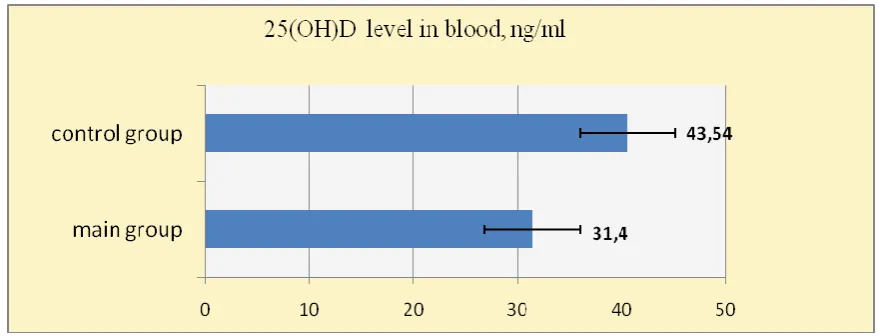
When assessing VD status of the patients, it was established that the mean level of blood VD in patients with PD was significantly lower (31.40 ± 8.6) ng / ml than in the patients with physiological pregnancy (43.54 ± 11,20) ng / ml, (p ≤ 0.05), (Figure 1).
[image:5.595.77.517.317.485.2].
Fig. 1. Vitamin D-status in women with a physiological course of the gestation process and in pregnant women with placental dysfunction.
In accordance with the guidelines for the treatment and prevention of VD deficiency for the population of central Europe, (Pludovsky P., Povoroznyuk V., et al., 2013), serum VD levels below 20 ng / ml indicate a deficiency of the latter, 20-30 ng / ml - about suboptimal status, which requires its daily dose increase. For adequate or optimal VD status, its content should be above 30-ng / ml.
According to our data, the average level of vitamin D in a group of patients with PD corresponds to a suboptimal status, which, probably, may not be sufficient to adequately support the mother's body and the growing intrauterine fetus.
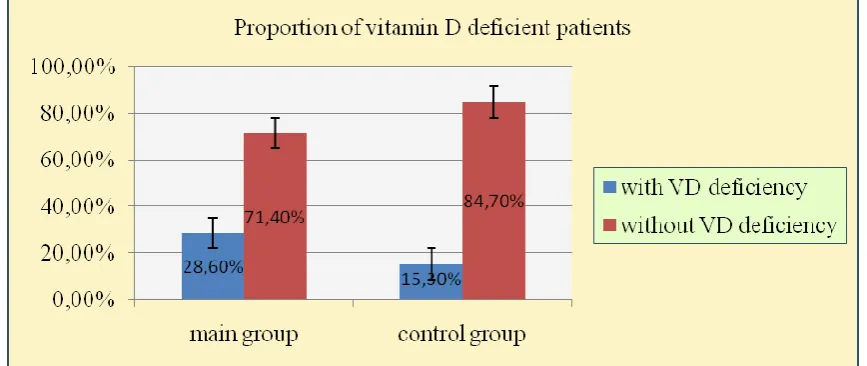
third patient (28.60%), which was 1.9 times more than in the group of women with physiological pregnancy, where there were only 15.30% , (RR = 1.42, CI95% -1.08-1.87, p ≤ 0.05), (Figure 2).
Fig. 2. Proportion of patients with vitamin D deficiency status in the group of pregnant women with PD and with the physiological course of pregnancy.
Taking into consideration the data of literature on the pleiotropic effects of vitamin D, in particular its role in regulating angiogenesis [13], invasion of trophoblast [14], implantation [15], it can be assumed that the suboptimal level of calcitriol in the blood of pregnant women does not adequately respond to the needs of a pregnant woman and can lead to an imbalance in adaptation-compensatory mechanisms aimed at the formation and functional formation of the utero-placental-fetal circle of the circulation.
In support of this assumption, data on the interaction of the calcitriol with the L-arginine-nitric oxide bioregulatory system, which in its turn plays one of the leading roles in the formation of endothelial dysfunction and in the genesis of the formation of various pathologies in the microcirculatory bed [16, 17, 18]. In this situation the utero-placental-fetal circle of blood circulation can be a target for the realization of the negative consequences of vitamin D deficiency.
When assessing the frequency of different genotypes and alleles of the BsmI polymorphism (rs1544410) of VD receptor gene, the following data were obtained in the patients of the groups under examination.
suggested that this variant of the genotype did not exert any influence on the formation of PD dysfunction.
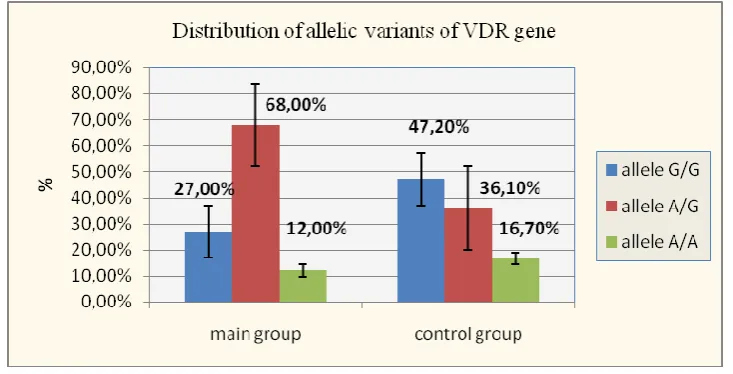
In abnormal pregnancy patients, homozygous carriage with GG-allele was observed in 20% of cases, which is 2.4 times less than in the group of patients without placental dysfunction, where this index was 47.20% (p ≤ 0.01).
Heterozygous combination of A / G alleles was noted in 68% of PD pregnant women, and in the group of healthy pregnant women it was 36.10% (p <0.01, CI 95%), (Fig. 3).
Fig. 3. Distribution of allelic variants of VDR gene in accordance with BsmI polymorphism in PD patients and in pregnant women with physiological pregnancy.
The data obtained allow to suggest that VDR gene polymorphism in the heterozygous variant of allele A / G, which is characteristic of 68% of the patients in the main group, ma y be a significant factor in complicating the gestational process by PD, whereas the homozygous combination of the G / G allele revealed in a half (47.20 %) of healthy pregnant women, can have a certain protective effect. The prevalence of the allelic combination of A / A in the groups did not have significant differences.
In pregnant women with BsmI polymorphism of gene encoding vitamin D receptor, in the presence of the A / G genotype, PD was observed 3.7 times more often (68% vs 36.10%: RR = 2.1, CI95% - 1.0-6, 6, OC = 3.7, CI 1.1-13.1), which may indicate a significant contribution of this variant of allelic genes to the development of PD.
The risk of a possible complication of pregnancy by PD in pregnant with A / G allelic VDR genes is 4 times higher than in patients with other variants of genotypes.
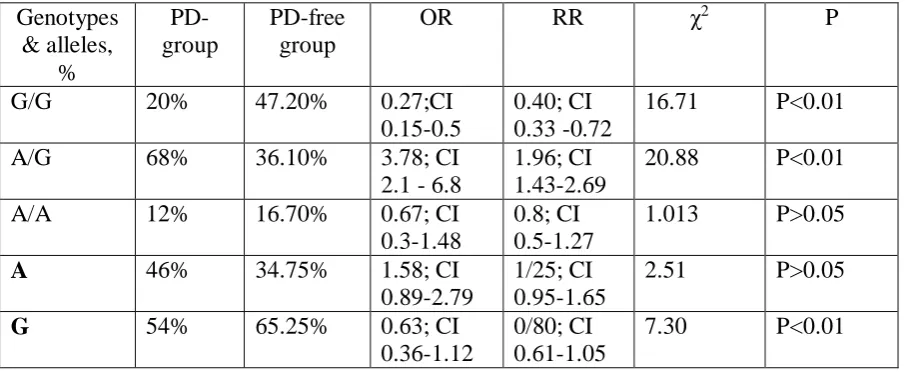
[image:7.595.115.482.236.423.2]formation of PD allowed to determine the odds ratio (OR, J. Cornfield, 1951) and to assess the degree of dependence of the revealed disorders with the patient's genotype (Table 1).
Table 1 The frequency of genotypes and alleles of BsmI polymorphism of the vitamin D receptor
gene inpregnant women with PD and in healthy pregnant women
Genotypes & alleles, % PD- group PD-free group
OR RR χ2 P
G/G 20% 47.20% 0.27;CI
0.15-0.5
0.40; CI 0.33 -0.72
16.71 P<0.01
A/G 68% 36.10% 3.78; CI
2.1 - 6.8
1.96; CI 1.43-2.69
20.88 P<0.01
A/A 12% 16.70% 0.67; CI
0.3-1.48
0.8; CI 0.5-1.27
1.013 P>0.05
A 46% 34.75% 1.58; CI
0.89-2.79
1/25; CI 0.95-1.65
2.51 P>0.05
G 54% 65.25% 0.63; CI
0.36-1.12
0/80; CI 0.61-1.05
7.30 P<0.01
It has been established that there is a direct relationship between the average force between placental dysfunction and the genotype of A / G calcitriol’sreceptors at 95% DIL, (RR = 1.96, CI 1.43-2.69, OR = 3.8, CI 2.1-6 , 8, χ2 = 20.88, p <0.01).
The revealed feedback of the mean force between this genotype and placental dysfunction (OR = 0.27, CI 0.15-0.5, RR = 0.40, CI 0.33-0, 72; χ2 = 16,716; p <0.01) testifies in favor of the protective value of the genotype G / G.
The risk of PD development in patients with the G / G genotype is significantly less (less than 1-0.27, 95% CI). In the group of pregnant women with a physiological course of gestation there are 47.20% of such women, while in the main group they are only 20%.
The frequency of allele A in the group of patients with PD was 46%, in the group of healthy pregnant women - 34.75%, (p> 0.05); and the allele G, respectively, 54% and 65.25%, (p <0.01), which also suggests the protective value of the G allele.
The Pearson criterion index (G / G-χ2 = 16.71, A / G-χ2 = 20.88) confirms the existence of significant differences between the frequencies of distribution of A / G genotypes in G / G in the compared groups and the dependence of PD incidence on BsmI polymorphism of the gene encoding the vitamin D receptor is statistically significant: patients with the A / G genotype can be attributed to the risk group for the development of PD.
occurrence of polymorphism of VD receptor gene (BsmI (A> G, rs1544410) in patients with a physiological course of the gestation process and in patients with PDallows for the number of conclusions.
In pregnancy, complicated by PD, the level of vitamin D (25 (OH) D) in the blood serum is significantly lower than in pregnant women with a physiological course of the gestational process (31.4 ng / ml versus 43.5 ng / ml, (p <0 , 05).
The proportion of patients with VD deficiency and suboptimal vitamin D level in the blood in the group of women with PD is 1.86 times more than in the group with a physiological pregnancy (28.5% VS 15.3%, RR = 1.42; CI 95%).
In carriers of BsmI polymorphism of the gene encoding VD receptor, in the presence of the genotype A / G, pregnancy is complicated by PD 3.6 times more often than in this polymorphism-free women.
The risk of formation of PD is minimal (OR = 0.27) in homozygous women with genotype G / G of VD receptor, which can, with a high probability, attest to the protective role of this genotype and the absence of predisposition to complicating pregnancy with impaired PD.
The data obtained indicate the necessity for further studies to determine the importance of vitamin D status during the gestational process and the formation of various complications of pregnancy.
References
1. Aghajafari F. Association between maternal serum 25-hydroxy vitamin D level and pregnancy and neonatal outcomes: systematic review and meta-analysis of observational studies. / Aghajafari F., Nagulesapillai T., Ronksley P.E. // BMJ. - 2013. – Vol. 346.- P. 1 - 14.
2. Barrera D. Calcitriol affects hСG gene transcription in cultured human syncytiotrophoblasts. / D. Barrera //Reprod. Biol. Endocrinol. – 2008. – Vol. 6,№ 3. – P. 1 – 8.
3. Javorskia I. N. Vitamin D receptor (VDR) polymorphisms are associated to spontaneous preterm birth and maternal aspects / I. N.Javorskiab et al. //Gene Volume. – 2017. – Vol. 642. – P. 58 – 63.
5. Haussler M.R. Vitamin D receptor: Molecular signaling and actions of nutritional ligands in disease prevention. / M. R. Haussler et al. // Nutr. Rev. – 2008. – Vol. 66. – P. 98 – 112.
6. Labuda M. Two hereditary defects related to vitamin D metabolism map to the same region of human chromosome 12q13–14. / M. Labuda et al. // J. Bone Miner. Res. – 1992. – Vol. 7. – 1447–1453
7. Haussler M.R. Vitamin D receptor (VDR)-mediated actions of 1α, 25 (OH) vitamin D: genomic and non-genomic mechanisms. / M.R. haussler, P.W. Jurutka, M. Mizwicki, A.W. Norman. // Best Pract. Res. Clin. Endocrinol.Metab. – 2011. – Vol.25. 4. – P.543 -559
8. Manzon L. Vitamin D receptor polymorphism FokI is associated with spontaneous idiopathic preterm birth in an Israeli population. / L. Manzon, et al. // Eur. J. Obstet. Gynecol. – 2014. – Vol. 177. – P. 84–88.
9. Reini F. Epigenetics in alternative pre-mRNA splicing. / F. Reini et al. // Cell. – 2011. – Vol. 144, № 1. – P. 16 – 26.
10. Shahrokhi S. Z.Role of vitamin D in female reproduction. / S.Z. Shahrokhi,F.Ghaffari, F. Kazerouni. // ClinChimActa. – 2016. – Vol. 455. – P. 33 – 38.
11. Norman A.W. Molecular tools for study of genomic and rapid signal transduction responses initiated by 1 alpha,25(OH2)-vitamin D3. / A.W. Norman et al. // Steroids. – 2002. – Vol. 67. – P. 457–466.
12. Shin, J.S. Vitamin D effects on pregnancy and the placenta / J.S. Shin, M. Y. Choi, M. S. Longtine, D.M. Nelson. // Placenta. – 2010. – Vol. 31. – P. 1027–1034.
13. Brosens I. A. The role of the spiral arteries in thepathogenesis of preeclampsia / I. A. Brosens, W. B. Robertson, H. G. Dixon // Obstetrics & Gynecology Annual. – 1972. – Vol.1. – P. 177-191.
14. Chan S.Y. Vitamin D promotes human extravilloustrophoblastinvasion in vitro / S.Y. Chan, R. Susarla // Placenta. – 2015. – Vol. 36, № 4. –Р. 403-409.
15. Evans K.N. Vitamin D and placental decidual function / K.N. Evans, J.N.Bulmer, M.D. Kilby, M. Hewison // J SocGynecolInvestig. – 2004. – Vol. 11. – P. 263-271.
17. Molinari C. 1α,25-Dihydroxycholecalciferol induces nitric oxide production in cultured endothelial cells / C. Molinari, F.Uberti, E. Grossini, G. Vacca, S. Carda, M. Invernizzi, C. Cisari // Cell. Physiol. Biochem. ─ 2011. ─ Vol. 27. ─ P. 661–668.