Copyright © 2016 (John Sinclair). Licensed under the Creative Commons Attribution Non-commercial No Derivatives (by-nc-nd). Available at http://ijoc.org.
Advertising and Media in the Age of the Algorithm
JOHN SINCLAIR
University of Melbourne, Australia
This article examines the disruption that the global advertising industry is undergoing as it struggles to adapt to the extraordinary opportunities for marketing over the Internet and still maintain its former hold over “legacy” media. The “fresh” global media players, particularly Google, have risen quickly to claim unprecedented influence over the flows of advertising revenue that are the lifeblood of the media, obliging advertising agencies to compete in the new digital space that Internet advertising has opened. However, U.S.-based new media companies are having to deal with strong local competitors in major developing markets, at the same time as they face social criticism and regulatory intervention for their practices in exploiting users for marketing purposes in their more established markets.
Keywords: search advertising, behavioral targeting, social networking, Google, Facebook
The 21st century is experiencing a fundamental transition in social communication paradigms, most often simplistically characterized as a shift from “mass” to “social” media. This article examines the disruption that the advertising industry is undergoing as it struggles to adapt to the extraordinary opportunities that are now afforded for marketing over the Internet, and still maintain its former hold over traditional media, notably television and print. The advertising industry has long enjoyed power in all of those markets in which the commercial model of media provision has triumphed. The article also reviews the strains in the formerly comfortable relationship between advertisers, agencies, and media provoked by the rise of search advertising in particular and the domination of it by Google. However, the Internet has opened a new competitive digital space requiring specialized technocommercial expertise in the placement of advertisements, and this is becoming an entire new area of advertising practice now embraced by global agencies. Both the agencies and the new media alike are implicated in the issues around privacy, security, and surveillance raised by the algorithmic targeting of users for marketing purposes, and they face social criticism and regulatory intervention in their more established markets. Meanwhile, in major developing markets, notably China, U.S.-based new media companies are having to deal with strong local competitors, but for the present, it is evident that Google dominates all of its competitors on a global basis.
Advertisers, Agencies, and the “New Media”
In the major national markets in which the commercial model of media provision applies, the relatively comfortable relationship that has existed between advertisers, agencies, and media throughout the golden age of mass media in decades past—in which the media would offer content that could attract audiences so as to sell access to those audiences to advertisers via the agencies—is a “business model” that has been put under severe pressure by the advent of the Internet. Commerce as we have known it has been transformed by the Internet, which is a new transactional space in which emergent new business models are competing strongly for hegemony. In this environment, not only is there a realignment taking place within the assemblage of interests we can think of as the “manufacturing/marketing/media complex,” but the very meaning of “advertising” as we have known it is in flux. Fresh global media players have changed the very rules of the game.
Functionally, we can think of advertising as just the most visible and public dimension of a much broader but still quite familiar set of practices intent on harnessing our ways of life to commercial purposes: marketing. Marketing practitioners and textbooks now tend to conceive of advertising in the context of what they like to call “integrated marketing communications.” This may sound like just industry hype, but it does express how advertising is now linked strategically to other dimensions of marketing and to other forms of promotion (Belch & Belch, 2014). So, the advent of the Internet has transformed the meaning of advertising media, although we still need to distinguish between the “old” (sometimes called “legacy”) advertising media of television, radio, newspapers and magazines, cinema, and outdoor, and the “new” advertising medium of the Internet, for a number of reasons. First, traditional media advertising still counts audiences by looking at how many people watched a television program or bought a newspaper or magazine, and then assumes on the basis of those figures that those viewers or readers have seen the advertising content. Each of us knows from our own behavior toward media advertising that that is not a valid assumption. Digital advertising, however, counts audiences on the basis of how many people have clicked on an ad, indicative of at least some minimal engagement. This interactive response affordance of digital advertising, and the data about users it can yield, is immensely attractive to advertisers.
Second, whereas the old media deliver a sales message to a prospective consumer, that message has to motivate the consumer to respond at a later time and in a different place: For instance, having seen a television commercial (TVC), the consumer has to go to a store to buy the product, if the message’s “call to action” is to fulfill its purpose. With the Internet, the consumer can respond to an advertising message then and there, such as clicking to add the product to a virtual “shopping cart” and paying online with a credit card. The point is not just that the Internet eliminates delay and distance in such consumption transactions, condensing time and space, or even that it combines the functions of both advertising medium and retail store, but that it is an interactive medium that has established itself as a site of transaction in its own right.
organization, as well as being a force for globalization in national media and consumer markets. Most of the advertisers, the clients that agencies serve, are the owners of globally familiar brand names. Historically, these are companies that grew from local to national scale, mainly in the United States and Western European countries, and then became what were called the “multinational” or “transnational” corporations of the 1960s and 1970s, and are known as “global” corporations today. On the other hand, contemporary marketing and media platforms have allowed certain other brands to achieve global reach in a matter of decades (Frith & Mueller, 2003, p. 1). The most striking phenomenon in recent times has been the relatively sudden rise of information and communication technology corporations, so that we now find Apple, Google, Microsoft, and IBM edging out veterans such as Coca-Cola and McDonald’s in benchmark annual surveys of the “most valuable” global brands (“2015 BrandZ Top 100,” 2015).
Google and Search Advertising
Although it already seems like Google has long been familiar to us, it deserves to be considered a fresh global media player. From its humble beginnings in a California garage in 1998, Google became a public company in 2004, scarcely 12 years ago. This may be a long time in the history of information and communication technology development, yet in that decade, Google has transformed advertising as we had formerly known it. Google has attained its position as one of the world’s most valuable brands precisely because of its dominance of advertising on the Internet, not the kind of creative advertising familiar to us from TVCs and splashed throughout the pages of newspapers and magazines. Rather, Google is the market leader by far in search advertising, a distinctive new model of advertising that capitalizes on search behavior as an intrinsic and elemental form of interaction on the Internet, as well as on the Internet’s unique affordance of hyperlinking from one site to another. Search is a fundamental function that everyone needs to use the Internet, for which we go to the services on offer from the main search engines, principally Google, Bing, and Yahoo! (“Top 15 Most Popular Search Engines,” 2015). The search engine’s basic business model rests on its ability to offer and sell advertising, but not on any platform other than its own. Instead of attracting an audience with the offer of information or entertainment content, as with traditional media, search engines attract users to the service itself and match search queries to ads. In both cases, the audiences or users collected are then “sold” to advertisers, but in distinct ways. In particular, traditional media depend on large advertisers, which place their advertising via an advertising agency. Yet, on one hand, search advertising has in principle diminished the need for any intermediary, such as an advertising agency, at the same time as it has enabled the rapid rise to power of Google, by far the most successful search engine in the field.
For example, in the United Kingdom, more than 55% of the ₤3.46 billion (US$5.3 billion) spent on all forms of Internet advertising in the first half of 2014 was on search, with display at 30% and classifieds at 14% (Internet Advertising Bureau [IAB] UK, 2014). Proportionally, it was rather less in the United States: 39% for search versus 28% for display and 10% for “other” (e.g., classifieds), of a much greater total expenditure of US$23 billion. Classified advertising was formerly seen as the “rivers of gold,” buoying up the wealth of the press, and online classified advertising is one of the few areas in which the legacy print media have been able to adapt to the Internet, but this kind of advertising is clearly behind the revenues generated by the new digital forms. Indeed, legacy media’s ventures into online advertising in general have not been competitive with the new media players, particularly Google.
Although Google is interested in expanding its display advertising activities, especially with video, search remains its core business, or as a Google executive put it, “Search is still the most monetizable moment on the web” (Sinclair, 2012, p. 60). And increasingly, as seems apparent, the mobile-accessed Internet has additional attractions to advertisers beyond home computer access, notably location-based advertising. Indeed, mobile advertising has emerged as the new competitive front. It has become the fastest-growing platform in the United States, where in 2014, it accounted for 23% of digital advertising spending, comparable to 20% in the United Kingdom (IAB US, 2014). In the United Kingdom, the Internet had already overtaken television advertising expenditure by 2009 (Sinclair, 2012), and a 2013 PricewaterhouseCoopers report attributed growth in mobile advertising as the cause of Internet advertising expenditure overtaking that of network (free-to-air) television in the United States (“Digital Advertising Hits,” 2014). Total digital advertising in the United States is predicted to overtake total television advertising spending (network plus cable) in 2017; as of 2016, more than 63% of digital advertising expenditure is already being spent on mobile (“Digital Ad Spending,” 2016).
Google’s AdWords system sells the advertising space that appears next to the results it provides when someone searches for a keyword. Advertisers must bid for their position in the list next to any given keyword, with “pay-per-click” being the basic unit of measurement charged to the advertiser if the searcher shows interest by clicking through to its website. This system is attractive to advertisers because it puts the buying of advertising on a performance basis, increases the calculability of return on investment, and gives their advertising global reach. Yet, although Google does attract large advertisers such as AT&T and Amazon, a leaked Google document with U.S. data from 2010 showed that the 10 biggest advertisers accounted for only 5% of Google’s revenue at that time (Learmonth, 2010), which would validate Spurgeon’s (2008) “long tail” analysis that “the tail of the demand curve can be cumulatively more valuable to advertisers than the head” (p. 27)—and more valuable to Google.
Amazon.com, with other Internet-era businesses in the top 10 such as Expedia, Experian, and the for-profit University of Phoenix (Peterson, 2014, September 15). This is a significant trend that not only has implications for the sidelining of the agencies, but also suggests that advertisers are now more diverse than in the era of mass media, some of them new media themselves.
Advertising’s “Third Major Line of Business”
Advertising agencies have met the rise of search advertising by developing their specialized Internet or digital divisions that advise advertisers on Internet strategies and buy Internet advertising on their behalf. From the advertising agencies’ point of view, the search companies’ practices on the Internet are blurring the boundaries between advertising agency and advertising medium, and potentially usurping the agencies’ media-buying function, squeezing them out of their traditional role, or “disintermediating” them. Agencies also have been acquiring technical companies specializing in digital advertising, for blurring also has tended to take place in the area of gaining control over the best proprietary software tools for advertising placement, measurement, and management; in this respect, it is not just about Google. Rather, it was Publicis Groupe, the Paris-based global marketing communications holding group, that initiated a rush of acquisitions in this crucial strategic area with its takeover of a U.S. online marketing specialist company, Digitas, in December 2006, with the aim of extending Digitas’ expertise worldwide (Pfanner, 2006). Publicis Groupe includes the major media-buying agency networks Starcom Mediavest and ZenithOptimedia and such creative networks as Leo Burnett and Saatchi & Saatchi.
The most significant move to follow was in May 2007 when the WPP Group bought 24/7 Real Media, a search optimization and online ad delivery network. WPP is the world’s largest global agency group, UK based, with international media-buying agencies such as Mindshare and creative networks such as Young & Rubicam under its umbrella, and serving global clients of the stature of Ford, Unilever, and HSBC. WPP’s CEO, Sir Martin Sorrell, had dubbed Google a “frienemy” just a few months before, and the 24/7 Real Media purchase was therefore interpreted at the time more as a preemptive strike against Google than as an attempt to match Publicis’ move with Digitas. Revealingly, Sorrell declared that, based on the new acquisition, WPP was entering “a third major line of business” beyond the traditional media buying and creative functions, that is, in what he called the “online technology space” (Story, 2007, para. 6).
thus challenging the agencies on their own turf. Google also has performed such agency services as tailoring online campaigns for Ford and other clients in the United States (“Google Gets ‘Creative,’” 2009).
Note that the agencies have been on the front foot in their struggle to occupy the new specialized technical areas that the Internet has opened in this third major line of business, that is, the generation, placement, distribution, measurement, and general management of online advertisements, as well as research and analysis and trading in ad inventory. These activities now populate a new digital space between the agencies and the Internet, and form a third area of commercial service provision for the agencies, the first two being historically the placement and then the creation of advertisements. Buying advertising space, selling it on to advertiser clients, and placing advertisements for them composed the original business model of the advertising agency. Only in subsequent decades did agencies begin to offer creative services. The paradox that gives rise to the “frienemy” or “sleeping with the enemy” metaphors is that while taking on Google on its own turf, WPP media-buying agencies remain major customers of Google. Indeed, one source suggests that WPP may have become Google’s biggest single customer, spending US$2 billion with Google in 2011 (Steel & Wembridge, 2012). At least as far as its involvement in Internet advertising is concerned, WPP needs Google much more than Google needs WPP.
Most recently, a digital ecosystem has been forming in the new business space. On one hand, the “publisher” (website owner) has a supply-side platform, that is, an ad server that interfaces with an online advertising network or exchange (such as DoubleClick), which in turn interfaces with a demand-side platform on the advertiser side. This system allows advertisers to put online advertising before a selected, individualized target audience, as will be outlined below (IAB US, 2016). Furthermore, by automating media sales, planning, and buying in such ways, there is considerable impact on human resource skills in the advertising industry, exacerbated by the extension of technological management into the advertising inventory of traditional media. Ever since the Internet was opened to advertising in the mid-1990s, the various public Internet portals and other website owners, as well as social media sites in more recent years, have sought to commercially exploit their relation to the new kind of audience that the Internet had brought into being. Marketing strategists have largely come to reject indiscriminate “cookie bombing” (Tso, 2012) in favor of “behavioral targeting.” In the course of everyday Internet use, users offer, both knowingly and unknowingly, information about themselves. Whereas in television’s golden age the ratings system yielded only a broad demographic breakdown of the anonymous mass audience, the Internet age is distinguished by unobtrusive electronic means of following users’ online tracks as the basis for personalizing commercial messages to individuals. Just as viewers pay the true price of “free” television in terms of the time spent watching TVCs and the hidden costs of advertising passed on to them when they pay to consume goods and services, the true price of using Internet services such as Google or Facebook is in how users, in using them, necessarily give over information about themselves that the services are able to monetize. In both cases, the illusion of something for nothing overshadows the implicit transaction.
ads in accordance with information that users, able to generate their own content, have included in their profile. These wildly popular social media sites are unprecedented vehicles for expressive individualism, personal opinion, and peer interaction, encouraging users to “share” the details of their lives with their “friends.” Some theorists argue that, because freely chosen online behaviors are monitored to collect information that then can be used to sell goods and services, this is “immaterial labor,” a form of work in which individuals produce themselves as economically valuable resources for advertisers. This informational environment positions each person as an “entrepreneurial self” (Arvidsson, 2006, pp. 132– 133). Thus, at the same time as the users are busily differentiating themselves, they are permitting others “to capture and exploit the information they generate in so doing” (Andrejevic, 2009, p. 32). This is what has been called the “empowerment–exploitation paradox” (Sinclair, 2012, p. 81) of social media.
The Age of the Algorithm
Although the search engine and social media site owners claim that such information cannot be traced back to any individual user, occasional public gaffes about their data management do nothing to alleviate concerns about privacy and surveillance or about their opaque practices of data collection, storage, and ownership (Angwin, 2012). This is not the place to pursue the issue of privacy as such, which has now become a matter of national policies, as governments seek appropriate ways to regulate the Internet against outright deceptive practices. More to the point here is that individual users can be targeted by marketers, although not necessarily as individuals. This is where algorithms come in, that is,
predictive audience models [able to discern] the particular pattern in user profiles and user transactions that are most indicative of a positive response to the ads. The model building process is a mathematically sophisticated deduction process based on large quantities of data. (Shao, 2011, para. 5)
This in turn raises the contemporary issue of “big data,” although as one industry insider avers,
the current fashion around “big data” is a misnomer. Data has been “big” all along. What has changed now is not just scale and cross-channel inputs, but the sheer speed and accessibility of data as it moves to the cloud and becomes present on any device anywhere. Making data actionable in real time and at the point of critical need or decision-making is where data is not just big, but enormously effective. (Smith, 2012, para. 1)
transaction is completed by the time the user’s page has finished loading, complete with the ad of the winning bidder (Marshall, 2014). As one industry insider sums it up,
The industry has come a long way from mediocre technology that gets the job done to building complex optimization algorithms that operate in milliseconds, turning data into predictive targeting and bid pricing. This level of complexity creates a more sophisticated approach to media buying. With today's computing power, brands can leverage the full scale of digital media data, statistically analyzing different variables such as time, location, page contents, recency, frequency, and velocity of user interactions. This impacts both performance and the understanding of a consumer’s decision process. (Shao, 2011, para. 6)
Social Networking and Advertising
With the immense rise to popularity of social media over the past decade and vast improvements in display technology, online display advertising has undergone much of the same blurring of the traditional line between editorial content and advertising that was already happening in the mass media, such as with “advertorials” and product placement (Couldry & Turow, 2014; Sinclair, 2012), but once again, the Internet can facilitate this in a more individually targeted manner. In particular, there is the rise of “native advertising,” the placement of paid advertising that is integrated with the look and feel of the website on which it appears, which the user can choose to view in the normal course of their browsing of the website. Examples are suggested posts on Facebook or promoted tweets on Twitter. Many traditional publishers are doing it—the BBC calls it “partnered content”—but native advertising as a strategic business model has motivated a host of sites that target certain demographics or interests, such as the U.S.-based youth-oriented “social news” site BuzzFeed, with its custom content. BuzzFeed works with brand advertisers to create “shareable” stories, videos, and other content that users will want to circulate to their social media peers (“Custom Content Worth Sharing,” 2014). Such sites offer the hope to advertisers of their content “going viral” among millions of users.
respectively. Nevertheless, it is striking that Facebook’s profitability is far less than what we might expect from its prominence in global popular culture.
That is also true of Twitter. Another fresh player, founded in 2006, Twitter describes itself as “a global platform for public self-expression and conversation in real time.” It began offering advertising under its sponsored tweets scheme in 2010, attracting advertisers of the caliber of Red Bull, Starbucks, and Virgin (Lee, 2010). However, as of 2013 when it made its initial public offering, Twitter was still unprofitable (Demos & Dieterich, 2013). Nevertheless, Twitter’s reach is extraordinary, claiming to reach more than a billion users each month, and it counts 271 million “average monthly active users.” Advertising income has been growing much faster than user numbers, as Twitter has made active efforts to provide global services for advertisers such as geotargeting. As of mid-2014, although still unprofitable, a third of its advertising income was coming from outside the United States, and significantly, more than 80% came from mobile (“Twitter Reports,” 2014). As we have seen, mobile advertising is the fastest-growing sector of advertising expenditure in the United States and United Kingdom, and this also is becoming the case internationally. Clearly, both Facebook and Twitter have positioned themselves well to take advantage of this trend, and they enjoy strong public profiles in the social media landscape, but for the present at least, Google is still the major financial beneficiary of the age of the algorithm.
Online video display is another fast-growing form of advertising enabled by the advent of the Internet, and Google has secured a preeminent position in that field via its ownership of YouTube (“Google Buys,” 2006). The video-sharing site had started up as yet another fresh player in 2005, and was acquired by Google the following year. Once again, YouTube’s popularity is far out of proportion to the advertising revenue it is believed to generate. By 2013, YouTube was claiming a billion worldwide visitors each month, greater than Facebook’s reach, and boasting, “If YouTube were a country, we’d be the third largest in the world after China and India” (“YouTube Launches,” 2013, para. 20). In addition to its sale of the familiar “preroll” advertisements seen on its more popular clips, YouTube offers some subscription channels, positioning itself to compete with Netflix, Hulu, and Amazon in the booming subscription video-on-demand field. YouTube does not publish financial information, but its market value is estimated to be greater than that of Netflix (Spangler, 2014).
Beyond the “Anglosphere”
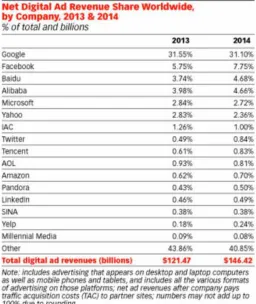
Fourth place in Table 1 is another Chinese company, Alibaba, but that is an e-commerce group whose collection of online companies does not compare with the U.S.-based search or social media. Fifth and sixth are Microsoft and Yahoo!. After U.S. media and Internet company IAC, only a decimal place separates Twitter from yet another Chinese corporation in the world league, Tencent, which has a mix of online companies, including social media. The comparative figures give a sense of competitive scale: Google has 31.10% of global ad revenue, and Facebook’s share is 7.75%; Baidu and Alibaba have less than 3%; Microsoft and Yahoo! have less than 2%; and Twitter has less than 1% (Peterson, 2014, December 15). Regarding mobile advertising in particular, eMarketer predicts strong growth for Facebook, Baidu, and Alibaba, but clearly, both Facebook and the Chinese market leaders have a long way to go before they could rival Google’s dominance of the digital advertising world.
Table 1. Net Digital Ad Revenue Share Worldwide, 2013 & 2014.
Conclusion
Nick Couldry and Joseph Turow (2014) have summed up how the new digital advertising technologies have enabled the current paradigm shift from old to new media. Advertisers and their agencies, they say,
are moving away from the traditional approach of using specific media environments (particular newspapers, magazines, or television shows) to reach target audiences that congregate there. Instead, ad practitioners home in on desirable individual consumers with technologies that reach those people at optimal times in optimal locations with advertising messages and, increasingly, publishing environments tailored to fit information about those consumers. (p. 1710)
Their concern is with what they see as the fragmentation of the civic sphere, in that “traditional content producing companies” (old media) have less “leverage” in attracting advertising, which they see as a kind of subsidy that has supported public culture. That is, we are seeing the end of an era in which the manufacturers of consumer goods, from cars to washing powder, and the providers of commercial services, such as banking or retailing, have subtended the provision of the most commonly accessed means of social communication in modern nations, notably print media and television. Without overstating the rate or extent of the transition to a new media era, there is a fragmentation of the public sphere going on as a result of the proliferation of sources of news and entertainment and the unprecedented affordances of peer-to-peer communication. Most significant in the context of this article, there is the personalization of markets, that is, the ability of advertisers to target prospective consumers in accordance not only with broad demographic criteria but also with the tracks of their personal interests, and even their physical mobility in real time. Thus, there are privacy and Internet security issues at stake as well as the role of communication in democratic societies. These are important questions, but not our concern here. Rather, this article has shown how the advertising industry has been transformed by the Internet and the fresh global media players that dominate it, as well as how the functions of advertising agencies have been augmented by sophisticated technocommercial expertise in placing and measuring online advertising as a third major line of business.
successful media forms, whether old or new, are those that are capable of assembling, or disassembling, as required, the prospective consumers that advertisers will pay to reach.
References
2015 BrandZ top 100 global brands. (2015). Retrieved from
http://www.millwardbrown.com/BrandZ/2015/Global/2015_BrandZ_Top100_Report.pdf
Ackerman, E. (2008). Google completes online-ad merger. Silicon Valley. Retrieved from http://www.siliconvalley.com/ci_8542803
Alexa. (2015). Orkut.com. Retrieved from http://www.alexa.com/siteinfo/orkut.com
Andrejevic, M. (2009). The twenty-first-century telescreen. In G. Turner & J. Tay (Eds.), Television studies after TV (pp. 31–40). London, UK: Routledge.
Angwin, J. (2012, July 11). Google to pay $22m in privacy fines. The Australian, p. 22.
Arvidsson, A. (2006). Brands: Meaning and value in media culture. London, UK: Routledge.
Belch, G., & Belch, M. (2014). Advertising and promotion: An integrated marketing communications perspective (10th ed.). New York, NY: McGraw-Hill.
Couldry, N., & Turow, J. (2014). Advertising, big data, and the clearance of the public realm: Marketers’ new approaches to the content subsidy. International Journal of Communication, 8, 1710–1726.
Custom content worth sharing. (2014). Retrieved from http://www.buzzfeed.com/advertise
Demos, T., & Dieterich, C. (2013, November 9–10). Relief and riches as Twitter takes off. The Weekend Australian, p. 27.
Digital ad spending to surpass TV next year. (2016, March 8). Retrieved from
http://www.emarketer.com/Article/Digital-Ad-Spending-Surpass-TV-Next-Year/1013671
Digital advertising hits $43B. (2014). Retrieved from http://venturebeat.com/2014/04/10/digital-advertising-hits-43b-passing-broadcast-tv-for-the-first-time-ever/
Doctor, K. (2014, February 3). Our open-ended deal with a social network demon. The Australian, p. 10.
Forrest, C. (2014, June 9). How big of a threat is Facebook’s ad play to Google? TechRepublic. Retrieved from http://www.techrepublic.com/article/how-big-of-a-threat-is-facebooks-ad-play-to-google/
Frith, K. T., & Mueller, B. (2003). Advertising and societies: Global issues. New York, NY: Peter Lang.
Google buys YouTube for $1.65 billion. (2006, September 10). NBC News.com. Retrieved from http://www.nbcnews.com/id/15196982/ns/business-us_business/t/google-buys-youtube-billion/#.UbECrBG9KSM
Google gets “creative.” (2009, October 8). WARC News. Retrieved from
http://www.warc.com/LatestNews/News/ArchiveNews.news?ID=25781
Internet Advertising Bureau UK. (2014). 2014 H1 digital adspend results. Retrieved from http://www.iabuk.net/research/library/2014-h1-digital-adspend-results
Internet Advertising Bureau US. (2014). IAB Internet advertising revenue report, first six months results 2014. Retrieved from http://www.iab.net/media/file/PwC_IAB_Webinar_Presentation_HY2014.pdf
Internet Advertising Bureau US. (2016). Advertising ecosystem. Retrieved from http://www.iab.net/data/ecosystem.html
Keane, J. (2015, June). Why Google is a political matter. The Monthly. Retrieved from
http://www.themonthly.com.au/issue/2015/june/1433080800/john-keane/why-google-political-matter
Learmonth, M. (2010, September 6). 'What big brands are spending on Google.' Advertising Age. Retrieved from http://adage.com/article/digital/big-brands-spending-google/145720/
Lee, E. (2010, November 1). Twitter begins publishing ads in users’ streams. Advertising Age. Retrieved from http://adage.com/article/digital/twitter-releases-ads-timelines-starbucks-virgin/146822/
Marshall, J. (2014, February 17). WTF is real-time bidding? Digiday. Retrieved from http://digiday.com/platforms/what-is-real-time-bidding/
Patel, K. (2011, September 8). Google buys Zagat: It’s all about local. Advertising Age. Retrieved from http://adage.com/article/digital/google-buys-zagat-local/229676/
Peterson, T. (2014, September 15). Amazon tops list of Google’s 25 biggest search advertisers. Advertising Age. Retrieved from http://adage.com/article/digital/amazon-tops-list-google-s-25-biggest-search-advertisers/294922/
http://adage.com/article/digital/alibaba-baidu-top-yahoo-s-twitter-s-ad-revenue-share/296218/?utm_source=digital_email&utm_medium=newsletter&utm _campaign=adage&ttl=1419353780
Pfanner, E. (2006, December 20). Publicis buys Digitas, an online marketer, for $1.3 billion. The New York Times. Retrieved from http://www.nytimes.com/2006/12/20/business/worldbusiness/20iht-publicis.3966509.html
Shao, X. (2011, March 14). It’s the algorithm, stupid. ClickZ. Retrieved from http://www.clickz.com/clickz/column/2031519/algorithm-stupid
Sinclair, J. (2012). Advertising, the media and globalisation: A world in motion. London, UK: Routledge.
Smith, S. (2012, December 21). You need a weatherman to know which way the data flows. Data and Targeting Insider. Retrieved from http://www.mediapost.com/publications/article/189909/you-need-a-weatherman-to-know-which-way-the-data-f.html?print
Spangler, T. (2014, September 11). YouTube U.S. video-ad revenue will top $1 billion in 2014. Retrieved from http://variety.com/2014/digital/news/youtube-u-s-video-ad-revenue-will-top-1-billion-in-2014-report-1201303523/
Spurgeon, C. (2008). Advertising and new media. London, UK: Routledge.
Steel, E., & Wembridge, M. (2012, August 30). WPP sees Google rivalling traditional media owners. Financial Times. Retrieved from http://www.ft.com/intl/cms/s/0/92874c60-f277-11e1-86e0-00144feabdc0.html#axzz3QeuClHSZ
Story, L. (2007, May 18). WPP Group to buy 24/7 Real Media, an online ad company. The New York Times. Retrieved from http://www.nytimes.com/2007/05/18/business/media/18online-web.html
Sullivan, D. (2004). Google releases Orkut social networking service. Retrieved from www.searchenginewatch.com
Top 15 most popular search engines, September 2015. (2015). Retrieved from http://www.ebizmba.com/articles/search-engines
Tso, R. (2012, September 26). The cookie bomb time bomb: Finding fault with the last-click attribution model. Adotas. Retrieved from http://www.adotas.com/2012/09/the-cookie-bomb-time-bomb-finding-fault-with-the-last-click-attribution-model/
Twitter reports second quarter 2014 results. (2014). Retrieved from
https://investor.twitterinc.com/releasedetail.cfm?ReleaseID=862505