O P T I M A L O P E R A T I O N O F M U L T I Q U A L I T Y N E T W O R K S . I : S T E A D Y - S T A T E C O N D I T I O N S
By Avi Ostfeld I and Uri Shamir, z Member, ASCE
ABSTRACT; A model is developed for optimal operation of a multiquality water- supply system, under steady-state conditions. The system contains: sources of different qualities, treatment facilities, pipes, and pumping stations. The objective is to minimize total cost, while delivering to all consumers the required quantities, at acceptable qualities and pressures. A special approximation of the equation for water quality in pipes is used, which enables the model to select the flow directions in pipes as part of the optimization. The steady-state operation of an example system is optimized: it supplies six consumers from three sources, two of them with treatment plants, and has three pumping stations and 10 pipes. The optimization is carded out with GAMS/ MINOS, which employs a projected augmented Lagrangian algorithm. The example system has been analyzed through a base run and four additional runs, aimed at studying the effects of modifications in key data. The optimal solutions of the five cases demonstrate the response to changes in economic and operational conditions.
INTRODUCTION
In recent years t h e r e is a growing interest in m o d e l s for simulation (Males et al. 1985; Shah 1985; L i o u and K r o o n 1987; G r a y m a n et al. 1988; C o h e n 1992), o p t i m a l design ( C o h e n 1987), and o p t i m a l o p e r a t i o n (Liang and Nahaji 1983; Schwartz et al. 1985; Sinai et al. 1985; R e i k e et al. 1987; Ostfeld 1990; C o h e n 1992) of m u l t i q u a l i t y w a t e r supply systems. T h e interest in quality stems from t h r e e types o f circumstances:
1. Use of waters from sources with different qualities in a single system, which serves to mix and c o n v e y them.
2. Concern o v e r quality changes, as w a t e r flows t h r o u g h the n e t w o r k , due to decay and g r o w t h o f various chemical and biological constituents.
3. A c c i d e n t a l e n t r y of l o w - q u a l i t y w a t e r into d r i n k i n g - w a t e r - s u p p l y sys- tems.
O u r work deals directly with the first of these cases, but s o m e of the methods and c o m p u t a t i o n a l tools m a y be useful for the o t h e r two.
M o r e and m o r e f r e q u e n t l y , " w a t e r " can no l o n g e r be c o n s i d e r e d a single commodity, and w a t e r n e t w o r k s are b e c o m i n g m u l t i c o m m o d i t y systems. W a t e r s of different qualities are t a k e n f r o m sources, possibly t r e a t e d , then mixed in the system, and a b l e n d is s u p p l i e d to the consumers.
W e consider o p t i m a l o p e r a t i o n of an existing w a t e r supply system with sources of different qualities, t r e a t m e n t plants, p u m p s , and pipes, which serves a n u m b e r o f consumers. In this p a p e r we d e a l with s t e a d y state operation; o p e r a t i o n u n d e r u n s t e a d y conditions is the topic o f a c o m p a n i o n p a p e r (Ostfeld and S h a m i r 1993). U n d e r s t e a d y - s t a t e conditions we assume
1Grad. Student, Fac. of Civ. Engrg., Technion, Haifa 32000, Israel. 2prof., Fac. of Civ. Engrg., Technion, Haifa 32000, Israel.
Note. Discussion open until May 1, 1994. Separate discussions should be submitted for the individual papers in this symposium. To extend the closing date one month, a written request must be filed with the ASCE Manager of Journals. The manuscript for this paper was submitted for review and possible publication on May 29, 1992. This paper is part of the Journal of Water Resources Planning and Management, Vol. 119, No. 6, November/December, 1993. 9 1SSN 0733-9496/93/0006-0645/$1.00 + $.15 per page. Paper No. 4145.
at the supply sources (wells, reservoirs) fixed heads and concentrations of the quality parameters. Therefore they do not affect the model formulation. Under unsteady conditions they will become important. Water quality is expressed by the concentrations of certain constituents. For simplicity we shall refer to them as "pollutants" although some, such as chlorine, may in fact be desirable.
The paper consists of two main parts: (1) Formulation of the model for optimal operation of a multiquality system under steady-state conditions; and (2) application to a system with three sources, two treatment plants, and 10 pipes, serving six consumers, with a single pollutant considered. The model is solved with GAMS/MINOS [general algebraic modeling system (Brooke et al. 1988)/mathematical in-core nonlinear optimization system (Murtagh and Saunders 1982)] on a personal computer.
MATHEMATICAL MODEL FORMULATION
Models of optimal operation of networks can be classified according to their consideration of time and of the physical laws that are included ex- plicitly. In time the distinction is between policy and real-time models. Policy models are run off-line, in advance, and generate the operating plans for a number of typical and/or critical operating conditions.
Real time (on-line) models are run continuously in real time, and generate an operating plan for the immediate coming period. The classification with respect to the physical laws that are considered explicitly as constraints is:
1. Q-H (discharge-head) models: quality is not considered, and the net-
work is described only by its hydraulic behavior.
2. Q-C (discharge-quality) models: the physics of the system are included
only as continuity of water and of pollutant mass at nodes. Quality is de- scribed essentially as a transportation problem, in which pollutants are car- fled in the pipes, and mass conservation is maintained at nodes. Such a model can account for decay of pollutants within the pipes and even chemical reactions, but does not satisfy the continuity of energy law (Kirchoff Law No. 2), and therefore there is no guarantee of hydraulic feasibility and of maintaining head constraints at nodes.
3. Q-C-H (discharge-quality-head) models: quality constraints, and the
hydraulic laws, which govern the system behavior, are all considered. The model described herein is a policy model, concerned with the optimal steady-state operation of a multiquality undirected distribution network, under Q-C-H constraints. The distribution network contains sources of dif- ferent qualities, pumping stations, treatment plants, and supply nodes. The optimal operation problem is to minimize the total cost of water, treatment, and energy, in compliance with the physical laws that govern the system behavior and with constraints at supply nodes, on water quantities, qualities, and pressures.
The equations that describe the quality in the network are based on the following main assumptions:
1. Mixing at nodes is complete and instantaneous.
2. The quality parameters are conservative; they do not decay with time, nor do they interact with each other.
The aforementioned second assumption constitutes a limitation on the applicability of the model. It may be possible to consider nonconservative (but noninteracting) pollutants--at some extra computational c o s t - - b y adding functions describing their attenuation during flow in a pipe, as has been done in water-quality simulation models (Liou and Kroon 1987; Grayman et al. 1988; Cohen 1992). This has not been tried in our work.
The nodes of the network are divided into three types:
1. T S N (treatment source nodes, indexed tsn): nodes where there is a facility in which water quality can be improved.
2. N T S N (nontreatment source nodes, indexed ntsn): nodes where there is no facility to improve water quality, and therefore water quality is assumed fixed.
3. I N (internal nodes, indexed in): internal nodes of the distribution system, which include the consumption nodes, and nodes at which two or more arcs meet.
A is the set of arcs (indexed a), where most of them are pipes. A subset of the set A is Apumps, on which pumping stations are located. Each arc is assigned an arbitrary positive direction. However, since arcs are generally undirected, the actual flow can end up being in either direction. Exceptions are where the direction of flow is known in advance; for example, arcs which connect the sources to the distribution system are always directed away from the sources.
CONSTRAINTS
The constraints are divided into three groups:
1. Q - H constraints: describe the hydraulics of the network and the head requirements at internal nodes.
2. C constraints: describe the pollutants behavior within the distribution network, and the quality requirements of the consumers at supply nodes (in the example described later we considered only one quality parameter). 3. Fixed values of three types: heads at sources ( T S N and N T S N ) , inlet qualities to tsn nodes, and fixed qualities at ntsn nodes.
Q-H CONSTRAINTS
The hydraulics of the network are formulated in the form given by Kessler and Shamir (1989).
1. Continuity of flows at internal nodes (Kirchoff's law No. 1 for water): RIMRNq = W . . . (1) where R I M RN = reduced incidence matrix with respect to a reference node R N , in an undirected network; q = vector of discharge along arcs; W = vector of consumptions (except for the reference node R N ) at nodes, (W~ = 0 if node i is not a consumption or a supply node).
2. Continuity of energy (Kirchoff's law No. 2):
where Floop = fundamental loop matrix for a given (arbitrarily selected) spanning tree; AHloop = head difference for a set of fundamental loops and paths (AHloop = 0 for loops, and equals the head difference b e t w e e n the end nodes of an o p e n path); A H p i p e ( q ) = vector of heads losses or gains along arcs as follows;
AHpipe(q) = - A n f a ( q a ) if a ~ A p u m p s V a E A . . . (2b) AHpipe(q) = AHpa(qa) - AHfa(qa) i f a E A p u m p s V a ~ A .. (2c) where
( e a ) ga
A H f . ( q o ) = ~ a f a
Ra, Daa O'~a
I q a l q . 9 . . .(2d)
Anfa(qa) = head loss along arc a, calculated by the Darcy-Weisbach for- mula; f.(Ra, ea/Oa) = friction factor, which depends on the Reynolds num- ber (R.), and the relative roughness ( e . / D . ) , where e. = a roughness coef- ficient (a measure of the roughness of the pipe); D . = internal diameter of the pipe; L . = arc length; q. = discharge in arc a; 1~. = a constant which depends on the units used for L . , D . , and q.. Assuming f . 4: R. means that we expect in advance the flow in every arc to be turbulent, and therefore f . to be constant, This assumption is reasonable in most water distribution systems, and is m a d e herein. A H p . (qa) = head gain at p u m p i n g station on arc a, given by:
AHp.(q.) = ( a ~ q a 2 + fS~ qa + "Y~) + (Xa -- Ya) V a ~ A p u m p s . . . . (2e) where a~, 138, ~/~ = coefficients for the ath p u m p i n g station at its m a x i m u m efficiency
[q~, AHp.(q~)] e "lqJa 'max j = 1 . . . , and qa rain < qJa -< qa max . . . . (2f) q~ = the j t h feasible discharge at the a t h p u m p i n g station, which gives the maximum efficiency (~q~,max) a m o n g all possible combinations of p u m p s at the station; q~ is b o u n d e d b e t w e e n m a x i m u m (qm.X) and m i n i m u m (qmi.) possible discharges; x., y . = d u m m y variables, which incur high (artificial) penalties in the objective function. These variables m a k e it possible to obtain a mathematical solution to the p r o b l e m even when the physical system cannot meet all the head constraints. If it can, then in the solution x. = y . = 0. If it cannot, then some of these variables will differ from zero, and it is necessary to examine the possible reasons for this infeasibility and correct it. Similar to the usage of the d u m m y variables x., y. it is possible to m a k e the intercept of the p u m p i n g curve Q-H, i.e., ~/~, a decision variable. Phys- ically this is interpreted as the ability to change the p u m p rotation speed, and allowing the intercept "yg to be set by the optimal solution.
3. H e a d constraints.
a. At selected internal nodes (usually at consumer nodes):
H rain ~ Bin = PRUAHpipe(q) ~ H max for s o m e in E I N . . . (3a) where Hi. = total head at selected internal nodes; pRN = path matrix, connecting the reference node R N with the prescribed subset of internal nodes; H ~ , H ; . min max = m i n i m u m and m a x i m u m total heads allowed at the selected internal nodes, respectively.
b. Heads at source nodes are known:
Hs,, = Heads, V sn ~ S N . . . (3b) 4. Discharge constraints for arcs. The purpose of these constraints is to limit the discharges to be within reasonable levels. Reasonable discharges are, for example, those which correspond to velocity values in the range of 0.5-4 m/s, or to hydraulic gradients in the range of 2-15%~:
q~ 3 (qmi., qm,X) V a C A . . . (4) For directed arcs qm~, = 0 and for undirected q a rain < 0.
C CONSTRAINTS
1. Continuity of loads (Kirchoff's law No. 1) at nodes, for quality pa- rameter k
Cpipe~qa = C~nqi,, V k ~ K . . . (5) a~(in)
where K = set of water quality parameters, indexed k; ~(in) = set of arcs connected to node, in; Cpipe~ = concentration of quality parameter k in arc a, computed by (6b); C~n = concentration of quality parameter k at node in; qin -- discharge at node in (q~n > 0 when water is withdrawn from the node).
2. Quality in arcs. In a multiquality distribution network two or more types of water are mixed at nodes, called dilution nodes. One of the as- sumptions of the model is that dilution at these nodes is complete and immediate. The concentration along every arc, for steady-state conditions, is that of its upstream node:
Cpipe~ = C~n a @ ~ - ( i n ) V in @ I N , k E K . . . (6a) where ~-(in) is the set of arcs with flow out of node, in.
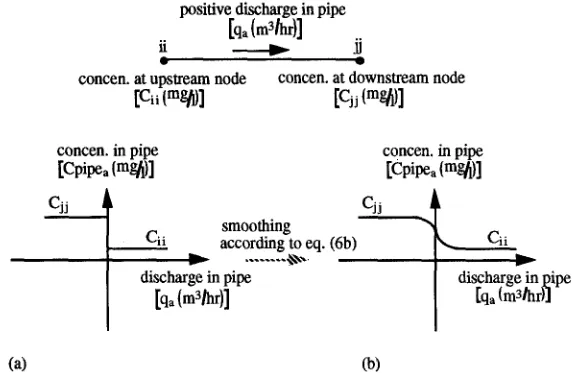
Eq. (6a) can be omitted at nodes with only one outgoing arc (Sinai et al. 1985). Embedding (6a) in a general nonlinear optimization problem of a multiquality undirected network requires the addition of binary variables to insure that the concentration along arcs, in steady-state conditions, is always the concentration of the upstream node. Since we deal with an undirected network, and do not wish to introduce binary variables to a nonlinear constrained optimization problem, we need to use a smoothing approximation for the concentrations equations, which allows the solution algorithm to reverse flow directions during the course of iterations, and still fulfill continuity of loads at internal nodes [(5)]. The equation we use is based upon a smoothing approximation, developed by Cohen (1992), and refined in our study. The equation is:
Cpipek" = 1 + e x p [ - q o P E N a ( q a ) ] + 1 + exp[qaPENa(qa)] . . . (6b) L N ( N M A X ) V i i , j j ~ I N , k ~ K . . . (6c) P E N a ( q , ) - 1 + IqaJ '
where ii, jj = end nodes of pipe a; Ci k, C~ = concentrations of quality parameter k at nodes ii and jj, respectively; L N = natural lagarithm; and N M A X = a very large n u m b e r . W e used the m a x i m u m n u m b e r possible for the PS/2 m o d 80, which is ~ 1022. T h e general f o r m of (6b) is shown in Fig. 1. Table 1 gives the value of the concentration in the pipe, by (6b) for the range of: - 2 , 0 0 0 (m3/hr) to +2,000 (m3/hr), with an accuracy better than 10 -8. Eq. (6b) need not be applied to arcs in which the direction of flow is fixed, such as pipes out of sources. T h e t e r m PENa(qa) produces a sufficiently large penalty product [qaPENa(qa)] even when qa approaches zcro.
3. Minimum and m a x i m u m concentrations allowed at internal nodes. C~g mi" -< Cfn -< C~,~ max for some in E IN, k ~ K . . . (7) where v,nr~k'm~n, --~Ck'm~* = m i n i m u m and m a x i m u m concentrations, respec- tively, of water-quality p a r a m e t e r k at s o m e internal nodes. Such constraints
positive discharge in pipe [qa (m3/hr)] ,.
ii ~ 11
6 6
concen, at upstream node concen, at downstream node [Cii (mg/l)] [Cjj (m~)]
concen, in pipe concen, in pipe
[Cpipea (mg/~)] [Cpipea (mg~}]
smoothing
Cii according to eq. (6b) Eli discharge in pipe discharge in pipe
[q~ (m3/hr)] [qa (m3/hr)]
(a) (b)
FIG. 1. Graphical Representation of Eq. (6b): (a) Discontinuity of Concentration along Arc when Flow Direction Reverses, Before Smoothing; (b) After Smoothing Discontinuity, by Eq. (6b)
TABLE 1. Computed Quality in Arc by Eq. (6b)
Discharge in arc Concentration along arc
qa (m3/hour) Cpipea (mg/L)
(I) (2)
2,000 100 1 0 - 1
- 100
-2,000
100 100 100 150 200 200 200
[image:6.396.53.342.207.397.2]are normally imposed only at consumption nodes. T h e minimum concen- tration level is usually zero, but there are quality parameters where a min- imum level is also imposed, for example, residual chlorine for drinking water.
4. Concentrations in pipes originating at n o n t r e a t m e n t source nodes. Cpipeka =
C~,,
V
a E ~ - ( n t s n ) , ntsn E N T S N , k E K . . . (8)Cn,s, = the where ~ - ( n t s n ) = set of arcs with flow out of node ntsn; k
concentration of water quality of p a r a m e t e r k at source node ntsn.
OBJECTIVE FUNCTION
The objective function includes two terms: (1) Water cost, which is the sum of water cost at source nodes and the treatment cost needed to improve water quality at treatment source nodes; and (2) energy cost needed to operate pumping stations.
COST OF TREATMENT
The resulting quality at the outlet of a treatment source node is approx- imated here by an exponential function:
Cpipek(TCkn) = Onitialkn exp( - Ktckn T C k , ) V a @ ~ - (tsn),
tsn E T S N , k @ K . . . (9a) where ~ - ( t s n ) = arcs directed away from the node tsn; Cinitial k . = con- centration of quality p a r a m e t e r k at the inlet of source node tsn; TCksn = treatment cost of quality p a r a m e t e r k, per unit volume of treated water, at source node tsn, Ktcks, = coefficient of the treatment cost of quality pa- rameter k at source n o d e tsn. A schematic representation of the outlet quality for a single quality parameter, as a function of treatment cost, is shown in Fig. 2.
REMARKS
1. T C k , are decision variables. W h e n no treatment is needed (i.e., con- centration constraints are met without treatment, possibly by dilution) the treatment cost is zero.
O u t l e t c o n c e n t r a t i o n
I n l e t _ _ . . ~ . c o n c e n t r a t i o n
M i n i m u m ~ ..a ... possible c o n c e n t r a t i o n
FIG. 2.
Treatment cost per unit water volume
Coat Function at Treatment Source Node
2. Treatment cost, per unit volume of treated water, increases as the concentration of the quality parameter k in the outflow is reduced. However, the treatment level of any quality parameter is bounded by the maximum removal ratio of the treatment facility, and therefore the treatment cost at any treatment source node is bounded. This is expressed by imposing bounds on the removal ratios at treatment source nodes for every quality parameter: 0 <_ Cinitial~n - Cpipe~(TC~,) _< ----RRk~, . . . . V a G ~-(tsn),
Cpipe](TC~,)
tsn @ TSN, k @ K . . . (9b) where .._RRk,~,, . . . . = maximum removal ratio of quality parameter k at node tsn.
The cost of water and treatment is:
[
(
)]
WC = D T E WC.,.,,q.,.. + E WC=~ " ' + E TCw q~.
n t s n ~ N T S N t s n ~ T S N k ~ K
. . . (lOa) where WC = water cost; D T = time unit of operation (e.g., hour, day); WCnu. = fixed charge for unit volume of water at node ntsn; q ... q,s., = discharge supplied by source node ntsn and source node tsn, respectively; WCini..~ = fixed charge per unit volume of untreated water at node v t s n tsn.
The cost of energy is:
EC = DTkwhc [~eA~pumps ECCPaq~AHP,(qa) ] + penalty(x~ + y,) . . (10b)
where EC = energy cost; kwhc = energy charge during time of operation; ECCP~ = power coefficient of pumping station located on arc a (a Apumps C A ) , assuming efficiency is constant; penalty = large positive number that incurs high (artificial) penalties in the objective function, on the dummy variables Xa, y~. The introduction of these artificial variables makes it possible to obtain a mathematical solution to the problem even when the physical system can not meet all the head constraints [Note that penalty has no connection to the P E N terms in the smoothing equation (6b)].
COMPLETE MODEL
The optimization problem to be solved is: minimize (WC + EC)
subject to: constraints (1) to (9), excluding (2e) and (6a) . . . (11) The decision variables are: (1) The discharges in all the arcs: q,, V a ~ A; and (2) the treatment costs at treatment source nodes for all the quality parameters involved: TC~, V tsn ~ TSN, k E K.
ASSUMPTIONS
The following assumptions were used in developing the optimization model: 1. The time of operation
(DT)
is much longer than the transient phase after a change in the operation, during which a steady-state concentration is reached.2. Water-quality parameters are conservative.
3. There are no chemical reactions among quality parameters. 4. Complete and instantaneous mixing at nodes.
5. The power coefficient of pumping stations is calculated assuming ef- ficiency is constant.
6. The cost of improving water quality at a treatment source node with respect to a specific water-quality parameter is independent of other treat- ment costs at the same node, i.e., improving water quality with respect to one quality parameter does not improve water quality with respect to other water-quality parameters in the same treatment plant.
Assumptions 1 - 3 allow us to employ a steady-state formulation with respect to quality parameters. If assumptions 2 and 3 were not valid, then the change of concentration of quality parameters as a function of time along the pipes and at the sources, should have been added. This is done in the companion paper (Ostfeld and Shamir 1993). In the next example we used only one conservative quality parameter,
The model is nonlinear and nonsmooth. Nonlinearities appear both in the objective function and the constraints. Nonsmoothness is due, for ex- ample, to the head-loss formula [(2d)] where the absolute value is used to allow the network to be undirected with respect to flows along arcs. Use of the smoothing approximation equation [(6b)], permits the consideration of an undirected multiquality flow model, as it smooths the discontinuity of the concentration equation for arcs.
METHOD OF SOLUTION
The solution is obtained on a PS/2 rood 80 using GAMS/MINOS, which is a software package designed to solve large-scale optimization problems involving sparse linear and nonlinear constraints. GAMS is used to build the model, MINOS is used to solve it, by employing a projected augmented Lagrangian algorithm. A detailed description of the optimization technique can be found in Murtagh and Saunders (1982).
EXAMPLE
The network is shown in Fig. 3. It contains 10 pipes and nine nodes: two treatment source nodes
(TS1, TS2),
one nontreatment source node(NTS1),
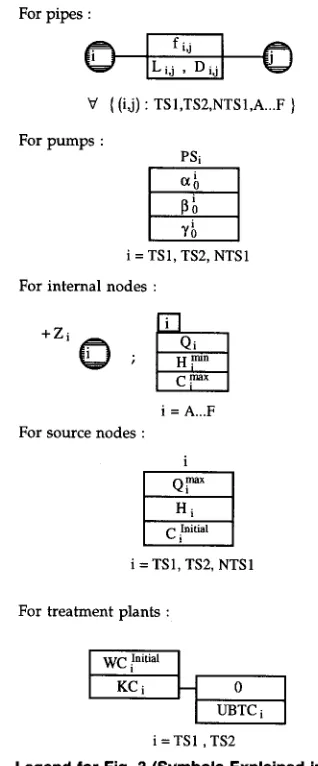
and six internal nodes (A . . . F). The legend for Fig. 3 is shown in Fig. 4. For pipes: fgj = friction coefficient of the Darcy-Weisbach head-loss for- mula; Li,(km) = length; D q ( m m ) = internal diameter. For pumping sta- tions: P ~ = name of pumping station located at source node i; c~6, [36, % = coefficients of the head-discharge curve for the pumping station at its maximum efficiency [see (2e)]. For internal nodes: i = name of node i; + Zi(m) = elevation of node i; Qi(m3/h) = consumption at node i; Hmi"(m) = minimum total head required at node i; Cm~x(mg/L) = maximum concentration allowed at node i. For source nodes: Qm~(m3/h) = maximumPSTsl - 0.001432
- 0.165
145 ~1~+5 I 0.038
v~'~s~ I
5.5,300TS1
0.25
4.0 0
0.4 PS NTSl
0.001542
[ [ 0.022
0.322
III
7.5.300I I
150 [] PS NTS~ ~ + 2 0
NTS 1
+50
+60
I 2.5. 200 I
I 0.028 I I 4.5,225 [
I 3.0. 200 I
90
400 25 80
+60
+ 4 0 ~ 6.5,300
TS2
PS TS2 - 0.001321
- 0.234 155
+5 I 0.036 I ~
PS TS2
~176176
I
FIG. 3. BASE RUN DATA for Optimal Operation of Multiquality Network Example
discharge allowed f r o m source n o d e i; H~(m) = h e a d at source n o d e i;
C~"itiat(mg/L)
= inlet c o n c e n t r a t i o n to source n o d e i, w h e r e at source n o d e sTS1, TS2
w a t e r quality c o n c e n t r a t i o n m a y be i m p r o v e d by a d d i t i o n a l t r e a t - ment, and at source n o d eNTS1
w a t e r quality c o n c e n t r a t i o n c a n n o t be changed. The elevations of source n o d e sTS1, TS2,
andNTS1
are: 5, 5, and 20 (m), respectively. F o r t r e a t m e n t plants:WC~nitial($/m 3)
= w a t e r cost before t r e a t m e n t at t r e a t m e n t source n o d e i;KC~(m3/$)
= cost coefficient of t r e a t m e n t cost function;UBTCi($/m 3)
= u p p e r b o u n d on t r e a t m e n t cost, generated from the m a x i m u m r e m o v a l ratio (zero is the lower b o u n d , which corresponds to no r e m o v a l ) . A d d i t i o n a l data: w a t e r cost at n o n t r e a t m e n t source n o d eNTS1
equals 0.40 ($/m3); efficiency, assuming constant at all pumping stations is 0.80; t i m e o f o p e r a t i o n 2 (h); and e n e r g y cost 0.08($&w-h).
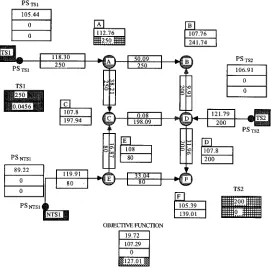
Results for the base run a r e shown in Fig. 5. L e g e n d for these results appears in Fig. 6. F o r pipes:
Qij(m3/h)
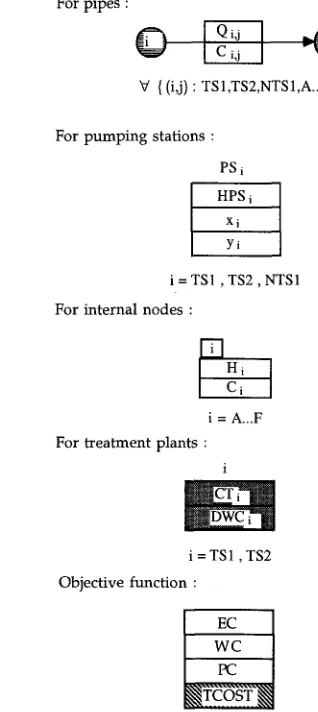
= discharge (the f a d e d a r r o w m e a n s that the flow in the final solution is in the direction o p p o s i t e to t h a t a r b i t r a r i l y selected as positive for the p i p e ) ; C i j ( m g / L ) = c o n c e n t r a t i o n in the pipe. F o r p u m p i n g stations:PSi
-- n a m e of p u m p i n g station l o c a t e d at source node i;HPSI
= h e a d (m); xl, y~ = d u m m y variables. F o r internal nodes: i = n a m e of n o d e ; H i ( m ) = total h e a d ; Ci(mg/L) = c o n c e n t r a t i o n . F o r t r e a t m e n t plants: i = n a m e o f t r e a t m e n t source n o d e ;CTi(mg/L)
= con- centration at the outlet;DWC,($/m 3)
= t r e a t m e n t cost p e r unit v o l u m e of treated water. F o r the o b j e c t i v e function:EC($)
= e n e r g y cost;WC($) =
For pipes :
V { (i,j) : TSI,TS2,NTS1,A...F
For pumps :
PSi
I1
%i = TS1, TS2, NTS1
For internal nodes :
i = A...F For source nodes :
i
Qy~
Hi
C Initial
i = TS1, TS2, NTS1
For treatment plants :
WC Initial
KC i 0
UBTC i
i = TS 1, TS2
FIG. 4. Legend for Fig. 3 (Symbols Explained in Text)
variables;
TCOST($)
= t o t a l c o s t o f o p e r a t i n g t h e s y s t e m f o r 2 h o u r s . R e m a r k : A n e t t e d b l o c k d e n o t e s a b i n d i n g c o n s t r a i n t . F o r e x a m p l e t h e c o n c e n t r a t i o n at n o d e A ( r e f e r to Fig. 5).BASE RUN AND SENSITIVITY ANALYSIS RESULTS
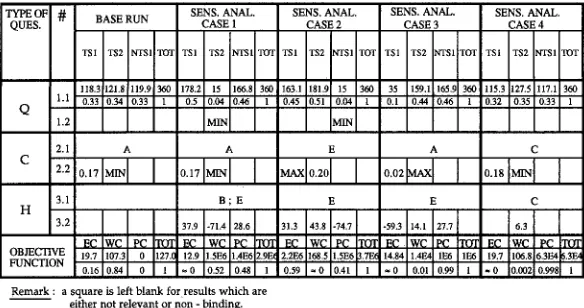
T h e b a s e d a t a a n d results o f t h e b a s e r u n a r e s h o w n in Figs. 3 a n d 5, r e s p e c t i v e l y . F o u r m o r e r u n s w e r e m a d e , to s t u d y h o w t h e o p t i m a l s o l u t i o n changes in r e s p o n s e to m o d i f i c a t i o n in c e r t a i n k e y data. I n e a c h case, f o u r aspects o f t h e results w e r e e x a m i n e d .
Discharge (Q)
1. F r o m w h i c h s o u r c e s is w a t e r b e i n g w i t h d r a w n , a n d w h a t is t h e r e l a t i v e c o n t r i b u t i o n o f e a c h s o u r c e n o d e t o t o t a l s u p p l y ?
[image:11.396.119.278.29.412.2]PS TSI
[•A
I 118.30 pS'~TS, I 250TS1
~25o
PS NTSI
89.22 I ~
~
o
II I ,o ,I
PS m'si h
FIG. 5. ample
I - ~ ) I 50.09 I 250 I
OBJECTIVE FUNCTION
N
--6
3~ PS TS2
~, 106.91
0
I 2~176 I PS TS2
TS2
~ . 2 0 0 . ~ ~ 0 . . . ~
BASE RUN RESULTS for Optimal Operation of Multiquality Network Ex-
2. Is there a source node at which supply reaches its bound (maximum or minimum)?
Quality (C)
1. Is there a node at which the threshold concentration requirement of water quality is reached?
2. To what degree is water being treated (removal ratio) at the treatment source nodes, and is there a treatment source node at which treatment reaches its bound (maximum or m i n i m u m ) ?
Head (H)
1. Is there a node at which the head requirement reaches its bound? 2. Are dummy variables being used within the pumping stations?
Objective Function
(OF)
What is the cost, and relative weight in the objective function value, of: energy (denoted
EC),
water and treatment (denotedWC),
and penalty (denotedPC).
Results of the base run and the four sensitivity runs are shown in Fig. 7. [image:12.396.65.337.35.304.2]F o r p i p e s :
V { (i,j) : T S 1 , T S 2 , N T S l , A . . . F }
FIG. 6.
F o r p u m p i n g s t a t i o n s :
P S i H P S i
x i Yi
i = TS1 , T S 2 , NTS1 F o r i n t e r n a l n o d e s :
i = A...F F o r t r e a t m e n t p l a n t s :
i
i = TS 1 , T S 2 O b j e c t i v e f u n c t i o n :
EC W C PC
Legend for Fig. 5 (Symbols Explained in Text)
BASE RUN RESULTS
Discharge (Q)
1. The total supply of 360 (m3/h) is taken in almost equal parts from the three sources.
2. None of the source nodes reaches its supply limits (maximum or min- imum).
Quality (C)
1. At node A the threshold concentration is reached.
2. Removal ratio at treatment source n o d e TS1 is 0.17. A t treatment source node TS2 water is not treated, i.e., treatment is at its minimum level.
[image:13.396.95.254.34.390.2]R e m a r k : a s q u a r e is left b l a n k for results w h i c h a r e
either n o t r e l e v a n t o r n o n - b i n d i n g .
FIG. 7. BASE RUN and SENSITIVITY ANALYSIS RESULTS for Optimal Operation of Multiquality Network Example under Steady State Conditions
Head (H)
1. None of the heads reaches its minimum level.
2. No dummy variables are used, i.e., the optimal solution is feasible.
Objective Function
(OF)
The total cost is $127. It is made up of $19.70 (16%) for energy (EC) and of $107.30 (84%) for water cost (including treatment at
TS1).
There are no penalty costs, which means that the solution is physically feasible.SENSITIVITY ANALYSIS RESULTS
The objective of the sensitivity analysis is to examine the response of the optimal solution to changes in the prices of water, treatment, and energy, and to changes in the constraints.
Case 1
Change in data relative to the base run: a very high cost of water in source
TS2
= 5 • 105 (S/m 3)[br
= 0.20 ($/m3), meaning that in the base run the corresponding value was 0.20($/m3)].
Results: The minimum possible is taken fromTS2;
the threshold concentration is reached at node A; minimum head reached at nodes B and E; dummy variables are used. Hence, in this case the dummy variables are used because of the high cost of water given in sourceTS2,
as compared to the penalty incurred on the valves in the objective function, and not as a result of infeasibilities.Case 2
Change in data relative to the base run: large energy cost at pumping station
NTS1, PCNTS1
= 103 ($ • hr/m 4)(br
= 0.000545 [$ x hr/m4]). Results: the minimum amount of water allowed is taken fromNTS1;
at node E, the closest toNTS1,
the threshold concentration and minimum head are reached; dummy variables are used, because of the large energy cost at pumping stationNTS1.
[image:14.396.51.343.33.187.2]Case 3
Change in data relative to the base run: large treatment cost K C r s l = 4 • 10 -2 (m3/$) (br = 4 [m3/$]). Results: The removal ratio at TS2 reaches its maximum value, while at TS1 the ratio is reduced to 0.02 (br = 0.17); at node A the threshold concentration is reached; at E the head is at its minimum level; dummy variables are used, because of the high treatment cost of water at source TS1.
Case 4
Change in data relative to the base run: the minimum head required at node C is raised to H min = 110 (m) (br = 85 [m]). Results: Thresholds
concentration and minimum head are reached at node C; a dummy variable operates at pumping station TS2.
CONCLUSIONS
A model for optimal operation of multiquality distribution systems under steady state flow and concentration conditions has been formulated and applied to an example network. The optimal solution is obtained with GAMS/ MINOS, using the projected augmented Lagrangian method.
The example network was solved for a base case and four additional cases, in each of which some of the base data were changed. Analysis of the results indicates that the optimal operation indeed responds in an ex- plainable manner to these changes in the data. The work reported here demonstrates that optimal operation of multiquality networks can be for- mulated and solved, albeit for small networks. It should be considered as a first step towards dealing with the operation of such networks. The next phase of this work, which is reported in a companion paper, expands the analysis to unsteady conditions.
ACKNOWLEDGMENT
The research was supported by the Technion V.P.R. Funds: Coleman Cohen Research Fund, and by the New York Metropolitan R. Fund.
APPENDIXI. REFERENCES
Brooke, A., Kendrick, D., and Meeraus, A. (1988). GAMS: A user's guide. Scientific Press U.S.
Cohen, D. (1987). "Optimal design of multiquality networks," MS thesis, Technion, Haifa, Israel.
Cohen, D. (1992). "Optimal operation of multiquality networks," DS thesis, Tech- nion, Haifa, Israel.
Grayman, W. M., Clark, R. M., and Males, R. M. (1988). "Modeling distribution system water quality: Dynamic approach." J. Water Res. Ping. and Mgmt. Div., ASCE, 114(3), 295-312.
Kessler, A., and Shamir, U. (1989). "Analysis of the linear programming gradient method for optimal design of water supply networks." Water Resour. Res., 25(7), 1469-1480.
Liang, T., and Nahaji, S. (1983). "Managing water quality by mixing water from different sources." J. Water Resour. Ping. Mgmt. Div., ASCE, 109(1), 48-57. Liou, C. P., and Kroon, J. R. (1987). "Modeling the propagation of waterborne substances in distribution networks." J. A m . Water Works Assoc., 79(11), 54- 58.
Males, R. M., Clark, R. M., Wehrman, P. J., and Gates, W. E. (1985). "Algorithm for mixing problems in water system." J. Hydr. Div., ASCE, 11(2), 664-661. Murtagh, B. A., and Saunders, M. A. (1982). "A projected Lagrangian algorithm
and its implementation for sparse nonlinear constraints." Mathematical program- ming study, 16, 84-117.
Ostfeld, A. (1990). "Management of a regional water supply system with sources of different qualities," MS thesis, Technion, Haifa, Israel.
Ostfeld, A., and Shamir, U. (1993). "Optimal operation of multiquality networks. II: unsteady conditions." J. Water Resour. Ping. and Mgmt. Div., ASCE, 119(6), 663-684.
Reike, M., Fasol, K. H., Sinai, G., and Pessen, D. (1987). "Hierarchical control of multi-quality water distribution systems." Comput. Electron. Agric., 2, 1-13. Schwartz, J., Meidad, N., and Shamir, U. (1985). "Water quality management in
regional systems." Scientific basis for water resources management, M. Diskin, ed., International Association of Hydrological Sciences, ed., 341-349.
Shah, M. (1985). "A dynamic model for dilution in water distribution systems," MS thesis, Technion, Haifa, Israel.
Sinai, G., Koch, E., and Farbman, M. (1985). "Dilution of brackish waters in irrigation networks--an analytic approach." Irrig. Sci., 6, 191-200.
APPENDIX II. N O T A T I O N
The following s y m b o l s are used in th& paper: A
A p u m p s = Cpipe~ =
C~n =
c ~ . ,
c~j
=c . k , m i n ( ' k , r n a x =
m ~ v i n
k
C n t s n
Cinitial ktsn = D T =
Oa = E C = ECCPa =
Floop = f~(Ra, 8a/Da) =
/ 4 , . =
m i n m a x
Hin , Hin nsn =
set of arcs, indexed a;
a subset of A, on which pumping stations are located;
concentration of quality parameter k in arc a, computed by (6b);
concentration of quality parameter k at node, in;
concentrations of quality parameter k at nodes ii and j j , respectively;
maximum and minimum concentrations, re- spectively, of water-quality parameter k at some internal nodes;
concentration of water quality of parameter k at source node ntsn;
concentration of quality parameter k, at the inlet of source node tsn;
time unit of operation (e.g., hour, serial hours, a day);
internal diameter of arc a; energy cost;
power coefficient of pumping station, located on arc a;
fundamental loop matrix for a given (arbi- trarily selected) spanning tree;
friction factor of arc a;
total head at selected: internal nodes; minimum and maximum total heads allowed at selected internal nodes, respectively; head at source node sn;
Headsn I N u, 11 K Ktc~.
kwhc La L N N M A X
N T S N PENo(qo) eRE penalty q q.
q,.
m i n
qamaX
qa ,
qin qntsn, q~n R I M RN R R k, max
t s n
Ra S N TSN ZC~n W WC WCn,s.
W l ~ i n i t i a l v t s n
x~, y.
AHfa(qa) AHloop AHpipe(q) AHpa(qa)
= k n o w n h e a d at source n o d e sn;
= set o f internal n o d e s , i n d e x e d in;
= e n d n o d e s o f p i p e a;
= set of w a t e r - q u a l i t y p a r a m e t e r s , i n d e x e d k; = coefficient o f t r e a t m e n t cost of quality p a r a m -
e t e r k, at source n o d e tsn;
= e n e r g y c h a r g e during t i m e o f o p e r a t i o n ; = length o f arc a;
= n a t u r a l l o g a r i t h m ;
= m a x i m u m n u m b e r possible in c o m p u t e r being used;
--- set of n o n t r e a t m e n t source nodes, indexed ntsn;
= p e n a l t y p r o d u c t in e q u a t i o n (6b);
= p a t h matrix, connecting r e f e r e n c e n o d e R N
with the subset of internal n o d e s ; = large positive n u m b e r ;
= v e c t o r o f discharge along arcs; = discharge in arc a;
= the j t h feasible discharge at a t h p u m p i n g sta- tion;
= m i n i m u m a n d m a x i m u m discharges in arc a,
respectively;
= discharge at n o d e in;
= discharge supplied b y source n o d e ntsn and source n o d e tsn, respectively;
= r e d u c e d incidence m a t r i x with r e s p e c t to ref- e r e n c e n o d e RN;
= m a x i m u m r e m o v a l ratio of quality p a r a m e t e r k at source n o d e tsn;
= R e y n o l d s n u m b e r of arc a;
= set o f source n o d e s , i n d e x e d sn (union of sets:
TSN a n d NTSN);
= set o f t r e a t m e n t source n o d e s , i n d e x e d tsn;
= t r e a t m e n t cost o f quality p a r a m e t e r k, p e r unit v o l u m e o f t r e a t e d w a t e r , at source n o d e tsn;
= v e c t o r of c o n s u m p t i o n s (except for r e f e r e n c e n o d e R N ) at nodes;
= w a t e r cost;
= fixed charge for unit v o l u m e of w a t e r at ntsn
nodes;
= fixed charge per unit volume of untreated water at n o d e tsn;
= d u m m y p e n a l t y variables;
= coefficients for the a t h p u m p i n g station at its m a x i m u m efficiency;
= h e a d loss along arc a, calculated by the D a r c y - W e i s b a c h formula;
= h e a d difference for set o f f u n d a m e n t a l loops and paths;
= v e c t o r o f h e a d s , losses o r gains, along arcs; = h e a d gain at p u m p i n g station, lcoated on arc a;
~a ealDa =
T~/~, .. . .
~(in) = - (in), ~ - (tsn), ~- (ntsn) =
~a
roughness coefficient of arc a; relative roughness of arc a;
maximum efficiency of jth feasible discharge at ath pumping station, among all possible combinations of pumps at station;
set of arcs connected to node, in,
set of arcs with flow out of nodes in, tsn, and ntsn, respectively; and
constant dependent upon units used for