First Traces
Late Pleistocene Human Settlement of the Arctic
Ted Goebel and Ben A. Potter
Introduction
The global dispersal of early modern humans during the late Ice Age is a principal chapter in the history of our species, and the colonization of the far north was a piv-otal step in “getting humans everywhere.” Success in the bitterly cold, open, and unpre-dictable Arctic and Subarctic required not only novel, innovative technologies— for example, reliable hunting weapons, substantial artificial shelters, and tailored, insulated clothing— but also complex long- distance social networks and flexible settlement strat-egies (Hoffecker 2005; Soffer 1994).
224 Ted Goebel and Ben A. Potter
Paleoclimatic Framework
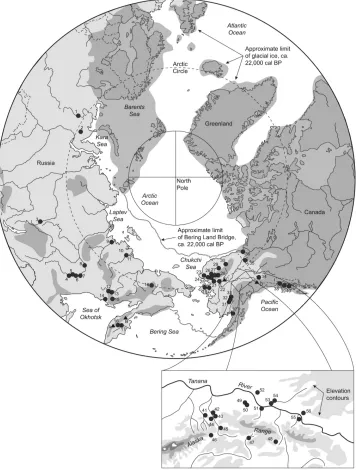
Our story begins ~40– 30 kya, when anatomically modern Homo sapiens first colonized Europe and northern Asia (Hoffecker 2005). Conditions in northern Asia around this time were relatively warm (so warm that Russian paleoecologists refer to this period as the Karga interglacial), but starting ~28 kya, climate deteriorated, culminating with the last glacial maximum (LGM) 24– 22.5 kya. Despite the existence of the Bering land bridge during this time, eastern Beringia became separated from the rest of North America by the expansion of ice sheets and glacier complexes in Canada (Clague et al. 2004; Kaufman and Manley 2004) (Figure 9.1). Northern Asia and Alaska, however, remained largely glacier- free during the LGM (Brigham- Grette et al. 2004). Climate was cold and dry, and environments were largely open and treeless, with variable steppe- tundra and shrub- tundra vegetation communities (Ager and Phillips 2008; Elias and Crocker 2008; Hoffecker and Elias 2007; Kuzmina et al. 2008). This tundra- steppe biome supported large- mammal populations, including woolly rhinoceros (Coelodonta antiquitatus), horse (Equus caballus), steppe bison (Bison priscus), and mammoth (Mammuthus primigenius) (Guthrie 2006; Lorenzen et al. 2011).
Soon after 22.5 kya, northern climates began to warm and glaciers melt (e.g., Dyke 2004), but not steadily (e.g., Menviel et al. 2011). Significant warming occurred during the Bølling interstadial, ca. 14.7 kya, and in some records this was followed by a brief cold period, the Older Dryas stadial, ca. 14 kya. Relatively warm conditions returned by 13.8 kya, with the onset of the Allerød interstadial. Shrub- tundra communities expanded during this time (Ager and Phillips 2008; Anderson et al. 2004; Hoffecker and Elias 2007), and trees soon followed, with larch (Larix) woodlands dispersing across Asian Beringia (Lozhkin et al. 1993) and groves of balsam poplar (Populus) appearing in interior Alaska (Brubaker et al. 2005). The disappearance of horse, woolly rhinoceros,
mammoth, and saiga antelope (Saiga tatarica) from Beringian landscapes may have
been a product of these changes (Guthrie 2003; Lorenzen et al. 2011); however, caribou (Rangifer tarandus), bison, and Dall sheep (Ovis dalli) survived, and wapiti (or red deer,
Cervus elaphus or C. canadensis) appeared for the first time in Alaska. Another notewor-thy change was gradual flooding of the Bering land bridge by 12.4– 11.3 kya (Hoffecker and Elias 2007).
The Allerød was interrupted 12.9 kya by the last cold episode of the Pleistocene, the Younger Dryas stade, which in global- climate records persisted for 1,300 years (Rasmussen et al. 2006). The effects of the Younger Dryas in northern Asia and Alaska appear to have been variable, with some proxy records indicating substantial cooling and drying, and others, persisting warm climate (Graf and Bigelow 2011; Kokorowski et al. 2008).
(5) Ust’- Mil’- 2; (6) Verkhne Troitskaia; (7) Ezhantsy; (8) Ikhine- 2; (9) Yana RHS; (10) Berelekh; (11) Achchagyi- Allaikha (paleontological site); (12) Siberdik; (13) Kongo; (14) Uptar; (15) Khaia; (16) Anavgai- 2; (17) Ushki; (18) Tytyl’vaam; (19) Serpentine Hot Springs; (20) Trail Creek Caves; (21) Onion Portage; (22) Nogahabara; (23) Raven Bluff; (24) Tuluaq Hill; (25) NR- 5; (26) Caribou Crossing; (27) Nat Pass; (28) Sluiceway; (29) Mesa; (30) Putu/ Bedwell/ Hilltop; (31) Spein Mountain; (32) Ilnuk; (33) Lime Hills Cave; (34) Little John; (35) Bluefish Caves; (36) Engigstciak; (37) Graveyard Point; (38) Groundhog Bay; (39) Hidden Falls; (40) On- Your- Knees Cave; (41) Owl Ridge; (42) Moose Creek; (43) Walker Road; (44) Dry Creek; (45) Carlo Creek; (46) Bull River- 2; (47) HEA- 454; (48) Tangle Lakes sites (Phipps, Whitmore Ridge, Sparks); (49) FAI- 2077; 50), FAI- 2019/ FAI- 2043; (51) Upward Sun River; (52), Chugwater; (53) Broken Mammoth/ Mead; (54) Swan Point; (55) Gerstle River Quarry; (56) Healy Lake Village/ Linda’s Point; (A) KAM- 05/ KAM- 07; (B) KAM- 03; (C) Batza Téna; (D) Wiki Peak.
226 Ted Goebel and Ben A. Potter
today. A final important change to the northern landscape was the spread of spruce (Picea) across northwestern Canada and Alaska by 10 kya or shortly thereafter (e.g., Anderson et al. 2011).
Earliest Inhabitants
of the Far North (42– 30 ka)
The earliest evidence of humans in far northern Eurasia, above 60°N latitude, coincides with the relatively warm mid- Upper Pleistocene, or Karga interglacial. In the Pechora River basin of far northeastern Europe, stone artifacts and faunal remains have been recovered from two sites, Mamontovaia Kuria and Byzovaia; however, in both cases, cultural layers were in coarse- grained fluvial cobble beds and likely redeposited. Mamontovaia Kuria yielded two possible stone tools and five flakes loosely associated with remains of extinct fauna, including a worked mammoth tusk; radiocarbon ages suggest an age of 42 kya (Pavlov et al. 2004). At nearby Byzovaia, a lithic assemblage of scrapers, backed knives, and bifaces dates to about 10,000 years later, ~32 kya (Pavlov et al. 2004). Associated faunal remains are dominated by bones of mammoth. Although some of the bones could be the product of human hunting, more likely they resulted from natural mammoth deaths, with humans scavenging the remains for raw material in tool manufacturing (Pavlov et al. 2004).
In Siberia, the earliest far northern Paleolithic sites are roughly the same age as Byzovaia. One of these is Nepa- 1, located along the Nizhnaia Tunguska River. Although only minimally tested, Nepa- 1 has yielded a small assemblage of stone artifacts (includ-ing a bipolar core and several flakes) found in a buried soil sealed by more than 2 meters of silts and sands (Sëmin and Shelkovaia 1991). Associated with the artifacts were remains of horse, woolly rhinoceros, auroch (Bos primigenius), and Siberian roe deer (Capreolus capreolus), two of which have been AMS radiocarbon (14C) dated to
before 30 kya (Goebel 2004). A cluster of early sites also occurs along the Aldan River (Mochanov 1977). The oldest of these seems to be Ikhine- 2, which contains multiple cul-tural layers dating to 34– 31 kya, where an excavated area exceeding 215 m2 yielded only
~20 inexpressive stone artifacts and ~200 bones of large mammals (mammoth, woolly rhinoceros, bison, horse, reindeer, red deer, and moose [Alces alces]) and carnivores (wolf [Canis sp.], Arctic fox [Vulpes lagopus], and fox [Vulpes vulpes]) (Mochanov 1977). Like the Pechoran sites, these remains may be redeposited (Goebel 2004).
et al. 2004). This, together with 34 other 14C dates, indicates an age of 33– 31 kya for the
Yana cultural layer (Pitulko and Pavlova 2010). Early occupants produced a unique stone- tool assemblage primarily based on simple core- and- flake and discoidal cores and unifacial retouching of flakes into side scrapers, points, burins, and wedge- like tools (Pitulko and Pavlova 2010). Blades are rare and microblades absent. Mammoth- ivory and bone awls as well as split longbones presumably used as wedges speak to the impor-tance of osseous material for the production of tools (Pitulko and Pavlova 2010). Many of these display ornamental incisions, and numerous beads and bead preforms are signs of art and bodily ornamentation (Pitulko et al. 2012). Subsistence at Yana RHS focused on bison, reindeer, horse, and hare (Lepus sp.); at one locus more than 1,000 mammoth bones representing at least 26 individuals have been recovered (Basilyan et al. 2011). A diverse array of other fauna— woolly rhinoceros, musk- ox (Ovibos moschatus), red deer, moose, wolf, brown bear (Ursus arctos), fox, wolverine (Gulo gulo), and beaver (Castor
sp.)— round out the assemblage, indicating diverse subsistence activities including the taking of some animals for their furs (Pitulko and Pavlova 2010). The density and extent of finds indicate that Yana represents a sustained, long- term settlement of Arctic north-western Beringia.
Whether humans persisted in the Asian Arctic and Beringia through the LGM is an open question, because no other archaeological site has yet been found in the far north that dates between the time of Yana RHS (~32 kya) and the terminal Pleistocene (~14– 12 kya). In the Yukon, Canada, early bone artifacts once argued to date to the onset of the
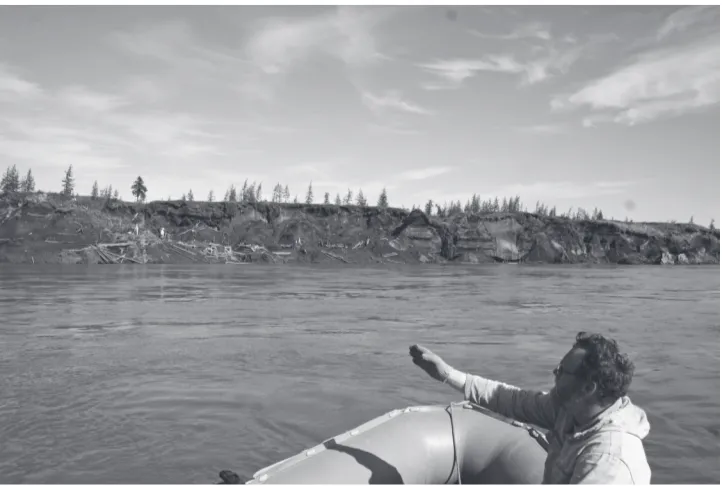
Figure 9.2 View of the Yana RHS site, with archaeologist Vladimir Pitul’ko in foreground.
228 Ted Goebel and Ben A. Potter
LGM (Irving and Harington 1973) are now interpreted to either date to the Holocene (Nelson et al. 1986) or not be artifacts at all, but naturally broken bones (Thorson and Guthrie 1984). Only the refitting mammoth- bone core and flakes from Bluefish Caves, directly 14C dated to ~28 kya (Cinq- Mars and Morlan 1999; Morlan 2003), remain as
pos-sible evidence of pre- LGM humans in eastern Beringia, but even these could be of natu-ral origin (Wilson and Burns 1999). Put simply, after Yana RHS, the earliest unequivocal signs of humans in the Eurasian far north date to after the LGM, in Beringia no earlier than 14 kya.
Late- Glacial Beringia (14– 12 kya)
Chronology and Colonization
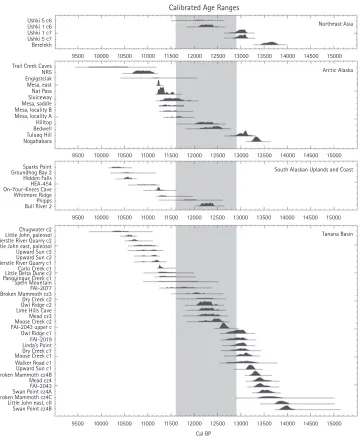
In Interior Alaska at least 30 precisely dated cultural occupations ranging from ~14 to 10 kya have been found (Figure 9.3). These archaeological sites are concentrated in the Tanana River basin, primarily in the middle Tanana valley (near Delta Junction) and middle Nenana valley (near Healy). Typically they occur in deeply buried (up to 2.5 m), well- stratified deposits of wind- blown silt (loess) and sand, and geochronologies are based on reliable radiocarbon dates from wood charcoal or bone clearly of cultural origin. Many sites (for example Swan Point, Broken Mammoth, Mead, Dry Creek, Owl Ridge, Upward Sun River, Moose Creek, and Gerstle River Quarry) contain multiple stratified cultural occupations, facilitating precise studies of human behavioral change across the Pleistocene- Holocene boundary.
(Cook 1996; Powers et al. 1983). Outside the Tanana basin, other interior Alaskan sites contain Younger Dryas occupations, most notably Lime Hills Cave and possibly Spein Mountain (Ackerman 2001, 2011). The earliest Holocene, 11.6– 11 kya, is better repre-sented in central Alaska: at least 11 cultural components document continued human occupation.
11500 12000 12500 13000 13500 14000 14500 15000 11000
10500 10000 9500
11500 12000 12500 13000 13500 14000 14500 15000 11000 10500 10000 9500 11500 12000 Arctic Alaska
South Alaskan Uplands and Coast
Tanana Basin Northeast Asia
Calibrated Age Ranges
12500 13000 13500 14000 14500 15000 11000
10500 10000 9500 Ushki 5 c6 Ushki 1 c6 Ushki 1 c7 Ushki 5 c7 Berelekh
Trail Creek Caves NR5 Engigstciak Mesa, east Nat Pass Sluiceway Mesa, saddle Mesa, locality B Mesa, locality A Hilltop Bedwell Tuluaq Hill Nogahabara
Sparks Point Groundhog Bay 2 Hidden Falls HEA-454 On-Your-Knees Cave Whitmore Ridge Phipps Bull River 2
Chugwater c2 Little John, paleosol Gerstle River Quarry c2 Little John east, paleosol Upward Sun c3 Upward Sun c2 Gerstle River Quarry c1 Carlo Creek c1 Little Delta Dune c3 Panguingue Creek c1 Spein Mountain FAI-2077 Broken Mammoth cz3 Dry Creek c2 Owl Ridge c2 Lime Hills Cave Mead cz3 Moose Creek c2 FAI-2043 upper c Owl Ridge c1 FAI-2019 Linda’s Point Dry Creek c1 Moose Creek c1 Walker Road c1 Upward Sun c1 Broken Mammoth cz4B Mead cz4 FAI-2043 Swan Point cz4A Broken Mammoth cz4C Little John east, cII Swan Point cz4B
11500 12000 12500 13000 Cal BP
13500 14000 14500 15000 11000
10500 10000 9500
Figure 9.3 Calibrated radiocarbon ages for Beringian archaeological sites of the terminal Pleistocene and earliest Holocene.
230 Ted Goebel and Ben A. Potter
South of the Alaska Range in southern Alaska, early cultural occupations are com-paratively few in number. Bull River 2, located in the Nenana- Chulitna divide area of the south Alaska Range, may date to 12.5– 12 kya (Wygal 2010), but this site has received limited testing. Other south Alaska Range sites (e.g., HEA- 454 along the uppermost Susitna River and Phipps, Whitmore Ridge, and Sparks Point in the Tangle Lakes vicin-ity) appear to date to latest Younger Dryas or post– Younger Dryas times (Blong 2012; West et al. 1996a, 1996b, 1996c), potentially indicating an initial pulse of upland human activity as postglacial climates warmed significantly. Several archaeological sites in southeast Alaska (and western coast of Canada) suggest a similarly aged dispersal of humans into Alaska’s southern maritime regions (Ackerman 1996; Dixon 1999; Fedje and Mathewes 2005).
Ten sites document the existence of late Pleistocene humans in north and north-west Alaska. The oldest, Tuluaq Hill, located in the north-western Brooks Range, yielded a hearth feature consistently dated to 13.2– 13 kya, indicating the presence of humans in Alaska’s Arctic during the late Allerød interstadial (Rasic 2011). Other early sites, typi-cally rich in lanceolate bifacial points, including Bedwell, Hilltop, Sluiceway, Nat Pass, and NR5 (Rasic 2011; Reanier 1995), appear to have been occupied during or soon after the Younger Dryas, as do the numerous hearth features and artifact concentrations atop the Mesa site (Kunz and Reanier 1995). Engigstciak and Trail Creek Caves may contain early Holocene occupations (Cinq- Mars et al. 1991; Larsen 1968), but their radiocarbon chronologies are imprecise or equivocal. Similarly, Nogahabara yielded lithic artifacts and faunal remains 14C dated to 13.7– 12.8 kya from a sand- dune
blow-out (Odess and Rasic 2007), but these could not be reliably associated, meaning that some, if not all, of the artifacts could be much younger than the bone, an interpreta-tion that explains the rather late- appearing notched bifacial points in the assemblage (Holmes et al. 2008).
A recent chronological development has been the dating of northern Alaska’s fluted- point complex. Although long known from more than 20 surface or near- surface sites that could not be reliably dated (Clark 1991), fluted points were recently recovered from two buried sites in northwest Alaska— Serpentine Hot Springs and Raven Bluff (Goebel et al. 2013; Hedman et al. 2011). At both they appear to date to ~12 kya.
Raw- Material Procurement
Although few studies of lithic raw- material procurement have been completed in the Beringian region, during the last decade significant developments have been made, pri-marily through the application of geochemical techniques to define the provenance of obsidian artifacts.
Pioneering geochemical work by Griffin et al. (1969), Clark (1972), and Cook (1995) demonstrated that numerous Alaskan sources of obsidian were used in pre-history. Early work used neutron activation analysis (NAA), a destructive technique, while more recent studies have focused on nondestructive X- ray fluorescence (XRF) analysis (Reuther et al. 2011). To date, 32 obsidian groups have been identified in the archaeological assemblages of Alaska, but for most of these, physical sources remain unknown (Reuther et al. 2011). For example, the earliest cultural occupation at Swan Point contains obsidian from unknown “Group H” (Reuther et al. 2011). Notable known sources include Batza Téna, located in the middle Koyukuk River basin of inte-rior northwest Alaska (Clark and McFadyen Clark 1993), and Wiki Peak, located in the northern Wrangell Mountains near the Alaska- Yukon border (Figure 9.1) (Cook 1995). Both Batza Téna and Wiki Peak obsidians occur in the earliest lithic assem-blages of central Alaska— Wiki Peak at Walker Road, Broken Mammoth, and Little John; Batza Téna at Dry Creek (component 2) and Swan Point (cultural zone 3); and both at Moose Creek and Healy Lake (Goebel 2011; Reuther et al. 2011). Batza Téna obsidian is even more common in early northwest Alaskan assemblages, for example Tuluaq Hill, Nogahabara, and Mesa. Distances between these sources and sites are typically on the order of hundreds of kilometers. Walker Road and Moose Creek, for example, are ~350 km from Wiki Peak, while Healy Lake and Tuluaq Hill are ~450– 500 km from Batza Téna. Even in southeast Alaska, the region’s earliest assemblages have obsidians demonstrating boat transport between the mainland and islands (Lee 2001). Obviously Alaska’s late Pleistocene inhabitants were well informed about the locations of high- quality tool stones and transported them great distances, but we still do not know whether these patterns represent high mobility or long- distance trade networks.
232 Ted Goebel and Ben A. Potter
between Ushki and its obsidian sources suggest the development of complex procure-ment strategies early in prehistory.
Procurement of other tool stones in Beringia is less well understood. In the Nenana val-ley, however, analyses of Nenana complex assemblages suggest they were founded largely on procurement of local raw materials like chert, chalcedony, quartzite, and rhyolite, to create expedient stone tools, while later Denali complex assemblages were sometimes based on exotic raw materials that arrived at sites as formal cores and tools (Goebel 2011; Graf and Goebel 2009). This may suggest fundamental differences in land use between earliest and later occupants of the Nenana valley, but in the middle Tanana valley, this does not seem to be the case— toolstone procurement and use at Mead (CZ4 and CZ3) did not vary (Little 2013). In northwest Alaska, geochemical analysis of cherts has identified at least four recognizable “quarry fields” where early humans procured tool stone that they transported to nearby sites like Onion Portage and Caribou Crossing (Malyk- Selivanova et al. 1998; Rasic 2011). Based on these data, lithic- conveyance zones and settlement sys-tems can be interpreted, but as Malyk- Selivanova et al. (1998) caution, regional databases of as many sources as possible are required. One thing is for certain, however: by the earli-est known occupations, Beringians had already acquired detailed knowledge of their lithic landscapes.
Lithic and Osseous Technology
Early northern technologies focused on stone and osseous materials like bone, antler, and ivory, with multiple types of weapon tips evident. A few early Beringian assem-blages contain slotted osseous projectile points presumably inset with microblades. At Lime Hills Cave 1 in interior southwest Alaska, fragments of three bilaterally grooved antler points were recovered, two directly dated to ~12.2– 9.7 kya (Ackerman 2011). At the nearby Ilnuk site, a medial fragment of a grooved antler point was also found but not dated (Ackerman 2011), and at Trail Creek Cave 2, Seward Peninsula, five nearly complete slotted antler points were recovered in association with bone conventionally
14C dated to ~10.3 kya (Larsen 1968). These inset osseous points likely functioned as
Nonslotted osseous projectile technologies also occur. At Broken Mammoth, these are represented by a cache of three ivory artifacts— two points and one possible atlatl handle (Holmes 1996; Yesner 1994, 1996)—as well as a carved and decorated bone rod broken into three sections, potentially representing a complex atlatl dart (Yesner et al. 2000). A bone needle from Broken Mammoth and additional fragments of worked ivory from this site as well as Swan Point, Mead, Berelekh, and Gerstle River indicate the importance of osseous materials for the production of tools during the late Pleistocene and early Holocene in Beringia.
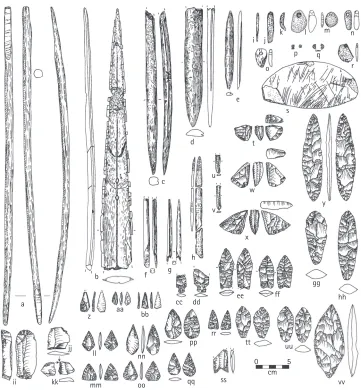
Stone bifacial points are also common across Beringia, but they vary greatly across space and time. In central Alaska, after Swan Point the earliest sites typically contain small stone points made on flakes and shaped into triangular or teardrop- shaped forms, often called “Chindadn points.” In the Nenana complex sites of the Nenana valley, for example, teardrop- shaped points have been recovered from Walker Road (Goebel et al. 1996), triangular points from Dry Creek (Powers and Hoffecker 1989), and both from Moose Creek (Pearson 1999) (Figure 9.4). These are small and thin, typically made on flakes and incompletely worked on both faces. At Walker Road, conjoining basal and tip fragments of two teardrop- shaped points were found around the same hearth features (Goebel et al. 1996), suggesting their use as hand- held knives; while at Dry Creek, two of three triangular points were just basal fragments (Powers and Hoffecker 1989), suggest-ing they functioned as projectiles. Chindadn points also occur in Younger Dryas- aged occupations at Broken Mammoth and Swan Point (Holmes 1996, 2001, 2011; Holmes et al. 1996), as well as at Healy Lake, where they were first described (Cook 1969), and at Little John and Chugwater (Easton et al. 2011; Lively 1996). The western Beringian sites Berelekh and possibly Ushki layer 7 have yielded teardrop- shaped points similar to Chindadn forms; at both sites they seem to date to ~13.5– 13 kya (Goebel and Slobodin 1999; Pitulko 2011). At Ushki, however, most of layer 7’s small bifacial projectiles are stemmed and shouldered (Dikov 1977 [2003]; Goebel et al. 2003). The widespread occurrence of Chindadn points in the terminal Pleistocene occupations of Beringia indicates they represent a unique fossile directeur of early Beringians.
Central Alaskan assemblages typically ascribed to the Denali complex often contain lanceolate- shaped bifaces, larger than Chindadn bifaces and frequently in association with microblades (Powers and Hoffecker 1989; West 1981). These stone points were typi-cally manufactured from large bifacial preforms and secondarily flaked to midlines, cre-ating thick lenticular or diamond- shaped cross sections. They have straight to convex bases and long downwardly contracting “stems,” lack obvious shoulders, and are wid-est nearer the tip than the base. Many basal fragments display impact fractures (Powers et al. 1983), suggesting their use as weapon tips, and at Upward Sun River, convex- based lanceolate points were recovered in a burial pit with decorated bibeveled antler fore-shafts (Potter et al. 2014)
a
b f g
h
x v
c u
w
y
d t
e
s
o r
q p i j k l
m n
z
ll jj
kk ii
nn
mm oo qq ss
cm uu
vv pp rr tt
0 5
aa bb
cc dd ee ff
gg hh
Figure 9.4 Northern Paleolithic artifacts referred to in text. (a) Woolly rhinoceros fore-shaft: Yana RHS; (b) osseous inset point with microblades: Chernoozer’e- 2; (c) osseous inset point: Tashtyk- 2; (d– e) osseous inset points: Kokorevo- 1; (f– g) osseous inset points: Trail Creek Caves- 2; (h) ivory foreshaft: Broken Mammoth; (i) osseous eyed needle: Yana RHS; (j) osse-ous diadem: Yana RHS; (k) tooth pendant, Yana RHS; (l– n) stone pendants: Berelekh; (o) stone pendant: Khaia; (p– q) stone beads: Ushki- 5; (r) stone pendant: Uptar; (s) stone tablet with inci-sions interpreted to represent huts: Ushki- 1; (t) wedge- shaped microblade core: Dry Creek; (u– v) microblades: Ushki- 5; (w) wedge- shaped microblade core: Swan Point; (x) wedge- shaped microblade core: Diuktai Cave; (y) biface: Diuktai Cave; (z, aa, bb) backed points: Yana RHS; (cc– dd) bifacial stemmed points: Ushki- 5; (ee– ff) bifacial Mesa lanceolate points: Mesa; (gg) bifacial Sluiceway point: Caribou Crossing; (hh) bifacial Sluiceway point: Upper Kelly site; (ii) end scraper: Kokorevo- 1; (jj) flake graver: Mesa; (kk) burin: Dry Creek; (ll– oo) bifacial Chindadn points: Healy Lake Village; (pp– qq) bifacial Chindadn points: Walker Road; (rr) bifacial triangu-lar point: Dry Creek; (ss) bifacial fluted point: Serpentine Hot Springs; (tt– uu) bifacial lanceolate points: Dry Creek; (vv) biface: Byzovaia
flutes on both faces, and edge- ground proximal margins, features suggestive of affinities with late Paleoindian industries of temperate North America, not surprising given their presumed ~12 kya ages at Serpentine and Raven Bluff. Another northern Alaskan point form, Mesa, is distinct from northern fluted points in that it has a shallow concave base, is basally thinned but not fluted, and has proximal lateral margins that contract down-ward (Kunz and Reanier 1995), features common on nonfluted late Paleoindian projec-tile points in temperate North America (e.g., Goshen/ Plainview). Sluiceway points of northwest Alaska also fit the northern Paleoindian pattern. These points are large and long, lanceolate- shaped with excurvate, edge- ground bases, and have thick, biconvex cross sections (Rasic 2011). Many have impact fractures, indicating their use as projectile tips, and many show signs of resharpening and recycling, an indication of differential land- use intensity in the Brooks Range and its foothills (Rasic 2011).
Besides projectile tips, studies of tool technology in late- glacial Beringia have focused on other bifacial tools, unifacial tools, cores, and debitage. In central Alaska, the few comprehensive technological studies that have been conducted suggest the use of a combination of informal and formal technologies. Nenana complex industries of the Allerød interstadial, on the one hand, are characteristically informal, being based on simply prepared flake and blade cores, with tool assemblages being dominated by marginally worked unifacial tools (Goebel 2011; Graf and Goebel 2009). Even bifaces are uncommon and often just bimarginally or invasively retouched. Denali complex industries of the Younger Dryas stade, on the other hand, contain higher frequencies of formal cores (e.g., wedge- shaped microblade cores) and tools that are either care-fully designed (e.g., microblades for use in composite projectiles, burins, and hafted bifacial points) or intensively reduced (e.g., side scrapers and cobble tools) (Graf and Goebel 2009). Burins are especially common in early central Alaskan assemblages, and they seem to most frequently co- occur with microblades, leading to the inference that they were used to trim, carve, and incise hard osseous materials (Powers et al. 1983). In northern Alaska, Paleoindian industries often have small, marginally worked tools like gravers and end scrapers, but these were often made on biface- thinning flakes (Kunz and Reanier 1995), by- products of a formal technology. The Sluiceway complex of northwest Alaska is characterized by similar flake tools as well as bend- break tools on broken bifaces (Rasic 2011). Burins are rare or absent in the northern Paleoindian assemblages, a further sign of a reliance on well- designed stone projectile points instead of inset osseous points.
236 Ted Goebel and Ben A. Potter
Subsistence Economy
Economic patterns among late Pleistocene eastern Beringian colonizers and later popu-lations adapting to oscillating climatic conditions are difficult to establish. Taphonomic factors within the modern boreal forest act to inhibit organic preservation, with birds and fish potentially being underrepresented in the faunal record. High residential- mobility strategies likely employed would have yielded relatively ephemeral sites (Kelly and Todd 1988; Powers et al. 1983). Work over the last 20 years in eastern Beringia, how-ever, has yielded significant patterning of early economic strategies and subsistence pat-terns. Several middle and upper Tanana valley sites (especially Broken Mammoth, Swan Point, Mead, Upward Sun River, Little John, and Gerstle River) have produced multiple components before, during, and after the Younger Dryas with substantial faunal preser-vation (e.g., Easton et al. 2011; Holmes 1996, 2011; Potter 2007; Potter et al. 2011a, 2011b; Yesner 2001, 2007; Yesner et al. 2011).
The debate regarding early Paleoindian subsistence strategies is sometimes dichot-omized as (1) large- mammal specialization and (2) broad- spectrum generalization (Grayson and Meltzer 2003; Waguespack and Surovell 2003; see review in Scott 2010), with some explaining variability in terms of logistical organization, resource schedul-ing, and seasonality (Potter et al. 2011b), local microenvironments (Yesner et al. 2011), or climate change (Graf and Bigelow 2011; Mason et al. 2001). The eastern Beringian data for the Allerød come from sites in the Tanana basin (and none elsewhere), specifi-cally Dry Creek, Broken Mammoth, Swan Point, Mead, Upward Sun River, and Little John (Holmes 2011; Holmes et al. 1996; Powers et al. 1983; Potter et al. 2011a; Yesner 1996, 2001; Yesner et al. 2011). These sites contain varying frequencies of large ungulates, pri-marily steppe bison and wapiti, but low frequencies of moose, caribou, and Dall sheep. Other important taxa include waterfowl (including swan and ducks), other birds (e.g., ptarmigan [Lagopus lagopus]), and small mammals, notably hare and ground squirrel.
Terminal Pleistocene (Younger Dryas) occupations at Broken Mammoth, Swan Point, Mead, and Upward Sun River include much the same suite of resources, but with the notable reduction in avian remains and addition of salmonid fish (at Upward Sun River and Broken Mammoth) (Potter et al. 2011b; Yesner 2001). Two additional sites in northwest Alaska (Raven Bluff and Serpentine Hot Springs) are notably different from the central Alaskan data, in that they have yielded small- sized ungulate remains, specifi-cally caribou at Raven Bluff, associated with fluted points (Goebel et al. 2013; Hedman et al. 2011). While some have argued for bison as the economic mainstay of northern Paleoindian sites (e.g., Kunz et al. 2003; Loy and Dixon 1998), paleontological data indicate regional extinction of bison in northwest Alaska by the end of the Pleistocene (Rasic and Matheus 2007). Moreover, the archaeological data suggest caribou was a more important resource. The implications of these new findings have not yet been incorporated into economic models, but they suggest considerable regional economic variability during the Younger Dryas.
Creek) indicate continued exploitation of large ungulates (bison and wapiti), small game, particularly hare, and to a much lesser extent, avians (Bowers 1980; Cook 1996; Easton et al. 2011; Potter 2007; Powers et al. 1983). Caribou is uncommon in these assem-blages (except Little John) and does not become a substantial element in central Alaskan diets until after 6 kya, when vegetation and fire- regime changes may have reduced bison habitat (Mason and Bigelow 2008; Potter 2008).
While these data are coarse grained and subject to varying interpretations, some ten-tative conclusions can be drawn. There is no indication that late Pleistocene or early Holocene eastern Beringian foragers practiced strictly megafaunal specialization or broad- spectrum foraging strategies, but rather complex strategies exploiting predictable resources that varied seasonally (Potter et al. 2011b) and regionally (Yesner et al. 2011). Data from contemporaneous sites indicate seasonal differences in procurement (Bowers 1980; Potter 2007), even controlling for local environment (e.g., Broken Mammoth cul-tural zones 3 and 4; Yesner 2001). Excluding the earliest Swan Point occupation, intersite analyses in central Alaska indicate that overall there appears to be little difference in economy before, during, or after the Younger Dryas. Instead, the first major economic transition occurred in the middle Holocene, when caribou replaced bison and wapiti as the major ungulate resource (Potter 2008).
Direct data on western Beringian subsistence economies are rare. From Ushki- 1 layer 7, a moose antler fragment was recovered (Goebel and Slobodin 1999), and from Ushki- 1 layer 6, Vereshchagin (1979) reported steppe bison, mountain sheep (Ovis nivicola), horse, lemming (Lemmus or Dicrostonyx sp.), and a deliberately buried dog (Canis familiaris), while Dikov (1990) added birds (possibly duck) and fish (possibly salmon). At Berelekh, remains of extinct hare (Lepus tanaiticus) and various birds dominate the assemblage, while mammoth, rhinoceros, bison, reindeer, horse, musk- ox, and cave lion (Panthera sp.) are minimally represented (Mochanov 1977; Vereshchagin 1979). The mammoth, rhinoceros, and cave- lion remains may have been scavenged from a nearby “mammoth cemetery,” or may be intrusive (Pitulko 2011).
The extent and nature of mammoth exploitation in Beringia has been a matter of some debate (see review in Hoffecker and Elias 2007). In northwest Beringia, mammoth- bone accumulations at the Berelekh and Achchagyi- Allaikha sites are not temporally asso-ciated with human occupations (Pitulko 2011; Nikolskiy et al. 2010). However, recent work at a mammoth locality (YMAM) near the Yana RHS site indicates anthropogenic accumulation (Basilyan et al. 2011; but see Pitulko and Nikolskiy 2012:26). Mammoth- tusk fragments are relatively common in eastern Beringian assemblages (e.g., Broken Mammoth, Swan Point, Mead, Gerstle River), but no postcranial remains have been recovered, suggesting scavenging of ivory for tools.
238 Ted Goebel and Ben A. Potter
ka, when they are largely replaced by caribou (Potter 2008, 2011). Compared with the earliest Paleoindian assemblages south of the ice sheet, a broader subsistence economy (Waguespack and Surovell 2003) or similarly broad economy (Grayson and Meltzer 2003) is evident in late- glacial Beringia, based on megafauna, medium and small mam-mals, birds (particularly waterfowl), and, to a lesser extent, fish (probably anadromous), with clear seasonal differences.
Settlement Organization
A general Beringian settlement- system model would be unrealistic given the observed and inferred ecological and physiographic variation throughout this large area; how-ever, regional systems of land use have been conjectured. An early influential settle-ment model was developed by Guthrie (in Powers et al. 1983) for central Alaska, where archaeologically visible sites like Dry Creek were interpreted to represent “spike camps” where recently acquired game was processed for transport to base camps. Yesner (1996) has argued these base camps may have been preferentially located on valley bottoms, and thus differentially eroded. More recent models include Rasic (2011) and Potter (2011), who posit settlement systems or land- use strategies at various scales for north-western and central Alaska, respectively. In these models, seasonal resource availability and abundance (particularly of caribou and bison) as well as mobility are key elements constraining potential land- use patterns. These models, while useful for regional prob-lems, may not be suitable for extrapolation to regions with less archaeological coverage, particularly western Beringia, where horse and mammoth may have been economically more important. Other Alaskan settlement models focus on specific aspects of technol-ogy, for example seasonal constraints on technology (Wygal 2011), or on later time peri-ods (e.g., Mason et al. 2001). Climatic effects on animal and plant distributions have been argued to have altered technology and settlement strategies before, during, and after the Younger Dryas (Graf and Bigelow 2011), though other analyses (Potter 2011) suggest broadly similar subsistence- settlement systems for these periods.
For western Beringia, well- dated stratified sites are rare, but Ushki- 1 contains mul-tiple features interpreted by Dikov to represent three types of structures, semisubterra-nean houses with central rock- lined hearths and entrance tunnels inferred to be winter dwellings, surface houses without entrance tunnels inferred to be contemporaneous summer dwellings, and irregularly shaped charcoal smears inferred to be earlier dwell-ing structures (Dikov 1977 [2003]). Ushki, however, remains unique in Berdwell-ingia, and no other dataset suggests such multiseasonal occupations.
Art, Ornamentation, and Ritual
and antler tools; however, often these are related to manufacture or use, not decoration. Nonetheless, numerous osseous tools at Yana RHS are ornamented (Pitulko and Pavlova 2010), a fragmented ivory point from Broken Mammoth (cultural zone 3) has patterned incisions suggesting a nonutilitarian, stylistic origin (Yesner et al. 2000), and an antler- point fragment from Lime Hills Cave bears signs of a reddish pigment (Ackerman 2011), suggesting the use of ochre as decoration.
Beads, pendants, and other items of personal adornment have not been recovered from securely dated early contexts in Alaska; however, in western Beringia they are more common. At Yana RHS hundreds of beads and bead preforms have been recovered (Pitulko et al. 2012). At Berelekh, five stone pendants occur on round to oval- shaped pebbles and have biconically drilled holes near one end; two of these display parallel incisions around their perimeters (Mochanov 1977). Raw materials vary and include green jadeite and white calcite. At Ushki, hundreds of small stone beads and a few stone pendants were found, primarily from layer 7 dating to ~13 kya, but also from layer 6, 12.5 kya (Dikov 1977 [2003]). The beads typically are tiny and disk- shaped with biconi-cally drilled holes; most were recovered from a burial pit at Ushki- 1, but they also occur in domestic settings preserved at Ushki- 1 and Ushki- 5 (Dikov 1977 [2003]; Goebel and Slobodin 1999; Goebel et al. 2003). A few labrets were also found in layer 6 at Ushki- 1. Stone pendants also have been recovered from presumed early contexts at the Khaia and Uptar sites, both located near Magadan, Russia (Slobodin 2011).
Works of Paleolithic art, so common in Europe and western Siberia, are so far rare from the early record of Beringia. Two possible exceptions are an engraving of a mam-moth on a fragment of tusk, found along the Berelekh River by local collectors in 1965 (Mochanov 1977), and a stone slab from Ushki with numerous incisions interpreted to represent conical- shaped huts (Dikov 1977 [2003]).
The near absence of clear signs of ornamentation, artwork, and ritual in Beringia’s early archaeological record may be a sign of high levels of mobility among the region’s late Pleistocene and early Holocene occupants (Goebel 2002), or it could be due to sampling— an obvious bias toward discovery and investigation of short- term camps and special- task sites instead of long- term settlements or villages. Not surprisingly, when obvious habitation features have been encountered, for example at Yana RHS, Ushki, and Upward Sun River, ornamented artifacts, works of art, and/ or ritual features have been unearthed.
Human Remains
240 Ted Goebel and Ben A. Potter
stone cobbles, and a few stone tools. The younger Ushki component (layer 6) yielded two unburned burials of children in small pits within separate houses (Dikov 1979; Slobodin 2006). Items within one of these included ochre, a pendant, numerous lemming inci-sors, and elements of microblade technology (Dikov 1979, 1996). Layer 6 at Ushki also yielded a dog burial which had been dug into the floor of a house. Some of the bones and surrounding sediment were stained by red ochre, and the burial pit contained an obsid-ian knife and end scraper, as well as a sandstone plate (Dikov 1979).
The second Beringian burial site is Upward Sun River, in central Alaska (Potter et al. 2011a, 2014). A child of about three years old was cremated and buried in a pit hearth (~45 cm deep) within a residential structure (which was abandoned after the crema-tion). Dental traits indicate a Sinodont pattern (Potter et al. 2011a). Directly below the child cremation was a second burial, which contained the remains of two infants, four bibeveled antler rods (three with multiple X- shaped incisions), and two lanceolate bifa-cial points in positions to suggest they had been hafted to the antler rods at the time of burial (Potter et al. 2014). All of the artifacts were ochre- stained. Overlapping 14C ages of
~11.5 kya on the two features suggest they are nearly contemporaneous, both being the product of either the same or successive seasonal occupations (Potter et al. 2014).
Conclusions
Given the record presented above, we offer the following tentative conclusions about the late Pleistocene settlement of Arctic Asia and America. It is evident more work— from field investigations in areas that have received relatively little attention (for example, the lower Kolyma basin, parts of interior Alaska) to larger, open excavations to evaluate site structure and organization— is necessary to test the many points of debate raised above.
(1) Initial human colonization of far northeastern Asia occurred by ~32 kya, based on the record from Yana RHS in Arctic western Beringia, as well as from a few scattered sites in the Lena and Nizhnaia Tunguska basins, Subarctic Siberia. Little is known about these early human inhabitants of the Arctic and Subarctic; however, at Yana we know they were full- time residents of the far north who pro-duced an Upper Paleolithic style of material culture and subsisted on a diverse array of fauna, much of it now extinct. At present, there is no clear linkage between these initial Arctic occupants and later populations that colonized the New World.
(2) Sustained human settlement of Arctic and Subarctic Siberia and Beringia through the last glacial maximum has not been demonstrated. Instead, the data suggest humans reappeared in the region during the late glacial, certainly by 16 kya in Iakutia and 14 kya in Beringia.
late- glacial Beringian occupation, dating to 14 kya at Swan Point in central Alaska, also contains evidence of microblade technology.
(4) After 14 kya, the late- glacial Beringian archaeological record, from Kamchatka to central Alaska, is characterized by diverse projectile- point technologies and forms. Some early industries are northeast Asian in character (i.e., they contain microblade technologies— the Denali and Diuktai complexes), some are North American in character (e.g., the Mesa and fluted- point complexes of northern Alaska), and some are distinctly Beringian in character (e.g., the Ushki layer 7 and Nenana complexes). Archaeologists still do not agree on how to explain this vari-ability, whether it represents cultural or behavioral differences, or some combina-tion of the two.
(5) Lithic raw- material procurement studies are still emerging, but already they are hinting at complex procurement and transport systems even in the earliest sites of Kamchatka and central Alaska. Without question, their occupants had “mapped onto” the Beringian landscape by 14– 13 kya.
(6) Beringian economies were internally quite diverse, with eastern Beringian popu-lations focusing on bison and wapiti during the terminal Pleistocene and early Holocene. Early Beringian diets also incorporated other large ungulates, small and medium mammals (some furbearing), waterfowl and other birds, and fish. (7) Although at Yana RHS the earliest Beringians appear to have regularly subsisted
on mammoth, during the late glacial current evidence suggests mammoths were not regularly hunted. Instead humans appear to have scavenged mammoth car-casses or “boneyards” for ivory to be used as tools. This may have important implications for resolving the extent to which human predation and climate change affected these and other late Pleistocene megafauna.
(8) Late- glacial Beringian settlement organization is more difficult to generalize. Most sites reflect short- term, limited- activity occupations of mobile hunter- gatherers, but two sites, namely Ushki and Upward Sun River, contain evidence of longer- term, potentially multiseason habitations with dwelling and burial features. As our site samples increase and our understanding of land use and organization of space develops, we suspect a more complex picture of Beringian settlement strategies and land use will emerge.
(9) Items of personal adornment, art, and ritual behavior are relatively rare in the Beringian record. The dearth of mobile art is consistent with the high mobility inferred for these early Beringians; however, the few sites that have yielded such articles in abundance represent habitation sites.
242 Ted Goebel and Ben A. Potter
archaeological occupations exist on the North American northwest coast, indicating a second migration route into North America. How did early Beringians adapt technol-ogy, subsistence, and settlement to the radically changing environments of the north during the late Pleistocene and early Holocene? Did they have a primary role in extir-pating certain megafauna? Finally, what role did the early Beringians have in the overall peopling of the Americas south of the Canadian ice sheets? Answers to these questions must await new discoveries as well as the application of new methods and theoretical perspectives that permit an investigation of the adaptive as well as historical compo-nents of the human past.
References Cited
Ackerman, Robert E.
1985 Southwestern Archaeological Survey. National Geographic Society Research Reports 19:67– 94.
1996 Ground Hog Bay, Site 2. In American Beginnings: The Prehistory and Palaeoecology of Beringia, edited by Frederick Hadleigh West, pp. 424– 430. University of Chicago Press, Chicago.
2001 Spein Mountain: A Mesa Complex Site in Southwestern Alaska. Arctic Anthropology 38(2):81– 97.
2011 Microblade Assemblages in Southwestern Alaska: An Early Holocene Adaptation. In From the Yenisei to the Yukon: Interpreting Lithic Assemblage Variability in Late Pleistocene/ Early Holocene Beringia, edited by Ted Goebel and Ian Buvit, pp. 255– 269. Texas A&M University Press, College Station.
Ager, Thomas A., and R. Lawrence Phillips
2008 Pollen Evidence for Late Pleistocene Bering Land Bridge Environments from Norton Sound, Northeastern Bering Sea, Alaska. Arctic, Antarctic, and Alpine Research 40:451– 461.
Anderson, Lynn L., Feng Sheng Hu, and Ken N. Paige
2011 Phylogeographic History of White Spruce during the Last Glacial Maximum: Uncovering Cryptic Refugia. Journal of Heredity 102(2):207– 216.
Anderson, Patricia M., Mary E. Edwards, and Linda B. Brubaker
2004 Results and Paleoclimate Implications of 35 Years of Paleoecological Research in Alaska. In The Quaternary Period in the United States, edited by Alan R. Gillespie, Stephen C. Porter, and Brian F. Atwater, pp. 427– 440. Elsevier, Amsterdam.
Basilyan, Alexander E., Mikhail A. Anisimov, Pavel A. Nikolskiy, and Vladimir V. Pitulko 2011 Woolly Mammoth Mass Accumulation next to the Paleolithic Yana RHS Site, Arctic
Siberia: Its Geology, Age, and Relation to Past Human Activity. Journal of Archaeological Science 38:2461– 2474.
Bever, Michael R.
2001 An Overview of Alaskan Late Pleistocene Archaeology: Historical Themes and Current Perspectives. Journal of World Prehistory 15:125– 187.
Blong, John C.
Bowers, Peter M.
1980 The Carlo Creek Site: Geology and Archaeology of an Early Holocene Site in the Central Alaska Range. Occasional Paper, Anthropology and Historic Preservation. Cooperative Park Studies Unit, University of Alaska, Fairbanks.
Brigham- Grette, Julie, Anatoly V. Lozhkin, Patricia M. Anderson, and Olga Y. Glushkova 2004 Paleoenvironmental Conditions in Western Beringia before and during the Last
Glacial Maximum. In Entering America: Northeast Asia and Beringia before the Last Glacial Maximum, edited by David B. Madsen, pp. 29– 61. University of Utah Press, Salt Lake City.
Brubaker, Linda B., Patricia M. Anderson, Mary E. Edwards, and Anatoly V. Lozhkin
2005 Beringia as a Glacial Refugium for Boreal Trees and Shrubs: New Perspectives from Mapped Pollen Data. Journal of Biogeography 32:833– 848.
Cinq- Mars, Jacques, C. Richard Harington, D. Erle Nelson, and Richard S. MacNeish
1991 Engigstciak Revisited: A Note on Early Holocene AMS Dates from the “Buffalo Pit.” In NOGAP Archaeological Project: An Integrated Archaeological Research and Management Approach, edited by Jacques Cinq- Mars and Jean- Luc Pilon, pp. 33– 44. Canadian Archaeological Association Occasional Paper No. 1. Victoria, British Columbia.
Cinq- Mars, Jacques, and Richard E. Morlan
1999 Bluefish Caves and Old Crow Basin: A New Rapport. In Ice Age Peoples of North America: Environments, Origins, and Adaptations of the First Americans, edited by Robson Bonnichsen and Karen L. Turnmire, pp. 200– 212. Oregon State University Press, Corvallis.
Clague, John J., Rolf W. Mathewes, and Thomas A. Ager
2004 Environments of Northwestern North America before the Last Glacial Maximum. In Entering America: Northeast Asia and Beringia before the Last Glacial Maximum, edited by David B. Madsen, 63– 94. University of Utah Press, Salt Lake City. Clark, Donald W.
1972 Archaeology of the Batza Tena Obsidian Source, West- Central Alaska. Anthropological Papers of the University of Alaska 15(2):1– 21.
1991 The Northern (Alaska- Yukon) Fluted Points. In Clovis: Origins and Adaptations, edited by Robson Bonnichsen and Karen L. Turnmire, pp. 35– 48. Oregon State University Press, Corvallis.
Clark, Donald Woodforde, and Annette McFadyen Clark
1993 Batza Téna: Trail to Obsidian. National Museum of Man Mercury Series, Archaeological Survey of Canada Papers No. 147. Canadian Museum of Civilization, Gatineau, Quebec.
Cook, John Paul
1969 The Early Prehistory of Healy Lake, Alaska. Unpublished PhD dissertation, Department of Anthropology, University of Wisconsin, Madison.
1995 Characterization and Distribution of Obsidian in Alaska. Arctic Anthropology 32(1):92– 100.
1996 Healy Lake. In American Beginnings: The Prehistory and Palaeoecology of Beringia, edited by Frederick Hadleigh West, pp. 323– 327. University of Chicago Press, Chicago. Dikov, Nikolai N.
244 Ted Goebel and Ben A. Potter
Chukotka and the Upper Kolyma. US Department of the Interior, National Park Service, Shared Beringian Heritage Program, Anchorage, Alaska.
1979 Zakhoronenie Domashnei Sobaki v Zhilishche Pozdnepaleoliticheskoi Stoianki Ushki- 1 na Kamchatke. In Novye Arkheologicheskie Pamiatniki Severa Dal’nego Vostoka (po Dannym Severo- Vostochno- Aziatskoi Kompleksnoi Arkheologicheskoi Ekspeditsii), pp. 12– 17. Severo- Vostochnoi Kompleksnyi Nauchno- Issledovatel’skii Institut, Dal’nevostochnyi Nauchnyi Tsentr, Akademiia Nauk SSSR, Magadan. 1990 Population Migration from Asia to Pre- Columbian America. Paper presented at
the Seventeenth International Congress of Historical Sciences, Madrid.
1996 The Ushki Sites, Kamchatka Peninsula. In American Beginnings: The Prehistory and Palaeoecology of Beringia, edited by Frederick Hadleigh West, pp. 244– 250. University of Chicago Press, Chicago.
Dixon, E. James
2001 Human Colonization of the Americas: Timing, Technology and Process. Quaternary Science Reviews 20:277– 299.
2011 Arrows, Atlatls, and Cultural- Historical Conundrums. In From the Yenisei to the Yukon: Interpreting Lithic Assemblage Variability in Late Pleistocene/ Early Holocene Beringia, edited by Ted Goebel and Ian Buvit, pp. 362– 370. Texas A&M University Press, College Station.
Dumond, Don E.
2011 Technology, Typology, and Subsistence: A Partly Contrarian Look at the Peopling of Beringia. In From the Yenisei to the Yukon: Interpreting Lithic Assemblage Variability in Late Pleistocene/ Early Holocene Beringia, edited by Ted Goebel and Ian Buvit, pp. 345– 361. Texas A&M University Press, College Station.
Dyke, Arthur S.
2004 An Outline of North American Deglaciation with Emphasis on Central and Northern Canada. In Quaternary Glaciations: Extent and Chronology, Part II, North America, edited by Jürgen Ehlers and Philip L. Gibbard, pp. 373– 424. Elsevier, Amsterdam.
Easton, Norman Alexander, Glen R. Mackay, Patricia Bernice Young, Peter Schnurr, and David R. Yesner
2011 Chindadn in Canada? Emergent Evidence of the Pleistocene Transition in Southeast Beringia as Revealed by the Little John Site, Yukon. In From the Yenisei to the Yukon: Interpreting Lithic Assemblage Variability in Late Pleistocene/ Early Holocene Beringia, edited by Ted Goebel and Ian Buvit, pp. 289– 307. Texas A&M University Press, College Station.
Elias, Scott A., and Barnaby Crocker
2008 The Bering Land Bridge: A Moisture Barrier to the Dispersal of Steppe- Tundra Biota? Quaternary Science Reviews 27:2473– 2483.
Fedje, Daryl W., and Rolf W. Mathewes (editors)
2005 Haida Gwaii: Human History and Environment from the Time of Loon to the Time of the Iron People. University of British Columbia Press, Vancouver.
Glascock, Michael D., Vladimir K. Popov, Yaroslav V. Kuzmin, Robert J. Speakman, Andrei V. Ptashinsky, and Andrei V. Grebennikov
Goebel, Ted
2002 The “Microblade Adaptation” and Recolonization of Siberia during the Late Upper Pleistocene. In Thinking Small: Global Perspectives on Microlithization, edited by Robert G. Elston and Steven L. Kuhn, pp. 117– 131. Archaeological Papers of the American Anthropological Association No. 12, Arlington, Virginia.
2004 The Search for a Clovis Progenitor in Subarctic Siberia. In Entering America: Northeast Asia and Beringia before the Last Glacial Maximum, edited by David B. Madsen, pp. 311–356. University of Utah Press, Salt Lake City.
2011 What Is the Nenana Complex? Raw Material Procurement and Technological Organization at Walker Road, Central Alaska. In From the Yenisei to the Yukon: Interpreting Lithic Assemblage Variability in Late Pleistocene/ Early Holocene Beringia, edited by Ted Goebel and Ian Buvit, pp. 199– 214. Texas A&M University Press, College Station.
Goebel, Ted, and Ian Buvit
2011 Introducing the Archaeological Record of Beringia. In From the Yenisei to the Yukon: Interpreting Lithic Assemblage Variability in Late Pleistocene/ Early Holocene Beringia, edited by Ted Goebel and Ian Buvit, pp. 1– 30. Texas A&M University Press, College Station.
Goebel, Ted, W. Roger Powers, Nancy H. Bigelow, and Andrew S. Higgs
1996 Walker Road. In American Beginnings: The Prehistory and Palaeoecology of Beringia, edited by Frederick Hadleigh West, pp. 356– 363. University of Chicago Press, Chicago.
Goebel, Ted, and Sergei B. Slobodin
1999 The Colonization of Western Beringia: Technology, Ecology, and Adaptations. In Ice Age People of North America: Environments, Origins, and Adaptations, edited by Robson Bonnichsen and Karen L. Turnmire, pp. 104– 155. Oregon State University, Corvallis.
Goebel, Ted, Heather L. Smith, Lyndsay DiPietro, Michael R. Waters, Bryan Hockett, Kelly E. Graf, Robert Gal, Sergei B. Slobodin, Robert J. Speakman, Steven G. Driese, and David Rhode
2013 Serpentine Hot Springs, Alaska: Results of Excavations and Implications for the Age and Significance of Northern Fluted Points. Journal of Archaeological Science 40:4222– 4233.
Goebel, T., Michael R. Waters, and Margarita Dikova
2003 The Archaeology of Ushki Lake, Kamchatka, and the Pleistocene Peopling of the Americas. Science 301:501– 505.
Graf, Kelly E., and Nancy H. Bigelow
2011 Human Response to Climate during the Younger Dryas Chronozone in Central Alaska. Quaternary International 242:434– 451.
Graf, Kelly E., and Ted Goebel
2009 Upper Paleolithic Toolstone Procurement and Selection across Beringia. In Lithic Materials and Paleolithic Studies, edited by Brian Adams and Brooke S. Blades, pp. 54–77. Wiley- Blackwell, Chichester.
Grayson, Donald K., and David J. Meltzer
2003 A Requiem for North American Overkill. Journal of Archaeological Science 30:585– 593. Griffin, James B., Gary A. Wright, and Adon A. Gordus
246 Ted Goebel and Ben A. Potter
Guthrie, R. Dale
2003 Rapid Body Size Decline in Alaskan Pleistocene Horses before Extinction. Nature 426:169– 171.
2006 New Carbon Dates Link Climate Change with Human Colonization and Pleistocene Extinctions. Nature 441:207– 209.
Hare, P. Gregory, Sheila Greer, Ruth Gotthardt, Richard Farnell, Vandy Bowyer, Charles Schweger, and Diane Strand
2004 Ethnographic and Archaeological Investigations of Alpine Ice Patches in Southwest Yukon, Canada. Arctic 57:260– 272.
Hedman, William, Jeff Rasic, Ian Buvit, and Steven Kuehn
2011 The Raven Bluff: A Fluted Point Site in the Western Arctic. Paper presented at the Thirty- Eighth Alaska Anthropological Association Meetings, Fairbanks.
Hoffecker, John F.
2005 A Prehistory of the North: Human Settlement of the Higher Latitudes. Rutgers University Press, New Brunswick, New Jersey.
2011 Assemblage Variability in Beringia: The Mesa Factor. In From the Yenisei to the Yukon: Interpreting Lithic Assemblage Variability in Late Pleistocene/ Early Holocene Beringia, edited by Ted Goebel and Ian Buvit, pp. 165– 178. Texas A&M University Press, College Station.
Hoffecker, John F., and Scott A. Elias
2007 Human Ecology of Beringia. Columbia University Press, New York. Hoffecker, John F., W. Roger Powers, and Ted Goebel
1993 The Colonization of Beringia and the Peopling of the New World. Science 259(5091):46– 53.
Holmes, Charles E.
1996 Broken Mammoth. In American Beginnings: The Prehistory and Palaeoecology of Beringia, edited by Frederick Hadleigh West, pp. 312– 318. University of Chicago Press, Chicago.
2001 Tanana River Valley Archaeology circa 14,000 to 9000 B.P. Arctic Anthropology 38(2):154– 170.
2011 The Beringian and Transitional Periods in Alaska: Technology of the East Beringian Tradition as Viewed from Swan Point. In From the Yenisei to the Yukon: Interpreting Lithic Assemblage Variability in Late Pleistocene/ Early Holocene Beringia, edited by Ted Goebel and Ian Buvit, pp. 179– 191. Texas A&M University Press, College Station. Holmes, Charles E., Ben A. Potter, Joshua D. Reuther, Owen K. Mason, Robert M. Thorson,
and Peter M. Bowers
2008 Geological and Cultural Context of the Nogahabara I Site. American Antiquity 73:781– 790.
Holmes, Charles E., Richard VanderHoek, and Thomas E. Dilley
1996 Swan Point. In American Beginnings: The Prehistory and Palaeoecology of Beringia, edited by Frederick Hadleigh West, pp. 319– 323. University of Chicago Press, Chicago. Irving, William N., and C. Richard Harington
1973 Upper Pleistocene Radiocarbon- Dated Artefacts from the Northern Yukon. Science 179(4071):335– 340.
Geirsdótter, Feng Sheng Hu, Anne E. Jennings, Mary R. Kaplan, Michael W. Kerwin, Anatoly V. Lozhkin, Glen M. MacDonald, Gifford H. Miller, Cary J. Mock, W. Wyatt Oswald, Bette L. Otto- Bliesner, David F. Porinchu, Kathleen R. Rühland, John P. Smol, Eric J. Steig, and Brent B. Wolfe
2004 Holocene Thermal Maximum in the Western Arctic (0– 180°W). Quaternary Science Reviews 23:529– 560.
Kaufman, Darrell S., and William F. Manley
2004 Pleistocene Maximum and Late Wisconsinan Glacier Extents across Alaska, U.S.A. In Quaternary Glaciations— Extent and Chronology, Part II, North America, edited by Jürgen Ehlers and Philip L. Gibbard, pp. 9– 28. Elsevier, Amsterdam.
Kelly, Robert L., and Lawrence C. Todd
1988 Coming into the Country: Early Paleoindian Hunting and Mobility. American Antiquity 53:231– 244.
Kokorowski, H. D., Patricia M. Anderson, Cary J. Mock, and Anatoly V. Lozhkin
2008 A Re- evaluation and Spatial Analysis of Evidence for a Younger Dryas Climatic Reversal in Beringia. Quaternary Science Reviews 27:1710– 1722.
Kunz, Michael, Michael Bever, and Constance Adkins
2003 The Mesa Site: Paleoindians above the Arctic Circle. BLM- Alaska Open File Report 86. US Department of the Interior, Bureau of Land Management, Anchorage.
Kunz, Michael L., and Richard E. Reanier
1995 The Mesa Site: A Paleoindian Hunting Lookout in Arctic Alaska. Arctic Anthropology 32(1):5– 30.
Kuzmin, Yaroslav V., Robert J. Speakman, Michael D. Glascock, Vladimir K. Popov, Andrei V. Grebennikov, Margarita A. Dikova, and Andrei V. Ptashinsky
2008 Obsidian Use at the Ushki Lake Complex, Kamchatka Peninsula (Northeastern Siberia): Implications for Terminal Pleistocene and Early Holocene Human Migrations in Beringia. Journal of Archaeological Science 35:2179– 2187.
Kuzmina, Svetlana, Scott Elias, Paul Matheus, John E. Storer, and Andrei Sher
2008 Paleoenvironmental Reconstruction of the Last Glacial Maximum, Inferred from Insect Fossils from a Tephra Buried Soil at Tempest Lake, Seward Peninsula, Alaska. Palaeogeography, Palaeoclimatology, Palaeoecology 267:245– 255.
Larsen, Helge
1968 Trail Creek: Final Report of the Excavation of Two Caves on Seward Peninsula, Alaska. Acta Arctica 15:7– 79.
Lee, Craig Michael.
2001 Microblade Morphology and Trace Element Analysis: An Examination of Obsidian Artifacts from Archaeological Site 49- PET- 1408, Prince of Wales Island, Alaska. Unpublished MA thesis, Department of Anthropology, University of Wyoming, Laramie.
Little, Allison A.
2013 Lithic Analysis at the Mead Site, Central Alaska. Unpublished MA thesis, Department of Anthropology, University of Alaska, Fairbanks.
Lively, Ralph A.
1996 Chugwater. In American Beginnings: The Prehistory and Palaeoecology of Beringia, edited by Frederick Hadleigh West, pp. 308– 311. University of Chicago Press, Chicago. Lorenzen, Eline D., David Nogués- Bravo, Ludovic Orlando, Jaco Weinstock, Jonas Binladen,
248 Ted Goebel and Ben A. Potter
Rasmus Nielsen, Simon Y. W. Ho, Ted Goebel, Kelly E. Graf, David Byers, Jesper T. Stenderup, Morten Rasmussen, Paula F. Campos, Jennifer A. Leonard, Klaus- Peter Koepfli, Duane Froese, Grant Zazula, Thomas W. StaffordJr., Kim Aaris- Sørensen, Persaram Batra, Alan M. Haywood, Joy S. Singarayer, Paul J. Valdes, Gennady Boeskorov, James A. Burns, Sergey P. Davydov, James Haile, Dennis L. Jenkins, Pavel Kosintsev, Tatyana Kuznetsova, Xulong Lai, Larry D. Martin, H. Gregory McDonald, Dick Mol, Morten Meltdgaard, Kasper Munch, Elisabeth Stephan, Mikhail Sablin, Robert S. Sommer, Taras Sipko, Eric Scott, Marc A. Suchard, Alexei Tikhonov, Rane Willerslev, Robert K. Wayne, Alan Cooper, Michael Hofreiter, Andrei Sher, Beth Shapiro, Carsten Rahbek, and Eeke Willerslev
2011 Species- Specific Responses of Late Quaternary Megafauna to Climate and Humans. Nature 479:359– 364.
Loy, Thomas H., and E. James Dixon
1998 Blood Residues on Fluted Points from Eastern Beringia. American Antiquity 63:21– 46. Lozhkin, Anatoly V., Patricia M. Anderson, Wendy R. Eisner, Lilia G. Ravako, David M.
Hopkins, Linda B. Brubaker, Paul A. Colinvaux, and Michael C. Miller
1993 Late Quaternary Lacustrine Pollen Records from Southwestern Beringia. Quaternary Research 39:314– 324.
Malyk- Selivanova, Natalia, Gail M. Ashley, Robert Gal, Michael D. Glascock, and Hector Neff 1998 Geological- Geochemical Approach to “Sourcing” of Prehistoric Chert Artifacts,
Northwestern Alaska. Geoarchaeology 13:673– 708. Mason, Owen K., and Nancy H. Bigelow
2008 The Crucible of Early to Mid- Holocene Climate in Northern Alaska: Does Northern Archaic Represent the People of the Spreading Forest? Arctic Anthropology 45(2):39– 70. Mason, Owen K., Peter M. Bowers, and David M. Hopkins
2001 The Early Holocene Milankovitch Thermal Maximum and Humans: Adverse Conditions for the Denali Complex of Eastern Beringia. Quaternary Science Reviews 20:525– 548. Menviel, Laurie, Axel Timmermann, O. Elison Timm, and Anne Mouchet
2011 Deconstructing the Last Glacial Termination: The Role of Millennial and Orbital- Scale Forcings. Quaternary Science Reviews 30:1155– 1172.
Mochanov, Yuri A.
1977 Drevneishie etapy zaseleniya chelovekom Severo- Vostochnoi Azii. Nauka, Novosibirsk. Translated in 2009 by Richard L. Bland as The Earliest Stages of Settlement by People of Northeast Asia. US Department of the Interior, National Park Service, Shared Beringian Heritage Program, Anchorage, Alaska.
Morlan, Richard E.
2003 Current Perspectives on the Pleistocene Archaeology of Eastern Beringia. Quaternary Research 60:123– 132.
Nelson, D. Erle, Richard E. Morlan, J. S. Vogel, J. R. Southon, and C. Richard Harington 1986 New Dates on Northern Yukon Artifacts: Holocene not Upper Pleistocene. Science
232(4751):749– 751.
Nikolskiy, Pavel A., Alexander E. Basilyan, Leopold D. Sulerzhitsky, and Vladimir V. Pitulko 2010 Prelude to the Extinction: Revision of the Achchagyi- Allaikha and Berelyokh Mass
Accumulations of Mammoth. Quaternary International 219:16– 25. Odess, Daniel, and Jeffrey T. Rasic
Pavlov, Pavel, Wil Roebroeks, and John Inge Svendsen
2004 The Pleistocene Colonization of Northeastern Europe: A Report on Recent Research. Journal of Human Evolution 47:3– 17.
Pearson, Georges A.
1999 Early Occupations and Cultural Sequences at Moose Creek: A Late Pleistocene Site in Central Alaska. Arctic 52(4):332– 345.
Pitulko, Vladimir V.
2011 The Berelekh Quest: A Review of Forty Years of Research in the Mammoth Graveyard in Northeast Siberia. Geoarchaeology 26:5– 32.
Pitulko, Vladimir V., and Pavel A. Nikolskiy
2012 The Extinction of the Woolly Mammoth and the Archaeological Record in Northeastern Asia. World Archaeology 44:21– 42.
Pitulko, Vladimir V., Pavel A. Nikolskiy, Evgeny Yurievich Girya, Alexander E. Basilyan, Vladimir E. Tumskoy, S. A. Koulakov, S. N. Astakhov, Elena Y. Pavlova, and Mikhail A. Anisimov 2004 The Yana RHS Site: Humans in the Arctic before the Last Glacial Maximum. Science
303(5654):52– 56.
Pitulko, Vladimir V., and Elena I. Pavlova
2010 Geoarkheologiia i Radiouglerodnaia Khronologiia Kamennogo Veka Severo- Vostochnoi Azii. Nauka, St. Petersburg.
Pitulko, Vladimir V., Elena Y. Pavlova, Pavel A. Nikolskiy, and Varvara V. Ivanova
2012 The Oldest Art of the Eurasian Arctic: Personal Ornaments and Symbolic Objects from Yana RHS, Arctic Siberia. Antiquity 86:642– 659.
Potter, Ben A.
2007 Models of Faunal Processing and Economy in Early Holocene Interior Alaska. Environmental Archaeology 12:3– 23.
2008 Radiocarbon Chronology of Central Alaska: Technological Continuity and Economic Change. Radiocarbon 50:181– 204.
2011 Late Pleistocene and Early Holocene Assemblage Variability in Central Alaska. In From the Yenisei to the Yukon: Interpreting Lithic Assemblage Variability in Late Pleistocene/ Early Holocene Beringia, edited by Ted Goebel and Ian Buvit, pp. 215– 233. Texas A&M University Press, College Station.
Potter, Ben A., Phoebe J. Gilbert, Charles E. Holmes, and Barbara A. Crass
2011b The Mead Site, a Late Pleistocene/ Holocene Stratified Site in Central Alaska. Current Research in the Pleistocene 28:73– 75.
Potter, Ben A., Joel D. Irish, Joshua D. Reuther, Carol Gelvin- Reymiller, and Vance T. Holliday 2011a A Terminal Pleistocene Child Cremation and Residential Structure from Eastern
Beringia. Science 331(6020):1058– 1062.
Potter, Ben A., Joel D. Irish, Joshua D. Reuther, and Holly J. McKinney
2014 New Insights into Eastern Beringian Mortuary Behavior: A Terminal Pleistocene Double Infant Burial at Upward Sun River. Proceedings of the National Academy of Sciences, USA 111:17060– 17065.
Powers, William Roger, R. Dale Guthrie, and John F. Hoffecker (editors).
1983 Dry Creek: Archeology and Paleoecology of a Late Pleistocene Alaskan Hunting Camp. Report submitted to the US National Park Service, Anchorage.
Powers, William R., and John F. Hoffecker
250 Ted Goebel and Ben A. Potter
Ptashinski, Andrei V.
2009 A New Upper Paleolithic Site in Kamchatka (Russia). Current Research in the Pleistocene 26:22– 24.
Rasic, Jeffrey T.
2011 Functional Variability in the Late Pleistocene Archaeological Record of Eastern Beringia: A Model of Late Pleistocene Land Use and Technology from Northwest Alaska. In From the Yenisei to the Yukon: Interpreting Lithic Assemblage Variability in Late Pleistocene/ Early Holocene Beringia, edited by Ted Goebel and Ian Buvit, pp. 128– 164. Texas A&M University Press, College Station.
Rasic, Jeffrey T., and Paul E. Matheus
2007 A Reconsideration of Purported Holocene Bison Bones in Northern Alaska. Arctic 60:381– 388.
Rasmussen, S. O., K. K. Andersen, A. M. Svensson, J. P. Steffensen, B. M. Vinther, H. b. Calusen, M.- L. Siggard- Andersen, S. J. Johnsen, L. B. Larsen, D. Dahl- Jensen, M. Bigler, R. Röthlisberger, H. Fischer, K. Goto- Azuma, M. E. Hansson, and U. Ruth
2006 A New Greenland Ice Core Chronology for the Last Glacial Termination. Journal of Geophysical Research 111:D06102.
Reanier, Richard E.
1995 The Antiquity of Paleoindian Materials in Northern Alaska. Arctic Anthropology 32(1):31– 50.
Reich, David, Nick Patterson, Desmond Campbell, Arti Tandon, Stéphane Mazieres, Nicolas Ray, Maria V. Parra, Winston Rojas, Constanza Duque, Natalia Mesa, Luis F. García, Omar Triana, Silvia Blair, Amanda Maestre, Juan C. Dib, Claudio M. Bravi, Graciela Bailliet, Daniel Corach, Tábita Hünemeier, Maria Cátira Bortolini, Francisco M. Salzano, María Luiza Petzl- Erler, Victor Acuña- Alonzo, Carlos Aguilar- Salinas, Samuel Canizales- Quinteros, Teresa Tusié- Luna, Laura Riba, Maricela Rodríguez- Cruz, Mardia Lopez- Alarcón, Ramón Coral- Vazquez, Thelma Canto- Cetina, Irma Silva- Zolezzi, Juan Carlos Fernandez- Lopez, Alejandra V. Contreras, Gerardo Jimenez- Sanchez, Maria José Gómez- Vázquez, Julio Molina, Ángel Carracedo, Antonio Salas, Carla Gallo, Giovanni Poletti, David B. Witonsky, Gorka Alkorta- Aranburu, Rem I. Sukernik, Ludmila Osipova, Sardana A. Fedorova, René Vasquez, Mercedes Villena, Claudia Moreau, Ramiro Barrantes, David Pauls, Laurent Excoffier, Gabriel Bedoya, Francisco Rothhammer, Jean- Michel Dugoujon, Georges Larrouy, William Klitz, Damian Labuda, Judith Kidd, Kenneth Kidd, Anna Di Rienzo, Nelson B. Freimer, Alkes L. Price, and Andrés Ruiz- Linares
2012 Reconstructing Native American Population History. Nature 488:370– 374.
Reuther, Joshua D., Natalia S. Slobodina, Jeffrey T. Rasic, John Paul Cook, and Robert J. Speakman
2011 Gaining Momentum: Late Pleistocene and Early Holocene Archaeological Obsidian Source Studies in Interior and Northeastern Beringia. In From the Yenisei to the Yukon: Interpreting Lithic Assemblage Variability in Late Pleistocene/ Early Holocene Beringia, edited by Ted Goebel and Ian Buvit, pp. 270– 286. Texas A&M University Press, College Station.
Scott, Eric