Volume 2007, Article ID 70914,13pages doi:10.1155/2007/70914
Research Article
Multiple Adaptations and Content-Adaptive FEC Using
Parameterized RD Model for Embedded Wavelet Video
Ya-Huei Yu, Chien-Peng Ho, and Chun-Jen Tsai
Department of Computer Science and Information Engineering, National Chiao Tung University, Hsinchu 30010, Taiwan
Received 12 September 2006; Revised 16 February 2007; Accepted 16 April 2007
Recommended by Anthony Vetro
Scalable video coding (SVC) has been an active research topic for the past decade. In the past, most SVC technologies were based on a coarse-granularity scalable model which puts many scalability constraints on the encoded bitstreams. As a result, the applica-tion scenario of adapting a preencoded bitstream multiple times along the distribuapplica-tion chain has not been seriously investigated before. In this paper, a model-based multiple-adaptation framework based on a wavelet video codec, MC-EZBC, is proposed. The proposed technology allows multiple adaptations on both the video data and the content-adaptive FEC protection codes. For multiple adaptations of video data, rate-distortion information must be embedded within the video bitstream in order to allow rate-distortion optimized operations for each adaptation. Experimental results show that the proposed method reduces the amount of side information by more than 50% on average when compared to the existing technique. It also reduces the number of iterations required to perform the tier-2 entropy coding by more than 64% on average. In addition, due to the nondiscrete na-ture of the rate-distortion model, the proposed framework also enables multiple adaptations of content-adaptive FEC protection scheme for more flexible error-resilient transmission of bitstreams.
Copyright © 2007 Ya-Huei Yu et al. This is an open access article distributed under the Creative Commons Attribution License, which permits unrestricted use, distribution, and reproduction in any medium, provided the original work is properly cited.
1. INTRODUCTION
Multimedia distribution over heterogeneous networks and devices has become the mainstream enabling technology for new generations of services. For distribution and playback of a video content on various devices under different network conditions, scalable video coding schemes are usually used. A typical approach for scalable coding is to use a layered coding approach such as that of MPEG-4 simple scalable profile [1] or FGS [2]. In these approaches, the video bitstream qual-ity is optimized for certain bitrate conditions. Adaptation of such content to a new target bitrate after the encoding pro-cess usually results in suboptimal bitstreams.
A different approach from the layered coding schemes is to design a scalable codec that produces embedded scal-able bitstreams without inherent layered structures. The wavelets-based video codecs belong to this category [3–5]. Because there is no inherent layer structure for wavelet video bitstreams, video parameters such as resolution, frame rate, and bitrate can be dynamically adapted with fine granular-ity after the encoding procedure. If the rate-distortion (R-D) tradeoffinformation is embedded in the bitstream, the adap-tation process can produce an R-D optimal bitstream at
runtime for the target application. One major advantage of wavelet codecs over coarse-granularity layer-based codecs is that wavelet bistreams facilitate multiple adaptations. For ex-ample, in Figure 1, the video server transmits dynamically adapted scalable bitstreams to two different devices, namely the notebook and the cellular phone. Upon reception of the embedded bitstreams, the notebook plays the high-quality bitstream on its screen. In addition, it truncates (adapts) the received bitstream further and sends it to another device (the PDA) with tighter channel and device constraints. For the other distribution chain inFigure 1, the cellular phone first receives an adapted bitstream from the server and plays it on its internal large screen. Later, when the user decides to watch the video on the small external screen to conserve power, the video decoder can extract and decode only part of the received bitstream and displays a smaller video.
1st adaptation
Video server receiver/serverIntermediate
2nd adaptation
Final receiver
1st adaptation 2nd adaptation Video display
on internal large screen
Video display on external small screen
Figure1: Two examples of multiple-adaptation applications where the same video content is adapted several times down the distribu-tion chains.
and device constraints of the PDAs. This approach is quite simple but the bitstream cannot achieve the best quality pos-sible since the runtime constraints may not meet the preop-timized layers embedded in the scalable bitstream. On the other hand, with a fully embedded bitstream where both R-D information and the wavelet video data are transmitted to the notebook, the notebook can extract an R-D optimized bitstream according to the runtime constraints of the target device. This approach achieves better quality than the layer-structured scheme, but the side information, namely the R-D information, is required and the complexity of the bitstream adaptor is higher. The issue is especially true for resource crit-ical systems, like PDAs or cellular phones. Therefore, a low-complexity bitstream adaptation mechanism which can ex-tract embedded R-D optimized bitstream is very important.
Many rate adaptation schemes have been proposed for embedded image/video codecs [6–8]. The basic idea behind these rate control techniques is similar. In general, the rate control scheme for embedded coders is composed of two parts. The first part is to model the rate-distortion charac-teristics of a group of input image/video data, and the sec-ond part is the bit allocation mechanism that assigns proper number of bits to various parts of the input data according to their importance. For wavelet video codecs, the most pop-ular rate adaptation scheme is the 3D-ESCOT proposed by Xu et al. [4]. In this approach, R-D information is computed from real data points and is encoded into the bitstream for later adaptation. Bisection search is applied at runtime to de-termine the optimal truncation point. Although the adapted bitstream achieves optimality given certain rate constraint, the size of the side information and the complexity of the adaptation are not trivial for small devices.
In addition to multiple adaptations of video data, R-D side information is also very useful for content-adaptive forward error correction (FEC) protection of video data. Several frameworks for wavelet-based video streaming have been proposed in the literature recently. However, none of the existing work allows for multiple-adaptation of content-adaptive FEC protection data. Chu and Xiong [9] introduced
a packetization scheme for combined wavelet video coding and FEC for video streaming and multicasting. However, data interleaving is not used in this work and the FEC protec-tion degree is not adaptive to coefficients of different coding passes, which makes the system less robust. Dong and Zheng [10] proposed a content-based retransmission framework for wavelet video streaming. Nevertheless, retransmission-based error control requires longer jitter buffer and may con-sume too much extra bandwidth in high error rate chan-nels [11]. In addition, fixed degree of FEC protection con-sumes considerable overhead which is wasted if there are less channel errors than estimated. Ho and Tsai [12] proposed a content-adaptive FEC protection/packetization mechanism of wavelet video data, but multiple adaptations of FEC codes are not considered because transmission of the side informa-tion was a nonnegligible overhead.
In this paper, a parameterized R-D model-based ap-proach for R-D optimized multiple adaptations of video bit-stream and content-adaptive FEC protection is proposed. The major achievement of the proposed framework is to re-duce both the size of the R-D side information embedded in the bitstreams and the computational complexity of the run-time rate adaptor. The organization of the paper is as follows. Section 2 introduces the problem of multiple-adaptation problem for embedded codecs and content-adaptive FEC protection to the granularity of coding pass level.Section 3 discusses a parameterized rate-distortion model for more ef-ficient R-D side information representation. The proposed multiple-adaptation schemes for both video data and FEC protection data based on the parameterized R-D model are presented inSection 4. The experimental results will be shown inSection 5. Finally, the conclusion and discussions are given inSection 6.
2. MULTIPLE-ADAPTATION PROBLEM OF FEC-PROTECTED WAVELET VIDEO DATA
The functional diagram of the wavelet-based embedded video codec with 3D-ESCOT [4] is shown in Figure 2. The input YCBCR frame data is first transformed into
fre-quency domain via temporal and spatial subband decom-positions. The transform process is followed by the quan-tization and the entropy coding processes with rate allo-cation mechanism. Popular wavelet-based image and video coders typically use discrete wavelet transform (DWT) for spatial subband decomposition and motion-compensated temporal filtering (MCTF) for temporal subband decom-position. Context-adaptive arithmetic coding is used for entropy coding. Finally, the rate allocation procedure 3D-ESCOT is used to explore bitrate (quality) scalability of the embedded bitstreams. For wavelet-based codecs, video data is partitioned into coding units, which could be a frame, a frequency band, or a coding block. The function of rate allo-cation is to extract a smaller subbitstream from a compressed bitstream that meets some application constraints.
Original
YCBCRdata
Y
N
Temporal scalability?
Temporal MCTF
Spatial DWT
Quantizer
Context modeling
Arithmetic coding
Tier-1 process of 3D-ESCOT
R-D point determination Parsing and truncation
Bitstream composition Meet target rate ?
Tier-2 process of 3D-ESCOT
Y N
Output embedded bitstream
Figure2: Wavelet video coding framework. The shaded areas illustrate the two-stage 3D-ESCOT rate adaptation process.
3D-ESCOT algorithm. As shown in Figure 2, the tier-two process is composed of three modules, namely, R-D point determination, parsing and truncation, and bitstream com-position. For each candidate R-D point selected by the rate allocation algorithm (in the R-D point determination mod-ule), the parse-and-truncation operation and the bitstream composition operation must be performed in order to get the actual bitrate associated with the candidate R-D point. It is important to point out that the parsing-and-truncation module requires a lot of level manipulations and the bit-stream composition module requires many memory copy operations. Therefore, reducing the number of search iter-ations is particularly crucial for a mobile decoder such as a handset or a PDA since theses devices uses RISC proces-sors with slow memory subsystems which are less efficient for these operations.
For multiple-adaptation applications, in order to achieve R-D optimal truncation of the bitstream and generation of content-adaptive FEC protection codes, R-D side informa-tion must be embedded into the bitstream throughout the distribution chain. Therefore, the size of the side information must be as small as possible to reduce transmission overhead. In addition, the intermediate adaptation of the bitstream is very likely to be performed by mobile devices. Therefore, a mechanism to reduce the complexity for the nonlinear R-D optimization problem is also crucial.
2.1. R-D side information and R-D optimized rate allocation
Several R-D models have been proposed to establish the tradeoffbetween rate and distortion for each coding unit [4,8,13]. An R-D model represents the degree of degrada-tion of a coding unit when the size of the compressed data is constrained by the available bandwidth. The R-D models
of the coding units can be used by the bit allocation algo-rithm to sort out the priority of the coding units. There are two typical ways to build the R-D characteristics model. The first method computes discrete R-D relationship data points from the real image data for model construction. The other method is to use a parameterized close-form model.
In wavelet-based embedded codecs, bitrate scalability is achieved by fractional bitplane coding. Inclusion of an ad-ditional fractional bitplane in a coding unit to the bitstream contributes to both increment of bits (rate) and reduction of quality loss (distortion). Recording of the rate and distor-tion data point of each fracdistor-tional bitplane provides a pre-cise, yet discrete, R-D model of the embedded bitstream [4]. However, storing all the discrete R-D values for each fractional bitplane in each coding unit is expensive. Even worse, for multiple adaptations, this R-D information must be embedded into the bitstream throughout the distribu-tion chain. Furthermore, in order to find the best truncadistribu-tion point which matches the rate constraint, nonlinear optimiza-tion techniques must be used for bit allocaoptimiza-tion.
Different from the discrete R-D model approach, some literatures [8,13] use close-form models to describe the R-D characteristic of the video data. In the closed-form R-D equa-tion, content-dependent information is summarized in a few parameters. In general, the parameters can be estimated from the content statistics and/or by curve fitting of sparse data points. By using a closed-form R-D model, memory con-sumption of the rate control process can be substantially re-duced, but the accuracy of bit allocation may decrease, de-pending on the accuracy of the R-D model.
in an optimal way. A popular approach is to use the Lagrange multiplier to transform constrained optimization problem into unconstrained optimization problem [4,8,13]. During this process, some truncation points will be deleted from the candidates of optimal solutions since they do not fall on the convex hull of R-D curves. Among the optimal truncation point attributes, theλvalues represent the tradeoff parame-ters between rate and distortion at those truncation points. By applying a specificλcto all coding units, the collective set
of all truncation points with theirλvalues closest toλcbuilds
an optimal bitstream with the given constraint. An iterative search method, such as bisection search, can be used to iter-atively select differentλcuntil the composed bitstream meets
the target constraint. The weakness of the iterative search method is that the convergence rate may be slow. Further im-provement can be achieved if the search process takes advan-tage of the R-D characteristics of the content.
Besides the iterative search method, some studies [14,15] designed special data structure to record R-D tradeoffpoints of all coding units. For example, a heap-based structure has been proposed to process rate allocation for embedded image coding in [14]. One major disadvantage of fast search algo-rithm with special data structure is that the required memory may be extremely large in order to build the complete data structure to store all coding unit information; therefore they are not suitable for small mobile devices.
2.2. R-D side information and content-adaptive FEC protection
For streaming of scalable video over lossy IP networks, FEC coding is a very practical error-resilience technique for unequal error protection of video data. However, previous FEC techniques only allow for coarse laybased unequal er-ror protection [16–18], or unequal protection between dif-ferent types of syntax elements [19,20]. Ho and Tsai [12] propose a new method for fine-level adaptive FEC protec-tion of wavelet coefficients. In [12], the R-D side information of wavelet codecs is used to calculate the degree of impor-tance of the wavelet coefficients given estimated packet loss rate of the channel. The granularity of the protection level can be fine-tuned for different wavelet video coefficient cod-ing passes. Although the proposed technique performs very well in practice, it does not allow for multiple adaptations since the side information will be discarded after packetiza-tion due to its nontrivial overhead.
3. THE PROPOSED R-D SIDE INFORMATION FOR MULTIPLE-ADAPTATION APPLICATIONS
In this section, the parameterized R-D model and the way the model is encoded in the wavelet bitstream are presented. Although the fundamental R-D model used in the proposed framework is well known for video codec researchers, some modifications must be exercised in order to facilitate tier-two of the 3D-ESCOT rate adaptation algorithm. In particular, two R-D models (one for coding block-level modeling and
400 300
200 100
0
Rate (bit) 0
0.5 1 1.5 2 2.5 3
×104
D
ist
or
ti
on
(MSE)
Coding block 1 Coding block 1
Coding block 2 Coding block 2
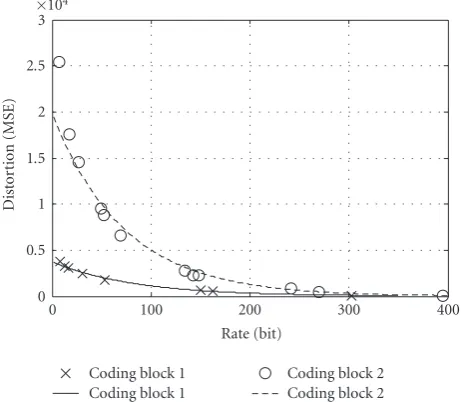
Figure3: R-D models for coding blocks in a wavelet video codec.
another one for GOP-level modeling) must be used together in order to speed up the nonlinear bitrate adaptation process.
3.1. Parameterized coding block-level R-D models
The application of the rate distortion theory [21] to video codecs is investigated in many literatures [12,19,20]. Some literatures [8,15] apply the function to embedded wavelet coder and make a little empirical adjustment on the parame-ters. A general R-D model for embedded wavelet coder with square-error distortion measure is as follows:
R(D)=γlnω
D, (1)
whereγandωare source-dependent parameters of the log-arithmic R-D model. In particular,ωis related to the signal variance of the source.
To verify the accuracy of (1) for wavelet coded sources, we conducted some experiments using the MSRA wavelet video codec reference implementation [5]. The test sequence is stefan in CIF resolution. The results for two coding blocks are shown inFigure 3. Each point in the figure represents an available truncated point in a coding block, and each curve represents the characteristic model for a coding block. The models are calculated by solving the parametersγandωin (1) using least-squares-error curve-fitting method. The ex-periment shows the precision and the reliability of the rate distortion function when applying to coding blocks with dif-ferent characteristics. Obviously, the R-D information of a coding block can be represented using simply two param-eters, γ andω, instead of 12 or 8 data points as shown in Figure 3.
algorithm of 3D-ESCOT, we still need a better model that represents the R-D information of a GOP of coding blocks.
3.2. GOP-level model and the proposed side information encoding mechanism
To apply the well-known R-D model (1) to efficient multiple adaptations of wavelet video bitstreams, two issues must be addressed first. First of all, an R-D model must be derived for a GOP of coding blocks. Second, the model should fa-cilitate the Lagrange multiplier-based iterative optimization algorithm of 3D-ESCOT. In order to achieve the second goal, the closed-form R-D model (i.e., theγ-ωmodel in (1)) must be changed to a closed-formR-λmodel.
3.2.1. R-lambda model and the model for a GOP of coding blocks
Recall that in (1), the parameterγdepends on the distribu-tion of the source, and the parameterωis related to the sig-nal variance. For a given valueλ, the Lagrange cost function J(R)=D+λRis minimized whendJ(R)/dR=0, that is,
λ= −dD(R)
dR . (2)
Taking the inverse of (1), we haveD(R)=ωe−R/γ.
Substi-tutingD(R) into (2), we obtain the relationship between the Lagrange multiplier and the rate. TheR-λmodel in coding block level can be written as
λ=αeβR, (3)
where the parameters α and β are source-dependent. For each coding block, a parameter pair of (α,β) will be esti-mated by curve fitting to realR-λdata points.
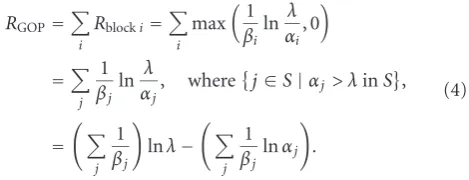
The GOP-levelR-λmodel can be extended from the cod-ing block model. First, defineR=max((1/β) ln(λ/α), 0) as a nonnegative R-D model. Forα >0 andβ <0, theR-λmodel at GOP level is derived as follows:
RGOP=
i
Rblocki=
i
max
1 βi
ln λ αi
, 0
=
j
1 βjln
λ
αj, where
j∈S|αj> λinS
,
=
j
1 βj
lnλ−
j
1 βj
lnαj
.
(4)
It is straightforward that the rate of a GOP is the sum of the rates of a group of coding blocks; and the size of the group is related to theλvalue. We define the two summation terms in (4) as follows:
pGOP=
j
1
βj, qGOP=
j
1
βjlnαj. (5)
11 10 9 8 7 6 5 4
ln(λ) 0
10 20 30 40 50 60 70 80 90
×104
Rat
e
y= −3957x3+ 128678x2−106x−5×10⁶
Figure 4: Example of GOP-level R-λmodel and real R-D data points.
In order to keep the model simple, we assume that these two summations can be modeled by polynomials as follows:
PGOP=a1 ln(λ)
n−1
+a2 ln(λ)
n−2
+· · ·+an,
qGOP=b1 ln(λ)
n−1
+b2 ln(λ)
n−2
+· · ·+bn.
(6)
Finally, the relationship of the GOP-levelR-λ model is established:
RGOP=pGOPlnλ−qGOP
=γ1(lnλ)n+γ2(lnλ)n−1+· · ·+γn+1.
(7)
Figure 4 illustrates the accuracy of the GOP-level R-λ model for a GOP of the stefan sequence. The order of the function is determined empirically. In general, a cubic func-tion can be used to fit the data points quite well for a wide range of rates.
3.2.2. Proposed rate-distortion side information coding mechanism
GOP 0 header Layer 0 header Comp 0 header Motion info if comp=0
Subband 0 Block 0 header · · ·
Subband 0 Blockn0header
Subband 1 Block 0 header · · ·
Subbandm−1 Blocknm−1header Subband 0
Block 0 body · · ·
Subband 0 Blockn0body
Subband 1 Block 0 body · · ·
Subbandm−1 Blocknm−1body . . . Layerk header Comp 0 header Motion info if comp=0
Subband 0 Block 0 header · · ·
Subband 0 Blockn0header
Subband 1 Block 0 header · · ·
Subbandm−1 Blocknm−1header Subband 0
Block 0 body · · ·
Subband 0 Blockn0body
Subband 1 Block 0 body · · ·
Subbandm−1 Blocknm−1body
Figure5: MSRA wavelet bitstream format (please note that there is no need to enforce layer structure for MCTF-based wavelet bitstreams).
The coding block-level model (3) is used as an adaptive model since the source-dependent parameters αandβare estimated based on the input data. Givennpairs of numer-ical data (λi,Ri),i = 0,. . .,n−1, the parametersαandβ
can be calculated as follows. First, (3) can be rewritten as lnλ=lnα+β·R. Therefore, forn >2, we have an overde-termined system of
⎛ ⎜ ⎜ ⎜ ⎜ ⎝
lnλ0
lnλ1
.. . lnλn−1
⎞ ⎟ ⎟ ⎟ ⎟ ⎠= ⎛ ⎜ ⎜ ⎜ ⎜ ⎝
1 R0
1 R1
1 ... 1 Rn−1
⎞ ⎟ ⎟ ⎟ ⎟ ⎠ lnα β . (8)
The system can be solved using least-squares estima-tion. Once the parameters α and β are determined, the relationship between the Lagrange multiplier and rate is di-rectly established. In a similar manner, the GOP-level R-λ model (equation (7)) is adaptively built by the least-squares curve-fitting method. For certain GOP, assume that
Y= ⎛ ⎜ ⎜ ⎝ RGOP1 RGOP2 .. . ⎞ ⎟ ⎟ ⎠, A= ⎛ ⎜ ⎜ ⎜ ⎝
lnλ1
n
lnλ1
n−1
· · · 1 lnλ2
n
lnλ2
n−1
· · · 1 .. . ... ... ⎞ ⎟ ⎟ ⎟ ⎠, X= ⎛ ⎜ ⎜ ⎜ ⎜ ⎝ γ1 γ2 .. . γn+1
⎞ ⎟ ⎟ ⎟ ⎟ ⎠, (9)
where the parametersγ1,γ2,. . .,γn+1 are solved by
comput-ing the pseudo inverse X = (ATA)−1ATY. As the whole
GOP-levelR-λmodel is established, theλvalue can be solved using closed-form solutions forn <5 (typicalnis 3).
The algorithm used to embed R-D information into an MSRA encoded bitstream is summarized as follows (note that the original discrete R-D information will be removed).
(1) Search for the optimal Lagrange multiplier at GOP level:
(a) find the firstnpairs of (λ,R) in a quality layer of the input wavelet bitstream (encoded by the original MSRA encoder), andnis typically 4 if cubic model is used in GOP level;
(b) solve for the parameter (γ1,γ2,. . .,γn+1);
(c) given the target bitrate, solve theR-λmodel for λ. Use the estimatedλto form a bitstream quality layer and obtain another (λ,R) data point; (d) add the new (λ,R) pair to the data set;
(e) iteratively doing the (b)–(d) steps until the R value is close enough to the target bitrate within a tolerable error rangeTR;
(f) repeat the procedure for other quality layers.
(2) Embed R-D property of each coding block. In proce-dure (d), a bitstream quality layer is formed given a GOP-level Lagrange multiplier value. The truncation point of each coding block is determined at the frac-tional bitplane pass with the nearest Lagrange multi-plier value using theR-λmodel of the coding block. The parameters α andβ are stored for each coding block, and the coding block-level rate allocation can be easily done by computing the inverseR-λmodel with a given Lagrange multiplier.
It must be emphasized again that storing a wavelet bitstream in multiple precomputed quality layers is not necessary, but can facilitate adaptation if the target rate happens to match exactly the quality layer rate. If this is not the case, new qual-ity layers must be formed at runtime (e.g., for the second adaptation and above).
4. PROPOSED MULTIPLE-ADAPTATION FRAMEWORK FOR CONTENT-ADAPTIVE FEC-PROTECTED WAVELET BIRSTREAMS
Proposed rate control extractor
Entropy-coded bitstream
Rate distortion characteristics
model
Bit allocation mechanism
Layer-structured /
fully embedded
bitstream Coding
block level
Rate (truncation point)
Rblock(λ) lambda
λ(RGOP)
rate (target bitrate) GOP level
Figure6: The framework proposed rate control extractor.
(
S
:2
,
T
:2
,
L
:
12)
(
S
:1
,
T
:2
,
L
:
12)
(
S
:2
,
T
:2
,
L
:5
)
(
S
:2
,
T
:4
,
L
:5
)
Condition 30
40 50 60 70 80 90
Ratio
(%)
Football Football Mobile
Mobile Foreman Foreman
Figure7: Computation reduction ratio of the proposed method.
encoded using the MSRA codec is organized in the format shown inFigure 5. InFigure 5,mis the total number of tem-poral and spatial subbands andniis the number of coding
blocks in subbandi.
To prepare a bitstream for multiple-adaptation applica-tion over lossy channels, the side informaapplica-tion will be used to determine the video data truncation point as well as the level of FEC protection for different fractional bitplanes. Note that the problem of adapting the bitstream to a specific bi-trate is not related the quality layer structure of the original bitstream mentioned inSection 3.2.2. If the target rate hap-pens to match one of the preencoded quality layers, the adap-tation process is as simple as extracting that quality layer as the output bitstream. However, preencoded quality layer only provides you with coarse-granularity scalability. In this sec-tion, it is assumed that the target bistream does not match
any of the quality layers in the original wavelet bitstream. Therefore, the adaptation process becomes much more com-plex.
A bitstream parser extracts the information for the trun-cated candidates from the headers. After all, the required data are collected, the subband data parsing-and-truncation procedure begins without entropy decoding involved. The parsing-and-truncation module is referred to as the tier-two process of 3D-ESCOT (seeFigure 2), and it decides the trun-cation point in order to meet the resolution, frame rate, and bit rate criteria. The bitstream is then composed again with new header information and truncated body bits. Note that in order to obtain an R-D optimized solution, the parsing-and-truncation process and bitstream composition process will be executed repeatedly until the quality layer converges to the target rate.
4.1. Rate adaptation procedure
R-D optimized adaptation of bitstreams is a complex process. Take the tier-two process of 3D-ESCOT for example. On a PC platform, according to a software profiler, the parsing-and-truncation process of the MSRA reference software ac-counts for 72% of the computation while the bitstream com-position process accounts for another 23% of the load. Note that the implementation of the MSRA reference software is not optimized, therefore this profile may be a rough indica-tion of the computaindica-tion distribuindica-tion of the algorithm. The proposed framework (seeFigure 6) tries to build a closed-formR-λrelationship for each coding block and each GOP. The rate of each coding block corresponds to the truncation point, and the rate of each GOP corresponds to the target bit rate. These two values are related to each others by theλ value. Therefore, the truncated point for each coding block can be selected given the target bit rate.
For the proposed algorithm, theλvalue is estimated in a different way. Because the GOP-level model is a cubic func-tion, the procedure begins with four evenly spaced initial guesses. Then the model is fitted to these data points. The closed-form model is then solved to determine theλvalue. If thisλvalue results in a bitstream that meets the target rate, the process stops, otherwise, the process will be repeated with the new (R,λ) pair replacing the first data point. Usually, the λestimation process can meet the target bitrate in two steps.
4.2. Adaptation of content-adaptive FEC protection
For video streaming applications, a source-coded video bit-stream is first protected by FEC codes, packetized into data packets, and then mapped to IP datagrams. If multiple adap-tations are required for a packetized bitstream, recalculation of the FEC codes may be required. In [12], we have proposed a fine-granularity unequal error protection mechanism for wavelet-based video. The mechanism uses the original MSRA R-D side information to fine-tune the protection level of coefficients of different fractional bitplanes. The approach maximizes the use of protection bit budget to achieve bet-ter performances than existing approaches of unequal error protection based on different syntax element types. However, multiple adaptations are not possible in [12] since side infor-mation were considered too expensive to protect and trans-mit.
In this section, the adoption of the proposed side infor-mation coding mechanism is incorporated into the content-adaptive FEC framework to facilitate multiple adaptations. For each group of video bitstream data, an (n,k) Reed-Solomon (RS) code can be applied to add resiliency to the data. For (n,k) RS code, nis the codeword length,kis the number of video data symbols (e.g., a symbol is composed of 8 bits of bitstream data). The number of parity symbols is 2s, where 2s=n−k. This means that if burst errors occur dur-ing transmission, the RS decoder can correct up toserrors and detect up to 2serrors per codeword.
Note that for content-adaptive FEC protection, the de-gree of protection levelsshould be based on the importance of the video data. In a wavelet video bitstream, the impor-tance of the coefficients within a coding block in a particular subband can be ranked based on the R-D side information of the coding block. After wavelet decomposition, the sub-bands can be arranged and indexed from low to high fre-quencies. The smaller the index is, the lower the frequency is. Therefore, each coding block in subbandihas a temporal subband indexωiand a spatial subband indexτi. The
impor-tance of the coefficients in a coding pass is first determined by the importance of the coding block it is located in. The importance of a coding block is in turn determined by the subband it is located in. The importance factorWiof a
cod-ing block is computed by
Wi=exp
(−1)·
T−ωi
·U1
T +
1 S−τi
, (10)
whereTis the maximum temporal-level index,Sis the max-imum spatial subband index, andU1is a weighting factor.
The level of FEC protection is defined by the values, the number of correctable symbols. Without loss of generality, assume that the bitstream of a coding block jis divided into mcodewords. The protection levelsj,xof the coefficients in
coding passxof coding blockjis computed by
sj,x=
αj·exp βj· x
k=0Rj,k
ω
·npl·Wj
,
sj,x=sj,x+o, o= ⎧ ⎪ ⎨ ⎪ ⎩
0 ifsj,xis even,
1 ifsj,xis odd,
(11)
wherex =0, 1,. . .,m−1, the parametersαiandβiare the
close-formR-λmodel (3) parameters for the coding blockj, Rj,xis the length of thexth RS codeword in coding block j,
npl denotes the estimated number of packet losses per
sec-ond, andωis a scale factor determined empirically. Equation (11) is designed so thatsi,0 ≥ si,1 ≥ · · · ≥ si,m−1, that is,
the level of protection decreases following fractional bitplane coding pass order. Note that the operation · stands for “taking the largest integer that is smaller than or equal to the parameter.”
For some multiple-adaptation applications, the second (and above) adaptations may be due to the change of de-vice capabilities instead of channel conditions. For such case, there is no need to recompute the FEC codes since the level of protection does not change. However, repacketization may still be necessary for efficient transmission of the readapted data.
5. EXPERIMENTAL RESULTS
In this section, some experiments on the proposed algorithm are conducted using the MSRA scalable video codec, with the MPEG test sequences, Stefan, Foreman, Mobile, and Football in CIF resolution.
5.1. Computational cost reduction for runtime bitstream adaptation
In this section, the number of iterations of the tier-two 3D-ESCOT nonlinear R-D optimization process is used as the measure for complexity analysis. This is a reasonable com-plexity measure since, as mentioned in Section 2, each it-eration of the nonlinear optimization must perform three things: R-D point determination, parsing and truncation of fractional bitplane coding passes, and bitstream composi-tion. A software profiler was used to estimate the ratio of re-quired machine instructions for these modules for Pentium instruction sets. On average, for each iteration, the parsing and truncation and bitstream composition together account for more than 95% of the complexity while the R-D point determination accounts for less than 1% of the complexity. Therefore, the overhead of R-D point determination is negli-gible.
Table1: Number of iterations for the MSRA and proposed approach.Sis Number of spatial scalabilities,Tis Number of temporal transform,
Lis Number of bitstream layers.
Sequence MSRA bisection R-λmodel Complexity saving ratio
Mobile (S: 2,T: 4,L: 5) 9.67 5.30 45.17% Mobile (S: 2,T: 2,L: 5) 9.67 4.18 56.77% Mobile (S: 1,T: 2,L: 12) 14.83 4.55 69.32% Mobile (S: 2,T: 2,L: 12) 14.83 3.39 77.14% Foreman (S: 2,T: 4,L: 5) 10.68 4.55 57.41% Foreman (S: 2,T: 2,L: 5) 10.68 3.48 67.43% Foreman (S: 1,T: 2,L: 12) 14.35 3.95 72.47% Foreman (S: 2,T: 2,L: 12) 14.92 2.68 82.04% Football (S: 2,T: 4,L: 5) 7.84 4.70 40.05% Football (S: 2,T: 2,L: 5) 7.67 3.26 57.50% Football (S: 1,T: 2,L: 12) 13.56 4.26 68.58% Football (S: 2,T: 2,L: 12) 13.62 3.12 77.09%
3000 2500 2000 1500 1000 500
0
Rate (kbps) 24
26 28 30 32 34 36 38 40 42
PSNR
(dB)
Stefan, CIF, frame rate 30
MSRA codec MSRA codec
Proposed method Proposed method
3000 2500 2000 1500 1000 500
0
Rate (kbps) 24
26 28 30 32 34 36 38 40 42
PSNR
(dB)
Stefan, CIF, frame rate 15
MSRA codec MSRA codec
Proposed method Proposed method
Figure8: PSNR performance comparison of Stefan.
used in the MSRA codec are shown inTable 1. The coding parameters used in the experiments are as follows. The GOP size is 64 and the frame rate is 30 fps. A cubic polynomial is used for the proposed GOP-level model, and the bitrate error threshold is set to 3% of the target bitrate. When the number of layers for each resolution and frame rate setting increases, the proposed search procedure can converge even faster by taking advantage of theR-λmodel from the previous layer. According to the experiments, the average complexity saving ratio is over 64%. The saving ratio of iteration times is about 60% when the layer number is 5, and up to 80% when the layer number is 12 (seeFigure 7).
Since the proposed mechanism allocates rate for each coding block differently from that of the MSRA codecs, the rate distribution (and quality) in a GOP is different from that
of the MSRA codecs. The coding efficiency is shown in Fig-ures8,9, and10. The test sequences are Stefan, Football, and Foreman in CIF resolution and are truncated at frame rates 30 and 15. The figures show that the proposed rate adapta-tion mechanism achieves similar PSNR performance in com-parison with that of the MSRA codecs at any rates. The aver-age PSNR degradation is less than 0.25 dB.
5.2. Side information saving for multiple adaptations
3000 2500 2000 1500 1000 500
0
Rate (kbps) 26
28 30 32 34 36 38 40 42
PSNR
(dB)
Football, CIF, frame rate 30
MSRA codec MSRA codec
Proposed method Proposed method
3000 2500 2000 1500 1000 500
0
Rate (kbps) 26
28 30 32 34 36 38 40 42
PSNR
(dB)
Football, CIF, frame rate 15
MSRA codec MSRA codec
Proposed method Proposed method
Figure9: PSNR performance comparison of Football.
1100 1000 900 800 700 600 500 400 300 200
Rate (kbps) 33
34 35 36 37 38 39 40 41
PSNR
(dB)
Foreman, CIF, frame rate 30
MSRA codec MSRA codec
Proposed method Proposed method
1100 1000 900 800 700 600 500 400 300 200
Rate (kbps) 33
34 35 36 37 38 39 40 41
PSNR
(dB)
Foreman, CIF, frame rate 15
MSRA codec MSRA codec
Proposed method Proposed method
Figure10: PSNR performance comparison of Foreman.
to 1.6%.Table 3illustrates the saving ratio for different GOP sizes. One can observe that the proposed method can prop-erly adapt for a variety of GOP lengths. In these experiments, the video sequences are encoded at 15 fps (150 frames) with temporal level 2 and single quality layer.
It is important to know that the original MSRA side in-formation is already in compressed format. Therefore, it is not possible to simply use a lossless compression technique to compress it. To demonstrate this point, two popular loss-less compression utilities, WinZIP and WinRAR, are used
to compress the side information of the original MSRA bistreams. The results are shown inTable 4 (the same en-coding settings as those forTable 3). FromTable 4, one can see that the average saving ratio using lossless compressor is about 2% while the proposed approach is more than 50%.
5.3. Content-adaptive FEC protection experiments
Table2: Side information saving ratio.
Sequence name Resolution/frame rate/bit rate(kbps)
Side information bits (% in bitstream)
Saving ratio MSRA Proposed method
Mobile
CIF/15/4096 CIF/15/2048 CIF/15/512 CIF/30/2048 CIF/30/512
898,872 (2.14%) 557,560 (2.66%) 163,944 (3.13%) 600,648 (2.86%) 164,864 (3.15%)
307,120 (0.73%) 245,696 (1.71%) 76,780 (1.47%) 297,500 (1.42%) 77,734 (1.48%)
65.89% 56.02% 53.04% 50.35% 53.02%
Foreman
CIF/15/1152 CIF/15/640 CIF/15/256 CIF/30/1152 CIF/30/640
433,112 (3.67%) 290,000 (4.43%) 127,120 (4.86%) 505,224 (4.28%) 308,480 (4.71%)
227,360 (1.93%) 140,963 (2.15%) 58,581 (2.24%) 245,089 (2.08%) 142,710 (2.18%)
47.41% 51.47% 53.91% 51.40% 53.72%
Stefan
CIF/15/4096 CIF/15/3072 CIF/15/1024 CIF/15/512 CIF/30/3072 CIF/30/1024
805,856(1.92%) 711,888(2.26%) 350,584 (3.34%) 218,112 (4.16%) 883,672 (2.81%) 404,744 (3.86%)
278,960 (0.67%) 312,435 (0.99%) 156,217 (1.49%) 103,215 (1.97%) 380,304 (1.21%) 190,152 (1.81%)
65.10% 56.19% 55.39% 52.64% 56.94% 53.11%
Average 3.39% 1.60% 54.73%
Table3: Side information bit overhead versus GOP size.
Sequence name Resolution/frame rate/bit rate(kbps)
Side information bits (% in bitstream)
Saving ratio MSRA Proposed method
Mobile
CIF/64/4096 CIF/32/4096 CIF/16/4096
898,872 (2.14%) 1,011,720 (2.41%) 890,696 (2.12%)
307,120 (0.73%) 307,440 (0.73%) 306,720 (0.73%)
65.89% 69.71% 65.57%
Foreman
CIF/64/1152 CIF/32/1152 CIF/16/1152
433,112 (3.67%) 552,744 (4.69%) 431,088 (3.66%)
227,360 (1.93%) 284,200 (1.95%) 227,200 (1.93%)
47.41% 58.85% 47.27%
Stefan
CIF/64/4096 CIF/32/4096 CIF/16/4096
805,856 (1.92%) 1,005,192 (2.40%) 759,384 (1.81%)
278,960 (0.67%) 278,720 (0.66%) 278,560 (0.66%)
65.1% 72.5% 63.54%
Average 2.76% 1.11% 61.76%
MPEG test sequences Stefan and Mobile are used. Those se-quences are encoded using the MSRA codec at 15 frames per second and the GOP size of 64 frames. Four levels of 5/3 MCTF temporal decomposition and three levels of 9/7 wavelet spatial decomposition are used for subband decomposition. The number of luma coding blocks is 1024 and the number of chroma coding blocks is 608.
Based on the reports in [22, 23], we have applied 5% packet loss rate to the IP packets in order to evaluate the performance of the proposed content-adaptive FEC protec-tion system. Adaptive FEC protecprotec-tion using the proposed side information is compared against that using the original MSRA side information. The PSNR of the luma channel of the reconstructed video sequences is shown in Figures11and
12. In either case, the maximal packet loss protection level can only recover up to 4% packet losses on average so that we can evaluate the differences in quality degradation using dif-ferent side information. As one can see from the figures, the proposed side information (using closed-form R-D model) is as efficient as the original side information (using discrete R-D data points) for content-adaptive FEC protection.
6. CONCLUSIONS AND FUTURE WORK
Table4: Lossless compression of side information.
Sequence name Resolution/GOP size/bit rate(kbps)
Side information bits (% for saving ratio)
MSRA WinZIP8.1 WinRar3.42
Mobile
CIF/64/4096 CIF/32/4096 CIF/64/512 CIF/32/512
898,872 1,011,720 163,944 164,144
869,288 (3.29%) 982,696 (2.87%) 162,464 (0.90%) 162,464 (1.02%)
869,256 (3.29%) 983,392 (2.80%) 162,280 (1.01%) 162,336 (1.10%)
Foreman
CIF/64/1152 CIF/32/1152 CIF/64/640 CIF/32/640
433,112 552,744 290,000 290,488
421,032 (2.79%) 542,904 (1.78%) 284,064 (2.05%) 284,600 (2.03%)
421,432 (2.70%) 543,008 (1.76%) 283,784 (2.14%) 284,384 (2.10%)
Stefan
CIF/64/4096 CIF/32/4096 CIF/64/1024 CIF/32/1024
805,856 1,005,192 350,584 350,504
780,752 (3.12%) 979,080 (2.60%) 343,536 (2.01%) 343,568 (1.98%)
780,584 (3.14%) 980,032 (2.50%) 343,312 (2.07%) 343,088 (2.12%)
Average 2.20% 2.23%
4000 3500 3000 2500 2000 1500 1000 500 0
Rate (kbps) 26
28 30 32 34 36 38 40 42
A
ver
age
P
SNR
(dB)
Coarse-discrete R-D model Coarse-discrete R-D model
Close-form R-D model Close-form R-D model
Figure11: Content-adaptive FEC test for the Stefan sequence (5% losses).
embedded in the coded bitstream by more than 50% on aver-age while maintaining the accuracy of the rate-distortion in-formation of the video data. In addition, the proposed tech-nique can reduce the computational complexity of the tier-two 3D-ESCOT wavelet adaptation process by more than 64% on average. Although the existing model achieves good performance, there are still rooms for improvement in the future. For example, at high resolution and high bitrate, the motion vector information is quite large and is not covered by existing R-D model. There have been some researches on scalable motion vector coding. Similar ideas can be applied to the construction of an R-D model for motion vector bits to further increase the performance.
5000 4500 4000 3500 3000 2500 2000 1500 1000 500 0
Rate (kbps) 26
28 30 32 34 36 38 40 42
A
ver
age
P
SNR
(dB)
Coarse-discrete R-D model Coarse-discrete R-D model
Close-form R-D model Close-form R-D model
Figure12: Content-adaptive FEC test for the Mobile sequence (5% losses).
ACKNOWLEDGMENT
This research is partly funded by National Science Council, Taiwan, under Grant no. NSC 95-2221-E-009-073-MY3.
REFERENCES
[1] ISO/IEC JTC 1/SC 29/WG 11, 14496-2: 2002 Information Technology - Coding of Audio-Visual Objects—Part 2: Visual 3rd Edition, March 2003.
[3] S.-J. Choi and J. W. Woods, “Motion-compensated 3-D sub-band coding of video,”IEEE Transactions on Image Processing, vol. 8, no. 2, pp. 155–167, 1999.
[4] J. Xu, Z. Xiong, S. Li, and Y.-Q. Zhang, “Three-dimensional embedded subband coding with optimized truncation (3-D ESCOT),”Applied and Computational Harmonic Analysis, vol. 10, no. 3, pp. 290–315, 2001.
[5] ISO/IEC MPEG Video Group,Wavelet Codec Reference Doc-ument and Software Manual V1.0, MPEG DocDoc-ument N7573, July 2005.
[6] A. Said and W. A. Pearlman, “A new, fast, and efficient im-age codec based on set partitioning in hierarchical trees,” IEEE Transactions on Circuits and Systems for Video Technol-ogy, vol. 6, no. 3, pp. 243–250, 1996.
[7] D. Taubman, “High performance scalable image compression with EBCOT,”IEEE Transactions on Image Processing, vol. 9, no. 7, pp. 1158–1170, 2000.
[8] P.-Y. Cheng, J. Li, and C.-C. J. Kuo, “Rate control for an em-bedded wavelet video coder,”IEEE Transactions on Circuits and Systems for Video Technology, vol. 7, no. 4, pp. 696–702, 1997. [9] T. Chu and Z. Xiong, “Combined wavelet video coding and
error control for Internet streaming and multicast,”EURASIP Journal on Applied Signal Processing, vol. 2003, no. 1, pp. 66– 80, 2003.
[10] J. Dong and Y. F. Zheng, “Content-based retransmission for 3-D wavelet video streaming on the Internet,” inProceedings of International Symposium on Information Technology: Coding and Computing (ITCC ’02), pp. 452–457, Las Vegas, Nev, USA, April 2002.
[11] W.-T. Tan and A. Zakhor, “Real-time Internet video using er-ror resilient scalable compression and TCP-friendly transport protocol,”IEEE Transactions on Multimedia, vol. 1, no. 2, pp. 172–186, 1999.
[12] C.-P. Ho and C.-J. Tsai, “Content-adaptive packetization and streaming of wavelet video over IP networks,”EURASIP Jour-nal on Image and Video Processing, vol. 2007, Article ID 45201, 12 pages, 2007.
[13] A. Aminlou and O. Fatemi, “Very fast bit allocation algorithm, based on simplified R-D curve modeling,” inProceedings of the 10th IEEE International Conference on Electronics, Circuits and Systems (ICECS ’03), vol. 1, pp. 112–115, Sharjah, United Arab Emirates, December 2003.
[14] W. Yu, “Integrated rate control and entropy coding for JPEG 2000,” inProceedings of Data Compression Conference (DCC ’04), pp. 152–161, Snowbird, Utah, USA, March 2004. [15] J. Li, C.-C. J. Kuo, and P.-Y. Cheng, “Embedded wavelet
packet image coder with fast rate-distortion optimized de-composition,” inVisual Communications and Image Process-ing, vol. 3024 ofProceedings of SPIE, pp. 1077–1088, San Jose, Calif, USA, February 1997.
[16] Y. Shan, S. Yi, S. Kalyanaraman, and J. W. Woods, “Two-stage FEC scheme for scalable video transmission over wireless net-works,” inMultimedia Systems and Applications VIII, vol. 6015 ofProceedings of SPIE, pp. 173–186, Boston, Mass, USA, Oc-tober 2005.
[17] W.-T. Tan and A. Zakhor, “Video multicast using layered FEC and scalable compression,”IEEE Transactions on Circuits and Systems for Video Technology, vol. 11, no. 3, pp. 373–386, 2001. [18] J. Goshi, A. E. Mohr, R. E. Ladner, E. A. Riskin, and A. Lipp-man, “Unequal loss protection for H.263 compressed video,” IEEE Transactions on Circuits and Systems for Video Technology, vol. 15, no. 3, pp. 412–419, 2005.
[19] J. T. H. Chung-How and D. R. Bull, “Robust H.263+ video for real-time Internet applications,” inProceedings of IEEE
Inter-national Conference on Image Processing (ICIP ’00), vol. 3, pp. 544–547, Vancouver, BC, Canada, September 2000.
[20] J.-R. Chen, C.-S. Lu, and K.-C. Fan, “A significant motion vector protection-based error-resilient scheme in H.264,” in Proceedings of the 6th IEEE Workshop on Multimedia Signal Processing (MMSP ’04), pp. 287–290, Siena, Italy, September-October 2004.
[21] C. Shannon, “A mathematical theory of communication,”Bell System Technical Journal, vol. 27, pp. 379–423, 623–656, 1948. [22] J. M. Boyce and R. D. Gaglianello, “Packet loss effects on MPEG video sent over the public Internet,” inProceedings of the 6th ACM International Conference on Multimedia, pp. 181– 190, Bristol, UK, September 1998.
[23] K. Lai, M. Roussopoulos, D. Tang, X. Zhao, and M. Baker, “Experiences with a mobile testbed,” inProceedings of the 2nd International Conference on Worldwide Computing and Its Ap-plications (WWCA ’98), pp. 222–237, Tsukuba, Japan, March 1998.
Ya-Huei Yuwas born in Taipei, Taiwan, in 1980. In 2003 and 2005, she received the B.S. and M.S. degrees in computer science and information engineering from National Chiao Tung University, Hsinchu, Taiwan. She joined MediaTek Inc. in 2005. Her re-search interests include image and video compression techniques and rate-distortion modeling of video contents.
Chien-Peng Ho received the M.S. degree in electrical engineering from National Tai-wan University of Science and Technology, Taipei, Taiwan, in 1995. He is currently pursuing the Ph.D. degree in the Depart-ment of Computer Science, National Chiao Tung University, Hsinchu, Taiwan. His re-search interests include video compression and transmission.
Chun-Jen Tsaireceived the B.S. degree in mathematics from Fu-Jen Catholic Univer-sity, Taiwan, in 1989, the M.S. degree in computer science and information engi-neering from National Taiwan University, Taipei, in 1992, and the Ph.D. degree in elec-trical engineering from Northwestern Uni-versity, Evanston, Ill, in 1998. From 1999 to 2002, he was with PacketVideo Corpo-ration, San Diego, CA, where he was