Security of the Internet of Things
Based on Game Algorithm
https://doi.org/10.3991/ijoe.v14i08.9178
Yue-e Yi
Changsha Social Work College, Changsha, China
Abstract—To explore the security mechanism of the Internet of Things
(IoT) perception environment, we perform a security research on the IoT on the basis of game algorithm. The dynamic game method of node cooperation is used in the experiments. Firstly, multiple report nodes are merged into a game party, and the dynamic game for two parties is established with the detection node. In the environment where the malicious nodes are dominant, the detection nodes collaborate, and the state of the unknown nodes is conjectured by the reputation value of the reporting nodes. The high trust reference report is used for the modification and reduction the weight of malicious nodes in the overall report, for node merging, and finally for bias equilibrium. The results show that cooperative game can significantly improve the success rate of incident moni-toring and reduce the number of forged reports.
Keywords—Internet of Things; perception environment; game; malicious
node; detection node
1
Introduction
The basic function of the IoT is to acquire and transfer information and realize the interconnection of all things. Therefore, expanding information source and realizing rapid and convenient information interaction has been the focus of IoT research. Co-operation is an important feature of the IoT. The IoT is recognized as a global net-work, enabling communication and cooperation between people and objects, things and objects. Wireless communication can support extensive cooperation in the IoT through wireless networks, which can significantly promote the development of the IoT. Therefore, more attention should be paid to research on cooperative-based wire-less communication in the IoT.
The starting point of game theory in mathematics was the publication of Theory of
Games and Economic Behavior in 1944. The work summarizes the typical behavior
characteristics of an economic subject, introduces the expansion and the strategic and matrix representation of game theory, defines the minimal and maximal solution, illustrates that the solution exists for all people's zero-sum games, proposes the con-cept and analysis method of a stable set solution. On the basis of summarizing the previous research results of game theory, the book Theory of Games and Economic Behavior provides the general framework and concept terms and expression methods of game theory and establishes a more systematic game theory. One of the main con-cerns of game theory is the problem of behavioral equilibrium among interacting strategies, and rational players in the system are important theoretical foundations of game theory. The rationality here refers to the driving effect of players' behavioral decisions. This process is one of the main concerns of game theory, namely, the sys-tem decision-making operation mechanism and syssys-tem optimization based on this guidance.
Based on the above background, this paper mainly combines game theory with the IoT, mainly aiming at the security of IoT based on game theory.
2
State of the art
In the last two years, privacy protection has elicited widespread interest along with the rise of the IoT, prompting several research institutions have started corresponding research plans.
authen-ticate device nodes [2]. Li (2017) proposed that the distributed management model, which considers the heterogeneous network as the center, was easier to implement in the Internet and mobile communication network. The sensing layer of the perception layer is the key to solving the problem of key management and authentication because of its limited resources [3].
In IoT mobile communication, Liu et al. (2014) analyzed the privacy of a location and the identity privacy of a 2G/3G system and proposed a solution for location pri-vacy in the cellular network through secure multiparty computing. The pripri-vacy pro-tection protocol is described as third party identity authentication, and the encryption-based identity standard is used in the new diffuse area [4]. Xie et al. (2017) used the location privacy protection mechanism based on density distribution function to pro-tect the privacy information, such as vehicle location in a vehicle network. This mechanism needs the help of the trusted third party, and some difficulty arises in the practical application [5].
Meanwhile, Shamshirband et al. (2014) pointed out that the game model can be di-vided into two categories: non-cooperative and cooperative. The former can be divid-ed into a complete rational game model and a limitdivid-ed rational game model according to the players' rational and irrational assumptions [6]. Tang et al. (2014) in the study pointed out that the game model can be divided into static, dynamic, and repeated action game models [7] in accordance with the sequential order of the players making decision actions in the game. Lee et al. (2015) stated that the information elements that players need to make decisions in the game can be divided into complete infor-mation and incomplete inforinfor-mation game models, and each of these models can be divided into complete information static, complete information dynamic, incomplete information static, and incomplete information dynamic [8]. Many other criteria and corresponding different division methods are available for game division.
In summary, research on the integration of the IoT and game theory remains lack-ing. The studies above focuses on either one or the other. Therefore, based on the above research status, this paper mainly studies the security of the IoT based on game theory. First, the game algorithm and the IoT are introduced, and then the game algo-rithm is applied to the security of the IoT, thereby enhancing the security of the IoT.
3
Method
3.1 Basic concepts of game theory
The basic concepts of game theory include player, action, information, strategy, utility, income, and equilibrium. Among them, the player is the decision maker who selects actions to maximize their utility. Action is the decision variable of the player, and strategy is the rule for players to select actions and provides the time and type of actions players select. Information refers to the knowledge of players in the game, including other players' strategies, actions, or utility functions.
{
1, ,
2 M; , ,
1 2 M}
G
=
S S
!
S u u
!
u
. (1)In (1), Si suggests the strategic collection of player I, S=S1!...!SM is the strategic combination space of all players, x refers to Cartesian product, and ui indicates the utility function of the player i.
3.2 Related concepts and hierarchical models of the IoT
On the premise of the continuous development of information science and technol-ogy, researchers in the related subjects of the IoT and related fields have started to investigate the IoT in depth, thereby producing a concrete image of the concept of the IoT. However, they have not yet formed a complete, accurate, and recognized con-cept. Generally, two common concepts of the IoT are used.
First, the IoT is a global network. It is based on the computer Internet and is formed by specific wireless data communication technologies (such as sensing tech-nology, radio frequency identification (RFID) technology and so on). Using specific information technology (sensor technology, RFID technology, etc.), the automatic recognition of global goods can be realized so as to share the relevant information of the computer Internet in real time, which is the essence of the IoT.
Second, the IoT is based on certain information sensing devices (such as RFID, in-frared sensors, laser scanners, and global positioning systems) and exchanges and processes information according to a single or multiple predetermined transmission protocols. The wired or wireless networks connect products and the Internet for the identification, location, tracking, monitoring, and management of objects, which is an intelligent network. The essence of intelligent network is to realize the interconnec-tion between all goods and the Internet and to achieve the purpose of quick identifica-tion and intelligent management. At present, this definiidentifica-tion is widely accepted and recognized. Therefore, managing object information perception, transmission, and monitoring processes is the core function of the IoT.
In the well-known architecture of the IoT, the IoT architecture of electric product code (EPC) global is the most representative. Its components are mainly composed of EPC coding technology, EPC label, EPC reader, server, and EPC middleware. Given these different functions, the architecture of the IoT can be roughly divided into three layers, namely, the perception layer, or the bottom, which is used for collecting in-formation; the network layer, or the middle layer, which is used for transmitting data; and the application/middleware layer, which is also known as the top layer.
In the architecture of the IoT, the functions of each layer are described in detail as follows:
sensor control technology, and short-distance wireless transmission and communica-tion technology.
The network layer (middle layer): the network is usually based on the existing In-ternet or mobile communication network, and the sensing data management and pro-cessing technology on this layer is the core technology for realizing the function of the IoT. The technology of perception data management and processing mainly in-cludes the theory of perception data storage, analysis, understanding, mining, and perception of database decision and behavior. As a major boost to the development of the IoT, the cloud computing platform has undergone rapid development. The cloud computing platform has a large storage capacity and capable of rapid analysis of mass sensing data. It is an important part of the network layer of the IoT and is the basis of application development.
The application layer (top layer): the problem of information processing and human–computer intersection is solved in the application layer. Perception data are analyzed and processed and then used in the application layer, which provides all types of applications for users and combines the information demand of individual industry with the technology of IoT. Thus, this layer is extensively used. The intelli-gent application of the IoT can be divided into various types, namely, logistics moni-toring and environmental monimoni-toring, inquiry of intelligent retrieval, intelligent trans-portation, smart grid control, mobile wallet, high-speed non-parking fee, and scanning type.
In 2005, the following key technologies in the IoT are described: device technolo-gy (used to perceive things), RFID technolotechnolo-gy (used for marking things), nanotech-nology, and key technology. Thus, a model of the IoT technology system can be ob-tained.
3.3 Attack suppression game method in a normal network
Given that malicious nodes in the IoT environment is capable of perceiving an en-vironment and intelligent processing, if the malicious nodes realize that unrestricted attacks will lead to their identification and isolation, a more flexible attack method will be taken, and such an attacker is conditional.
The attack logic of malicious nodes is discussed from the perspective of game the-ory. If the reputation is expected to be maintained in the inferior scene by the intelli-gent malicious node, the best strategy is not to take the attack behavior and not to forge the report, thereby reaching the bias equilibrium with the normal report node. This type of game is called the simple game.
mul-tiple reports on the same incident are combined in a manner that a game between several report nodes and an observation node is formed. Each report node has its own optimal strategic inference, and the final detection node makes its own optimal strate-gic inference according to the behaviors of all reporting nodes.
The specific deduction process is shown in Figure 1. The node first calculates the prior nature of the other party, the probability of taking a strategy, and the return val-ue of the other side after the other party takes the strategy. After determining the three values, the optimal strategy that maximizes the benefit can be calculated, and the conditional probability of the party is finally updated. This process can be conducted iteratively, and the strategic convergence of both sides is balanced.
Calculating the nature of
the other Calculate the possibility of a person taking a strategy Calculate the other side to take a strategy to benefit
Calculate the best strategy for yourself
Fig. 1. Derivation process of simple game
4
Results
4.1 Experimental setup
A network simulator can simulate different scenarios of the perception network. We reuse the module of node detection to evaluate the performance of the intrusion detection mechanism. The default parameters of the simulation are shown in Table 1.
Table 1. Experimental parameter setting
Area volume 1000!800 m2 Number of nodes 80 Node
communica-tion distance 200 m
Mobile node ratio 30% Mobile node speed 10 m/s Simulation time 200 s
4.2 Effect of simple game
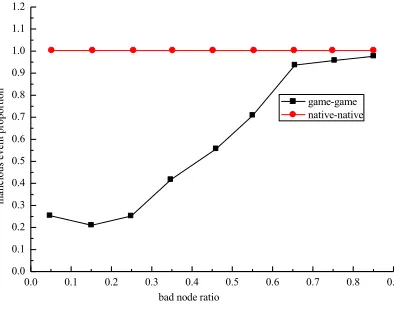
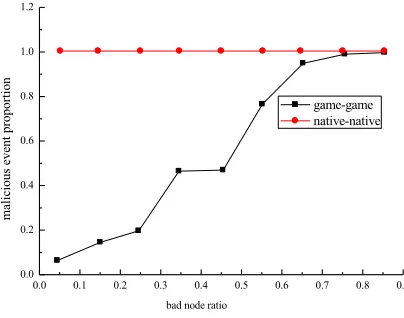
In this section, we design two groups of experiments. In the first group of experi-ments, malicious nodes unconditionally generate malicious incidents. In the second group of experiments, malicious nodes dynamically detect malicious incidents by a simple game by observing the surrounding environment. Figures 2–5 show the inci-dence of malicious incidents and the successful detection rate of the both experiments in normal and abnormal scenarios.
0.0 0.1 0.2 0.3 0.4 0.5 0.6 0.7 0.8 0.9 1.0 0.0
0.1 0.2 0.3 0.4 0.5 0.6 0.7 0.8 0.9 1.0
succe
ss
ful
dedu
ct
ion
rat
io
bad node ratio game-game native-native
Fig. 2. Success rate of incident detection in normal scene
0.0 0.1 0.2 0.3 0.4 0.5 0.6 0.7 0.8 0.9 0.0
0.1 0.2 0.3 0.4 0.5 0.6 0.7 0.8 0.9 1.0 1.1 1.2
bad node ratio
m
al
ici
ou
s event
proport
ion game-game
native-native
0.0 0.1 0.2 0.3 0.4 0.5 0 .6 0.7 0 .8 0.9 0 .0
0 .1 0 .2 0 .3 0 .4 0 .5 0 .6 0 .7 0 .8 0 .9 1 .0
su
cces
sf
u
l d
ed
uct
io
n
r
at
io
b ad n ode ratio
native-native game-game
Fig. 4. Success rate of incident detection in abnormal scene
0.0 0.1 0.2 0.3 0.4 0.5 0.6 0.7 0.8 0.9 0.0
0.2 0.4 0.6 0.8 1.0 1.2
bad node ratio
mal
ici
ou
s even
t p
ro
po
rti
on
game-game native-native
Fig. 5. Incidence rate of false report in abnormal scene
As unconditional malicious nodes forge reports anytime, the incidence of mali-cious incidents in the two scenes are all 100%, and malimali-cious nodes in a simple game forge report only when the nearby nodes are dominant. Therefore, the numbers of forged reports in Figs. 3 and 5 are approximately linear with the number of malicious nodes.
misjudg-ment. The greater the proportion of malicious nodes is, the lower the detection suc-cess rate is. As a result, when 90% of the malicious nodes are present, the detection success rates of methods are both less than 20%.
When the game mechanism is not used and malicious nodes are small, malicious attacks are easily detected but cannot be suppressed. The use of a simple game mech-anism not only enables the detection but also the suppression of malicious attacks. However, when the number of the malicious node is slightly less than that of the nor-mal node, nor-malicious incidents cannot be suppressed. When the number of nor-malicious nodes is equal to the number of normal nodes or larger than the normal node, the success rate of malicious incident detection drops sharply. Thus, the simple game is unsuitable for a scenario with prevalent malicious nodes.
4.3 Effect of cooperative game
The previous experiment indicates that the simple game method cannot reduce the number of false reports of malicious nodes and cannot effectively detect malicious events in environments with prevalent malicious nodes. In this section, we verify the performance of the cooperative game method.
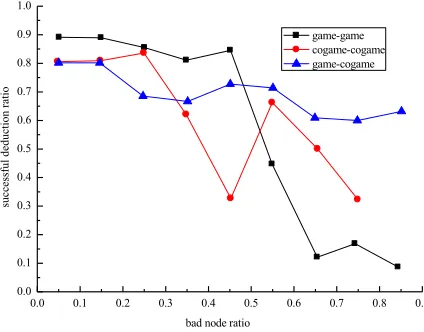
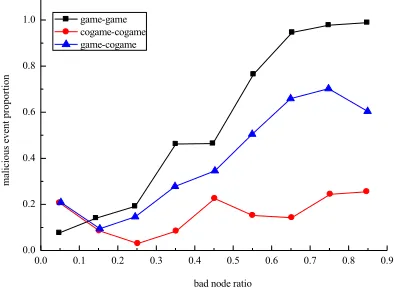
First, we perform four sets of experiments. In the first experiment, malicious report nodes and detection nodes do not use a game (native–native). In the second group, malicious report nodes and detection nodes both use the simple game (game–game). In the third group, malicious report nodes still use the simple game, but detection nodes use the cooperative game (game–cogame) to verify the success rate of the de-tection of malicious incidents by the cooperative game. In the fourth group, both use the organization cooperative game (cogame–cogame) to verify the restriction effect of the cooperative game on a malicious attack. Then, the forgery report incidence and incident detection success rates of the experiments in normal and abnormal scenarios are compared. The results are shown in Fig. 6–9.
0.0 0.1 0.2 0.3 0.4 0.5 0.6 0.7 0.8 0.9 0.0
0.1 0.2 0.3 0.4 0.5 0.6 0.7 0.8 0.9 1.0
succe
ss
ful
dedu
ct
ion
rat
io
bad node ratio
game-game cogame-cogame game-cogame
0.0 0.1 0.2 0.3 0.4 0.5 0.6 0.7 0.8 0.9 0.0
0.2 0.4 0.6 0.8 1.0 1.2
bad node ratio
m
al
ici
ou
s event
proport
ion
game-game cogame-cogame game-cogame
Fig. 7. Incidence rate of false report in normal scene
0.0 0.1 0.2 0.3 0.4 0.5 0.6 0.7 0.8 0.9 1.0 0.0
0.1 0.2 0.3 0.4 0.5 0.6 0.7 0.8 0.9
bad node ratio
succe
ss
ful
dedu
ct
ion
rat
io
game-game cogame-cogame game-cogame
Fig. 8. Success rate of incident detection in abnormal scene
0.0 0.1 0.2 0.3 0.4 0.5 0.6 0.7 0.8 0.9 0.0
0.2 0.4 0.6 0.8 1.0
m
al
ici
ou
s event
proport
ion
bad node ratio game-game
cogame-cogame game-cogame
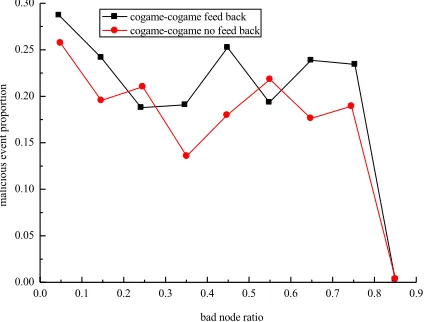
The previous experiment indicates that the success rate of incident detection is low when the detection report node uses a simple game, especially when the malicious nodes are above 80%. The detection success rates under the two scenarios do not exceed 20% and 30%, respectively. When the detection node uses the cooperative game and the normal node is dominant, the number of malicious reports is low, and the report tends to be normal. Thus, the success rate of incident detection is higher. When the malicious node is dominant, the malicious report in game–cogame increas-es, but at this time, the detection node reduces the weight of the suspicious node ac-cording to the observation of its own node, thereby reducing the proportion of the malicious report in the entire report. As a result, the success rate of the game-cogame incident detection is stable. When the historical records of observation nodes and malicious organization nodes are inconsistent with current observations, the larger the number of the inconsistent nodes is, the more effective the weight reduction process of a malicious organization is. When the number of malicious nodes increase from 70% to 90%, the success rate in abnormal scenes increases from 40% to 55%. When malicious organizations are dominant (malicious nodes account for 70%–90%), game–cogame relies on collaboration mechanisms to increase the detection success rate to a value that is higher than that of game-game (48.7% and 17.1% in two scenar-ios). By contrast, when malicious nodes are dominant, malicious nodes in cogame– cogame infer the strategy of detecting nodes. When the “detection node thinks that the best strategy is the refusal of forged report,” the report is not forged. Thus, the occur-rence rate of cogame-cogame malicious events in Figs. 7 and 9 is less than 30%, which is far lower than that of the other two methods, and the success rate of incident detection is high.
In a dynamic network, the report node cannot obtain all the data of the detection nodes, and the detection node cannot obtain the state of the uninteractive report node. Thus, an error occurs in the game. Therefore, the incident detection success rates of game–cogame and cogame–cogame contain errors, but the difference average is not higher than 15%. Similarly, few forgery reports are found in cogame-cogame, but they cannot be avoided completely. The two sides attain approximate bias equilibri-um.
In the actual detection success rate, although the mechanism cooperation game method can effectively improve the success rate of incident detection, a delay occurs in the interaction between the nodes in an organization. A certain time is required for the updating of the weight of an organization in a dynamic network. If the node is unstable, a certain influence occurs on the detection results. Therefore, the detection success rate of cogame–cogame in both scenarios is not higher than 80%.
4.4 Deduction of the effect of feedback interaction on game
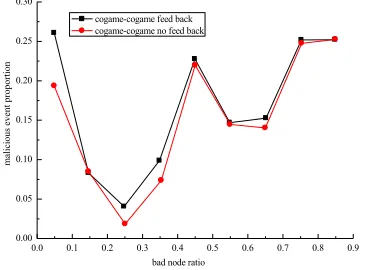
the error in the next round of speculation node strategy, and malicious incidents oc-cur. To reduce the number of malicious incidents, a detection node sends the infor-mation on weight reduction to the node after the malicious node is derived, so the malicious node may select not to forge a malicious report in the next interaction. Fig-ures 10–13 show the effect of mechanism with and without feedback on a game. In the two scenarios, the number of forged reports produced by the method of inference feedback is 20% and 13% less than that in the absence of feedback. The reason is that when a malicious node forges a report, in the absence of feedback, the detection node detects malicious behavior and reduces its credibility. However, a malicious node does not know the malicious behavior and may continue to take a forged report next time.
0.0 0.1 0.2 0.3 0.4 0.5 0.6 0.7 0.8 0.9 0.0
0.1 0.2 0.3 0.4 0.5 0.6 0.7 0.8 0.9
succe
ss
ful
dedu
ct
ion
rat
io
bad node ratio
cogame-cogame feed back cogame-cogame no feed back
Fig. 10. Success rate of incident detection in normal scene
0.0 0.1 0.2 0.3 0.4 0.5 0.6 0.7 0.8 0.9 0.00
0.05 0.10 0.15 0.20 0.25 0.30
m
al
ici
ou
s event
proport
ion
bad node ratio cogame-cogame feed back cogame-cogame no feed back
0.0 0.1 0.2 0.3 0.4 0.5 0.6 0.7 0.8 0.9 0.0
0.1 0.2 0.3 0.4 0.5 0.6 0.7 0.8 0.9
succe
ss
ful
dedu
cti
on
rat
io
bad node ratio cogame-cogame feed back cogame-cogame no feed back
Fig. 12. Success rate of incident detection in abnormal scene
0.0 0.1 0.2 0.3 0.4 0.5 0.6 0.7 0.8 0.9
0.00 0.05 0.10 0.15 0.20 0.25 0.30
m
al
ici
ou
s event
proport
ion
bad node ratio cogame-cogame feed back cogame-cogame no feed back
Fig. 13. Incidence rate of forged report in abnormal scene
5
Conclusion
6
References
[1]Chettri, R., Pradhan, S., Chettri, L. Internet of things: comparative study on classification algorithms (k-nn, naive bayes and case based reasoning). International Journal of Comput-er Applications, 2015, vol. 130(4), pp. 1009-1014. https://doi.org/10.5120/ijca2015907120 [2]Zeng, M., Wang, S. Fuzzy comprehensive evaluation algorithm for power information
sys-tem security level based on the internet of things. International Journal of Online Engineer-ing, 2016, vol. 12(5), pp. 17.
[3]Li, Z. A data classification algorithm of internet of things based on neural network. Inter-national Journal of Online Engineering, 2017, vol. 13(9), pp. 28. https://doi.org/10.3991/ ijoe.v13i09.7587
[4]Li, C., Liu, Q., Wang, G. Integrity verification algorithm for remote data in internet of things based on bilinear pairings. Zhongnan Daxue Xuebao, 2014, vol. 45(11), pp. 3824-3831.
[5]Xie, M., Huang, M., Bai, Y., & Hu, Z. The anonymization protection algorithm based on fuzzy clustering for the ego of data in the internet of things. Journal of Electrical and Computer Engineering, 2017, vol. 17, pp. 1-10. https://doi.org/10.1155/2017/2970673 [6]Shamshirband, S., Amini, A., Anuar, N. B., Kiah, M. L. M., Ying, W. T., Furnell, S.
D-ficca: a density-based fuzzy imperialist competitive clustering algorithm for intrusion de-tection in wireless sensor networks. Measurement, 2014, vol. 55(9), pp. 212-226. https://doi.org/10.1016/j.measurement.2014.04.034
[7]Tang, X. F., Niu, X. Z., Ali, S. Research on energy-aware topology strategy based on wireless sensor in internet of things. International Journal of Computational Intelligence Systems, 2014, vol. 7(6), pp. 1137-1147. https://doi.org/10.1080/18756891.2014.889858 [8]Lee, J. H., Jang, K. S., Kim, B. G., Jeong, S., Jin, S. C. Fast video encoding algorithm for
the internet of things environment based on high efficiency video coding. International Journal of Distributed Sensor Networks, 2015, vol. 6, pp. 4. https://doi.org/10.1155/ 2015/146067
7
Author
Yue-e Yi is associate professor at the School of Changsha Social Work College,
Changsha, China ([email protected]), His research interests include soft.