Extended Study of the Flipped Instruction
and Its Usefulness
https://doi.org/10.3991/ijoe.v15i03.9841
Christopher Nwosisi
The College of Westchester, New York, USA
Abstract—The old-style pattern of instruction has been to allocate students to read textbooks and work on assigned problems outside of school, while lis-tening to lectures and taking exams in class. With the introduction of Flipped instruction or a flipped classroom the students absorb new content online by watching video lectures, usually at home, and what used to be homework is now done in class with teachers offering more tailored direction and communi-cation with students, instead of lecturing. Up to fifty percent of the course, con-tent was flipped in this study. Results on six of the courses used will be present-ed and deliberatpresent-ed on.
Keywords—Flipped instruction and Flipped Classroom.
1
Introduction
Flipped instructions allow class time for practical work [1]. Students absorb by asking questions and doing. The innovated process benefit both the advanced and less advanced students because they can help each other [2].
In reversed instruction, the students typically use video lessons prepared by the teacher [3],[4] or third parties to first learn the topic by themselves. Students apply the knowledge by solving problems and doing practical work in class [5]-[6]. The Instruc-tor guides the students when they have trouble, rather than communicating the initial lesson in person. Corresponding methods comprise [7] of project-based learning and differentiated instruction [8]. Educators are combining the advantages of flipped learning with the old in-class lecturing through tools like eduCanon that keep students answerable to video lessons at home-based through time-engrained developmental assessments [9].
The thought behind the flip is that Instructors can spend time working with stu-dents who need their help in the classroom—and stustu-dents can work together to solve problems—rather than sitting home alone with work that they might not understand with nobody to ask for assistance.
Table 1. Students’ perceptions survey results
Questions Agree Disagree Neutral
I like this style to learning 85% 5% 10%
This style helped me learn the material better 76% 7% 17%
This style required more work 50% 17% 33%
I would want more of the material in the course taught this way 67% 17% 16% I would want other courses to use this style to learn 62% 17% 21%
The reason for this study is to confirm our previous study by adding four more courses. The paper is ordered as follows: Section 2 provides the Literature Review, Section 3 deliberates on the method and results, and section 4 presents the conclusion and proposals for future work.
2
Literature Review
The Literature review contains the previous results about Flipped or reversed in-struction or hybrid courses. Mixed (Blended) learning courses are well-defined as “classes in, which instruction takes place in an old-style classroom setting augmented by computer-based or online activities which can replace classroom seat time” [11]. Jeffrey R. Young pointed [12], “a growing number of colleges are experimenting with hybrid‟ or blended” models of teaching that replace some in-person meetings with virtual sessions.” Scida and Saury [11] further argue that hybrid courses are becom-ing increasbecom-ingly the norm in higher education in the United States as earlier predic-tions of the explosion of completely online courses have not been borne out in prac-tice” (see [13]-[16]). Additionally, Young [12] argues that hybrid classes are less controversial among university faculty than offering old-style fully virtual courses and that “hybrid courses may be a better way than fully online courses to help busy com-muter students.”
online than face-to-face, and therefore a mixture is the best way. What percentage that mixture should be would vary from course to course [12]. Over the past decade, there have been many advances in the technology and pedagogy of hybrid, or blended learning, courses. Moore [18], Moore, and Kearsley [19] have looked at the role of blended learning within the distance education landscape and Staker [20] has exam-ined the role of the disruptive innovation of online learning in the world of education. [21] looked specifically at emerging technologies that are continuing to enhance stu-dent-centered classrooms and [22] have looked at the recent practices and trends in blended learning from a global perspective. [23], [24] emphasized the role of commu-nity building and development of a commucommu-nity of inquiry in order to increase effec-tiveness and success of online teaching and learning. [25] found important relation-ships among teaching presence, cognitive presence, social presence, and students' perceived learning and satisfaction in the course. Finally, [26] argue that “The power of the hybrid course model is its flexibility and pedagogical effectiveness. Because it emphasizes active learning methods, it increases student interaction with other stu-dents and the instructor.”
3
Method and Results
3.1 Overview
The early work was deemed “Phase I” of the institution’s evaluation of flipped in-struction and learning, with the purpose of expanding on the process should the results of the first phase prove encouraging. DFW Rates and average Non-DFW were used as metrics. The average non-DFW grades, the average above D will be used as a com-parative assessment element for this research. The F grades and Withdrawals are clearly failures as Learning Outcomes. Both the Quantitative and Qualitative results from Phase I were very encouraging. Average grades increased, and even better, DFW rates are significantly reduced. Qualitative findings were also reassuring as 94% of students in this initial group responded that they liked this method to learning and 72% indicated that this approach “Helped [them] learn the material better”. The effort was then extended with a Phase II, in which 4 course offerings were correspondingly reversed, including one Evening course, comprised of customarily adult students.
All the participating instructors were required to explain and record their method. Each instructor chose to flip roughly every other week’s content, providing diversity of digital learning materials (videos, podcasts, docs, web-based tools) to be used out-side of class, joined with in-class exercises, projects, collaborative group work, and work on assigned labs, in groups and individual.
after the in-class session to clarify any misconception they may have about the mate-rial [27].
In Class Meeting: In each class meeting, the Instructor offers an outline of the course content. The students would have completed most of their outside require-ments and would be ready with any questions that they needed to ask. After the ques-tions are answered and the Instructor feels reassured that the students have proper understanding and clarity, the Instructor would then facilitate an in-class Lab activity to strengthen the student learning. The students would work on their Labs but are encouraged to collaborate with each other. At the same time, the Instructor provides help with the Lab as he moves from group to group and by answering any questions. After completing the Labs, the students are expected to be capable on that idea and are ready to take the quiz at that time [27].
Technologies Used: Packet tracer and Moodle are the main online technologies used in the Cisco Networking Basic pilot course. The Moodle enables the students to watch their online lectures as well as submit their completed Labs, which was done with Packet tracer. Packet tracer and Moodle are great resources to use outside of the classroom because of the many different methods they use to assist students to com-plete assignments. Each problem that the students encounter has links to various re-sources that they can use as an example. A given problem may have a link to a com-parable problem that shows step by step what to do. These solutions help, along with other tools, that give students the resources that they need to understand the course content [27].
3.2 Evaluation
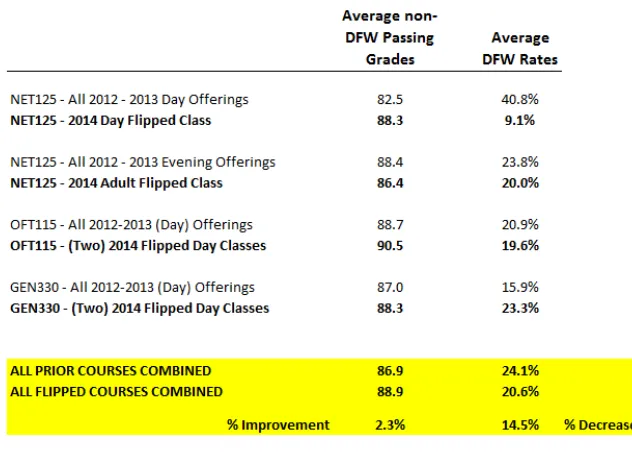
Qualitative and quantitative evaluation methods were designed and incorporated into the research. Quantitative methods include a comparison of final grades in the flipped course section to average grades and completion rates in prior offerings of the same courses, as well as possible comparisons of performance on assessments related to the flipped portions of each course to the assessments of the non-flipped portions. Table 2 shows the Quantitative results of current research as compared to 2012-2013. There were enhancements five out of the six courses. Five of six flipped classes expe-rienced higher average rates in the A to C- range, and the average grade rose by about 2%. This was not a statistically significant change.
Table 2. Average passing grade and improvement
Course Number Current Study 2012-2013 Improvement
NET-125 (DAY) 88.3 82.5 5.8%
NET-125 (EVENING) 86.4 88.4 -2%
OFT-115 (DAY) (2) 90.5 88.7 1.8%
GEN-330 (DAY) (2) 88.3 87 1.3%
rates across the six courses offered, on average, when compared to average rates for all same-shift availabilities of the courses during 2012 and 2013.
The decreases in DFW rates are reassuring and powerful outcomes. Grades of D, F, or Withdrawal play an important contributory role in the students’ failure to recall and ultimately graduate. A method that can steadily reduce DFW Rate occurrence is cer-tainly worth further exploration and pursuit.
Table 3. Average DFW rates
Course Number Current Study 2012-2013 Improvement
NET-125 (DAY) 9.1% 40.8% Yes
NET-125 (EVENING) 20.0% 23.8% Yes
OFT-115 (DAY) (2) 19.6% 20.9% Yes
GEN-330 (DAY) (2) 23.3% 15.9% No
Table 4. Grades and DFW rate comparisons
3.3 Qualitative evaluation: Student observations survey
To measure student’s thoughts on how the flipped delivery method affected their learning, five Questions were asked on this survey. Strongly Disagree, Disagree, Nei-ther Agree nor Disagree, Agree, and Strongly Agree, were response options for each question. Responses were summarized into 3 groups (by combining “Strongly Agree” and “Agree” together and combining “Strongly Disagree” and “Disagree” together). Table 1, shows the Qualitative outcomes of this study.
Most of the students (85%) in question No. 1 selected “Strong Agree” or “Agree” for this question (see Table I). 76% of students in question No. 2, a significant majori-ty, agreed that the flipped instruction method helped them learn the material better. In question No. 3, over half of the students felt that flipped instruction and learning did require more work, which is not surprising. In question 4, 67% of students answered in the affirmative on this question. In question 5, 62% of students agreed that they would want other courses to use this style to learn. It is interesting since most of the students said that they like the style and that they learned more. We believe that this might be due to multiple factors such as: the early class time, which is 8:00 am, stu-dents do not like to start their homework before class and they do not want to appear unknowledgeable on a certain topic [27]. These outcomes are quite supportive of the use of flipped instruction methods in students’ educative participations.
4
Discussion and Conclusion
5
Acknowledgement
The College of Westchester, White Plains, New York provided the opportunity for this study. I express my sincere gratitude to the Institution and to some of my Col-leagues.
6
References
[1]"The Flipped Classroom: Turning Traditional Education on Its Head". Knewton.
[2]Rosenberg, Tina (2013-10-09). "Turning Education Upside Down". New York Times. Re-trieved 2013-10-11
[3]Marco Ronchetti (June 2010), "Using video lectures to make teaching more interactive", International Journal of Emerging Technologies in Learning (iJET)
[4]Greg Topp (6 Oct 2011), "Flipped classrooms take advantage of technology", USA Today [5]"Flipping the classroom", The Economist, 17 Sep 2011
[6]Diana Mehta (8 Sep 2011), "Video in the class keeps savvy students engaged", The Cana-dian Press (Toronto)
[7]Daniel Pink (12 Sep 2010), "Flip-thinking - the new buzz word sweeping the US", The Daily Telegraph (London)
[8]Alvarez, Brenda. "Flipping the Classroom: Homework in Class, Lessons at Home". Na-tional Education Association. Retrieved 22 February 2012.
[9]Bill Tucker (Winter 2012), "The Flipped Classroom", EducationNext
[10]Jonathan Olsen and Sarah Gross (March 21, 2014). "Skills Practice - Alternative History as Narrative". New York Times.
[11]E. E. Scida and R. E. Saury, “Hybrid courses and their impact on Student and classroom performance:
[12]A case study at the University of Virginia,” CALICO Journal, vol. 23, no. 3, pp. 517–531, 2006.
[13]J. R. Young, “Hybrid‟ Teaching Seeks to End the Divide between Traditional and Online Instruction,” Chronicle of Higher Education, vol. 48, no. 28, pp. A33-A34, 2002.
[14]M. T. Ijab, R. Anwar, and S. Hamid, “Teaching and learning of e-commerce courses via hybrid e learn-ing model in Unitar,” Journal of Electronic Commerce in Organizations, vol. 2, no. 2, pp. 79-94, 2004. https://doi.org/10.4018/jeco.2004040107
[15]E. B. Lindsay, “The best of both worlds: Teaching a hybrid course,” Academic Exchange Quarterly, vol. 8, no. 4, pp. 16-20, 2004.
[16]D. Sauers and R. C. Walker, “A comparison of traditional and technology-assisted instruc-tional methods in the business
[17]H. G. Willet, “Not one or the other but both: Hybrid course delivery using WebCT,” The Electronic Library, vol. 20, no. 5, pp. 413-419, 2002. https://doi.org/10. 1108/02640470210447847
[18]T. Boyle, C. Bradley, P. Chalk, Jones, and P. Pickard, “Using blended learning to improve student success rates in learning to program,” Journal of Educational Media, vol. 28, no. 2–3, pp. 165−178, 2003. https://doi.org/10.1080/1358165032000153160
[19]M. G. Moore, Handbook of distance education, Routledge, 2013. [19] M. G. Moore and G. Kearsley, https://doi.org/10.4324/9780203803738
[21]H. Staker, “The Rise of K-12 Blended Learning: Profiles of Emerging Models,” Innosight Institute, 2011.
[22]C. R. Tucker, Blended Learning in Grades 4–12: Leveraging the Power of Technology to Create Student-Centered Classrooms, SAGE, 2012.
[23]C. J. Bonk and C. R. Graham, The handbook of blended learning: Global perspectives, lo-cal designs, Wiley. Com, 2012.
[24]Z. Akyol and D. R. Garrison, “Community of inquiry in adult online Learning: Collabora-tive-constructivist approaches,” in T. T. Kidd (Ed.), Adult learning in the digital age: Per-spectives on online Technologies and outcomes (Ch.VI), Hershey, PA: IGI Global, 2009. [25]Z. Akyol, N. Vaughan, and D. R. Garrison, “The impact of course duration on the
devel-opment of a community of inquiry,” Interactive Learning Environments, 2011.
https://doi.org/10.1080/10494820902809147
[26]Z. Akyol and D. R. Garrison, “The development of a community of inquiry over time in an online course: Understanding the progression and integration of social, cognitive and teaching presence,”
[27]Journal of Asynchronous Learning Networks, vol. 12, no. 2-3, pp. 3-23, 2008.
[28]Aycokc, C. Garnham, and R. Kaleta. (2002). Lessons learned from the Hybrid Course Pro-ject. Teaching with Technology Today, Online.
[29]C. Nwosisi, “A Study of the Flipped Classroom and Its effectiveness in Flipping Thirty Percent of the Course Content,” International Journal of Information and Education Tech-nology, Vol. 6, No. 5, May 2016 https://doi.org/10.7763/IJIET.2016.V6.712
7
Authors
Dr. Christopher Nwosisi attained his Doctorate Degree in Computing from Pace University, Master of Science in Management of Technology from Polytechnic Uni-versity and BA in Computer Science from Hunter College of the City UniUni-versity of New York. He has co-authored several papers in International Conferences and Scien-tific Journals. He has served as co-program chair, Session chair and as keynote speak-er at various Intspeak-ernational Confspeak-erences. At present, he is a Professor and an Associate Chair at The College of Westchester in White Plains, New York. He had received Faculty Recognition Awards, the Shining Star award in Teaching and numerous Pres-idential Commendations from the College of Westchester. He received the Upsilon Pi Epsilon Honors award for the Computing and Information Disciplines from Pace University in 2010. He received the IEEE senior membership award in 2007. He re-ceived the Recognition and Appreciation Awards from the Association for System Management in 1993 and 1994 respectively. Dr. Nwosisi has over 25 years of profes-sional experience and over 23 years of teaching experience. His current research interests include Teaching Methodology, Decision Tree, Machine Learning, Data mining, and Pattern recognition.