Multi-agent Finite-time Ideal Convergence Algorithm
Based on Bilinear Manifold
https://doi.org/10.3991/ijoe.v14i04.8364
Yuan Feng
Baoji University of Arts and Sciences, Baoji, China [email protected]
Abstract—Based on the traditional belief updating model, a concept of lief distance is put forward in this paper. On the basis of this concept, a new be-lief distance updating model for the multi-agent system is proposed, and the ra-tionality of the model is proved. In this model, the belief distance updating pro-cess of the multi-agent system is described, and the linear system is used to de-scribe the belief convergence process of the multi-agent system, which has sim-plified the complexity of the belief reachability analysis for the multi-agent tem. On the basis of this model, the belief reachability for the multi-agent sys-tems in the network control is analyzed, and the necessary and sufficient condi-tions for judging the belief reachability of the multi-agent system are given.
Keywords—Network Control; Multi-agent; Reachability of Belief; Bilinear Manifold Network
1
Introduction
With the rapid development of network technology and application and the emer-gence of multi-terminal and the integration with the multi-service, the Internet has shown more and more complex, heterogeneous, ubiquitous and other characteristics, which makes the current network more and more complicated and difficult to control. In order to improve the controllability of the network, a lot of literatures at home and abroad put forward the architecture of new bilinear manifold network [1-2] at present. As the multi-agent system has the distribution, autonomy, sociality and other charac-teristics, the realization of network control by using the multi-agent system is condu-cive to reducing the complexity of the network control and improving the reliability and intelligence of the network control. And the use of multi-agent system to realize the network control has become an effective means to implement the bilinear mani-fold network [3].
con-trol by using the multi-agent system, it is necessary to ensure that each agent before making the decision should have the belief that is consistent with the current network status, that is, the multi-agent system should have the belief reachability [5]. In the bilinear manifold network, what people are concerned is whether the belief of the multi-agent system has the reachability under the current network conditions as well as the belief convergence rate of the system, while they are not concerned about the specific behavior of each agent. In this case, if the traditional belief updating model of the multi-agent system is used to study the multi-agent system belief updating model, a large volume of unnecessary calculations will be introduced [6].
Aiming at the above problem, a belief distance concept and a new belief distance updating model for the multi-agent system in the new bilinear manifold network is put forward on the basis of the traditional multi-agent belief updating model in this paper, and the rationality of the model is proved. The model describes the belief distance updating process of each agent in the multi-agent system, regardless of the specific behavior of each agent in the belief updating process. A linear system is used to de-scribe the belief convergence process of the multi-agent system, which has simplified the belief updating process of the agent, and provides an abstract platform for the direct research of the belief reachability of the multi-agent system in the bilinear man-ifold network. On the basis of the model, the belief reachability of the multi-agent system with bilinear manifold network realized in the normal environment is ana-lyzed, and the upper bound of the necessary and sufficient conditions for the belief reachability that the multi-agent system has is given.
2
Multi-agent Belief Reachability Algorithm
2.1 Multi-agent System Belief Distance Updating Model
As network control is a dynamic process, the belief updating process of each agent may be interrupted by the network events at any time, people are not concerned about the updating behavior of each agent in the process of the belief updating, but are con-cerned about whether the belief of each agent can reach its reachability rate under the current network conditions and the magnitude of the reachability rate. Therefore, in this section, a new model for the analysis of the belief reachability and the reachabil-ity rate of the multi-agent systems in the bilinear manifold network is provided.
further change of the former route. Through the repetition, it finally reaches the stabil-ity of the two AS routing. In the bilinear manifold network, the state of the network at the moment
t
can be expressed by ann
dimensional vectory t
( )
, and the belief ofagent
iat the momentt
can also be represented by ann
dimensional vectorx t
i( )
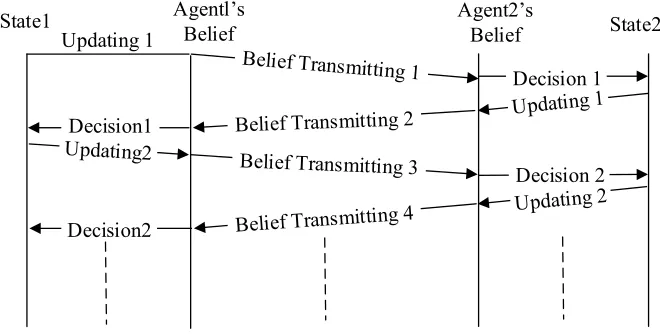
.State1
Updating 1
Agentl’s
Belief State2
Decision2 Decision1
Decision 2 Decision 1 Agent2’s
Belief
Fig. 1. Multi-agent system belief interaction process
Definition 1 (Belief distance)
.
At the momentt
, the belief distancex
!
it
( )
ofi
agent
is defined as the Euclidean distance from the beliefx t
i( )
of
agent
ito thenetwork state
y t
( )
, that is!
x
i( )
t
=
x
i( )
t
!
y
(
t
)
(1)
At the moment
t
, the belief distance of each agent can form ann
dimensional vec-torX t
!
( )
. And it can be considered that when the belief distance of each agent is 0, the belief of the agent is consistent with the actual state of the network, that is, the SCE state. Therefore, SCE state can be defined as the following:Definition 2 (SCE state)
.
At the momentt
, if the belief distancex
!
it
( )
of any of the agents in the multi-agent system is 0, that is!
x
i( )
t
=
0
(2)
Definition 3 (belief reachability)
.
If the belief of the multi-agent system con-verges to the SCE state, that islim
t!"
!
X t
( )
=
0
(3)
It is referred to as that the belief of the multi-agent system has the reachability. It can be obtained from the belief updating process of the agent that, the belief dis-tance of each agent to the network state is constantly updated through the interaction between each other. In order to make it more convenient to study the belief reachabil-ity and the reachabilreachabil-ity of the multi-agent system in the bilinear manifold network, in this paper, a new belief distance updating model based on the updating process of the belief distance of each agent is put forward, as shown in the theorem a the following.
Theorem 1. In the bilinear manifold network, the dynamic updating process of the belief of each agent can be expressed by the linear differential equations as the fol-lowing:
!"
X t
( )
=
A
X t
!
( )
(4)
In which,
X t
!"
( )
stands forn
dimensional vector, which shows the difference of the belief distance of each agent at the momentt
, andA
is a coefficient matrixProve: The difference equation of
agent
ifrom the belief to the network state is as the following!
x
i( )
t
+1
+
x
!
i( )
t
=
x
i( )
t
+1
!
y t
( )
+1
!
x
!
i( )
t
=
!
i( )
t
+1
!
x
!
i( )
t
In which,
!
n+1stands for the remaining distance of the network state fitting bythe
agent
i. In the the multi-agent system, the remaining distance of the network statefitting by the
agent
iis caused by the difference of the belief from the network state ofthe agent in the process of interacting with the other agents. And the magnitude of the remaining distance is determined by the distance of the belief of each agent to the network state, that is,
!
i( )
t
+1
=
h
(
x
!
1( )
t
,
…
,
x
!
i( )
t
,
…
,
x
!
n( )
t
)
. It can be simplyconsidered that
h
is a linear function, that is,!
i(
t
+
1)
can be expressed as a linearcombination of
x
!
j( )
n
, that is,!
i( )
t
+
1
=
b
ij
x
!
j( )
t
(
)
j=1
n
Let
a
ij=
b
ij( )
i
!
j
, thena
ii=
b
ii!1
. Hence the difference equation of the belief of theagent
ito the network state can be written as the following:!
x
i( )
t
+
1
!
x
!
i( )
t
=
a
ijx
!
j( )
t
(
)
j=1
n
"
(5)
Therefore, the belief updating process of the multi-agent system can be expressed as the difference equation form as
!"
X t
( )
=
A
X T
!
( )
. Thus it is proved.In the equation (5),
a
ijstands for the coefficient of the ratio of the distance change of the belief of the relatedagent
ifrom the network state in the next moment caused by the change in the network state which is perceived by theagent
jat the momentt
,and
0
!
a
ij!
1
(
i j
"
)
,! "
1
a
ii"
0
, which is referred to as the belief couplingbetween the agents. The coefficient matrix
A
is referred to as the belief coupling matrix.2.2 Analysis of the Multi-agent System Belief Reachability
In the bilinear manifold network, the belief reachability of the multi-agent system is the basis for the effective control of the network. Each agent can control the net-work only when it has the same belief, so as to avoid the ambiguity on the control of the network. In this section, based on the belief distance updating model of the multi-agent system, the related knowledge of modern cybernetics will be used to make analysis on the realization of the belief reachability of the multi-agent system of the bilinear manifold network in general network environment, and the corresponding examples will be given.
Theorem 2
.
The belief of the multi-agent system has the reachability, if and only if all the eigenvalues of the belief coupling matrix have the negative real part.Proof: Assuming that
A
has the different eigenvalue! !
1, ,
2!
!
n, then the non-singular transform matrix must be constructed fromn
independent eigenvectors so as to achieve the diagonalization ofA
, that is,A P AP
'=
!1 , in whichA
'is thediago-nal matrix with
! !
1, ,
2!
!
nas the diagonal elements.eAt=PeA't
P!1=P
e!1
e!2 !
e!n " # $ $ $ $ $ % & ' ' ' ' '
P!11=P E ie
!itP!1 i=1
n
(
= PEiP!1e!it= R
ie !it
i=1 n
(
i=1n
In which,
E
istands for a matrix, thei
-th element on its diagonal is 1, and there-maining elements are 0;
R PE P
i=
i !1stands for a constant matrix. Therefore, thesolution for the equation (4) is
X t
!
( )
=
e
AtX
!
( )
0
=
R
ie
!it i=1n
!
"
#
$$
%
&
''
X
!
( )
0
, inwhich
X
!
( )
0
is the initial value.Sufficiency: If
R
e( )
!
i<
0
is established,lim
t!"
X t
!
( )
=
0
. Therefore, belief of the
multi-agent system has the reachability. Hence the sufficiency is proved. Necessity: The reduction to absurdity method is adopted.
lim
t!"
X t
!
( )
=
0
, but thereare some
!
iexisting which makeR
e( )
!
i>
0
and, then whenX
!
( )
0
!
0
, thecorre-sponding items in
X t
!
( )
will be extended infinitely, which is contradictoryto
lim
t!"
!
X t
( )
=
0
. Therefore,R
e( )
!
i<
0
. In addition, ifR
e( )
!
i=
0
is existent, thecorresponding item of
X t
!
( )
is constant, which is also contradictoryto
lim
t!"
!
X t
( )
=
0
at this point. Hence the necessity is provedTheorem 2 gives the necessary and sufficient conditions for the belief reachability of the multi-agent system under the new belief distance updating model. It can be seen that the problem of the belief reachability of the multi-agent system in the biline-ar manifold network is equivalent to the problem of the asymptotic stability of the linear system constructed by the equation (4).
3
Experiment and Analysis
1
0.84878 0.075706 0.063819 0.12743 0.085986 0.066239
0.11169
0.99357 0.042132 0.062858 0.015051 0.12193
0.16031 0..093739
0.94285 0.15005
0.12255
0.11411
0.027163 0.062052
0.1613
0.96943
0.0007
0.16308
0.12477
0.13213 0.
A
!
!
!
=
!
079968 0.061386
0.89948 0.033964
0.062344
0.13254
0.061388 0.15291
0.15948
0.90112
"
#
$
%
$
%
$
%
$
%
$
%
$
!
%
$
%
$
!
%
&
'
20.9207 0.062538 0.039798 0.064406 0.070308 0.01094
0.021689
0.98948 0.010758 0024773 0.073458 0.060394
0.04289
0.00358
0.95968 0.014821 0.058335 0.07496
0.053028 0.03091
0.0788
0.94243 0.062974 0.014225
0.033413 0.0577
A
!
!
!
=
!
75 0.030645 0.021995
0.91878 0.003585
0.040551 0.077985 0.027374 0.038145 0.033513
0.96007
"
#
$
%
$
%
$
%
$
%
$
%
$
!
%
$
%
$
!
%
&
'
30.95034 0.076475 0.053419 0.04989 0.000489 0.061663
0.065152
0.96766 0.082992 0.018435 0.06805
0.06826
0.002799 0.039332
0.95837 0.033223 0.057574 0.021737
0.071415 0.007338 0.035838
0.9749 0.081749 0.058668
0.056884 0
A
!
!
!
=
!
.077092 0.069097 0.052795
0.99149 0.024706
0.066821 0.05654 0.009724 0.078749 0.003746
0.99314
"
#
$
%
$
%
$
%
$
%
$
%
$
!
%
$
%
$
!
%
&
'
And the corresponding eigenvalues of
A A A
1, ,
2 3are as the following1 2
0.4853 0.7313
1.1201 0.0248i 1.1035 1.1201 0.0248i 0.9518
( ) , ( ) ,
1.0319 0.0777i 1.0227 0.0208i 1.0319 0.0777i 1.0227 0.0208i
0.9975 1.0066
A A
!
!
" "
# $ # $
%" + & % " &
% & % &
%" + & % " &
=% & =% &
" + " "
% & % &
%" + & %" " &
% & % &
% " & % " &
3
1.8834
0.6045 0.3004i
0.6045 0.3004i
( )
1.0009 0.3919i
1.0009 0.3919i
1.1825
A
!
"
#
$
&
+
%
$
%
$
&
+
%
=
$
%
&
&
$
%
$
&
&
%
$
%
$
&
%
'
(
Since the real parts of the eigenvalues
!
( )
A
1 and!
( )
A
2 ofA
1andA
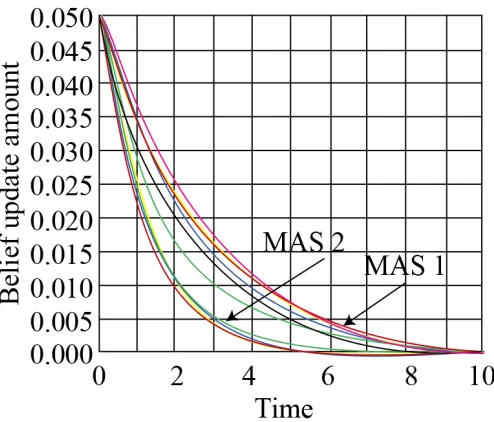
2 are both less than 0, the belief space of the two multi-agent systems is finally belief accessible. As shown in Fig. 2, each curve in the figure stands for the belief convergence process of an agent. In the figure, the curves are divided into two groups: The belief conver-gence process of each agent in MAS1 is represented by the dotted line in the figure; and the time convergence process of each agent in MAS2 is represented by the solid line in the figure. It can be seen from the figure that, the belief distance updating pro-cess of the two systems is convergent, and there is a non-negative real part existing in!
( )
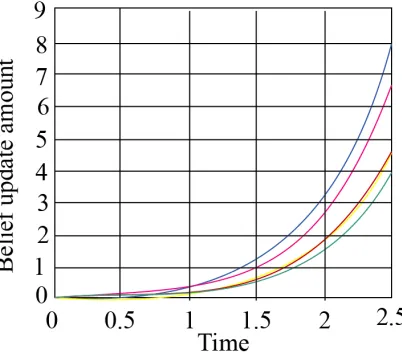
A
3 . The belief updating between the agents will increase with the network time. And the belief of MAS3 is divergent, as shown in Figure 3.Fig. 3. MAS3 belief convergence process
4
Conclusions
In the bilinear manifold network, the use of multi-agent system is an important method of the network control, while the belief reachability of the multi-agent system is the basis for the effective control of the network. Therefore, the studies on the be-lief reachability of the multi-agent system are of very important significance. In this paper, a new belief distance updating model for the multi-agent system is put forward, which transforms the belief reachability problem of the multi-agent system in the bilinear manifold network into a linear system problem. This has simplified the com-plexity of the studies of the belief reachability of the multi-agent system in the biline-ar manifold network. On the basis of the model, the belief reachability of the multi-agent system is studied accordingly.
5
References
[1]Bnouhachem, A., Ansari, Q. H., & Yao, J. C. (2016). Strong convergence algorithm for hi-erarchical fixed point problems of a finite family of nonexpansive mappings. Fixed Point Theory, 17(1), 1-17.
[2]Bauschke, H. H., Cruz, J. B., Nghia, T. T., Phan, H. M., & Wang, X. (2014). The rate of linear convergence of the Douglas–Rachford algorithm for subspaces is the cosine of the Friedrichs angle. Journal of Approximation Theory, 185, 63-79. https://doi.org/10.1016/ j.jat.2014.06.002
[3]Bnouhachem, A. (2014). Strong convergence algorithm for approximating the common so-lutions of a variational inequality, a mixed equilibrium problem and a hierarchical fixed-point problem. Journal of Inequalities and Applications, 2014(1), 154.
[4]Boissier, O., Bordini, R. H., Hübner, J. F., Ricci, A., & Santi, A. (2013). Multi-agent ori-ented programming with JaCaMo. Science of Computer Programming, 78(6), 747-761.
https://doi.org/10.1016/j.scico.2011.10.004
[5]Seyboth, G. S., Dimarogonas, D. V., & Johansson, K. H. (2013). Event-based broadcasting for multi-agent average consensus. Automatica, 49(1), 245-252. https://doi.org/10.1016/ j.automatica.2012.08.042
[6]Oh, K. K., Park, M. C., & Ahn, H. S. (2015). A survey of multi-agent formation control. Automatica, 53, 424-440. https://doi.org/10.1016/j.automatica.2014.10.022
6
Author
Yuan Feng is with the School of Electrical&Electronic Engineering at Baoji Uni-versity of Arts and Sciences, Baoji, China ([email protected]).