Assessment of palm kernel shell as a composite aggregate in
concrete
Okechukwu P. Oti
1, Kevin N. Nwaigwe
2*, Ngozi A. A. Okereke
1(1. Department of Agricultural and Bioresources Engineering, Federal University of Technology Owerri, PMB 5206 Nigeria; 2. Department of Mechanical and Industrial Engineering, University of South Africa, Science Campus Florida, 1710 South Africa)
Abstract: This manuscript presents a report on the physical properties of palm kernel shell used as a coarse aggregate and their effect on the strength properties of palm kernel shell concrete. Laboratory research was carried out to observe the effects of replacing crushed granite by palm kernel shell on the compressive strength and density of palm kernel shell concrete. Mix design of 1:2:4 and a water-cement ratio of 0.6 were used to produce concrete specimen cubes of size 150 mm3. A total of 60 cubes were made and wholly submerged in water to cure for 28 days at intervals of seven days i.e. seven, 14, 21 and 28 days after which their densities and compressive strengths were determined. Granite was replaced by palm kernel shell in the mix at 25% interval resulting in three replicates of specimen cubes at each curing age. Compressive strength and density decreased continuously as palm kernel shell was added to the mix for all the Curing ages tested. The 28 day compressive strength of the palm kernel shell concrete ranged from 12.71 to 16.63 N mm-2, whereas the density ranged from 1562 to 2042 kg m-3. Physical properties tests conducted include sieve analysis, bulk density, moisture content and specific gravity to describe aggregates. The specific gravities of sharp sand, crushed granite and palm kernel shell were found to be 2.5, 2.76 and 1.301 while their bulk densities are 1650, 1545, and 634 kg m-3 respectively. Water absorption capability tests on crushed granite and palm kernel shell were observed to be 6% in both 1 h and 24 h, 11% in 1 h and 21.5% in 24 h respectively. All the aggregates utilized in this research work demonstrated their suitability in concrete production given by the observations as physical properties result presented.
Keywords: palm kernel shells, coarse aggregate, curing, physical properties, compressive strength
Citation: Oti, O. P., K. N. Nwaigwe, N. A. A. Okereke. 2017. Assessment of palm kernel shell as a composite aggregate in concrete. Agricultural Engineering International: CIGR Journal, 19(2): 34–41.
1 Introduction
The management and pollution problems associated
with agricultural and industrial wastes have posed a lot of
challenges to engineers and experts in different
engineering and related fields. The nuisance caused by
the dumping of palm kernel shell waste and the quest to
investigate its possible utilization has necessitated this
work. Recently, research has been conducted by
Alengaram et al.(2011), Alengaram et al. (2013), Shafigh
et al. (2010), Shafigh et al. (2011), Shafigh et al. (2012)
Received date: 2016-09-25 Accepted date: 2017-01-13 * Corresponding author: Dr Kevin N. Nwaigwe, Research Fellow, Mechanical & Industrial Engineering Department University of South Africa. Tel: +27 62 756 8992, Email: [email protected].
on palm kernel shell and its concrete. Palm kernel shells
are inflexible, carbonaceous, and organic by-products of
the processing of the palm oil fruit; they consist of small,
medium and large sizes of particles in the range 0-5 mm,
5-10 mm and 10-15 mm respectively; they are organic
waste materials obtained from crude palm oil producing
factories in Asia and Africa (Alengaram et al., 2010).
Okiy (1988) reported palm kernel shell to be made up of
33% charcoal, 45% pyroligneous liquor and 21%
combustible gas. Basri et al. (1999) observed the hard
nature of the shell and went further to report that once it
is bound in concrete matrix it does not easily deteriorate
and consequently, does not contaminate or leach to
produce lethal substances. Basically, composites of
concrete are known to be cement, water, fine and coarse
which concrete is made. The cement in concrete matrix is
what binds all the other components together in the
presence of water. Varying proportions of the different
composites of concrete in the matrix determine to a great
extent the outcome of the structure. Alexander and
Mindness (2005) observed and reported the obvious
importance of aggregate in a concrete matrix especially in
the coarse composite. They reported that aggregate
occupies between 70% and 80% of the total volume of
concrete. With this large proportion of the concrete being
occupied by aggregate, it is expected for aggregate to
have an overwhelming effect on the properties of
concrete as well as its general performance.
The compressive strength of concrete is one of the
most important technical properties. In most structural
applications, concrete is employed primarily to resist
compressive stress. In those cases where other stresses
(tensile, etc.) are of primary importance, the compressive
strength is still frequently used as a measure of the
resistance because this strength is the most convenient to
measure. For the same reason, the compressive strength is
generally used as a measure of the overall quality of the
concrete, even when strength itself may be relatively
unimportant (Popovics, 1998; Kibar and Öztürk, 2015).
Analysing hydraulic mortars from ancient cisterns and
baths, Stefanidou et al. (2014) observed that the coherent
and dense structure of hydraulic mortars is due to the
action of different mechanisms caused by the selection
and combination of raw materials and the interaction with
the special environment into which they served. This
emphasises the importance of selection of raw materials
utilized as aggregates.
The objectives of this research include determining
the compressive strength of lightweight concrete
containing palm kernel shell aggregate in percentage
replacements and to determine the physical properties of
palm kernel shell, sharp sand and crushed granite.
2 Materials and Methods
2.1 Materials Selection
2.1.1 Palm Kernel Shell
Palm kernel shell used in this study was collected
from a local palm oil processing factory at Mbarakpaka
village in Ihiala town, Ihiala Local Government Area of
Anambra State in Nigeria. In most parts of South-South
and South-East of the Country palm kernel shells are
dumped in open fields. Due to the organic nature and
pore spaces in these shells, they are likely to either
enhance or reduce their moisture contents over these
periods of exposure due to varying weather conditions in
these areas. It is important to determine the moisture
content of palm kernel shell especially before use in
concrete specimen production. Preparation of palm kernel
shell was done first by soaking overnight in water with
detergents after which shells were washed and then
spread to dry. This is necessary to remove impurities such
as oil coating and mud particles which stick to the surface
of fresh palm kernel shell during processing. In this
investigation, boiling in water as well as washing with
detergent was adopted. Washing and rinsing were used to
process the palm kernel shell so as to remove the effects
of the remnants of the detergent used which if not done
properly could reduce the performance of cement and the
resultant concrete. The shells were finally exposed to dry
under natural sun and air after which they were packed in
waterproof sacks and transported to the location of
research. Alengaram et al. (2010) reported that with
varying palm kernel shell sizes, water absorption also
varies in the range of 8%-15% and 21%-25% for 1 h and
24 h, respectively. Alengaram et al. (2011) proposed that
due to the high water absorption property of palm kernel
shell, pre-soaking of aggregates for about 45 minutes to
1 h is mandatory before use in concrete production. The
absorption during this period of pre-soaking was
therefore determined in this research and was found to be
11%.
2.1.2 Sharp Sand and Crushed Granite
Clean river sharp sand (fine aggregate) and crushed
granite (coarse aggregate) were used for this research.
They were sourced from a construction site along Chime
Avenue, Enugu in Enugu State of Nigeria. In compliance
with the requirements of BS 812 (2002), test on
aggregates were carried out. The sharp sand was dried
under the sun to control the moisture content during
usage to conform to the requirements of BS 882 (1992). It
gravity of 2.5, and a fineness modulus of 2.69.
2.1.3 Cement
Ibeto 42.5 grade ordinary Portland cement with
specific gravity of 3.0 was used for this study. The bags
were observed to be airtight from the manufacturer and
free from moisture-related fluids. The cement therefore
conforms to BS 12 (1996) requirements.
2.1.4 Water
Portable water supplied by Enugu State Water
Co-operation was used in mixing the materials. The water
was tested using basic sense of smell and taste, observed
to be clean and free from any visible impurities hence
being in conformity with BS 3148 (1980).
2.2 Research Procedure
The Aggregates in study were characterized with tests
like water absorption capacity, bulk density, specific
gravity, and gradation test/sieve analysis. Sieve analysis
was used to sort palm kernel shell and crushed granite of
sizes 10 mm and 14 mm that were used for this study.
The water absorption of the palm kernel shell was
determined in accordance with the recommendations for
testing aggregates in BS 812 (2002). Slump and
compressive strength tests were performed to determine
the workability and strength of the palm kernel shell
concrete at varying percentage replacements of crushed
granite with palm kernel shell as well as different curing
ages respectively. The slump and compressive tests were
carried out in agreement with the British Standards, BS
1881: Part 102 (1983) and BS 1881-116 (BS 1881: Part
116, 1996). Percentage Water Absorption of palm kernel
shell in 1 h and 24 h is 11% and 21.5%, respectively
while the Percentage Water Absorption of crushed granite
in 1 h and 24 h is 6%. Sieve analysis was performed on a
weighed sample of crushed granite, sand and palm kernel
shells to determine their grading. All samples of
aggregates were washed by water and dried under the sun
for 2 days before analysis. Sieve analysis provided
information on the gradation of aggregates from which
grain size distribution curves were drawn. Experimental
procedure conformed to the specifications of ASTM C
136 (2003). The dry weight of original sample for sharp
sand, crushed granite and palm kernels is all 1000 g. Mix
design of 1:2:4 and a water-cement ratio of 0.6 were used
to produce concrete specimen cubes of size 150 mm3. A
total of 60 cubes were made and wholly submerged in
water to cure for 28 days at intervals of seven days i.e.
seven, 14, 21 and 28 days after which their densities and
compressive strengths were determined. Granite was
replaced by palm kernel shell in the mix at 25% interval
resulting in three replicates of specimen cubes at each
curing age.
2.3 Physical Properties Test on Aggregates
2.3.1 Specific Gravity
ASTM C 127-07 (2007), a standard that is used to
determine the specific gravity of materials, was
employed to ascertain specific gravities of sand and
cement using the density bottle while the pycnometer was
used to determine the specific gravities of palm kernel
shell and crushed granite. Specific gravity given with
Equation (1),
2 1
4 1 3 2
( )
( ) ( )
W W
SG
W W W W
− =
− − − (1)
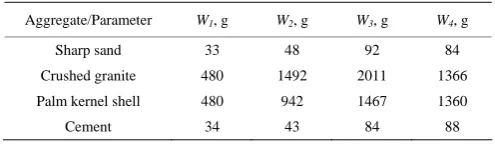
where, SG=Specific gravity; W1=Weight of empty density
bottle (g); W2=Weight of density bottle +Sample (g);
W3=Weight of density bottle + Sample +Water (g);
W4=Weight of density bottle + Water (g).
From Equation (1) and Table 1, the specific gravities
of sharp sand, crushed granite, palm kernel shell and
cement are 2.5, 2.76, 1.301 and 3.0 respectively.
Table 1 Results for specific gravity determination
Aggregate/Parameter W1, g W2, g W3, g W4, g
Sharp sand 33 48 92 84 Crushed granite 480 1492 2011 1366 Palm kernel shell 480 942 1467 1360
Cement 34 43 84 88
2.3.2 Bulk Density
Test carried out on the samples of aggregates used for
the research was in accordance with the provisions of
ASTM C 29/C29M (2003). Bulk density given with
Equation (2),
Weight of sample
Volume of mould (2)
where, W1 =Weight of empty mould (g); W2 =Weight of
mould + Sample (g); W3 =(W2 – W1) = Weight of Sample
(g).
Hence, volume of mould used = 1735.5 cm3 =
depth = 11.4 cm.
From Equation (2) and Table 2, the bulk densities of
sharp sand, crushed granite and palm kernel shell are
1650 kg m-3, 1545 kg m-3 and 634 kg m-3, respectively.
Table 2 Results for bulk density determination
Aggregate/Parameter W1, g W2, g W3, kg Volume, m3
Sharp sand 622 3486 2.864 0.0017355 Crushed granite 611 3293 2.682 0.0017355 Palm kernel shell 611 1712 1.101 0.0017355
2.3.3 Water Absorption
Water Absorption test on materials was carried out in
accordance with BS 1881-Part 122 (BS 1881: Part 122,
1983) and the equation given with Equation (3),
2 1
1
( )
( )
W W
W
−
(3)
where, W1 = Weight of sun - dried sample; W2 = Weight
of sample after 1 h divided by 24 h immersion in water.
(W2–W1) = Weight of water absorbed.
From Equation (3), Table 3 and Table 4, the
percentage water absorption of palm kernel shell in 1 h and
24 h is 11% and 21.5%, respectively while the percentage
water absorption of crushed granite in 1 h and 24 h is 6%.
Table 3 Results for water absorption determination for 1 h
Aggregate/Parameter W1, g W2, g (W2 – W1), g
Palm kernel shell 1000 1110 110 Crushed granite 1000 1006 6
Table 4 Results for water absorption determination for 24 h
Aggregate/Parameter W1, g W2, g (W2 – W1), g
Palm kernel shell 1000 1215 215 Crushed granite 1000 1006 6
Table 5 Sieve analysis of aggregates used in this research
Parameters Sharp sand Crushed granite Palm kernel shell Coefficients of curvature (Cc), 1.3 1.6 2.0
Coefficients of uniformity (Cu) 6.0 1.4 1.2
Fineness modulus (FM) 2.69 5.74 3.81
Table 6 Comparison of properties of aggregates used in this research
Properties Crushed granite Palm kernel shell Sharp sand Thickness, mm - 1.0-3.0 -
Bulk density, kg m-3 1545 634 1650
Specific gravity 2.76 1.30 2.5 Fineness modulus 5.74 3.81 2.69 Water absorption – 1 h, % 0.6 11 - Water absorption – 24 h, % 0.6 21.5 - Maximum aggregate size, mm 12 12 4.75
Table 7 Density and Compressive strength developments of palm kernel shell concrete for mix design 1:2:4 and
water/cement ratio 0.6
% replacement of palm kernel 0 25 50 75 100 Density, kg m-3 2304 1632 1572 1529 1490 Seven days Compressive
strength, N mm-2 15.10 12.11 9.16 8.44 3.90 Density, kg m-3 2337 1684 1608 1556 1504
14 days Compressive
strength, N mm-2 18.97 15.19 13.70 13.03 6.59 Density, kg m-3 2406 1762 1644 1591 1543
21 days Compressive
strength, N mm-2 19.44 15.58 14.18 13.88 7.95
Density, kg m-3 2420 2042 1810 1638 1562
28 days Compressive
strength, N mm-2 21.73 16.63 15.60 14.63 12.71
2.4 Strength properties determination
The Slump test was conducted on all the percentage
replacements of freshly prepared palm kernel shell
concrete as well as the control to determine workability
of concrete. Density and compressive strength test were
also carried out to determine the strength of concrete.
Procedures from BS 1881: Part 102 (1983) was adopted
in carrying out the slump test. Excess concrete which
could not be contained in the mould for a batch of three
was observed when concrete was batched by weight. This
is basically due to the differences in specific gravities of
palm kernel shell and crushed granite resulting in the
batching and concrete specimen cube production in this
research being done by absolute volume. Densities of
specimens were determined after de-moulding and
samples completely immersed in a curing tank of water
until the set day for specimen cube crush testing. All
specimen cubes were totally immersed in curing tank for
a total of 28 days in intervals of 7 days, after which the
cubes were brought out of the curing tank and left for two
hours to allow for rest and water from the curing tank to
dry out from the surfaces of cubes. Cubes were taken to a
SEIDNER Compression Testing Machine of maximum
capacity 2000 KN to determine compressive strength.
The density of each specimen was once more determined
before crushing. Three replicates were prepared for
specimens at each curing age for the specified 5nos
percentage replacements of granite with palm kernel. The
specimens were produced with reference to the provisions
in BS 1881: Part 108 (1983). A total of 60 specimen
with three cubes representing each designated curing age
and percentage palm kernel shell replacement. The
maximum loads at which the three replicates fail on the
compression testing machine were recorded with their
average values computed which is the resultant
compressive strength. Prior to this compression testing,
the density was calculated as the ratio of the weight to the
volume of each specimen. This test was conducted at the
Civil Engineering Laboratory of the Institute of
Management and Technology (IMT), campus III, Enugu
in Enugu State using a SEIDNER machine. Compressive
strength was determined in accordance with BS EN
12390-3 (2002).
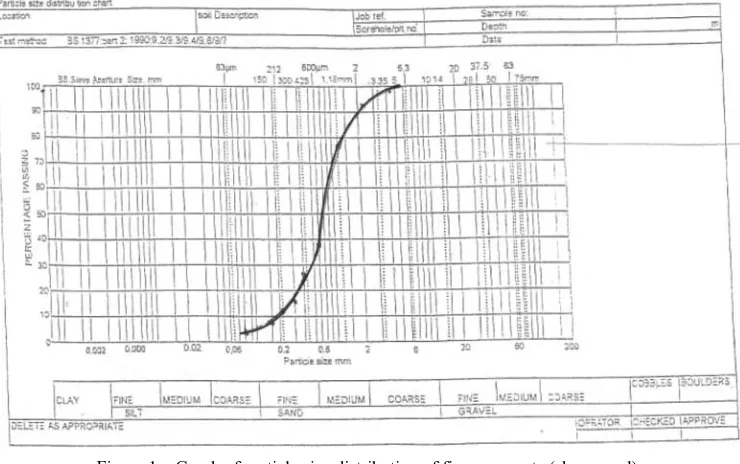
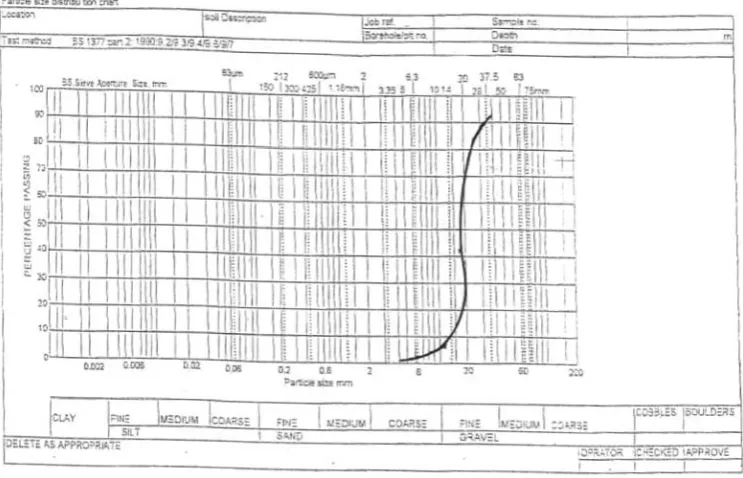
2.5 Particle Size Distribution Results
The figures below are the particle size distribution for
sand, palm kernel shell and coarse aggregate.
Figure 1 Graph of particle size distribution of fine aggregate (sharp sand)
Figure 3 Graph of particle size distribution of coarse aggregate (crushed granite)
3 Results and Discussions
From the results of palm kernel aggregate from Table
6, bulk density and specific gravity is 634 kg m-3 and 1.30
respectively. This verifies its adequacy to be used both as
a normal aggregate and lightweight aggregate while the
other properties confirm only use as a lightweight
aggregate. The strength properties of palm kernel shell
concrete at age 28 days from Table 7 show that it is
appropriate and could be used as a lightweight concrete.
However, the values of the mechanical strength for both
palm kernel shell concrete and crushed granite concrete
increase with age. The density of the normal concrete is
in the order of 2304-2420 kg m-3, while the lightweight
concrete has density ranging from 1490 to 2042 kg m-3.
The results of the density tests presented in Table 7 show
an average density of 1763 kg m-3 for the palm kernel
shell concrete and 2420 kg m-3 for normal weight
concrete at 28 days. These results show that palm kernel
shell concrete is about 27% lower in density than the
normal weight concrete. Conversely, the range for density
of structural lightweight concrete is 1440 kg m-3 to 1850
kg m-3 (ACI 213 R-87, 2003). The density of 1562 kg m-3
recorded for full replacement at curing age of 28 days
falls within the range for structural lightweight concrete
and suggests that palm kernel shell can be used as
structural lightweight concrete (ASTM C 330, 2004).
From Table 7, the 28 days compressive strength
values of all the percentage replacements - 0, 25%, 50%,
75% and 100% - with palm kernel shell are 21.73, 16.63,
15.60, 14.63 and 12.71 N mm-2 respectively. This
demonstrates the huge influence the amount and type of
coarse aggregate used in the production of concrete has
on the compressive strength of the corresponding
concrete. Grading of aggregates is done using values
from coefficient of curvature and coefficient of
uniformity. Fineness Modulus which is mainly used for
sand is another important determinant in expressing the
physical properties of aggregates. Jerry (2008) reports
that the values for Coefficient of curvature (Cc) should lie
between one and three for well graded gravel and sand
whereas the Uniformity coefficient (Cu) should be more
than four for well graded gravel and more than six for
well graded sand. The range for fineness modulus
according to specifications from ASTM C 33 (2003) is
2.3 to 3.1 and from the results presented in Table 5 the
fineness modulus of the sand used in this research was
found to be 2.69. This value also satisfied the requirement
of BS EN 12620:1, (BS EN 12620-1, 2007) for sand to be
used for concrete production. Additionally, from the same
results of Table 5 the Coefficient of uniformities (Cu) of
the sand, gravel and palm kernel shell is 6.0, 1.4 and 1.2,
respectively; while their coefficient of curvatures (Cc) is
as well graded if their Cc value is between one and three
(Jerry, 2008). Hence, the sand, gravel and palm kernel
shell used for the study are well graded and suitable for
making good concrete.
4 Conclusion
Palm kernel shell concrete has similar strength
properties and relative more structural performance than
normal weight concrete from the observations and
experimental results presented. However, it can be
concluded that the palm kernel shell concrete showed
better performance compared to normal weight concrete
with respect to cracking from observations from the
compression testing machine. Concrete specimen cubes
with 0% palm kernel aggregate cracked explosively
unlike gradual crack that was experienced with the
specimen cubes that had 25% to 100% palm kernel shell
content. This could be attributed to the relatively lower
density of palm kernel shell concrete as it plays its role in
the reduction of dead load as well as its better impact-
resistant nature.
Additionally, the density of the palm kernel shell
concrete was found to be about 27% lower compared to
the normal weight concrete and it is very noteworthy
when dead load of the structures is concerned in the
design and construction of structural elements. Thus, it
can be concluded that palm kernel shell concrete has
advantage in both strength and density. The values of
16.63, 15.60, 14.62 and 12.71 N mm-2 being compressive
strengths obtained for the palm kernel shell concrete at
28 days curing for 25, 50, 75, and 100%, respectively
imply that the shell used in this research is suitable for
achieving adequate compressive strength. Previously,
compressive strengths of palm kernel shell concrete with
mix design of 1:2:4 and water/cement ratio 0.6 have been
reported to range from 5 to 25 N mm-2 (Okafor, 1988).
Okpala (1990) and Olanipekun et al. (2006) achieved
16.50 N mm-2 and 14.70 N mm-2 respectively. Generally,
the compressive strength of 13-22 N mm-2 was reported
for palm kernel shell concrete by many previous
researchers. This research has shown that concrete
strengths development is directly proportional to curing
age and varies inversely with progressive addition of
palm kernel shell. The research has also revealed that the
physical and mechanical properties of the palm kernel
shell aggregates are satisfactory for producing structural
concrete.
Additionally, by the prescription of the American
Society for Testing of Materials (ASTM) and British
Standards Institution (BS), the results of the
characterization of the palm kernel shell used in the
research for the production of specimen concrete cubes
have shown that it met the requirements for use as
aggregates in concrete.
Further studies should be conducted with other water
cement ratios and mix designs to further evaluate their
influences on concrete strength. Subsequent studies on
palm kernel shell concrete should allow a curing age of
up to 90 days and above. More research is needed to
reduce water absorptive nature of palm kernel shell
concrete. There is need therefore to intensify studies to
reduce the density of palm kernel shell concrete without
compromising strength so as to produce medium and high
strength concrete. This could be done by crushing the
larger original palm kernel shell aggregate so as to
improve on the compressive strength of Lightweight
aggregate concrete.
References
ACI 213 R-87. 2003. Guide for structural lightweight aggregate concrete. Michigan: American Concrete Institute.
Alengaram, U. J., B. A. A. Muhit, and M. Z. b. Jumaat. 2013. Utilization of oil palm kernel shell as lightweight aggregate in concrete– A review. Construction and Building Materials, 38(38): 161–172.
Alengaram, U. J., H. Mahmud, and M. Z. Jumaat. 2010. Comparison of mechanical and bond properties of oil palm kernel shell concrete with normal weight concrete. International Journal of the Physical Science, 5(8): 1231–1239.
Alengaram, U. J., H. Mahmud, and M. Z. Jumaat. 2011. Enhancement and prediction of modulus of elasticity of palm kernel shell concrete. Materials and Design, 3(4): 2143–2148. Alengaram, U. J., H. Mahmud, M. Z. Jumaat, and S. M. Shirazi.
2010. Effect of aggregate size and proportion on strength properties of palm kernel shell concrete. International Journal of the Physical Sciences, 5(12): 1848–1856.
beams. Construction and Building Materials, 25(6): 2918–2927. Alexander, M. G., and S. Mindness. 2005. Aggregates in Concrete (Modern Concrete Technology). New York, USA: Taylor and Francis Group.
ASTM C 127-07. 2007. Standard test method for specific gravity and absorption of coarse aggregate. Philadelphia, PA: American Society for Testing and Materials.
ASTM C 136. 2003. Standard test method for sieve analysis of fine and coarse aggregates. In Annual Book of ASTM Standards. Philadelphia, PA: ASTM.
ASTM C 29/C29M. 2003. Standard test method for bulk density and voids in aggregate. In Annual Book of ASTM Standards. Philadelphia, PA: ASTM.
ASTM C 33. 2003. Standard specification for concrete aggregates. In Annual Book of ASTM standards: West Conshohocken, PA: American Society for Testing and Materials.
ASTM C 330. 2004. Standard specification for lightweight aggregates for structural concrete. In Annual Book of ASTM standards: Philadelphia, PA: American Society for Testing and Materials.
Basri, H. B., M. A. Mannan, and M. F. M. Zain. 1999. Concrete using waste oil palm shells as aggregate. Cement and Concrete Research, 29(4): 619–622.
BS 12. 1996. Specification for portland cement. London: British Standards Institution.
BS 1881: Part 102. 1983. Method for determination of slump. London: British Standards Institution, Her Majesty Stationery Office.
BS 1881: Part 108. 1983. Method for making test cubes from fresh concrete. London: British Standards Institution, Her Majesty Stationery Office.
BS 1881: Part 116. 1996. Method for determination of compressive strength of concrete cubes. London: British Standards Institution.
BS 1881: Part 122. 1983. In Method for Determination of Water Absorption. London: British Standards Institution.
BS 3148. 1980. Methods of test for water for making concrete (including notes on the suitability of the water). London: British Standards Institution.
BS 812. 2002. Methods for sampling and testing of mineral aggregates sands and fillers. London: British Standards Institution.
BS 882. 1992. Specification for aggregates from natural sources for
concrete. London: British Standards Institution.
BS EN 12390-3. 2002. Compressive strength of test specimens. In Testing Hardened Concrete, Part 3. London: British Standards Institution.
BS EN 12620-1. 2007. Aggregates for concretes. London: British Standard Institution.
Jerry, V. P. E. 2008. Soil Mechanics. (502) 493–7100. Kentucky, USA: GEM Engineering Inc.
Kibar, H., and T. Öztürk. 2015. Determination of concrete quality with destructive and non-destructive methods. Computers and Concrete, 15(3): 473–484.
Okafor, F. O. 1988. Palm kernel shell as a lightweight aggregate for concrete. Cement and Concrete Research, 18(6): 901-910. Okiy, D. A. 1988. Chemical and biological characterization of the
by-products of NIFOR palm oil mill. In Proceedings of International Oil Palm/palm Oil Conference Progress & Prospects Conference II Technology, 434-437. Malaysia, Kuala Lumpur.
Okpala, D. C. 1988. Palm kernel shell as lightweight aggregate in concrete. Building and Environment, 25(4): 291–296.
Olanipekun, E. A., K. O. Olusola, and O. Ata. 2006. A comparative study of concrete properties using coconut shell and palm kernel shell as coarse aggregates. Building and Environment, 41(3): 297–301.
Popovics, S. 1998. Strength and Related Properties of Concrete: A Quantitative Approach. New York: Compressive Strength. Shafigh, P., M. Z. Jumaat, and H. Mahmud. 2010. Mix design and
mechanical properties of oil palm shell lightweight aggregate concrete: A review. International Journal of the Physical Sciences, 5(14): 2127–2134.
Shafigh, P., M. Z. Jumaat, H. B. Mahmud, and N. A. A. Hamid. 2012. Lightweight concrete made from crushed oil palm shell: Tensile strength and effect of initial curing on compressive strength. Construction and Building Materials, 27(1): 252–258.
Shafigh, P., M. Z. Jumaat, H. B. Mahmud, and U. J. Alengaram. 2011. A new method of producing high strength oil palm shell lightweight concrete. Materials and Design, 32(10): 4839–4843.