PhD Dissertation
International Doctorate School in Information and
Communication Technologies
DISI - University of Trento
M
ANAGING THE
U
NCERTAINTY OF THE
E
VOLUTION OF
R
EQUIREMENTS
M
ODELS
Le Minh Sang Tran
Advisor Committee
Fabio Massacci, Professor John Mylopoulos, Professor Università degli Studi di Trento Università degli Studi di Trento
Haralambos Mouratidis, Professor University of Brighton
Ketil Stølen, Professor
University of Oslo, SINTEF ICT
A
BSTRACT
“...There are known unknowns: that is to say,
there are things that we now know we don’t know..."
Donald Rumsfeld, United States Secretary of Defense
E
VOLUTIONis an inevitable phenomenon during the life time of a long-lived software systems due to the dynamic of their working environment. Software systems thus need to evolve to meet the changing demands. A key point of evolution is its uncer-tainty since it refers to potentialfuturechanges to software artifacts such as requirements models. Thus, the selection ofevolution-resilientdesign alternatives for the systems is a sig-nificant challenge.This dissertation proposes a framework for modeling evolution and reasoning about it and its uncertainty in requirements models to facilitate the decision making process. The framework providesevolution rulesas a means to capture requirements evolution, and a set ofevolution metricsto quantify design alternatives of the system. This enables more useful information about to what extent design alternatives could resist to evolution. Thus, it helps decision makers to make strategic moves.
Both evolution rules and evolution metrics are backed up with a formal model, which is based on a game-theoretic interpretation, so that it allows a formal semantics understanding of the meaning of the metrics in different scenarios.
The proposed framework is supported by a series of algorithms, which automates the cal-culation of metrics, and a proof-of-concept Computer Aided Software Engineering (CASE) tool. The algorithms calculate metric values for each design alternative, and enumerate pos-sible design alternatives with the best metric values,i.e.,winner alternatives. The algorithms have been designed to incrementally react to every single change made to requirements models in an efficient way.
do-with appropriate knowledge (i.e., knowledge of method for domain experts, knowledge of domain for method experts, and knowledge of both domain and method for novices), to build significantly large models, and identify possible ways for these models to evolve. More-over, the studies show that obviously there is a difference between domain experts, method experts, and students on the “baseline" (initial) model, but when it comes to model the changes with evolution rules, there is no significant difference.
The proposed framework is not only applicable to requirements model, but also other system models like risk assessment. The framework has been adapted to deal with evolving risks in long-lived software systems at a high level of abstraction. It thus could work with many existing risk-assessment methods.
A
CKNOWLEDGEMENTS
I owe my great thanks to many people, without whom, this dissertation could not be finished. First and foremost, I profoundly thank my PhD supervisor, Professor Fabio Massacci. I was fortunate enough to be under his guidance. I would like to thank him for all of his ad-vice, his patience, and his guidance over the past five years and beyond. I thank him for his countless hours providing ideas, explanation and feedback, also his listening and helping me to formulate initial ideas. I learnt from him the passion in doing research. During my grad-uate studies, I have received invaluable support from him to travel widely (summer schools, project meetings and conferences) to communicate with many researchers worldwide.
I am grateful to Professors John Mylopouslous for his support, invaluable comments and discussion since the very first days of my doctorate. His courses – Requirements Engineering and Conceptual Modeling – have provided me the essential background in this work.
I would like to express my gratitude to Professor Ketil Stølen, my mentor during my in-ternship at SINTEF. I appreciate his precious guidance, his time spending as chair of PhD committee, and his encouragement for me to go running, which I now seriously practise. I also would like to thank the many people at SINTEF, particularly Bjørnar Soulhalg, who have helped me a lot too during my internship there.
I am thankful to Professor Haralambos Mouratidis, another PhD committee member. I was very impressed when I received his feedback on the draft of my dissertation. I believed that he had spent a plenty of time to read every word of my dissertation, and gave me a list of extremely helpful suggestions.
I am grateful to Dr. Federica Paci, who co-authored an article which is an essential part of my dissertation. Many thanks to other co-authors who contributed to publications, and to my colleagues and my friends at University of Trento, in particular Bruno Crispo, Jennifer Horkoff, Elda Paja, Tong Li, Katsiaryna Labunets and Luca Allodi for helpful feedback, sug-gestions, and encouragement. My sincere thanks also go to the staffs Luca Valenzin, Michela Angeli, Elisa Chiarani, Andrea Stenico, and Francesca Belton for helping me with adminis-trative stuffs so that I could channel my time into my work.
uation of my proposed approach.
I also wish to express my thanks to anonymous reviewers whose the feedback was daunt-ing to me at the first sight, but indeed was fruitful criticism that helped me to improve my research resulting in the publications, which are included in this dissertation.
Many thanks to all of my friends in Trento, in Viet Nam and elsewhere for the pleasure and nice time which make up my social life. I apologize for not listing your names because it would be unfair for anyone, whom I might forget to mention by mistake.
Thanks to my sweetheart Viet Hung Nguyen for his true love and endless care. I thank him for giving me advice and encouragement, and lifting the spirits up for both of us during this tough time.
Finally, my deepest thanks to my family for their unconditional love, unbounded pa-tience and endurance through years when I was far away. Although they may not completely understand the things that I am working on, they remained supportive and proud of my at-tainments.
C
ONTENTS
Contents i
List of Tables vii
List of Figures ix
Acronyms xiii
I Motivation and Background
1
1 Introduction 3
1.1 Contributions . . . 5
1.2 Terminology . . . 6
1.3 Structure of the Dissertation . . . 6
1.4 Publications . . . 10
1.4.1 Publications Reported in the Dissertation . . . 10
1.4.2 Additional Publications . . . 11
2 Research Roadmap 13 2.1 Problem Characterization and Research Questions . . . 13
2.1.1 The Need of Managing the Evolution Uncertainty of Requirements Mod-els . . . 13
2.1.2 Research Questions and Success Criteria . . . 14
2.2 Strategies for Evaluation . . . 17
2.3 Framework Overview . . . 19
2.4 Chapter Summary . . . 22
3 State-of-the-Art 23 3.1 Evolution Perspectives . . . 23
3.2 Studies on Requirements Evolution . . . 25
3.2.1 Studies on Impacts of Evolution . . . 27
3.2.2 Studies on Reaction on Evolution . . . 28
3.3 Studies on Empirical Evaluation . . . 29
3.3.1 Empirical Research Methodologies . . . 29
3.3.2 Empirical Studies on Requirements Evolution . . . 30
3.4 Studies on Selecting Risk Countermeasures . . . 32
3.5 Chapter Summary . . . 34
4 Application Scenarios 35 4.1 The SWIM Scenario . . . 37
4.2 The AMAN Scenario . . . 39
4.3 Chapter Summary . . . 40
II Framework Details
41
5 The Proposed Framework 43 5.1 Modeling the Requirements Evolution . . . 455.2 Semantics of Evolution Probability: a Game-Theoretic Interpretation . . . 47
5.3 Semantics of Reasoning about the Evolution Uncertainty . . . 49
5.4 Formal Rules for Complex Evolution Scenarios . . . 52
5.4.1 Evolution in Large Requirements Model . . . 53
5.4.2 Continuous Evolution in Requirements Models . . . 54
5.5 Chapter Summary . . . 56
6 Automated Reasoning Support 59 6.1 Hypergraph Requirements Model . . . 60
6.1.1 A Formalization of Hypergraph . . . 60
6.1.2 Hypergraph Representation for Existing Modeling Languages’s Con-structs . . . 64
6.2 Algorithms . . . 65
6.2.1 Generating the DATs . . . 66
6.2.2 Calculating Metrics for a Design Alternative . . . 71
6.2.3 Updating the DATs due to Incremental Changes . . . 72
6.3 The Complexity of Algorithms . . . 73
6.4 Proofs of Algorithm Complexity . . . 78
CONTENTS iii
6.4.2 Proof of Lemma 1 . . . 78
6.4.3 Proof of Lemma 2 . . . 78
6.4.4 Proof of Lemma 3 . . . 80
6.4.5 Proof of Theorem 1 . . . 82
6.4.6 Proof of Theorem 2 . . . 83
6.4.7 Proof of Theorem 3 . . . 83
6.5 Chapter Summary . . . 83
7 Unicorn: Tooling and the First (Self ) Evaluation 85 7.1 Features Overview . . . 85
7.2 Architectural Overview . . . 87
7.3 Screen Shots . . . 90
7.4 Performance Simulation of the Algorithms . . . 92
7.5 A Self-Evaluation Case Study . . . 94
7.6 Chapter Summary . . . 95
8 Empirical Evaluation of the Framework with Third-Party 111 8.1 Requirements Evolution in Si* Modeling Language. . . 113
8.2 Evaluation Method . . . 116
8.2.1 Research Objectives . . . 116
8.2.2 Experimental Design . . . 117
8.2.3 Experimental Procedure . . . 118
8.2.3.1 Study 1: Preliminary Study within the Research Group . . . . 119
8.2.3.2 Study 2: Workshops with ATM experts . . . 120
8.2.3.3 WS1: The Training Workshop . . . 120
8.2.3.4 WS2: The Evaluation Workshop. . . 120
8.2.3.5 WS3: The Application Workshop . . . 121
8.2.3.6 Study 3: Study with Master Students . . . 122
8.3 Quantitative Data Analysis . . . 122
8.3.1 Preparation for an Analysis of Variance . . . 124
8.3.2 Results . . . 125
8.4 Discussion . . . 129
8.4.1 Method’s Effectiveness . . . 129
8.4.2 Impact of Knowledge of Domain and Knowledge of Method. . . 130
8.5 Threats to Validity . . . 131
8.6 Lessons Learnt . . . 133
8.7 Chapter Summary . . . 135
III Applying the Proposed Framework to Evolving Risks
137
9 Early Dealing with Evolving Risks in Software Systems 139 9.1 Terminology . . . 1419.2 The Risk-Evolution Approach . . . 142
9.2.1 Step 1 – Identify Evolving Contexts . . . 143
9.2.2 Step 2 – Perform Risk Assessment . . . 145
9.2.3 Step 3 – Model Context Evolution . . . 146
9.2.4 Step 4 – Perform Evolution Analysis . . . 148
9.3 The Running Example. . . 149
9.4 Chapter Summary . . . 153
10 Selecting Cost-Effective Risk Countermeasures 155 10.1 The Proposed Method. . . 156
10.1.1 Input Assumptions . . . 157
10.1.2 Detailing of Step 1 – Annotate Risk Model . . . 158
10.1.3 Detailing of Step 2 – Countermeasure Analysis. . . 159
10.1.4 Detailing of Step 3 – Synergy Analysis . . . 160
10.2 The Calculus . . . 161
10.2.1 Rules for Risk Graphs. . . 161
10.2.2 Rules for Treatment Diagrams . . . 162
10.3 Exemplification in CORAS . . . 164
10.3.1 eHealth Running Example: Patient Monitoring . . . 165
10.3.2 Applying Step 1 – Annotate Risk Model . . . 166
10.3.3 Applying Step 2 – Treatment Analysis . . . 168
10.3.4 Applying Step 3 – Synergy Analysis . . . 169
10.4 Modeling Evolution in Risk Graph. . . 170
10.4.1 Challenges in Modeling Evolution in Risk Graph . . . 171
10.4.2 Modeling the Evolution . . . 172
CONTENTS v
IV Discussion and Conclusion
177
11 Discussion 179
11.1 Fulfillment of the Success Criteria. . . 179
11.1.1 The Modeling Approach of the Framework . . . 180
11.1.2 The Reasoning Approach of the Framework . . . 182
11.2 How to Apply the Proposed Framework . . . 183
11.3 How The Proposed Framework Relates to State-of-the-Art . . . 184
11.3.1 Requirements Evolution . . . 184
11.3.2 Empirical Studies . . . 186
11.3.3 Selecting Countermeasure Alternatives for Evolving Risks . . . 187
12 Conclusion 189 12.1 Summary . . . 189
12.2 Limitations and Future Work. . . 191
L
IST OF
T
ABLES
2.1 Success Criteria. . . 15
2.2 Evaluation activities to fulfill success criteria. . . 18
3.1 Overview of Research Methodology . . . 29
4.1 Technical documents of the scenario.. . . 36
4.2 The evolution ofISS-ENT (includingIKMIandIDS),BP, and their possible design alternatives. . . 38
5.1 The asset value of Company based on different decisions . . . 49
5.2 Qualitative metrics for design alternatives of the running example. . . 52
6.1 Data structures and algorithms for the metric calculation. . . 67
7.1 Descriptive statistics of the hypergraph. . . 95
8.1 Participants’ knowledge in the empirical studies. . . 119
8.2 Data about the Type of Participants and the Artifacts Generated. . . 123
8.3 Scale for expert assessment on the quality of requirements and evolution rules.. . 123
8.4 Kruskal Wallis Summary . . . 126
8.5 Wilcoxon Rank-Sum Test Summary -Pairwise Comparison among Type of Partic-ipants. . . 127
8.6 Hypothesis testing results . . . 129
9.1 The steps of the proposed risk-evolution approach. . . 144
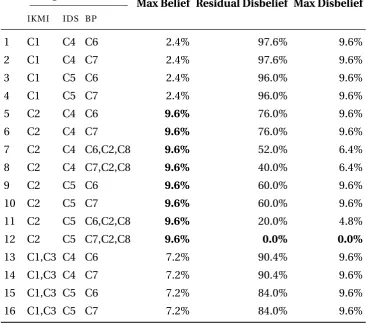
9.2 TheMax Belief andResidual Disbelief. . . 153
10.1 Analysis for the risk LMD. . . 171
10.2 The global treatment alternatives in synergy analysis. . . 172
11.1 Summary of the success criteria fulfillment. . . 180
L
IST OF
F
IGURES
2.1 The framework overview and associated evaluation activities. . . 20
3.1 The evolution perspectives of requirements evolution. . . 25
5.1 The conceptual model of the proposed framework. . . 44
5.2 The observable and controllable evolution. . . 47
5.3 The protocol of the game explaining the sematic of the evolution probability. . . . 48
5.4 An example of the long tail problem. . . 50
5.5 Example of combining two observable evolution rules. . . 54
5.6 Observable rules in a continuous evolution requirements model. . . 55
6.1 The hypergraph requirements model of the SWIM scenario. . . 62
6.2 Some modeling constructs in different modeling languages and their equivalence in the hypergraph. . . 63
6.3 The requirements model ofISS-ENTmodeled by existing languages and by hyper-graph. . . 64
7.1 The constructs to modeling requirements evolution in UNICORN. . . 87
7.2 The overall architecture of the UNICORNtool. . . 89
7.3 The class diagram of theUniversal Data Model . . . 89
7.4 The compact syntax of the construct definition file. . . 90
7.5 A fragment of a construct definition file. . . 90
7.6 The requirements model of the scenario with evolution rules. . . 91
7.7 The evolution analysis on the requirements model of the scenario. . . 91
7.8 An example of generated hypergraph for simulation.. . . 92
7.9 The complexity of the simulation hypergraphs. . . 93
7.10 The execution time of the algorithms on simulation hypergraphs. . . 94
7.11 Requirements diagram for Airspace Navigation Service Provider (ANSP) actor. . . 96
7.12 Requirements diagram for Planning Controller (PLC) actor.. . . 97
7.13 Requirements diagram for Air Traffic Control Center (ATCC) actor. . . 98
7.14 Requirements diagram for Admin actor. . . 99
7.15 Requirements diagram for Executive Controller (EC) actor. . . 100
7.16 Requirements diagram for Conflict Tools System (CTS) actor.. . . 101
7.17 Requirements diagram for Flight Data Processing System (FDPS) actor. . . 102
7.18 Requirements diagram for Aircraft actor. . . 103
7.19 Hypergraph requirements diagram for Airspace Navigation Service Provider (ANSP) actor. . . 103
7.20 Hypergraph requirements diagram for Planning Controller (PLC) actor. . . 104
7.21 Hypergraph requirements diagram for Air Traffic Control Center (ATCC) actor. . . 105
7.22 Hypergraph requirements diagram for Admin actor. . . 106
7.23 Hypergraph requirements diagram for Executive Controller (EC) actor. . . 107
7.24 Hypergraph requirements diagram for Conflict Tools System (CTS) actor. . . 107
7.25 Hypergraph requirements diagram for Flight Data Processing System (FDPS) actor.108 7.26 Hypergraph requirements diagram for Aircraft actor.. . . 109
8.1 Chronology of the family of empirical studies . . . 113
8.2 An excerpt of the goal model for the Sector Team. . . 114
8.3 The graphical representation of the observable for goalg3. . . 115
8.4 Third ATM workshop. . . 121
8.5 The quality of requirements models and evolution rules produced by students. . . 124
8.6 Size of Baseline and Size of Changes for Type of Participants . . . 125
8.7 Number of Rules and Branches for Participants Type. . . 128
9.1 The conceptual model of the proposed risk-evolution approach. . . 143
9.2 The evolution perspectives of contexts . . . 145
9.3 Risk level and Residual risk level. . . 146
9.4 The context evolution model. . . 147
9.5 The architecture of the Messaging Service within SWIM. . . 150
9.6 The evolution of Messaging Service.. . . 152
10.1 Steps of the proposed method. . . 157
10.2 Conceptual model.. . . 157
10.3 Risk graph. . . 158
10.4 Countermeasure withtreatsrelation. . . 158
10.5 Effect dependency relation.. . . 158
10.6 Decision diagram. . . 160
List of Figures xi
10.8 Risk diagram of the scenario. . . 166
10.9 Annotated diagram . . . 167
10.10Annotated treatment diagram with frequencies propagated. . . 169
10.11Decision diagrams of risks in the eHealth scenario.. . . 170
10.12The meta-model of evolutionary risk graph. . . 173
A
CRONYMS
AHP Analytic Hierarchical Process
AMAN Arrival Manager
ANSP Airspace Navigation Service Provider
ATCC Air Traffic Control Center
ATCO Air Traffic Controller
ATM Air Traffic Management
ATSU Air Traffic Service Unit
CASE Computer Aided Software Engineering
CTS Conflict Tools System
DMAN Departure Manager
EC Executive Controller
FAA United State Federal Aviation Authority
FDPS Flight Data Processing System
GUI Graphical User Interface
ICT Information and Communication Technology
PLC Planning Controller
RBT Reference Business Trajectory
RE Requirements Engineering
SESAR European Single European Sky ATM Research Initiative
SWIM System Wide Information Management
TCC Tactical Controller
Part I
Motivation and Background
C
H
A
P
T
E
R
1
I
NTRODUCTION
“...There are known unknowns: that is to say,
there are things that we now know we don’t know..."
Donald Rumsfeld, United States Secretary of Defense
This chapter presents the motivation of this dissertation. It also summarizes the ma-jor contributions of this work, as well as published/in submission publications on which the dissertation is built.
T
HEtermsoftware evolutionhas been introduced in 1980 by Lehman in his work[Leh80a;Leh80b], and was widely adopted since the 90s. In the domain of software systems [Pro96;Has+05;LL98;Rus+99;ZO97], evolution refers to a process of continually up-dating software systems in accordance to changes in their working environments such as business requirements, regulations and standards. Recent studies in software evolution at-tempt to understand causes, processes, and effects of the phenomenon [AP03;KS99;LaM+08]; or focus on the methods and tools that manage the effects of evolution [Sof05; Sou+11;
Has+05]; or offset their effects in advance. The aim of this dissertation focuses on the last setting.
A key observation underpinning this dissertation is that while some changes (i.e., evo-lution) are unpredictable, many others can be predicted albeit with some uncertainty
cause they will be the result of a process. A representative example is Air Traffic Manage-ment (ATM). The increment in both quantity and complexity of air traffic requires a better collaboration amongATMsystems and actors across air spaces and nations. To address this requirement, Europe has launched several long-term projects 1 2and programs 3 4, which include: introducing new cooperation regulations, ATMbusiness processes; improving ex-istingATMsystems (e.g.,Arrival Management –AMAN, Department Management –DMAN); introducing new infrastructure for information interchange (i.e.,System Wide Information Management –SWIM[Adm09]), and so on. The requirements of these systems may evolve in many directions and at different levels from organizational, architectural, to operational as-pects. Such evolutions are known to be possible, yet unknown whether they would happen: theknown unknowns.
Unfortunately, a company that produces or procures software for these systems cannot wait until all unknowns in the standardization [old: SWIM standardization] become known. The process of tendering and organizational restructuring requires a significant amount of time and planning. Therefore decision makers must essentially bet on the final solution and possibly minimize the risks that the solution (i.e.,design alternative, implementation choice) would turn out to be wrong and require last minute acquisitions. For instance, while the European Single European Sky ATM Research Initiative (SESAR) and the United State Federal Aviation Authority (FAA), in [Pro08;Fed09; Adm09], have listed a number of design alternatives forSWIM(both architectural and technical), which satisfy different high level decisions, still there is no means to support the choice of an optimal alternative that could minimize the risk of wrong local choices.
While many approaches have been proposed to perform the management or consistency checking on requirements evolution, there has been less effort on delivering an explicit mod-eling and reasoning framework to assist decision makers to select a good design alternative. In the realm of requirements evolution, a “good" design alternative is an evolution-resilient one. Anevolution-resilient design alternative, in the context of this dissertation, is under-stood as a design alternative that has more chances to be operational even if evolution hap-pens, or requires less modification to be operational due to evolution.
We need to capture what Loucopoulos and Kavakli [LK99] identify as the knowledge about“what the current state is",“where the desired state to-be is in the future", and
“alter-1http://www.sesarju.eu/
2http://www.swim-suit.aero/swimsuit/
1.1. CONTRIBUTIONS 5
native designs"for the desired future state. In this respect, it is important to provide a sound quantitative analysis, which is one of the current weaknesses (see Dalalet al. [Dal+04] for a discussion) of many existing approaches.
As an effort to bridge the gap, this thesis proposes a framework that provides support for modeling and reasoning about the uncertainty of requirements evolution, and at the utmost importance, assisting the decision makers in the selection of a “good" design alternative with respect to evolution.
1.1 Contributions
The major contribution of this dissertation is a framework dealing with evolution in require-ments models. The proposed framework includes:
• A set of notions to model the uncertainty of requirements evolution. We propose evolu-tion rules, which includeobservable ruleandcontrollable rule, as a mean to capture the uncertainty in requirements evolution. The former kind captures potential evolution and its uncertainty. The latter kind captures different design alternatives that fulfill re-quirements. These evolution rules are used to capture the evolution in requirements models at high level of abstraction. They could be adapted to different requirements engineering languages.
• A set of quantitative metrics for reasoning on the evolution uncertainty. With respect to evolution, we propose three quantitative metrics to assess how well a design alter-native could be able to resist to evolution. In other word, we measure the probability by which the implementation of a system using the given design alternative could be operational when evolution happens. The proposed metrics are based on evolution rules. Therefore they could be also applied to abstract requirements model.
• A series of algorithm automating the reasoning.To make the proposed framework more feasible in practice, we develop a series of algorithms that automate the reasoning on requirements evolution. To maintain the generality of the framework, we propose hy-pergraph as a means to express requirements models. Based on hyhy-pergraph the algo-rithms enumerate possible design alternatives and calculate their metrics values. Thus it could help to facilitate the decision making process.
cus-tomize graphical constructs that are used to model requirements models. It also im-plements the proposed algorithms to perform automated reasoning on requirements evolution.
• A modeling and reasoning approach on risk evolution. We extend the proposed ap-proach for requirements evolution to the realm of risk management. We propose a generic method to select cost-effective countermeasures for software risks based on risk graph. We then adapt evolution rules to cope with evolution in risk graphs, and integrate the proposed metrics to the reasoning process to select cost-effective and evolution-resilient countermeasures for risks in software systems.
1.2 Terminology
Evolution Potential changes make to software artifacts (e.g.,requirements models) after de-ployment of system-to-be.
Evolution uncertainty The uncertainty of whether an evolution actually applies to given circumstances.
Requirements evolution Potential changes make to requirements after deployment of system-to-be.
System-to-be The system as it should be when it will be built and operated.
System-to-be-next After deployment of system-to-be, new requirements or problems may arise. We may need to consider the next system versions are likely to be. The system versions beyond the system-to-be are the systems-to-be-next.
1.3 Structure of the Dissertation
The dissertation is organized into four parts. The first part focuses on the introductory basics consisting of following chapters:
1.3. STRUCTURE OF THE DISSERTATION 7
• Chapter2: Research Roadmap. This chapter discusses the global research questions that drive the research plan for this dissertation. This chapter also summarizes the pro-posed framework to deal with requirements evolution, as well as how various artifacts in later chapters are fitted into the framework.
• Chapter3: State-of-the-Art. This chapter discusses in detail related works in the field of requirements evolution. Particularly, it presents different approaches in require-ments evolution modeling, requirerequire-ments evolution management, and relevant analy-sis techniques, such as inconanaly-sistency checking, change impact analyanaly-sis. The chapter also gives a comparison between the proposed framework and its closed approaches in the literature.
Referred publication(s):This chapter has been partially published in:
– Michael Felderer, Basel Katt, Philipp Kalb, Jan Jürjens, Martín Ochoa, Federica Paci, Le Minh Sang Tran, Thein Than Tun, Koen Yskout, Riccardo Scandariato, Frank Piessens, Dries Vanoverberghe, Elizabeta Fourneret, Matthias Gander, Bjørnar Solhaug, and Ruth Breu. “Evolution of Security Engineering Artifacts: A State of the Art Survey”. In: International Journal of Secure Software Engineering(2014). To appear.
• Chapter 4: Application Scenarios . This chapter summarizes the two scenarios that we employ to illustrate the proposed framework, and to conduct evaluation studies. The scenarios are both extracted from theATMdomain. The first one, which is taken from the SecureChange FP7 project, concerns the evolution of both business processes and support-tools of Air Traffic Controllers (ATCOs), particularly, changes in the arrival management process and the introduction of Arrival Manager (AMAN). The second scenario is taken from theSWIMproject where evolution occurs at the infrastructure for information interchange and collaboration amongATMsystems across airspaces and nations.
The second part presents the body of framework that is conveyed in following chapters:
to assess quantitatively design alternatives, and hence, to facilitate the selection of an evolution-resilient design alternative.
Referred publication(s):This chapter has been partially published in:
– Le Minh Sang Tran and Fabio Massacci. “Dealing with Known Unknowns: Towards a Game-Theoretic Foundation for Software Requirement Evolution”. In: Proceedings of the 23th Confer-ence On Advanced Information Systems Engineering (CAiSE’11). 2011, pp. 62–76
– Le Minh Sang Tran and Fabio Massacci.Dealing with Known Unknowns: a General Approach for Modeling and Reasoning on Requirements Evolution. Tech. rep. (to be submitted to the Software and Systems Modeling (SOSYM) journal). University of Trento, 2013
• Chapter6: Automated Reasoning Support. This chapter presents a set of algorithms that automates the analysis and the incremental calculation of metrics described in chapter5. Requirements models and evolution rules are represented by a hypergraph structure. The algorithms perform calculation and propagation values from leaf nodes to the root. The propagated values at the root are used to calculate values of the met-rics. This chapters also presents the computational complexity of the proposed algo-rithms with proofs.
Referred publication(s):This chapter under submission, which is part of:
– Le Minh Sang Tran and Fabio Massacci.Dealing with Known Unknowns: a General Approach for Modeling and Reasoning on Requirements Evolution. Tech. rep. (to be submitted to the Software and Systems Modeling (SOSYM) journal). University of Trento, 2013
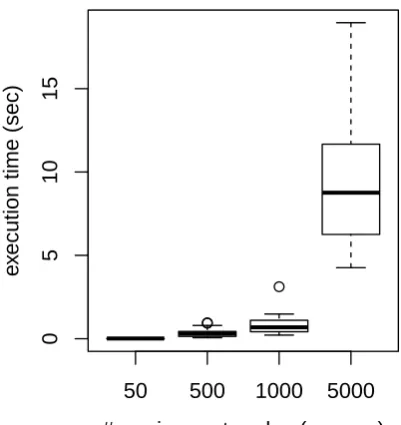
• Chapter7: Unicorn: Tooling and the First (Self ) Evaluation. This chapter provides an overview about the proof-of-conceptCASEtool, namely UNICORN, that implements the modeling and reasoning described in previous chapters. UNICORN takes advan-tage on the Eclipse plugin infrastructure platform to enhance its extendability. The tool is logically organized into two parts, one for modeling and another one for rea-soning. Both are developed to maximize the extendability. We also discuss a perfor-mance simulation of the proposed algorithms, as well as a self-evaluation study on a large example taken from an industrial project.
Referred publication(s):This chapter has been published in:
– Le Minh Sang Tran and Fabio Massacci. “UNICORN: A Tool for Modeling and Reasoning on the Uncertainty of Requirements Evolution”. In:CAiSE Forum. 2013, pp. 161–168
1.3. STRUCTURE OF THE DISSERTATION 9
the proposed framework. These studies follow the Goal-Question-Metric template and orient to different types of participants: researchers, domain experts, and students. All the studies lasted for more than a year. The important outcome from these studies shows that the proposed framework is effective in capturing requirements evolution of complex systems.
Referred publication(s):This chapter has been published in:
– Fabio Massacci, Deepa Nagaraj, Federica Paci, Le Minh Sang Tran, and Alessandra Tedeschi. “As-sessing a Requirements Evolution Approach: Empirical Studies in the Air Traffic Management Do-main”. In:Proceedings of the 2nd International Workshop on Empirical Requirements Engineering (EmpiRE’12). 2012, pp. 49–56
– Fabio Massacci, Federica Paci, Le Minh Sang Tran, and Alessandra Tedeschi. “Assessing a Re-quirements Evolution Approach: Empirical Studies in the Air Traffic Management Domain”. In: Journal of Systems and Software(2013). Article in press
The third part shows how the proposed framework could be applied on other aspects of software evolution. Therefore we aim to migrate the proposed framework in requirements evolution into the realm of security risk management. We choose to adapt the framework on the risk assessment process as the importance of early risk identification and mitigation is well known. Since software systems might evolve, their risk pictures consequently might also evolve. Nonetheless, most major approaches in the field do not explicitly support the modeling and analysis on the evolution of risks. This drives the focus in the next part of the dissertation that consists of following chapters:
• Chapter9:Early Dealing with Evolving Risks in Software Systems.Founded on chapter
5, this chapter presents a risk-evolution approach that adapt the proposed framework to early deal with evolving risks. The main objective is to assist the decision makers to select an evolution-resilient countermeasure alternative with respect to evolving risks.
Referred publication(s):This chapter has been partially published in:
– Le Minh Sang Tran. “Early Dealing with Evolving Risks in Long-Life Evolving Software Systems”. In:Advanced Information Systems Engineering Workshops – CAiSE Workshops. 2013, pp. 518–523
fine-grain risk evolution modeling. Since risk graph is an abstraction of several model-driven risk analysis techniques, this work provides an evidence that the proposed risk-evolution approach could work on these risk analysis techniques.
The work in this chapter is supported by the Mobility Program of the NESSoS FP7 project, under the supervision of Prof. Ketil Stølen.
Referred publication(s):This chapter has been partially published in:
– Le Minh Sang Tran, Bjørnar Solhaug, and Ketil Stølen. “An Approach to Select Cost-Effective Risk Countermeasures”. In:Data and Applications Security and Privacy XXVII - 27th Annual IFIP WG 11.3 Conference, (DBSec 2013). 2013, pp. 266–273
Finally, the last part provides discussion with respect to research questions and success criteria and conclusion for the dissertation:
• Chapter11: Discussion. This chapter discusses the fulfillment of success criteria, as well as how the proposed framework relates to the literate. This chapter also proposes a potential steps to apply the framework in the software development process.
• Chapter12: Conclusion.This chapter summarizes the major contributions of the dis-sertation and describes possible future directions based on the results.
1.4 Publications
1.4.1 Publications Reported in the Dissertation
• Le Minh Sang Tran. “Requirement Evolution: Towards a Methodology and Frame-work.” In:CAiSE Doctoral Consortium 2011. London, 2011
• Le Minh Sang Tran and Fabio Massacci. “Dealing with Known Unknowns: Towards a Game-Theoretic Foundation for Software Requirement Evolution”. In: Proceedings of the 23th Conference On Advanced Information Systems Engineering (CAiSE’11). 2011, pp. 62–76
1.4. PUBLICATIONS 11
• Le Minh Sang Tran and Fabio Massacci. “UNICORN: A Tool for Modeling and Reason-ing on the Uncertainty of Requirements Evolution”. In: CAiSE Forum. 2013, pp. 161– 168
• Fabio Massacci, Deepa Nagaraj, Federica Paci, Le Minh Sang Tran, and Alessandra Tedeschi. “Assessing a Requirements Evolution Approach: Empirical Studies in the Air Traffic Management Domain”. In: Proceedings of the 2nd International Workshop on Empirical Requirements Engineering (EmpiRE’12). 2012, pp. 49–56
• Fabio Massacci, Federica Paci, Le Minh Sang Tran, and Alessandra Tedeschi. “Assessing a Requirements Evolution Approach: Empirical Studies in the Air Traffic Management Domain”. In:Journal of Systems and Software(2013). Article in press
• Le Minh Sang Tran, Bjørnar Solhaug, and Ketil Stølen. “An Approach to Select Cost-Effective Risk Countermeasures”. In:Data and Applications Security and Privacy XXVII - 27th Annual IFIP WG 11.3 Conference, (DBSec 2013). 2013, pp. 266–273
• Le Minh Sang Tran. “Early Dealing with Evolving Risks in Long-Life Evolving Software Systems”. In: Advanced Information Systems Engineering Workshops – CAiSE Work-shops. 2013, pp. 518–523
1.4.2 Additional Publications
• Viet Hung Nguyen and Le Minh Sang Tran. “Predicting Vulnerable Software Compo-nents using Dependency Graphs”. In: International Workshop on Security Measure-ment and Metrics (MetriSec’10). 2010
• Katsiaryna Labunets, Fabio Massacci, Federica Paci, and Le Minh Sang Tran. “An Ex-perimental Comparison of Two Risk-Based Security Methods”. In: Proceedings of the ACM / IEEE International Symposium on Empirical Software Engineering and
Measure-ment (ESEM). 2013
C
H
A
P
T
E
R
2
R
ESEARCH
R
OADMAP
This chapter presents the high level research questions for the whole dissertation, as well as success criteria for research questions. The chapter also provides an overview of the proposed framework in this work to address those questions.
T
HISchapter characterizes the problem and the global research questions of this dis-sertation, and the research activities to address these questions. This chapter is orga-nized as follows. Section2.1presents problem characterization and research ques-tions that drive the rest of the dissertation. Section2.2shows the evaluation strategies for invented artifacts. Section2.3briefly discusses the proposed framework in this work. Finally Section2.4summarizes the chapter.2.1 Problem Characterization and Research Questions
2.1.1 The Need of Managing the Evolution Uncertainty of Requirements
Models
Long-lived systems are built to satisfy a set of mandatory requirements in a period of time, and operate under assumptions of working environment and context. However, reality might change and evolve. Nowadays, evolution is an inevitable phenomenon [Set+04] [Lam09b,
Chap. 6] during the life time of a long-lived software systems due to the dynamic of their working environments. Consequently, software systems might be unstable or non-operational.
Evolution refers to potential changesin futureto software artifacts such as requirements models. Requirements evolution could be understand as potential future changes to require-ments models, for example, new requirerequire-ments might arise, some current requirerequire-ments may become obsoleted. Such changes could cause the systems stop working properly and lead to significant economic loss. Fortunately, we can anticipate possibilities of these changes with the help of expertise knowledge in the domain. They areknown, but which possibilities of changes could happen isunknown. Hence, a key point of evolution is itsuncertainty. Evo-lution might or might not occur due to some external factors such as changes in regulation, law, and standards. These factors usually cannot be controlled by either software developers or stakeholder. The uncertainty of evolution however could be partially predicted with the aid of domain expertise knowledge, for instanceATMexperts could foresee new standards, regulations in theATMdomain in next few years. The likelihood of occurrence of evolution thus could be estimated.
As requirements might change and evolve over time, systems might be non-operational because some mandatory requirements are not satisfied. It is essential for long-lived sys-tems that they need to be still operational during their lifetime. Requirements evolution thus should be taken into account during the software development process. However, many ex-isting requirements modeling languages (e.g.,Tropos, KAOS) provide neither notations nor tools to capture evolution in requirements models.
There are some efforts to extend these original modeling languages to support the evo-lution in software development [CH11;MD00;FB01]. However, none of them pays attention to the uncertainty of evolution. Additionally, these studies are still lacking of a systematic and quantitative reasoning to support decision makers in order to choose a system design alternative that is moreresilientto potential evolution.
Anevolution-resilientdesign alternative, in the context of this dissertation, is understood as a design alternative that has more chances to be operational even if evolution happens, or requires less modification to be operational due to evolution.
2.1.2 Research Questions and Success Criteria
2.1. PROBLEM CHARACTERIZATION AND RESEARCH QUESTIONS 15
Table 2.1: Success Criteria.
RQ Success Criteria
RQ1
SC1 A modeling approach that is:
SC1.1 Able to effectively capture the requirements evolution and its uncertainty.
SC1.2 Accompanied with a formal semantics of the evolution uncertainty. SC1.3 Potentially applicable to a variety of requirements and system models.
RQ2
SC2 A reasoning approach that is:
SC2.1 To provide a set of metrics with formal semantics for reasoning about evolu-tion uncertainty.
SC2.2 Able to automate (with formal analysis and tool-support) the reasoning that can enumerate and quantitatively assess individual design alternatives.
SC2.3 Able to support the incremental modeling of evolution.
RQ1 How to effectively capture the uncertainty of evolution in requirements models and its uncertainty?
RQ2 How to perform reasoning about the evolution uncertainty to support decision makers?
To satisfy the above questions, we propose a framework that could capture the require-ments evolution and evolution uncertainty. The framework provides a quantitative analysis that support the identification and assessment of design alternatives. To facilitate the evalu-ation of the proposed framework, in Table2.1we identify several success criteria with respect to research questions. The details are as follows:
AddressingRQ1. The proposed framework should include a modeling approach that is: • SC1.1 Able to effectively capture the requirements evolution and its uncertainty. The
to the situation that there are many parallel, competing changes. To address future changes, a requirements model is revised to a new revision. Due to parallel and com-peting changes, the new revision could have many variants. When evolution actually happens, only one variant holds.
An important assumption that drives the modeling approach is that we only consider predictable changes (i.e., the known) whose occurrences are not sure for 100%, but could be estimated at some level of uncertainty (i.e.,theunknown). We do not take into account unknown changes that could not be predicted, and their occurrences are unknownas well. In short, this work focuses onknown-unknownevolution, not
unknown-unknown ones, which are analyzed in different direction (see works of Ernst
et al.[Ern+11;Ern+09]).
• SC1.2Accompanied with a formal semantics of the evolution uncertainty. The evolu-tion uncertainty is represented as evoluevolu-tion probability. This probability has clearly not a frequentist because we cannot measure the frequency of an evolution since it might occur only once. Thus it is necessary to an interpretation of evolution uncer-tainty to understand the semantics of this unceruncer-tainty. Such interpretation and under-standing are very helpful for elicitation and evaluation of acquired evolution uncer-tainty.
• SC1.3Potentially applicable to a variety of requirements and system models. There are many existing Requirements Engineering (RE) languages for modeling requirements. The modeling approach doesnotaim to provide a newRElanguage, but it should be a set of notions and concepts that could be able to adapt to a particularRElanguage and make it possible to deal with evolution. Evolution might happen not only in require-ments models, but also in other system models such as product line modeling or risk assessment. It thus is better that the modeling approach could be adapted to support the modeling of evolution also for other kinds of artifacts.
AddressingRQ2. The proposed framework should include a reasoning approach that is:
2.2. STRATEGIES FOR EVALUATION 17
• SC2.2Able to automate (with formal analysis and tool-support) the reasoning that can enumerate and quantitatively assess individual design alternatives.Requirements mod-els are usually big and complex, so does the requirement evolution. It is also important that the reasoning is automated (fully or partially). Thus the proposed reasoning ap-proach should include a set of algorithms that enumerate design alternatives, as well as calculate the metrics for each design alternative.
• SC2.3Able to support the incremental modeling of evolution. While developing com-plex software systems, the iteration approach is usually preferred than the legacy wa-terfall approach. Therefore the process of modeling and reasoning about requirements evolution could also have several iterations where changes are identified incremen-tally. The reasoning approach therefore should be support the incremental modeling of evolution. It should efficiently deal with this incremental behavior rather than start over the analysis from ground up.
2.2 Strategies for Evaluation
In this section we discuss some evaluation activities that are usually taken into consideration while evaluating anREmethodology or artifact. These evaluation activities are described as follows:
E1 Self-evaluation study (sometimes called “case study”): the author(s) of the research applies the methodology or use the artifact in a complex, real life scenario. The pur-pose of this study is to show that the artifact can capture most of the important fea-tures of the scenario. This approach is used in [Bry+09;Sol+07;Erd+13].
E2 Empirical study: the author(s) of the research conduct empirical study(ies) with third people who apply the methodology or use the artifact in complex, real life scenar-ios. The purpose of this study is to show how other people could use the proposed methodology (or artifact) to capture most of the important features of the scenarios. This approach is used to study other characteristics of the methodology (or artifact) such as effectiveness, applicability, perceived ease of use, intend to use. This approach is used in [Ncu+07;MR05;Mai+04;Vil+10].
Table 2.2: Evaluation activities to fulfill success criteria.
Modeling Reasoning
SC1.1 SC1.2 SC1.3 SC2.1 SC2.2 SC2.3
E1 Self-evaluation study X X X
E2 Empirical study X X X
E3 Formal semantics X X X
E4 Tool construction X X X X
E5 Algorithmic complexity analysis X X
E6 Simulation experimental algorith-mic analysis
X
The purpose of this evaluation is to show that the mathematical underpinnings of the original artifact can be explained and characterized by a known framework. This ap-proach is used in [Jür02;Hau+03;LS06]
E4 Tool construction: the author(s) of the artifact constructs a proof-of-concept tool that implements the artifact. This is to partially show the applicability of the artifact. It might be also used to study the empirical applicability of the artifact (e.g.,via empirical simulation). This approach is used in [Dal11;Ali10].
E5 Algorithmic complexity analysis: the purpose of this evaluation activity is to show the worst case complexity of the approach and to identify the cause of intractability. This approach is used in [Mas+06].
E6 Simulation experimental algorithmic analysis: the purpose of this evaluation activity is to provide an approximation to the performance of the proposed algorithms. This approach is used in [Dal11].
Not all evaluation activities are equally suited or equally accepted to prove the efficacy and applicability of a research artifact. For example inRE, aSelf-evaluation study(E1) and aTool construction(E4) are the most popular evaluation techniques followed by aFormal semantics(E3) and frequently by empirical studies [CF+09].
2.3. FRAMEWORK OVERVIEW 19
diverse expectations of the corresponding artifacts: a modeling artifact is expected to “ease” the work of the analyst and hence it is crucial forSelf-evaluation study(E1) andEmpirical study(E2). On the opposite side, a reasoning algorithm should not be sensitive to the human pressing the button, but only to the “shape" of the problem (i.e.,problem dependence, not human dependence). In Table2.2we have clustered the evaluation activities in two groups (one for modeling and another one for reasoning).
2.3 Framework Overview
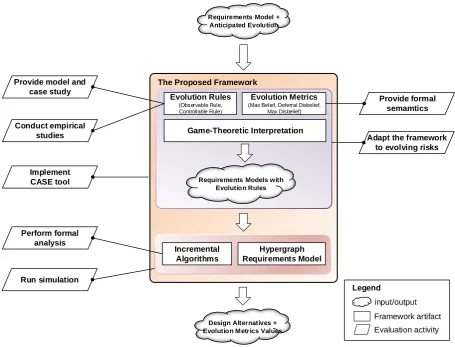
Figure2.1presents an overview about the proposed framework and various activities to eval-uate it. In the figure, the framework artifacts are represented by rectangles, and evaluation activities are depicted as parallelograms connected to relevant artifacts. The input of the framework is a requirements model in a particularRElanguage and anticipated evolution with its likelihoods of occurrences. The output of the framework is a set of design alterna-tives quantified by evolution metrics. Below we describe the artifacts of the framework:
• Evolution Rules(see Section5.1) to serve as concepts and notations to capture the evo-lution in requirements models at high level of abstraction.
• Game-Theoretic Interpretation(see Section5.2) for the evolution uncertainty. The evo-lution uncertainty, which is further referred to asevolution probability, is the belief of domain experts about the chance to be materialized of evolution in future. It is a kind of subjective probability. Thus we need a semantics backing up for evolution proba-bility that could be helpful to facilitate the elicitation and evaluation of these probabil-ities. This interpretation is also used to provide the semantics of evolution metrics.
• Evolution Metrics(see Section5.3) that leverages on evolution uncertainty to support the decision makers in the selection of evolution-resilient design alternatives for the system. The evolution-resilience is defined as the probabilities to be operational re-gardless of evolution. The semantics of evolution metrics are also accounted by the game-theoretic interpretation.
Evolution Rules
(Observable Rule, Controllable Rule)
Game-Theoretic Interpretation
Requirements Model + Anticipated Evolution Hypergraph Requirements Model Incremental Algorithms Evolution Metrics
(Max Belief, Deferral Disbelief, Max Disbelief) Conduct empirical studies Perform formal analysis Implement CASE tool
Adapt the framework to evolving risks
Requirements Models with Evolution Rules
The Proposed Framework
Design Alternatives + Evolution Metrics Values
Framework artifact
Evaluation activity Legend
Provide formal semamtics Provide model and
case study
input/output Run simulation
Figure 2.1: The framework overview and associated evaluation activities.
When transforming requirements models into hypergraphs, only requirements and necessary information about requirements satisfaction are transformed.
• Incremental Algorithms(see Chapter6) to automate the enumeration of design alter-natives and the calculation of evolution metrics. These algorithms take a hypergraph requirements model as input.
Figure2.1also illustrates various activities to evaluate the proposed framework. The or-der of evaluation activities in the figure doesnot represent the actual order of execution of these activities.
2.3. FRAMEWORK OVERVIEW 21
do make sense. We also provided a formal mathematic model to back up the proposed metrics.
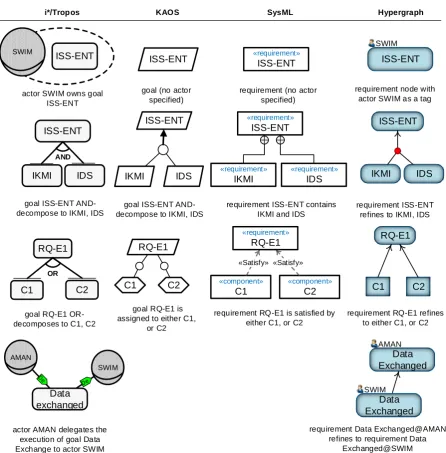
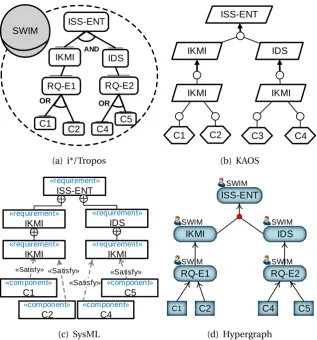
• Perform formal analysis(E5, see Section6.3,6.4). To evaluate the algorithms, we de-scribed a set of mathematical properties and their proof of the algorithms. The details of properties and algorithms are presented in Section6.4. To evaluate that the devel-oped algorithms could be applied to differentRElanguages, we have proposed several transformation patterns transforming i*, KAOS, and SysML requirements models to hypergraphs. We also adapt the proposed framework in i* language to conduct the empirical studies mentioned above.
• Implement CASE tool(E4, see Chapter7). To further evaluate the framework, we have implemented a CASEtool, namely UNICORN. The tool consists of a Graphical User Interface (GUI) for hypergraph requirement model, and an implementation of the al-gorithms.
• Provide model and case study (E1, see Section 7.4, 7.5). We have conducted a self-evaluation study to evaluate the proposed framework. We applied the proposed frame-work to model the evolution in a requirements model of a case study taken from an industrial project. Notably, here the term“case study”, which is also used by otherRE
researchers, is different from the case study used in the field of empirical experiments (see further Table3.1).
• Run simulation (E6, see Section 7.4). We have run a simulation on an implementa-tion of the algorithms. The simulaimplementa-tion is to study the empirical performance of the algorithms with respect to the complexity of input hypergraphs (or the complexity of requirements models).
• Conduct empirical studies (E2, see Chapter8). To evaluate the high level semantics of the evolution rules we have conducted an empirical study with domain experts to obtain their feedback about using evolution rules to model requirements evolution. To evaluate the effectiveness of the proposed framework, we have conducted other empirical studies with researchers, domain experts, and master students.
2.4 Chapter Summary
C
H
A
P
T
E
R
3
S
TATE
-
OF
-
THE
-A
RT
This chapter provides a background about different evolution perspectives that we address in this work. The chapter also briefly summarizes relevant studies in the field of requirements evolution, as well as empirical studies on requirements from which we learn to conduct evaluation study for the proposed framework. We also briefly re-view studies in the risk assessment area where we later adapt the proposed framework to early address evolving risks.
P
AST studies do strongly impact present work. Thus in this chapter we briefly review recent studies relating to the purpose to understand the status of the art. Based on this understanding we build the proposed framework. This chapter is organized as follows. Section3.1presents a background about different evolution perspectives. Sec-tion3.2reviews past studies in the field of requirements evolution. Section3.3reviews em-pirical studies on requirements. Section3.4review studies in the field of risk analysis. Sec-tion3.5concludes the chapter.3.1 Evolution Perspectives
Evolution in a requirements model is basically studied within a time period. This study pe-riod may be short (one year), or very long (ten years or more) depending on the life time of
the software system. Depended on the scenarios about how to study evolution, we have dif-ferent evolution perspectives. Lundet al.[Lun+11a, Chap. 15] describe three evolution per-spectives in risk analysis, including:maintenance, before-after,continuous evolution. Out of these, the maintenance evolution perspective mostly relates to the outdate of a document (e.g.,requirements model) of an existing system. Since this work mostly focuses on the early solution of requirements evolution, this evolution perspective is not being considered in this work.
We can adapt the last two evolution perspectives in the proposed framework to deal with evolution in requirements models as follows.
• Before-After evolution perspectivepredicts future contexts by anticipating planned and unplanned changes in the current requirements models at the end of the study period. Multiple possibilities of evolutions are considered. Each can have its own likelihood of occurrence. For example, the ATM 2000+ Strategic Agenda [Eur03] and SESAR Initia-tive [SES08] have outlined the direction of theATMdevelopments in a period 2010 to 2020 to have one or more of variants of new queue management tools including Arrival Manager (AMAN), Departure Manager (DMAN) or Surface Manager (SMAN).
• Continuous evolution perspective predicts the evolution of the current context over time based on planned gradual changes. In this perspective, the entire study period is divided into several milestones. At each milestone, potential changes in the require-ments model are anticipated. Multiple possibilities of evolution are also allowed.
The major difference between this continuous evolution perspective and the one with similar name described in [Lun+11a, Chap. 15] is that: while the latter considers only one possibility of evolution at certain time points in future; the former enables multiple possi-bilities of evolution at certain time points. The former will collapse to the latter if there is only one possibility of evolution in each time point. Therefore, the definition of continuous evolution perspective here is the generalization of Lundet al.[Lun+11a]’s one.
Figure3.1visualizes the evolution perspectives. In this figure, a requirements model is depicted as a cloud. Figure 3.1(a) illustrates the before-after evolution perspective where a requirements model might evolve to one of possibilities models at the end of the study period. Meanwhile, Figure3.1(b)exemplifies thecontinuousevolution perspective. In this illustration, at timet0the original requirements model isR M0, which can evolve to one of
R Mi at timet1. The evolution continuously happens. And at the end of the study period,
3.2. STUDIES ON REQUIREMENTS EVOLUTION 25
RM0
RM1 RM2 RMn
(a) Before-after evolution
RM0
RM1m RM2n RMkt
t0 t1 t2 tn
RM12
RM11
RM22
RM21
RMk2
RMk1
(b) Continuous evolution
Figure 3.1: The evolution perspectives of requirements evolution.
3.2 Studies on Requirements Evolution
Lam and Loomes [LL98] present the EVE (Evolution Engineering) framework, which includes a meta model and a process model to deal with requirements evolution. They classify changes into the following types:
• Environment change (E-change): these are changes that occur within the environment where the target software system is working,e.g.,the introduction of new laws, changes in business agreement.
• Requirement change (R-change): these are changes in requirements and derived from environment changes,e.g.,new requirements arrive, current requirements are modi-fied or deleted.
• Viewpoint change (V-change) also called ‘impact’: these are impacts on the ‘life’ of stakeholders once R-changes are implemented. For example, the introduction ofAMAN
PLC); the SWIM will change the way of communication from telephone-based to an ICT-based infrastructure amongATMactors.
• Design change (D-change): these are changes in the design of the system implied by requirement change,e.g.,the introduction or removal of a function, control.
The authors also mention seven key issues that need to be addressed by requirements evolution studies. Those issues include:
• Modeling evolution: this is the most important and a fundamental issue. This refers to the way to model, represent, and reason about evolutions.
• Change analysis: this is to study about the nature of change to answer ‘why’ and ‘where from’ questions about changing requirements.
• Impact assessment approaches: this is to assess the impact of changing requirements on other domains, such as social, environmental and cultural issues.
• Risk assessment: this refers to risk assessment in relation to requirements changes.
• Multiple change: this is the ability to consider many changes that are parallel, and possibly competing. These changes may be originated from environmental changes.
• Extended traceability: this is concerned with establishing relationships between engi-neering artifacts during software maintenance.
• Tool support: this is concerned with tool to provide support for requirements evolution such as change management tool, traceability tool, and so on.
3.2. STUDIES ON REQUIREMENTS EVOLUTION 27
3.2.1 Studies on Impacts of Evolution
Russoet al.[Rus+99] propose an analysis and revision approach to restructure requirements to detect inconsistency and manage changes. The main idea is to allow evolutionary changes to occur first, and then in the next step, verify their impact on requirements satisfaction. The restructuring includes three activities: (1) decomposing the specification into parts, (2) representing those parts within viewpoints (in four templates: hierarchic tree, input-output flow, data-flow diagram, state transition diagram), and (3) enriching the viewpoints with rules that express relationships between different specification fragments. The impact anal-ysis includes steps to check consistency and completeness, tracking changes in the original requirements specification. However, their approach is manually performed.
Hassineet al. [Has+05] present an approach to change impact analysis, which refers to identify potential consequences of a change, or estimate what needs to be modified to ac-complish a change. Their approach applies both slicing and dependency analysis at the Use Case Map specification level to identify the potential impact of requirements changes on the overall system. The resulting output includes scenarios and components that subject to change. Chechiket al. [Che+09] and Lin et al. [Lin+09] focus on change propagation. Chechik et al. [Che+09] assist users in propagating changes across requirements, design, and implementation artifacts. They use the UML model-based approach and provide auto-mated propagation for changes between requirements and design models via relationships between them. The relationship between models are formalized by OCL rules. The auto-mated change propagation between models localizes the regions in models that should be modified. However, the work is limited to activity diagrams and sequence diagrams of UML language. Linet al. [Lin+09] capture requirements changes as series of changes in specifi-cations. They propose algorithms for managing all possible atomic requirements changes to a sequence-based specification. The algorithms address atomic requirements changes and push them through changes in specifications, maintain old specifications over time and evolved into new specifications with least rework.
Fabbriniet al. [Fab+07] work on requirements expressed in natural language. They ad-dress the inconsistency between requirements that belong to different evolutionary stages (or evolution steps). Their approach employs Formal Concept Analysis theory to verity the requirements consistency. Requirements of different evolutionary stages have a traceability link to others. By checking the inconsistency, they may detect the error in evolution from one requirement in a stage to another requirement in a different stage.
evo-lution management developed in the context of the SecureChange project1. The methodol-ogy addresses the before-after evolution perspective and provides support for:
• Modeling requirements evolution: requirements models of the ‘before’ or ‘after’ situa-tion are depicted in the Si* language.
• Change management based on evolution rules: security properties are modeled as patterns by Si* language. Any changes made to the requirements model is checked with the argument validity to detect the violations or fulfilment of security properties. If a security property is violated, an alert prompting human intervention is automati-cally issued with possibly suggested corrective actions.
• Argumentation-based security analysis: this provides evidence if a security property is preserved by evolution or not.
3.2.2 Studies on Reaction on Evolution
Apart from the above approaches that aim to manage requirements evolution (such as check-ing inconsistency, propagatcheck-ing changes, and change impact) at design time. There exists a number of approaches aiming to support the system evolution driven by requirements evo-lution [Bri+06;ZO97;Sou+11;Ern+11]. Some of these works focus on the design phase while others target the deployment and execution phases.
Brieret al.[Bri+06] present a manual change analysis process in which a situation ‘before-the-change’ is changed into a situation ‘after-‘before-the-change’. They adopted the diagrammatic notation from Problem Frame to model these situations. The approach however did not go further with any specific reasoning for change rather captures the part of before model that is changed.
Zowghi and Offen [ZO97] work at meta level to capture intuitive aspects of managing changes to requirements models. Their approach involves modeling requirements models as theories and reasoning changes by mapping changes between models.
Among the work focusing on run-time, Souzaet al.[Sou+11] propose a systematic method for adaptive software system. In this approach, the dynamic behavior of the system is gov-erned by of a set of (in)equations calledqualitative differential constraints. The authors char-acterize the controllability space for a software system defined in terms of a requirements model, variation points, control variables and indicators. All of these are correlated with qualitative differential constraints.
3.3. STUDIES ON EMPIRICAL EVALUATION 29
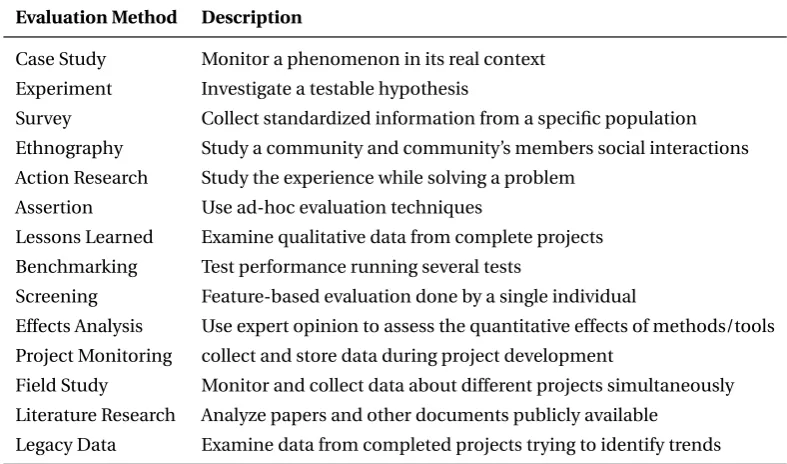
Table 3.1: Overview of Research Methodology
Evaluation Method Description
Case Study Monitor a phenomenon in its real context Experiment Investigate a testable hypothesis
Survey Collect standardized information from a specific population Ethnography Study a community and community’s members social interactions Action Research Study the experience while solving a problem
Assertion Use ad-hoc evaluation techniques
Lessons Learned Examine qualitative data from complete projects Benchmarking Test performance running several tests
Screening Feature-based evaluation done by a single individual
Effects Analysis Use expert opinion to assess the quantitative effects of methods/tools Project Monitoring collect and store data during project development
Field Study Monitor and collect data about different projects simultaneously Literature Research Analyze papers and other documents publicly available
Legacy Data Examine data from completed projects trying to identify trends
Ernstet al. [Ern+11] focus on unknown-unknown evolution,i.e., evolution that we do not know what it is, and when it happens. Instead of finding a solution anticipating evolu-tion, the authors in [Ern+11] study a class of algorithms usingAI Truth Maintenance Systems
(ATMS) to find new solutions that use as much as possible of the old solution (i.e., maximize familiarity), and minimize the number of tasks that need to be implemented (i.e., minimize effort).
3.3 Studies on Empirical Evaluation
In order to have a glance on the types of empirical studies so that we can learn to conduct the evaluation for the proposed framework (see Chapter8later), we first overview the exist-ing empirical research methodologies and introduce a set of terms in the field of empirical research. Then, we discuss the works reporting empirical studies on requirements evolution.
3.3.1 Empirical Research Methodologies
Runeson and Host [RH09] identify four classes of empirical research methods:case study, which is an empirical inquery that investigates a contemporary phenomenon within a real-life context;surveythat is a collection of standardized information from a specific population by means of a questionnaire or interview;experimentis an investigation of a testable hypoth-esis when one or more independent variables are manipulated to measure their effect on one or more dependent variables;action researchaims to solve a real-world problem while simultaneously studying the experience of solving the problem. Easterbrooket al. [Eas+07] also countethnographic studiesamong the major research methodologies. Ethnographic re-search studies based on field observations a community of people to understand how the members of that community make sense of their social interactions. Kitchenham [Kit96] also consider case study, experiment and survey as classes of empirical research methodolo-gies, but it also identifyscreening,effects analysis, andbenchmarking as classes of research methods. Screening is a feature-based evaluation done by a single individual who not only determines the features to be assessed and their rating scale but also does the assessment. Effects analysis is a method that uses expert opinion to assess the quantitative effects of dif-ferent methods and tools. Benchmarking is a process of running a number of standard test-s/trials using a number of alternative tools/methods (usually tools) and assessing the relative performance of the tools in those tests.
Zelkowitz and Wallace [ZW98] enrich the taxonomies proposed in [RH09;Eas+07;Kit96] with new classes of empirical research methodologies: project monitoring, assertion, and
field study,literature research,legacy data, andlessons learned. Project monitoring focus on the collecti