https://doi.org/10.5194/gmd-12-2635-2019 © Author(s) 2019. This work is distributed under the Creative Commons Attribution 4.0 License.
Sensitivity of deep ocean biases to horizontal resolution in prototype
CMIP6 simulations with AWI-CM1.0
Thomas Rackow1, Dmitry V. Sein1,2, Tido Semmler1, Sergey Danilov1, Nikolay V. Koldunov1,3, Dmitry Sidorenko1, Qiang Wang1, and Thomas Jung1,4
1Alfred Wegener Institute (AWI), Helmholtz Centre for Polar and Marine Research, Bremerhaven, Germany 2Shirshov Institute of Oceanology, Russian Academy of Science, Moscow, Russia
3MARUM, University of Bremen, Bremen, Germany
4Institute of Environmental Physics, University of Bremen, Bremen, Germany
Correspondence:Thomas Rackow ([email protected]) Received: 1 August 2018 – Discussion started: 10 August 2018
Revised: 15 June 2019 – Accepted: 18 June 2019 – Published: 5 July 2019
Abstract.Models from phase 5 of the Coupled Model Inter-comparison Project (CMIP5) show substantial biases in the deep ocean that are larger than the level of natural variability and the response to enhanced greenhouse gas concentrations. Here, we analyze the influence of horizontal resolution in a hierarchy of five multi-resolution simulations with the AWI Climate Model (AWI-CM), the climate model used at the Al-fred Wegener Institute, Helmholtz Centre for Polar and Ma-rine Research, which employs a sea ice–ocean model com-ponent formulated on unstructured meshes. The ocean grid sizes considered range from a nominal resolution of ∼1◦ (CMIP5 type) up to locally eddy resolving. We show that increasing ocean resolution locally to resolve ocean eddies leads to reductions in deep ocean biases, although these im-provements are not strictly monotonic for the five different ocean grids. A detailed diagnosis of the simulations allows to identify the origins of the biases. We find that two key re-gions at the surface are responsible for the development of the deep bias in the Atlantic Ocean: the northeastern North Atlantic and the region adjacent to the Strait of Gibraltar. Furthermore, the Southern Ocean density structure is equally improved with locally explicitly resolved eddies compared to parameterized eddies. Part of the bias reduction can be traced back towards improved surface biases over outcrop-ping regions, which are in contact with deeper ocean layers along isopycnal surfaces. Our prototype simulations provide guidance for the optimal choice of ocean grids for AWI-CM to be used in the final runs for phase 6 of CMIP (CMIP6) and for the related flagship simulations in the High
Reso-lution Model Intercomparison Project (HighResMIP). Quite remarkably, retaining resolution only in areas of high eddy activity along with excellent scalability characteristics of the unstructured-mesh sea ice–ocean model enables us to per-form the multi-centennial climate simulations needed in a CMIP context at (locally) eddy-resolving resolution with a throughput of 5–6 simulated years per day.
1 Introduction
Biases at the ocean surface are relatively well studied (e.g., C. Wang et al., 2014). However, climate models also suffer from less-known biases in the deep ocean that have the po-tential to impact the storage of heat by the ocean. This issue may be of relevance for projections of the future climate per-formed in the framework of the Coupled Model Intercompar-ison Project (CMIP; Taylor et al., 2012).
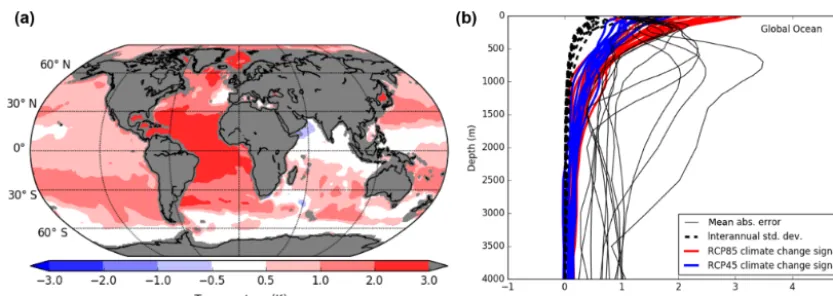
et al., 2001).(a)Ensemble mean DJF potential temperature bias [K] at a depth of 1000 m in 13 CMIP5 historical simulations for the period 1971–2000.(b)Individual depth profiles of the mean absolute potential temperature error in the considered CMIP5 models (black lines). The interannual standard deviation [K] (dashed black lines) and the RCP4.5 and RCP8.5 climate change signal [K] (2071–2100 minus 1971–2000; blue and red lines) are given for comparison.
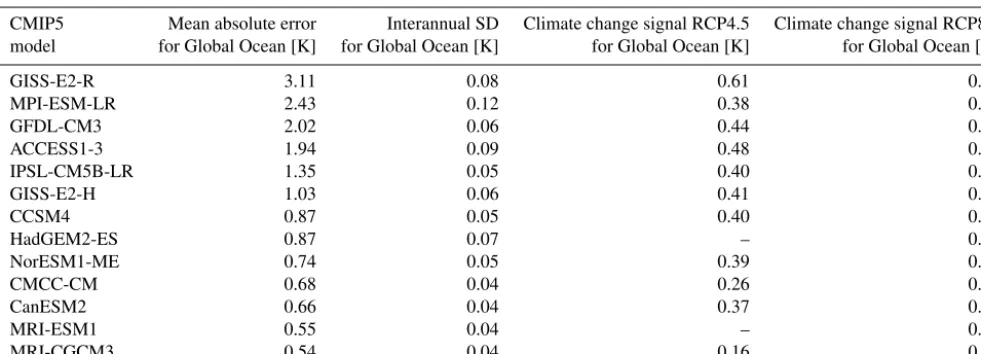
formulated differently, deep ocean biases are larger than the signals we aim to predict, which may be cause for concern in non-linear systems. When considering horizontal maps of the multi-model-mean potential temperature bias in 1000 m depth (Fig. 1a), one can clearly see that the largest bias is located in the Atlantic sector. As seasonal variability is low in 1000 m depth, the bias is very similar for different sea-sons (not shown). Although one could argue that this error is “well hidden” from the atmosphere, thus having little im-pact on atmospheric parameters, it has the potential to change the outcropping region and position of isopycnals. This could lead to a wrong “mapping” of the deep ocean to the surface; in other words, this could link the deep ocean to incorrect lo-cations at the surface, which may result in erroneous water mass formation. In turn, this can potentially have significant effects on the heat uptake of the deep ocean, thus impacting climate change projections. As an example, the magnitude of the projected climate change in the ocean appears to be ordered according to the models’ mean absolute errors (Ta-ble 1).
Previous work has identified an important role for mesoscale eddies, showing that they act “as a barrier or gate-keeper to heat penetration from the surface into the ocean interior” (Hewitt et al., 2017) by counteracting the down-ward heat transport from the mean ocean circulation (Griffies et al., 2015; von Storch et al., 2016). With the increase in simulated eddy activity when increasing resolution towards 0.1◦, the magnitude of vertical eddy heat transport also in-creases, which in turn reduces temperature drifts in the simu-lated deep ocean when compared to coarse-resolution ocean models of about 1◦(Hewitt et al., 2017; Griffies et al., 2015). The physical mechanism behind this upward eddy heat trans-port is the mixing of heat along inclined surfaces of constant density (isopycnals) by eddies and eddy-induced transport. However, the position and tilt of the isopycnals themselves
are also strongly impacted by mesoscale eddies, which can influence the mapping from the surface ocean layers to the deeper ocean. Since globally eddy-resolving climate simula-tions are still very expensive in a CMIP context, and since current eddy parameterizations do not seem to capture verti-cal eddy fluxes to the full degree (Hewitt et al., 2017), loverti-cal refinement to explicitly resolve regions of high eddy activ-ity is thus a promising approach to tackle deep ocean biases (Zadra et al., 2017).
To study the impact of horizontal resolution on the bi-ases in the deep ocean, the AWI Climate Model (AWI-CM; Sidorenko et al., 2015; Rackow et al., 2018a) is employed in this work. The “deep bias” can be reproduced in the AWI-CM “benchmark” configuration that has a rather coarse nom-inal ocean resolution of∼1◦typically employed in CMIP5 (not shown). Therefore, the model is well suited to study the impact that locally enhanced resolution can have on deep ocean biases in CMIP5 models. In order to test the hypoth-esis that locally too-coarse spatial resolution is responsible for the development of the deep ocean biases, we gradu-ally increase the number of ocean grid points in four addi-tional AWI-CM configurations with otherwise identical set-tings and parameter choices. It is shown that the strong “deep bias” in the North Atlantic reduces with higher res-olution to rather small values that are comparable to those found in other ocean basins. Together with a competitive throughput of 5–6 simulated years per day for the highest analyzed resolutions, this gives a strong case to aim for a high resolution (10 km and higher) in eddy-active regions not only in the High Resolution Model Intercomparison Project (HighResMIP) (Haarsma et al., 2016) but already for AWI’s CMIP6 standard configuration.
At-lantic. The sensitivity of vertical profiles and horizontal maps of surface and interior biases to increasing spatial resolution is studied in Sect. 3, as well as the development of deep ocean biases along relevant surfaces of constant density. The paper closes with a conclusion and further discussions in Sect. 4.
2 Model configuration
The AWI-CM (formerly ECHAM6-FESOM; Sidorenko et al., 2015; Rackow et al., 2018a) is a coupled configuration in which ECHAM 6.3.01 (Stevens et al., 2013) is coupled to the Finite Element Sea Ice-Ocean Model (FESOM1.4; Wang et al., 2008; Timmermann et al., 2009; Sidorenko et al., 2011; Q. Wang et al., 2014). It supports unstructured multi-resolution grids for the ocean and sea ice and has shown good performance in simulating present-day climate when compared to more traditional regular-grid climate models participating in CMIP5 in terms of both the mean climate state (Sidorenko et al., 2015) and climate variability (Rackow et al., 2018a). Compared to the coupling procedure detailed in the above mentioned studies, the model now uses a bicubic mapping for the interpolation of the wind-stress components to the ocean grid in order to better conserve higher-order properties like the curl (Valcke, 2013) using OASIS3-MCT (Craig et al., 2017). In this study, we will analyze monthly mean output of five 100-year long pre-industrial simulations. The simulations are initialized from PHC (PHC 3.0, updated from Steele et al., 2001) and zero velocities. The ocean model does not apply geothermal heating as a lower boundary con-dition (e.g., Adcroft et al., 2001; Downes et al., 2016). In order to parameterize eddies at non-eddy-resolving resolu-tions, the Gent and McWilliams (1990) (GM) parameteriza-tion is applied with isoneutral diffusion (Redi, 1982). All pro-totype simulations use a reference diffusivity Kref(x, y)=
600 m2s−1, which is scaled by the local resolution (Q. Wang et al., 2014), and a GM coefficient KGM=Kref/2. As
de-tailed by Q. Wang et al. (2014), tapering functions follow-ing Danabasoglu and McWilliams (1995) and Large et al. (1997) are also applied toKGM. Depending on the local
res-olution, the GM parameterization in FESOM1.4 is smoothly switched off at resolutions smaller than 25 km (red areas in Fig. 2), and its effect increases linearly until 50 km, when the parameterization is fully active (Q. Wang et al., 2014). For example, the parameterization is locally switched off when using the MR and HR meshes, which are locally eddy re-solving, and it is generally active in the lower-resolution (LR) mesh (see next sections). At midlatitudes, the Rossby radius is between 25 and 50 km, which is why this simple choice was made. Still, the thresholds of 25 km and 50 km can be considered to be tuning parameters and were chosen in stand-alone simulations with FESOM1.4 using the LR grid. For the Arctic, changing the thresholds can result in too-diffuse boundary currents (Q. Wang et al., 2014). Ultimately, these thresholds should be chosen automatically and separately for
differently resolved regions of the global ocean. Their op-timal choice thus remains an important research topic for multi-resolution climate applications.
2.1 Target resolution
In order to find an optimal mesh for the CMIP6 configu-ration and the associated endorsed Model Intercomparison Projects (MIPs), we performed a hierarchy of prototype pre-industrial CMIP6 simulations with AWI-CM, run at differ-ent ocean resolutions (Table 2). Ultimately, we will target coupled configurations with a globally eddy-resolving mesh, which implies “resolving the Rossby radius” almost every-where with at least two grid intervals per Rossby radius (Hallberg, 2013). Using this criterion, we have recently re-ported on the development of such a frontier mesh (XR; see Fig. 2, right globe), with resolution capped at 4 km (7 km) in the Arctic (Antarctic) (Sein et al., 2017). Sein et al. (2017) note that an even finer resolution will be required locally to fully capture mesoscale eddies. A lot of engineering goes into the creation of such meshes, balancing computational resources and simulation quality, since the multi-resolution approach allows for a flexible distribution of the grid points. It is not clear a priori how best to distribute a fixed number of degrees of freedom over the globe, and Sein et al. (2016) have coined the term “mesh design” for this non-trivial task. The XR mesh has about 5 million surface nodes, which is roughly comparable to a 1/10◦ quasi-Mercator mesh with about 5–6 million (wet) nodes. However, as of today, the XR mesh is still too computationally demanding for the multi-centennial simulations needed in a CMIP context. Therefore, here, the idea is to retain some of the beneficial properties of the XR ocean-only simulation analyzed by Sein et al. (2017) by keeping higher resolution only in hotspots of high eddy activity. This reduces the computational cost to a level that is suitable for multi-centennial coupled climate simulations and ensemble simulations.
2.2 Hierarchy of ocean meshes
CMCC-CM 0.68 0.04 0.26 0.33
CanESM2 0.66 0.04 0.37 0.46
MRI-ESM1 0.55 0.04 – 0.26
MRI-CGCM3 0.54 0.04 0.16 0.22
This is based on the DJF season and historical runs for the period 1971–2000; for RCP4.5 and RCP8.5, the climate change signal is based on the period 2071–2100 compared to the historical period (1971–2000).
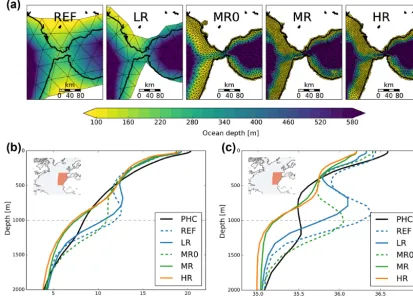
Figure 2.Hierarchy of a set of different ocean grid resolutions that are used in this study. The number of surface grid points increases from left to right and, specifically, the spatial resolution in the North Atlantic Ocean increases from REF up to the frontier mesh (XR). REF and LR use CMIP5-type spatial resolution, with moderate refinement to about 25 km in the tropics and in the Arctic (Rackow et al., 2018a; Sidorenko et al., 2011). MR0, MR, and HR are medium- and high-resolution meshes, following a different mesh design strategy (Sein et al., 2016), and focus on the Agulhas and North Atlantic current region. The resolution of XR additionally follows the local Rossby radius of deformation and is capped at 4 km (7 km) in the Arctic (Antarctic) (Sein et al., 2017). White numbers indicate the approximate spatial resolution of corresponding quasi-Mercator grids with the same number of (wet) surface nodes. The GM parameterization is switched off within the red areas (≤25 km).
2008) and GEBCO (2008) bottom topography data sets, as detailed by Q. Wang et al. (2014).
“REF” and “LR” (low-resolution) use CMIP5-type spatial resolution (∼1–0.7◦) with moderate isotropic refinement to about 25 km in the tropics and in the Arctic. The LR mesh was used for ocean-only simulations within the CORE-II in-tercomparison project (Danabasoglu et al., 2014; Wang et al., 2016a, b), while REF was used as a “benchmark” mesh for the coupled AWI-CM (Rackow et al., 2018a). Although all prototype simulations except REF use a T127 atmosphere
(Table 2), we still include the REF/T63 benchmark config-uration here for better comparability with previous studies (Sidorenko et al., 2015; Rackow et al., 2018a).
fo-Table 2.Model settings for the different AWI-CM configurations.
AWI-CM (Previous) ocean 2-D ocean Atm. time step CPU cores Sim. years
configuration mesh name grid points resolution FESOM ECHAM6 Coupling (FESOM+ECHAM) per day (SYPD)
REF ref87k 86 803 T63 30 min 450 s 1 h 384+192 21.8 LR∗ core2 126 859 T127 15 min 200 s 1 h 192+576 5.6 MR0 aguv 810 471 T127 7.5 min 200 s 1 h 2304+1152 6.2 MR∗ glob 830 305 T127 10 min 200 s 1 h 1920+1152 6.4 HR∗ bold 1 306 775 T127 10 min 200 s 1 h 2400+1200 5.5
XR (ocean only) fron 5 007 727 – 4 min – – 7200 1.5–2
∗More details on the AWI-CM CMIP6 configurations can be found at https://github.com/WCRP-CMIP/CMIP6_CVs/blob/master/CMIP6_source_id.json (last access: July 2019).
cuses them into the North Atlantic Current region (Fig. 2). The HR grid is more balanced in this respect and further in-creases the size of the areas that use locally increased reso-lution, resulting in an increase of the number of surface grid points by more than 60 %.
It is worth mentioning that HR uses 1.3 million sur-face grid points (Table 2), similar to traditional 1/4◦ quasi-Mercator grids (about 1.5 million nodes of which about 1 million are wet). However, the degrees of freedom on HR are differently distributed, focusing resolution on hotspots of high eddy activity such as the Western Boundary Cur-rents and the Southern Ocean. In fact, this configuration reaches ocean resolutions as high as 1 km locally, e.g., in the Bosporus or over the Danish Straits – but still runs at a com-petitive throughput of 5–6 simulated years per day due to the excellent nearly linear scalability of the FESOM model (e.g., Biastoch et al., 2018). For a spatial map of the eddy-permitting and eddy-resolving regions on the HR grid, please refer to Fig. 4c in Sein et al. (2016).
3 Results
3.1 Atlantic meridional overturning circulation (AMOC) and ocean transports
The Atlantic meridional overturning circulation (AMOC) pattern is similarly simulated between the model experiments (Fig. 3a). However, it appears that the change of the atmo-spheric resolution from REF/T63 to T127 (used in all other configurations) reduces the maximum AMOC strength sig-nificantly, which fits to the earlier result by Sein et al. (2018). In contrast, with increasing ocean resolution in the North At-lantic, the AMOC maximum slightly increases to more than 18 Sv in MR and HR (Fig. 3a). The ocean heat transport (Fig. 3b) reflects the behavior of the AMOC: a stronger pole-ward ocean heat transport is seen in REF, while LR, MR0, MR, and HR differ only in details. Concerning the transport of the Antarctic Circumpolar Current (ACC) at the Drake Passage (Table 3), REF/T63 somewhat stands out, while the other configurations with T127 atmosphere are in closer
Table 3. Transport of the ACC at Drake Passage [1 Sv =
106m3s−1].
AWI-CM ACC configuration transport REF 153.7 Sv LR 213.1 Sv MR0 186.1 Sv MR 186.4 Sv HR 195.6 Sv CMIP5a 155±51 Sv Observational estimateb 136.7±7.8 Sv
aMeijers et al. (2012).bCunningham et al. (2003)
agreement. REF is close to an observational estimate for the ACC transport, which is 136.7±7.8 Sv (Cunningham et al., 2003). The mean ACC transport of current CMIP5 models is however 155±51 Sv after Meijers et al. (2012), with a range from 90 Sv up to 264 Sv. This means that all analyzed config-urations simulate an ACC transport within the typical model spread.
We conclude that all five experiments, with vastly different spatial ocean resolution and computational demand, depict a canonical overturning circulation and very similar north-ward ocean heat transport. These large-scale transport pat-terns, however, do not necessarily reflect possible differences in the hydrography of the deep ocean. In the following, we will therefore analyze temperature and salinity in more de-tail.
mod-Figure 3. (a)AMOC streamfunction [1 Sv=106m3s−1] and(b)meridional ocean heat transport [1 PW=1015W] in the five pre-industrial experiments (years 71–100). The black contour in panel(a)denotes the 18 Sv streamline.
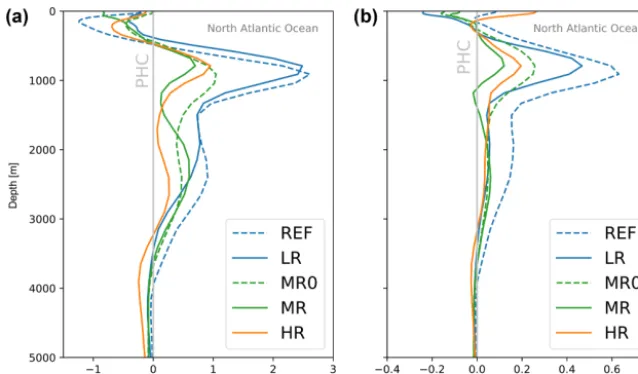
els (Fig. 1) and in the benchmark REF/T63 and LR/T127 versions of AWI-CM, successively decrease with increasing ocean resolution, both for potential temperature and for salin-ity (Fig. 4). Although the changes are not strictly monotonic when moving from REF to HR, this highlights the benefit of enhanced spatial resolution. The simultaneous change of the ocean and atmospheric resolution from REF/T63 to LR/T127 leads to a clear improvement of the salinity profiles below 1500 m, and all configurations with T127 atmosphere (LR, MR0, MR, and HR) share a very similar salinity bias in this range. While it is difficult to say what the relative influence is between the atmospheric resolution change (T63 vs. T127) and the switch of the ocean grid (REF vs. LR), it appears that surface conditions can significantly impact deep ocean biases. Note that the slight drift in HR towards colder tem-peratures in the 3000–5000 m range is due to a production of denser waters around Antarctica, coinciding with a stronger deep overturning cell in this model configuration.
3.3 Hovmöller diagrams for temperature and salinity drift
In addition to considering biases at the end of the 100-year simulations discussed above, it is instructive to study the transient development of the biases over time. To this end, time–depth Hovmöller diagrams (Griffies et al., 2015; von Storch et al., 2016; Hewitt et al., 2017) have been com-puted for both potential temperature and salinity. The REF and LR configurations show a strong erroneous initial warm-ing at a depth of around 1000 m, together with a coolwarm-ing in the upper ocean above about 400 m (Fig. 5). In the medium-and high-resolution configurations, both the erroneous deep ocean warming and upper-ocean cooling are reduced. Con-sistent with the study by von Storch et al. (2016), a similar pattern holds for salinity, with freshening in the upper ocean and salinization in the deep ocean. The improvement of the
salinity field with increased spatial resolution is similar to the potential temperature case (Fig. 6).
3.4 Spatial patterns of temperature and salinity biases 3.4.1 Deep ocean (1000 m)
When considering horizontal maps of potential temperature and salinity biases in the deep ocean, the REF and LR con-figurations show an erroneous warming in the deep Atlantic Ocean (Fig. 7a), similar to the pattern identified for the CMIP5 models (Fig. 1a). With increasing resolution in the North Atlantic, there is a very consistent improvement in deep ocean hydrography (Fig. 7), making the remaining ases in MR and HR comparable in magnitude to smaller bi-ases in the other ocean basins. Compared to the changes in the Atlantic, the other basins remain largely unchanged, sug-gesting that resolution changes in distant regions play a mi-nor role for the bias reduction in the Atlantic.
Figure 4.Profiles of potential temperature(a)and salinity(b)in the North Atlantic Ocean for years 71–100 of the pre-industrial simulations. Shown is the mean difference to PHC (PHC 3.0, updated from Steele et al., 2001). With the medium- and high-resolution meshes, the biases around 1000 m depth decrease strongly for both temperature and salinity.
entrainment. Vertical profiles of regionally averaged poten-tial temperature (Fig. 8b) and salinity (Fig. 8c) in the vicin-ity of the Strait of Gibraltar show that REF/LR (and MR0) generate too much Mediterranean outflow waters at 1000 m depth, while MR and HR lack these at a depth of 1000 m. Since the simulated model profiles envelop the observed pro-files from PHC (at 1000 m), there is potential for much bet-ter agreement by systematically adjusting the representation of the local bathymetry and the width of the strait. In or-der to simulate the correct spreading of Mediterranean wa-ters from the Gulf of Cádiz into the North Atlantic, another approach could be to add additional physics like the effect of tides (Izquierdo et al., 2016), which are usually not included in current climate models. Without tides, ocean models of-ten simulate erroneous southwestward spreading, leading to stronger biases when compared to climatology than in simu-lations with active tides (Izquierdo and Mikolajewicz, 2018).
3.4.2 Surface conditions
Since there are no heat sources or sinks in the interior ocean, the observed deep bias cannot develop in situ. Furthermore, since there is no sizable cold (fresh) bias above 1000 m, it cannot be entirely explained by a vertical redistribution of heat (salt). Instead, the surface has to be a major origin of the simulated deep ocean warming, and improvements in the deep ocean hydrography with higher resolution should be caused by improved surface fields.
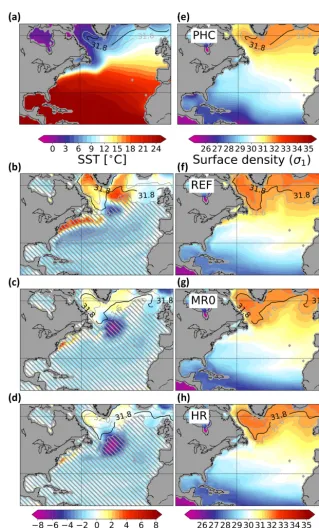
Focusing on the SST bias in the last 30 years of the REF, MR0, and HR pre-industrial simulations (years 71–100) in detail (Fig. 9), systematic differences between the simula-tions are evident (for the discussion of LR and MR, see Ap-pendix A). The surface is consistently colder than PHC in all simulations, which is expected, since pre-industrial (PI) runs
are compared with a climatology representing present-day conditions. However, in the whole Labrador Sea, REF, MR0, and HR are on the warmer side for years 71–100. When over-laying their SST bias with simulated surface isopycnals (gray and black contours in Fig. 9b–d), which represent the map-ping to the deep ocean in 600–1000 m depth (see details in the sections below), it is evident that warm SSTs over these critical regions are systematically reduced when going to the higher resolutions (Fig. 9b–d). Consistent with uncoupled ocean-only results for LR and HR (Sein et al., 2016, their Fig. 7), which show a much better simulation of the position and separation of the Gulf Stream further south at higher res-olutions, the coupled simulations analyzed here also show a successively reduced meridional warm/cold bias pattern along the east coast of North America.
Figure 5.Time–depth Hovmöller diagram of the potential temperature drift [K] in the North Atlantic for(a–e)the five pre-industrial simu-lations.(f)Definition of the North Atlantic mask that was used in the Hovmöller analysis.
We conclude that the deeper ocean is connected to less-warm surface conditions (non-hatched regions in Fig. 9b–d) in the higher-resolution model versions, and in the next sec-tion we will study how this translates to the improvements seen in the deep ocean.
3.5 Along-isopycnal bias propagation in the Atlantic By focusing on surfaces of constant potential density (isopy-cnals), it is possible to trace the development of the biases from the surface to the deep ocean around 1000 m depth, where our lower-resolution simulations and the CMIP5
mod-els show the strong anomalous warming (Fig. 1). We com-pute running 10-year means for the temperature bias along theσ1=31.8 isopycnal (σ1denotes potential density,
refer-enced to 1000 m depth). We chose this specific isopycnal, be-cause it coincides with a depth of 800–1000 m in the North Atlantic area (Fig. 10). It also lies in the middle of the enve-lope formed by the 31.6 and 32.0 contours that were already shown in Fig. 9 (gray contours).
Sup-Figure 6.Time–depth Hovmöller diagram of the salinity drift [psu] in the North Atlantic for(a–e)the five pre-industrial simulations. The definition of the North Atlantic mask is identical to the one used in Fig. 5.
plement videos; Rackow et al., 2018c), there are two major surface source regions for the deep bias in the Atlantic – the Strait of Gibraltar and the northeastern North Atlantic. The first source of the warm bias in 1000 m is likely to be of geo-metric nature, since the very narrow Strait of Gibraltar cannot be properly discretized at coarse resolutions. However, sim-ply increasing the resolution in the Strait of Gibraltar does not automatically remove the bias; instead, climatological T/S profiles in the vicinity of Gibraltar lie between the ac-cording REF/LR/MR0 and MR/HR profiles (Fig. 8b, c). As mentioned before, a systematic geometric tuning of the ocean bathymetry in this area was not attempted (Fig. 8a), and there
is thus potential for closer agreement with climatological po-tential temperature and salinity profiles in this region by ad-justing the spatial resolution within (and in the vicinity) of the strait.
Figure 8. (a)Spatial discretization of the Strait of Gibraltar and the Gulf of Cádiz in the five different model grids. The thick black line shows the true coastline as implemented in the Basemap plotting toolbox, using data from GSHHS (http://www.soest.hawaii.edu/pwessel/gshhs/ index.html, last access: 17 May 2019). Triangular elements are shown with thin black lines; colors depict the local ocean depth in meters.
(b, c)Vertical profiles of regionally averaged potential temperature and salinity in the vicinity of the Strait of Gibraltar (20–40◦N, 5–30◦W; red box in the insets). The horizontal dashed line highlights the depth of 1000 m.
Atlantic, part of the flow has to become downwelling here, which we suspect could explain part of this deficiency by entraining waters and deepening the mixed layer. Other fac-tors influencing the mixed layer depth could be biased buoy-ancy fluxes or the restratification process via eddy activity. By comparing the years 21–30 to the years 91–100 of LR (second row in Fig. 10), the advective nature of the bias sig-nal propagation from the surface in high latitudes to the deep ocean at lower latitudes is evident, which coincides with the mean currents of the subtropical gyre that go into the same direction.
The mixed layer (green line and shading in Fig. 10) is deep enough so that surface biases can reach the 31.8 and neigh-boring isopycnals, from where the signal is further advected towards the south. Eventually, the signal is advected towards the Equator, from where it propagates to the east as a Kelvin wave (Supplement video S1; Rackow et al., 2018c).
In contrast, all abovementioned issues are almost absent in the HR configuration (see last row in Fig. 10 or Supple-ment video S2; Rackow et al., 2018c), which is a major im-provement compared to the previous AWI-CM-LR configu-ration. This strongly suggests that also in the CMIP5 models
Figure 9. (a)The North Atlantic sea surface temperature and(e)σ1–density structure at the ocean surface, as determined from PHC (PHC
3.0, updated from Steele et al., 2001). Black and gray contours indicate outcropping areas for typical isopycnal surfaces found in the deep ocean around 1000 m (e.g.,σ1=31.8).(f–h)Same for the simulated density structure in REF, MR0, and HR (years 71–100).(b–d)Sea
surface temperature (SST) biases in the three simulations (years 71–100) with respect to PHC in panel(a). Three simulatedσ1–density
Figure 10.Meridional section at 30.5◦W through the Atlantic Ocean for the potential temperature bias in the five simulations. The difference compared to PHC is shown with colors for years 21–30 (left column) and years 91–100 (right column), illustrating the North Atlantic bias development along isopycnal layers (see animations S3 and S4 for LR and HR with a 10-year running window in the Supplement videos; Rackow et al., 2018c). The contours showσ1density contours that are representative for the deep ocean between 600 and 1000 m (gray
and black;σ1=31.6, 31.8, 32.0) and for the surface ocean until a maximum depth of about 300 m (red;σ1=30.5, 30.8). The average
(maximum) mixed layer depth in the 10-year windows is overlaid with a green line (green shading).
the fact that the eddy parameterization (GM) has difficulties in representing the slope of the isopycnals, which is deter-mined by the counteracting effects of Ekman pumping and eddy transport (Farneti et al., 2015). As an example, merid-ional sections along 10.5◦E reveal that the strong deep ocean warming in LR seen in Fig. 7a to the west of Cape Agulhas is linked to too-steep simulated isopycnals between 40 and
be caused by shifted water masses as indicated by the erro-neous northward shift of theσ1=30.5 contour, leading to a
warm bias on its northern side and to a cold bias on its south-ern side. Flattening the slope would result in a southward shift with potentially reduced biases. Indeed, the surface bi-ases are strongly diminished in MR (Fig. 11a) with better-resolved eddies and the associated flatter isopycnals, which are a close fit to the target contours from PHC (Fig. 11b).
4 Perspective and implications for model initialization The five simulations in this study are initialized from rest with zero velocities, prescribing long-term mean temperature and salinity fields for boreal winter from PHC. This leads to a fast initial adjustment of geostrophic currents, usually based on a rather smooth climatology as done in this study, while in reality, e.g., zonal fronts will move up and down through-out the year. After this first phase of fast adjustment, which takes months to 1 year and is also influenced by the topogra-phy as represented on the model grids, significant biases are already apparent after the first years (not shown). As an ex-ample, the warm/cold bias pattern along the eastern coast of North America (Fig. 9b), which is related to the too-northerly course of the Gulf Stream in AWI-CM-LR and REF, fully develops within a couple of years. We are confident that a focus on (and good understanding of) the initial bias devel-opment could lead to significantly improved models, as the later stages are likely dominated by slow developments in the deep ocean, following these fast initial “damages”. At higher resolutions like MR and HR, when initialized from zero ve-locities, it could also become important to temporarily hold the 3-D temperature and salinity fields close to a (seasonally varying) climatology as the circulation and eddy fields are still developing.
Interestingly, in HR, an initial movement of the 31.8 isopy-cnal surface contour in the Southern Ocean towards the Equator apparently leads to larger initial biases than in LR (Fig. 12, left), and then it returns back to the south after 20 or 30 years. In years 31–40, the biases seem to recover and are again smaller than in LR (Fig. 12, right). We hypothesize
It has been found that CMIP5 models tend to show a strong anomalous warming and salinization in the deep North At-lantic Ocean. Although being substantial in magnitude, to our surprise, the deep ocean biases in CMIP5 models did not re-ceive a lot of attention yet. While one could argue that this bias is well hidden from the atmosphere and therefore not as critical for climate simulations as surface biases, it can im-pact the outcropping and position of isopycnals. This could lead to a wrong mapping of the deep ocean to the surface and as a consequence to erroneous projections of the heat uptake of the deep ocean. Here, we exploit the fact that the AWI-CM at low CMIP5-type resolutions reproduces the behavior seen in CMIP5 models. We show how the deep ocean bias devel-ops from the surface and how it propagates along relevant isopycnal layers into the deep ocean. Along-isopycnal anal-yses are common oceanographic diagnostics to trace sources and pathways of temperature and salinity anomalies (e.g., Lazar et al., 2001; Nonaka and Sasaki, 2007); and they could be further applied in climate models to determine pathways of anthropogenic heat uptake by the ocean. While the im-provements are not strictly monotonic, we found that the deep bias seen in AWI-CM-LR and REF is generally reduced when moving to higher resolutions (10 km and higher) in eddy-active regions, a capability supported by FESOM1.4’s use of multi-resolution ocean grids. Although there is cer-tainly scope for improved eddy parameterizations, our re-sults thus highlight the benefit of using high-resolution ocean components in climate modeling.
resolu-Figure 11. (a)Right: the Southern Oceanσ1–density structure at the ocean surface in LR and MR (years 71–100). Black and gray contours
indicate outcropping areas for typical isopycnal surfaces found in the deep ocean around 1000 m; red contours represent shallower isopycnal surfaces with a maximum depth of about 200 m. Left: sea surface temperature (SST) biases in the two simulations (years 71–100) with respect to PHC. Simulatedσ1–density contours are overlaid (identical to the contour levels in the right panels). A meridional section at 10.5◦E is
highlighted with a vertical red line.(b)Meridional section at 10.5◦E, to the west of Cape Agulhas, showing the potential temperature bias with respect to PHC in (left) LR and (right) MR (years 71–100). Contours show simulatedσ1–density contours that are representative for the deep ocean between≈600 and 1000 m (gray and black; 31.6, 31.8, 32.0) and for the surface ocean until a maximum depth of about 200 m (red; 30.5, 30.8). In contrast to LR, the tilt of the isopycnals in MR is a close fit to the “target”σ1contours from PHC (given in magenta).
The average (maximum) mixed layer depth in the 30-year window is overlaid with a green line (green shading).
Figure 12.Southern Ocean potential temperature biases [K] with respect to PHC, on the constant isopycnalσ1=31.8, in(a)LR and(b)HR
tential temperature error in 1000 m in Table 1) use eitherk -profile parameterization (KPP) or Pacanowski and Philander (PP) mixing (Huang et al., 2014, their Table 1). This suggests that spatial resolution provides an alternative way to reduce long-standing deep ocean biases.
We identified two major sources for the deep ocean biases in the Atlantic Ocean. The first source is the Strait of Gibral-tar, which is likely to be a geometric issue related to the spa-tial discretization of this narrow strait (15 km) at relatively coarse resolution that is typical for CMIP5 models (about 100 km), and that often leads to increased Mediterranean out-flow (e.g., Sterl et al., 2012). Much more systematic efforts are required to tune the horizontal and at the same time the vertical discretization of the Strait of Gibraltar. The warm and saline biases originating from this area largely disappear with higher resolution in AWI-CM-MR/HR, probably due to lower spurious numerical mixing and an improved represen-tation of the bathymetry to the west of the Strait of Gibraltar (Fig. 8), which should add to the realism of the simulated plume. At the highest resolutions considered here, the bias in the proximity of the Strait of Gibraltar changes sign to-wards a too-cold and fresh anomaly. Ongoing tests suggest a similar sensitivity to the chosen vertical viscosity/diffusion, as it can also affect the exchange by changing the friction between Atlantic and Mediterranean waters (not shown). We suspect that besides local resolution increases using multi-resolution grids, the incorporation of (the effect of) tides in climate models and the addition of an overflow parameteri-zation might be necessary steps to further improve the model performance.
The second source in the low-resolution configurations is the northeastern North Atlantic, where erroneous down-welling associated with typically anomalously deep mixed layer depth (MLD) (Danabasoglu et al., 2014, their Fig. 13) communicates biased surface conditions into deeper layers. The signal then further propagates along isopycnal layers with the subpolar gyre circulation into the deep Atlantic around 1000 m. This source of the deep ocean biases is largely diminished in the higher-resolution configurations, which better simulate the separation of the Gulf Stream and the North Atlantic Current; and, in fact, we could ascribe
ases as well as their surface representations locally, e.g., to the west of Cape Agulhas and in the Brazil–Malvinas Con-fluence region. Since we were using a default GM coefficient for all simulations, it can be argued that a regional tuning of GM with a horizontally varying coefficient (Visbeck et al., 1997; Danabasoglu et al., 2012) could lead to a better simu-lation of the Southern Ocean in low-resolution AWI-CM con-figurations. Moreover, high-resolution simulations and their effectiveKGMcould also serve as a template for the regional
tuning of low-resolution simulations.
The remaining biases between ±20 and 40◦N/S, seen in meridional sections along 30.5◦W through the Atlantic, show a consistent warm/cold pattern in the vertical direction. Griffies et al. (2015) also study surface and interior tempera-ture bias maps and show that “where the upper portion of the gyres is cool, the deeper portion is warm”. They conclude that mean vertical heat transport from the upper ocean into the interior ocean by the time-mean currents is too strong in their 1◦(and to some extent in their 0.25◦) configurations, or rather it is not sufficiently compensated by the upward trans-port from mesoscale eddies. Apparently, typical current eddy parameterizations are not sufficient to offset the downward heat transport from the mean circulation. This implies a pos-sible limitation of our focus of high spatial resolution only in areas of strong eddy activity in MR and AWI-CM-HR (mainly over the Western Boundary Currents and in the Southern Ocean) since resolution could be important even in the gyre centers to get a realistic magnitude of vertical eddy transports.
Overall, we have shown major improvements when using MR and HR meshes in representing the hydrography in the deep ocean around 1000 m. These improvements at depth do not come at the expense of degradations in other climatically relevant fields, as shown by a performance index analysis (Appendix B), but rather improve both the ocean and atmo-spheric simulation. These grids are partly eddy resolving and partly at most eddy permitting, so that eddy parameteriza-tions still need to be applied locally. This calls for dedicated in-depth analyses of eddy heat fluxes (and budgets) and their representation on multi-resolution unstructured grids in fu-ture studies. Due to the competitive speed of 6 simulated years per day, the MR mesh can be used for our CMIP6 stan-dard configuration (AWI-CM-MR, with T127 atmosphere), and the HR mesh is used in the HighResMIP project. The next steps will be the development of frontier climate sim-ulations (e.g., AWI-CM-XR) with meshes of 6 million (or more) surface grid points and higher-resolution atmospheres (T255 or higher). With FESOM1.4’s finite-volume successor FESOM2 (Danilov et al., 2017), which is ∼3 times faster and more resource efficient, running this class of flagship meshes will become possible even for coupled simulations. The corresponding coupled model with its tentative name (AWI-CM2) is close to its test phase, and we expect a major step change in the quality of the simulated climate at these resolutions.
This paper does not document AWI’s final CMIP6 pre-industrial control simulations (Semmler et al., 2018) that will undergo additional changes to the model configuration and further tuning. Tuning could potentially affect the deep ocean simulation, although the global top-of-the-atmosphere (TOA) balance in particular appears not to be directly related to the magnitude of North Atlantic deep ocean biases (not shown). Additionally, the final simulations will use updated ozone forcing that had not yet been available at the time of writing. However, we deem it very important to report on significant improvements during the model development cy-cle that could also be of interest for other groups developing high-resolution models, in order to document identified sen-sitivities of model biases to the various possible sources in global coupled climate models.
Code availability. The source code and used configuration
(namelists) for the coupled FESOM model that is part of AWI-CM1.0 are archived at http://doi.org/10.5281/zenodo.1342014 (Rackow et al., 2018b). The ECHAM6 source code is maintained by the Max Planck Institute for Me-teorology and freely available to the public at large (http://www.mpimet.mpg.de/en/science/models/mpi-esm/echam/, Max Planck Institute for Meteorology, 2019a). External access to the ECHAM6 model is provided through their licensing pro-cedure (http://www.mpimet.mpg.de/en/science/models/license/, last access: July 2019). If you are interested in the full coupled model including the ECHAM6 sources, you need to register on the MPI-ESM user page (https://www.mpimet.mpg.de/en/science/
models/mpi-esm/users-forum/, Max Planck Institute for Meteorol-ogy, 2019a) and then download the complete coupled AWI-CM model (rev140 was used in this study) from the SVN repository at https://swrepo1.awi.de/svn/awi-cm/trunk@140 (last access: July 2019). After registering, the code can be accessed using the open-source subversion software (http://subversion.apache.org/, last access: July 2019). Updated code for AWI-CM will be available through the same link. Mesh partitioning in FESOM is based on the METIS version 4.0 package developed at the Department of Computer Science & Engineering at the University of Minnesota (http://glaros.dtc.umn.edu/gkhome/views/metis, Karypis Lab, 2019). METIS and the pARMS solver (Li et al., 2003) are separate libraries which are freely available subject to their licenses. The OASIS3-MCT coupler is available for download at https://portal.enes.org/oasis (ENES Portal, 2011).
Data availability. The data of the five simulations (years 71–100) can be publicly accessed at the DKRZ cloud at https://swiftbrowser. dkrz.de/public/dkrz_035d8f6ff058403bb42f8302e6badfbc/ Rackow_DeepBias_GMD2018/ (Rackow, 2019). The Polar Sci-ence Center Hydrographic Climatology (PHC3.0; Steele et al., 2001) is used for comparison and is freely available online (http://psc.apl.washington.edu/nonwp_projects/PHC/Data3.html, last access: July 2019).
Video supplement. The animations (with a 10-year running win-dow) show the development of temperature biases in the deep ocean over a period of 100 years in the two pre-industrial configurations with AWI-CM-LR and AWI-CM-HR. Meridional biases along the 30.5◦W transect through the Atlantic Ocean are shown (Supple-ment videos S3 and S4; animated version of Fig. 10 for LR and HR). Maps of potential temperature biases on the constant isopyc-nalσ1=31.8 are given in Supplement videos S1 and S2 (animated
age, leading to the strong cold SST biases. To draw defi-nite conclusions at the surface for the LR and MR config-uration is thus more difficult than for the deep ocean analy-sis. We therefore focused the surface analysis in Sect. 3.4.2 on the other low-, medium-, and high-resolution simulations (REF, MR0, and HR). A separate branch of development at AWI is dealing with this issue of too-high variability in the Labrador Sea, and in preliminary tests with a newer AWI-CM version that uses a different mixing scheme in the ocean (KPP; Large et al., 1994) and newer versions of ECHAM6 (ECHAM 6.3.02p4/6.3.04p1) this issue is gone, and we will report on these simulations in the future.
Figure A1. Maximum mixed layer depth [m] for March in the Labrador Sea for the five 100-year simulations with AWI-CM. The simulated mixed layer starts to diverge after about 20–30 years into the coupled simulations. At the end of the simulation (years 71– 100), LR and MR have the lowest mixed layer, while REF, MR0, and HR simulate overly deep mixed layers in the Labrador Sea.
ual ocean basins. The same is done with an ensemble of 21 CMIP5 models for which the three-dimensional temperature and salinity fields were available at the time of download. FESOM absolute errors for winter and summer temperature and salinity are normalized with the mean absolute errors of the CMIP5 ensemble (for each individual ocean basin and globally). In Table B1, we give the average over the two pa-rameters and two seasons globally and for two key ocean ar-eas (North Atlantic and Southern Ocean). We set the south-ern limit of the North Atlantic as 0◦N, while the northern limit is composed of the 65◦N latitude line west of Iceland, a straight line from Iceland to Spitsbergen, and a straight line from Spitsbergen to the northern tip of Norway (as shown in Fig. 5f). The Southern Ocean is defined here as the ocean area south of 40◦S. The atmospheric PIs are computed as de-tailed in Sidorenko et al. (2015) and Appendices 1 and 2 in Rackow et al. (2018a).
Table B1.Oceanic performance indices (PIs) for the global ocean, two important areas (North Atlantic and Southern Ocean), and key atmospheric parameters.
AWI-CM Oceanic Atmospheric configuration PI PI∗
Global North Southern Ocean Atlantic Ocean
REF (T63) 0.87 0.98 0.68 1.03 LR (T127) 0.72 0.80 0.74 0.87 MR (T127) 0.64 0.62 0.62 0.81 MR0 (T127) 0.61 0.57 0.62 0.79 HR (T127) 0.66 0.63 0.62 0.80
∗PIs below (above) 1 indicate that a model performs better (worse) than the average
Author contributions. TR conceived the study together with SD and TJ. TR performed the analysis and wrote the manuscript with contributions from all co-authors. DVS, TS, and TR ran the pre-industrial simulations. TS performed the performance index analy-sis and created Fig. 1. NVK and DS supported the post-processing of the data. All authors added to the scientific discussion.
Competing interests. The authors declare that they have no conflict of interest.
Acknowledgements. Dmitry Sein’s work was supported by the PRI-MAVERA project, which has received funding from the Euro-pean Union’s Horizon 2020 research and innovation program un-der grant agreement no. 641727, and by the state assignment of FASO Russia (theme 0149-2019-0015). This paper is a contribution to the project S1 (Diagnosis and Metrics in Climate Models) and S2 (Improved parameterisations and numerics in climate models) of the Collaborative Research Centre TRR 181 “Energy Transfer in Atmosphere and Ocean” funded by the Deutsche Forschungs-gemeinschaft (DFG, German Research Foundation) – project no. 274762653 (Nikolay Koldunov, Sergey Danilov, Thomas Jung). Dmitry Sidorenko and Qiang Wang were supported through the re-gional climate initiative REKLIM. Some of the research underlying this report was also funded by the Federal Ministry for Education and Research (Germany) with the support codes 01DJ15029 and 01DJ16016. The responsibility for the content of this publication lies with the authors. All plots except Fig. 2 have been made with the 2-D graphics environment Matplotlib (Hunter, 2007) using Jupyter (Kluyver et al., 2016). We acknowledge the World Climate Re-search Programme’s Working Group on Coupled Modelling, which is responsible for CMIP, and we thank the climate modeling groups (listed in Table 1 of this paper) for producing and making avail-able their model output. All simulations have been performed at the German Climate Computing Center (DKRZ).
Financial support. This research has been supported by the
European Commission (PRIMAVERA; grant no. 641727), the Deutsche Forschungsgemeinschaft (project no. 274762653), the Helmholtz Association (REKLIM grant), FASO Russia (grant no. 0149-2019-0015), and the Bundesministerium für Bildung und Forschung (grant nos. 01DJ15029, 01DJ16016).
The article processing charges for this open-access publication were covered by a Research
Centre of the Helmholtz Association.
Review statement. This paper was edited by Sophie Valcke and re-viewed by two anonymous referees.
References
Adcroft, A., Scott, J. R., and Marotzke, J.: Impact of geothermal heating on the global ocean circulation, Geophys. Res. Lett., 28, 1735–1738, https://doi.org/10.1029/2000GL012182, 2001. Allison, L. C., Johnson, H. L., Marshall, D. P., and
Mun-day, D. R.: Where do winds drive the Antarctic Cir-cumpolar Current?, Geophys. Res. Lett., 37, L12605, https://doi.org/10.1029/2010GL043355, 2010.
Biastoch, A., Sein, D., Durgadoo, J. V., Wang, Q., and Danilov, S.: Simulating the Agulhas system in global ocean models – nesting vs. multi-resolution unstructured meshes, Ocean Model., 121, 117–131, https://doi.org/10.1016/j.ocemod.2017.12.002, 2018. Craig, A., Valcke, S., and Coquart, L.: Development and
performance of a new version of the OASIS coupler, OASIS3-MCT_3.0, Geosci. Model Dev., 10, 3297–3308, https://doi.org/10.5194/gmd-10-3297-2017, 2017.
Cunningham, S. A., Alderson, S. G., King, B. A., and Brandon, M. A.: Transport and variability of the Antarctic Circumpolar Current in Drake Passage, J. Geophys. Res.-Oceans, 108, 8084, https://doi.org/10.1029/2001JC001147, 2003.
Danabasoglu, G. and Mc Williams, J. C.: Sensitiv-ity of the Global Ocean Circulation to Parame-terizations of Mesoscale Tracer Transports, J. Cli-mate, 8, 2967–2987, https://doi.org/10.1175/1520-0442(1995)008<2967:SOTGOC>2.0.CO;2, 1995.
Danabasoglu, G., Bates, S. C., Briegleb, B. P., Jayne, S. R., Jochum, M., Large, W. G., Peacock, S., and Yeager, S. G.: The CCSM4 Ocean Component, J.Climate, 25, 1361–1389, https://doi.org/10.1175/JCLI-D-11-00091.1, 2012.
Danabasoglu, G., Yeager, S. G., Bailey, D., Behrens, E., Bentsen, M., Bi, D., Biastoch, A., Böning, C., Bozec, A., Canuto, V. M., Cassou, C., Chassignet, E., Coward, A. C., Danilov, S., Dian-sky, N., Drange, H., Farneti, R., Fernandez, E., Fogli, P. G., Forget, G., Fujii, Y., Griffies, S. M., Gusev, A., Heimbach, P., Howard, A., Jung, T., Kelley, M., Large, W. G., Leboissetier, A., Lu, J., Madec, G., Marsland, S. J., Masina, S., Navarra, A., Nurser, A. G., Pirani, A., y Mélia, D. S., Samuels, B. L., Schein-ert, M., Sidorenko, D., Treguier, A.-M., Tsujino, H., Uotila, P., Valcke, S., Voldoire, A., and Wang, Q.: North Atlantic simu-lations in Coordinated Ocean-ice Reference Experiments phase II (CORE-II). Part I: Mean states, Ocean Model., 73, 76–107, https://doi.org/10.1016/j.ocemod.2013.10.005, 2014.
Danilov, S., Sidorenko, D., Wang, Q., and Jung, T.: The Finite-volumE Sea ice–Ocean Model (FESOM2), Geosci. Model Dev., 10, 765–789, https://doi.org/10.5194/gmd-10-765-2017, 2017. Downes, S. M., Hogg, A. M., Griffies, S. M., and Samuels,
B. L.: The Transient Response of Southern Ocean Circulation to Geothermal Heating in a Global Climate Model, J. Climate, 29, 5689–5708, https://doi.org/10.1175/JCLI-D-15-0458.1, 2016. ENES Portal: The OASIS Coupler, available at: https://portal.enes.
org/oasis/ (last access: July 2019), 2011.
as-A., Bao, Q., Chang, P., Corti, S., Fuˇckar, N. S., Guemas, V., von Hardenberg, J., Hazeleger, W., Kodama, C., Koenigk, T., Leung, L. R., Lu, J., Luo, J.-J., Mao, J., Mizielinski, M. S., Mizuta, R., Nobre, P., Satoh, M., Scoccimarro, E., Semmler, T., Small, J., and von Storch, J.-S.: High Resolution Model Intercomparison Project (HighResMIP v1.0) for CMIP6, Geosci. Model Dev., 9, 4185–4208, https://doi.org/10.5194/gmd-9-4185-2016, 2016. Hallberg, R.: Using a resolution function to regulate
parameteriza-tions of oceanic mesoscale eddy effects, Ocean Model., 72, 92– 103, https://doi.org/10.1016/j.ocemod.2013.08.007, 2013. Hewitt, H. T., Bell, M. J., Chassignet, E. P., Czaja, A.,
Ferreira, D., Griffies, S. M., Hyder, P., McClean, J. L., New, A. L., and Roberts, M. J.: Will high-resolution global ocean models benefit coupled predictions on short-range to climate timescales?, Ocean Model., 120, 120–136, https://doi.org/10.1016/j.ocemod.2017.11.002, 2017.
Huang, C. J., Qiao, F., and Dai, D.: Evaluating CMIP5 simulations of mixed layer depth during summer, J. Geophys. Res.-Oceans, 119, 2568–2582, https://doi.org/10.1002/2013JC009535, 2014. Hunter, J. D.: Matplotlib: A 2D graphics environment, Comput. Sci.
Eng., 9, 90–95, https://doi.org/10.1109/MCSE.2007.55, 2007. Izquierdo, A. and Mikolajewicz, U.: The role of tides in
the spreading of Mediterranean Outflow waters along the southwestern Iberian margin, Ocean Model., 133, 27–43, https://doi.org/10.1016/j.ocemod.2018.08.003, 2018.
Izquierdo, A., Kagan, B. A., Sein, D. V., and Mikolajewicz, U.: Modelling in the Strait of Gibraltar: from Operational Oceanog-raphy to Scale Interactions, Fundamental and Applied Hy-drophysics, Russian Academy of Sciences: Saint Petersburg, ISSN 2073-6673, 9, 15–24, 2016.
Jakobsson, M., Macnab, R., Mayer, L., Anderson, R., Edwards, M., Hatzky, J., Schenke, H. W., and Johnson, P.: An im-proved bathymetric portrayal of the Arctic Ocean: Implica-tions for ocean modeling and geological, geophysical and oceanographic analyses, Geophys. Res. Lett., 35, L07602, https://doi.org/10.1029/2008GL033520, 2008.
Karypis Lab: METIS – Serial Graph Partitioning and Fill-reducing Matrix Ordering, available at: http://glaros.dtc.umn.edu/gkhome/ views/metis/, last access: July 2019.
Kluyver, T., Ragan-Kelley, B., Pérez, F., Granger, B., Bussonnier, M., Frederic, J., Kelley, K., Hamrick, J., Grout, J., Corlay, S., Ivanov, P., Avila, D., Abdalla, S., and Willing, C.: Jupyter Note-books – a publishing format for reproducible computational
Li, Z., Saad, Y., and Sosonkina, M.: pARMS: a parallel version of the algebraic recursive multilevel solver, Numer. Linear Algebr., 10, 485–509, https://doi.org/10.1002/nla.325, 2003.
Max Planck Institute for Meteorology: The ECHAM model, available at: http://www.mpimet.mpg.de/en/science/models/ mpi-esm/echam/, last access: July 2019.
Max Planck Institute for Meteorology: The MPI-ESM user page, available at: https://www.mpimet.mpg.de/en/science/models/ mpi-esm/users-forum/, last access: July 2019.
Marzocchi, A., Hirschi, J. J.-M., Holliday, N. P., Cunning-ham, S. A., Blaker, A. T., and Coward, A. C.: The North Atlantic subpolar circulation in an eddy-resolving global ocean model, J. Marine Syst., 142, 126–143, https://doi.org/10.1016/j.jmarsys.2014.10.007, 2015.
Meijers, A. J. S., Shuckburgh, E., Bruneau, N., Sallee, J.-B., Brace-girdle, T. J., and Wang, Z.: Representation of the Antarctic Circumpolar Current in the CMIP5 climate models and future changes under warming scenarios, J. Geophys. Res.-Oceans, 117, C12008, https://doi.org/10.1029/2012JC008412, 2012. Nonaka, M. and Sasaki, H.: Formation Mechanism for Isopycnal
Temperature–Salinity Anomalies Propagating from the Eastern South Pacific to the Equatorial Region, J. Climate, 20, 1305– 1315, https://doi.org/10.1175/JCLI4065.1, 2007.
Penduff, T., Le Sommer, J., Barnier, B., Treguier, A.-M., Mo-lines, J.-M., and Madec, G.: Influence of numerical schemes on current-topography interactions in 1/4◦global ocean simulations, Ocean Sci., 3, 509–524, https://doi.org/10.5194/os-3-509-2007, 2007.
Rackow, T.: Model data for five pre-industrial simulations (years 71–100) with AWI-CM1.0 in the DKRZ Cloud, available at: https://swiftbrowser.dkrz.de/public/dkrz_ 035d8f6ff058403bb42f8302e6badfbc/Rackow_DeepBias_ GMD2018/, last access: July 2019.
Rackow, T., Goessling, H. F., Jung, T., Sidorenko, D., Semmler, T., Barbi, D., and Handorf, D.: Towards multi-resolution global climate modeling with ECHAM6-FESOM. Part II: climate variability, Clim. Dynam., 50, 2369–2394, https://doi.org/10.1007/s00382-016-3192-6, 2018.
Rackow, T., Sein, D., Semmler, T., Danilov, S., Koldunov, N., Sidorenko, D., Wang, Q., and Jung, T.: Sensitivity of deep ocean biases to horizontal resolution in prototype CMIP6 simulations: video supplements, https://doi.org/10.5281/zenodo.1323333, 2018c.
Redi, M. H.: Oceanic Isopycnal Mixing by Coordinate Rotation, J. Phys. Oceanogr., 12, 1154–1158, https://doi.org/10.1175/1520-0485(1982)012<1154:OIMBCR>2.0.CO;2, 1982.
Reichler, T. and Kim, J.: How Well Do Coupled Models Simu-late Today’s Climate?, B. Am. Meteorol. Soc., 89, 303–312, https://doi.org/10.1175/BAMS-89-3-303, 2008.
Sein, D. V., Danilov, S., Biastoch, A., Durgadoo, J. V., Sidorenko, D., Harig, S., and Wang, Q.: Designing variable ocean model resolution based on the observed ocean variability, J. Adv. Model Earth Sy., 8, 904–916, https://doi.org/10.1002/2016MS000650, 2016.
Sein, D. V., Koldunov, N. V., Danilov, S., Wang, Q., Sidorenko, D., Fast, I., Rackow, T., Cabos, W., and Jung, T.: Ocean Modeling on a Mesh With Resolution Following the Lo-cal Rossby Radius, J. Adv. Model. Earth Sy., 9, 2601–2614, https://doi.org/10.1002/2017MS001099, 2017.
Sein, D. V., Koldunov, N. V., Danilov, S., Sidorenko, D., Wekerle, C., Cabos, W., Rackow, T., Scholz, P., Semmler, T., Wang, Q., and Jung, T.: The Relative Influence of Atmospheric and Oceanic Model Resolution on the Circulation of the North Atlantic Ocean in a Coupled Climate Model, J. Adv. Model. Earth Sy., 10, 2026– 2041, https://doi.org/10.1029/2018MS001327, 2018.
Semmler, T., Danilov, S., Rackow, T., Sidorenko, D., Barbi, D., Hegewald, J., Sein, D., Wang, Q., and Jung, T.: AWI AWI-CM1.1MR model output prepared for CMIP6 CMIP, https://doi.org/10.22033/ESGF/CMIP6.359, 2018.
Sidorenko, D., Wang, Q., Danilov, S., and Schröter, J.: FESOM un-der coordinated ocean-ice reference experiment forcing, Ocean Dynam., 61, 881–890, 2011.
Sidorenko, D., Rackow, T., Jung, T., Semmler, T., Barbi, D., Danilov, S., Dethloff, K., Dorn, W., Fieg, K., Goessling, H. F., Handorf, D., Harig, S., Hiller, W., Juricke, S., Losch, M., Schröter, J., Sein, D. V., and Wang, Q.: Towards multi-resolution global climate modeling with ECHAM6–FESOM. Part I: model formulation and mean climate, Clim. Dynam., 44, 757–780, https://doi.org/10.1007/s00382-014-2290-6, 2015.
Steele, M., Morley, R., and Ermold, W.: PHC: A Global Ocean hydrography with a high-quality Arctic Ocean, J. Climate, 14, 2079–2087, 2001.
Sterl, A., Bintanja, R., Brodeau, L., Gleeson, E., Koenigk, T., Schmith, T., Semmler, T., Severijns, C., Wyser, K., and Yang, S.: A look at the ocean in the EC-Earth climate model, Clim. Dy-nam., 39, 2631–2657, https://doi.org/10.1007/s00382-011-1239-2, 2012.
Stevens, B., Giorgetta, M., Esch, M., Mauritsen, T., Crueger, T., Rast, S., Salzmann, M., Schmidt, H., Bader, J., Block, K., Brokopf, R., Fast, I., Kinne, S., Kornblueh, L., Lohmann, U., Pin-cus, R., Reichler, T., and Roeckner, E.: Atmospheric component of the MPI-M Earth System Model: ECHAM6, J. Adv. Model. Earth Syst., 5, 146–172, https://doi.org/10.1002/jame.20015, 2013.
Taylor, K. E., Stouffer, R. J., and Meehl, G. A.: An overview of CMIP5 and the experiment design, B. Am. Meteorol. Soc., 93, 485–498, 2012.
Timmermann, R., Danilov, S., Schröter, J., Böning, C., Sidorenko, D., and Rollenhagen, K.: Ocean circulation and sea ice distri-bution in a finite element global sea ice–ocean model, Ocean Model., 27, 114–129, 2009.
Valcke, S.: The OASIS3 coupler: a European climate mod-elling community software, Geosci. Model Dev., 6, 373–388, https://doi.org/10.5194/gmd-6-373-2013, 2013.
Visbeck, M., Marshall, J., Haine, T., and Spall, M.: Spec-ification of Eddy Transfer Coefficients in Coarse-Resolution Ocean Circulation Models, J. Phys. Oceanogr., 27, 381–402, https://doi.org/10.1175/1520-0485(1997)027<0381:SOETCI>2.0.CO;2, 1997.
von Storch, J.-S., Haak, H., Hertwig, E., and Fast, I.: Vertical heat and salt fluxes due to resolved and pa-rameterized meso-scale ddies, Ocean Model., 108, 1–19, https://doi.org/10.1016/j.ocemod.2016.10.001, 2016.
Wang, C., Zhang, L., Lee, S.-K., Wu, L., and Mechoso, C. R.: A global perspective on CMIP5 climate model biases, Nat. Clim. Change, 4, 201–205, https://doi.org/10.1038/nclimate2118, 2014.
Wang, Q., Danilov, S., and Schröter, J.: Finite element ocean circulation model based on triangular prismatic el-ements, with application in studying the effect of to-pography representation, J. Geophys. Res., 113, C05015, https://doi.org/10.1029/2007JC004482, 2008.
Wang, Q., Danilov, S., Sidorenko, D., Timmermann, R., Wek-erle, C., Wang, X., Jung, T., and Schröter, J.: The Finite Ele-ment Sea Ice-Ocean Model (FESOM) v.1.4: formulation of an ocean general circulation model, Geosci. Model Dev., 7, 663– 693, https://doi.org/10.5194/gmd-7-663-2014, 2014.
Wang, Q., Ilicak, M., Gerdes, R., Drange, H., Aksenov, Y., Bailey, D. A., Bentsen, M., Biastoch, A., Bozec, A., Böning, C., Cas-sou, C., Chassignet, E., Coward, A. C., Curry, B., Danabasoglu, G., Danilov, S., Fernandez, E., Fogli, P. G., Fujii, Y., Griffies, S. M., Iovino, D., Jahn, A., Jung, T., Large, W. G., Lee, C., Lique, C., Lu, J., Masina, S., Nurser, A. G., Rabe, B., Roth, C., y Mélia, D. S., Samuels, B. L., Spence, P., Tsujino, H., Valcke, S., Voldoire, A., Wang, X., and Yeager, S. G.: An assessment of the Arctic Ocean in a suite of interannual CORE-II simulations. Part I: Sea ice and solid freshwater, Ocean Model., 99, 110–132, https://doi.org/10.1016/j.ocemod.2015.12.008, 2016a.
Wang, Q., Ilicak, M., Gerdes, R., Drange, H., Aksenov, Y., Bailey, D. A., Bentsen, M., Biastoch, A., Bozec, A., Böning, C., Cas-sou, C., Chassignet, E., Coward, A. C., Curry, B., Danabasoglu, G., Danilov, S., Fernandez, E., Fogli, P. G., Fujii, Y., Griffies, S. M., Iovino, D., Jahn, A., Jung, T., Large, W. G., Lee, C., Lique, C., Lu, J., Masina, S., Nurser, A. G., Rabe, B., Roth, C., y Mélia, D. S., Samuels, B. L., Spence, P., Tsujino, H., Valcke, S., Voldoire, A., Wang, X., and Yeager, S. G.: An assessment of the Arctic Ocean in a suite of interannual CORE-II simu-lations. Part II: Liquid freshwater, Ocean Model., 99, 86–109, https://doi.org/10.1016/j.ocemod.2015.12.009, 2016b.
![Table 3. Transport of the ACC at Drake Passage [1 Sv10 =6 m3 s−1].](https://thumb-us.123doks.com/thumbv2/123dok_us/8978036.1887404/5.612.46.562.85.193/table-transport-acc-drake-passage-sv-m-s.webp)
![Figure 3. (a) AMOC streamfunction [1 Sv = 106 m3 s−1] and (b) meridional ocean heat transport [1 PW = 1015 W] in the five pre-industrialexperiments (years 71–100)](https://thumb-us.123doks.com/thumbv2/123dok_us/8978036.1887404/6.612.66.533.67.239/figure-amoc-streamfunction-meridional-transport-ve-industrialexperiments-years.webp)
![Figure 5. Time–depth Hovmöller diagram of the potential temperature drift [K] in the North Atlantic for (a–e) the five pre-industrial simu-lations](https://thumb-us.123doks.com/thumbv2/123dok_us/8978036.1887404/8.612.105.493.64.522/figure-hovmoller-diagram-potential-temperature-atlantic-industrial-lations.webp)
![Figure 6. Time–depth Hovmöller diagram of the salinity drift [psu] in the North Atlantic for (a–e) the five pre-industrial simulations](https://thumb-us.123doks.com/thumbv2/123dok_us/8978036.1887404/9.612.107.492.66.520/figure-hovmoller-diagram-salinity-north-atlantic-industrial-simulations.webp)
![Figure 7. (a) Potential temperature [K] and (b) salinity [psu] biases with respect to PHC (PHC 3.0, updated from Steele et al., 2001) at1000 m depth, plotted on the observational grid](https://thumb-us.123doks.com/thumbv2/123dok_us/8978036.1887404/10.612.129.479.62.662/figure-potential-temperature-salinity-respect-updated-plotted-observational.webp)