Construction Materials
and Technologies
J. Sustain. Construct. Mater. Technol. 3(1) (2018) 163–173 http://www.eds.yildiz.edu.tr/jscmtCharacterization of Waste Bamboo Strips Underscoring Node
Effects
Mohammad Irfan Iqbal
1,a,
S
.
M
.
Fijul Kabir
2,b,*,
Mohammad Abu Nasir Rakib
3,c 3,dMohammad Mamunur Rashid
,
Partha Pratim Sikdar
4,e1Wuhan Textile University, Wuhan, Hubei, China
2Dept of Textiles, Apparel Design & Merchandising, Louisiana State University, Baton Rouge, LA USA 3BGMEA University of Fashion & Technology (BUFT), Bangladesh
College of Family and Consumer Sciences, University of Georgia, Athens, GA USA
[email protected], [email protected], [email protected], [email protected], [email protected]
Received June17, 2017; accepted August14, 2017
Abstract
Bamboo waste, a type of solid waste, is often thrown away ignorantly as non-usable hard waste or for combustion, whereas still it could be a good source of raw materials for structural composites. The purpose of this research is to extract and characterize the strips of internodes (only) and strips along with nodes of bamboo waste from composite perspective in order to seek their suitability for prospective composite applications. Strips of bamboo waste were collected from bamboo mats, and their morphological structure, mechanical properties (tensile strength, compression, flexural, and impact testing) and thermal properties were observed. It is found that three of the mechanical properties such as, tensile, compression, impact test results as well as thermal properties of strips bamboo waste are comparable to virgin materials and far better than many other bio fibers like, alifa, coir, feather, pineapple etc. Resembling the fresh material, the node portion is somewhat inferior to internode because of structural variations. The characterized properties also reveal that the waste bamboo can be used as a potential reinforcement material for some composite applications.
Keywords: Bamboo waste, characterization, composites, reuse and recycle, nodes
*Corresponding author.
E-mail address: [email protected] (S.M.F. Kabir)
1. Introduction
(10 pt) La Mantia and Morreale (2011) state that composite industries have been led by synthetic fibers; for instance, fiberglass, carbon fiber, polyurethane for their superior mechanical properties and lower preparatory cost. However, due to growing global environmental concern, synthetic materials are now losing appeal, since most of them cause higher carbon footprint during production. In addition, they are not bio degradable. So, the use of natural fibers as reinforcement like jute, kenaf, sisal, hemp, coir, straw, bamboo, banana leaf is now a growing focal of attention of stakeholders throughout the worldwide. Scurlock, Dayton, & Hames (2000) mention that especially the appeal of bamboo fiber is gradually being boosted in the world market for its high mechanical properties, rapid growing nature, low production cost, and environmentally friendly behavior.
Bamboo is the longest grass. It belongs to the Poaceae family, a sub-family of Bambusoideae with a large variety of 1250 spices and 75 genera. It is one of the oldest building materials. Now, it is more extensively used for household, handicraft, furniture, agriculture, architecture paper-making and other industrial purposes due to advancement in processing technology and rising market demand (Li, 2004; Taijun & Gangyi, 2005). Ray, Mondal, Das, & Ramachandrarao (2005) compare the mechanical properties of bamboo with other mostly used fiber for composites viz. bamboo offers maximum mechanical strength and minimum density of 0.9 g/cm3, whereas jute and
glass fiber have 1.45 g /cm3 and 2.5 g /cm3 respectively. Although mechanical properties of bamboo are relatively
lower than fiberglass, they are approximately 10 times cheaper than fiberglass. La Mantia & Morreale (2011) find bamboo have much higher aspect ratio than wood fibers originated from pine (La Mantia & Morreale, 2011). Bamboo itself is considered as a natural composite material in which cellulose fibers are implanted in lignin and hemicellulose matrix. It shows maximum strength along the fibers and minimum across the fibers. Thus, they provide maximum tensile strength than many other natural fibers. Cellulose (60%) is the main chemical constituent of bamboo. Other major constituents are hemicellulose and lignin (Kazuya Okubo, Fujii, & Yamamoto, 2004). The microfibrillar angle of bamboo is relatively small (10°–12°) (Jain, Jindal, & Kumar, 1993). Due to these outstanding specific properties bamboo fiber is also known as ‘natural glass fiber’ (Jain, Kumar, & Jindal, 1992). These superior characteristics have made the bamboo suitable as reinforcement material for composite applications. But, the extraction of undamaged long technical bamboo fibers of about 25cm is very challenging due to nodes (Van Vuure, Osorio, Trujillo, Fuentes, & Verpoest, 2009). For this concern, recently an attempt has been made to produce composite from bamboo strips instead of fiber for the difficulty associated to the extraction of fibers. This approach is appreciable as it enables the researchers to take the advantage of cohesiveness. Because, the cohesive strength of individual fiber is significantly low (Huda, Reddy, & Yang, 2012).
Bamboo plays an essential role to the economy more than 5 billion USD per year sole in China (S. Chen, Zheng, & Huang, 2011). Significant portion of them is invested to manufacture bamboo sleeping mat. But, after the end use they are often discarded as trash which is a type of solid waste in the form of strips. Hence, waste management has become one of the major concerns of the researchers (Cheng & Hu, 2010). Usually, there are two common practice to dispose the waste: land filling and burning. Land filling barrens the valuable land and burning causes environmental pollution (D. Q. Zhang, Tan, & Gersberg, 2010). Now, scientific community often use 3Rs principle: reduce, reuse and recycle as the greatest mean of waste management (Yuan & Shen, 2011). With a view to practicing 3Rs, researchers are showing keen interest for alternative means of recycling them than simply disposing. Bamboo particle board has been manufactured by the unused parts (node portion) of bamboo (Biswas, Bose, & Hossain, 2011). Transformation of bamboo scaffolding waste into activated carbon has appealed tremendous research attention recently (Choy, Barford, & McKay, 2005). In another study, the effects of steam activation and its surface chemistry for pore structure of bamboo waste were investigated (Y.-J. Zhang, Xing, Duan, Li, & Wang, 2014). Activated carbon from bamboo waste could also be prepared from phosphoric acid (H 3PO 4) (Ahmad & Hameed, 2010).
In contrast, the solid waste from bamboo mat could have some more industrial applications like composite manufacturing, which has not been attempted yet. In addition, whatever composites have been prepared to date, all are from the internode portions of fresh bamboo, whereas separation of internodes is laborious, time consuming and arises process complexity. It also deprives us to take the facility of long length of the culm. Therefore, this study has been undertaken to characterize the nodes and internodes of waste bamboo to apprehend the variations in their characteristics by comparing them with fresh bamboo from composite perspective, and finally finding out their applications based on the observed properties. Consequently, we have determined various mechanical, and thermal properties of strips including morphological structure analysis of strips of only internodes and stripes along with nodes of bamboo waste with a view to assessing whether the strips of bamboo waste bear the properties for composite applications.
2. Experimental
1.1. Materials
The waste bamboo strips were extracted from 50 sleeping mats randomly after using them approximately for one year. They were bought from mid of China. The bed mats had an average length of 74 cm. The average distance between the nodes was 26.5 cm, 16.5 cm at the top and 20 cm at the bottom. The width and thickness of bamboo mats were 4 mm and 1.2 mm respectively.
1.2. Extraction of strips
The bamboo mats were manually splited longitudinally into fine strips with & without nodes in Wuhan, Hubei Province and then brought into the laboratory where they were further processed for testing. The strips were classified into two categories: internode strips (no nodes along the strip) and node strips (node with strip in the middle of the strip). The term internode may also be interchangeably used as without node. All specimens were tested in standard air-dried condition (65% relative humidity and 20oC temperature).
1.3. Surface Morphology
A scanning electron microscope (JSM-6510LV, voltage: 20 kV) was used to investigate the surface morphology of the fibers to uncover the structural variation in terms of compactness and fiber orientation of both note and internode portions along the bamboo culm. Before observation, the samples were coated in gold by ion sputtering.
1.4. Measurements
materials thermogravimetric analysis is performed (Petersson, Kvien, & Oksman, 2007; Yasmin & Daniel, 2004). Therefore, all these properties will be evaluated, reported and compared. In addition, to illustrate the microstructure of note and internode, scanning electron microscopy (SEM) analysis will be investigated.
1.1.1. Mechanical properties
For each mechanical property, 20 samples were considered randomly and their averages were reported.
Tensile Testing: Tensile testing was carried out using an Instron 2712 pneumatic grips machine, ISO 11566 was
followed to determine tensile properties. The specimen geometry was 250 mm×4 mm× 1.2 mm. The gauge length was 150 mm and the cross-head speed was 1 mm/min. The tests were carried out until the materials got broken. The samples with Jaw break were not taken into consideration for the analysis. Furthermore, tenacity has also been determined calculating linear density in decitex (dtex).
Compression Testing: Compression test was carried as per procedure given in ASTM-D3410 using an electronic
compression testing machine for both strips. The specimens were cut into samples with dimensions of 30mm×4mm×1.2mm for compression test. For more accuracy, the samples were placed within the center of the cross head and perpendicular to the longitudinal axis. The cross-head speed was followed at10mm/min.
Flexural Testing: Loading nose and its supports were arranged and finally three-point bend tests were performed with samples of 150mm×4mm×1.2mm dimensions. Flexural strength was received from auto generated computer sheet through a software called WinWdw inbuilt in universal testing machine equipment as per procedure given in ASTM-D7164 standard. The ratio of support span to thickness was maintained as 20:1 so that breakage could arise at the outer surface of specimens for higher bending moment. The similar speed of cross head was maintained like compression test.
Impact Testing: For impact behavior, test specimens without notch were of 60 mm long, cross-section of
4mmx1.2mm, and A 7.5 J pendulum was used to break the specimens. The impact energy was noted down. The final impact strength was obtained by dividing the impact energy by the cross-sectional area. The unit of the impact strength is KJ/m2. ASTM D7136/D7136-M15 has been followed for the test.
1.1.2. Thermogravimetric analysis (TGA)
The thermal degradation of bamboo strips occurred during the processing of composite that decreases the effect of mechanical reinforcement. Thus, to analyze the degradation behavior of bamboo strips, TGA analysis was conducted.The thermal decomposition of bamboo strip was evaluated by thermogravimetric analysis (TGA) using a NETZSCH instrument of TG 209 F1 instruments. Roughly 5 mg of sample was heated under air from room temperature to 600oC at a rate of 10 oC /min to yield the onset temperature for decomposition, mass loss and
maximum decomposition peak.
1.5. Statistical Analysis
The average of the values and the comparisons of different properties between the strips of nodes and internodes have been calculated using SPSS software with 95% confidence interval.
3. Results and Discussion
1.6. Strip Morphology
(a) (b)
Fig. 1. (a) SEM photograph of bamboo strip of node potion (b) SEM photograph of bamboo strip of internode potion
1.7. Mechanical Properties
1.1.3. Tensile Properties of Bamboo Strip
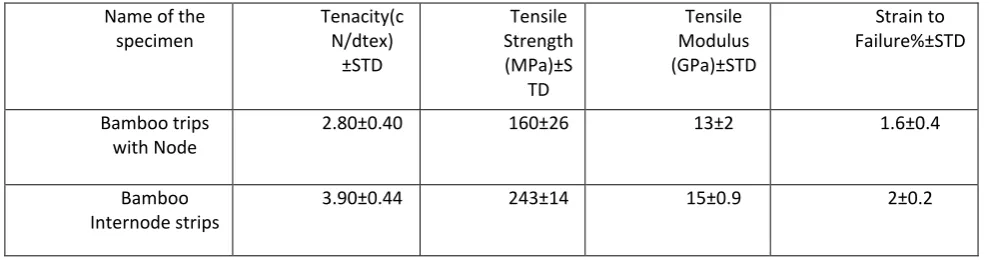
Tensile properties of the waste bamboo strip with node and without node are shown in Table 1. The average value of Tenacity, Tensile Strength, Tensile Modules and Strain at failure% of bamboo strips of node and internodes are 2.80cN/dtex, 160MPa, 13GPa, 1.6% and 3.90cN/dtex, 243 MPa, 15GPa, 2% respectively. These results seem to be consistent with data of other research that tenacity, tensile strength, tensile modulus and strain at failure% are 2.41cN/dtex, 140-230Mpa, 11-17GPa and 1.1% respectively (Faruk, Bledzki, Fink, & Sain, 2012; Liu, Wang, Cheng, Qian, & Yu, 2011; Yan, Chouw, & Jayaraman, 2014).
Table 1. Tensile properties of waste bamboo strip
Name of the specimen
Tenacity(c N/dtex)
±STD
Tensile Strength (MPa)±S
TD
Tensile Modulus (GPa)±STD
Strain to Failure%±STD
Bamboo trips with Node
2.80±0.40 160±26 13±2 1.6±0.4
Bamboo Internode strips
3.90±0.44 243±14 15±0.9 2±0.2
From table 1, it is also observed that the tensile property of bamboo internode strip was significantly greater than bamboo strips with node. These results are in agreement with the study conducted by (Li, 2004; Oka, Triwiyono, Awaludin, & Siswosukarto, 2014; Shao, Zhou, Liu, Wu, & Arnaud, 2010). A possible explanation for this might be that the fiber cells in the bamboo internodes arranged directly and continuously, while those in the bamboo nodes were arranged discontinuously. Furthermore, strip morphology and fiber alignment in the strip of nodes are less compact than internodes (Qi, Xie, Yu, & Chen, 2015).
1.1.4. Compressive Properties of Bamboo Strip
Li’s finding which is 16.1MPa for one-year-old bamboo (Li, 2004) and (Oka et al., 2014; Shao et al., 2010). surprisingly, there were no significant differences (P=0.43) in compressive strength between strips internodes and nodes. On the contrary, the difference in compressive moduli between nodes and internodes is statistically significant (P = 0.0013).
Fig. 2. Compressive properties of bamboo strip of node and internode
In contrast to earlier findings, no evidence of compressive strength and modulus of waste bamboo strip was detected. The difference in the compressive modulus explained by the fact that node strips are loose and structurally less compact due to the variation in characteristics (morphology and anatomy) (Qi et al., 2015), which ultimately result less stiffness in node compared to internode strips.
1.1.5. Flexural Properties of Bamboo Strip
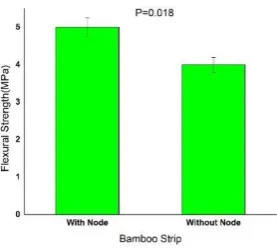
Figure 3 shows the results of the flexural tests conducted on waste bamboo strips of nodes and internodes. Paired
Student’s t tests were used to determine statistical significance. It is found that nodes have significant effect on
lowering bending strength having p value 0.018, which is statistically significant. Most of the available studies have been done on the flexural performance of fresh bamboo, since fresh bamboo having high moisture content can alter the flexural properties of material. (Taylor et al., 2015).
Fig. 3. Flexural properties of bamboo strip of node and internode
1.1.6. Impact Properties of Bamboo Strip
Impact strength is defined as “the ability of a material to resist fracture under stress applied at high speed”
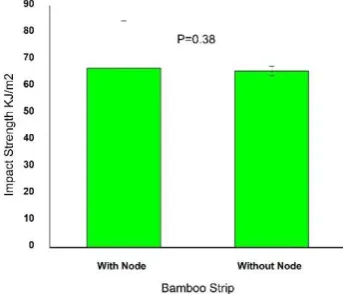
(Srinivasa & Bharath, 2013). The Pendulum type impact test provides a record of the impact event.
Figure 4 shows the results of impact tests conducted on strip of node and internode specimens. This finding supports previous research, which reveals that the impact strength of bamboo along the fibers is 63.54(±4.63) (Jain et al., 1992). Paired Students t tests were used to determine statistical significance. It is apparent from figure 4 that internodes having a little less strength of 65.8 KJ/m2 (SD=17) than nodes of (66.9 KJ/m2 (SD=17) make sure no
statistical significant difference (P=0.38). It is probably due to different shapes and sizes of samples. These results suggest that the nodes have only a minor effect on the impact properties of the waste strips. The significant effect could be obtained for high frequency of the nodes along the culm and for more compact structure in the nodes areas (Taylor et al., 2015).
1.8. Thermal Property
Thermogravimetric analysis (TGA)
The thermo-gravimetric curves of waste bamboo strip at a heating rate 10o C/min are shown in Fig 5. There is a
peak at approximately 1000C indicating the removal of moisture from the strip. Bamboo strips show thermal
decomposition within the temperature range of 200 and 3600C, which are in line with those of previous studies .
However, the maximum decomposiion peak was observed at 3430C. Thus the bamboo strips had higher thermal
stability as compared to other natural fiber commonly used in the polymer processing industry (Yao, Wu, Lei, Guo, & Xu, 2008).
4. Conclusion
Bamboo waste in the form of strips of with and without node were characterized in terms of mechano-physical and thermal properties from composite perspective. This study has shown that all the criteria of mechanical properties of internode except flexural properties: tensile (243MPa), Compression (13MPa), Impact (66.9KJ/m2)
have been found almost like fresh material. In addition, interestingly, the thermal property shows that the molecular degradation of wastage material does not get significantly deteriorated from its initial condition. Although both mechanical and thermal properties of waste bamboo do not possess as high as those of synthetic materials (Glass ,Carbon), they do have better performance than other bio fibers like alifa, coir, feather, pineapple etc. (Faruk et al., 2012; K Okubo & Fujii, 2002; Yan et al., 2014) . The second major finding was that the contribution of node on improving the mechanical properties of bamboo strips, which is not much encouraging. Rather, they have negative influence on the strip property.
Despite we considered only the waste of bamboo sleeping mat hence research can also be conducted on bamboo wastage from other sources. However, the properties revealed from the characterization imply that materials could be applied for structural and non-structural applications. Consequently, future research can be conducted by developing composites from bamboo waste materials to understand their performance and behavior in the composites and other high-performance materials. However, the test results these materials could be fit for structural and non-structural applications. Consequently, future research can be designed using these bamboo waste materials to assess their suitability for fabrication of high performance composite materials which will facilitate the sustainable approach of composite industries. As the material is reusable, recyclable, lower in cost and easily available it could be a good replacement for traditional wood in terms of indoor and outdoor applications; for example, furniture, housing, packaging, transportation, automobile, decking, fencing, dustbin.
Acknowledgement
This work was supported by the graduate research funds of the Wuhan Textile University, China. The authors wish to thank Dr. Zhou Yi for his technical and administrative support.
References
Ahmad, A., & Hameed, B. (2010). Effect of preparation conditions of activated carbon from bamboo waste for real textile wastewater. Journal of hazardous materials, 173(1), 487-493.
Biswas, D., Bose, S. K., & Hossain, M. M. (2011). Physical and mechanical properties of urea formaldehyde-bonded particleboard made from bamboo waste. International Journal of Adhesion and Adhesives, 31(2),
84-87.
Chen, H., Miao, M., & Ding, X. (2009). Influence of moisture absorption on the interfacial strength of bamboo/vinyl ester composites. Composites Part A: Applied Science and Manufacturing, 40(12), 2013-2019.
Chen, H., Miao, M., & Ding, X. (2011). Chemical treatments of bamboo to modify its moisture absorption and adhesion to vinyl ester resin in humid environment. Journal of composite materials, 45(14), 1533-1542.
Chen, S., Zheng, Z., & Huang, P. (2011). Sustainable Development for Bamboo Industry in Anji, Zhejiang Province of China. Research Journal of Environmental Sciences, 5(3), 279.
Cheng, H., & Hu, Y. (2010). Municipal solid waste (MSW) as a renewable source of energy: Current and future practices in China. Bioresource technology, 101(11), 3816-3824.
Choy, K. K., Barford, J. P., & McKay, G. (2005). Production of activated carbon from bamboo scaffolding waste—
process design, evaluation and sensitivity analysis. Chemical Engineering Journal, 109(1), 147-165.
Das, M., & Chakraborty, D. (2007). Role of mercerization of the bamboo strips on the impact properties and morphology of unidirectional bamboo strips–novolac composites. Polymer composites, 28(1), 57-60.
Das, M., & Chakraborty, D. (2008). Processing of the Uni-directional Powdered Phenolic Resin–Bamboo Fiber Composites and Resulting Dynamic Mechanical Properties. Journal of Reinforced Plastics and Composites.
Das, M., & Chakraborty, D. (2009a). The effect of alkalization and fiber loading on the mechanical properties of bamboo fiber composites, Part 1:—Polyester resin matrix. Journal of applied polymer science, 112(1),
489-495.
Das, M., & Chakraborty, D. (2009b). Effects of alkalization and fiber loading on the mechanical properties and morphology of bamboo fiber composites. II. Resol matrix. Journal of applied polymer science, 112(1),
447-453.
Das, M., Prasad, V., & Chakrabarty, D. (2009). Thermogravimetric and weathering study of novolac resin composites reinforced with mercerized bamboo fiber. Polymer composites, 30(10), 1408-1416.
Faruk, O., Bledzki, A. K., Fink, H.-P., & Sain, M. (2012). Biocomposites reinforced with natural fibers: 2000–2010.
Progress in polymer science, 37(11), 1552-1596.
Huda, S., Reddy, N., & Yang, Y. (2012). Ultra-light-weight composites from bamboo strips and polypropylene web with exceptional flexural properties. Composites Part B: Engineering, 43(3), 1658-1664.
Jain, S., Jindal, U., & Kumar, R. (1993). Development and fracture mechanism of the bamboo/polyester resin composite. Journal of materials science letters, 12(8), 558-560.
Jain, S., Kumar, R., & Jindal, U. (1992). Mechanical behaviour of bamboo and bamboo composite. Journal of materials science, 27(17), 4598-4604.
Kumar, K., Nair, C., & Ninan, K. (2008). Effect of fiber length and composition on mechanical properties of carbon fiber‐reinforced polybenzoxazine. Polymers for Advanced Technologies, 19(7), 895-904.
Kushwaha, P., & Kumar, R. (2009). Enhanced mechanical strength of BFRP composite using modified bamboos.
Journal of Reinforced Plastics and Composites, 28(23), 2851-2859.
La Mantia, F., & Morreale, M. (2011). Green composites: A brief review. Composites Part A: Applied Science and Manufacturing, 42(6), 579-588.
Li, X. (2004). Physical, chemical, and mechanical properties of bamboo and its utilization potential for fiberboard manufacturing. Beijing Forestry University.
Liu, L., Wang, Q., Cheng, L., Qian, J., & Yu, J. (2011). Modification of natural bamboo fibers for textile applications. Fibers and Polymers, 12(1), 95-103.
Oka, G. M., Triwiyono, A., Awaludin, A., & Siswosukarto, S. (2014). Effects of node, internode and height position on the mechanical properties of Gigantochloa atroviolacea bamboo. Procedia Engineering, 95, 31-37.
Okubo, K., & Fujii, T. (2002). Eco-composites using natural fibres and their mechanical properties. WIT Transactions on The Built Environment, 59.
Okubo, K., Fujii, T., & Yamamoto, Y. (2004). Development of bamboo-based polymer composites and their mechanical properties. Composites Part A: Applied Science and Manufacturing, 35(3), 377-383.
Panneerdhass, R., Gnanavelbabu, A., & Rajkumar, K. (2014). Mechanical properties of luffa fiber and ground nut reinforced epoxy polymer hybrid composites. Procedia Engineering, 97, 2042-2051.
Qi, J., Xie, J., Yu, W., & Chen, S. (2015). Effects of characteristic inhomogeneity of bamboo culm nodes on mechanical properties of bamboo fiber reinforced composite. Journal of Forestry Research, 26(4),
1057-1060.
Ray, A. K., Mondal, S., Das, S. K., & Ramachandrarao, P. (2005). Bamboo—a functionally graded composite-correlation between microstructure and mechanical strength. Journal of materials science, 40(19),
5249-5253.
Samuel, O. D., Agbo, S., & Adekanye, T. A. (2012). Assessing mechanical properties of natural fibre reinforced composites for engineering applications. Journal of Minerals and Materials Characterization and Engineering, 11(08), 780.
Scurlock, J., Dayton, D., & Hames, B. (2000). Bamboo: An overlooked biomass resource? Biomass and bioenergy, 19(4), 229-244.
Shao, Z., Zhou, L., Liu, Y., Wu, Z., & Arnaud, C. (2010). Differences in structure and strength between internode and node sections of moso bamboo. Journal of Tropical Forest Science, 133-138.
Srinivasa, C., & Bharath, K. (2013). Effect of alkali treatment on impact behavior of areca fibers reinforced polymer composites. fiber composites, 1(2), 8.
Taijun, C., & Gangyi, L. (2005). Development of Textiles Made from Bamboo Fiber and its Prospect, J. Hunan Liberal Art Sci. College (Natural Sci. Ed.), 17(1), 57-59.
Taylor, D., Kinane, B., Sweeney, C., Sweetnam, D., O’Reilly, P., & Duan, K. (2015). The biomechanics of bamboo:
investigating the role of the nodes. Wood science and technology, 49(2), 345-357.
Van Vuure, A., Osorio, L., Trujillo, E., Fuentes, C., & Verpoest, I. (2009). Long bamboo fibre composites. Paper
presented at the Proceedings of the ICCM.
Wahab, R., Mohamed, A., Mustafa, M., & Hassan, A. (2009). Physical characteristics and anatomical properties of cultivated bamboo (Bambusa vulgaris Schrad.) culms. Journal of Biological Sciences, 9(7), 753-759.
Yan, L., Chouw, N., & Jayaraman, K. (2014). Flax fibre and its composites–a review. Composites Part B: Engineering, 56, 296-317.
Yao, F., Wu, Q., Lei, Y., Guo, W., & Xu, Y. (2008). Thermal decomposition kinetics of natural fibers: activation energy with dynamic thermogravimetric analysis. Polymer Degradation and Stability, 93(1), 90-98.
Yasmin, A., & Daniel, I. M. (2004). Mechanical and thermal properties of graphite platelet/epoxy composites.
Polymer, 45(24), 8211-8219.
Yuan, H., & Shen, L. (2011). Trend of the research on construction and demolition waste management. Waste management, 31(4), 670-679.
Zhang, D. Q., Tan, S. K., & Gersberg, R. M. (2010). Municipal solid waste management in China: status, problems and challenges. Journal of Environmental Management, 91(8), 1623-1633.
Zhang, Y.-J., Xing, Z.-J., Duan, Z.-K., Li, M., & Wang, Y. (2014). Effects of steam activation on the pore structure and surface chemistry of activated carbon derived from bamboo waste. Applied Surface Science, 315,