ISSN 1473-2866 (Online) ISSN 2052-1499 (Print) www.ephemerajournal.org volume 17(3): 609-618
A note on notes: On the rise of ‘special sections’
in academic journals
Sverre Spoelstra
Introduction
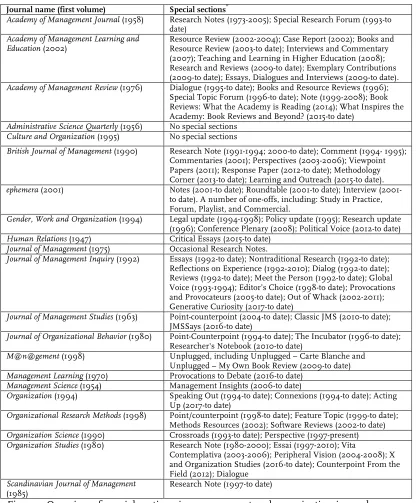
In this short paper I explore the rise of ‘special sections’ in academic journals (such as this ‘Note’ section in ephemera). Prior to the 1990s, management journals had two major sections: peer-reviewed articles and book reviews. There was very little published that did not fit into these categories: the occasional obituary, an erratum or retraction, a call for papers, some announcements, and very little else. All this started to change in the 1990s and 2000s with the emergence of special sections, i.e. a designated space within journals designed to host papers that fall outside the purview of a regular article (for an overview, see figure 1).1 This note reflects on the rise of these special sections: what explains their popularity, and what do they accomplish? I argue that behind their various forms is a collective shame about what journal publishing has become.
In preparing this paper, I interviewed six former and current editors of five different management and organization journals who have been directly involved
1 To my knowledge, the only special section that predates the 1990s is the section
‘Research Notes’, which was a regular feature in Academy of Management Journal
with special sections. I also had email correspondence with another eight former and current editors about particular special sections. I spoke to the editors about their impressions of the rise of special sections, and about their experiences with the particular sections that they developed or worked with. Additionally, the paper draws on my own experiences as part of the ephemera editorial collective between 2004 and 2013.
What is a special section?
We may characterize a special section as a less defined space within a more defined space, like Freetown Christiania in the city of Copenhagen. Special sections represent an attempt to create a space where the rules of the larger space of which it is part (constituted by the rules of journal article publishing, or Danish law in the case of Christiania) are not in effect. Often this is accomplished by creating a different set of rules, which effectively protect the section from the rules of ‘ordinary’ journal publishing. However, it is not always clear what the rules of special sections are. In some cases, the rules that govern special sections are negative, in that they neutralize the ‘normal’ rules but do not themselves provide the section with clear guidelines for content. In other cases, the types of contributions that special sections call for are also positively defined.
An example of a purely negative definition is M@n@gement’s section ‘Carte Blanche’, which, as the name suggests, gives authors complete freedom to do whatever they wish to do: any normal rules are suspended and the editorial police is off-duty. The only catch is that you have to be a ‘world-class scholar’ who writes upon invitation of the editor.
papers that often, implicitly or explicitly, challenge the stuff that happens in the normal section.
Some of the editors I spoke to distinguish between the ‘rigour’ that constitutes regular publishing and the ‘novelty’ and ‘creativity’ that is offered by special sections. In this narrative, there is nothing wrong with regular publishing as such (it’s of a high scientific standard, i.e. ‘rigorous’) but it is highly specialized and doesn’t appeal to a broad audience, not even within the walls of the university. This increasing degree of specialization, the narrative continues, has created a demand for different kinds of writing, and special sections are an answer to this demand. Hence special sections are seen as add-ons to ‘normal science’, to use Thomas Kuhn’s (1962) term, bringing something different to the table or opening something up for debate.
For other editors, however, the term ‘rigour’ – shorthand for the standard methodological rules for doing management research – is far too positive to capture the sorry state of ‘normal science’, which, to them, seems formulaic rather than rigorous. For instance, one of the editors I spoke to told me that
the reason why there are increasingly more journals doing new kinds of sections [is] to get away from this very formulaic writing that we tend to have developed over the years. […] In order to break with that very formulaic style of writing, these new sections have come up. (R1)
Journal name (first volume) Special sections*
Academy of Management Journal (1958) Research Notes (1973-2005); Special Research Forum (1993-to date)
Academy of Management Learning and
Education (2002) Resource Review (2002-2004); Case Report (2002); Books and Resource Review (2003-to date); Interviews and Commentary (2007); Teaching and Learning in Higher Education (2008); Research and Reviews (2009-to date); Exemplary Contributions (2009-to date); Essays, Dialogues and Interviews (2009-to date).
Academy of Management Review (1976) Dialogue (1995-to date); Books and Resource Reviews (1996); Special Topic Forum (1996-to date); Note (1999-2008); Book Reviews: What the Academy is Reading (2014); What Inspires the Academy: Book Reviews and Beyond? (2015-to date)
Administrative Science Quarterly (1956) No special sections
Culture and Organization (1995) No special sections
British Journal of Management (1990) Research Note (1991-1994; 2000-to date); Comment (1994- 1995); Commentaries (2001); Perspectives (2003-2006); Viewpoint Papers (2011); Response Paper (2012-to date); Methodology Corner (2013-to date); Learning and Outreach (2015-to date).
ephemera (2001) Notes to date); Roundtable to date); Interview
(2001-to date). A number of one-offs, including: Study in Practice, Forum, Playlist, and Commercial.
Gender, Work and Organization (1994) Legal update (1994-1998); Policy update (1995); Research update (1996); Conference Plenary (2008); Political Voice (2012-to date)
Human Relations (1947) Critical Essays (2015-to date)
Journal of Management (1975) Occasional Research Notes.
Journal of Management Inquiry (1992) Essays (1992-to date); Nontraditional Research (1992-to date); Reflections on Experience (1992-2010); Dialog (1992-to date); Reviews (1992-to date); Meet the Person (1992-to date); Global Voice (1993-1994); Editor’s Choice (1998-to date); Provocations and Provocateurs (2005-to date); Out of Whack (2002-2011); Generative Curiosity (2017-to date)
Journal of Management Studies (1963) Point-counterpoint (2004-to date); Classic JMS (2010-to date); JMSSays (2016-to date)
Journal of Organizational Behavior (1980) Point-Counterpoint (1994-to date); The Incubator (1996-to date); Researcher's Notebook (2010-to date)
M@n@gement (1998) Unplugged, including Unplugged – Carte Blanche and
Unplugged – My Own Book Review (2009-to date)
Management Learning (1970) Provocations to Debate (2016-to date)
Management Science (1954) Management Insights (2006-to date)
Organization (1994) Speaking Out (1994-to date); Connexions (1994-to date); Acting
Up (2017-to date)
Organizational Research Methods (1998) Point/counterpoint (1998-to date); Feature Topic (1999-to date); Methods Resources (2002); Software Reviews (2002-to date)
Organization Science (1990) Crossroads (1993-to date); Perspective (1997-present)
Organization Studies (1980) Research Note (1980-2000); Essai (1997-2010); Vita
Contemplativa (2003-2006); Peripheral Vision (2004-2008); X and Organization Studies (2016-to date); Counterpoint From the Field (2012); Dialogue
Scandinavian Journal of Management
A recent editorial of Journal of Management Studies, launching the new special section ‘JMSSays’, offers the same dichotomy between a formulaic standard and a more exciting outside. They write that they are ‘strongly of the view that too much management scholarship has become formulaic, sterile and just plain dull’ (Delbridge et al., 2016: 238-239) and express their hope that ‘JMSSays’ will ‘provide a forum for scholarship which is not constrained by the norms of conventional academic research and theorizing’ (Delbridge et al., 2016: 242). The same editorial also mentions ‘institutional pressures’ as the main reason why academics produce dull stuff. This, of course, includes pressures that come from journals themselves (not mentioned in their editorial), especially those journals that are heavily oriented towards journal ranking lists and impact factors (Journal of Management Studies included). One may guess, then, that some editors have excellent reasons to feel embarrassed about the regular stuff that fills the pages of their journal. Perhaps special sections are one way of softening this embarrassment.
A great variety
Despite the common theme of being outside the ordinary, there is great variety among special sections. Indeed, the openness that is called for in terms of submissions to special sections often goes hand in hand with great editorial flexibility in handling these submissions. Some special section submissions are blind peer reviewed, like regular submissions, but many journals treat special sections differently. For instance, papers may only go through one round of review or they are evaluated by special section-editors only. Hence, apart from double-blind review, one can also find variations such as single-blind or one-eyed and two-eyed review. For some sections the review process (or lack thereof) is publicly announced, but for other sections there is no such transparency.
Special sections may or may not be open for the general public of academics (and, occasionally, non-academics).2 Quite a few special sections are set up as ‘commissioned articles only’ (e.g. Academy of Learning and Education’s ‘Exemplary Contributions’), which – in practice – may mean that they are open to big names only (e.g. Organization Studies’ ‘Vita Contemplativa’) or (especially)
2 One of the founding editors of ephemera recalls that part of ephemera’s ‘motivation [to
open to friends and colleagues of the editors.3 Other special sections, in contrast, are fully open.
There often is a tension between the formal rules, which you may read on a journal’s website, and actual practices. The influence that editors have in this regard should not be underestimated. One editor of a top-ranked journal I spoke to said: ‘You know, if I really wanted to, I could get everybody from [my university] to write, and then our department would look great’ (R5). Of course, it is a myth to begin with that the review process of regular articles is blind (journal editors often have a great power in steering papers in the ‘right’ direction), but special section papers are even more dependent on editorial preferences, for better and for worse. In a rare public confession, Glassman and Cummings (2011: 352), both former editors of Journal of Management Inquiry, admit that they actively recruited ‘eminent colleagues’, while ‘violating our public commitment that all articles would be double-blind reviewed’.
There is no common function behind formally or informally commissioned papers in special sections. In my experience in ephemera, commissioned notes have been popular especially for issues with a rather small amount of submissions. An editor of a different journal confirms that this is not unique to ephemera: special sections may be useful because ‘you’ve got to fill space’ (R4). But invited submissions, or what we could call ‘red carpet papers’, may also serve to bind big names to a journal. For instance, I spoke to one ‘world-class’ scholar who has published in the earlier mentioned ‘Carte Blanche’ section of M@n@gement. He confided that the paper in question was rejected by other journals because it contained a message that ‘the field does not like to hear’ (R9, email correspondence). The author was also eager ‘to get it out’, as some of its contents was (also) forthcoming in a book. In this way, the author could get a rejected paper through without too much of a hassle, and the journal binds a big name to the journal. A win-win, it may seem.
with (near) immediate acceptance as the only appropriate response. If the editor stands their ground, there is a great pleasure in defying such expectations.
But many journals do try to attract big names to their journals, even when the paper isn’t up to scratch. Special sections, as the space that tends to be governed the least, are a means that journals have at their disposal in achieving this aim. One editor I informally spoke to mentioned that special sections, in his view, are the place where ‘the best and the worst papers get published’. If true, this may well be a consequence of the fact that many special sections are particularly open to big names, who may or may not put effort into their freebie. Anecdotally, I know of one professor who cut-and-pasted something together after being invited to submit to a special section of an ABS 4-rated journal – not always a recipe for (scholarly) success.
Also for the big journals, some with well over a 1000 submissions per year, special sections can be a way to attract prominent scholars who would otherwise not go through the trouble of a tiresome review process.One editor of an ABS 4-rated journal recalls that even with the red carpet in place it can be difficult to fill special sections with special guests:
It was pulling teeth, a lot of people would promise then they would never come through […] it was much harder than I ever dreamed it would be. (R5)
One reason for this difficulty is that papers in special sections are not always taken seriously. For some, special sections are filled with content that is not ‘rigorous’, and therefore do not count as an outlet for research proper. This is at times also reflected on an institutional level. A former editor of Academy of Management Journal recalls that AMJ’s section ‘Research Notes’ was partly terminated for that reason: ‘it sort of devalued/demeaned the papers’ that were published there, because some ‘schools didn’t credit authors for having a “note” in AMJ’ (R11, email correspondence).4
The prospect of citations is a final factor that may be at play in special sections, but also here there is no standard. Some sections are set up in the hope that they cite well, while other special sections have been designed without projected returns in citations (e.g. this ‘Note’ section). Even when citation potential is part of the rationale, actuality may not confirm such hopes. Tsoukas (2008: 1095), in
4 A second reason is that ‘
his comments as departing editor, admits that papers published in Organization Studies’ ‘Vita Contemplativa’ ‘have not been cited as well as I had hoped’. A low return on investment in citations can also be a reason to cut the section entirely. I attended one meet-the-editor session where the editor of a fairly highly ranked journal (4-star ABS, with aspirations to compete with the most cited journals in the field) proudly announced that they got rid of a special section because it had a negative influence on their impact factor, ‘despite the fact that the readers really liked it’.
Special sections as an expression of collective shame
Despite the variety in special sections and the different functions that they may serve, I believe it is possible to say something about their increasing popularity on a general level: they are an expression of a collective shame for what normal research has become, and they serve as a protective layer for the articles that we have become so ashamed of.
As we have seen, the rise of these sections could be interpreted as a playground within the reality of social science; a free space where the normal requirements of research do not apply. Outside these sections we find ‘real’ social science, and inside these sections we encounter free experimentation with ideas. Special sections, then, are the place where playfulness is allowed to happen.
Equally plausible, however, is the exact opposite thesis: we are all aware that ‘game playing’, this time used pejoratively, really takes place within the ‘normal’ process of journal publication, and that the only way out is to create space for ‘reality’ to re-enter in special sections. Special sections, on this view, are not special at all: they help us remember what normal research ought to look like. Continuing this thought, we may perhaps even say that Organization’s ‘out’ in ‘Speaking Out’ is the scream to re-connect to ‘reality’, to the outside of the games that academics play.
and 1990s (e.g. is normal science desirable in organization studies? should we be in a permanent state of extraordinary science?). Journals are now both ‘ordinary’ and ‘extraordinary’; ‘normal’ and ‘special’. They have their cake and eat it too. The problem, however, is that ‘extraordinary sections’ are far from a sign that normal science is in crisis, which is what extraordinary science signals in Kuhn. Indeed, the exact opposite is the case: they strengthen ‘normal science’ in its legitimacy.
(No) practical recommendations
I don’t want to end this note with some practical recommendations with regards to special sections. Despite some reservations, I have nothing against special sections per se. Quite the contrary: they usually really are more interesting, through-provoking, readable, creative, and so on, than the normal stuff published in the field.
What I do find problematic is rather the ever-growing need for the distinction between ‘normal articles’ and ‘special papers’ that journals create within themselves (as well as some dubious motivations and practices that inevitably lurk behind the scenes – in spaces that are accessible only to journals editors, journal publishers and a handful of other players). From this perspective, I have great sympathy for two journals in particular: first, Journal of Management Inquiry, which, on paper, turned all its sections into ‘special sections’. In reality two of these sections, ‘Essays’ and ‘Nontraditional Research’, are de facto regular sections that were supposed to give the journal ‘academic legitimacy’ (Glassman and Cummings, 2011: 351). But by refusing to succumb to a strict division between the ordinary and the extraordinary, they maintain an openness in journal publishing that is absent from most other management and organization journals. Second, Culture and Organization’s stoic refusal to adapt to new times: they still have just one section, which remains very open (more open than the few other journals that have never had special sections), which is to say that the articles that are published have not become more formulaic over time (at least not in my reading).
references
Delbridge, R., R. Suddaby and B. Harley (2016) ‘Introducing JMSSays’, Journal of Management Studies, 53(2): 238-243.
ephemera (2016) ‘How to submit’. [http://www.ephemerajournal.org/how-submit]
Organization (2016) ‘Description’. [https://uk.sagepub.com/en-gb/eur/journal/ organization]
Glassman, A.M. and T. G. Cummings (2011) ‘The wilderness years at JMI’, Journal of Management Inquiry, 20(4): 349-354.
Kuhn, T. (1962) The structure of scientific revolutions. University of Chicago Press: Chicago and London.
Stackman, R. W. and D. R. Hannah (2017) ‘Generative curiosity: Introducing JMI’s newest section’, Journal of Management Inquiry, 26(1): 112-115.
Tsoukas, H. (2008) ‘Thank you and goodbye! Reflections of a departing editor-in-chief’, Organization Studies, 29(8-9): 1085-1107.