
Smart Grids and Ethics
A Case Study
Hatzakis, Tally, Trilateral Research, UK
Rodrigues, Rowena Trilateral, UK
Wright, David Trilateral Research, UK
Corresponding Author: Tally Hatzakis, [email protected]
Abstract: This case study explores the principal ethical issues that occur in the use of Smart Information Systems (SIS) in smart grids and offers suggestions as to how they might be addressed. Key issues highlighted in the literature are re-viewed. The empirical case study describesone of the largest distribution system operators (DSOs) in the Netherlands . The aim of this case study is to identify which ethical issues arise from the use of SIS in smart grids, the current efforts ofthe organisation to address them, and whether practitioners are facing additional issues not addressed in current literature. The literature review highlights mainly ethical issues around health and safety, privacy and informed consent, cyber-risks and energy security, affordability and equity, sustainability. The key topics raised by interviewees revolved around privacy and to some extent cybersecurity. This may be due to the prevalence of the issue within the sector and the company in particular or due to the positions held by interviewees in the organisation. Issues of sectorial dynamics and public trust, codes of conduct and regulation were raised in the interviewswhich are not discussed in the literature. The paper hence highlights the ability of case studies to identify ethical issues not covered (or cov-ered to an inadequate degree) in the academic literature which are facing practi-tioners in the energy sector.
Citation: Hatzakis, T., Rodrigues, R., & David, W. (2019). Smart Grids and Eth-ics. ORBIT Journal, 2(2). https://doi.org/10.29297/orbit.v2i2.108
Introduction
“As a crucial element of our overall energy and climate strategy, we need to ensure that our energy infrastructure is sustainable, goal-oriented and operational.”
Miguel Arias Cañete, European Commissioner for Climate Action and Energy
The energy sector represents the critical infrastructure upon which all other economic activities, modern life conveniences and services, including the wide spectrum of infor-mation and communication technologies (ICT) are based. The expected demands on the energy sector over the coming years will be immense, due to the proliferation of ICT technologies and their ubiquitous use in all aspects of social and economic life.
Many factors will increase society’s electricity demands in Europe, such as the advent of Internet of Things1 (IoT) sensors, the increased digitalisation of social life due to robotics and blockchain2, the further digitalisation of industry, and the transition from fossil
fuel-powered to electric cars. In parallel, to tackle climate change and decrease reliance on imported fossil fuels, Europe is pushing for greater integration of renewables in the mix of energy production sources. In combination, both put great pressure on the capacity of Europe’s pre-existing energy distribution network infrastructure, which cannot currently scale up to meet expected demands, at least not if managed in traditional ways. European countries have two options(EC Com 356, 2014): invest in upgrading energy infrastructure networks; or optimise the use of the existing infrastructure capacity by utilising SIS. On the supply side, improved efficiency can derive from better management of volatile renewable energy generation solutions, improved maintenance of the energy grid infra-structure, and even enhancing modelling of demand needs and thereby infrastructure
1“The interconnection via the Internet of computing devices embedded in everyday objects, enabling them to send and receive data”. Source: https://en.oxforddictionaries.com/definition/internet_of_things
vestments. On the demand side, improved efficiency can derive from shifting energy con-sumption patterns through real-time demand-response pricing and load balancing across the grid (EC, 2016).
While the use of SIS in energy distribution, i.e. in smart grids, hold the promise that countries will be able to ensure affordable and sustainable energy for the ever-increasing energy demands of smart living (EC, 2016), it presents a number of ethical challenges (Sarvapali, et.al, 2012).
This case study reviews the social, ethical, and human rights issues arising from the utili-sation of SIS (AI technologies and big data analytics) in the energy sector and in particu-lar in smart energy grids. Section 1 explains the use of SIS in the energy sector and in particular in energy distribution via energy grids.Section 2 will review the current im-plementation of big data and AI-powered analytics in the energy sector and the ethical issues that may arise as a result. It will focus on the types of SIS technologies being used and highlight the range of social and ethical issues surrounding their use. Section 3 will analyse a Dutch DSOcompany. Section 4 will explore and critically evaluate ethical is-sues arising from the introduction of SIS technologies in smart grids in practice, through interviews conducted with staff members. This section will evaluate whether there are policies and procedures in place to tackle these issues, and what the protocol is for ad-dressing concerns.
The Use of SIS in Smart Grids
The use of SIS in energy promises to ensure sustainable affordable energy for the ever-increasing demands of smart living without big investments in the energy distribution systems in two ways. First, SIS allow to optimise the management of energy demand and energy supply from existing resources. Smart grids involve a host of intelligent technolo-gies to improve the management of the energy distribution network that connects energy producers with consumers. These include:
• sensors that collect real-time information about energy quality at different points along the distribution network,
• sensors that collect information about consumption via smart meters installed in people’s houses,
• mechanism to analyse all collected data in order to better predict energy needs, optimise supply and demand and swiftly respond to unpredicted changes in either, and
• finally means to provide the necessary insights to design incentivisation pro-grammes to change energy consumption behaviours.
integration poses a challenge for traditional power grids. Surges of power generated by renewables may overcharge the grid leading to power cuts and costly maintenance work, or compromise the reliability and quality of the electricity provided (Rathi, 2017). SIS allow to safely manage the risks from integrating renewables into the energy production mix. According to Liang (2017), quality issues arise from:
• voltage and frequency fluctuations that can be caused by the intermittent nature of renewable energy production due to changing weather conditions and
• harmonic (wavelength) distortions introduced by electronic devices utilised in re-newable energy generation.
Such risks introduced by renewable energy technologies may affect the performance of electrical equipment, particularly sensitive electronic devices. A number of problems can compromise the performance and reliability of electronic systems, such as equipment shutoff, errors or memory loss, loss of data and burned circuit boards, reader errors and the like. To handle such volatility requires the monitoring and control of electricity from the point of production to the point of consumption, as well as real-time adjustments in energy distribution depending on fluctuations in weather conditions, fluctuations in en-ergy generation and demand and other factors that can affect the quality of the enen-ergy supply (Rojin, 2013). Hence, the use of smart grid technologies can help solve the Energy Trilemma: how to secure (energy security) affordable energy for all (energy equity) in a sustainable manner (environmental sustainability).
Energy security: Effective Man-agement of primary energy supply from domestic and external sources, reliability of energy infra-structure, and ability of energy pro-vide to meet current and future de-mand.
Energy equity: Accessibility and affordability of energy supply across the population.
Environmental Sustainability: Encompasses achievement of sup-ply- and demand-side energy effi-ciencies and development of energy supply from renewable and other
Energy security
Environ-mental Sustain-ability
Energy Trilemma
low-carbon sources.
Figure 1: The three dimensions of the energy trilemma. Source: World Energy Trilemma Index 2018, World Energy Council 2018 at:
https://trilemma.worldenergy.org/reports/main/2018/2018%20Energy%20Trilemma%20Index.pdf
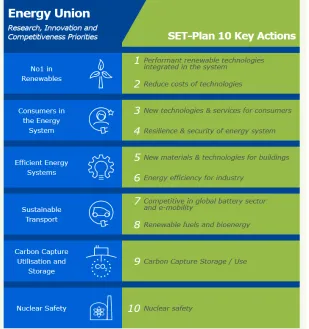
Figure 2: Top 10 priorities of the SET plan ratified in Tallinn 2016. Source: EC (2016) Transforming the European Energy System through Innovation: Integrated Strategic Energy Technology (SET) Plan Progress
in 2016 (doi:10.2833/661954), Luxembourg: Publications Office of the European Union, 2016
Smart grids involve a host of intelligent technologies to improve monitoring and control of energy consumption, and communication technologies to address operational issues around distribution and production, but also collect real-time information about energy consumption from consumers via smart meters. It is worth noting that such technologies do not substitute but complement traditional grids. Such technologies comprise:
• HAN (Home Area Networks), which ensure the communication between smart meters and smart appliances
• WASA (Wide Area Situational Awareness) which provides monitoring of performance and ensures dynamic prevention and response services when necessary.
• SCADA (Substation Supervisory Control and Data Acquisition) systems, which are used to monitor andcontrolenergy plants or equipment, as well as transportation.
• PMUs (Phasor Measurement Units) which allow the concurrent, real-time monitoring of energy supply systems by measuring electricity current and voltage by amplitude and phase across selected locations (stations) of the grid.
• WAMPAC (Wide Area Monitoring Protection and Control) which ensures the security of the power system.
• IEDs (Intelligent Electronic Devices), smart devices which can communicate with each other and with SCADA to enable fault detection and rectification.
• FACTS (Flexible AC Transmission Systems, such as Unified Power Flow Controllers), which enable long distance transport and integration of renewable energy sources.
Energy data from a variety of sources is combined and analysed (ENSI 2016), in order to:
• Develop a responsive power grid to achieve appropriate levels of reliability, re-silience and economic efficiency in the face of the fluctuations of renewable power generation. Smart power grids optimise not only the seamless integration of sustainable power, but also its storage, its connection with other networks (e.g. heat and cold, transport), and the inter-regional exchange of power.
• Develop local and regional energy systems to facilitate the integration of re-newables in the local or regional supply by 2030, and enable the inter-regional exchange of spare energy, as well as the security and resilience of European en-ergy systems (see Figure 3 below) .
Smart grid management systems require the analysis of real-time energy consumption data and energy production data. AMI collect household energy consumption data, as well as data relating to voltage quality, power quality, active energy and reactive power, as well as diagnostics information about the condition and control of the smart meter it-self (pinging the meter) and operational status (indicators, alarms and error messages) from the meter.
Figure 3: Current Innovation Priorities of SET plan Source: Regulatory Innovation Zones for Smart Energy Networks Source: ENSI (2018) Regulatory Innovation Zones for Smart Energy Networks
[online] Available at https://www.youtube.com/watch?v=JyR9aitMfIU [Accessed 27 Nov, 2018]
households which are to be financed via network tariffs3. DSOs are responsible for
en-ergy distribution infrastructure (mainly electricity and gas piles, exchanges, etc.). Not only are DSOs responsible for installing the meters, but also for data analytics in most countries, with the exception of Denmark, Estonia, Poland and the UK, where data will be handled by an independent central data hub; and with the exception of Czech Repub-lic, Germany and Slovakia where alternative options for data handling are being consid-ered. The European Commission requires that companies advise customers on how best to balance their energy consumption and enable new energy related services and prod-ucts. This hinges on access to real-time customer information and raises issues of profil-ing due to the gatherprofil-ing and storprofil-ing of sensitive information on the household energy footprint, and stored data in the light of privacy and confidentiality policies (EC Com 356, 2014).
The European Energy Union aspires to connect different country networks in an inte-grated energy system. This will require data and knowledge exchange as well as collabo-rations across the energy, transport, and ICT sectors, experts and regulators transnation-ally. The stakeholder landscape in the energy sector is beginning to change, giving rise to the development of cross-sectoral and cross-country collaborations, such as the European Technology and Innovation Platform on Smart Networks for the Transition, with the par-ticipation of industry representatives, research, academia, and users (see Figure 4 below). The development of cross-border groups is an interesting development in that there is an international collaboration between DSOs to tackle common issues, which is of particular interest to the case below. Platforms for a public debate with the participation of all types of future energy providers might be more useful in voicing concerns, getting public commitments towards agreed courses of action and informing policy and regulations.
Figure 4: The smart grid innovation landscape: The European Technology and Innovation Platform on Smart Networks for the Transition involves industry representatives, research, academia, and users. Source:
https://setis.ec.europa.eu/system/files/Communication_SET-Plan_15_Sept_2015.pdf
Not only isthe relationship between companies within the energy supply chain beginning to change, but also the relationship between companies and customers. Smart utilities promise consumers greater control over their energy consumption choices by collecting and providing customers with real-time information related to energy use and pricing. In addition, the role of end users in the energy value chain is likely to change. With the ad-vent of household renewables solutions, end users will increasingly generate their own power to use, give back to the grid or exchange at a local level. Hence their role will in-creasingly change from that of passive consumers of energy to that of an energy pro-sumer4. This will require the development of smart household energy management and
billing systems that can become an extension of the existing energy grid (IEA, 2017). Typically, end users receive their household energy from energy providers (gas and elec-tricity companies) with whom they have a contract agreement. Many such utilities strug-gle to garner their customers’ support for the installation of smart meters in households, particularly in Europe and the USA. The two primary concerns fuelling the resistance to smart meters relate to health and data privacy issues. Customers, in general, are uncom-fortable with commercial organisations, including utilities, possessing such fine-level
data that can give away intimate information about one’s lifestyle (EC Com 356, 2014). Aside from privacy, a number of other ethical issues relate to the use of SIS in smart grids.
Ethical issues of using SIS in smart grids
Despite the wide range of articles on smart grids, there has been very little research on the ethical and legal implications of using SIS technologies in energy. The installation of smart meters in the mainstream is not completed. Consumer research that has taken place relies mostly on pilots with interested parties and looks at the response and use of such technologies, from a functional rather than an ethical perspective. There have been few articles that have cohesively addressed ethical issues of SIS technology in the energy sector. A key issue receiving little attention at present is the implications of energy grids for energy justice and transitional justice to smart grids. Smart grids and their manage-ment are only a part of the new energy ecosystem and will likely become the key cus-tomer platform and key industry gatekeeper collecting cuscus-tomer insight. There seems to be an underlying mistrust towards energy players and governments about their positions and commitments towards practices that benefit society as a whole once implementation takes place.
Anticipated consumer benefits, such as energy savings,are predicated on the collection and analysis of granular information on household energy usage via smart meters, but these can be used to reveal detailed information about people’s private lives within the home, raising serious questions at a technical and policy level about in-home surveillance and how to address consumers’ privacy interests. These issues have been particularly controversial for gaining user acceptance in the US and Europe (Weaver, 2014). In addi-tion, energy systems are strategic targets for economically-motivated cybercrime, cy-berterrorism, and even cyberwar. Smart grids have ICT dependencies that make them more prone to additional security risks (perpetuated by deficiencies in system configura-tions, network design, software and platform vulnerabilities or lack of standards and poli-cies). Hence, the use of SIS in the energy sector brings into question societal norms around competing priorities and around the deliberation processes for resolving conflicts and reaching consensus.
This section explores the ethical tensions related to the smart grid. Section 2.1 refers to ethical issues arising from the impact of smart grids on people’s health. Section 2.2 deals with implications around privacy and industry practices around eliciting informed con-sent. Section 2.3 deals with cybersecurity risks threatening energy security.
The wireless communication between smart appliances and the smart grid raises health and safety concerns relating to radio frequency radiation and its possible carcinogenic effects. Similar concerns are associated with cell phone usage. Research conducted by the Electric Power Research Institute on the health implication of the radio-frequency expo-sure of smart grids indicated that levels fall within acceptable thresholds as defined by the Federal Communications Commission (FCC) for the general public. Yet, adverse public perceptions persist. This has led to various levels of resistance and disputes. For example, in California, citizens and municipalities have resisted the rollout of smart meters, taking the case to the Federal court. The matter also remains open for debate by the International Agency for Research on Cancer (IARC, 2011). While the case was recently resolved in court, negative perceptions about potential health risks still persist (Weaver, 2018).
Privacy and Informed Consent: Does the smart grid
give away household privacy?
Privacy concerns relate to the granularity of electricity consumption data that can be col-lected about a household and the intimate lifestyle information that can be inferred from it. For instance, smart meters can tell when someone is at home, whether they are cook-ing, taking a shower, or watching TV based on the monitoring the energy consumptions patterns (loads) of such appliances. Customers in general are uncomfortable with com-mercial organisations, including utilities, possessing such fine-level information (Gray, 2018). Some people also object to the mandate of being told to have a smart meter in-stalled, unaware of how this decision was made and who were involved in this decision. Objections are then related to trust and transparency (Gray, 2018, Knapman, 2018). To mitigate such concerns, and in response to the General Data Protection Regulation (GDPR), utilities have embarked on educating customers regarding their privacy policies, the reasons behind data collection and sharing, accessing of data, and consumer rights. Ofgem, the government regulator for gas and electricity markets in Great Britain for ex-ample, informs citizens of their rights and suggests that energy suppliers and network companies access smart meter data no more than once every 30 minutes to ensure accu-rate billing, carry out other essential tasks and share data (with customer consent) with third parties to offer them new products/services, such as dynamic billing options (see Smart Meter Your Rights at Ofgem.gov.uk).. Yet, the British Chartered Trading Stan-dards Institute (CTSI) have,however, received complaints from citizens about being mis-informed and pressured to install smart meters, potentially breaching Consumer Protec-tion RegulaProtec-tions and raising doubts about the industry’s overall ethical code (Knapman, 2018).
custom-ers’ consent to share their household consumption data. The company Efficiency 2.0, for example, delivers energy efficiency via customer engagement programmes, combining personalised technology portfolios and energy conservation actions with rewards and loyalty incentives to optimize energy savings5. This raises the question as to who will be
able to afford such services and at what cost. Given the high cost of energy as a percent-age of discretionary income for poorer families, it also raises the question as to whether poorer families can afford to opt out from giving their consent if this is the only way to get cheaper energy, or will they be indirectly coerced into it? Furthermore, those who live in e.g. government-assisted accommodation where electricity is paid by the stateor are occupants in shared private housing where the landlord controls the energy supply may not be given the option to consent individually.
Cyber-risks and Security: Do we jeopardise energy
se-curity?
Cyber-attacks on the smart grid can do significant damage, yet are still inadequately ad-dressed, due to their low probability of occurrence (Eder-Neuhauser, et. al., 2017). Using coordinated, distributed resources, cyber-attacks could potentially target sufficient critical power control equipment simultaneously to originate cascading effects and eventually cause the system to collapse. This would not only be harmful to system integrity but also poses huge risks to human safety. The use of sensors and IoT networks opens up the en-ergy grid to cyber-attacks that can cause disruption to enen-ergy distribution flows and even to the distribution infrastructure itself. As energy is fundamental for all aspects of modern living (from cooking to heating to telecoms), such disruptions can directly affect people’s wellbeing.
To date, cyber-attacks on the energy grid have been sparse but raise significant concerns. In 2015 and again in 2016, hackers launched a cyber-attack on West Ukraine’s power grid (Cherepanov,2016). The Industroyer malware hijacked standardised industrial com-munication protocols, which are used in most critical infrastructure systems, to take direct control of electricity substation switches and circuit breakers to cut electricity in 250,000 households in Western Ukraine for several hours (Cherepanov and Lipovsky, 2017). Lying dormant until instructed otherwise, malware can be reactivated remotely to over-write documents with random data or make the operating system unbootable. Cyberat-tacks on the energy grid have knock-on economic implications for citizens at a national level, and have cost the UK 545 million euro in losses alone, while global losses were estimated to be 1.69 billion euro in 2018 (Tofan et. al, 2016).
https://www.greentechmedia.com/articles/read/c3-acquires-efficiency-2-Affordability and energy equity
6: A new criteria to set
society apart
One of the key drivers for the smartification7 of energy grids is to create energy
abun-dance, or at least sufficiency, without the need for costly infrastructure investments, in order to maintain energy affordability for all (Ricci, et. al, 2012). The introduction of smart grids and active demand systems that monitor and incentivise alternative energy consumption habits can enable dynamic consumption of energy by enabling customers to shift their consumption to take advantage of dynamic pricing (ibid.).
Industrial and commercial organisations have experts who work on optimising energy requirements for their organisations. Citizens, however, lack the expertise, drive and flexibility to change their lifestyles according to dynamic pricing. The same holds for most SMEs and their energy consumption patterns (Faruqui, 2010). Energy aggregators and storage operators are expected to offer alternative services to facilitate dynamic con-sumption and manage the energy production of individual or community owned renew-ables. Nevertheless, smart energy systems will pose energy equity dilemmas around en-ergy justice. For example, while the cost of the enen-ergy grid is funded via taxation and hence shared between citizens, the benefits from transition to smart grids are not equally shared. Affluent consumers (e.g. those who can afford electric cars or to invest in photo-voltaic energy production) will reap the benefits of smart grids earlier and to a larger ex-tent. Smart grids also raise questions about the potential of algorithmic bias in managing energy distribution. For example, how can we ensure that energy distribution algorithms will not be designed to favour charging an affluent person’s electric car over the washing machine of a poorer family?
While smart grids are seen as one of the solutions to effecting energy justice or equity, what they in fact try to achieve is energy abundance so that there is enough supply to satisfy the disproportionate increases in energy demand (Sovakool and Dworkin, 2015). One could argue that via dynamic pricing, such technologies promote social engineering of the energy consumption patterns of large sections of the population for whom spend-ing on energy consumption is a considerable part of their discretionary income, to support
6 Energy equity: An index that evaluates the accessibility and affordability of energy within a country or region, and one of the 3 core dimensions of the Energy Trilemma (Source: https://www.worldenergy.org/wp-content/uploads/2017/11/World-Energy-Trilemma-2017_Full-report_WEB.pdf)
the ever-expanding list of electronic gadgets and (soon) electric vehicles available to the more affluent members of society (McCauley, et. al. 2019). Poorer socio-economic strata would be the most motivated to save on their energy costsbut might find it difficult to benefit from dynamic pricing as their energy use is frugal to begin with. There is also a concern that dynamic pricing will leave consumers who are unable to shift their energy consumption worse off, as companies will try to ‘penalise’ energy use during peak times by raising prices (Faruqui, 2010).
Sustainability: Doing our bit for climate change
Smart grids are part of the EU’s green energy strategy to tackle CO2 emissions and
cli-mate change, in cost efficient ways. The more accurate and real-time the modelling that matches energy production with consumption can be, the more responsive the grid will be in managing electricity flows. Hence, the more reliably renewables can be incorporated into the energy production mix. The transition to sustainable energy resources is key part of the climate change agenda and closely linked to issues of intergenerational justice. Another key contribution of smart grids towards the EU’s sustainability goals is the tran-sition of transportation systems from fossil-fuels to electric. While this will exponentially increase the demand for electricity over the coming years, it enables greater freedom as to which sources this electricity will come from. On the other hand, smart meters and SIS technologies come at an energy cost, as they themselves use electricity to function. Hence, they contribute to a country’s overall energy consumption by the public sector as they become operational part of the energy distribution network, a critical infrastructure funded by taxation.
The Case of a Large Dutch Distribution System
Opera-tor using SIS in Smart Grids
This section will focus on a specific Dutch energy company. The company is a large Dutch DSO and as such responsible for introducing smart grid technologies (including smart meters) in the geographical areas of the Netherlands where it operates. According to Foss Ballo (2015), in the Netherlands the introduction of smart meters was met with resistance or indifference by the public for two key reasons: (i) unresolved privacy issues and (ii) lack of transparency, since decision-making about this policy happened ‘behind closed doors’.
The aim of this section is to understand the company’s perspective on the ethical issues arising from use of SIS by the organisation and by the sector overall. The section is in-formed by background research on the company’s use of SIS technology, and interviews with staff members on their experiences and use of SIS technologies and their views on the current and anticipated ethical issues pertaining to the use of SIS by both the com-pany and the energy sector more generally.
Description of Company
The company is a typical Distribution System Operator (DSO) operating in the Nether-lands. It manages the networks that transport electricity and gas from energy producers to customers. The company was founded in 2000 and it is based in themiddle of the Nether-lands . It is one of the largest DSOs and part of a energy provider group. There are seven DSOs in the Netherlands, among which three large DSO’s each servicing a different geo-graphical area. The company services 3.3 million households in the middle band of the Netherlands in the provinces of GelderlandandNoord-Holland, and parts of Flevoland, Friesland andZuid-Holland. Much like other DSOs, it is publicly funded, and is expected to maintain its financial independence from its holding companyto ensure that it provides a level ground for all utilities relying on its distribution network.
According to its website, the company is “implementing Smart Grids to create an intelli-gent electricity supply system: substations and mid-voltage units are equipped with ICT and sensor technology to make the network intelligent, while also raising its capacity from 10 kV to 20 kV.”8 This is in response to the environmental sensibilities of modern
society around energy use and the need to detach from fossil fuels which will become increasingly scarce and expensive. As part of that, the holding company has invested in a LiveLab to bring together managers, engineers and procurement staff to experiment with new technologies, equipment and processes that can improve the management and main-tenance of energy networks.
tion in the energy ecosystem. For example, this could enable energy suppliers to develop and deliver new services and flexible tariffs for electricity; allow for more than one elec-tricity provider to serve the same household; and facilitate transactions in renewable mi-crogrids with the main grid.
The company is involved in various pilot initiatives to experiment with smart grid tech-nologies. For example, it has been involved in microgrids projects with citizens and ag-gregators, such as citizens investing together in generating energy via solar panels, and in collective purchasing of energy facilitated by aggregators (companies which specialize in the automation of high and middle voltage stations), as well as the production of smart sensors. The holding companyhas also created a living lab, a mid-voltage network dedi-cated to live testing of innovative technologies, equipment and processes, with collabora-tion from asset managers, network managers, engineers and procurement staff (see Figure5 below).
Figure 5: The company’s living lab approach
custom-ers. GDPR is seen by the interviewees as a factor halting progress towards the further adoption of technology by new customers by raising suspicion about corporations’ use of smart meter data. Hence, the company has been proactive in coordinating its effort to-wards lifting barriers to smart meter adoption and utilisation of smart meter dataand ad-vising on how to use personal data within the limits of the law.
Description of SIS technologies used in the company
The company does not yet currently use AI as a means to run and manage energy distri-bution, as envisioned by industry and academic literature, and makes limited use of exist-ing smart meter data for smart grid purposes. Smart meter data collection and analysis is a prerequisite for the development and testing of an operating model that could utilise AI to run a smart grid autonomously or semi-autonomously, and hence the installation of smart meters to the majority of the customer basis is a first step in this direction. Yet, while data from smart meters are getting collected by smart meters in approx. 60% of the company’s customer base, they remain mostly unused for smart grid purposes (see more on this in section 3.3 below) primarily due to lack of clarity in the implementation of pri-vacy laws in combination with energy laws. Despite these tensions, different types of data can legitimately be collected via smart meters:
a) Consumption data collected in 15-minute intervals (electricity) and 60-minute intervals (gas) cur-rently stored within the smart meters.
b) Power quality voltage data are not hard related to energy consumption behaviour of individual households. Power quality data relate to voltage spikes and dips and are made available through smart meters because of their less privacy sensitive character (voltage spikes and dips have no hard relation to specific energy usage of households). In addition, such data cannot be requested by third parties.
c) Power quality data (current related) is directly related to energy consumption behaviours. This type of data is treated the same as consumption data. Power quality current data is not lightly made available via the smart meters and also cannot be requested by third parties.
d) Pinging the meter, to ensure control of and access to the meter by the company.
e) Event data, i.e. status information (indicators, alarms and error messages) from the meter
• Error, failure and hazard detection, analysis, and prediction
• Power quality monitoring to ensure quality standards set out by law
• Network capacity planning to inform investments
• Visualisation of performance and adherence to quality standards
• Status and events recording
To monitor the functioning of the energy grid and detect any malfunction, one needs to combine smart meter readings of events and check the accessibility of the meters and the power quality voltage. This is in line with the company’s legal obligations from the en-ergy law and no analysis of enen-ergy consumption data is required. Malfunctions of the energy grid are automatically linked to a compensation fee to the customer, hence it is important to accurately record the duration of the malfunction. To do so, a post-hoc analysis is performed by reading smart meter data on power quality.
Consumption data are used for predicting and projecting energy demand and detecting possible fraud. Consumption data, along with power quality, can be read for a specific period in order to monitor the capacity of the network for the purposes of planning, so that potential bottlenecks can be solved or limited. Consumption data can indicate possi-ble cases of energy theft (as in the case of drug farms, or vacant property squatting, for example) or loss of energy due to technical issues. According to the company’s drafted code of conduct, personal data can be used when:
(a) the data subject has given consent for the processing of personal information for one or more specific purposes;
(b) The processing of personal data is necessary for the execution of an agreement in which the Party concerned is involved, or to take measures at the request of the person concerned before the conclusion of an agreement;
(c) The processing of personal data is necessary in order to comply with a legal obli-gation which rests on the system operator;
(d) The processing of personal data is necessary to protect the vital interests of the person concerned or of another natural person;
(e) The processing of personal data is necessary for the performance of a task of gen-eral interest or of a task within the framework of the exercise of the public author-ity entrusted to the processor responsible;
(f) The processing of personal data is necessary for the protection of the legitimate interests of the network operator or of a third party, except where the interests or fundamental rights and freedoms of the person concerned which protect Personal data require more weight than those interests, especially when the person con-cerned is a child.
Both interviewees agreed that the use of AI for the company is at an early stage and that moving towards the development of autonomous grid management systems will require the majority of consumers to install smart meters, and legal and regulatory barriers to be lifted. Currently, smart sensors and Big Data analytics are successfully used for post-hoc analysis of energy disturbances to create models that can predict future disturbances. SIS allow the organisation to quickly locate technical issues within the grid and respond swiftly to manage energy disturbances. This also allows for accurate accounting of en-ergy outages to provide customer compensation. Smart meter data is also used to locate energy loss and understand the reasons for the energy loss due to theft, unaccountability of energy usage and/or inaccurate information.
Analysis of smart meter data from already installed smart meters is ridden with difficul-ties due to GDPR and its interpretation. Big Data analytics are used ad hoc, on a case-by-case basis, following the consent of affected customers and/or obtaining the approval of the Dutch Personal Data Authority, both of which cause delays and require a clear and detailed justification. The interviewees said that the reason for these difficulties is that the authority does not understand the business and its applications. They just check the data analytics processes against the letter of the law, the implementation of which can be un-clear. This, coupled with negative publicity about the potential misuse of smart meter data, deters the authority from approving something that society might have a problem with afterwards and setting precedence that would be difficult to undo.
To tackle privacy concerns, company has come together with the other DSOs serving the Netherlands to develop a code of conduct for the branch in terms of dealing with smart meter data. This was submitted to the Personal Data Authority for approval in March 2018, prior to GDPR becoming effective. The code of conduct seeks to bring some clarity around the implementation of GDPR in the sector and its agreement with the Personal Data Authority in order to provide some peace of mind around legal implications. This was to clarify the authority’s position on “processing of meter data by or on behalf of the System Operator for its statutory duties” and “for market facilitation”. It also clarifies the extent to which smart meters are considered to process personal data (article 29, GDPR) and whether data contain any special categories of personal data mentioned in article 9 of the GDPR. The purpose of this code of conduct (Unpublished, 2018) is:
a) to establish rules for network operators to process meter data from remotely read-able meters;
b) to provide information to data subjects whose meter information is processed by grid operators in relation to the distance readable meter;
(a) to contribute to transparency with regard to the processing of personal data col-lected by remotely readable meters.
The code of conduct has been returned with comments and recommendations and is soon to be revised.
The Company: Ethical issues from SIS Technology
This section aims to identify which ethical issues have arisen for the company, whether there are policies and procedures in place, and what their protocol is for addressing these concerns. This section relies not only on the interviews conducted with representatives of the company, but also on desktop research on the company’s website and related material from the organisation.
The following ethical concerns are listed: 4.1 Privacy and informed consent; 4.2 Security of the smart grid; 4.3 Data stewardship and market dynamics; 4.4 Prioritization of energy distribution and energy justice.
Privacy and informed consent
The company sees smart meter acceptance levels dropping due to ethical tensions in the interaction between customers and organisations. According to theinterviewees, the cur-rent barrage of GDPR articles in the media has raised the public’s privacy concerns and suspicion towards the company. The situation is exacerbated by the fact that it has been difficult to obtain certification by Dutch Personal Data Authority to demonstrate to the public that the organisation follows acceptable data management practices. Privacy con-cerns relate primarily (but not solely) to energy consumption data collected by smart me-ters from which inferences about behaviour can be drawn, due to the granularity of elec-tricity consumption data that can be collected about a household and the intimate lifestyle information that can be inferred from it.
visualised by reading consumer data from all individual smart meters collectively in real time.
The company’s frustration with GDPR can be explained by the sector’s failure to resolve competing demands facingDSOs and the lack of a cohesive strategy for doing so, as well as the company’s inability to tackle the distrust facing utilities overall. On the one hand, the target for introducing smart meters by 2020 to 80% of the customer basis did not ac-count for GDPR and was not reviewed after the effects of GDPR on public perception became apparent. The company is, thus left with the obligation to adhere to a goal while the conditions have changed, with little support or guidance from relevant authorities. For example, the Personal Data Authority was unable to provide guidance on how the com-pany can use smart data within the limits of the new law and unwilling to ratify any pro-posals put forward in time to facilitate progress. On the other hand, the company has lim-ited capacity, capability and experience in engaging the sector and the public in direct deliberation processes, and perhaps even feels constrained by industry norms to do so in order to explore acceptable ways forward. Admittedly, there will be ethical issues arising from the constant surveillance of energy consumption in Phase II of the energy transition, and there is a lack of deliberation of how these issues will be resolved, or institutional and political commitments on how they will mitigated. Phase II is often discussed in rela-tion to the ability of the organisarela-tion to incentivise behavioural change via economic benefits, rather than the ethical and social implications of dynamic pricing with respect to energy equity or energy justice.
Security of the smart grid
The ultimate threat to smart grids is the possibility of disruption in energy transmission, which can affect energy security and effectively all fundamental aspects of life – includ-ing heatinclud-ing, cookinclud-ing, communication, transportation, healthcare, commerce, and many more. According to the company representatives, as the grid will ultimately rely only on the data from sensors and their automated processing, the impact of disruption may be high and the possibility of it going unnoticed for long periods will be longer. On the other hand, insights into the energy flows and monitoring usage data from all individual smart meters collectively and in real-time will help to detect inconsistencies faster. In addition, analytics can help to resolve disruptions faster because energy flows can be redirected in near real-time.
Dealing with cybersecurity issues arising from the complexity of the decentralised archi-tecture and the digitisation of multiple points in the grid, all of which can be individually attacked to trigger a cascading response that may lead to energy disruption or failure of the infrastructure (e.g., blowing the fuses of energy exchanges). As it will be impossible to safeguard the infrastructure entirely, the emphasis is shifting towards containing possi-ble contagion and its cascading effects. Interestingly, reliance on standardized technolo-gies and technology vendors may increase risks, as the same bugs can be exploited for bigger impact. Hence, avoiding long-term contractual agreement with supplies is para-mount. Changing vendors quickly to avoid viruses exploiting common vendor vulner-abilities can be a mitigation tactic to avoid contamination.
This will require systemic coordination by all parties in the energy sector – suppliers, DSOs, and energy consumers. DSOs are joint owners of EDSN (Energy Data Services Netherlands), the entity with the task of distributing energy data to all players in the en-ergy sector. While the company, as a DSO and grid operator, must ensure that enen-ergy transport is fulfilled and that the energy balance in the grid is always maintained, other key players have roles to play. For example, the government must draft relevant laws and regulations and ensure compliance with these regulations and clarify their implementa-tion. Solutions on how to respond to these legal requirements should be accepted by the energy ecosystem to avoid each player seeking to protect their own interests and ensure that the implementation of legislation does not leave room for internal politics that block such solutions. Specific cyber threats and implications for cybersecurity are difficult to predict in order to make provisions into the system design and the institutional environ-ment, yet a concerted effort to put together a pan-European cybersecurity framework has recently been formed by means of a Cybersecurity Act, which includes an EU Cybersecu-rity that will affect the management of critical infrastructures and related equipment as well as consumer products (EC, 2017).
Other issues
Data stewardship and market dynamics: the company sees the role of the organisation developing as one of energy data stewardship, which manages the “Data-Driven Grid”. In a digital world where information is power, smart meter stewardship is changing industry dynamics and has created conflicts within the sector, halting progress towards energy transition. Energy consumption data is particularly crucial for energy service providers who traditionally had access to both customer information and customers. With DSOs having direct access to and responsibility for customer data, customer insights become the privilege of DSOs. Hence their role is growing more prominent within the market and will be even more so in phase II of the Energy Transition.
tween competing priorities will become a point of political and societal debate that will touch company policies and priorities in Phase II of the Energy Transition. For example, how should AI be able to distinguish and prioritise between domestic uses, industrial uses and electric car uses, particularly in cases of energy scarcity? These concerns relate pri-marily to issues of distributive justice. Transparency in energy distribution and the use of “explainable AI”9 that can provide evidence of energy distribution choices and inform social debates is likely tobecome pertinent in the future and is fundamental for establish-ing the social capital and procedural justice that can sprestablish-ingboard technology acceptance.
Mechanisms for addressing ethical issues
The company recognises that engagement of the public has been relatively low and local-ised, a step forward from typical old-fashioned management strategies, particularly in traditional services such as the utility sector. They are actively looking to set up a pro-gramme to engage customers and relevant NGOs more substantively.
The company has been instrumental in aiming to address issues of social acceptability of smart meters and address the privacy issues. For example, it has coordinated the devel-opment of a code of conduct to address public concerns and sought to have it approved by the Personal Data Authority to ensure that the company remains within the law and attracts public trust. The company is also keen to develop a scheme to engage the public in dialogue to address their concerns.
Conclusion
This case study contributes to knowledge regarding Big Data/AI ethics, and to empirical research on the implementation of SIS technologies in the energy sector.
Ethical issues are delaying the integration and use of SIS technologies in energy grids. This case study explores the ethical issues arising from its implementation the purpose of using SIS in the energy sector. The two interviews with company employees offered an understanding of the current state of the use of SIS in the energy sector and discussed the practical, industry, and ethical issues arising from the use of SIS in this sector.
The critical ethical issue resulting from the use of SIS by energy utilities to date is pri-vacy. Privacy directly relates to household energy consumption data currently collected and stored in smart meters. Privacy issues are seriously debated and are affecting the in-stallation of smart meters in households in the Netherlands to the desired 80% level. Pri-vacy concerns are thus presently a key barrier for the rollout of smart meters and their
acceptance by the public. The following issues were also identified: security of the smart grid, changes in market dynamics, and energy justice. In addition to suspicion around the use of technology, there is suspicion about the company, its role and agendas, and the extent to which it operates in the public interest. The company has recognised the need for further engagement with the public and actively seeks solutions and recommendations to achieve this goal. During the interview, the idea of engaging them as members of the living lab to capture the concerns during the development of ideas and ensure that solu-tions are based on their values and privacy concerns. They can also engage the whole ecosystem in Future Search research to give customers an insider’s view of industry de-velopments and rationale and allow them to influence priorities and industry strategies. There is also the possibility to:
I. undertake deep qualitative, ethnographic research with their most avid objectors to understand their underlying concerns and their relative importance;
II. guarantee adherence and transparency of industry practices by allowing customer juries on their board and data management practices;
co-opt other DSOs internationally in educating the public and co-develop a code of con-duct in collaboration and even create a sectoral fund to employ an international legal firm to promote its progression with Personal Data Authorities (or their equivalent) in all European countries.
Implications of this Report
This report highlights the interplay between government policy, legal requirements, and industry dynamics with respect to the ethical issues arising from the use of SIS in the energy sector. While transition to smart grids is fundamental at a country our research highlights the inability of policy makers, industry players and legal authorities to engage the public in meaningful dialogue and align public and national interests around the en-ergy transition.The document highlights the need for clarification in practice of privacy policies (particularly of GDPR) to lift concerns about the capability of organisations to remain within its boundaries without holding back progress.
Further Research
This report has implications for the further exploration of ethical issues in the use of SIS in the energy sector. While smart grid technologies are a relatively new phenomenon, piloting research needs to take place to understand how they change social life, interac-tions between people in a community, their values and local culture.
and informing funding decisions and economic investments into smart grids to include further research.
Acknowledgements
This SHERPA project has received funding from the European Union’s Horizon 2020 Framework Programme for Research and Innovation under the Specific Grant Agreement No. 786641. The author acknowledge the contribution of the consortium to the develop-ment and design of the case study approach. They are grateful to UCLan Cyprus for their contribution to quality assurance of the case study.
References
Ballo-Foss, I. (2015). Imagining energy futures: Sociotechnical imaginaries of the future Smart
Grid in Norway. Energy Research & Social Science, [online] 9, pp.9-20. Available at:
https://ac.els-cdn.com/S2214629615300384/1-s2.0-S2214629615300384-
main.pdf?_tid=a0793a08-5d01-46db-add0-1be97a108d21&acdnat=1539713779_a89a14c136f0aec5b771404bc5b191c9. [Accessed 25 Jan. 2019].
Cherepanov, A. and Cherepanov, A. (2016). BlackEnergy by the SSHBearDoor: attacks against
Ukrainian news media and electric industry. [online] WeLiveSecurity. Available at:
https://www.welivesecurity.com/2016/01/03/blackenergy-sshbeardoor-details-2015-attacks-ukrainian-news-media-electric-industry/ [Accessed 25 Jan. 2019].
Cherepanov, A. and Cherepanov, A. (2017). Industroyer: Biggest threat to industrial control
systems since Stuxnet. [online] WeLiveSecurity. Available at:
https://www.welivesecurity.com/2016/01/03/blackenergy-sshbeardoor-details-2015-attacks-ukrainian-news-media-electric-industry/ [Accessed 25 Jan. 2019].
EC (2014) COM(2014) 356 Benchmarking smart metering deployment in the EU-27 with a focus on electricity final
EC (2016) Transforming the European Energy System through Innovation: Integrated Strategic Energy Technology (SET) Plan Progress in 2016 (doi:10.2833/661954), Luxembourg: Publica-tions Office of the European Union, 2016
EC, (2017). State of the Union 2017 - Cybersecurity: Commission scales up EU's response to
cyber-attacks Available at: http://europa.eu/rapid/press-release_IP-17-3193_en.htm[Accessed 25 Jan. 2019].
Faruqui, A. (2010) The Ethics of Dynamic Pricing Available at:
http://gridsolar.com/smartgrid/docket2010-267/Attachment_11.pdf[Accessed 25 Jan. 2019].
Gray, J. (2019). Pricing and trust: a utilities conundrum - Utility Week. [online] Utility Week.
IARC MONOGRAPHS 102 (2011) Non-ionizing Radiation Part 2: Radiofrequency electromag-netic fields. Available at: https://monographs.iarc.fr/wp-content/uploads/2018/06/mono102.pdf
IEA (2017) Digitization and Energy Available at:
https://www.iea.org/publications/freepublications/publication/DigitalizationandEnergy3.pdf [Ac-cessed 25 Jan. 2019].
Knapman, H. (2018). Households pressured into getting smart meters. [online] Available at:
https://www.moneywise.co.uk/news/2018-01-30/households-pressured-getting-smart-meters [Ac-cessed 25 Jan. 2019].
Liang, X. (2017). Emerging Power Quality Challenges Due to Integration of Renewable Energy
Sources. IEEE Transactions on Industry Applications, [online] 53(2), pp.855-866. Available at:
https://ieeexplore.ieee.org/abstract/document/7738432.
McCauley, D., Ramasar, V., Heffron, R., Sovacool, B., Mebratu, D. and Mundaca, L. (2019). Energy justice in the transition to low carbon energy systems: Exploring key themes in
interdisci-plinary research. Applied Energy, [online] 233-234, pp.916-921. Available at:
https://www.sciencedirect.com/science/article/pii/S0306261918315587#!.[Accessed 25 Jan. 2019].
Rathi, A. (2017) The UK’s electrical grid is so overrun with renewable power, it may pay wind
farms to stop producing it. Available at: https://qz.com/952827/the-uks-electrical-grid-is-so-overrun-with-renewable-power-it-may-pay-wind-farms-to-stop-producing-it/ [Accessed: 19 Janu-ary, 2019]
Ricci, A., Faberi, S., Brizard, N., Bougnoux, G., Degel, M., Velte, D and Garcia, E. (2012):
Smart grids/Energy grids: The techno-scientific developments of smart grids and the related
po-litical, societal and economic implications. Available at:
http://www.europarl.europa.eu/RegData/etudes/etudes/join/2012/488797/IPOL-JOIN_ET(2012)488797_EN.pdf [Accessed 25 Jan. 2019].
Rojin, R. K. (2013). A Review of View of Power Quality Problems and Solutions in Electrical
Power System. International Journal of Advanced Research in Electrical, Electronics and
In-strumentation Engineering. Available at: http://www.rroij.com/open-access/a-review-of-power-qualityproblems-and-solutions-inelectrical-power-system.php?aid=42532 [Accessed 25 Jan. 2019].
Sovacool, B. and Dworkin, M. (2015). Energy justice: Conceptual insights and practical
applica-tions. Applied Energy, 142, pp.435-444.
TOFAN, D., NIKOLAKOPOULOS, T., DARRA, E. (2016) ENISA: The cost of incidents
Weaver, K. T. (2018)Federal Court Rules against Consumers on Smart Meters and Pri-vacy Rights. Available at: https://smartgridawareness.org/2018/08/18/federal-court-rules-against-consumers-on-smart-meters/ [Accessed 25 Jan. 2019].
Weaver, K.T (2014) Dutch case study: “smart” meter privacy invasions are unjustifiable in a
![Figure 3: Current Innovation Priorities of SET plan Source: Regulatory Innovation Zones for Smart Energy Networks Source: ENSI (2018) Regulatory Innovation Zones for Smart Energy Networks [online] Available at https://www.youtube.com/watch?v=JyR9aitMfIU [Accessed 27 Nov, 2018]](https://thumb-us.123doks.com/thumbv2/123dok_us/8966457.1875825/8.612.100.513.87.518/innovation-priorities-regulatory-innovation-regulatory-innovation-networks-available.webp)


