Issues
ISSN: 2146-4138
available at http: www.econjournals.com
International Journal of Economics and Financial Issues, 2017, 7(4), 530-536.
Time Taken to Reach the Performance Summit: Nature of
Relation Between Working Capital Management and Firm
Performance in the Indian Context
Nitya Nand Tripathi
1*, Naseem Ahamed
21IFHE University, Hyderabad, Telangana, India, 2IBS, The ICFAI, Hyderabad, Telangana, India. *Email: nityanand.tripathi@
ibsindia.org
ABSTRACT
This article examines the impact of working capital management (WCM) measured by cash conversion cycle (CCC) on the financial performance of firms in the Indian context. The period of study is from the year 2000 to 2014 for companies listed on the National Stock Exchange, India. The study
uses regression model to analyze panel data. Financial and banking related companies have been removed from the dataset to mitigate bias. This
study finds that WCM is an important variable that affects the financial performance of firms. An empirical examination has been conducted in this study over a fairly big dataset spread over a long period in the Indian context. Increasing the efficiency of CCC would lead to an increment in firm’s
performance up to a certain point which is referred to as the “performance summit” in this study. Our study concludes that there exists an inverse U-shaped relationship between WCM and performance.
Keywords: Cash Conversion Cycle, Working Capital Management, Firm Profitability, Emerging Markets
JEL Classifications: O16, F65, G3
1. INTRODUCTION
Working capital management (WCM) refers to investment in current assets and current liabilities which are liquidated within 1 year or less and is therefore crucial for firm’s day-to-day operations (Kesimli and Gunay, 2011). Working capital is the money needed to finance the daily revenue generating activities of the firm. According to Vahid et al. (2012) WCM plays a significant role in determining success or failure of firm in business performance due to its effect on firm’s profitability as well on liquidity. Business success depends heavily on the ability of financial managers to effectively manage the components of working capital (Filbeck and Krueger, 2005).
Modern theories offer two alternative strategies of WCM, that is, conservative WCM policy and aggressive WCM policy. The literature contains an extensive debate on the risk/return trade-off among different working capital policies (Gitman, 2005; Moyer et al., 2011; Brigham and Ehrhardt, 2004). While more aggressive working capital policies are associated with higher returns and
current ratio; current asset to total asset ratio; current liabilities to total asset ratio; and debt to asset ratio. Using correlation and multiple regression analysis techniques, the study established that a significant negative relationship exists between CCC and market valuation and a firm’s performance. The study, however, only focused on short-term financing decisions.
WCM falls (WCM henceforth) under the gambit short term investment and financing decisions, unlike capital expenditure (popularly known as CapEx) which involves a substantial amount of capital and has a longer duration to account for. WCM can also be easily distinguished from the CapEx decisions by its virtue of frequency and reversibility. Singh and Kumar (2014) state that considerable amount has research have been dedicated to long term investment and financing decisions over the past four decades leading to both theoretical and application based developments. The field of short term investments and finance, i.e., WCM in contrast fallen short in terms of attention deserved. Analyzing the trend of research articles published on the stream of WCM year on year reveals that post 2008 following the global financial crisis, the research work on WCM picked up. The importance of WCM research has also been highlighted in the study by Padachi (2006) which states that WCM is often high in proportion to the total assets employed, so it becomes imperative to utilize it effectively. Most of the research in extant literature has unanimously agreed that improved working capital policy could improve firm profitability by reducing the firm’s CCC, thereby creating additional firm value. In addition, the results can be used for other purposes, including monitoring of firms by auditors, debt holders, and other stakeholders. Increased competition in recent decades has directed attention to the rationalization of short-term investments, giving WCM a crucial role in firm profitability (Jose et al., 1996; Shin and Soenen, 1998; Lazaridis and Tryfonidis, 2006; Appuhami, 2008; Falope and Ajilore, 2009). Furthermore, various problems related to WCM have been regarded as significant reasons for small and medium-sized enterprise (SME) failure (Cielen et al., 2004). WCM, which involves managing cash, inventory, accounts receivables and account payables etc. affects a firm’s short-term financial performance. Several previous studies have measured the impact of working capital on firm profitability (e.g., Padachi, 2006; García-Teruel and Martinez-Solano, 2007). According to Ebben and Johnson (2011), WCM has increasingly been measured by CCC. Most previous studies of CCC have investigated its impact on profitability in large countries (e.g., Jose et al., 1996; Shin and Soenen, 1998).
The present study analyses the impact of CCC (a proxy for WCM) on performance in terms of performance in Indian firms. The results confirm an inverse U shaped relationship between CCC length and performance. The study contributes to the financial management literature in at least two ways. First, it uses a unique method to analyze a large sample of firms. Second, it establishes an inverse U shaped regarding the relationship between CCC and firm performance in a previously unstudied context.
The present study contributes to the literature by extending the extant literature in an emerging market context. To the authors’ knowledge, this is the first empirical study to address this issue in
the Indian context based on a large data set covering large number of companies from diversified sectors.
The next section describes the conceptual framework of WCM. In section 3 we review relevant literature in the context of WCM and ROA and summarize previous research briefly in this area. In section 4 elaborates on the variable selection, research hypotheses, in section 5 we discus about data and model specification. Section 6 reports the results of the empirical analyses, and section seven presents the concluding discussion.
2. CONCEPTUAL FRAMEWORK
Numerous transactions take place in a company which are short term in nature that leads to cash inflow and outflow on a routine basis. WCM fundamentally is related with all these transactions that include current assets and current liabilities. Current assets include inventory or stocks that comprises of all forms of stock i.e. raw materials, work in progress as well as finished goods, debtors, trade credit, cash in hand and miscellaneous short term securities. On the other hand current liabilities comprise of bank overdrafts, short term loans if any, creditors, outstanding tax, dividend obligations and interest to be serviced etc. These payments and incomes take place continuously and WCM attempt to match the current assets to the current liabilities. The CCC has been repeatedly used in the extant literature as a measure for WCM. This study is no different from the earlier ones in that regard. The concept behind CCC is that it takes a firm certain amount of time in completing one full business operating cycle that encompasses everything from procurement of raw materials to completion of final product and receiving payment for the product. This entire cycle completion takes various number of days depending upon various factors like the sector in which a company is operating, the credit policy of the company, size of the firm etc. CCC has been calculated using the following formula:
CCC=Number of days of inventories+Number of day accounts receivable–Number of days accounts payable.
CCC expresses the net time interval between a firm’s cash expenditures for purchases and its final recovery of cash receipts from product sales (Richards and Laughlin, 1980). The average CCC can be calculated by adding day sales outstanding to day sales of inventory and subtracting days payable outstanding . Since CCC indicates how quickly current assets are converted into cash, it measures the efficiency of WCM. CCC provides an overview of a critical financial process in firms. If a firm invests more capital than is considered normal in any particular industry, this leads to increased costs and decreased competitiveness. The assets invested in working capital often represent a major share of total assets and could therefore be an incentive for capital rationalization. CCC management requires planning, routing, and evaluating alternative capital structures to improve firm performance.
The following model illustrates how this study has been modeled to test the impact of WCM on firm performance.
thus disturbing the frail balance of short term and long term money requirements. Reducing the CCC way too much on the other hand could lead the company to lose customers and business. Hence, companies should maintain a balance in formulating their CCC policy. Shin and Soenen (1998) found significant impact on efficient cash cycle conversion management on profitability and liquidity of companies.
2.1. Research Problem at Hand
Business success depends heavily on the ability of financial managers to effectively manage the components of working capital (Filbeck and Krueger, 2005). A firm may adopt an aggressive or a conservative WCM policy to achieve this goal. In this study we attempt to investigate the existence of optimal WCM period (proxied by CCC). How long a period should a company extend so that it generates more business and after what period it hampers the business by virtue of bad debts, untimely payments and collecting expenses etc. It is important to keep short term liquidity of a company in order so that its short term obligations can be met by short term earnings. It is important for a company to keep short term and long term stream of income and finances separate from each other.
2.2. The Implication of Excessive or Inadequate Working Capital
The concern for managers should be the maintenance of a sound working capital position at all times. Organizations should have adequate working capital to run their business operations smoothly and efficiently. Both excessive as well as inadequate working capital positions are dangerous.
Excessive working capital means idle funds lying in the concern which earn no profits for the concern. It results into unnecessary accumulation of inventories, hence, inventory mishandling, waste, theft and losses increase. It is also an indication of defective credit policy and slack collection period. Consequently, higher incidence of bad debts results, which adversely affects profits.
Paucity of working capital, on the hand, not only impairs firm’s profitability but also results in production interruptions and inefficiencies. Similarly, the firm losses its reputation when it is not in a good position to honor its short term obligations as a result of which the firm faces tight credit terms.
3. LITERATURE REVIEW
WCM has not received the same degree of attention from the research community as long term sources/avenues of finance and investment did for a long time. However, the insurgence of a global market meltdown by the end of 2008, made researchers to look into this dimension as well as an important one that may have an influence on the overall health of the company. Singh and Kumar (2014) did an extensive literature review survey that included important articles in this field from the year 1980 to 2012. Using a sample of 126 articles out of 527 screened initially they concluded that the majority of the papers were empirical in nature that attempted to study the relationship between WCM and firm’s profitability. Given the recent surge in the number of
articles post 2008 crisis, WCM research could be considered as a stream of recent origin in the new world financial order setting. This does not discount the relevance or importance of a handful of studies prior to 2008, but it emphasizes that to be turning point in WCM research. Important articles include studies by Yazdanfar and Ohman (2014) where they undertake the study on small and medium Swedish manufacturing firms and conclude the existence of a negative relation between the CCC and firm profitability. Their study focused on four important sectors of Swedish economy.
Several studies have examined the issue in small European countries. Deloof (2003) examined the relationship between WCM and profitability in 1009 large non-financial companies in Belgium over the 1992-1996 period. Based on a correlation analysis of the relationship between gross profit and accounts receivable, inventory oraccounts payable respectively the empirical results confirmed a hypothesized significant negative relationship between the dependent and independent variables. Lazaridis and Tryfonidis (2006) studied the effect of WCM on profitability in 131 Greek firms operating in various industries listed on the Athens Stock Exchange over the 2001-2004 period. García-Teruel and Martinez-Solano (2007) investigated the effects of WCM on profitability in Spanish SMEs using a sample of 8,872 companies operating in eight industries over the 1996-2002 period. In addition, Mathuva (2010) used a sample of 30 listed Kenyan firms in several industries over the 1993-2008 period. A key finding of these three studies was a highly significant negative relationship between CCC and firm profitability. Consequently, firms could enhance their profitability by shortening their CCCs.
Other significant contribution has been by Shin and Soenen (1998) who analyzed more than fifty thousand companies based in the U.S. over a period of 20 years to conclude the existence of a strong negative relation between CCC and profitability. In the European context Deloof (2003) studied more than a thousand Belgian firms for 5 years arriving at the same conclusion as that of the previous studies mentioned. Lazaridis and Tryfonidis (2006) analyzed the Greek firms, García-Teruel and Martinez-Solano (2007) conducted similar study on a large scale in the Spanish corporate environment taking almost nine thousand companies for a period of 7 years.
In the African corporate landscape Mathuva (2010) studied the relationship between WCM and profitability in Kenyan firms for a period of 15 years reaching the same conclusion as that of the earlier research.
string of studies on the WCM substantiating positive relationship between CCC and performance of the firm.
Although there is an overwhelming amount of research suggesting a negative relationship between WCM and firm performance there is no dearth of studies suggesting otherwise. Hence, one can safely conclude that there is a mixed bag of results which warrants further exploration into the subject. As mentioned earlier that the study undertaken by Sharma and Kumar (2011) established a positive relation between WCM and firm performance, we set out to delve deep into this relationship by increasing the sample size almost twenty fold and increasing the period of study from 9 years to 15 years. This study would provide additional insights into the study for the Indian context.
4. VARIABLE CONSTRUCTION
Variable selection The main independent variable studied here, CCC, may overlap with other variables such as firm size and firm age. To measure the effect of each variable, the independent variables were classified in two groups, i.e., the main independent variable and control variables.
4.1. The Dependent Variable: Profitability
In line with several studies (Shin and Soenen, 1998; Deloof, 2003; Filbeck and Krueger, 2005; García -Teruel and Martinez-Solano, 2007), we predict a negative relationship between CCC and profitability. In addition, as in most previous studies (e.g., Jose et al., 1996; Wang, 2002), we define firm profitability as book value of net profit after tax divided by total assets, i.e., ROA.
4.2. The Independent Variable: CCC
In agreement with Lazaridis and Tryfonidis (2006), the independent variable, CCC, is measured as follows: Number of days of accounts receivable + number of days of inventory - number of days of accounts payable. In other words, CCC is a proxy for net time interval between a firm’s cash expenditures for purchases and its final recovery of cash receipts in terms of days. The fact that previous studies were based on different sample selections and were carried out in diverse contexts somewhat explains the disagreement between their findings. Although previous findings are not consistent, more evidence seems to support the existence of a negative relationship between CCC and profitability.
4.3. Control Variables
In line with García-Teruel and Martinez-Solano (2007), the present study employs the natural logarithm of net sales as a proxy for firm size. In addition to these a battery of control variables are employed which include size of firm (proxied by ln sales), leverage condition of the firm (proxied by debt to equity ratio), ownership of firm (dummy variable) which gets the value 1 if the ownership is private and 0 otherwise, age if the firm.
4.4. Hypotheses Postulated
In order to explore the relationship between WCM and firms’ performance, the study picks up proxy variables as relevant indicators of dependent and independent variables. The relation between working capital management on firm performance is depicted in Figure 1.
In line with the majority of previous studies we hypothesize: H1a: Null: CCC does not influence ROA
H1a: Alternate: CCC negatively influences ROA
5. DATA AND METHODOLOGY
The data for this study comes from a “Prowess” database managed by Centre for Monitoring Indian Economy (CMIE). CMIE contains firm level data for approximately 27000 firms in India under listed and unlisted category. Out of the total approx 5000 firms are listed on various national and regional exchanges. Depending upon the availability of data for the listed firms, we have gathered 4687 for analysis for this study for a period ranging from 2000 to 2014. A descriptive statistics of the data is tabulated in Table 1.
The study uses a panel regression analysis to analyze the impact of CCC on performance of firm measured by ROA. The model used for this study is documented below:
, 1 ln2 , 3 , 4 , 5 , ,
i t i t i t i t D i t i t
ROA CCC lCSQ lCQ Ratio
E
= β +β +β + β + β +ε
In the equation, β1 is the intercept or constant, ROAi,t is the profitability percentage of ith firm in tth time, lnCCC
i,t is the CCC
(the natural logarithm of number of days), lCSQ denotes the square of logarithm of cash conversion cycle (LNCCC). lCQ denotes the square-cube of LNCCC. Debt Ratio denotes total debt/total assets and is the error term.
6. RESULTS
The descriptive statistics are documented in Table 1. The table contains the description of all the variables on top and row wise descriptive statistics representation of various variables. Mean and standard deviation has been used as measures of central tendency and dispersion respectively. In order to make various variables comparable across board, coefficient of variation is provided as well. The values at different quartiles are in the last three columns of the table.
Table 2 displays the Pearson Correlation coefficient for all the variables. It measures the degree of correlation between two variables. On close observation it can be noticed that there is a negative correlation between ROA and natural log of CCC, in fact the degree of correlation is significant at 1% level of significance. Given all the correlation coefficient correlations and their corresponding significance at 1% level of significance in Table 2, any conclusion on the causality can’t be drawn as correlation does not establish causality. The Table 2 nevertheless gives the researcher an idea about the direction in which these variables move with respect to each other.
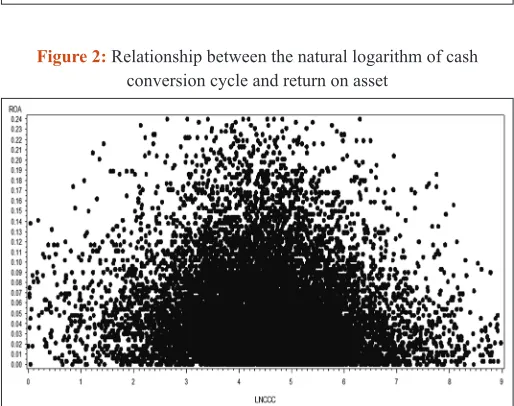
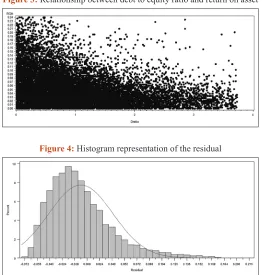
As per Figure 2, the peak of return on asset is at its summit from ln 3.9 to ln 4.2 days (i.e., 49-67 days). This insinuates that firms should formulate their short term WCM policy in such a manner that their CCC should be between 49 and 67 days keeping other factors constant. Figure 3 exhibits that ROA is inversely related to a firm’s debt to equity ratio. Hence a company should maintain optimal debt ratio which can maximize wealth of the shareholders. The residual as depicted in Figure 4 is normally distributed, thus validating the results achieved by the tools employed.
7. CONCLUSION AND DISCUSSION
The analysis of results leads to the conclusion that WCM is too important to not receive its due attention. It has the potential to bring down the financial performance of the company if not managed properly. WCM for this study is a construct comprising of three different components viz. inventory holding period, accounts payable period and accounts receivable period. It is
imperative that the manager entrusted with the well being of firm takes into account the merits and demerits of over and under investment costs by accumulating just the right amount of inventory, and similar actions for accounts payable and receivable. Firm profitability is just a periodic assessment of the firm performance and WCM still has considerable role to play in that, it goes without saying that WCM would be of utmost importance when long term value based assessment of the firm would be done. The optimum peak of performance which is measured by ROA in this study turns out to be approximately Table 2: Pearson correlation coefficients
ROA LNCCC LCSQ LCQ Debt ratio
ROA 1.00000
LNCCC −0.10247 1.00000 (<0.0001)***
LCSQ −0.10578 0.97321 1.00000 (<0.0001)*** (<0.0001)***
LCQ −0.10288 0.91660 0.98253 1.00000 (<0.0001)*** (<0.0001)*** (<0.0001)***
Debt ratio −0.30508 0.00898 0.00772 0.00644 1.00000
(<0.0001)*** (0.2755) (0.3483) (0.4341)
ROA denotes pat/total assets. LNCCC denotes the natural logarithm of cash conversion cycle. LCSQ denotes the square of LNCCC. LCQ denotes the square-cube of LNCCC. Debt ratio denotes total debt/total assets. In each cell the coefficient is reported in the upper part and the P value in parentheses is reported in the lower part. ***represents the significance level of 1%
Figure 1: Impact of working capital management on firm performance
Figure 2: Relationship between the natural logarithm of cash conversion cycle and return on asset
Table 1: Summary statistics of all variables
Variable No. Mean±SD Coefficient variation Q1 Q2 Q3
ROA (return on assets) 14744 0.05078±0.0436 85.88 0.039 0.039 0.072
LNCCC 14744 4.54±1.247 27.47 3.807 4.593 5.295
LCSQ 14744 22.188±11.41 51.42 14.493 21.095 28.037
LCQ 14744 114.64±89.01 77.64 55.17 96.89 148.45
Debt ratio 14744 1.056±0.808 76.51 0.43 0.87 1.50
ROA denotes pat/total assets. LNCCC denotes the natural logarithm of cash conversion cycle. LCSQ denotes the square of LNCCC. LCQ denotes the square-cube of LNCCC. Debt ratio denotes total debt/total assets
Table 3: Regression model: ROA (return on assets)
Intercept 0.06712
(<0.0001)***
LNCCC 0.00800
(0.0107)***
LCSQ −0.00231
(0.0017)***
LCQ 0.00013
(0.0109)***
Debt ratio −0.01642
(<0.0001)***
No. 14744
Adjusted R2 0.1042
90 days (89.75 to be precise) or 3 months. Pre and post 3 months would lead to lower profitability by the virtue of loss of customers ad opportunity cost and bad debts and relaxed cash management policy respectively.
Improved working capital policy could improve firm profitability by reducing the firm’s CCC, thereby creating additional firm value. In addition, the results can be used for other purposes, including monitoring of firms by auditors, debt holders, and other stakeholders. This study will help to provide clear understanding of the effect of WCM on corporate profitability to managers. It will aid their financial management decision making aimed at maintaining a balance between profitability and liquidity. Similarly, the study will help provide information for shareholders, prospective customers and creditors with regards to profitability in relation to efficient WCM. Furthermore, the study will help, through its findings, to provide a guideline for those who intend conduct their study on similar topic. Finally, the study will assist the researcher in obtaining new knowledge about the problem under study.
REFERENCES
Abuzayed, B. (2012), Working capital management and firms’
performance in emerging markets: The case of Jordan. International Journal of Managerial Finance, 8(2), 155-179.
Appuhami, B.R. (2008), The impact of firms’ capital expenditure on
working capital management: An empirical study across industries in Thailand. International Management Review, 4(1), 8-15.
Brigham, E.F., Ehrhardt, M.C. (2004), Financial Management: Theory
and Practice. 11th ed. New York: South-Western College Publishers.
Brigham, E., Ehrhardt, M. (2013), Financial Management: Theory and Practice. UK: Cengage Learning.
Cielen, A., Peeters, L., Vanhoof, K. (2004), Bankruptcy prediction using
a data envelopment analysis. European Journal of Operational Research, 154(2), 526-532.
Deloof, M. (2003), Does working capital management affect profitability of Belgian firms? Journal of Business Finance and Accounting, 30(3-4), 573-588.
Ebben, J.J., Johnson, A.C. (2011), Cash conversion cycle management in small firms: Relationships with liquidity, invested capital, and firm performance. Journal of Small Business and Entrepreneurship,
24(3), 381-396.
Falope, O.I., Ajilore, O.T. (2009), Working capital management and
corporate profitability: Evidence from panel data analysis of
selected quoted companies ın Nigeria. Research Journal of Business
Management, 3(3), 74-84.
Filbeck, G., Krueger, T.M. (2005), An analysis of working capital
management results across industries. American Journal of Business,
20(2), 11-20.
Gardner, M.J., Mills, D.L., Pope, R.A. (1986), Working capital policy and
operating risk: An empirical analysis. Financial Review, 21(3), 31.
Gill, A., Biger, N., Mathur, N. (2010), The relationship between working capital management and profitability: Evidence from the United States. Business and Economics Journal, 10(1), 1-9.
Gitman, L.A. (2005), Principles of Managerial Finance. 11th ed. New York: Addison Wesley Publishers.
Jose, M.L., Lancaster, C., Stevens, J.L. (1996), Corporate returns
and cash conversion cycles. Journal of Economics and Finance,
20(1), 33-46.
García-Teruel, P.J., Martinez-Solano, P. (2007), Effects of working capital management on SME profitability. International Journal of
Managerial Finance, 3(2), 164-177.
Kesimli, I.G., Gunay, S.G. (2011), The impact of the global economic
crisis on working capital of real sector in Turkey. Business and Economic Horizons, 4(1), 52-69.
Lazaridis, I., Tryfonidis, D. (2006), Relationship between working capital management and profitability of listed companies in the athens
stock exchange. Journal of Financial Management and Analysis, 19(1), 26-35.
Lyroudi, K., Lazaridis, Y. (2000), The Cash Conversion Cycle and Liquidity Analysis of the Food Industry in Greece.
Mathuva, D. (2009), The influence of working capital management components on corporate profitability: A survey on Kenyan listed firms. Research Journal of Business Management, 3(1), 1-11. Moyer, R.C., McGuigan, J., Rao, R., Kretlow, W. (2011), Contemporary
Financial Management. Mason, OH: Cengage Learning.
Nyamao, N.R., Patrick, O., Martin, L., Odondo, A.J., Simeyo, O. (2012),
Effect of working capital management practices on financial performance: A study of small scale enterprises in Kisii south district,
Kenya. African Journal of Business Management, 6(18), 5807. Ogundipe, S.E., Idowu, A., Ogundipe, L.O. (2012), Working capital
management, firms’ performance and market valuation in Nigeria.
World Academy of Science, Engineering and Technology, 61(1),
1196-1200.
Padachi, K. (2006), Trends in working capital management and its impact on firms’ performance: An analysis of Mauritian small manufacturing firms. International Review of Business Research
Papers, 2(2), 45-58.
Richards, V.D., Laughhin, E.J. (1980), A cash conversion cycle approach
to liquidity analysis. Financial management, 9(1), 32-38.
Singh, H.P., Kumar, S. (2014), Working capital management: A literature
review and research agenda. Qualitative Research in Financial Markets, 6(2), 173-197.
Sharma, A.K., Kumar, S. (2011), Effect of working capital management on firm profitability empirical evidence from India. Global Business
Review, 12(1), 159-173. Figure 3: Relationship between debt to equity ratio and return on asset
Shin, H.H., Soenen, L. (1998), Efficiency of working capital management and corporate profitability. Financial Practice and Education, 8,
37-45.
Vahid, T.K., Mohsen, A.K., Mohammadreza, E. (2012), The impact of working capital management policies on firm’s profitability and
value: Evidence from Iranian companies. International Research Journal of Finance and Economics, 88, 155-162.
Wang, Y.J. (2002), Liquidity management, operating performance,
and corporate value: Evidence from Japan and Taiwan. Journal of Multinational Financial Management, 12(2), 159-169.
Weinraub, H.J., Visscher, S. (1998), Industry practice relating to aggressive conservative working capital policies. Journal of Financial and Strategic Decision, 11(2), 11-18.