Issues
ISSN: 2146-4138
available at http: www.econjournals.com
International Journal of Economics and Financial Issues, 2017, 7(3), 186-195.
Redenomination: Why is It Effective in One Country but Not in
Another?
Erwin Bramana Karnadi
1*, Putu Rusta Adijaya
21Faculty of Economics and Business, Atma Jaya Catholic University of Indonesia, Jakarta, Indonesia, 2Faculty of Economics and
Business, Atma Jaya Catholic University of Indonesia, Jakarta, Indonesia. *Email: [email protected]
ABSTRACT
The real impact of redenomination is still an on-going debate in the academic world. Redenomination is process decreasing values of a currency without changing its real currency exchange rate. In this research, we are using a panel data set obtained from The World Bank to estimate the impact
of redenomination on macroeconomic variables such as inflation rate, real gross domestic product (GDP) per capita and real currency exchange rate. We decided to use fixed effects estimators to take into account the impact of specific characteristics of each country. We concluded that redenomination can significantly decrease estimated inflation rate and increase estimated real GDP per capita. We also concluded that redenomination has no significant
impact on estimated real currency exchange rate. However, the effectiveness of redenomination depends on the country’s government effectiveness and political stability which will improve country’s economic conditions and their competitiveness.
Keywords: Fixed Effects Estimators, Redenomination, Government Effectiveness, Political Stability
JEL Classifications: C5, E0, E5
1. INTRODUCTION
The real impact of redenomination in a country is a topic that invites many dissenting arguments. Redenomination policy is a policy that is implemented by the government to change the denomination
values of their currency by a certain ratio (Dogarawa, 2007). As an
example, in 1983, Argentina implemented a redenomination policy
that changed the denomination value of 1000 Peso into 1 Peso, without changing its real exchange rate (Mosley, 2005). In general,
redenomination is considered to be symbolic, however based on previous cases, redenomination can become one of the factors that can improve a country’s economy. In contrast, redenomination is
not effective in some countries, as persistence hyperinflation causes
the currency to naturally get back to the old denomination values.
In Section 2, we will discuss further regarding redenomination theories. Why does a country implement redenomination policy, and what was the impact of the policy? Furthermore, we will discuss arguments and results that support the implementation of the policy. Of course, we are going to talk about arguments and results that are against redenomination as well.
In Section 3, we will talk about the methods that are used in this paper. The easiest way to estimate the relationship between redenomination and macroeconomic variables is by using ordinary
least squares (OLS). However, OLS estimators are not consistent in this case, so we decided to use fixed effects estimators. The
panel data set consisting macroeconomic variables are obtained from The World Bank.
In Section 4, we estimate the impact of redenomination on
inflation rate, gross domestic product (GDP), real exchange rate, government effectiveness and other factors using fixed effects
estimators. In addition, we observe the impact of redenomination
on those variables for countries with specific characteristics
separately. We grouped the countries based on their level of government effectiveness and political stability using dummy variables. Then, we discuss our results by estimating what would happen if a country adopts redenomination policy, using Indonesia as an example.
In Section 5, we concluded that redenomination has a significant
impact on a country’s real GDP per capita. However, the impact of the policy can only be statistically significant if the country is
politically stable. We also discussed the limitations of this paper, and wrote several recommendations to Bank Indonesia and future researchers who are interested in this topic.
2. LITERATURE REVIEW
In general, redenomination policy is implemented as a response of hyperinflation. According to Suhendra and Ozdemir
(2011), inflation is a significant predictor of redenomination policy. However, there are other factors that can influence the
government’s decision in implementing redenomination policy.
Mosley (2005) argues that political factors can influence the
likelihood of implementing redenomination policy. These political factors include remaining length of current government’s period of governance, government ideology, division between executive and legislative and the country’s diversity. In addition,
Mosley also concludes that inflation is a significant predictor of redenomination. If the inflation rate is high and the current
government still has a long period of governance remaining, the chance of implementing redenomination policy is higher.
Why is redenomination policy implemented? According to
Agyepong et al. (2010), redenomination can increase the
currency’s credibility. Normally, the currency of a developed country uses small denomination values, and so redenomination can show the public a better perception of the country. In other words, redenomination can be a signal to the public that the
hyperinflation period is over and the government is serious in
dealing with country’s economic problems. Currency credibility can increase the country’s credibility in general, and hence it can
increase the public’s trust on the government (Stokes, 2001). In
addition, currency credibility can also improve the economic
image a country gives to other countries (Jensen, 2005). For example, the youths of Ghana feel embarrassed of their currency before they implement their redenomination policy (McDonnell and Fine, 2011). Influences from the international market can
also affect a country’s decision in implementing redenomination
policy (Stone, 2002).
Redenomination, most of the time, is implemented as a response
of hyperinflation. As mentioned in the previous paragraph, it is
usually implemented by the government after the hyperinflation period has passed, as a signal to the public that the hyperinflation
period is over. In this case, it is argued that redenomination is implemented by countries whose economies have stabilized
(Bernholz, 1995). As public’s trust on the government increases,
an arguably symbolic policy such as redenomination can improve a country’s economy. In contrast, some countries implement redenomination before or during the stabilization process. Using a currency with high denomination values is a constant reminder to the public that their country is not doing well economically, and this causes them to be more likely to save and use other currencies
(Cohen, 2004). Implementing redenomination policy can increase the public’s confidence in their currency, which can improve the country’s economy. In addition, Priyono (2013), argued that
although redenomination does not have a real concrete effect, it
can increase a country’s efficiency and reduce transaction costs. This argument is supported by Suhendra and Handayani (2012), who concluded that redenomination has a significant impact on a country’s inflation rate and economic growth.
The arguments in the previous paragraph are consistent with
the conclusion drawn by Dzokoto et al. (2010). In 2007, Ghana
implemented redenomination policy by changing “New Cedi”
to “Ghana Cedi” (The Bank of Ghana, 2016). The denomination value of the currency is divided by 10000 (1 Ghana Cedi = 10000 New Cedi). Interestingly, their research found that there is a significant increase in consumption after redenomination. They concluded that although the impact of redenomination in Ghana
is only nominal, redenomination causes a currency illusion effect
that can influence the public behavior.
However, in the same paper, Dzokoto et al. also found that inflation
rate has surprisingly increased after redenomination. Although
there is a currency illusion effect that influences the public’s
perspective on the government, the real effect of redenomination
on macroeconomic variables are not significant in Ghana. In addition, Dzokoto and Mensah (2010) observed Ghana’s public
perception regarding redenomination policy, before and after it is implemented. Before the policy is implement, there are many voiced who criticize the policy. However, after it is implemented,
there are many respondents who are satisfied with the policy. They
argued that the new currency feel safer and easier to use. The small denomination values also increase the amount of donations, because coins are more likely to be donated. Furthermore, from
a psychological perspective, Dzokoto et al. (2010) also found that the resident of Ghana values the new currency higher than the old one. Interestingly, in their next research, Dzokoto et al. (2011) found that the old currency is still used in Ghana after
redenomination. The old currency is still being used in daily life, and so they used a hybrid system where both currencies can be used. So, the effectiveness of the policy depends on the public’s readiness on implementing the policy.
As mentioned by Mosley (2005), the effectiveness of redenomination
policy depends on the timing of the implementation. For example,
Taylor (2006) argued that redenomination in Azerbaijan ended up increasing inflation rate. Taylor concluded that this is caused by
the fact that in Azerbaijan the policy was implemented in January, when prices are high. Redenomination is usually followed by “technical” changes in prices caused by the rounding of prices, so the policy should not be implemented when prices are at their
seasonal peak, usually from January to March.
Another example can be drawn from the research done by
Calomiris (2007), who argued that the impact of redenomination on investment rate in Argentina is not significant. On the other hand, by using chow test, Zidek and Chribik (2015) found that redenomination has a significant negative impact on inflation
growth rate in Turkey. Why is redenomination policy effective in Turkey, but not Argentina? Surely, each country has their own
specific characteristics that can affect the impact of redenomination on their economic variables. For example, Fiq and Saqib (2006)
interest rate. On the other hand, Odior and Shodeinde (2013)
argued redenomination can have a positive or negative impact in Nigeria, and so more attention must be given to their political
stability. According to Somoye and Onakoya (2013), a country’s
productivity can also affect the effectiveness of the country’s redenomination policy.
Throughout history, Indonesia has also revalued their currency, in
both 1950 and 1959. However, the policy that they implemented
was not redenomination. In those years, they implemented currency remediation instead, where the policy would affect the
real value of the currency. This policy significantly reduced the
value of the Rupiah. However, redenomination is not the same as
currency remediation (Bank Indonesia, 2010). Redenomination
can change the denomination values of the currency without changing the currency’s real exchange rate. Thus, as an example, we can argue that the effects of Indonesia’s currency remediation cannot be used to estimate the impact of redenomination, if they choose to implement it.
As for Indonesia’s public perception, the research has been done
by Lianto and Suryaputra (2012). Using structural equation
modeling, they concluded that according to public perspective,
redenomination has a significant impact on Indonesia’s credibility.
Furthermore, they found that most Indonesian residents support
the decision of implementing redenomination policy. As of 2017,
they are considering to implement redenomination policy, but they
have not made any confirmations.
3. METHODOLOGY
3.1. OLS
One way – the simplest way – to estimate the impact of
redenomination to any macroeconomic variable is to use OLS on a time-series data set. We can start by using inflation as our dependent
variable, as normally the main purpose of redenomination is to
decrease hyperinflation. Consider the following equation
In(inflationt)=β1+β2 redenominationt+β3 trendt+µt (3.1)
where inflationt represents inflation rate (GDP deflator) at period
t, redenominationt is a dummy variable that takes the value of 1 if
period t is during or after redenomination period and 0 otherwise,
trendt represents the trend value at period t and µt represents any
unobserved variables that can affect inflation.
In order to consistently estimate equation (3.1) using OLS, there are several assumptions that need to be satisfied. One of them is the
assumption that the explanatory variables must not be correlated with the error term. In this case, this means that we need.
A1: cov(redenominationt, µt)=0
In order to consistently estimate Equation (3.1). However, it is very
unlikely that we are able to satisfy assumption A1. In Section 2,
we discussed several country-specific variables that may affect the
decision to redenominate currency, such as the political variables we discussed in Section 2. Thus, redenomination is very likely
to be correlated with these political variables. Furthermore, it is reasonable to argue that these political variables can have a
significant impact on inflation rate, which means they are in the error term of Equation (3.1). Therefore, it is reasonable to argue that in Equation (3.1), redenomination is correlated with the error
term. If that is the case, then redenomination is endogenous in
Equation (3.1), the estimator b
2 is biased and any inferences such
as t-tests and F-tests will be invalid.
One way to satisfy assumption A1 is to add the country-specific political variables to Equation (3.1). However, it is difficult to
obtain data that can represent the political variables we are looking for. Thus, we must consider other approaches to estimate the
relationship between redenomination and inflation.
3.2. Fixed Effects
Another way to estimate the relationship between redenomination
and the macroeconomic variables (such as inflation) is to use a fixed-effects estimation method. Consider the following equation:
In(inflationit)=β1+β2redenominationit+β3trendt+hi+vit (3.2)
Where inflationit represents inflation rate of country i at period t,
redenominationit is a dummy variable that takes the value of 1
if period t is during or after redenomination for country i and 0
otherwise, trendt represents the trend value at period t (this does not vary across countries), hi represents any unobserved
country-specific variables that can affect inflation (this does not vary across time) and vit represents any time-varying unobserved variables
that can affect inflation.
In order to consistently estimate Equation (3.2), there are criteria that we need to fulfill. First, we need a panel data set. Fortunately, it is not difficult to obtain panel data for macroeconomic variables
from The World Bank. The second criterion is we need to satisfy the following assumption:
A2: E(vit|redenominationit,hi)=0
Which means that the error term cannot be correlated with redenomination and the country-specific time-constant
variables (the trend variable is fixed) for all periods. Although
assumption A2 is a very restrictive assumption, we can argue that
redenomination decision tends to only significantly be affected by two types of variables: Inflation (hyperinflation) and political
variables. We can argue that although the political variables can technically change over time, but the changes happen slowly and rarely i.e. they do not consistently vary across time. This means that we can argue that the political variables are captured by hi in
Equation (3.2) Thus, it is reasonable to argue that redenomination decision is not significantly correlated with the error term in Equation (3.2).
The main benefit of using fixed effects estimation is the fact that
we are allowing the explanatory variables to be correlated with
the unobserved time-constant country-specific variables, that is,
Which means we do not need to specifically obtain and include the time-constant country-specific variables in the model, as we can consistently estimate Equation (3.2) without them. In fact, assumption A3 needs to be satisfied in order to efficiently estimate Equation (3.2). Otherwise, we are better off using random effect
estimators. In Section 4, we are going to use Redundant Fixed
Effect tests and Hausman tests to test whether the fixed effect estimators are better than the pooled OLS estimators and the
random effect estimators respectively.
3.3. Data Description
As discussed in the previous subsection, we decided to use a panel data set to estimate the relationship between redenomination and the macroeconomic variables. We got most of our data from The World Bank. The macroeconomic variables obtained from The
World Bank consists of 264 countries and 56 periods (from 1960 to 2015). This makes our total sample to be 264 * 56 = 14784
observations.
The inflation rate is obtained from The World Bank (2016e). The inflation data that we use is the one that represents the GDP deflator. It represents the price change in a country as a whole, and it is calculated by dividing nominal GDP by real GDP. It is measured in percentage. Other than inflation, we also obtained
several other macroeconomic variables; we want to know the impact of redenomination to these variables as well.
First, we have real GDP per capita, which is obtained from The World Bank (2016g). We chose to use the one that uses
international dollars, also known as purchasing power parity
GDP. This means that the GDP of each country is converted into
international dollars, which has the same purchasing power over
GDP as U.S. dollars in the United States. GDP, by itself is the gross value added by producers to the economy, and GDP per capita means GDP divided by population. Our real GDP per capita is measured in constant 2011 international dollars.
We also want to see how redenomination affects real GDP per
capita growth. We easily obtained this variable from The World
Bank (2016f). It is measured as the percentage change in real GDP
per capita, and it is measured in percentage.
Next, we want to see the impact of redenomination on real exchange rate. We obtained the real exchange rate data from
The World Bank (2016h). The real exchange rate is the nominal exchange rate divided by a price deflator. We use the 2010 exchange rate as the basis (2010 = 100).
Redenomination can also have an impact on the real interest rate.
Real interest rate is the inflation-adjusted lending rate measured by the GDP deflator. We obtained this data from The World Bank (2016b). The data is measured in percentage.
We obtain the variable trade from The World Bank (2016d).
Trade measures the sum of exports and imports of a country as a
percentage of GDP. Arguably it can represent the openness of a
country, hence we want to see the impact of redenomination on
the variable. It is measured in percentage of GDP.
Another variable that we are interested in is gross capital formation
(GCF). We obtain this data from The World Bank (2016c).
Formerly known as gross domestic investment, it measures
domestic investment in fixed assets such as plants, land and schools. This data is measured in constant 2010 U.S. dollars.
Finally, we are interested in seeing the impact of redenomination
on foreign direct investment (FDI). We obtain this data from The World Bank (2016a). FDI measures investment in a country made by a foreign country. In this case, FDI is measured in percentage of GDP.
As for the redenomination variable, we decided to input the data
manually based on the information we get from Mosley (2005). We give the value of 1 to the period when a country first decided to redenominate its currency due to hyperinflation. We also give
the value of 1 to the periods afterwards. Then we give the value
of 0 to anything before redenomination. When a country does
not redenominate its currency at all, the redenomination dummy
variable will take the value of 0 for all periods.
4. RESULTS AND DISCUSSION
4.1. Preliminary Analysis and Tests
In Section 3, we have decided to use a panel data set to estimate the relationship between redenomination and the macroeconomic
variables. However, there are several issues that we first need to
tackle. First, the data that we obtained from The World Bank is not complete i.e. what we have is an unbalanced panel data set. Fortunately, it is possible to estimate unbalanced panel data using advanced statistical applications such as EViews 9. The second
thing that we want to confirm is the fact that the fixed effect estimator is better for this model than a pooled OLS estimator
and/or a random effect estimator. Thus, there are formal tests that we need to do. First, consider the following equations
In(inflationit)=β1+β2 redenomiationit+β3 trendt+μit+εit (4.1)
In(inflationit)=β1+β2 redenomiationit+β3 trendt+hi+vit+εit (4.2)
In(inflationit)=β1+β2 redenomiationit+β3 trendt+wi+vit+εit (4.3)
Where inflationit represents inflation rate (GDP deflator) for
country i at period t, redenomiationit is a dummy variable that takes the value of 1 if period t is during or after redenomination for
country i and 0 otherwise and trendt represents the trend value at period t. The difference between the three variables is the methods
that we are using. In Equation (3.1), we are using a pooled OLS
estimator, where we basically just pooled all the data into one
huge cross-section data. The term μit in Equation (3.1) represents any unobserved variables that can affect inflation. In contrast, hi
and wi represents only time-constant country-specific unobserved variables that can affect inflation. The difference between hi and wi is that hi is correlated with redenomiationit, while wi is not. The term vit in Equation (3.2) and (3.3) both represent any time-varying unobserved variables that can affect inflation. Finally, εit
We estimate Equation (4.1), (4.2) and (4.3) using EViews 9. The
results can be summarized by the following Table 1.
Table 1 shows the parameter estimates (and their t-statistics) of model (4.1), (4.2) and (4.3). It can be seen that the estimated marginal effect of redenomination on inflation varies greatly between model (4.1), model (4.2) and model (4.3), although all of them show that redenomination has a statistically significant impact (at 1% level of significance) on inflation. Using the Redundant
Fixed Effects test, we can conclude that there is heterogeneity
between the countries and hence fixed effects estimators are better than the pooled OLS estimators. Based on the Hausman
test, we can conclude that the estimators are correlated with the
country-specific variables, and thus the fixed effects estimators are consistent and efficient. Furthermore, the R2 value of model (4.2) is higher than the ones in model (4.1) and (4.3). Therefore, we decided to use fixed effect estimator to estimate the model.
Note that the R2 value is not extremely important when the main
goal is just to examine the relationship between the independent and dependent variables.
We can see from Table 1, model (3.2) that redenomination has a statistically significant negative impact on inflation. After redenomination, a country is expected to have lower inflation rate, on average, by 61.86%, ceteris paribus. Note that we are
talking about percentage change, not a change in percentage
point (a change from 4% to 8% is a 4% points increase, and is a 100% increase). This is consistent with the argument that redenomination can help decrease inflation rate, and shows that
in general, the redenomination policy can work and achieve the goal that is pursued.
4.2. Impact of Redenomination on Inflation, Real GDP
per Capita and Other Macroeconomic Variables
The next thing we want to examine is how redenomination affect
other macroeconomic variables such as real GDP per capita, real exchange rate and real GCF. Consider the following equations
In(inflationit)=β1+β2 redenomiationit+β3 trendt+hi+vit+εit (4.4)
In(realgdppercapitait)=β1+β2 redenomiationit+β3 In(inflationit)+β4
trendt+hi+vit+εit (4.5)
In(gdppercapitagrowthit)=β1+β2 redenomiationit+β3
In(inflationit)+β4 trendt+hi+vit+εit (4.6)
In(realexchangerateit)=β1+β2 redenomiationit+β3 In(inflationit)+β4
trendt+hi+vit+εit (4.7)
In(realinterestrateit)=β1+β2 redenomiationit+β3 In(inflationit)+β4
trendt+hi+vit+εit (4.8)
In(tradeit)=β1+β2 redenomiationit+β3 In(inflationit)+β4 trendt+
hi+vit+εit (4.9)
In(gcfit)=β1+β2 redenomiationit+β3 In(inflationit)+β4 trendt+hi+vit+εit (4.10)
In(fdiit)=β1+β2 redenomiationit+β3 In(inflationit)+β4 trendt+hi+vit+εit (4.11)
Where inflationit represents inflation rate (GDP deflator) for country
i at period t, redenominationit is a dummy variable that takes the value of 1 if period t is during or after redenomination for country
i and 0 otherwise, trendt represents the trend value at period t, realgdppercapitait represents GDP divided by population, measured
in constant dollars for country i at period t, gdppercapitagrowthit
represents annual percentage change in GDP per capita for country
i at period t, realexchangerateit represents currency exchange rate
divided by price deflator for country i at period t, realinterestrateit represents inflation-adjusted inflation rate for country i at period t,
tradeit represents total imports and exports for country i at period t, gcfit represents GCF (gross domestic investment) for country i at
period t, fdiit represents FDI for country i at period t, hi represents
any unobserved time-constant country-specific variables that affect
the dependent variable, vit represents any unobserved time-varying
variables that affect the dependent variable and εit represents the unbalanced panel data set error.
Using fixed effects estimation, we estimate equation (4.4) to (4.11).
The following Table 2 summarizes the output.
Table 2 summarizes the estimation output of model (4.4) to (4.11). First, we confirm that redenomination has a statistically significant negative impact on inflation. After redenomination, a country is expected to have lower inflation rate, on average, by 61.84% (not percentage points), than before redenomination, ceteris paribus. Model (4.4) also shows that in 1959, a country that has not redenominate its currency is expected to have ln(inflation) value
of 2.648, although this interpretation does not make any useful
sense. Furthermore, it shows that on average, inflation decreases by 1.18% every year, ceteris paribus. The R2 value means that 27.62% of the variation in ln(inflation) is explained by the variation
in redenomination and trend. Note that the sample size is only 9858 instead of 14784 observations because of the missing values i.e. we are using an unbalanced panel data set. These results are
reasonable, as we want redenomination to decrease hyperinflation.
Table 1: Pooled OLS, fixed effect and random effect estimations
Estimation Model (4.1) Model (4.2) Model (4.3)
Constant 2.157 (71.2108)*** 2.2648 (80.1015)*** 2.2725 (49.0007)***
Redenomination 0.6165 (13.6009)*** −0.6184 (−7.7057)*** −0.2625 (−3.7191)***
Trend −0.0117 (−13.6606)*** −0.0118 (−14.2469)*** −0.0122 (−14.9426)***
Sample size 9858 9858 9858
R2 0.0318 0.2762 0.0267
Redundant fixed effects χ2 statistic - 2867.3802
-Hausman χ2 statistic - - 97.2076
Model (4.5) shows the relationship between redenomination and real GDP per capita. It can be seen that at 5% level of significance, there is sufficient evidence to conclude that there is a significant positive relationship between redenomination and real GDP per capita. It means that after redenomination, the real GDP
per capita of a country is expected to be higher, on average, by
3.81%, ceteris paribus. It also shows that there is a statistically significant relationship between inflation and real GDP per capita, as an increase in inflation by 1% is expected to decrease real GDP per capita, on average, by 0.01%, ceteris paribus. Furthermore, in model (4.6), we can see that after redenomination, a country is expected to have higher GDP per capita growth, on average, by 23.54%, ceteris paribus. The relationship is shown to be statistically significant. Based on these results, we can argue that
perhaps redenomination can have a positive impact on a country’s well-being.
Next, we look at model (4.7) and (4.8) to look at the impact
of redenomination on interest rate and exchange rate. After redenomination, a country is expected to have lower real interest
rate, on average, by 94.89%, ceteris paribus. This relationship is statistically significant. In contrast, the relationship between
redenomination and real exchange rate is shown to be statistically
significant. This is consistent with the argument given by Bank Indonesia (2010).
Finally, model (4.9), (4.10) and (4.11) shows the impact of redenomination on trade, GCF and FDI. After redenomination, a country is expected to have higher trade, on average, by 8.01%,
ceteris paribus. Redenomination is also expected to have positive
impact on GCF, as on average redenomination is expected to increase GCF by 27.42%. Furthermore, after redenomination, a country is expected to have higher FDI, on average, by 46.07%
than before redenomination, ceteris paribus. All these three
relationships are shows to be statistically significant at 1% level of significance.
All the results that we get from model (4.4) to (4.11) show that in
general, redenomination has a positive impact on the economy. If
anything, at the very least it decreases inflation rate and increases real GDP per capita. Therefore, the results we get so far supports
redenomination policy as its effect on a country’s economy seems to be very positive.
The question we then need to ask is: How come redenomination works for some countries, but not for others?
4.3. Government Effectiveness and Political Stability
We introduce a new variable to the data set: Government Effectiveness. We obtain this data from The World Bank (2016i). Government Effectiveness measured the perceptions of the
quality of public services, civil services and its independence
from political pressures (Kaufmann et al., 2010). It also measures
the quality of policy formulation and implementation, and the credibility of the government’s commitment to such policies. It is
measured as an index, and it ranges from approximately −2.5-2.5.
Similar to the previous section, we first want to see the impact
of redenomination on government effectiveness. Consider the following equation:
goveffit=β1+β2 redenominationit+β3 ln (inflationit)+β4 trendt+hi+
vit+εit (4.12)
Where goveffit represents government effectiveness of country i
at period t. We estimate Equation (4.12) and summarize the result
in the following Table 3.
From Table 3, we can see that the estimated parameter value of redenomination is positive. However, its t-statistics suggests
that it is not statistically significant. In general, this result shows that redenomination has no significant impact on a country’s
government effectiveness. Of course, this is not a result that would support redenomination policy.
The question that we need to address is still the same: Why does redenomination policy works effectively in one country, but not in another? Based on Table 2, we conclude that redenomination
has a significant negative impact on inflation rate and a significant positive impact on real GDP per capita, but we know that it
does not work for all countries. On the other hand, our results in Table 3 shows that redenomination does not improve government
Table 2: Impact of redenomination on inflation, real GDP per capita, GDP per capita growth, real exchange rate, real interest rate, trade, GCF and FDI
Estimation (4.4) - ln
(inflation) (4.5) - ln (real GDP per capita)
(4.6) - ln (GDP per capita growth)
(4.7) - ln (real exchange
rate)
(4.8) - ln (real interest
rate)
(4.9) - ln
(trade) (real GCF)(4.10) - ln (4.11) - ln (FDI)
Constant 2.2648
(80.1015)*** (458.5996)***7.9057 (30.8813)***1.1541 (154.3474)***5.0812 (37.1926)***2.6956 (355.3692)***3.6903 (1104.775)***22.3850 (−24.7823)***−1.6451
Redenomination −0.6184
(−7.7057)*** (2.0964)**0.0381 (2.7756)***0.2354 (−1.1094)−0.0482 (−6.8073)***−0.9489 (3.7295)***0.0801 (7.5296)***0.2742 (4.3277)***0.4607
ln (Inflation) - −0.0063
(−2.5663)** (2.0677)**0.0237 (−5.4679)***−0.0367 (−21.0111)***−0.3350 (0.8285)0.0024 (2.3972)**0.0122 (−3.6132)***−0.0545
Trend −0.0118
(−14.2469)*** (67.5427)***0.0232 (−7.7119)***−0.0064 (−14.3895)***−0.0094 (−4.8961)***−0.0072 (50.5392)***0.0117 (97.6183)***0.0419 (41.6804)***0.0542
Sample size 9858 5389 7305 3129 3591 8994 6575 7370
R2 0.2762 0.9811 0.1588 0.3101 0.3829 0.8045 0.9792 0.5464
effectiveness, but history suggests that redenomination can improve a country’s economy and effectiveness.
In order to answer this question, we need to group our observations based on the characteristics that can affect the effectiveness of
redenomination. So, we add another variable: Political stability, which we obtained from The World Bank (2016i). Our political
stability variable is an index that measures a country’s public perception on the possibility of political instability or
politically-motivated violence (such as terrorism). This index ranges from −2.5 (very unstable) to 2.5 (very stable).
Consider the following equation:
goveffit=β1+β2 redenominationit+β3 ln(inflationit)+β4 trendt+β5 (re
denominationit×highpolit)+hi+vit+εit (4.13)
Where highpolit is a dummy variable that takes the value of 1 when country i has positive political stability index period
t, 0 otherwise. The estimated parameter b
5 is a parameter that
represents the marginal impact of the interaction dummy variable
(redenominationit×highpolit) on government effectiveness. With
this parameter, we can estimate the impact of redenomination on government effectiveness for countries with positive and negative
political stability index separately. We estimate Equation (4.13) using fixed effects to obtain the following output (Table 4).
From Table 4 we can see that b
2 is not statistically significant in both model (4.12) and (4.13). However, the estimated parameter
b
5 is significant in model (4.13). This means after redenomination,
the estimated government effectiveness is higher for countries with
positive political stability index, on average by 10.04% than for
countries with negative political stability index, ceteris paribus. In contrast, for countries with low political stability, the impact of redenomination on government effectiveness is not statistically
significant.
The result in Table 4 is one of the answers we can use to our question above. From the results, we found that the impact of redenomination on a country’s government effectiveness depends on the country’s political stability. In general, this result supports the redenomination policy because so far, we did not
find any significant negative impact of the policy on government
effectiveness. However, the effectiveness of the policy depends on the country’s political stability.
How about the impact of redenomination on real GDP per capita?
We consider the following equations:
ln (inflationit)=β1+β2 redenominationit+β3 trendt+β4 (redenominat
ionit×highpolit)+hi+vit+εit (4.14)
ln (inflationit)=β1+β2 redenominationit+β3 trendt+β4 (redenominat
ionit×highpolit)+hi+vit+εit (4.15)
ln (realgdppercapitait)=β1+β2 redenominationit+β3 ln
(inflationit)+β4 trendt+β5 (redenominationit×highpolit)+hi+vit+εit (4.16)
ln (realgdppercapitait)=β1+β2 redenominationit+β3 ln
(inflationit)+β4 trendt+β5 (redenominationit×higheffit)+hi+vit+εit (4.17)
Where higheffit is a dummy variable that takes the value of 1 if country i has positive government effectiveness index at period t,
0 otherwise. The interaction dummy (redenominationit×higheffit)
is used to measure the impact of redenomination on the dependent variable for countries with positive government effectiveness index.
Using fixed effects, we estimate Equation (4.14) to (4.17) to obtain the following output (Table 5).
Based on Table 5, we can see that redenomination has a significant impact on inflation and real GDP per capita. However, the
effectiveness of this impact depends on the country’s political
stability and government effectiveness. From model (4.14) and (4.15), we can see that redenomination has a significant impact on inflation rate. For countries with high government efficiency, redenomination is expected to decrease estimated inflation more than countries with low government efficiency, on average by 71.93%, ceteris paribus. On the other hand, redenomination is only expected to decrease estimated inflation by −33.37% for countries with low government efficiency, ceteris paribus. So, the effectiveness of redenomination policy in decreasing inflation
in a country depends on the country’s government effectiveness.
The results of model (4.16) and (4.17) show that the impact of redenomination on real GDP per capita in a country depends on
the country’s political stability. On average, redenomination is
Table 3: Impact of redenomination on government effectiveness
Estimation Model (4.12)
Constant 0.0201 (0.5621)
Redenomination 0.0091 (0.2772)
ln (Inflation) −0.0132 (−3.1279)***
Trend −0.0004 (−0.4666)
Sample size 2747
R2 0.9624
***Significant at 1%
Table 4: Impact of redenomination on government effectiveness, with political stability dummy
Estimation Model (4.12) Model (4.13)
Constant 0.0201
(0.5621) (0.1980)0.0075
Redenomination 0.0091
(0.2772) (−1.1238)−0.0400
ln (Inflation) −0.0132
(−3.1279)*** (−3.5746)***−0.0148
Trend −0.0004
(−0.4666) (−0.1901)−0.0002
Redenomination*highpol - 0.1004 (2.9310)***
Sample size 2747 2712
R2 0.9624 0.9643
expected to increase estimated real GDP per capita for countries with high political stability by 10.7% more than countries with
low political stability, ceteris paribus. As for countries with low political stability, redenomination is expected to increase estimated
real GDP per capita by 7.77%, ceteris paribus.
The conclusion that we can draw from Table 5 is that redenomination
has a significant negative impact on inflation rate and positive impact on real GDP per capita. However, the effectiveness of
redenomination depends on a country’s political stability and government effectiveness. In a country with high government
efficiency, redenomination policy will decrease inflation rate more than a country with low government efficiency. On the other
hand, a country with high political stability will experience higher
increase in real GDP per capita from redenomination than a country
with low political stability. Thus, the impact of redenomination is different for each country, because each country has a different level of political stability and government effectiveness.
Based on this conclusion, should a country adopt redenomination policy?
4.4. Discussion – Should a Country Implement Redenomination Policy?
Based on the fixed effects estimation, we can conclude that in general, redenomination can decrease inflation rate and increase the level and growth of real GDP per capita. This is consistent with the results obtained by Suhendra and Handayani (2012), who concluded that redenomination has a significant impact on inflation rate and economic growth. In addition, redenomination does not have a significant impact on real interest rate. This is consistent with the statement made by Bank Indonesia (2010),
who argued that redenomination does not reduce real interest rate, unlike currency remediation. The results obtained are also
consistent with the conclusion drawn by Odior and Shidoinde
(2013), that political stability can affect the effectiveness of
redenomination policy.
So, should a country implement redenomination policy? As of
2017, Indonesia is considering implementing redenomination policy, but they have made any confirmations as they are still
unsure. So as an example, we are going to use Indonesia. Based on our results, we generally support Bank Indonesia’s willingness
to implement redenomination policy. Our fixed effects analysis did not find any significant negative impact on economic growth. Furthermore, the research made by Lianto and Suryaputra (2012)
concluded that most Indonesian residents support implementing redenomination policy. So, based on our results and the impact redenomination has on other countries, we argue that there is no
significant damaging risk in implementing the policy.
However, using Nigeria as an example, redenomination policy will not be effective if Indonesia is politically unstable. According to
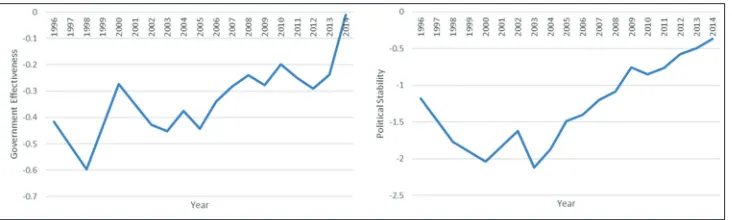
The World Bank (2016i), Indonesia’s government effectiveness index in 2014 is −0.0109, and its political stability index in 2014 is −0.3687. So, since both indices are negative, in 2014, Indonesia
is politically unstable and its government is not effective. If these problems persist, redenomination policy will not be effective in improving Indonesia’s economy.
How about Indonesia’s political stability and government
effectiveness index values in 2017? The data is still unavailable as of 2017. However, in Indonesia’s case, it is reasonable to
be optimistic. According to the surveys done by
Indonesia-investments (2016), most Indonesian residents show high level of confidence on Joko Widodo’s governance. Furthermore, we can see
a positive trend in Indonesia’s political stability and government
effectiveness index (Figure 1).
Figure 1: Government effectiveness and political stability trend in Indonesia Table 5: Impact of redenomination on inflation and real GDP per capita, with interaction dummies Estimation (4.14) ‑ ln (inflation) (4.15) ‑ ln (inflation) (4.16) - ln (real GDP
per cap) (4.17) - ln (real GDP per cap)
Constant 3.5644 (21.4204)*** 3.5774 (21.6213)*** 7.7861 (269.4063)*** 7.7850 (299.6814)***
Redenomination −0.4001 (−2.3389)** −0.3337 (−2.0940)** 0.0777 (3.1275)*** 0.1184 (5.2043)***
ln (Inflation) - - 0.0040 (1.3565) 0.0040 (1.3631)
Trend −0.0405 (−11.3226)*** −0.0402 (−11.3155)*** 0.0251 (47.3213)*** 0.0251 (47.8825)***
Redenomination*highpol −0.1421 (−0.8617) - 0.1070 (4.2676)***
-Redenomination*higheff - −0.7193 (−3.4243)*** - 0.0445 (1.4477)
Sample size 2731 2747 2662 2689
R2 0.4654 0.4645 0.9896 0.9896
Thus, in Indonesia’s case, we support the redenomination policy considered by Bank Indonesia. In addition, it is reasonable to be optimistic about the effectiveness of the policy.
5. CONCLUSIONS
The conclusions that we can draw from our research are the following. First, we conclude that in general, redenomination can
decrease estimated inflation rate and increase the level and growth of estimated real GDP per capita. Second, redenomination does not have a significant impact on real currency exchange rate. Third, redenomination has a significant positive impact on government
effectiveness, if the country is politically stable. If the country is politically unstable, redenomination will not have a significant
impact on government effectiveness. Fourth, redenomination is
more effective in lowering inflation and increasing real GDP per
capital if the country has strong government effectiveness and political stability.
As an example, we discussed the possible impact of redenomination in Indonesia based on our results. We concluded that although Indonesia has weak political stability and government effectiveness
in 2014, we still support their willingness in implementing
redenomination policy, because there are reasons to argue that there is positive trend in Indonesia’s political stability and government effectiveness in the future.
It is important to remember that this paper has some limitations. Because of the incomplete nature of the panel data set obtained from The World Bank, we are using an unbalanced panel data set, which will increase residual values. In the future, it is better to use a balanced panel data set if possible. Furthermore, in the next research, it is recommended to estimate the impact of a country’s productivity on the effectiveness of redenomination policy.
REFERENCES
Agyepong, E.A., Tankam, L.M., Oti-Boateng, B., Owosu-Ansah, E. (2010), The Effect of Redenomination of the Ghanaian Currency (cedi) on Local Trade. Paper Delivered at the Ghana Graduates Conference, Accra Ghana.
Bank Indonesia. (2010), Indonesia: Redenomination is not Reducing the Value of Money. Asia News Monitor.
Bernholz, P. (1995), Hyperinflation and Currency Reform in Bolivia: Studies from a General Perspective. Great Inflations of the 20th Century: Theories, Policies and Evidence. Aldershot, UK: Edward Elgar.
Calomiris, C.W. (2007), Devaluation with contract redenomination in
Argentina. Annals of Finance, 3, 155-192.
Cohen, B. (2004), The Future of Money. Princeton: Princeton University Press.
Dogarawa, A.B. (2007), The economics of redenomination: An appraisal
of CBN redenomination proposal. Abuja Journal of Business Administration, 1, 23-39.
Dzokoto, V.A.A., Mensah, E.C. (2010), Making sense of a new currency: An exploration of Ghanaian adaptation to the New Ghana cedi. Journal of Applied Business and Economics, 10(5), 11-18. Dzokoto, V.A.A., Young, J., Mensah, E.C. (2010), A tale of two cedis:
Making sense of a new currency in Ghana. Journal of Economic Psychology, 31(4), 520-526.
Dzokoto, V.A.A., Mensah, E.C., Twum-Asante, M., Opare-Henaku, A. (2010), Deceiving our minds: A qualitative exploration of the money illusion in post-redenomination Ghana. Journal of Consumer Policy,
33, 339-353.
Dzokoto, V.A.A., Mensah, E.C., Twum-Asante, M., Opare-Henaku, A. (2011), A bird, a crocodile, and the 21st century cowrie shell:
Analyzing Ghana’s currency change. Journal of Black Studies, 42(5), 715-736.
Fiq, T., Saqib, O.F. (2006), Political instability and the August 1998 ruble crisis. Journal of Economic Integration, 21(4), 764-783.
Indonesia-Investments. (2016), Survey Shows High Degree of Confidence
in Jokowi’s Indonesia. Available from: http://www.indonesia-
investments.com/id/news/todays-headlines/survey-shows-high-degree-of-confidence-in-jokowi-s-indonesia/item7033. [Last accessed on 2016 Sep 27].
Jensen, N. (2005), The Political Economy of Foreign Direct Investment. Princeton: Princeton University Press.
Lianto, J., Suryaputra, R. (2012), The impact of redenomination in
Indonesia from Indonesian citizens’ perspective. Social and
Behavioral Sciences, 40, 1-6.
Kaufmann, D., Kraay, A., Mastruzzi, M. (2010), The Worldwide Governance Indicators: Methodology and Analytical Issues. World Bank Policy Research Working Paper No. 5430.
McDonnell, E.M., Fine, G.A. (2011), Pride and Shame in Ghana:
Collective memory and nationalism among elite students. African
Studies Review, 54(3), 121-142.
Mosley, L. (2005), Dropping Zeros, Gaining Credibility? Redenomination in Developing Nations. Washington, DC: Paper Delivered at the American Political Science Association.
Odior, E.S., Shodeinde, A.A. (2013), Currency restructuring exercise
in Nigeria: Overview and potential implications. The Journal of
Business, 3(6), 8-16.
Priyono, M.M. (2013), Redenomination; Between hope and reality. International Journal of Business and Management Invention, 2(4), 36-40.
Somoye, R.S.C., Onakoya, A.B. (2013), Macroeconomic implication of
currency management in Nigeria: A synthesis of the literature. British
Journal of Economics, Finance and Management Sciences, 8(1), 12-28. Stokes, S. (2001), Public Support for Market Reforms in New
Democracies. Cambridge: Cambridge University Press.
Stone, R. (2002), Lending Credibility: The IMF and the Post-Communist Transition. Princeton: Princeton University Press.
Suhendra, E.S., Handayani, S.W. (2012), Impact of Redenomination on Economic Indicators. Paper Delivered at the International Conference
on Eurasian Economies.
Suhendra, E.S., Ozdemir, B.K. (2011), The Impact of Inflation on Redenomination. Paper Delivered at the Anadolu International
Conference in Economics II, Eskisehir, Turkey.
Taylor, M. (2006), Azerbaijan: Revalued Manat may contribute to inflation. Oxford Analytica Daily Brief Service. Available from: https://search.proquest.com/docview/192446531?accountid=48149 [Last accessed on 2016 Sep 27].
The Bank of Ghana. (2016), Redenomination of the Cedi. Available from: https://www.bog.gov.gh/indeks.php?option=com_content&view=ar ticle&id=1401:redenomination-of-the-cedi-faqs&catid=107:public-notices&Itemid=244. [Last accessed on 2016 Sep 25].
The World Bank. (2016a), Api_bx.klt.dinv.wd.gd.zs_ds2_en_excel_v2 [Data File]. Available from: http://www.data.worldbank.org/ indicator/BX.KLT.DINV.WD.GD.ZS. [Last accessed 2016 Sep 23]. The World Bank. (2016b), Api_fr.inr.rinr_ds2_en_excel_v2 [Data File].
RINR. [Last accessed on 2016 Sep 23].
The World Bank. (2016c), Api_ne.gdi.totl.kd_ds2_en_excel_v2 [Data File]. Available from: http://www.data.worldbank.org/indicator/ NE.GDI.TOTL.KD. [Last accessed on 2016 Sep 23].
The World Bank. (2016d), Api_ne.trd.gnfs.zs_ds2_en_excel_v2 [Data File]. Available from: http://www.data.worldbank.org/indicator/ NE.TRD.GNFS.ZS. [Last accessed on 2016 Sep 23].
The World Bank. (2016e), Api_ny.gdp.defl.kd.zg_ds2_en_excel_v2 [Data File]. Available from: http://www.data.worldbank.org/indicator/ NY.GDP.DEFL.KD.ZG. [Last accessed on 2016 Sep 23].
The World Bank. (2016f), Api_ny.gdp.pcap.kd.zg_ds2_en_excel_v2 [Data File]. Available from: http://www.data.worldbank.org/indicator/
NY.GDP.PCAP.KD.ZG. [Last accessed on 2016 Sep 23].
The World Bank. (2016g), Api_ny.gdp.pcap.pp.cd_ds2_en_excel_v2 [Data File]. Available from: http://www.data.worldbank.org/ indicator/NY.GDP.PCAP.PP.KD. [Last accessed on 2016 Sep 23]. The World Bank. (2016h), Api_px.rex.reer_ds2_en_excel_v2 [Data File].
Available from: http://www.data.worldbank.org/indicator/PX.REX. REER. [Last accessed on 2016 Sep 23].
The World Bank. (2016i), Wgi [Data File]. Available from: http://www.
data.worldbank.org/data-catalog/worldwide-governance-indicators.
[Last accessed on 2016 Sep 23].