of Practice: A Qualitative Study of
an Interprofessional Fellowship
Susan E. Sterrett, BSN, MSN, MBA, EdD
Abstract
Background: The social learning model, Communities of Practice (CoP), serves as an organizing framework for this study of interprofessional learning. The author, a nurse, completed the study while a doctoral student in a school of education. The objective of the study was to understand the phenomenon of participation in interprofessional learning experiences among a group of graduate students, fac-ulty, and administrators, and the extent to which the markers of the communities of practice model were present in those experiences.
Methods and Findings: This qualitative study used principles of constructivist grounded theory methodology. The objective was to seek out participants’ expressed experience as data to guide theory development. The participants were graduate students, faculty, and administrators from an interprofessional fellow-ship in developmental disabilities. Processes of building community and making meaning of the experience were themes that related to the Wenger CoP model. Feeling respected was a theme that was identified in this study and that is not found in the CoP model.
Conclusions: The findings indicated that participants were able to form an inter-professional community of practice based on the markers of Wenger’s model. This initial study moves toward the development of an organizing theory of an effec-tive interprofessional community of practice (EICoP).
Keywords: Interprofessional education; Communities of practice; Social learning theory; Collaboration
Introduction
Redesigning health profession education in ways that educate students from across disciplines is a significant challenge facing deans of health science programs in the United States today. Calls for the development of interprofessional (IP) experiences as part of the curriculum have come from the Institute of Medicine [1], the Association of American Medical Colleges [2], the American Association of Colleges of Pharmacy [3], and the American Association of Colleges of Nursing [4], among others. Interprofessional education (IPE) is the process of preparing people for col-laborative practice [5]. The goal is to prepare health practitioners who will be able to work collaboratively, leading to improved health outcomes for clients [5]. Although many studies have examined the structural barriers and program design of IPE, miss-ing are qualitative studies which, through participants interviews, offer insights into the underlying social processes of learning in an interprofessional environment [6]. Professional practice is relational and enacted through discursive exchange [7]. Lave and Wenger’s social learning theory, also called situated learning, with its focus on relational aspects of learning and forming community, is therefore a potentially Journal of Research in
Interprofessional Practice and Education
Vol. 1.3
December, 2010
Journal of Research in Interprofessional Practice and Education (JRIPE)
Vol. 1.3 © 2010
useful organizing theory for interprofessional education. Martin’s 2005 study [8] of students’ perspectives of their shared learning experiences concluded that IPE could be reframed by social learning theory. This article reports on the results of a qualitative study of participants in an interprofessional learning environment. Based on social learning theory, the study looked for indications of the develop-ment of a community of practice (CoP) [9,10]. CoPs are defined as a group of peo-ple “who share a concern, a set of problems, or a passion about a topic and who deepen their knowledge and expertise by interacting on an ongoing basis” [11, p. 4]. The study also looked for other themes generated by the participants.
Purpose and objectives
The primary purpose of the study was to explore participant perspectives of an interprofessional fellowship in developmental disabilities, looking for the essential components of participation in the fellowship. Are there common components identified by participants as significant to the fellowship that lead to the develop-ment of a sense of community? Using a constructivist approach to grounded theory [12, 13] I compared responses of participants to components of the social learning model, communities of practice [9], and looked for other components generated by the participants, unrelated to the CoP model. Using social learning theory [10] as a lens to study participants’ perceptions of IP learning environments, this work con-tributes to literature that analyzes interprofessionalism, using a theoretical base from another discipline.
The study questions were developed based on Wenger’s hallmarks of a commu-nity of practice. Learning, according to Wenger, is based on social participation. Successful learning in a practice environment occurs as one becomes immersed in the environment. Two components of practice in the Wenger model are meaning and community. The community component involves mutual engagement, joint enterprise, and shared repertoire. These lead to the formation of a community of practice [9]. Five research questions were identified:
1. How are components of participation in the fellowship evident? 2. How do the components contribute to the participant’s ability to
generate and articulate the meaning of the IP community of practice (IPCoP)?
3. How do participants demonstrate and articulate the meaning of the IPCoP for themselves, and as an entity itself?
4. How do these components foster a sense of IP community? 5. Are there other themes in the data?
Questions 2 and 3 relate to a primary process of CoP [9], that of making meaning. The second primary process of the CoP model is building community. Questions 1 and 4 seek out components identified by fellowship participants that may relate to this process. Finally, question 5 captures any other themes in the data.
Journal of Research in
Interprofessional Practice and Education
Vol. 1.3
December, 2010 248
Becoming an Interprofessional Community of Practice
Methods
Study design
This qualitative study is based on the constructivist grounded theory approach [13]. This is a contemporary revision of classic grounded theory. It assumes that the data are constructed, rather than emergent. This design allowed for an exploration of the properties and dimensions of the data that could be constructed as relating to CoP processes and components, and also look for other concepts coming out of the tran-scripts. While original grounded theory methodology [14] advocates no theoretical framework, this study intentionally looked for emerging themes as well as the processes and components of CoP. These processes and components were used as points of departure and “sensitizing concepts and disciplinary perspectives [that] provide a place to start” [12, p. 16]. CoP processes and components were used as a lens to identify and compare participants’ perspectives against other emerging themes respondents defined as crucial to their positive experience.
Sampling procedures
The study used purposeful sampling for the initial interviews, then theoretical sam-pling to further analyze any recurring themes. As opposed to samsam-pling in quantita-tive research where the aim is generalizability, purposeful sampling is sampling with a purpose in mind, seeking information-rich cases [15]. Theoretical sampling helps obtain data to further understand recurring themes and explicate categories [12]. The evolving theory directs the analyst to more specific sampling over time [16]. For initial interviews, I established criteria to find relevant data for the study [12]. The initial sample comprised 12 participants. In the second set of interviewing for theo-retical depth, I re-interviewed all initial participants who spoke of respect in their ini-tial interview. I continued sampling until I reached saturation of the data when further sampling ceased to yield any new analytical concepts [16].
Participants
A group of graduate students (N=7) and faculty (N=5) who were currently or had recently been in an intensive interprofessional learning experience were inter-viewed. They were part of a yearlong fellowship in developmental disabilities affil-iated with an academic health centre. This is a competitive fellowship with positions awarded based on students’ transcripts and potential for leadership (as demonstrated by students’ essays). The program is one of 38 similar programs occurring throughout the United States with funding from the Department of Health and Human Services. Participants take three credit courses in leadership and medical disabilities. They also work collaboratively in a weekly pediatric clinic at a large academic health centre, seeing patients with varying developmental dis-abilities. Students pay for course credits and receive a small stipend for the clinical component.
The fellowship faculty and students came from a wide variety of professions, rep-resenting the disciplines of medicine (3), public health (1), social work (1), nursing Journal of Research in
Interprofessional Practice and Education
Vol. 1.3
December, 2010 249
Becoming an Interprofessional Community of Practice
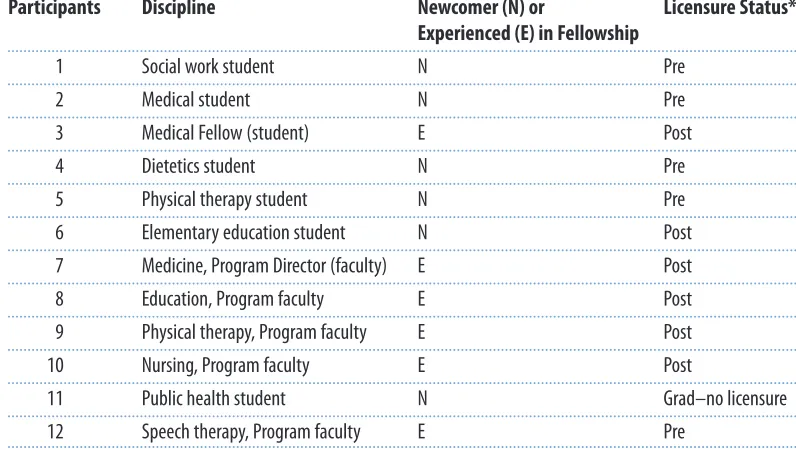
(1), dietetics (1), speech therapy (1), physical therapy (2), and education (2). The medical students all had completed medical school as they began the fellowship. Nonmedical students were pre-licensure except the education student. Participants also included five faculty members from speech therapy, nursing, education, physi-cal therapy, and medicine. They were faculty and mentors in the program. The goal of this annual fellowship was to develop leaders in developmental disabilities. Table 1 gives participant data. This setting was chosen for the study because it was an intense interprofessional fellowship taking place over the period of a year.
Table 1
Participants’ discipline and level of experience
Participants Discipline Newcomer (N) or Licensure Status* Experienced (E) in Fellowship
1 Social work student N Pre
2 Medical student N Pre
3 Medical Fellow (student) E Post
4 Dietetics student N Pre
5 Physical therapy student N Pre
6 Elementary education student N Post
7 Medicine, Program Director (faculty) E Post
8 Education, Program faculty E Post
9 Physical therapy, Program faculty E Post
10 Nursing, Program faculty E Post
11 Public health student N Grad–no licensure
12 Speech therapy, Program faculty E Pre
* Pre-licensure = Prior to the granting of a license to practice their profession; Post licensure = Licensed in their profession
Data collection
Grounded theorists often begin their studies with some guiding empirical interests [12]. The study was designed to explore CoP as a concept within IP experience and seek out concepts emerging from the data expressed by participants. Study partici-pants were solicited by letter from the list of participartici-pants in the current and recent past fellowship groups (2004 to 2006). Approximately 80% of those contacted agreed to be interviewed. Those responding agreed to participate in an interview arranged at their convenience. Twelve semi-structured interviews were conducted originally. The length of the interviews was between 30 minutes and one hour. Interviews took place in faculty offices, small empty classrooms, and coffee shops. The interviews were conducted using a semi-structured interview guide (see Appendix A). Thoughts and feelings relating to participants’ interprofessional experiences were evoked by asking questions concerning the focal components of mutual engagement and joint enterprise that occurred during their fellowship. Other questions were more general and sought out other experiences. To further explicate the recurring Journal of Research in
Interprofessional Practice and Education
Vol. 1.3
December, 2010 250
Becoming an Interprofessional Community of Practice
theme of respect, a second set of questions was developed. All participants who spoke of respect in the initial interview were contacted to answer additional ques-tions related to the recurring theme of respect, following the process of theoretical sampling. All agreed to respond to a second set of questions (see Appendix B). The interviews were recorded and transcribed into written documents.
Data analysis
Data were analyzed as collected through coding of texts in the software program QSR NVivo7 Version 2. Initial coding involved looking at words or lines of text, breaking up the data into component parts [12]. The process involved comparing codes with the components of CoP—mutual engagement, joint enterprise, and
shared repertoire—and also being open to emerging themes unrelated to these com-ponents. As similarities and differences in the codes were identified, conceptual cat-egories were created by clustering codes together to define processes with associated themes and subthemes. Themes of mutual engagement and joint enter-prise were identified with related components. For example, themes of articulating professional role, collegiality, informality, and use of mentors from their profession were identified by the participant transcripts. These were placed in the conceptual category of mutual engagement based on their similarity with that CoP component. Journal of Research in
Interprofessional Practice and Education
Vol. 1.3
December, 2010 251
Becoming an Interprofessional Community of Practice
Sterrett
Table 2
Conceptual categories
The process of building community Mutual engagement
Articulating one’s professional role Collegiality and informality Mentors from their profession Joint enterprise
Being needed Looking for leaders Your tools become our tools Shared repertoire
Assessment tools Shared stories The process of making meaning
Participation
Becoming a member of both communities The mentor-Fellow relationship
Reification
Tools in a new light—adding to my depth
The work of alignment of the Fellowship to my professional life The process of feeling respected
Likewise other themes of fellowship participation were identified, such as good faith and competence, willingness to engage in dialogue, acceptance of difference, and valuing the relationship. These themes were categorized into a process of feel-ing respected. This process, emergfeel-ing from the data, is unrelated to Wenger’s CoP model. The codes were placed in a hierarchy based on theoretical coding that con-ceptualizes how the codes relate to each other [12]. This hierarchy is presented in Table 2. Data collection and analysis ended when no new codes or categories were being produced, at the point of theoretical saturation [12,16].
Findings
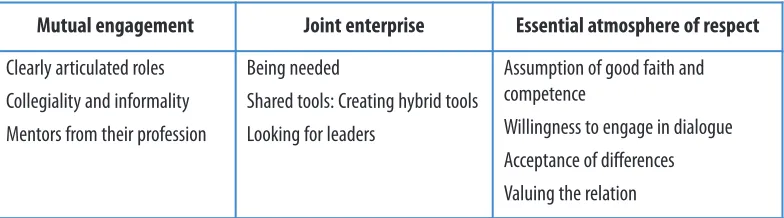
The essential components of participation (mutual engagement, joint enterprise, and respect) are reviewed below and summarized in Table 3. The findings related to research question 4, how the components foster a sense of IP community, are also reviewed.
Table 3
Themes and accompanying components
Mutual engagement
Participants spoke of working with a collective vision of improving the quality of life for children with developmental disabilities and their families. Both newcomer and experienced participants negotiated their actions with the collective goal of developing as leaders in this area. This section discusses three themes that emerged in the interviews related to mutual engagement: clearly articulated professional roles, collegiality and informality, and the importance of mentors from the partici-pant’s field.
Clearly articulated professional role
As newcomers begin the fellowship, they represent members of their professional community of practice. Many stated that the ability to clearly articulate their profes-sional role in this interprofesprofes-sional group was important. For some newcomers, suc-cessfully establishing their identity in the group set the stage for the interactions to come. This issue was not the same for everyone and appeared to be based on pro-fessional affiliation. For example, a social work student expressed concern that his concentration in social policy left him less prepared in the clinical area. Articulating his professional role as policy based instead of clinically based was important to him in explaining his level of participation during clinical interventions.
Journal of Research in
Interprofessional Practice and Education
Vol. 1.3
December, 2010 252
Becoming an Interprofessional Community of Practice
Sterrett
Mutual engagement Joint enterprise Essential atmosphere of respect
Clearly articulated roles
Collegiality and informality
Mentors from their profession
Being needed
Shared tools: Creating hybrid tools
Looking for leaders
Assumption of good faith and competence
Willingness to engage in dialogue
Acceptance of differences
It was one of the real difficulties that I felt, just explaining to people what I did. Not that there is anything wrong with direct care social work, but I didn’t want anyone to think that’s what I was, because I wasn’t. (Social work student)
As a newcomer, this student wanted to be clear with the others about his profes-sional role. Since he was also new to the school of social work, he was trying to first understand his role, then to be able to articulate it clearly to others. He felt the oth-ers would consider he should have the clinical skills of a traditional social worker. His focus was policy, and he did not feel competent clinically. Fellowship newcom-ers in education and speech therapy also needed to identify their role.
I was able to clarify the fact that I was in education and didn’t under-stand all the terms. (Education student)
In contrast, none of the medical students expressed any concern about identify-ing their professional role. The medical students already understood their role in the group, that of clinical expert and leader by virtue of their knowledge and histor-ical power. The setting, a medhistor-ical clinic, added to their ease in the community as identities were being established. According to their reported accounts, they gave their self-introductions with ease and confidence.
Collegiality and informality
The participants saw informality and collegiality as surprising and uncommon dur-ing experiences in their professional schools. Startdur-ing from the experience of the fel-lowship open house and participants’ first encounters during seminars, collegiality and informality was empowering to the newcomers. It encouraged open communi-cation and mutual engagement.
The faculty, in conversation with the newcomers, asked to be called by their first names and asked new participants for their opinions. For the newcomers, the infor-mal tone made it clear that this would be a different experience than many had experienced in their traditional professional programs. One newcomer stated:
The first meeting was the faculty interview and we started talking about the fellowship. They asked me what views do I have and what do I think about it. (Education student)
The student stated her usual demeanour with faculty was quiet, but it was clear from the start that the student would be called upon to be fully engaged with other participants. The medical student who was beginning the fellowship was also sur-prised by the informal and collegial atmosphere of this first encounter. She spoke of the expectations in her professional training:
When we would talk I felt they [the faculty] really wanted to hear what I thought about the matter. We all used first names. It was won-derful. It made it hard to go back to medical school, where it was very hierarchical. There it is “yes sir” and “no sir.” (Medical student) Journal of Research in
Interprofessional Practice and Education
Vol. 1.3
December, 2010 253
Becoming an Interprofessional Community of Practice
Participants were surprised by this aspect of fellowship culture. It set the relation-ship on equal ground. By asking the students to call them by their first names, the faculty was establishing a professional-to-professional relationship that allowed authentic discussion. This is not the culture in many professional schools and prac-tice environments. This culture of collegiality and informality developed, many par-ticipants said, because of the views of the founding director and the similar views held by other experienced members in the group.
The collegial culture allowed relationships to develop, and set the expectation for full participation in conversations and clinical experiences. For some of the new-comers this was unnerving. The collegial culture also meant they were expected to step up to the plate during clinical assessments, even if the tools they were using were new to them. They often felt they did not understand enough of the medical conditions or the assessment tools:
I didn’t feel I was ready to do that assessment. I just saw the tool for the first time a few minutes earlier, but there I was handling it myself. (Dietician student)
This student wished to stay on the periphery and observe someone more famil-iar with the assessment tool completing the assessment. She would have been more comfortable on the periphery and would have learned a little about this assessment by observing. She knew however that she learned more by participating.
Mentors from their profession
Part of the experience of the fellowship is pairing each participant with a mentor. Faculty originally planned to pair a student with a mentor from another profession. Faculty assumed that this experience would add to the depth of understanding of another profession. Participants, however, spoke of two benefits of pairing a mentor and student from the same profession. The achievement of the goals of that stu-dent’s professional school and what the student learns about how to present their profession to another member are both outcomes of same-profession pairing. For example, when the team is assessing the patient, a speech therapy faculty member paired with a speech therapy student will clearly demonstrate how a speech thera-pist would assess the client and the tools a speech therathera-pist has to treat the client. A student who is a newcomer may not be confident enough in the group, or sure enough of her speech assessment and treatment knowledge to speak up.
If the speech therapy student is unclear about his/her professional role and does not have a good understanding of the tools speech therapy can bring to the assess-ment and treatassess-ment of the client, the whole team’s experience is weakened. In con-trast, a mentor who is either a faculty member or an experienced practitioner allows for the professional growth of the mentored student, as well as a better understand-ing by the whole team of the role speech therapy plays in the care of the client. Having a mentor from the same profession brings the profession’s unique tools to the joint enterprise of clinical work.
Journal of Research in
Interprofessional Practice and Education
Vol. 1.3
December, 2010 254
Becoming an Interprofessional Community of Practice
Joint enterprise
It was in the pursuit of caring for the child with developmental disabilities that the participants, both newcomers and experienced members of the fellowship, felt they had become a community. Attending the open house and the seminars began the convergence, but it was in working together during the clinic that the practice com-munity actually formed.
Being needed
Newcomers to the fellowship came with very different levels of experience in healthcare settings and within their professions. Some were medical residents who were beginning a fellowship in developmental disabilities. Others were beginning a social work or education graduate degree with much less clinical experience. Despite the different starting points, experienced members tried to encourage new-comers’ full participation in the enterprise early on:
We are all expected to step up to the plate and contribute to the team work.… It doesn’t work if somebody stays behind. Sometimes that might be hard for people who are just starting. We will need every-body on the team—wherever they are in their program—they are a leader. (Medical student)
In being accountable to the group, participants became interconnected because they were all authentically engaged in the activity or enterprise. One student stated:
When I am working with the client I forget my uncertainty over my role in the group. (Education student)
This “stepping up to the plate” approach to learning assessment was the norm in the fellowship. The phrase was used by the program developer and leader fre-quently and then became part of the regular language of program faculty. Experienced members actively took those who were watching on the sidelines and expected them to assess the patient. For the newcomers, this created a sense of being a full participant, of being needed. The supportive environment of collegial-ity seemed to allow this level of participation to occur without hard feelings and developed the sense in the newcomer that they were capable, fully participating members of the group.
Shared tools: Creating hybrid tools
Fellowship participants at the clinic interviewed and assessed the patient. Participants gathered during the assessment and, when appropriate, suggested the approach of their profession to assessing the patient. The education student con-ducted a behavioural assessment. The speech/language therapist gathered speech data, while the physical therapist examined and “[felt] those particular joints” in a way that is familiar to him but unfamiliar to the others.
As the participants came together to write the final report on a particular client, they negotiated a summary of the case called the case report that was made Journal of Research in
Interprofessional Practice and Education
Vol. 1.3
December, 2010 255
Becoming an Interprofessional Community of Practice
into an interprofessional report. The participants were each deciding on an assess-ment based on tools they had used as a group. They were familiar with some of the tools, while other tools were new to them. Having these new tools deepened their understanding of the patient’s situation. The group’s discussions around the IP assessments also changed perceptions and understandings even to the people presenting them. The process of assessment with each profession utilizing its unique tools changed each student. They developed an expanded number of assessment tools and improved techniques by observing each member assessing the patient. In their deliberation to reach a consensus on the patient, they devel-oped a greater understanding of the patient, and also a greater understanding of the other professions.
A medical student noted how much is learned from watching others assessing the client. He spoke of it adding to his depth, indicating that he has added these assessment techniques to his repertoire:
Just watching a speech therapist gather speech data, and I get to do a physical exam alongside of a physical therapist faculty. How does she feel those particular joints? The way they go about an exam is different. It adds to my depth. (Medical student)
This interprofessional experience enabled participants to gain more complex assessment skills. They spoke of “bringing your profession to the table.” In this clin-ical experience each person was expected to bring the aspects of their profession that were pertinent to the clinical situation and model them so that the others might also learn. They learned about the physical therapist’s role in patient care, and they learned a different way of doing an assessment of the joints. Gaining those skills, some stated, made them better and more interprofessional practition-ers. The mutual engagement of these practitioners in assessing the client brought each profession’s tools and each practitioner’s creativity into a space where what was a tool of one profession became a tool of each person present, an interprofes-sional, hybrid tool.
Essential atmosphere of respect
Feeling respected was the “elephant in the room” of this study. The phrase, indicat-ing somethindicat-ing that everyone is aware of but no one discusses, aptly describes the need for feeling respected to become part of a community. Creating mutual respect was a necessary process to bring about a successful experience for all the partici-pants. The following four themes describe participant statements that can be related to this essential process.
Assumption of good faith and competence
Participants spoke of the assumption of good faith and competence of fellow mem-bers as a necessary ingredient for the group to come together.
I should have been intimidated, but I wasn’t at all. The faculty made me feel like a valued member. (Physical therapy student)
Journal of Research in
Interprofessional Practice and Education
Vol. 1.3
December, 2010 256
Becoming an Interprofessional Community of Practice
The acknowledgment of each participant’s intrinsic worth by experienced mem-bers resulted in feelings of appreciation:
The people associated with the fellowship were amazing. I should have been intimidated, but that wasn’t the feeling at all. This is so dif-ferent than the experience I am in right now in medical school, where it is so hierarchical. (Medical student)
The inherent assumption of competence was represented by the expectation to be a fully engaged participant. Participants spoke of being treated respectfully, and with that respect came the expectation to be fully participating in the experience. Faculty assumed students’ competence and expected them to use their knowledge and skills.
Willingness to engage in dialogue
Secondly, there had to be a willingness to engage in dialogue. Engaging in authentic dialogue requires the participant to be genuinely present. A medical student referred to the need to be completely there, not distracted or too tired to be “putting their all into it.” Participants had to value the relationship.
They can debate, discuss, and they will throw out an idea, and every-one kind of chews that over and then builds on more ideas. You have to really respect each other to be able to take that criticism.… That kind of back and forth banter is wonderful.… It’s just discussions, and it is fluid, and it is respectful. (Social work student)
Acceptance of differences
The third theme related to respect is the acceptance of differences. Many times in conversation, for example, a dietician’s view of what should happen might differ from that of another clinician:
This whole experience made me realize that I was not working with a homogenous group, but rather a group with many different per-spectives on what disability was or was not. Neither is right or wrong. They just have a personal opinion that is right for them. Being a leader in the field of disabilities is creating a community of many choices and listening to individual needs. (Dietician student)
Participants accepted differences and were willing to listen, understanding that the reasoning was correct from the other’s perspective.
Valuing the relationship
Finally, to the study participants, respect meant valuing the relationship, despite the differences. It involved doing the work required to build alliances. Taking the time to establish the relationship would not happen unless there was a value attached to it. As one participant stated, the goal of a cohesive community made the effort worthwhile:
Journal of Research in
Interprofessional Practice and Education
Vol. 1.3
December, 2010 257
Becoming an Interprofessional Community of Practice
To others it is sort of like the Army, where you have different ranks and different levels. Here you have different professionals from different areas who bring different things to the table. I was seeing teammates, and we were working together towards a goal. (Medical student)
Discussion
I identified the core processes and themes emerging from this study as essential to the development of a sense of community among health professionals. These processes included building community, making meaning, and feeling respected. Community-building had three essential components: mutual engagement, joint enterprise, and shared repertoire. Meaning-making included components of partic-ipation and reification. Feeling respected included four themes: 1) the assumption of good faith and competence; 2) willingness to engage in dialogue; 3) acceptance of differences; and 4) valuing of the relationship. Both community-building and meaning-making were commonly held elements in social learning theory and the CoP model, whereas feeling respected, identified so strongly by participants, was not a component of Wenger’s CoP model. The themes of mutual engagement and its accompanying component of role clarification are worthy of further discussion and possible future studies.
Role clarification
The IP literature has many references to role clarification. A recent large study funded by Health Canada reported understanding and appreciating professional roles and responsibilities to be one of two core competencies for collaborative practice [17]. Other published studies discussed role identification and clarity as important to collaboration [18, 19, 20]. The focus of the discussion of role in the IP literature is the understanding of the other practitioner’s role. The nursing stu-dent gains an understanding of the role of the social worker, for example. Valuing of the other’s role has also been discussed as an essential attribute to successful collaboration.
Participants expressed the need to verbalize their role to identify their place in the community. This clarification was of great importance to some individuals. For some newcomers, establishing their role in the group set the stage for future inter-actions. This was true for those in the less historically dominant professions like social work and speech therapy. Medical students did not express that need. The fac-ulty mentor from their own profession helped them understand their role, and then assisted them to bring their profession “to the table.”
Engaging in the work
The clinical work experience was where the participants came together as a commu-nity. Although the fellowship included didactic and clinical components, all discus-sion of significant gains in becoming a cohesive community related to the clinical experience. This is consistent with the tenet of social learning theory, and IPE can be viewed as a process mediated by social relationships [21] and mutual accounta-Journal of Research in
Interprofessional Practice and Education
Vol. 1.3
December, 2010 258
Becoming an Interprofessional Community of Practice
bility [7]. In working together toward the common goal of improving the health of the patient, participants come together as a community, understanding their role and negotiating the work.
Clinical practice placements for students have been discussed in the IP literature.
The processes of informal learning and unconscious role modeling are deemed essential in developing collaborative skills [22]. The role models here are those working at the sites where students are placed. Shaw & Simon [23] looked at IP development in a primary care setting and reported barriers to effective teamwork that included the absence of a common goal and inadequate communication. McNair, Stone, Sims, & Curtis [24] also looked at the “placement experience,” as a component of interprofessional development.
This study identifies the components of an effective interprofessional clinical encounter and adds a different dimension to the IP literature. Although it has been reported that clinical sites are important to the development of essential collabora-tive skills, the words of this study’s participants give insight into how these skills and attributes develop. Participants gave voice to the importance of clinical encounters to becoming interprofessional. Experienced members encouraged newcomers to come to full participation by telling them they needed everyone to “come to the plate.” They negotiated alternating leadership roles in leading the assessment of the client and in preparing reports.Finally, the role of observation of each other’s assessments of the same client was important. Participants reported taking aspects of another’s assessment and integrating them into their assessment of that type of client. “It adds to my depth,” one student reported. Seeing themselves become better practitioners because of the clinical interactions increased for them the value of being sional. The assessment tools created by participants became hybrid tools, interprofes-sional tools that integrate aspects of each profession’s traditional assessments.
Respect as the cornerstone
Respect and trust have been mentioned as precursors to the interprofessional tionship in the work setting [25, 26, 27]. Pullon [20] studied nurse physician rela-tionships in a primary care setting and found competence, respect and trust to be the key features of success. Howell [28] also reported the need to build a culture of mutual respect in a grounded theory study of occupational therapy (OT) students regarding their IPE experiences.
Although these authors identified respect as key, the essential processes of respect identified in this study are different. Howell stated students went through a progression of steps, including learning to represent their profession and hold their weight in a conversation that lead to building a culture of mutual respect. This study identifies detailed elements of the development of respect that can assist in its devel-opment in the interprofessional setting.
Implications for practice and further research
This study focused on the underlying social processes of IPE participants and iden-tified three essential processes that allowed for the creation of an interprofessional Journal of Research in
Interprofessional Practice and Education
Vol. 1.3
December, 2010 259
Becoming an Interprofessional Community of Practice
CoP. These processes of building community, making meaning, and creating a respectful culture can be used to guide the development of IPE programs and as benchmarks for evaluation. Strategies for success can be found in the voices of study participants. Participants in this study spoke of creating a sense of collegiality and informality and mentioned the importance of mentors from their profession. The four subthemes of respect illustrated in their remarks may guide the development and evaluation of an effective interprofessional CoP.
Further research in other IP learning environments would allow for comparison and continued theory and model development. Grounded theory studies and par-ticipative research as well as tool development for quantitative research would aid model and theory development. Eventually, studies to identify the impact of stu-dents’ involvement in an interprofessional CoP on their collaborative ability as a practitioner would reveal the true impact on practice and patient outcomes.
Conclusion
This article highlights the results of a qualitative study of participants in a yearlong interprofessional fellowship aimed at developing leaders in developmental disabili-ties. The findings of the study indicate that participants developed as a community while engaging in clinical experiences and coming together through the work of caring for patients. Participants identified the assumption of good faith and compe-tence, willingness to engage in dialogue, acceptance of differences, and valuing of the relationship as essential components associated with the process of feeling respected. At the same time they developed a shared repertoire of tools and tech-niques. Initial seminars in the fall semester had them meeting at their professional boundaries. As they began to meet at the clinic and work with patients using the tools each brought to the table, community-building continued. Tools, once the pro-prietary interest of the speech therapist or the physical therapist, became hybrid tools, with a negotiated, new meaning to the group and its members.
Each member “gained depth” as an interprofessional practitioner while they were concurrently making meaning of the experience. By participating in the fellowship they experienced becoming a member of their professional and interprofessional communities. They realigned their professional life to include a desire for an inter-professional work life.
In summary, an effective interprofessional community of practice may result from members of different professions having developed a cohesive set of practices and a sense of community through a process that includes mutual engagement, joint enterprise, and feeling respected. Health professionals can become a cohesive community that works together to care for an individual or solve healthcare issues. Respect, collegiality, and informality seem to be the glue that establishes relation-ships. People who come together in environments designed with these principles in mind can build a cohesive community. They make meaning of their professional experiences that can be life changing as values of respect and collegiality flow through the community they form, driven by a common goal to improve the qual-ity of life of the patients they care deeply about.
Journal of Research in
Interprofessional Practice and Education
Vol. 1.3
December, 2010 260
Becoming an Interprofessional Community of Practice
Acknowledgements
I would like to acknowledge the support of the members of my dissertation com-mittee: Dr. Maureen Porter, Dr. John Weidman, and Dr. Charlene Trovato of the University of Pittsburgh, and also Dr. Ellen Olshansky of the University of California at Irvine. Finally, thanks to the fellowship participants for their willing-ness to speak about their experiences.
References
1. Greiner, A., & Knebel, E. (Eds.). (2003). Health professions education: A bridge to quality. Washington, DC: National Academies Press.
2. Association of American Medical Colleges. (2006). Interprofessional learning. URL: http://www .aamc.org/meded/cme/lifelong/interprofessional/il-recommendations.htm [October 11, 2010]. 3. American Association of Colleges of Pharmacy. (2007). Final report of the 2006-2007 council of faculties interprofessional task force.URL: http://www.aacp.org/governance/councilfaculties /Documents/COF_InterprofEd2007.pdf [October 10, 2010].
4. American Association of Colleges of Nursing. (1995). AACN position statement: Interdisciplinary education and practice.URL: http://www.aacn.nche.edu/publications/positions/interdis.htm [October 10, 2010].
5. Canadian Interprofessional Health Collaborative (CIHC). (2009). A national interprofessional competency framework. URL: http://www.cihc.ca/files/CIHC_IPCompetencies _Feb1210.pdf [October 11, 2010]
6. Artinian, B. (1988). Qualitative modes of inquiry. Western Journal of Nursing Research, 10(2), 138-140. 7. Piantanida, M., Tananis, C., & Grubs, R. (2004). Generating grounded theory of/for educational
practice: The journey of three epistomorphs. International Journal of Qualitative Studies in Education, 17(3), 325-346.
8. Martin, J. (2005). Interprofessional education reframed by social practice theory. In H. Colyer, M. Helme, & I. Jones (Eds.), The theory-practice relationship in interprofessional education (Occasional paper, pp. 50-59). Retrieved from Higher Education Academy Health Sciences and Practice website: http://www.health.heacademy.ac.uk/publications/occasionalpaper [October 10,2010].
9. Wenger, E. (1998). Communities of practice: Learning, meaning and identity. New York, NY: Cambridge University Press.
10. Lave, J., & Wenger, E. (1991). Situated learning: Legitimate peripheral participation. New York, NY: Cambridge University Press.
11. Wenger, E., McDermott, R., & Snyder, W. M. (2002). Cultivating communities of practice: A guide to managing knowledge. Boston, MA: Harvard Business School Press.
12. Charmaz, K. (2006). Constructing grounded theory: A practical guide through qualitative analysis. Thousand Oaks, CA: Sage Publications.
13. Charmaz, K. (2009). Shifting grounds. In J. Morse, et al. (Eds.), Developing grounded theory: The second generation. Walnut Creek, CA: Left Coast Press.
14. Glaser, B., & Strauss, A. (1970). The discovery of grounded theory.New York, NY: Aldine.
15. Barbour, R. (2001). Checklist for improving rigour in qualitative research: A case of the tailwag-ging the dog. British Medical Journal, 322,1115-1117.
16. Strauss, A., & Corbin, J. (1998). Basics of qualitative research: Techniques and procedures for devel-oping grounded theory.Thousand Oaks, CA: Sage Publications.
17. Suter, E., et al. (2009). Role understanding and effective communication as core competencies for collaborative practice. Journal of Interprofessional Care, 23(1), 41-51.
18. Jacobsen, F., Fink, A., Marcussen, V., Larsen, K., & Hansen, T. (2009). Interprofessional undergrad-uate clinical learning results from a three year project in a Danish interprofessional training unit. Journal of Interprofessional Care, 23(1), 30-40.
19. Makowsky, M., et al. (2009). Collaboration between pharmacists, physicians and nursepractition-ers: A qualitative investigation of working relationships in the inpatient medical setting. Journal of Interprofessional Care, 23(2), 169-184.
20. Pullon, S. (2008). Competence, respect and trust: Key features of successful interprofessional nurse-doctor relationships. Journal of Interprofessional Care,22(2), 133-147.
Journal of Research in
Interprofessional Practice and Education
Vol. 1.3
December, 2010 261
Becoming an Interprofessional Community of Practice
21. Clark, P. (2006). What would a theory of interprofessional education look like? Some suggestions for developing an theoretical framework for teamwork training. Journal of Interprofessional Care, 20(6), 577-589.
22. Pollard, K. C. (2008). Non-formal learning and interprofessional collaboration in health and social care. Learning in Health and Social Care, 7(1), 12-26.
23. Shaw, A., & Simon, R. (2005). Do primary care professionals work as a team: A qualitative study. Journal of Interprofessional Care, 19(4), 396-405.
24. McNair, R., Stone, N., Sims, J., & Curtis, C. (2005). Australian evidence for interprofessional edu-cation contributing to effective teamwork preparation and interest in rural practice. Journal of Interprofessional Care, 19(6), 579-594.
25. Aldous, L. & Hall, S. (2001). Debate. Is partnership with GPs the way forward for practice nurses? Nursing Times, 97(43), 16.
26. Dielman, S., et al. (2004). Primary health care teams: Team members’ perceptions of the collabo-rative process. Journal of Interprofessional Care, 18(1) 75-78.
27. Gianakos, D. (1997). Physicians, nurses and collegiality. Nursing Outlook, 45,57-58.
28. Howell, D. (2009). Occupational therapy students in the process of interprofessionalcollaborative learning: A grounded theory study. Journal of Interprofessional Care, 23(1), 67-80.
Journal of Research in
Interprofessional Practice and Education
Vol. 1.3
December, 2010 262
Becoming an Interprofessional Community of Practice
Appendix A
Initial Student Interview Questions
1. What is your latest degree?
2. What attracted you to your field of study?
3. What work experiences have you had in your field?
4. What was it about this program that attracted you?
5. How did you find out about the program?
6. What did you hope to accomplish by involvement in the program?
7. Initially, did you feel a part of the group, or an outsider?
8. What activities allowed you to feel like you were a part of the group?
9. Were there activities the group did socially, beyond the program hours?
10. Did you email or talk on the phone with another member of the group?
11. Did you feel you were a valued member of the group?
12. How often did another member ask you for advice?
13. Did you feel respected? If so how?
14. Did you feel connected to other members of the group? Can you explain?
15. In a clinical situation, how was it decided who did what work to complete the task?
16. Think of a situation where there was disagreement. How was it resolved?
17. What medical terms used in the group were unfamiliar to you?
18. If two terms were used in a similar situation how was it decided which to use—or was a new term devised?
19. When the group was seated did you notice any pattern in the seat-ing arrangements?
20. Were any forms designed, or papers written? What discussions took place about different field or view?
21. Any policies? From which discipline?
22. Are there any other stories or experiences you would like to share about the experience?
Journal of Research in
Interprofessional Practice and Education
Vol. 1.3
December, 2010 263
Becoming an Interprofessional Community of Practice
Appendix B
Theoretical Sampling Questions Related to Respect
1. Can you describe a time when you felt respected? What happened? What contributed to that experience?
2. When you felt respected, in what way did that impact your actions?
3. What do you think are the most important ways to convey respect?
4. How would you define respect?
5. As you look back do any events stand out related to feeling respected?
6. Is there anything else you would like to tell me about feeling respected?
Journal of Research in
Interprofessional Practice and Education
Vol. 1.3
December, 2010 264
Becoming an Interprofessional Community of Practice