Appraising the E in STEM Education:
Creative Alternatives to “Engineering”.
Susan Blackleyand Rachel Sheffield
Corresponding author: [email protected]
School of Education, Curtin University, Perth, WA, 6845, Australia Keywords: STEM, enquiry, ethics, environment, education
International Journal of Innovation in Science and Mathematics Education, 23(3), 1-10, 2015.
Abstract
This paper examines the ongoing dilemma of successfully integrating science, technology, engineering, and mathematics (STEM) education into classrooms, and considers how re-imaging the components of STEM could lead to more positive outcomes. The paper considers three alternative options for the E in STEM: Enquiry, Ethics, and Environment, and in each case we examine how this could be developed and integrated into the curriculum. Finally we investigate “E for Engineering”, as it was originally conceived in the acronym, and consider how this could be refined and developed to reflect the application of knowledge and the incorporation of 21st century skills. The implications are clear: teachers and policy makers must be innovative and imaginative to garner exciting STEM opportunities in order to equip future citizens with the necessary skills and strategies for a globally productive and informed future.
Introduction
The emergence of STEM in the late 1990s heralded the beginning of a new age in education:
geo-political rationalisation. This term refers to the driving of educational policies of individual countries by politicians seeking to justify expenditure and agendas. This was led, and is still be driven by, the United States, in a frenzied “nation-centric” (Steele, Brew, & Beatty, 2012) reaction to the Global Financial Crisis and consistently poor rankings in international assessments of student achievement such as: the Program for International Student Assessment (PISA) and the Trends in Mathematics and Science Study (TIMSS). The latest PISA data (OECD, 2012) positions the United States 27th in mathematics and 20th in science amongst the 34 OECD countries; with 25% of students tested not reaching the level 2 baseline proficiency level. Furthermore the trend data show no significant changes in the average performance of US 15-year-old students in mathematics and science over time; this is alarming given the expenditure of time and money on programs for improvement in student outcomes. The latest TIMSS (Mullis, Martin, Foy, & Arora, 2012) positioned the United States 11th in Year 4 mathematics, 9th in Year 8 mathematics, 7th in Year 4 science, and 10th in Year 8 science. Whilst the positions may be acceptable at face value, geo-politically they are not, given that the consistent top scores for both assessments are either historical economic rivals (such as Japan) or emerging and strengthening economies such as Korea and Chinese-Taipei.
Despite being 15 years on, billions of dollars in expenditure for STEM programs, and periodic resurgences of interest in STEM, integrated STEM education (Sanders, 2009) has not been realised - nor has the desired increase in students choosing STEM subjects in senior secondary schooling or the expected increase in STEM graduates from tertiary institutions eventuated (Burke & Baker McNeill, 2011). We suspect that the problem lies in the E of STEM.
Originally the E stood for “engineering”; however without any agreement on what was actually meant by “engineering”, particularly in a school context, that part of the acronym has remained in quotation marks. Politicians, corporations, and those teaching in STEM-related areas in universities have a vested interest in the E being developed in schools; however this is a somewhat naïve assertion. There are a number of reasons for this: first, “engineering” is not a subject area in the curriculum of either primary or secondary phases of schooling, and second pre-service teachers are not trained in the engineering discipline (Blackley & Howell, 2015).
So what can be done to authentically move STEM education forward in schools? We believe that the key to this lies in the term “integrated STEM education” (Sanders, 2009, p. 21), with a focus on the integration component. Integration of science, technology and mathematics (ST & M) could be robustly achieved by re-imagining what the E could be. In this paper, we explore four E scenarios: E as in “enquiry”, E as in “ethics”, E as in “environment”, and E as in “engineering” with examples from both the US and Australian landscapes.
E as in enquiry
By defining the E in STEM as Enquiry (use of the “e” spelling over “Inquiry”) an opportunity for authentic integration of science, technology and mathematics in the context of an enquiry could be achieved. Traditional “science inquiry” in the classroom focused on activities, usually called “experiments”, in which students follow a series of recipe-type steps to reach a conclusion that is often known in advance (Goodrum, Hackling, & Rennie, 2001; Martin, 2012). These recipe style inquiries often generate little or no new knowledge, and students frequently know what the “right” answer is and will fiddle the results to get this answer especially where grades are involved. Wenning (2005) mapped inquiry against a continuum, from teacher directed “discovery” inquiry that requires a low level of intellectual sophistication to the “hypothetical inquiry” where the student is totally autonomous and operates at the highest level of cognitive sophistication. A remodeling of the traditional prescriptive activities would need to occur in order to successfully integrate the STEM components (science, mathematics, enquiry and particularly technology). To promote authentic integrated STEM education enquiry needs to be re-conceptualised so that it draws on higher-order skills: students may have an area to investigate and need to create their own questions, and collate, curate, and evaluate their findings.
The inquiry approach has been long considered an important component of national and international curricula across many subject areas. In science there is acknowledgement of the importance of inquiry skills and strategies: The Overview of the Australian Curriculum Science
(ACARAb, n.d.) aims to ensure that students develop “an understanding of the nature of scientific inquiry and the ability to use a range of scientific inquiry methods, including questioning; planning and conducting experiments and investigations based on ethical principles; collecting and analysing data; evaluating results; and drawing critical, evidence-based conclusions”. There are three strands identified in the science curriculum: science inquiry, science as a human endeavor, and science concepts (ACARAb, n.d.). In this way the E for Enquiry and the S for Science are integrated by the design of the curriculum; so the S and the E are positioned together but what of the M for Mathematics and the T for Technology? Can they be as easily integrated?
Continuing with the example of the Australian curriculum, in addition to the learning areas that have detailed Content Descriptors, General Capabilities, which are skills that are to be taught in all learning areas, are also stated. These include literacy, numeracy, information and
communication technology capability, critical and creative thinking, personal and social capability, ethical understanding, and intercultural understanding. They have been developed along a continuum of levels 1–6 through the curriculum from Foundation to Year 10. It appears that science inquiry skills and the General Capability of information and communication technology (ICT) are closely aligned. This would mean that in Australia there could be an integrated approach to the ST & E of STEM if the enquiry was implemented using ICTs such as on-line scaffolded inquiry (Sheffield & McIlvenny, 2014). Table 1 shows an example of how the science inquiry skills align with ICTs capabilities, and this representation would be a useful tool for teachers in their planning across all year and achievement levels.
Table 1
Alignment of science inquiry skills with ICTs capabilities (ACARAb, n.d; Sheffield & Quinton, 2015a)
Science Inquiry Skills (Years 7/8)
ICTs Capability (Level 5) Questioning and predicting
Identify questions and problems that can be investigated scientifically and make
predictions based on scientific knowledge.
Define and plan information searches Use a range of ICTs to analyse information in terms of implicit patterns and structures as a basis to plan an information search or generation.
Generate ideas, plans and processes Use appropriate ICTs to collaboratively generate ideas and develop plans. Planning and conducting
Collaboratively and individually plan and conduct a range of investigation types, including fieldwork and experiments, ensuring safety and ethical guidelines are followed.
In fair tests, measure and control variables, and select equipment to collect data with accuracy appropriate to the task.
Locate, generate and access data and information
Locate, retrieve or generate information using search facilities and organise information in meaningful ways. Generate solutions to challenges and learning area tasks
Design and modify simple digital solutions, or multimodal creative outputs or data transformations for particular audiences and purposes following recognised convention. Processing and analysing data &
information
Construct and use a range of representations, including graphs to represent and
analyse patterns or relationships, including using digital technologies as appropriate.
Summarise data, from students’ own investigations and secondary sources, and use scientific understanding to identify relationships and draw conclusions.
Select and evaluate data and information Assess the suitability of data or information using appropriate own criteria.
Manage digital data
Manage and maintain data for groups of users using a variety of methods and systems.
Evaluating
Reflect on the method used to investigate a question or solve a problem, including evaluating the quality of the data collected, and identify improvements to the method.
Evaluating
Review the research process and compare and evaluate information and data.
Use scientific knowledge and findings from investigations to evaluate claims.
Communicating
Communicate ideas, findings and solutions to problems using scientific language and representations using digital technologies as appropriate.
Collaborate, share and exchange Select and use appropriate ICTs safely to lead groups in sharing and exchanging information, and taking part in online projects or active collaborations with appropriate global audiences.
Understand computer mediated communications
Understand that there are various methods of collaboration through computer-mediated communications that vary in form and control.
The last piece of the integration puzzle is mathematics. There are two aspects of mathematics that can readily be addressed in integrated STEM education: the Australian Curriculum Proficiency Strands and a subset of mathematics skills and procedures that, in this context, will be referred to as Enquiry numeracy.
There are four components to the Mathematics Australian Curriculum Proficiency Strands:
Understanding, Fluency, Problem Solving and Reasoning. Understanding (ACARAa, n.d.) is developed when students make connections between mathematical concepts, represent them in different ways, describe their mathematical thinking, and interpret information. Fluency refers to the ability to carry out procedures “flexibly, accurately, efficiently and appropriately” (ACARAa, n.d.). The proficiency of problem solving is quite complex and to a certain extent reflects the scientific process: formulate, model and investigate problems and effectively communicate solutions. The fourth Proficiency Strand, Reasoning, describes students’ increasing ability to analyse, prove, evaluate, explain, infer, justify, and generalise.
We define Enquiry numeracy as a collection of mathematical skills and procedures that would be used as tools at some point within an integrated STEM enquiry. They include: measuring (choosing the unit, instrument, degree of accuracy, and attribute); recording data; displaying data; calculating statistics (descriptive and inferential); and modelling. At times various digital tools and programs could do many of these procedures more rapidly and accurately than they could be done manually. The skill in integrating enquiry numeracy into STEM education lies in the educator’s ability to dissolve the subject silos and make clear the affordances of the mathematics to undertake the enquiry.
Sheffield and Quinton (2015b) determined that whilst numeracy skills are often an important underpinning in science, making the mathematical concepts explicit would do much to strengthen the enquiry approach in STEM education.
E as in ethics
The second scenario explores the E in STEM standing for “ethics”. Ethics is the careful and rigorous examination of societal beliefs about right/wrong and good/bad. In the context of STEM education, it can be viewed as grappling with some of the most complex challenges facing human beings such as: How do we promote the availability of information while protecting individual identity and privacy? How do we meet our energy needs and desires today without compromising those of future generations? There is an ever-increasing tension between the cost and benefit of technology, and engineers must often balance quality
considerations with time and financial constraints when undertaking real-life design processes. Underlying this is the impact upon the inhabitants of this planet – not just human. “Many of the most important ethical predicaments the world community is facing today arise in connection with science, in scientific research and in the development and applications of new technologies” (UNESCO, 2005, p.3).
As politicians seek to increase the number of people working in STEM areas and students opting for STEM subjects, it is vital that educators convey the importance of ethics (Burgess, 2012). We are not suggesting that this would result in adding to teacher curriculum overload; rather ethics could be incorporated into STEM education through the use of well-formulated questions and discussion. Examples of the kinds of questions that can be asked of students that will undoubtedly trigger discussions are:
1. What materials and resources will be needed for the construction, operation and maintenance of the technology, machine or process? When discussing the materials, factors of durability, cost, accessibility, sustainability, and disposability need to be considered. Resources could encompass the energy requirements for construction and operation. 2. Who will use this technology, machine or process, and how will they be impacted
physically, emotionally, and financially?
3. Other than the people using this technology, machine or process, who else may be affected by it? What is the social and economic impact?
4. What else may be affected? (urban environment and natural environment)
5. What will be done with this technology or machine when is it superseded or no longer used by anyone?
Questions of this nature strongly reflect the ethical framework called Consequentialism
(McKim, 2010), and classroom discourse would be shaped as the teacher and students consider and discuss scenarios and viable solutions. Consequentialism directs attention from the facts and procedures of traditionally taught ST & M to the interconnected nature of our world. As Steele, Brew, and Beatty (2012, p. 129) conclude: “STEM disciplines provide an important canon of knowledge and skills but STEM without ethical grounding, remains self-serving and hegemonic”.
Unfortunately, similar to the experience of the original engineering focus of STEM, incorporating ethics into the integrated teaching of ST & M may be problematic as many teachers report being professionally unprepared to integrate ethical considerations in the curriculum, and to deal with the ensuing, potentially controversial, classroom discussions (Jones, McKim, & Reiss, 2010; UNESCO, 2005). Teaching STEM through an ethics lens could prove to be problematic for many science educators for a number of complex reasons: (1) it can challenge a teacher’s sense of identity and socio-cultural beliefs and through this their pedagogical practices (Kim, 2005); (2) the ethics focus takes science teaching and learning away from the norm of memorising content knowledge and following recipe laboratory activities, into the realms of social, environmental, and ethical issues and actions (Steele, 2011); (3) even when teachers feel confident and motivated to teach from an ethics perspective, they often butt up against implementation obstacles in their schools (Pedretti, Bencze, Hewitt, Romkey, & Jivraj, 2008).
Some curriculum strands, such as the Science as a human endeavour strand of the Science Australian Curriculum (ACARAb, n.d.), offer teachers a space to engage with ethical issues and, in response to need, materials are being created to support and guide teachers who are
prepared to engage in ethical issues. For example, the wide range of “Dilemmas” on the dilemmas website (www.dilemmas.net.au) was created by science experts to support teachers in this endeavour. Each dilemma has a problem that outlines specific scenarios, details, and questions to help teachers negotiate this interesting yet challenging space.
E as in environment
Despite roughly 30 years of rhetoric about environmental and sustainability education, Western education systems tend to reinforce competition and consumption rather than care and conservation (Sterling, 2001). Our capitalist societies are communities of “autonomous individuals without collective responsibility” (Stevenson, 2007, p. 145). The guiding principles of environmental education, outlined as far back as the Tbilisi Declaration (1977), focus on learning that is the result of the “reorientation and dovetailing of different disciplines and educational experiences which facilitate an integrated perception of the problems of the environment” (Recommendation 2). Ideally students work independently and collaboratively towards the resolution of current, local, and global environmental problems. Imagine if the E in STEM referred to “environment”.
Envisaging E for Environment lends itself to: a focus on students’ understanding of important facts, concepts and theories (not just those in the subject are of science, also geographical, historical, and socio-cultural); the involvement of students in direct contact with a locale (ie., a beach, forest, street or park) to develop an awareness of and concern for the environment; and the “promotion of a willingness and ability to adopt lifestyles that are compatible with the wise use of environmental resources” (Australian Government, Dept. of the Environment and Heritage, 2005, p. 6.).
In the Australian Curriculum, “sustainability” has been identified as an area of significance and forms one of the cross-curriculum priorities that overarch the traditional subject silos. It has been defined as:
Sustainable patterns of living meet the needs of the present without compromising the ability of future generations to meet their needs. Actions to improve sustainability are both individual and collective endeavours shared across local and global communities. They necessitate a renewed and balanced approach to the way humans interact with each other and the environment ACARAc (n.d.).
This environmental problem-resolution approach should take into consideration the students’ “cognitive and experiential development” (Stevenson, 2007, p. 146) so that engagement with the problem is accessible based upon concurrent learnings in traditional curriculum areas such as science. The Science Australian Curriculum begins targeting an environmental consideration as early as Year 1: in the strand “Science as a Human Endeavour” a content descriptor states: People use science in their daily lives, including when caring for their environment and living things (ACSHE022). In the Year 7 content descriptors for “Science as a Human Endeavour” the curriculum input is even more explicit: Science and technology contribute to finding solutions to a range of contemporary issues; these solutions may impact on other areas of society and involve ethical considerations (ACSHE120).
It is important to note the terminology used here: problem resolution rather than problem
solution. In this context the “resolution” could be propositional rather than actionable, multi-faceted rather than singular, and logistically viable. By their very nature, environmental
problems require an interdisciplinary or integrated approach, and as such make an ideal alternative to the traditional E in STEM.
E as in engineering
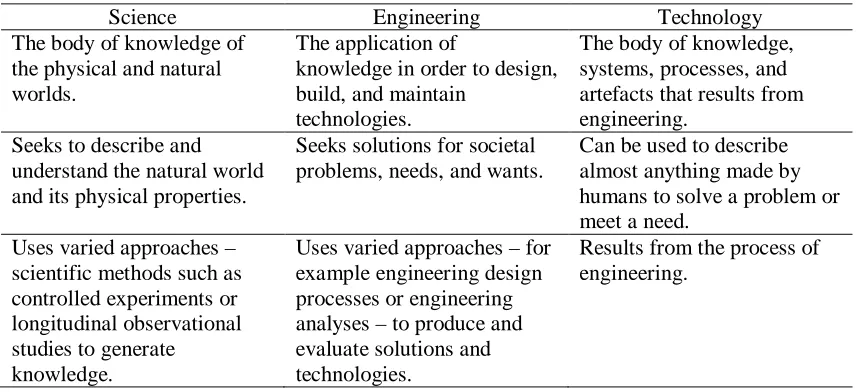
When trying to implement the E as Engineering in STEM education in schools, some fundamental questions surface: what does “engineering” mean in primary and secondary school contexts; how does engineering differ from “technology”; and how does engineering relate to science and mathematics curricula? (Vest, 2009). Table 2 summaries the connectedness between science, engineering, and technology, and as such may assist in clarifying the content and intent of each facet of ST & E (Engineering is elementary, nd).
Table 2
Defining science, engineering, and technology.
Science Engineering Technology
The body of knowledge of the physical and natural worlds.
The application of
knowledge in order to design, build, and maintain
technologies.
The body of knowledge, systems, processes, and artefacts that results from engineering.
Seeks to describe and understand the natural world and its physical properties.
Seeks solutions for societal problems, needs, and wants.
Can be used to describe almost anything made by humans to solve a problem or meet a need.
Uses varied approaches – scientific methods such as controlled experiments or longitudinal observational studies to generate knowledge.
Uses varied approaches – for example engineering design processes or engineering analyses – to produce and evaluate solutions and technologies.
Results from the process of engineering.
Even after the fundamental questions have been answered, consideration needs to be given to an additional question: “What are the benefits for students given the time, cost, and energy expenditure of E for Engineering?” We believe that STEM education in schools will progress much further if we are able to answer and demonstrate the solution to this question.
There seems to be three main benefits in pursuing engineering as the E in STEM education: (1) building, re-enforcing, and connecting science and mathematical skills; (2) promoting equity in the classroom; and (3) developing 21st century learning skills. Engineering calls for students to apply what they know about science and mathematics, thus enhancing their learning. At the same time, because engineering activities are based on real-world technologies and problems, they help students see how disciplines like science and mathematics are relevant to their lives. Inequity in the classroom that may be due to the stigma of failure could be removed by teaching the engineering design process in which “failure” is a crucial part of the problem solving process and a powerful way to learn. Equally important, in engineering there is no single “correct” answer; one problem can have many viable solutions - so all students have the opportunity to see themselves as successful (Cunningham, 2009). When engineering is approached in schools as hands-on, project or problem-based challenges, students need to collaborate, think critically and creatively, and communicate with one another – the lynch pins of 21st century learning skills (Silva, 2009).
Katehi, Pearson, and Feder (2009) promote “habits of mind” associated with engineering that add to the generic 21st century skills. These are: systems thinking, optimism, and ethical considerations. “Systems thinking” refers to an awareness of the essential interconnections in the technology world and an appreciation that systems may be unpredictable. Optimism “reflects a world view in which possibilities and opportunities can be found in every challenge and every technology can be improved” (Katehi, Pearson, & Feder, 2009, p. 7). Ethical considerations are about the impacts of engineering on people and the environment, including possible “unintended consequences of a technology, the potential disproportionate advantages or disadvantages for certain groups or individuals, and other issues” (Katehi, Pearson, & Feder, 2009, p. 7).
We believe that for the effective implementation of E for Engineering, an engineering design
process needs to be followed to identify and solve problems. This process has four key features: “(1) highly iterative, (2) open-ended, in that a problem may have many possible solutions, (3) a meaningful context for learning scientific, mathematical, and technological concepts, and (4) a stimulus to systems thinking, modelling, and analysis” (Katehi, Pearson, & Feder, 2009, p. 6). To do this requires confidence, a rich and connected knowledge of science and technology, and competence in linking concepts to the engineering design process. It is unrealistic to expect generalist primary school teachers to be able to successfully do this without considerable support.
The US is much further along in providing both teacher professional development and high quality support materials than we are in Australia; perhaps this is a direct result of the continued budgeting and purposeful spending of the government in this area. In Australia, despite a much more modest approach to advancing STEM education at the grassroots level of the teacher-in-class, we do have access to high quality programs that can readily be enacted in and adapted to our context. One such example is the “Engineering is Elementary” (EiE) collection developed by the Museum of Science, Boston. The associated website provides teachers with access to 20 hands-on engineering design challenges, as well as steps for implementation, clear links to science and technology, required materials, and guiding questions. Each challenge is also connected to a picture book that can be used to engage students in the initial problem to be solved. Video clips of students working through the engineering design process, and teacher reflections on and extensions to the challenges accompany the collection.
One example from the suite of challenges is Catching the Wind: Designing Windmills. The science concepts are air and weather (Earth and space science), and the engineering focus is on mechanical engineering that involves the design of anything with moving parts. The associated picture book, Leif Catches the Wind, introduces students to wind turbines that generate renewable energy. While working through this unit, students investigate how common machines such as mechanical pencils work, and then use their mechanical engineering skills to design sailboats and windmills that catch the wind. In all of the challenges students are encouraged to think like engineers, and to engage in the engineering design process as they imagine, plan, create, test, and improve their products (machines).
Implications
This paper has essentially been an exploration of what the E in STEM could signify. Whether it is enquiry, ethics, environment or engineering, the need for teacher support (professional development and readily accessible resources) to incorporate this dimension into their
approach to STEM education is what is consistently evident. In regards to professional development, teachers should be encouraged to reflect on what concepts can be learned or reinforced through a specific activity or project; what concepts and skills students are actually learning, and which aspects of the activity are most effective in this learning; and to consider how to transfer their learning to their classroom, and whether there might be opportunities to connect and reinforce learning from other content areas (Custer & Daugherty, 2009). There are also significant implications for initial teacher education programs – how can STEM education be accommodated in an authentic and robust manner when subject areas are taught as separate entities? There is an opportunity to re-conceptualise initial teacher education courses so that they better reflect the connected nature of integrated STEM education, and provide scope for The Arts and English to become significant adjuncts in the pursuit of STEM.
References
ACARAa (n.d.). Australian Curriculum Mathematics.
http://www.australiancurriculum.edu.au/Mathematics/Content-structure ACARAb (n.d.). Australian Curriculum Science.
http://www.australiancurriculum.edu.au/science/curriculum/f-10?layout=1 ACARAc (n.d.). Australian Curriculum Cross Curricula Priority Sustainability.
http://www.australiancurriculum.edu.au/CrossCurriculumPriorities/Sustainability
Blackley, S., & Howell, J. (2015). A STEM Narrative: 15 Years in the Making. Australian Journal of Teacher Education, 40(7). http://dx.doi.org/10.14221/ajte.2015v40n7.8
Burgess, R. A. (2012). Incorporating Ethics into K-12 STEM Education: An Introduction. Texas Tech University. http://www.depts.ttu.edu/tstem/curriculum/ethics/docs/ethics_module_I.pdf
Burke, L.M., & Baker McNeill, J. (2011). “Educate to Innovate”. How the Obama Plan for STEM Education Falls Short. Backgrounder, 2504, 1-8.
Cunningham, C. M. (2009). Engineering is elementary. The Bridge: Linking Engineering and Society, 39(3), 11-17. Washington: National Academy of Engineering. https://www.nae.edu/File.aspx?id=16147
Custer, R. L., & Daugherty, J. L. (2009). Professional Development for Teachers of Engineering: Research and Related Activities. The Bridge: Linking Engineering and Society, 39(3), 18-24. Washington: National Academy of Engineering. https://www.nae.edu/File.aspx?id=16147
Department of the Environment and Heritage (2005). Educating for a Sustainable Future: A National
Environmental Education Statement for Australian Schools.
http://www.environment.gov.au/system/files/resources/1b93d012-6dfb-4ceb-a37f-209a27dca0e0/files/sustainable-future.pdf
Engineering is elementary (n.d.). Museum of Science, Boston. http://www.eie.org/overview/science-engineering-technology
Goodrum, D., Hackling, M., & Rennie, L. (2001). The status and quality of teaching and learning of science in Australian schools [Research Report]. Department of Education Training and Youth Affairs.
http://catalogue.nla.gov.au/Record/879767
Jones, A., McKim, A., & Reiss, M. (Eds.) (2010). Ethics in the science and technology classroom: A new approach to teaching and learning. Rotterdam/Boston/Taipei: Sense Publishers.
https://www.sensepublishers.com/media/379-ethics-in-the-science-and-technology-classroom.pdf Katehi, L., Pearson, G., & Feder, M. (2009). The Status and Nature of K-12 Engineering Education in the
United States. The Bridge: Linking Engineering and Society, 39(3), 5-10. Washington: National Academy of Engineering. https://www.nae.edu/File.aspx?id=16147
Kim, M. (2005). Ethics of pedagogy in world-becoming: Contemplations on scientific literacy for citizenship. Delta Kappa Gamma Bulletin 71(3), 52-58.
http://connection.ebscohost.com/c/articles/17000667/ethics-pedagogy-world-becoming-contemplations-scientific-literacy-citizenship
Martin, D. (2012). Elementary Science Methods: A Constructivist Approach (6th Ed.). California Wadsworth Cengage Learning. https://www.cengagebrain.co.nz/content/9781133694540.pdf
McKim, A. (2010). Bioethics Education. In A. Jones, A. McKim, & M. Reiss (Eds.), Ethics in the science and technology classroom: A new approach to teaching and learning (pp. 19-36).
Rotterdam/Boston/Taipei: Sense Publishers.
Mullis, I.V.S., Martin, M.O., Foy, P., & Arora, A. (2012). Trends in International and Mathematics Science Study: TIMSS 2011. Chestnut Hill, MA: TIMSS & PIRLS International Study Center, Boston College.
http://timss.bc.edu/timss2011/international-results-mathematics.html
http://www.nap.edu/openbook.php?isbn=0309064767
OECD (2012). Programme for International Student Assessment (PISA) Results from PISA 2012.
http://www.oecd.org/pisa/keyfindings/PISA-2012-results-US.pdf
Pedretti, E. G., Bencze, L., Hewitt, J., Romkey, L., & Jivraj, A. (2008). Promoting issues-based STSE perspectives in science teacher education: Problems of identity and ideology. Science and Education, 17, 941-960. http://link.springer.com/article/10.1007%2Fs11191-006-9060-8#page-1
Reinfeld B, McQuade V, & Knight S. (2012). Ethics in Science Adelaide South Australia:
Sanders, M. (2009). STEM, STEM Education, STEMmania. The Technology Teacher, December/January, 20-26. http://www.teachmeteamwork.com/files/sanders.istem.ed.ttt.istem.ed.def.pdf
Sheffield, R. & McIlvenny, L. (2014). Using Technology To Teach Scientific Inquiry In a Teacher Education Programme: Why Do Whales Beach Themselves? International Journal of Innovation in Science and Mathematics Education, 22(6).
Sheffield, R., & Quinton, G. (2015a). Learning by linking Science Inquiry, ICT and CCT Capability in a Middle School Classroom. Teaching Science, in press
Sheffield, R., & Quinton, G. (2015b). Technology and Inquiry in a Science Context: Case studies of Scaffolded On-line Inquiry in Primary and Secondary classrooms. In J. Howell, N. Ostashewski & M. Cleveland-Innes (Eds.), Handbook of Research on Optimizing K-12 Education through Online and Blended Learning. Canada: IGI Global:
Silva, E. (2009). Measuring Skills for 21st - Century Learning. The Phi Delta Kappan, 90(9), 630-634.
http://216.78.200.159/RandD/Phi%20Delta%20Kappan/Measuring%20Skills%20for%2021st%20Cent ury%20-%20Silva.pdf
Steele, A. (2011). Beyond Contradiction: Exploring the work of secondary science teachers as they embed environmental education in curricula. International Journal of Environmental and Science Education, 6(1), 1-22. http://www.ijese.com/IJESE_v6n1_Steele.pdf
Steele, A., Brew, C. R., & Beatty, B. R. (2012). The Tower Builders: A Consideration of STEM, STSE and Ethics in Science Education. Australian Journal of Teacher Education, 37(10).
http://ro.ecu.edu.au/ajte/vol37/iss10/8/
Sterling, S. R. (2001). Sustainable Education: Re-visioning Learning and Change. Issue 6 of Schumacher briefing. US: Green Books.
http://www.developmenteducationreview.com/issue6-perspectives1?page=show
Stevenson, R. B. (2007): Schooling and environmental education: contradictions in purpose and practice. Environmental Education Research, 13(2), 139-153.
http://www.geos.ed.ac.uk/~sallen/hamish/Stevenson%20(2007).%20Schooling%20and%20environmen tal%20education%20-%20contradictions%20in%20purpose%20and%20practice.pdf
Tbilisi Declaration (1977). Toward an action plan: A report on the Tbilisi Intergovernmental Conference on Environmental Education. http://www.gdrc.org/uem/ee/tbilisi.html
UNESCO. (2005). Scientism: A weed well fertilized in the garden of science education? Connect: UNESCO International Science, Technology and Environmental Education Newsletter, 30(3-4), 2-5.
http://unesdoc.unesco.org/images/0014/001422/142273e.pdf
Vest, C. M. (2009). Putting the E in STEM education. The Bridge: Linking Engineering and Society, 39(3), 3-4. Washington: National Academy of Engineering. https://www.nae.edu/File.aspx?id=16147
Wenning, C. (2005). Levels of inquiry: Hierarchies of pedagogical practices and inquiry processes. Journal of Physics Teacher Education, 2(3).
http://www.dlsu.edu.ph/offices/asist/documents/Levels_of_Inquiry.pdf