Software Defined Networks: It’s About Time
Tal Mizrahi, Yoram Moses
∗Technion — Israel Institute of Technology
Email:
{
dew@tx, moses@ee
}
.technion.ac.il
Abstract—With the rise of Software Defined Networks (SDN), there is growing interest in dynamic and centralized traffic engineering, where decisions about forwarding paths are taken dynamically from a network-wide perspective. Frequent path re-configuration can significantly improve the network performance, but should be handled with care, so as to minimize disruptions that may occur during network updates.
In this paper we introduce TIME4, an approach that uses accurate time to coordinate network updates. We characterize a set of update scenarios called flow swaps, for which TIME4 is the optimal update approach, yielding less packet loss than existing update approaches. We define thelossless flow allocation problem, and formally show that in environments with frequent path allocation, scenarios that require simultaneous changes at multiple network devices are inevitable.
We present the design, implementation, and evaluation of a TIME4-enabled OpenFlow prototype. The prototype is publicly available as open source. Our work includes an extension to the OpenFlow protocol that has been adopted by the Open Network-ing Foundation (ONF), and is now included in OpenFlow 1.5. Our experimental results demonstrate the significant advantages of TIME4compared to other network update approaches.
Time is what keeps everything from happening at once
– Ray Cummings
I. INTRODUCTION
A. It’s About Time
The use of synchronized clocks was first introduced in the 19th century by the Great Western Railway company in Great Britain. Clock synchronization has significantly evolved since then, and is now a mature technology that is being used by various different applications, from mobile backhaul networks [1] to distributed databases [2].
The Precision Time Protocol (PTP), defined in the IEEE 1588 standard [3], can synchronize clocks to a very high degree of accuracy, typically on the order of 1 microsecond [1], [4], [5]. PTP is a common and affordable feature in commodity switches. Notably, 9 out of the 13 SDN-capable switch sili-cons listed in the Open Networking Foundation (ONF) SDN Product Directory [6] have native IEEE 1588 support.
In this work we introduce TIME4, ageneric tool for using time in SDN. One of the products of this work is a new feature that enables timed updates in OpenFlow, and has been incorporated in OpenFlow 1.5. Furthermore, we present a class of update scenarios in which the use of accurate time is provably optimal, while existing update methods are sub-optimal.
∗Yoram Moses is the Israel Pollak academic chair at Technion.
B. The Challenge of Dynamic Traffic Engineering in SDN
Defining network routes dynamically, based on a complete view of the network, can significantly improve the network performance compared to the use of distributed routing pro-tocols. SDN and OpenFlow [7], [8] have been leading trends in this context, but several other ongoing efforts offer similar concepts (e.g., [9]).
Centralized network updates often involve multiple network devices. Hence, updates must be performed in a way that strives to minimize temporary anomalies such as traffic loops, congestion, or disruptions, which may occur during transient states where the network has been partially updated.
While SDN was originally considered in the context of campus networks [7] and data centers [10], it is now also being considered for Wide Area Networks (WANs) [11], [12], carrier networks, and mobile backhaul networks [13].
WAN and carrier-grade networks require a very low packet loss rate. Carrier-grade performance is often associated with the term five nines, representing an availability of 99.999%. Mobile backhaul networks require a Frame Loss Ratio (FLR) of no more than 10−4 for voice and video traffic, and no more than 10−3 for lower priority traffic [14]. Other types of carrier network applications, such as storage and financial trading require even lower loss rates [15], on the order of
10−5.
Several recent works have explored the realm of dynamic path reconfiguration, with frequent updates on the order of minutes [11], [12], [16], enabled by SDN. Interestingly, for voice and video traffic, a frame loss ratio of up to10−4implies that service must not be disrupted for more than6milliseconds per minute. Hence, if path updates occur on a per-minute basis, then transient disruptions must be limited to a short period of no more than a few milliseconds.
C. Timed Network Updates
We explore the use ofaccurate timeas a tool for performing coordinated network updates in a way that minimizes packet loss. We introduce TIME4, which is an update approach that performs multiple changes at different switches at the same time.
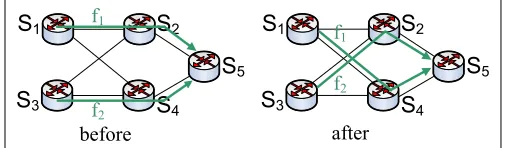
their paths at the same time, there is no congestion during the update procedure, and the reconfiguration is smooth. As clocks will typically be reasonably well synchronized, albeit not perfectly synchronized, such a scheme will result in a very short period of congestion.
S
1S
2S
3S
4S
5f1
f2
S
1S
2S
3S
4S
5f1
f2
before after
Fig. 1: Flow Swapping—Flows need to convert from the “before” configuration to the “after”.
In this paper we show that in a dynamic environment, where flows are frequently added, removed or rerouted, flow swaps are inevitable. A notable example of the importance of flow swaps is a recently published work by Fox Networks [17], in which accurately timed flow swaps are essential in the context of video switching.
One of our key results is that simultaneous updates are the optimal approach in scenarios such as Example 1, whereas other update approaches may yield considerable packet loss, or incur higher resource overhead. Note that such packet loss can be reduced either by increasing the capacity of the communication links, or by increasing the buffer memories in the switches. We show that for a given amount of resources, TIME4 yields lower packet loss than other approaches.
Accuracy is a key requirement in TIME4; since updates cannot be applied at the exact same instant at all switches, they are performed within a short time interval called the
scheduling error. The experiments we present in Section IV show that the scheduling error in softwareswitches is on the order of 1 millisecond. The TCAM-based hardwaresolution of [18] can execute scheduled events in existing switches with an accuracy on the order of 1 microsecond.
D. Related Work
Various network update approaches have been analyzed in the literature. A common approach is to use a sequence of configuration commands [16], [19]–[21], whereby theorderof execution guarantees that no anomalies are caused in interme-diate states of the procedure. However, as observed by [16], in some update scenarios, known asdeadlocks, there is no order that guarantees a consistent transition.Two-phaseupdates [22] use configuration version tags to guarantee consistency during updates. However, as per [22], two-phase updates cannot guarantee congestion freedom, and are therefore not effective in flow swap scenarios, such as Fig. 1. Hence, in flow swap scenarios the order approach and the two-phase approach produce the same result as the simple-minded approach, in which the controller sends the update commands as close as possible to instantaneously, and hopes for the best.
In this paper we present TIME4, an update approach that is most effective in flow swaps and other deadlock [16] scenarios,
such as Fig. 1. We refer to update approaches that do not use time asuntimed update approaches.
In SWAN [11], the authors suggest that reserving un-used scratch capacity of 10-30% on every link can allow congestion-free updates in most scenarios. The B4 [12] ap-proach prevents packet loss during path updates by temporarily reducing the bandwidth of some or all of the flows. Our ap-proach does not require scratch capacity, and does not reduce the bandwidth of flows during network updates. Furthermore, in this paper we show that variants of SWAN and B4 that make use of TIME4 can perform better than the original versions.
Rearrangeably non-blocking topologies (e.g., [23]) allow new traffic flows to be added to the network by rearranging existing flows. The analysis of flow swaps presented in this paper emphasizes the requirement to perform simultaneous
reroutes during the rearrangement procedure, an aspect which has not been previously studied.
Preliminary work-in-progress versions of the current paper introduced the concept of using time in SDN [24] and the flow swapping scenario [25]. The use of time forconsistentupdates was discussed in [26]. TimeFlip [18] presented a practical method of implementing timed updates. The current work is the first to present a generic protocol for performing timed updates in SDN, and the first to analyzeflow swaps, a natural application in which timed updates are the optimal update approach.
E. Contributions
The main contributions of this paper are as follows:
• We consider a class of network update scenarios called
flow swaps, and show that simultaneous updates using synchronized clocks are provably the optimal approach of implementing them. In contrast, existing approaches for consistent updates (e.g., [16], [22]) are not applicable to flow swaps, and other update approaches such as SWAN [11] and B4 [12] can perform flow swaps, but at the expense of increased resource overhead.
• We present the design, implementation and evaluation of a prototype that performs timed updates in OpenFlow.
• Our work includes an extension to the OpenFlow protocol that has been approved by the ONF and integrated into OpenFlow 1.5 [27], and into the OpenFlow 1.3.x exten-sion package [28]. The source code of our prototype is publicly available [29].
• We present experimental results that demonstrate the ad-vantage of timed updates over existing approaches. More-over, we show that existing update approaches (SWAN and B4) can be improved by using accurate time. Due to space limits, some of the proofs and experimental results are presented in [30].
II. THELOSSLESSFLOWALLOCATION(LFA) PROBLEM
A. Inevitable Flow Swaps
Fig. 1 presents a scenario in which it is necessary toswap
d
q1 q2
o1 o2
(a) Clos network.
d
o1 o2 on
q1 q2 qm
c c c
s ∞
∞ ∞
c c c
e1 e2 em
(b) Unsplittable flow graph.
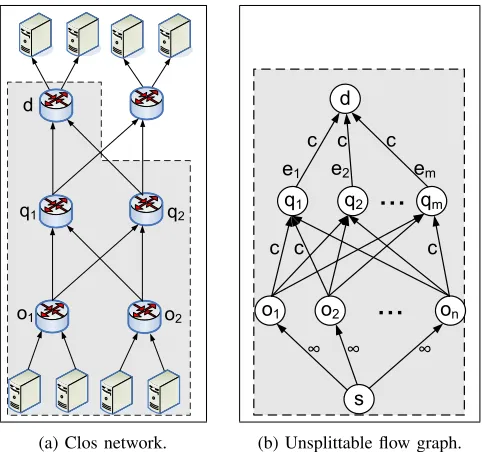
Fig. 2: Modeling a Clos topology as an unsplittable flow graph.
show that there does not exist a controller routing strategy that avoids the need for flow swaps.
Our analysis is based on representing the flow-swap problem as an instance of an unsplittable flow problem, as illustrated in Fig. 2b. The topology of the graph in Fig. 2b models the traffic behavior to a given destination in common multi-rooted network topologies such as fat-tree and Clos (Fig. 2a).
The unsplittable flow problem [31] has been thoroughly discussed in the literature; given a directed graph, a source node s, a destination node d, and a set of flow demands (commodities) between sand d, the goal is to maximize the traffic rate from the source to the destination. In this paper we define agame between two players: a source1 that generates
traffic flows (commodities) and acontrollerthat reconfigures the network forwarding rules in a way that allows the network to forward all traffic generated by the source without packet losses.
Our main argument, phrased in Theorem 1, is that the source has a strategy thatforcesthe controller to perform a flow swap, i.e., to reconfigure the path of two or more flows at the same time. Thus, a scenario in which multiple flows must be updated at the same time is inevitable, implying the importance of timed updates.
Moreover, we show that the controller can be forced to invoke nindividual commands that should optimally be per-formed at the same time. Update approaches that do not use time, also known asuntimedapproaches, cause the updates to be performed over a long period of time, potentially resulting in slow and possibly erratic response times and significant packet loss. Timed coordination allows us to perform the n updates within a short time interval that depends on the scheduling error.
1The source player does not represent a malicious attacker; it is an
‘adversary’, representing the worst-case scenario.
Although our analysis focuses on the topology of Fig.2b, it can be shown that the results are applicable to other topologies as well, where the source can force the controller to perform a swap over the edges of the min-cut of the graph.
B. Model and Definitions
We now introduce thelossless flow allocation (LFA) prob-lem; it is not presented as an optimization problem, but rather as a game between two players: asourceand acontroller. As the source adds or removes flows (commodities), the controller reconfigures the forwarding rules so as to guarantee that all flows are forwarded without packet loss.The controller’s goal is to find a forwarding path for all the flows in the system without exceeding the capacity of any of the edges, i.e., to completely avoid loss of packets from the given flows. The source’s goalis to progressively add flows, without exceeding the network’s capacity, forcing the controller to perform a flow swap. We shall show that the source has a strategy that forces the controller to swap traffic flows simultaneously in order to avoid packet loss.
Our model makes three basic assumptions: (i) each flow has a fixed bandwidth, (ii) the controller strives to avoid packet loss, and (iii) flows areunsplittable. We discuss these assumptions further in Sec. V.
We use the term flow in its OpenFlow sense, i.e., a set of packets that share common properties, such as source and destination network addresses. A flow in our context, can be seen as a session between the source and destination that runs traffic at a fixed rate.
The network is represented by a directed weighted acyclic graph (Fig. 2b), G= (V, E, c), with a sources, a destination d, and a set of intermediate nodes, Vin. Thus, V = Vin∪
{s, d}. The nodes directly connected tosare denoted byO= {o1, o2, . . . , on}. Each of the outgoing edges from the source shas an infinite capacity, whereas the rest of the edges have a capacity c. For the sake of simplicity, and without loss of generality, throughout this section we assume thatc= 1. Such a graphGis referred to as an LFA graph.
The source node progressively transmits traffic flows to-wards the destination node. Each flow represents a session between s and d; every flow has a constant bandwidth, and cannot be split between two paths. A centralized controller configures the forwarding policy of the intermediate nodes, determining the path of each flow. Given a set of flows froms tod, the controller’s goal is to configure the forwarding policy of the nodes in a way that allows all flows to be forwarded todwithout exceeding the capacity of any of the edges.
The set of flows that are generated bysis denoted byF::= {F1, F2, . . . , Fk}. Each flowFiis defined asFi::= (i, fi, ri), whereiis a unique flow index, fi is the bandwidth satisfying
0 < fi ≤ c, and ri denotes the node that the controller forwards the flow to, i.e.,ri∈ {o1, o2, . . . , on}.
It is assumed that the controller monitors the network, and thus it is aware of the flow set F. The controller maintains a
an element υ ∈F×Vin is referred to as an entryfor short. An update of Rcon is defined to be a partial function u :
F×Vin*Vin∪ {d}. We define arerouteas an updateuthat has a single entry in its domain. We call an update that has more than one entry in its domain a swap, and it is assumed that all updates in aswapare performed at the same time. We define ak-swap fork≥2as a swap that updates entries in at least kdifferent nodes. Note that ak-swap is possible only if n≥k, where n is the number of nodes in O. We focus our
analysis on 2-swaps, and throughout the section we assume that n≥2. In Section II-E we discuss k-swaps for values of k >2.
C. The LFA Game
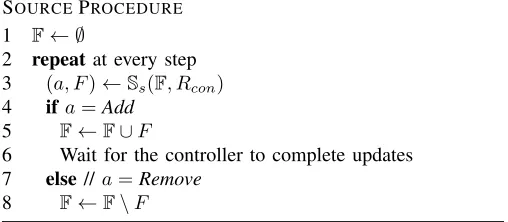
The lossless flow allocation problem can be viewed as a game between two players, the source and the controller. The game proceeds by a sequence of steps; in each step the source either adds or removes a single flow (Fig. 3), and then waits for the controller to perform a sequence of updates (Fig. 4). The source’s strategySs(F, Rcon) = (a, F), is a function that defines for each flow setF and forwarding functionRcon for
F, a pair (a, F) representing the source’s next step, where a ∈ {Add,Remove} is the action to be taken by the source, and F = (j, fj, rj)is a single flow to be added or removed. The controller’s strategy is defined byScon(Rcon, a, F) =U,
where U={u1, . . . , u`} is a sequence of updates, such that (i) at the end of each update no edge exceeds its capacity, and (ii) at the end of the last update, u`, the forwarding function Rcondefines a forwarding path for all flows inF. Notice that
when a flow is to be removed, the controller’s update is trivial; it simply removes all the relevant entries from the domain of Rcon. Hence our analysis focuses onaddingnew flows.
The following theorem, which is the crux of this section, argues that the source has a strategy that forces the controller to perform a swap, and thus that flow swaps are inevitable from the controller’s perspective.
Theorem 1. Let Gbe an LFA graph. In the LFA game over G, there exists a strategy,Ss, for the source that forces every
controller strategy,Scon, to perform a2-swap.
Proof. Letmbe the number of incoming edges to the destina-tion nodedin the LFA graph (see Fig 2b). Form= 1the claim is trivial. Hence, we start by proving the claim form= 2, i.e., there are two edges connected to node d, edges e1 and e2.
SOURCEPROCEDURE 1 F← ∅
2 repeatat every step 3 (a, F)←Ss(F, Rcon) 4 if a=Add
5 F←F∪F
6 Wait for the controller to complete updates 7 else //a=Remove
8 F←F\F
Fig. 3: The LFA game: the source’s procedure.
CONTROLLERPROCEDURE 1 repeat at every step
2 {u1, . . . , u`} ←Scon(Rcon, a, F) 3 forj∈[1, `]
4 Update Rcon according touj
Fig. 4: The LFA game: the controller’s procedure.
We show that the source has a strategy that, regardless of the controller’s strategy, forces the controller to use a swap. In the first four steps of the game, the source generates four flows, F1 = (1,0.35, o1), F2 = (2,0.35, o1), F3 = (3,0.45, o2),
andF4= (4,0.45, o2), respectively. According to the Source
Procedure of Fig. 3, after each flow is added, the source waits for the controller to updateRconbefore adding the next flow. After the flows are added, there are two possible cases:
(a) The controller routes symmetrically through e1 and e2,
i.e. a flow of0.35and a flow of0.45through each of the edges. In this case the source’s strategy at this point is to generate a new flowF5 = (5,0.3, o1)with a bandwidth
of0.3. The only way the controller can accommodateF5
is by routingF1andF2through the same edge, allowing
the new0.3flow to be forwarded through that edge. Since there is no sequence of reroute updates that allows the controller to reach the desiredRcon, the only way to reach a state whereF1andF2are routed through the same edge
is to swap a0.35flow with a0.45flow. Thus, by issuing F5 the controller forces a flow swap as claimed.
(b) The controller routesF1andF2through one edge, andF3
andF4 through the other edge. In this case the source’s
strategy is to generate two flows, F6 and F7, with a
bandwidth of 0.2 each. The controller must route F6
through the edge withF1andF2. Now each path sustains
a bandwidth of0.9units. Thus, whenF7 is added by the
source, the controller is forced to perform a swap between one of the0.35flows and one of the0.45 flows.
In both cases the controller is forced to perform a 2-swap, swapping a flow fromo1with a flow fromo2. This proves the
claim form= 2.
The case ofm >2 is obtained by reduction tom= 2: the source first generatesm−2flows with a bandwidth of1each, causing the controller to saturate m−2 edges connected to node d(without loss of generality e3, . . . , em). At this point
there are only two available edges,e1ande2. From this point,
the proof is identical to the case ofm= 2.
D. The Impact of Flow Swaps
We define a metric for flow swaps, by considering the oversubscription that is caused if the flows are notswapped simultaneously, but updated using an untimed approach.
switch
Time controller
Ts B
u n d le C o m m it (a
t t im
e T s)
Switch executes bundle at time Ts B
u n d le O
p e n
B u n d le A
d d 1
...
Commit may include scheduled time Ts 1
rep ly
B u n d le A
d d N
B u n d le C
lo s e re
ply
rep ly
2 3 4
B u n d le D
isc a rd 5'
5
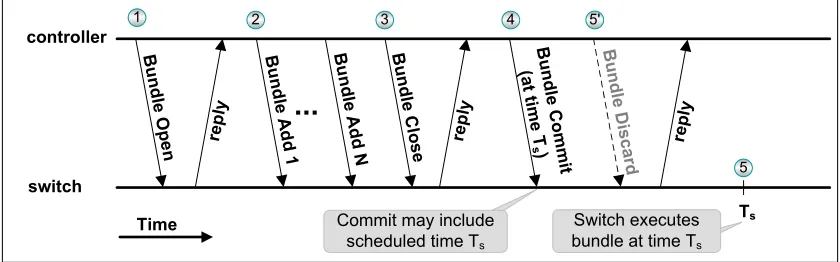
Fig. 5: AScheduled Bundle: theBundle Commitmessage may includeTs, the scheduled time of execution. The controller can use aBundle Discard message to cancel the Scheduled BundlebeforeTs.
Definition 1 (Flow swap impact). Let F be a flow set, and Rcon be the corresponding forwarding function. Letu: F× V * V∪ {d} be a 2-swap, such that u = u1∪u2, where ui = (υi, vi), forυi ∈F×V,vi ∈V∪ {d}, andi∈ {1,2}. The impact of u is defined to be the minimum of: (i) The oversubscription caused by applying u1 to Rcon, or (ii) the
oversubscription caused by applyingu2 toRcon.
The following theorem shows that in the LFA game, the source can force the controller to perform a flow swap with a swap impact of roughly 0.5.
Theorem 2. Let Gbe an LFA graph, and let 0 < α <0.5. In the LFA game over G, there exists a strategy, Ss, for the
source that forces every controller strategy, Scon, to perform
a swap with an impact of α.
The proof is presented in [30].
Intuitively, Theorem 2 shows that not only are flow swaps inevitable, but they have a high impact on the network, as they can cause links to be congested by roughly50%beyond their capacity.
E. n-Swaps
As defined above, a k-swap is a swap that involves k or more nodes. In previous subsections we discussed 2-swaps. The following theorem generalizes Theorem 1 to n-swaps, wherenis the number of nodes in O.
Theorem 3. Let Gbe an LFA graph. In the LFA game over G, there exists a strategy,Ss, for the source that forces every
controller strategy,Scon, to perform ann-swap. The proof is presented in [30].
III. DESIGN ANDIMPLEMENTATION
A. Protocol Design
We present an extension that allows OpenFlow controllers to signal the time of execution of a command to the switches. This extension is described in full in [30].2
2A preliminary version of this extension was presented in [32].
Our extension makes use of the OpenFlow [8] Bundle feature; a Bundle is a sequence of OpenFlow messages from the controller that is applied as a single operation. Our time extension definesScheduled Bundles, allowing all commands of a Bundle to come into effect at a pre-determined time. This is a generic means to extend all OpenFlow commands with the scheduling feature.
Using Bundle messages for implementing TIME4 has two significant advantages: (i) It is a generic method to add the time extension to all OpenFlow commands without changing the format of all OpenFlow messages; only the format of Bundle messages is modified relative to the Bundle message format in [8], optionally incorporating an execution time. (ii) The Scheduled Bundle allows a relatively straightforward way tocancelscheduled commands, as described below.
Fig. 5 illustrates theScheduled Bundlemessage procedure. In step 1, the controller sends a Bundle Open message to the switch, followed by one or more Add messages (step 2). EveryAdd message encapsulates an OpenFlow message, e.g., a FLOW MOD message. A Bundle Close is sent in step 3, followed by the Bundle Commit (step 4), which optionally includes the scheduled time of execution,Ts. The switch then executes the desired command(s) at timeTs.
TheBundle Discardmessage (step 50) allows the controller to enforce an all-or-none scheduled update; after the Bundle Commitis sent, if one of the switches sends anerrormessage, indicating that it is unable to schedule the current Bundle, the controller can send a Discard message to all switches, cancel-ing the scheduled operation. Hence, when a switch receives a scheduled commit, to be executed at timeTs, the switch can verify that it can dedicate the required resources to execute the command as close as possible toTs. If the switch’s resources are not available, for example due to another command that is scheduled toTs, then the switch replies with an error message, aborting the scheduled commit. Significantly, this mechanism allows switches to execute the command with a guaranteed scheduling accuracy, avoiding the high variation that occurs when untimed updates are used.
OpenFlow Agent Dpctl
OpenFlow Switch CPqD OFSoftswitch
PTPd Master PTPd Slave i
Controller
Switch i
OpenFlow protocolusing time extension PTP
Time extension
Switch scheduling
SDN application using time-based updates
offseti Time-based
update
REVERSEPTP
Clock
O
p
e
n
s
o
u
rc
e
REVERSEPTP
Clock
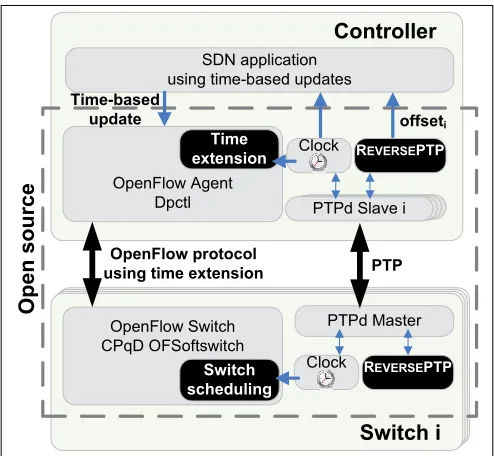
Fig. 6: TIME4 prototype design: the black blocks are the components implemented in the context of this work.
switches about whether they support Scheduled Bundles, and to configure some of the switch parameters related to Sched-uled Bundles.
B. Clock synchronization
TIME4 requires the switches and controller to maintain a local clock, enabling time-triggered events. Hence, the local clocks should be synchronized. The OpenFlow time exten-sion we defined does not mandate a specific synchronization method. Various mechanisms may be used, e.g., the Network Time Protocol (NTP), the Precision Time Protocol (PTP) [3], or GPS-based synchronization. The prototype we designed and implemented uses REVERSEPTP [33], a variant of PTP that is customized for SDN.
C. Prototype Design and Implementation
We have designed and implemented a software-based pro-totype of TIME4, as illustrated in Fig. 6. The components we implemented are marked in black. These components run on Linux, and are publicly available as open source [29].
Our TIME4-enabled OFSoftswitch prototype was adopted by the ONF as the official prototype of Scheduled Bundles.3
Switches.Every switchiruns an OpenFlow switch software module. Our prototype is based on the open source CPqD OF-Softswitch [34],4 incorporating theswitch schedulingmodule (see Fig. 6) that we implemented. When the switch receives aScheduled Bundlefrom the controller, theswitch scheduling
module schedules the respective OpenFlow command to the
3The ONF process for adding new features to OpenFlow requires every
new feature to be prototyped.
4OFSoftswitch is one of the two software switches used by the Open
Networking Foundation (ONF) for prototyping new OpenFlow features. We chose this switch since it was the first open source OpenFlow switch to include the Bundle feature.
desired time of execution. The switch scheduling module also handles Bundle Feature Request messages received from the controller.
Each switch runs a REVERSEPTP master, which distributes the switch’s time to the controller. Our REVERSEPTP proto-type is a lightweight set of Bash scripts that is used as an abstraction layer over the well-known open source PTPd [35] module. Our software-based implementation uses the Linux clock as the reference for PTPd, and for the switch’s schedul-ing module. To the best of our knowledge, ours is the first open source implementation of REVERSEPTP.
Controller.The controller runs an OpenFlow agent, which communicates with the switches using the OpenFlow protocol. Our prototype uses the CPqD Dpctl (Datapath Controller), which is a simple command line tool for sending OpenFlow messages to switches. We have extended Dpctl by adding the time extension; the Dpctl command-line interface allows the user to define the execution time of a Bundle Commit. Dpctl also allows a user to send aBundle Feature Requestto switches.
The controller runs REVERSEPTP withninstances of PTPd in slave mode, wherenis the number of switches in the net-work. One or more SDN applications can run on the controller and perform timed updates. The application can extract the offset,offseti, of every switchifrom REVERSEPTP, and use it to compute the scheduled execution time of switchiin every timed update. The Linux clock is used as a reference for PTPd, and for the SDN application(s).
IV. EVALUATION
A. Evaluation Method
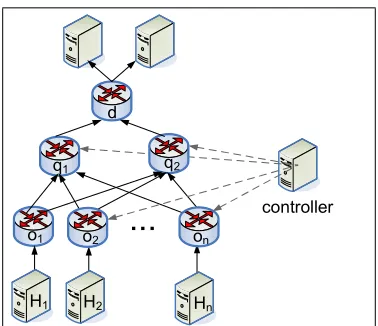
Environment. We evaluated our prototype on a 71-node testbed in the DeterLab [36] environment. Each machine (PC) in the testbed either played the role of an OpenFlow switch, running our TIME4-enabled prototype, or the role of a host, sending and receiving traffic. A separate machine was used as a controller, which was connected to the switches using an out-of-band network.
Performance attributes.Three performance attributes play a key role in our evaluation, as shown in Table I.
∆ The average time elapsed between two consecutive messages sent by the controller.
IR Installation latency range: the difference between the maximal
rule installation latency and the minimal installation latency. δ Scheduling error: the maximal difference between the actual
update time and the scheduled update time.
TABLE I: Performance Attributes.
Intuitively,∆andIRdetermine the performance of untimed updates. ∆ indicates the controller’s performance; an Open-Flow controller can handle as many as tens of thousands [37] to millions [38] of packets per second, depending on the type of controller and the machine’s processing power. Hence,
a rule modification message until the rule has been installed. The installation latency of an OpenFlow rule modification (FLOW MOD) has been shown to range from 1 millisecond to seconds [16], [39], and grows dramatically with the number of installations per second.
The attribute that affects the performance oftimedupdates is the switches’ scheduling error, δ. When an update is scheduled to be performed at time T0, it is performed in
practice at some timet∈[T0, T0+δ].5 The scheduling error, δ, is affected by two factors: the device’s clock accuracy, which is the maximal offset between the clock value and the value of an accurate time reference, and the execution accuracy, which is a measure of how accurately the device can perform a timed update, given run-time parameters such as the concurrently executing tasks and the load on the device. The achievable clock accuracy strongly depends on the network size and topology, and on the clock synchronization method. For example, the clock accuracy using the Precision Time Protocol [3] is typically on the order of 1 microsecond (e.g., [4]).
B. Performance Attribute Measurement
Our experiments measured the three attributes,∆,IR, andδ, illustrating how accurately updates can be applied in software-based OpenFlow implementations. It should be noted that these three values depend on the processing power of the testbed machine; we measured the parameters for three types of DeterLab machines, Type I, II, and III, listed in Table II.
In software-based switches, the CPU handles both the data-plane traffic and the communication with the controller, and thusIRandδcan be affected by the rate of data-plane traffic through the switch. Hence, in our experiments we fixed the rate of traffic through each switch to 10 Mbps, allowing an ‘apples-to-apples’ comparison between experiments.
5An alternative representation of the accuracy, δ, assumes a symmetric
error,T0±δ. The two approaches are equivalent.
controller
...
o1 o2 on
H1 H2 Hn
q1 q2
d
Fig. 7: Experimental evaluation: every host and switch was emulated by a Linux machine in the DeterLab testbed. All
links have a capacity of 10 Mbps. The controller is connected to the switches by an out-of-band network.
Machine Type ∆ IR δ
I Intel Xeon E3 LP2.4 GHz, 16 GB RAM 9.64 1.3 1.23
II Intel Xeon 9.6 1.47 1.18
2.1 GHz, 4 GB RAM
II Intel Dual Xeon3 GHz, 2 GB RAM 14.27 2.72 1.19
TABLE II: Measured attributes in milliseconds.
C. Flow Swap Evaluation
1) Experiment Setting
We evaluated our prototype on a 71-node testbed under. We used the testbed to emulate an OpenFlow network with 32 hosts and 32 leaf switches, as depicted in Fig. 7, withn= 32. Metric.A flow swap that is not performed in a coordinated way may bare a high cost: either packet loss, deep buffering, or a combination of the two. We use packet loss as ametric for the cost of flow swaps, assuming that deep buffering is not used.
We used Iperf to generate flows from the sources to the destination, and to measure the number of packets lost between the source and the destination.
The flow swap scenario.All experiments were flow swaps with a swap impact of 0.5.6 We used two static flows,
which were not reconfigured in the experiment:H1 generates
a5Mbps flow that is forwarded throughq1, andH2generates
a5 Mbps flow that is generated through q2. We generated n
additional flows (where n is the number of switches at the bottom layer of the graph): (i) A 5 Mbps flow from H1 to
the destination. (ii)n−1 flows, each having a bandwidth of
5
n−1 Mbps. Every flow swap in our experiment required the
flow of (i) to be swapped with the n−1 flows of (ii). Note that this swap has an impact of0.5.
2) Experimental Results
TIME4 vs. other update approaches. In this experiment we compared the packet loss of TIME4 to other update approaches described in Sec. I-D. As discussed in Sec. I-D, applying theorderapproach or thetwo-phaseapproach to flow swaps produces similar results. This observation is illustrated in Fig. 8b. In the rest of this section we refer to these two approaches collectively as theuntimed approaches.
In our experiments we also implemented a SWAN-based [11] update, and a B4-SWAN-based [12] update. In SWAN, we used a 10% scratch on each of the links, and in B4 updates we temporarily reduced the bandwidth of each flow by 10% to avoid packet loss. As depicted in Fig. 8b, SWAN and B4 yield a slightly lower packet loss rate than TIME4; the average number of packets lost in each TIME4 flow swap is0.2, while with SWAN and B4 only0.1 packets are lost on average.
To study the effect of usingtime in SWAN and in B4, we also performed hybrid updates, illustrated in Fig. 8c and 8d, and in the two right-most bars of Fig. 8b. We combined SWAN and TIME4, by performing a timed update on a network with scratch capacity, and compared the packet loss
6By Theorem 2, the source can force the controller to perform a flow swap
0 5 10 15 20 25 30 35
0 10 20 30
P a c k e t L o s s
Number of switches
Time4 Untimed
(a) The no. of packets lost in a flow swap vs. no. of switches
involved in the update. 0.01
0.1 1 10 100
Order Two-phase Time4 B4 SWAN Time4B4 Time4SW
P a ck et L o ss ( lo g a ri th m ic ) B4 Time4SWTimed Untimed
(b) The number of packets lost in a flow swap in different update approaches
(withn= 32).
0 5 10 15 20 25 30 35 40
0 2 4 6 8 10
P a ck et L o ss
Scratch Capacity [%]
Time4 + SWAN SWAN
(c) The number of packets lost in a flow swap using SWAN and TIME4+SWAN (withn= 32).
0 5 10 15 20 25 30 35 40
0 2 4 6 8 10
P a c k e t L o ss
Flow Bandwidth Reduction [%]
Time4 + B4 B4
(d) The number of packets lost in a flow swap using B4 and TIME4+B4 (withn= 32).
Fig. 8: Flow swap performance: in large networks (a) TIME4 allows significantly less packet loss than untimed approaches. The packet loss of TIME4 is slightly higher than SWAN and B4 (b), while the latter two methods incur higher overhead. Combining TIME4 with SWAN or B4 provides the best of both worlds; low packet loss (b) and low overhead (c and d).
to the conventional SWAN-based update. We repeated the experiment for various values of scratch capacity, from 0% to 10%. As illustrated in Fig. 8c, the TIME4+SWAN approach can achieve the same level of packet loss as SWAN with less scratch capacity. We performed a similar experiment with a timed B4 update, varying the bandwidth reduction rate between 0% and 10%, and observed similar results.
Number of switches. We evaluated the effect of n, the number of switches involved in the flow swap, on the packet loss. We performed an n-swap with n = 2,4,8,16,32. As illustrated in Fig. 8a, the number of packets lost during an untimed update grows linearly with the number of switches n, while the number of packets lost in a TIME4 update is less than one on average, and is not affected by the number of switches. As n increases, the update duration7 is longer, and
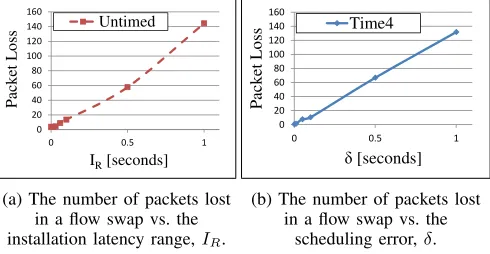
hence more packets are lost during the update procedure. Installation latency variation. Our next experiment (Fig. 9a) examined how the installation latency variation, denoted by IR, affects the packet loss during an untimed update. We analyzed different values ofIR: in each update we synthetically determined a uniformly distributed installation latency, I ∼ U[0, IR]. As shown in Fig. 9a, the switch’s installation latency range, IR, dramatically affects the packet loss rate during an untimed update. Notably, whenIRis on the order of 1 second, as in the extreme scenarios of [16], [39], TIME4 has a significant advantage over the untimed approach. Scheduling error. Figure 9b depicts the packet loss as a function of the scheduling error of TIME4. By Fig. 8a, 9a and 9b, we observe that if δ is sufficiently low compared to IR and (n−1)∆, then TIME4 outperforms the untimed approaches. Note that even if switches are not implemented with extremely low scheduling error δ, we expect TIME4 to outperform the untimed approach, as typically δ < IR, as further discussed in Section V.
Summary. The experiments presented in this section demonstrate that TIME4 performs significantly better than untimed approaches, especially when the update involves mul-tiple switches, or when there is a non-deterministic installation
7Theupdate durationis the time elapsed from the instant the first switch
is updated until the instant the last switch is updated. In our setting the update duration is roughly(n−1)∆.
0 20 40 60 80 100 120 140 160
0 0.5 1
P a c k e t L o ss
IR[seconds] Untimed
(a) The number of packets lost in a flow swap vs. the installation latency range,IR.
0 20 40 60 80 100 120 140 160
0 0.5 1
P a c k e t L o ss
δ [seconds] Time4
(b) The number of packets lost in a flow swap vs. the
scheduling error,δ.
Fig. 9: Performance as a function ofIR andδ.
latency. Interestingly, TIME4 can be used in conjunction with existing approaches, such as SWAN and B4, allowing the same level of packet loss with less overhead than the untimed variants.
V. DISCUSSION
Scheduling accuracy. The advantage of timed updates greatly depends on the scheduling accuracy, i.e., on the switches’ ability to accurately perform an update at its sched-uled time. Clocks can typically be synchronized on the order of1microsecond (e.g., [4]) using PTP [3]. However, a switch’s ability to accurately perform a scheduled action depends on its implementation.
• Software switches: Our experimental evaluation showed
that the scheduling error in the software switches we tested was on the order of 1 millisecond.
• Hardware-based scheduling:The work of [18] has shown a method that allows the scheduling error of timed events in hardware switches to be as low as 1 microsecond. It is an important observation that in a typical system we expect the scheduling error to be lower than the installation latency variation, i.e., δ < IR. Untimed updates have a non-deterministic installation latency. On the other hand, timed updates are predictable, and can be scheduled in a way that avoids conflicts between multiple updates, allowing δ to be typically lower thanIR.
of a setting in which these assumptions are often valid is a WAN or a carrier network. In carrier networks the max-imal bandwidth of a service is defined by its bandwidth profile [15]. Thus, the controller cannot dynamically change the bandwidth of the flows, as they are determined by the SLA. The Frame Loss Ratio (FLR) is one of the key performance attributes [15] that a service provider must comply to, and cannot be compromised.Splittinga flow between two or more paths may result in packets being received out-of-order. Packet reordering is a key performance parameter in carrier-grade performance and availability measurement, as it affects various applications such as real-time media streaming [40]. Thus, all packets of a flow are forwarded through the same path.
Network latency. In Fig. 1, the switches S1 and S3 are
updated at the same time, as it is implicitly assumed that all the links have the same latency. In the general case each link has a different latency, and thus S1 and S3 should not be
updated at the same time, but at two different times, T1 and T3, that account for the different latencies.
VI. CONCLUSION
Time and clocks are valuable tools for coordinating up-dates in a network. We have shown that dynamic traffic steering by SDN controllers requires flow swaps, which are best performed as close to instantaneously as possible. Time-based operation can help to achieve carrier-grade packet loss rate in environments that require rapid path reconfiguration. Our OpenFlow time extension can be used for implementing flow swaps and TIME4. It can also be used for a variety of additional timed update scenarios that can help improve network performance during path and policy updates.
VII. ACKNOWLEDGMENTS
We gratefully acknowledge Oron Anschel and Nadav Shiloach, who implemented the TIME4-enabled OFSoftswitch prototype. We thank Jean Tourrilhes and the members of the Extensibility working group of the ONF for many helpful comments that contributed to the OpenFlow time extension. We also thank Nate Foster, Laurent Vanbever, Joshua Reich and Isaac Keslassy for helpful discussions. We gratefully acknowledge the DeterLab project [36] for the opportunity to perform our experiments on the DeterLab testbed. This work was supported in part by the ISF grant 1520/11.
REFERENCES
[1] ITU-T G.8271/Y.1366, “Time and phase synchronization aspects of packet networks,”ITU-T, 2012.
[2] J. C. Corbettet al., “Spanner: Google’s globally distributed database,” ACM Transactions on Computer Systems (TOCS), 2013.
[3] IEEE TC 9, “1588 IEEE Standard for a Precision Clock Synchronization Protocol for Networked Measurement and Control Systems Version 2,” IEEE, 2008.
[4] H. Li, “IEEE 1588 time synchronization deployment for mobile back-haul in China Mobile,” keynote presentation, IEEE ISPCS, 2014. [5] IEEE Std C37.238, “IEEE Standard Profile for Use of IEEE 1588
Precision Time Protocol in Power System Applications,”IEEE, 2011. [6] “ONF SDN Product Directory,” https://www.opennetworking.org/
sdn-resources/onf-products-listing, January, 2015.
[7] N. McKeown, et al., “OpenFlow: enabling innovation in campus net-works,”ACM SIGCOMM Computer Communication Review, 2008.
[8] Open Networking Foundation, “OpenFlow Switch Specification,” Ver-sion 1.4.0, 2013.
[9] “Interface to the Routing System (I2RS) working group,” https:// datatracker.ietf.org/wg/i2rs/charter/, IETF, 2016.
[10] M. Al-Fares, S. Radhakrishnan, B. Raghavan, N. Huang, and A. Vahdat, “Hedera: Dynamic flow scheduling for data center networks.,” inNSDI, 2010.
[11] C.-Y. Hong, S. Kandula, R. Mahajan, M. Zhang, V. Gill, M. Nanduri, and R. Wattenhofer, “Achieving high utilization with software-driven WAN,” inACM SIGCOMM, 2013.
[12] S. Jainet al., “B4: Experience with a globally-deployed software defined WAN,” inACM SIGCOMM, 2013.
[13] Open Networking Foundation, “OpenFlow-enabled mobile and wireless networks,”ONF Solution Brief, 2013.
[14] Metro Ethernet Forum, “Mobile backhaul - phase 2 implementation agreement,”MEF 22.1, 2012.
[15] Metro Ethernet Forum, “Carrier ethernet class of service - phase 2 implementation agreement,”MEF 23.1, 2012.
[16] X. Jin, H. H. Liu, R. Gandhi, S. Kandula, R. Mahajan, J. Rexford, R. Wattenhofer, and M. Zhang, “Dionysus: Dynamic scheduling of network updates,” inACM SIGCOMM, 2014.
[17] T. G. Edwards and W. Belkin, “Using SDN to facilitate precisely timed actions on real-time data streams,” inACM SIGCOMM Workshop on Hot topics in Software Defined Networks (HotSDN), 2014.
[18] T. Mizrahi, O. Rottenstreich, and Y. Moses, “TimeFlip: Scheduling network updates with timestamp-based TCAM ranges,” in IEEE IN-FOCOM, 2015.
[19] P. Franc¸ois and O. Bonaventure, “Avoiding transient loops during the convergence of link-state routing protocols,” IEEE/ACM Transactions on Networking (TON), 2007.
[20] L. Vanbever, S. Vissicchio, C. Pelsser, P. Francois, and O. Bonaventure, “Seamless network-wide IGP migrations,”ACM SIGCOMM Computer Communication Review, vol. 41, no. 4, pp. 314–325, 2011.
[21] H. H. Liu, X. Wu, M. Zhang, L. Yuan, R. Wattenhofer, and D. Maltz, “zUpdate: updating data center networks with zero loss,” in ACM SIGCOMM, 2013.
[22] M. Reitblatt, N. Foster, J. Rexford, C. Schlesinger, and D. Walker, “Abstractions for network update,” inACM SIGCOMM, 2012. [23] N. Pippenger, “On rearrangeable and non-blocking switching networks,”
Journal of Computer and System Sciences, 1978.
[24] T. Mizrahi and Y. Moses, “Time-based updates in software defined networks,” in ACM SIGCOMM Workshop on Hot topics in Software Defined Networks (HotSDN), 2013.
[25] T. Mizrahi and Y. Moses, “On the necessity of time-based updates in SDN,” inOpen Networking Summit (ONS), 2014.
[26] T. Mizrahi, E. Saat, and Y. Moses, “Timed consistent network updates,” inACM SIGCOMM Symposium on SDN Research (SOSR), 2015. [27] Open Networking Foundation, “OpenFlow switch specification,”Version
1.5.0, 2015.
[28] Open Networking Foundation, “OpenFlow extensions 1.3.x package 2,” 2015.
[29] “TIME4 source code,” https://github.com/TimedSDN, 2015.
[30] T. Mizrahi and Y. Moses, “TIME4: Time for SDN,” technical report, arXiv preprint, 2016.
[31] J. M. Kleinberg, “Single-source unsplittable flow,” in Symposium on Foundations of Computer Science (FOCS), 1996.
[32] T. Mizrahi and Y. Moses, “Time-based Updates in OpenFlow: A Pro-posed Extension to the OpenFlow Protocol,” technical report, Technion, http://tx.technion.ac.il/%7Edew/OFTimeTR.pdf, 2013.
[33] T. Mizrahi and Y. Moses, “Using REVERSEPTP to distribute time in software defined networks,” inIEEE ISPCS, 2014.
[34] “CPqD OFSoftswitch,” https://github.com/CPqD/ofsoftswitch13, 2014. [35] “Precision Time Protocol daemon,” http://ptpd.sourceforge.net/, 2013. [36] “The DeterLab project,” http://deter-project.org/, 2015.
[37] A. Tavakoli, M. Casado, T. Koponen, and S. Shenker, “Applying NOX to the datacenter,” inHotNets, 2009.
[38] A. Tootoonchian, S. Gorbunov, Y. Ganjali, M. Casado, and R. Sherwood, “On controller performance in software-defined networks,” inHot-ICE, 2012.
[39] C. Rotsos, N. Sarrar, S. Uhlig, R. Sherwood, and A. W. Moore, “OFLOPS: An open framework for openflow switch evaluation,” in Passive and Active Measurement, 2012.