Journal of Applied Linguistics and Language Research Volume 3, Issue 7, 2016, pp. 20-46
Available online at www. jallr. com ISSN: 2376-760X
* Correspondence:Shekha A. Al-Bereiki, Email: abdoali914 gmail. com © 2016 Journal of Applied Linguistics and Language Research
Spelling Errors of Omani EFL Students: Causes and Remedies
Shekha A. Al-Bereiki* Ministry of Education, Sultanate of Oman
Abdo Mohamed Al-Mekhlafi (Ph.D.)
Sultan Qaboos University, Sultante of Oman
Abstract
The purpose of this study was to investigate the causes of the spelling errors students of grade ten make and to explore the possible remedies for the treatment of the misspellings. The sample of the study included 91 grade ten teachers in North Batinah and South Batinah governorates in Oman. A questionnaire was designed to cover the causes and remedies. The findings revealed that the highly rated causes of the misspellings as perceived by the teachers were the complexity of the English spelling system, letter(s)’ combinations in English, poor reading proficiency, students' carelessness, sounds that exist in English but not in Arabic and the fact that sound-letter correspondence in English is not regular. The most frequent suggestions for remedy of the spelling errors as perceived by grade ten teachers were breaking long words into smaller parts, drawing students' attention to silent letters, keeping personal dictionaries of challenging words, including tasks that stimulate both sound-to-letter phonic spelling and spelling of irregular words, noting down the most common spelling errors and praising the students for spelling difficult words correctly. In light of the findings, the study presents some recommendations and suggestions for further studies.
Keywords: causes, remedies, spelling errors, mother tongue, orthography, classroom instruction, techniques
INTRODUCTION
This study aims to investigate the likely causes of the spelling errors of Omani EFL grade ten students. It also intends to explore the possible remedies for the treatment of their spelling errors.
The following research questions were investigated in this study.
1. What are the possible causes of the spelling errors made by the students as perceived by the teachers?
2. What are the remedies of the spelling errors as suggested by the teachers?
LITERATURE REVIEW
Reviewing pertinent literature, a number of reasons are given for the misspellings of ESL/EFL learners. These include; influence of mother tongue, nature of English language, syllabi and spelling instruction, teachers’ education and training and learners and learning.
Causes of spelling errors
Influence of mother tongue
ESL/EFL learners are influenced by their particular mother tongues. For example, the Chinese language is a character based script that employs the visual route in its writing system (Cook, 1997) whereas other languages such as Spanish are alphabet-based scripts that follow the phonological route in their writing systems. According to Cook, a Chinese learner of English who has largely acquired language symbols for different Chinese words may therefore find it relatively easy to learn English spellings visually. Cook (1997) further illustrated the distinction between different languages. He described Chinese as an orthographically deep language since it is a ‘meaning-based’ language. Conversely, languages such as Spanish are described as orthographically shallow. However, other languages like English and German are somewhere between the two types. Thus, according to Cook (1997), ESL or EFL users from orthographically deep languages are expected to face spelling problems with words that employ sound to letter correspondences while users from orthographically shallow first languages are expected to make spelling errors with words that are to be learned visually.
Corder (1993) explained that the L1 of the learner causes serious difficulties if the two languages are ‘linguistically distant’ like English and Arabic. Specifically, an Arab learner of English will most probably look for sound-letter relationships since s/he is used to rely greatly on phonetic bases. Arabic is a sematic language with non-Roman alphabet (Azzam, 1990). Its script is cursive and written from right to left. There are 28 letters in Arabic. Out of the 28 letters, there are 3 vowels, 15 letters that are dotted: 10 have one dot, 3 have two dots and 2 have three dots. The Arabic language does not have capital letters and does not use hyphens (Azzam, 1990).
provide the correct vowelization of the Arabic words. Only long vowels are represented as graphemes in text, as the three short vowels are represented by diacritic marks above or below consonants. They are usually only included to help early or poor readers with pronunciation . This fact about short vowels in Arabic is believed to be the reason why Arab learners seem to face difficulties with English short vowels. The findings of a number of studies support this fact. Emery (2005) found that the most common spelling errors among her Arab participants were the vowels. Indicated by El-Dakhs and Mitchell (n. d. ), short vowels are absent in Modern Standard Arabic (MSA) and this causes what Ryan and Meara (1991) called ‘vowel blindness’.
Another aspect of the Arabic language that is seen to be a source of difficulty for Arab learners of English is the fact that some letters in English do not exist in Arabic. An example of these letters is (p) and (v). In an attempt to examine the influence of Arabic on the spelling of consonants of Arab learners, Allaith and Joshi (2011) compared the performance of Arabic students in grade four and six with English students in spelling “cognate phoneme pairs which exist across both languages (/d/ and /t/), and pairs in which only one of the phonemes exists in Arabic (/b/ and /p/, /f/ and /v/) using a spelling test which contained words with the target phonemes” (p. 1089). The researchers found out that both groups of students performed similarly in spelling the phonemes /d/ and /t/; however, Arabic participants tended to confuse the spelling of the words that contained the phoneme /f/ and /v/ and /b/ and /p/.
Additionally, the amount of silent letters in Arabic is small compared to English. Therefore, Arab learners of English tend to omit silent letters when they spell English words. The study conducted by Al-Jabri (2006) revealed that silent letters were a problem for 76. 8% of his participants. Vaddapalli (2012) believed that Arab learners of English experience a particular difficulty in English spelling due to the differences between English and Arabic in the phonological systems. He added that interference of the mother tongue, Arabic, results in serious spelling difficulties for Arab ESL learners. To sum up, ESL and EFL learners have their first language as an additional resource making their spelling development different from English monolinguals.
Nature of the English language
It is important to understand the nature of the English language or orthography in order to gain insight about the difficulties leaners face when learning English spelling. It is crucial to define orthography. In Merriam-Webster electronic dictionary (2012), orthography is defined as “a part of language study that deals with letters and spelling” (n. p. ). According to Tavosanis (2007), orthography refers to the correct way to write words in any language. It is then the correct combinations of letters that make up accurate words.
guided by straightforward sound-letter correspondence” (Frith, 1979, p. 386). Thus, relying on sound-letter rules for spelling English words would be problematic. According to Peters (1985), “between 1 and 3 words in every 10 are grapho-phonemically regular” (p. 9), so between 9-7 words in every 10 words cannot be spelled on the basis of sound-letter mappings. The challenge in spelling is more demanding in a language like English and knowing the correct pronunciation of words does not give learners enough clues on how to spell the words correctly (Tavosanis, 2007).
Kohnen, Nickels and Castles (2009) described English orthography as irregular and “irregularity is often conceived of in terms of how easy it is to predict which letter to use to spell a sound” (p. 114). For example, a /b/ sound is always represented by (b) or (bb); therefore, it can be regarded as regular. Whereas, a /k/ sound is most often represented with a (k), but sometimes with a (c), (ch), (ck), (x) or (q). In such a case, a /k/ sound can be regarded as irregular since the sound “is not represented by its usual letters” (Kohnen, Nickels & Castles, 2009, p. 114). The irregularities of English orthography is a main cause of learners’ spelling errors (Al-Hassan, 2011; Al-Jayousi, 2011; Bahloul, 2007).
Cook (1997) believes that the complexity of the English spelling system is merely a matter of regularities of letter combinations not a matter of sound-letter correspondences or individual visual forms. A fact about the English language is that there is a varying number of letter combinations for a single sound. For example, there are different spellings for /ei/ such as name, play, paper, they, train, great and straight. Similarly, a single letter can be used for different phonemes. For example, an (s) can be pronounced as a /z/ or /s/. The various numbers of letter-sound-letter combinations are considered to be a serious cause of learners’ misspellings. It is a noteworthy fact that the English language has far more phonemes than graphemes. There are 44 sounds which can be represented by different combinations of 26 letters.
Another source of difficulty is the large number of sounds associated to the letters. According to Arndt and Forman (2012), there is a large number of sounds associated with each vowel letter and for this reason vowels are more often misused in spelling compared to consonants (as cited in Ingebrand, 2013). A number of studies (Al-Jabri, 2006; Emery, 2005) that attempted to examine Arab learners’ spelling difficulties found that English vowels are among the main causes for learners’ misspellings.
Syllabi and classroom instruction
Students’ difficulties in spelling may be attributed to lack of appropriate classroom instruction. Johnston (2001) conducted a study in an American school with the purpose of surveying teachers’ beliefs and practices regarding spelling instruction. Forty-two teachers of grades two through five were interviewed. Most of the teachers believed “spelling was not adequately addressed in the elementary curriculum” and “that students today spell worse than students did in the past” (p. 6).
Warda (2005) pointed out another concern regarding classroom spelling instruction. The researcher stated that “since spelling education is highly time consuming and repetitive, many teachers cannot properly accommodate their students’ needs, especially if the disparity between advanced and low achieving students is high” (p. 3). Thus, teachers usually ignore their students’ spelling needs. Warda added the point that teachers can no longer provide individualized instruction because of loaded curriculum requirements, increasing classroom sizes and decreasing education budgets. In a study done by Al-Jayousi (2011) in a UAE public school, the findings uncovered the seriousness of the spelling problem. Teachers involved in his study indicated some of the reasons behind the spelling problem. They mentioned that the spelling activities in the English syllabus were not adequate, time devoted to spelling instruction was limited and teachers themselves were not fully aware of the nature of English spelling.
Furthermore, individuals in one classroom prefer different learning styles. Some are visual learners, others are auditory or kinesthetic. Most classroom environments lack the use of various teaching methods that realize the various learning styles of the individuals which may contribute to learners’ low level in spelling skills (Warda, 2005).
Teachers’ education and training
Teachers and methods of teaching play a major role in the success of learners. Likewise, teachers’ education and training may contribute to learners’ difficulties.
indicated that teachers might not be able to develop appropriate spelling activities and they just confine themselves to what is in the textbooks (cited in Al-Jayousi, 2011). How well are teachers aware of the various rules and patterns of English spelling?The responses of the teachers in Al-Jayousi’s (2011) study revealed that teachers had very limited knowledge of spelling rules. They were not taught many spelling rules during their college study and they did not receive a specified training in the topic of spelling. One can conclude that teachers’ insufficient knowledge about spelling rules and patterns may affect classroom instruction negatively as teachers would not be able to deal with leaners’ apparent spelling difficulties.
Learners and learning
One of the ways of becoming a proficient speller is the use of multi strategies in learning to spell. According to the Department of Education and Children’s Services (DECS) (2011), learning to spell is a “multi-sensory process” that involves “auditory strategies, visual strategies, kinesthetic strategies and morphemic and etymological strategies”(p. 6). Learners will likely find spelling English words difficult if they rely on a solo strategy, e. g. sounding out. In an attempt to explore the causes of misspellings, Al-Jayousi (2011) surveyed seven teachers’ viewpoints via a questionnaire. The teachers blamed the commission of spelling errors to students’ carelessness, lack of proofreading, poor reading, writing and listening abilities.
After covering the causes of misspellings, a question to be asked is; what are the ways to improve students’ spelling abilities?Are there any ways of remedies to treat learners’ spelling difficulties?
Teaching spelling
Improving the level of spelling proficiency is a shared responsibility of various parties in education. Understanding the theoretical framework of spelling knowledge and spelling development provides the basis for improving the learners’ spelling ability. This understanding highlights the role of syllabi and spelling instruction and the role of teaching and learning in becoming proficient spellers.
Syllabi and spelling instruction
In the 1960s, it was believed that the teaching of spelling was not necessary as it was thought to be means to an end. However, in the 1980s, the attitudes of teachers towards teaching spelling changed (Peters, 1985). “Spelling is a tool for communication, not an end in itself” (Chandler, 2000, p. 89).
Hammond (2004) investigated teachers’ beliefs about spelling and instructional practices. Fifteen teachers from Grove Primary School in Australia were interviewed. The teachers were teaching children aged 7 to 10 years old. Students at Grove Primary School demonstrated superior spelling outcomes compared to their neighboring peers of similar backgrounds. Two semi-structured interviews were conducted to help teachers articulate their beliefs. The first interview’s questions related to approaches to spelling instruction while the second interview included questions about the frequency, structure and content of teachers’ spelling lessons. Teachers’ responses showed that the average time allocated to spelling lessons was 150 minutes per week. All the teachers reported following a set structure of spelling activities either daily, weekly or fortnightly. It was apparent from the teachers’ responses that they tended to employ teaching strategies that combined child-centered approach and instruction-based approach. The researcher mentioned that teachers’ beliefs about spelling and instructional practices raised concerns similar to previous studies about the complexity of teaching spelling. Also, all teachers interviewed reported using commercial spelling texts that supported both child-centered approach and instruction-based approach. The researcher interpreted the findings of her study stating that, “in order to provide effective spelling instruction, teachers are choosing to mix strategies and spelling resources that are based on fundamentally different assumptions about how children learn to spell” (p. 17).
Ehri, Nunes, Stahl and Willows (2001) showed that systematic phonics instruction led to better spelling and reading outcomes. Cook (1997) stressed the fact that relying on a solo route to teaching spelling, for example synthetic phonics approach, does not allow for any other methods of learning like visual learning. Thus, the English syllabus must include tasks that stimulate both the phonological route, for words like got and hand, as well as the orthographic spelling of less regular words, for words like yacht and though (Cook, 1997; Emery, 2008). McMurray (2006) asserted that it is important to combine teaching strategies that enable both encoding for regular words (direct sound to letter correspondence) and visual recall of whole words that are irregular.
These studies provide enough evidence about the importance of combining approaches when teaching spelling and the helpfulness of direct spelling instruction in improving students’ spelling ability. Hence, it is important to give more emphasis to spelling instruction.
Techniques for improving spelling instruction
Field (2009) indicated that some facts about the English language will most probably be of high significance in learning to spell in English. He pointed out that vowels are placed between consonants so words can be pronounced easily. He also listed another interesting fact about English words; that is, no more than three consecutive consonants can be placed together. This fact can be employed by English teachers to help learners spell more words correctly. The researcher also recommended teaching students some English language rules that could apply to a large number of words; e. g. how to form the plural, making adverbs from adjectives, adding –ing to the words and the effect of the final silent 'e' on the preceding vowel (bit vs. bite).
Similarly, Stirling (2011) gave many suggestions for teaching spelling. Following is a list of some of these suggestions:
1. A teacher can highlight the troublesome vowels in different colors in order to make these letters “visually salient and therefore more memorable” (Stirling, 2011, p. 132).
2. Teachers should bring up words with similar patterns; e. g. if the learners find it difficult to spell the word trouble, then the teacher can elicit other previously learned words with quite similar letter strings like out, our, should, you, etc. 3. It is not recommended to compare words to their homophones, words that
sound the same but which are spelled differently, because it generates more confusion rather than help. Kohnen, Nickels and Castles (2009) noted that when teaching the spelling of homophones, the teachers must remember to join meaning to spelling. Such words as write, right or rite cannot be spelled in isolation from their meaning.
4. Teachers need to make learners aware of the effect of silent letters on sound level, e. g. how final silent (e), ‘magic e’, affects the pronunciation of the preceding vowel. For example, learners can be guided to discover the difference in spelling and pronunciation between car&care, rat &rate, mat&mate, and so on in order to see the effect of the final silent e.
5. It is advisable to use a combination of strategies in teaching spelling successfully. Therefore, a multi-dimensional approach to teach spelling is highly recommended. This approach to teaching spelling incorporates visual, auditory, kinesthetic and cognitive methods too.
In his comprehensive review, Graham (1983) validated that students correct their own mistakes. It is favored over teacher's correction or peer correction for more learning occurs when a student corrects for him/herself (cited in Gentry, 2004).
Many studies mentioned that there is a dearth of research that examined spelling topics compared to other language areas like reading. Mahmoud (2013) reviewed many studies and found out that the number of studies in spelling was very small compared to other language skills such as reading and vocabulary. Thus, it is important that more research is done on spelling and its related topics.
Teaching and learning
Teachers are the backbone of the educational system. Thus, they can contribute largely to their learners’ spelling proficiency. Al-Harrasi (2012) expressed that it is essential for teachers to teach spelling in school and implement some effective spelling strategies to overcome spelling problems. For example, teachers can explain to their learners that English spelling isn't chaotic. It is just complex and it is made up of various underlying logical systems. As Stirling (2011) has put it, “echoing negative opinions about English spelling won't help your students” (p. 127). Therefore, teachers should avoid stressing that English spelling lacks regularities; instead, they should demonstrate the logical system that builds up English orthography.
On the other hand, learners should take responsibility for their own learning and teachers can help them become responsible learners. For example, teachers can explain to the students what to expect from them, discuss the issues of motivation and self-study and teach them some spelling strategies (Stirling, 2011). Additionally, teachers can provide learners with opportunities to read more, discover patterns and give them choices on what and how to learn.
Additionally, learners can edit their own work in order to minimize their spelling errors. An edited work will most probably communicate the intended message since it does not contain misspellings that hinder understanding of ideas and the ideas are expressed with the precise words with no avoidance of certain words. However, it might be argued that learners who made the spelling errors would probably fail to spot the errors for the same reasons that have led them to make the errors in the first place (Mitton, 1996 as cited in Stirling, 2011). It is true that identifying the spelling errors by oneself is a hard job, but teachers can guide their learners on the best ways to do so. For instance, learners should be encouraged to look for recurrent spelling errors and to identify the words they are not sure of their accurate spelling (Stirling, 2011). Thus learners need to look for their own errors using electronic spell checkers, refer to their own knowledge or notes, consult a dictionary or even seek help from others.
ten students made a large number of spelling errors. There were over ten thousand spelling errors in their test papers.
A preliminary field survey conducted by the researcher of the present study on the analysis of the academic year's (2012/2013) summative English language examination results of grade ten basic education has revealed some important findings. This survey study included four cycle two (5-10) schools. Students in grade ten scored very low marks in vocabulary questions that required accurate spelling. In some cases, the percentage of passing in the vocabulary question was as low as 8%. A look at the analysis of writing questions showed that students scored low marks too. In some schools, the percentage of failure was higher than the percentage of passing. All in all, the anecdotal evidence of the analysis of 2012/2013 summative English language examination results uncovered the fact that students of grade ten face difficulties in spelling (Afra School 5-10; Hunain School 5-10; Jumanah School 5-10; Khadeejah School 5-10, personal communication, November 14th, 2013). One can conclude that Omani students face difficulties in English spelling. But, what are the causes of these spelling errors? And are there any suggestions for the treatment of the students' spelling errors? The current study is an attempt to answer the aforementioned questions.
METHODOLOGY
Population and sample
The population of the study comprised of male and female teachers teaching grade ten basic education in both North and South Batinah Governorates. According to the Directorate General of Education for North Batinah, there were 119 male and female teachers teaching English language in this governorate for the academic school year 2013/2014. Similarly, according to the Directorate General of Education for South Batinah, there were 106 male and female teachers teaching English language in this governorate for the academic school year 2013/2014. Thus, the total number of the study population was 225 male and female teachers teaching English for grade ten basic education in both North and South Batinah Governorates. A total of 200 questionnaires were distributed to both governorates and the returned questionnaires were 95. Four out of the 95 were discarded for being incomplete and invalid for analysis. Thus, the questionnaires used for analysis in the present research study were 91 (40. 44% out of the total population). Out of the 91 teachers, 39 were males and 52 were females.
Instruments
Applied Sciences and specialists from the curriculum department in the Ministry of Education. The researcher reviewed the pertinent literature with respect to the causes of the spelling errors committed by EFL/ESL in general and Arab learners of English in particular. In light of the relevant literature and from the responses of the interviewed people in the preliminary investigation, the questionnaire items were generated.
Description of the teachers' questionnaire
There were three sections in the questionnaire. The first section asked for some personal data about the teachers. The second section addressed possible causes of the spelling errors. There were five dimensions in this section; causes related to the influence of the mother tongue, causes related to the nature of the English language, causes related to syllabus and spelling instruction, causes related to teachers' education and training and causes related to students' performance. A space was provided under the causes section for the participants to add other causes of the spelling errors. The third section covered possible remedies for the treatment of the spelling errors. There were four dimensions in this section; remedies related to syllabus and curriculum developers, remedies related to teachers' education and training, remedies related to students' performance and remedies related to suggested techniques for teaching spelling. A space was provided under the remedies section for the participants to suggest more ideas. The second and the third sections were five-point scale (strongly agree, agree, not certain, disagree and strongly disagree). For a full copy of the questionnaire, see appendix A.
The validity of the teachers' questionnaire
The primary version of the questionnaire was validated by a panel of experts that included two applied linguistics instructors at the College of Arts at Sultan Qaboos University (SQU), three faculty members in the Language Center at SQU, one research consultant from the College of Education at SQU, one curriculum officer from the Ministry of Education, one English regional supervisor from North Batinah Governorate, two teacher trainers from North Batinah Governorate, one senior English teacher and an English teacher.
Their suggestions were taken into consideration in order to amend and modify the questionnaire. Possible modifications involved rephrasing some items, eliminating any ambiguities and deleting irrelevant items. A number of the validators suggested making the questionnaire shorter by deleting some items that were irrelevant or by combining some ideas that serve the same purpose. After carrying out an item analysis, the questionnaire was finalized.
The reliability of the teachers' questionnaire
male teachers and 15 female teachers. Then, the questionnaire items were entered into the SPSS software to measure the reliability of its items. The Cronbach alpha was. 93 which represents a high level of reliability.
RESULTS AND DISCUSSION
The first question: the causes of the spelling errors
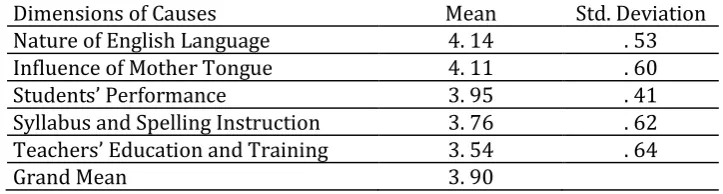
A questionnaire was distributed to English language teachers of grade ten in both North and South Batinah Governorates in order to find out teachers’ perceptions about the causes of the spelling errors for grade ten students. In SPSS, the total mean of all the statements have been calculated allowing the comparison between the means of the dimensions themselves. Table 1 shows the ranking order of the five dimensions of the different causes based on the total mean of all the statements in each dimension.
Table 1. Means and Standard Deviations of the Dimensions of the Causes for the Spelling Errors as Perceived by the Teachers
Dimensions of Causes Mean Std. Deviation Nature of English Language 4. 14 . 53 Influence of Mother Tongue 4. 11 . 60 Students’ Performance 3. 95 . 41 Syllabus and Spelling Instruction 3. 76 . 62 Teachers’ Education and Training 3. 54 . 64
Grand Mean 3. 90
A 5- point scale was used to compare between the means of the statements throughout the different sections of the questionnaire. The mean was considered very high if it ranged between 4. 5 and 5, high if it ranged between 3. 5 and 4. 4, moderate if it ranged between 2. 5 and 3. 4, low if it ranged between 1. 5 and 2. 4, and very low if it ranged between 1 and 1. 4.
Table 1 illustrates some important findings about the dimensions of spelling errors’ causes. First of all, the grand mean of all the mean of the dimensions was 3. 90 which is high. This draws a general picture of the perceptions of the teachers towards the causes given in the questionnaire. Secondly, all the causes are of high importance since the means ranged between 4. 14 and 3. 54. The nature of the English language is seen as the main cause for the spelling errors of the students. In a study conducted by Al-Jayousi (2011), the researcher categorized the spelling errors to their likely causes. He concluded that irregularity of the English spelling system accounted for the majority of the errors ranging from 58. 8% to 68. 7% of errors across all grades. Also, the teachers’ responses, in Al-Jayousi’s study, showed that the main cause of the students’ spelling problems was students’ carelessness and then came the irregularity of the English language and the linguistic differences between English and Arabic as the second and third reasons respectively
the interference of mother tongue and to the lack of correspondence between English sounds and letters. Vaddapalli (2012) stated that there were various reasons that caused students’ spelling errors. These reasons included, “English spelling system, Arabic phonology, lack of proper spelling instruction at schools and colleges, lack of motivation and seriousness among students, poor reading skills, poor listening skills” (p. 272). It becomes apparent that the teachers in the present study tend not to blame teachers’ education and training as the main reason for students’ spelling difficulties since this dimension came last among the five dimensions of the causes of students’ misspellings.
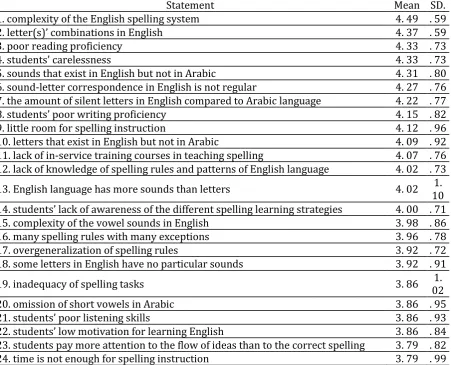
For specific details of each statement in the causes section of the questionnaire, table 2 shows the means and standard deviations of the causes of the spelling errors of grade ten in the order of level of agreement as perceived by the teachers.
It appears clearly, from table 2, that the English language teachers agreed to all the causes given in the questionnaire as the reasons for their students’ spelling problems. Teachers considered the complexity of the English spelling system as the main cause of students’ difficulties in English spelling. Also, the data obtained from the questionnaire showed that 30 causes were perceived of high importance.
Table 2. Means and Standard Deviations of the Causes of Spelling Errors as Perceived by the Teachers
Statement Mean SD.
1. complexity of the English spelling system 4. 49 . 59 2. letter(s)’ combinations in English 4. 37 . 59 3. poor reading proficiency 4. 33 . 73 4. students' carelessness 4. 33 . 73 5. sounds that exist in English but not in Arabic 4. 31 . 80 6. sound-letter correspondence in English is not regular 4. 27 . 76 7. the amount of silent letters in English compared to Arabic language 4. 22 . 77 8. students’ poor writing proficiency 4. 15 . 82 9. little room for spelling instruction 4. 12 . 96 10. letters that exist in English but not in Arabic 4. 09 . 92 11. lack of in-service training courses in teaching spelling 4. 07 . 76 12. lack of knowledge of spelling rules and patterns of English language 4. 02 . 73
13. English language has more sounds than letters 4. 02 1. 10 14. students’ lack of awareness of the different spelling learning strategies 4. 00 . 71 15. complexity of the vowel sounds in English 3. 98 . 86 16. many spelling rules with many exceptions 3. 96 . 78 17. overgeneralization of spelling rules 3. 92 . 72 18. some letters in English have no particular sounds 3. 92 . 91
19. inadequacy of spelling tasks 3. 86 02 1.
25. students’ different learning styles 3. 64 1. 00 26. lack of teachers' awareness of how to teach spelling 3. 63 . 93
27. spelling needs of students are ignored 3. 62 12 1.
28. lack of teachers' awareness of spelling rules and patterns 3. 62 . 87 29. lack of knowledge on how to correct mistakes indicated by teachers. 3. 59 . 91 30. lack of correction of spelling errors 3. 52 . 91
31. teachers' inability to develop appropriate spelling activities 3. 45 1. 05
32. inadequacy of time to practice spelling 3. 34 18 1.
33. applying methods that do not address students' spelling needs 3. 28 01 1.
34. teachers lack knowledge on how to deal with spelling errors 3. 16 04 1.
Note: See Appendix A for complete statements of questionnaire
On the other hand, the remaining three causes (items 20, 23 and 24 as ordered in the complete questionnaire) were considered of moderate effect on students’ spelling problem. Two causes out of the three were related to teachers’ education and training:
applying methods that do not address students' spelling needs, and teachers lack knowledge on how to deal with spelling errors.
Teachers’ responses to the items in the dimension of teachers’ education and training uncovered the fact that teachers do not want to take the responsibility for students’ spelling problems. This is quite normal since human nature tends to avoid blame and responsibility. Another possible reason might be the fact that teachers follow a syllabus designed by the Ministry of Education; thus, it is not the teachers who are responsible for the students’ poor spelling rather than it is the syllabus.
The statement ‘inadequacy of time to practice spelling’ was rated by the teachers as of moderate contribution to the causes of spelling errors. This statement is linked to students’ performance. Clearly, teachers want to indicate that students do have time to practice spelling but they might just be careless. This is supported by teachers’ responses to the statement ‘students' carelessness’ which came in fourth place of high importance among the causes of students’ misspellings. In a study conducted by Al-Jayousi (2011), the teachers’ responses showed that the main cause of the students’ spelling problems was students’ carelessness. Students’ carelessness can be explained in light of the level of importance students give to spelling among other language skills. Students might not see the importance of correct spelling when they write. Teachers’ perceived the statement ‘In writing tasks, misspellings can be attributed to the fact that students pay more attention to the flow of ideas than to the correct spelling’ of high importance, as a contributing cause to the spelling errors of grade ten students.
the first place’. Similarly, Al-Harrasi (2012) pointed out that lack of spelling correction leads learners to be careless about the accuracy of their spelling.
In the present study, three teachers only (3. 3% of the sample) took in-service training courses in spelling instruction. Also, teachers displayed high level of agreement that lack of in-service training courses specified for spelling instruction was one of the reasons for students’ spelling difficulties. Thus, teachers were unable to design activities that would probably improve students’ spelling proficiency due to their limited knowledge about the nature of English spelling and due to restraints of classroom time and the load of the syllabus. Consequently, students’ actual spelling needs were ignored. Comparably, the teachers in Al-Jayousi’s (2011) study raised some issues that affected the spelling instruction; teachers’ lack of in-service training courses in teaching spelling and the teachers appeared to have inadequate knowledge about the nature of English spelling and students’ spelling problems.
‘Inadequacy of spelling tasks’ was perceived by grade ten teachers as a major cause. Thus, students lack knowledge of many spelling rules and patterns of English. In support to this notion, Al-Harrasi (2012) stated that English for Me (EFM), which is the Omani national curriculum for teaching English for grades 1-10, “includes very few exercises related to spelling which are basically not enough for practice (and) it gives very limited emphasis on spelling rules” (p. 107).
Here, the statement ‘textbooks are overloaded’ was given a high level of agreement as a possible cause of students’ spelling problem. Similarly, teachers in Al-Jayousi’s (2011) study in UAE indicated that the textbooks were condensed with other language skills but they have inadequate spelling activities.
In the present study, teachers agreed that the amount of silent letters in English caused a problem for the learners. This is in agreement to Al-Jabri’s (2006) study in which the researcher found that silent letters were a problem for 76. 8% of the learners. Also, Al-Harrasi (2012) indicated that learners tended not to write silent letters in words like knife, ghost and sign and to omit one double letter from doubled consonants in words like successful and necessary.
Al-Jabri gave students a spelling test of ten words, a very small number of words to draw a conclusion from.
Grade ten teachers rated the causes; students’ poor reading proficiency, poor writing proficiency and poor listening skills as reasons of high contribution to the spelling problems. In support to this finding, Al-Jarf (2008), in her study of listening-spelling strategies among freshmen students, found that omission spelling errors constituted the largest category in the faulty graphemes. The researcher recommended giving direct spelling instruction and recommended that spelling be integrated within reading, listening and writing components of the English courses.
Other causes of the spelling errors as perceived by the teachers
The teachers participating in the present study responded to both the close-ended part of the questionnaire and to the open-ended part. Their responses to the open-ended question revealed other causes such as students do not care about memorizing words for spelling, grade ten textbooks focus on reading tasks with an obvious ignorance of spelling tasks, students do not study spelling at home and every year, students usually start from the basics and do not build upon what they have learned in previous years.
The second question: the remedies for the treatment of the spelling errors
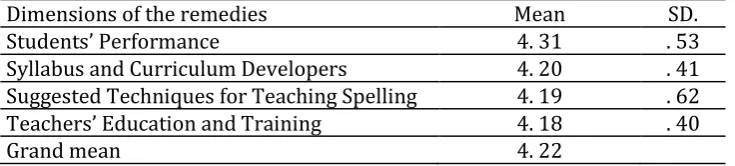
The teachers’ questionnaire included statements suggesting the possible remedies for the treatment of the spelling errors. Using SPSS, the total mean of each dimension was calculated by measuring the mean of all the means of all the statements under each dimension. This is to make it possible to compare between the total means of all the four dimensions. Table 3 shows the ranking order of the four dimensions.
Table 3. Means and Standard Deviations of the Dimensions of the Remedies for the Spelling Errors
Dimensions of the remedies Mean SD. Students’ Performance 4. 31 . 53 Syllabus and Curriculum Developers 4. 20 . 41 Suggested Techniques for Teaching Spelling 4. 19 . 62 Teachers’ Education and Training 4. 18 . 40
Grand mean 4. 22
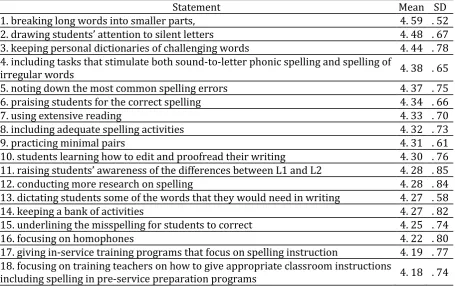
Table 4 shows that teachers held very high level of agreement to the statements ‘breaking long words into smaller parts’, and ‘drawing students' attention to silent letters’. Thus, they considered these two techniques highly effective for the treatment of spelling difficulties. Teachers rated the remaining 28 statements as being of high importance for the treatment of the spelling errors. Learning the origin of some English words was of the least important according to teachers’ perceptions.
Previous research work lend support to the findings of the present study. The analysis of teachers’ responses in the present study showed that many teachers agreed that the syllabus should include tasks that stimulate both sound-to-letter phonic spelling and spelling of irregular words (e. g. enough). Emery (2008) indicated that the curriculum should include tasks that can stimulate spelling by ear, sound to letter correspondences, and spelling by eye, spelling of irregular words. A similar notion was stressed by Al-Harrasi (2012) indicating that teaching spelling needs to combine both the auditory approach, for words that employ sound-to-letter mappings the visual approach for words with less regular spelling.
The teacher also rated the statement ‘It is important to include adequate spelling activities in the syllabus that respond to students’ spelling needs,’ as highly important. The literature supports this notion. Teachers interviewed in Al-Jayousi’s (2011) study stressed the importance of adding adequate spelling activities. Additionally, Al-Jayousi recommended conducting more research in order to assess learners’ current level at spelling and to identify their main spelling problems. This statement was ranked of high importance by grade ten teachers in the present study.
Table 4. Means and Standard Deviations of the Suggested Remedies for the Treatment of the Spelling Errors as Perceived by the Teachers
Statement Mean SD
1. breaking long words into smaller parts, 4. 59 . 52 2. drawing students’ attention to silent letters 4. 48 . 67 3. keeping personal dictionaries of challenging words 4. 44 . 78 4. including tasks that stimulate both sound-to-letter phonic spelling and spelling of
irregular words 4. 38 . 65
5. noting down the most common spelling errors 4. 37 . 75 6. praising students for the correct spelling 4. 34 . 66 7. using extensive reading 4. 33 . 70 8. including adequate spelling activities 4. 32 . 73 9. practicing minimal pairs 4. 31 . 61 10. students learning how to edit and proofread their writing 4. 30 . 76 11. raising students’ awareness of the differences between L1 and L2 4. 28 . 85 12. conducting more research on spelling 4. 28 . 84 13. dictating students some of the words that they would need in writing 4. 27 . 58 14. keeping a bank of activities 4. 27 . 82 15. underlining the misspelling for students to correct 4. 25 . 74 16. focusing on homophones 4. 22 . 80 17. giving in-service training programs that focus on spelling instruction 4. 19 . 77 18. focusing on training teachers on how to give appropriate classroom instructions
19. memorizing a list of words 4. 17 . 73 20. learning that English spelling system is manageable 4. 17 . 77 21. using color to highlight key features 4. 16 . 63 22. including reading aloud activities 4. 09 . 71 23. monitoring learners while practicing spelling 4. 08 . 82 24. knowing the roots and affixes of words and their meanings 4. 05 . 82 25. remembering the shape of some words 4. 04 . 88 26. teachers expanding their knowledge about the nature of English spelling 4. 03 . 87 27. giving direct spelling instruction 4. 03 . 75 28. including spelling rules and patterns that can apply to a big number of words 4. 01 . 67
29. using mnemonics 3. 73 . 96
30. learning the origin of some English words 3. 55 14 1.
Note: See Appendix A for complete statements of questionnaire
The teaching of spelling rules and patterns that can apply to a big number of words and have few exceptions was perceived by the teachers of high importance. One example is the effect of final silent (e) on the vowel in some words, e. g. rat vs. rate; tub vs. tube). Many researchers (Al-Harrasi 2012; Al-Jayousi, 2011; Field, 2009; Kharma&Hajjaj, 1997) expressed the importance of teaching some useful spelling rules that could apply to a large number of words.
Grade ten teachers highly agreed to the importance of giving direct spelling instruction for the sake of decreasing students’ spelling problems. Similarly, Peters (1985) indicated that giving direct spelling instruction is a determiner of progress in spelling. Peters also pointed out that reading only does not guarantee catching the internal structure of words; that is, good readers are not necessarily good spellers. However, teachers involved in the present study agreed that extensive reading can improve students’ spelling proficiency.
Teachers in the present study believed that raising students’ awareness of the differences between English and Arabic can be helpful in improving learners’ spelling. Likewise, Al-Jabri (2006) recommended that spelling should be taught systematically in which learners are shown the linguistic differences between English and Arabic spelling systems. Additionally, grade ten teachers, of the present study, agreed to the use of colors in order to make the troublesome parts of the word, like vowels, visually salient. Al-Harrasi (2012) and Stirling (2011) both proposed using color to highlight confusing vowels and some letter combinations like diagraphs, e. g. –ph.
Al-Harrasi (2012) listed some spelling teaching techniques in light of reviewing some researchers’ work. Examples of these techniques involved:
breaking long words into smaller parts to make it easier to learn and memorize, e. g. part-ic-ul-arly. In the present study, teachers rated the item ‘breaking long words into smaller parts’ of high importance for the treatment of spelling errors, making use of some mnemonics (memory tricks), e. g. a piece of pie, in order to
However, it came the second before the last among the other items. This might suggest that some teachers did not seem to approve of the effectiveness of mnemonics for facilitating the recall of some tricky words or it might also be that they did not really know many. Studying the effect of mnemonics on improving spelling proficiency is a possible area of research, and
learning affixation rules for word formation, e. g. interest, interesting, interestingly, uninteresting, etc. can help students spell more words correctly. The findings in the present study highlighted that knowing the roots and affixes of words and their meanings can help learners with their spelling.
Also, participating teachers in the current study believed in the role of reading aloud in developing learners’ spelling proficiency. Comparably, Al-Harrasi (2012) indicated that reading aloud can benefit learners in their spelling. She emphasized that reading aloud can help learners with ‘phonological obstacles’ as in spelling words with consonant clusters, e. g. children.
Grade ten teachers indicated high level of agreement to remembering the shape of some words. In his study, Al-Hassan (2006) indicated that showing students how a word shape can create a visual image is of good help in spelling. A similar idea was emphasized by Stirling (2011) who argued that the shape of the letters within the words can help students store the spelling of some words in memory and later recall the spelling when necessary. Also, monitoring learners while practicing spelling, and keeping personal dictionaries of challenging words were rated by the teachers of high importance and were supported by some previous studies, e. g. Chandler (2000).
Other suggestions for remedy of spelling errors as perceived by the teachers
Teachers’ responses to the open-ended question added the following ideas as suggestions for the remediation of the spelling errors:
1. Using pair spelling in which one student tests the spelling for the other partner. 2. Students need to hear the words from the teacher, then practice repeating them
until they memorize them.
3. Spelling must be part of students’ continuous assessment.
4. Teachers should specify 4 or 5 words from any reading text for each lesson for revision. Then, students use the words in full sentences.
5. Teachers can highlight the hard part of the word to focus on, e. g. enough. 6. Teachers can use the trace, copy and recall technique.
7. Teachers can use flashcards which can help students recognize the length of the word and its shape.
8. Students should be encouraged to use words in short phrases, e. g. enough food. 9. Curriculum developers should include more strategies for teaching spelling. 10. Students should be given spelling books that include clear spelling rules and
11. More in-service training courses are needed to be conducted not only for teaching spelling but also for all other language skills.
CONCLUSION
Learning a second language is a challenging process that involves making errors. Learners of English as a second language face difficulties with English spelling. Causes to these difficulties vary. Causes can entail the influence of mother tongue, the nature of the English language, teachers’ education and training, curriculum developers and learners’ performance. Therefore, being able to detect the precise causes of the spelling problem may contribute to its remediation.
In light of the findings of the present study, a number of recommendations are deemed to be important. Teachers need to be well trained to deal with students’ spelling difficulties. Therefore, curriculum developers in coordination with training and supervision departments can survey teachers’ training needs with respect to teaching and learning spelling. Then, in-service training needs that can correspond with students’ actual needs can be designed and implemented. Also, English language syllabus can include more effective spelling learning strategies for students to employ when learning spelling, another contribution of curriculum developers. In addition, reading-spelling, writing-spelling and listening-spelling links can be taken into consideration when developing spelling tasks. Another recommendation is that systematic teaching of spelling is fundamental. Thus, teachers need to follow a systematic approach to teaching spelling based on their students’ needs. Testing the effectiveness of a teaching approach or a teaching/learning strategy for spelling is also recommended in order to measure their effect on improving students’ spelling proficiency.
The present study sought teachers’ perceptions regarding the causes and remedies for the spelling problems. Exploring separately teachers’, senior teachers’ and supervisors’ perceptions about the same topic and then comparing whether there are any significant differences between the means of the perceptions may highlight an interesting dimension to spelling difficulties in an EFL context.
REFERENCES
Al-Breiki, S. (2014). Spelling errors of Omani grade ten EFL students: Types, cause and remedies. Unpublished master thesis. Sultan Qaboos University, Oman.
Al-Harrasi, K. (2012). The most common spelling errors among Omani learners. Arab World English Journal, 3(2), 96 –116.
Al-Jabri, F. (2006). Common English spelling difficulties of Omani learners. In S. Borg (Ed. ), Classroom Research in ELT in Oman (pp. 88-93). Sultanate of Oman: Ministry of Education.
Al-Jarf, R. (2008). Listening Spelling Strategies in EFL Arab College Students. Retrieved from http://repository. ksu. edu. sa/jspui/bitstream/123456789/7716/1/ Listening-spelling%20strategies%20in%20EFL%20Arab%20college%20students. pdf
Al-Jayousi, M. T. (2011). Spelling errors of Arab students: Types, causes and teachers' responses. Master Thesis. American University of Sharjah. Retrieved from https://dspace. aus. edu/xmlui/bitstream/handle/11073/2716/29. 232-2011. 09%20Mohannad%20Al%20Jayousi. pdf?sequence=1
Allaith, Z. A. & Joshi, R. M. (2011). Spelling performance of English consonants among students whose first language is Arabic. Reading and Writing, 24(9), 1089-1110. Al-Mezeini, H. (2009). Does teaching spelling rules make a difference?. In S. Borg (Ed.),
Understanding English Language Teaching and Learning in Oman (pp. 124-131). Sultanate of Oman: Ministry of Education.
Al-Yahyai, S. (2009). Spelling Difficulties in Grade 4. In S. Borg (Ed.), Understanding English Language Teaching and Learning in Oman (pp. 132-139 ) Sultanate of Oman: Ministry of Education.
Azzam, R. (1990). The nature of Arabic reading and spelling errors of young children: A descriptive study. PhD Thesis, Columbia University Teachers College.
Bahloul, M. , 2007. Spelling errors of Arab learners: Evidence of inter-graphic mapping. In: Combe, C. and Barlow L. , Eds. Language Teacher Research in The Middle East. Mattoon, Ill: United Graphics, inc. , (pp. 41-51).
Chandler, K. (2000). What I wish I'd known about teaching spelling, English Journal (online), 87-95. Retrieved from http://budden. wikispaces. com/file/view/Teaching+Spelling. pdf
Cook, V. (1997). L2 users and English spelling, Journal of Multilingual and Multicultural Development, 18(6), 474-488.
Corder, P. (1993). A role for the mother tongue. In Gass, M. S. &Selinker, L. (Eds. ),
Language transfer in language learning, (pp. 18-31). Philadelphia: John Benjamin Publishing Company.
Department of Education and Children’s Services. (2011). Spelling: From beginnings to proficiency. The State of South Australia.
Ehri, L. (1987). Learning to read and spell words. Journal of Reading Behaviour, 1, 5-31. Ehri, L. , Nunes, S. , Stahl, S. A. , & Willows, D. M. (2001). Systematic phonics instruction
helps students learn to read: Evidence from the National Reading Panel’s meta-analysis. Review of Educational Research, 71, 393 447. doi:10. 3102/00346543071003393
El-Dakhs, D. & Mitchell, A. (n. d. ). Spelling errors among EFL high-school graduate. Retrieved from http://www. ksaalt. org/conference%20proceedings/Spelling %20Errors%20among%20EFL%20High. pdf
Field, M. (2009). Improve your written English: Master the essentials of grammar, punctuation and spelling and write with greater confidence. Oxford: Spring Hill House.
Frith, U. (1979). Reading by eye and writing by ear. In Kolers, P. , Wrolstad, M. &Bouma, H. (Eds. ), Processing of Visible Language, vol. 1. (pp 379-390). Plenum Publishing Corporation.
Gentry, J. (2004). The science of spelling: The explicit specifics that make great readers and writers (and spellers). Portsmouth, NH: Heinemann.
Hammond, L. (2004). Getting the right balance: Effective classroom spelling instruction. Australian Journal of Learning Disabilities, 9(3), 11-18. doi: 10. 1080/19404150409546769
Ingebrand, S. (2013). Spelling as it Relates to Literacy: Reading, Writing and Language. Retrieved from ProQuest Digital Dissertations. (UMI 1539241)
Johnston, F. R. (2001). Exploring classroom teachers' spelling practices and beliefs. Reading Research and Instruction, 40, 143-156.
Kharma, N. &Hajjaj, A. (1997). Errors in English among Arabic speakers: Analysis and remedy. Beirut: Librairie du Liban.
Kohnen, S., Nickles, L. & Castles, A. (2009). Assessing spelling skills and strategies: Acritique of available resources, Australian Journal of Learning Difficulties, 14(1), 113-150. doi: 10. 1080/19404150902783450
Mahmoud, A. (2013). Spelling errors of Arab learners of EFL: A two-way analysis. TESOL Arabia Perspectives, 20(1), 6-12.
Merriam Webster. (2012). Merriam-Webster [mobile phone application], Inc.
McMurray, S. (2006). Learning to spell: Raising standards in spelling and independent writing. Support for learning, 21, 100-107.
Peters, M. L. (1985). Spelling caught or taught: A new Look. London: Routledge & Kegan Paul plc.
Randall, M. , &Meara, P. (1988). How Arabs read Roman letters. Reading in a Foreign Language,4(2), 133-145.
Ryan, A. , &Meara, P. (1991). The case of the invisible vowels: Arabic speakers reading English words. Reading in a Foreign Language, 2, 531-540.
Smedley, D. (1983). Teaching the basic skills: Spelling, pronunciation and grammar in secondary English. London, Methuen.
Smith, F. (1973). Decoding: The great fallacy. In F. Smith (Ed.), Psycholinguistics and Reading (pp. 70- 89). New York: Holt, Rinehart and Winston.
Spencer, K. (2000). Is English a dyslexic language? Dyslexia [Abstract], 6, 152–162. Stirling, J. (2011). Teaching spelling to English language learners. Raleigh, USA: LULU. Tavosanis, M. (2007). A causal classification of orthography errors in web texts.
Proceedings from AND 2007, 99–106. Retrieved from http://research. ihost. com/and2007/cd/Proceedings_files/p99. pdf
Vaddapalli, M. (2012). Spelling and auditory discrimination difficulties of students in Oman: An analysis. Language in India, 12(1), 261-276.
APPENDIX A
Teachers’ Questionnaire
Sultan Qaboos University
College of Education
A Questionnaire on the Spelling Errors of Omani Grade Ten EFL Students: Causes and Remedies
Dear English Language Teachers of Grade Ten Basic,
I am conducting a research study as part of my master degree. The major focus of my thesis is: Spelling Errors of Grade Ten Students: Types, Causes and Remedies. This research paper intends to survey teachers’ perceptions about two areas:
the causes of the spelling errors made by grade ten students some suggested remedies for the treatment of the spelling errors
You are kindly requested to complete the following questionnaire that has three sections. Data gathered by this questionnaire will be used for research purposes only. No identity of the individual respondents is required and your individual responses will be treated confidentially. Your cooperation is highly appreciated.
Section One: (General Personal Data) Gender:malefemale
Did you take any in-service training courses in spelling?
Yes………
……… (Please list them)
No
Section Two: Causes of Spelling Errors
The statements below represent the causes of the spelling errors divided under five different dimensions. Please tick the option that most accurately reflects your personal opinion. (SA= Strongly Agree, A=Agree, NC= Not Certain, D=Disagree, SD=Strongly Disagree).
No. Statement SA A NC D SD
First: The Influence of the Mother Tongue
1. Some letters of English do not exist in Arabic, for example, letter (p) and (v) which make it hard for the students to use them accurately.
No. Statement SA A NC D SD that contain these sounds (for example; Tchina or Shina for
China).
3. The fact that Arabic has a small number of silent letters compared with English makes students omit silent letters when writing (e. g. writing when as wen).
4 The fact that Arabic short vowels (diacritical marks;¯, _ۥ_, ___)
are traditionally omitted in writing can frequently lead Arab learners to inaccurately spell English words, for example, writing seven as svn.
Second: The Nature of the English Language
5. The complexity of the English spelling system causes spelling errors, e. g. words are not spelled the way they sound.
6. There are varying numbers of letter combinations in English for a single sound making it difficult to spell words correctly. (e. g. a /f/ sound can be spelled as (f), (ff), (gh) and (ph) . ) 7. Learning to spell is difficult because English language has
more sounds than letters (26 letters with 44 sounds).
8. The sound-letter correspondence in English is not regular. For example, a /k/ sound can be spelled as (c), (k), (ch) or (ck) and an (s) letter can be /s/ or /z/. This might cause difficulties for the learners in their spelling.
9. Students of English face difficulties in spelling because English spelling system has many rules with far many exceptions to these rules.
10. The complexity of the vowel sounds in English (12 vowels and 8 diphthongs with different letters representing them) is a problem for the students in their spelling.
11. Students find it difficult to spell words containing the letters (x), (c) and (q) because these letters have no particular sounds, but they take other sounds /eks/, /k/ or /s/ and /k/ respectively.
Third: Syllabus and Spelling Instruction
12. Spelling tasks in grade ten English syllabus are not adequate. 13. Textbooks are overloaded and they leave little space for
spelling instruction.
14. Some repeated spelling errors persist because they have not been corrected by the teacher in the first place.
15. The classroom instruction does not consider visual, auditory and kinesthetic learning styles.
16. Classroom time devoted to spelling instruction is not adequate.
17. Guidelines and textbooks of the MOE do not provide adequate spelling instruction, thus teachers ignore the spelling needs of their students.
Fourth: Teachers' Education and Training
18. Many teachers are not aware of how to teach spelling.
19. Many teachers might not be able to develop appropriate spelling activities that address their students' spelling needs. 20. Many teachers might be affected by the way they learned
English as students, so they tend to apply methods that do not address their students' spelling needs.
No. Statement SA A NC D SD 22. Teachers are not adequately aware of the various rules and
patterns that underlie the English spelling system.
23. The causes of students' spelling errors are not clear to teachers, so teachers lack the knowledge on how to deal with misspellings.
Fifth: Students' Performance
24. Students do not have enough time to practice spelling. 25. Students lack knowledge of the many spelling rules and
patterns of English language.
26. Students' carelessness is one cause of spelling errors.
27. Students overgeneralize spelling rules which leads to spelling errors.
28. In writing tasks, misspellings can be attributed to the fact that students pay more attention to the flow of ideas than to the correct spelling.
29. Students' poor reading proficiency contributes to poor spelling.
30. Students' poor writing proficiency can be one cause of students' misspellings.
31. Students' poor listening skills can be one cause of the spelling errors.
32. Students are not aware of the different strategies of learning spelling.
33. Poor spelling is a result of students' low level of motivation in learning English.
34. Students lack knowledge on how to correct mistakes indicated by their teachers.
Any other causes of misspellings not listed above, please write them below.
Section Three: Suggestions for Remedies
The statements below represent suggested remedies for the treatment of the spelling errors categorized under four dimensions. Please tick the option that most accurately reflects your personal opinion. (SA= Strongly Agree, A=Agree, NC= Not Certain,
D=Disagree, SD=Strongly Disagree).
No. Statement SA A NC D SD
First: Syllabus and Curriculum Developers
1. The syllabus should include tasks that stimulate both sound-to-letter phonic spelling and spelling of irregular words (e. g. enough).
2. Curriculum developers should add adequate activities that respond to students' spelling problems.
3. Direct spelling instruction may help learners decrease their spelling errors.
4. Extensive reading may help students develop good spelling skills.
No. Statement SA A NC D SD in some words, e. g. rat vs. rate; tub vs. tube. )
6. English syllabus should include reading aloud activities in order to check learners' decoding of letter-sound correspondences.
Second: Teachers' Education and Training
7. In-service training programs that focus on spelling instruction need to be developed to equip teachers with the skills they need to respond to their students' needs.
8. Research is needed to assess students' real current level in spelling and their main spelling problems. 9. Teachers need to expand their knowledge of the nature
of English spelling and spelling instruction by reviewing literature on spelling.
10. Pre-service teacher preparation programs need to focus on training teachers on how to give appropriate spelling instructions.
Third: Students' Performance
11. Leaners need to keep personal dictionaries of challenging words to be learned later on.
12. Learners should know that English spelling system is manageable. This can help them spell more words correctly.
13. Students should learn how to edit and proofread their writing.
Fourth: Suggested Techniques for Teaching Spelling
14. Using mnemonics can help in spelling difficult words like the word ' because' (Big Elephants Can't Always
Understand Small Elephants).
15. Breaking long words into smaller parts can help learners spell them correctly e. g. the word 'personally can be tracked back into person(noun),
personal(adjective), personally (adverb), allowing the learner to see the logic behind the double l.
16. Learning the origin of some English words helps in spelling, (e. g. the word ballet originates from French language. )
17. Memorizing a list of words each time may help students learn the spelling of words.
18. Practicing minimal pairs, e. g. take, bake, sake & fake, may help in improving students' spelling.
19. Dictating students some of the words that they would need in writing adds meaning to learning spelling. 20. Knowing the roots and affixes of words and their
meanings can help learners with their spelling.
No. Statement SA A NC D SD (e. g. tall or short letters) in spelling some words.
22. The use of color to highlight the key features such as short vowels can be helpful.
23. The teacher can focus on homophones like to/two/too, way/weigh in order to overcome some spelling difficulties.
24. The teacher can monitor learners while they are practicing spelling rather than correcting their work at the end.
25. The teacher can underline the misspellings and ask the students to correct them.
26 Teachers can note down the most common spelling errors across the class and work on them in subsequent lessons.
27. Teachers can praise the students for the correct spelling of difficult words or words that they have previously misspelled.
28. Keeping a bank of activities for the most common spelling errors may assist teachers in giving individual practice activities that deal with the spelling errors. 29. It is important to draw students' attention to silent
letters.
30. It is useful to raise students' awareness of the differences between the writing systems of Arabic and English.
Any other suggestions for remedies not listed above. Please write them below.
End of Questionnaire