Issues
ISSN: 2146-4138
available at http: www.econjournals.com
International Journal of Economics and Financial Issues, 2016, 6(4), 1632-1636.
Investment in Information and Communication Technology in
Developing Countries: The Effect of Foreign Direct Investment:
Evidences from Sultanate of Oman
Mansour Naser Alraja
1*, Samir Hammami
2, Hazem Mohammed Al Samman
31Department of Management Information Systems, College of Commerce and Business Administration, Dhofar University, Salalah,
Sultanate of Oman, 2Department of Management Information Systems, College of Commerce and Business Administration,
Dhofar University, Salalah, Sultanate of Oman, 3Department of Accounting and Finance, College of Commerce and Business
Administration, Dhofar University, Salalah, Sultanate of Oman. *Email: [email protected]
ABSTRACT
Foreign direct investment (FDI) is a crucial tool developing the economy of any country if it is employed in a proper manner. Moreover, FDI has many effects; and one of them is thriving the information and communication technology (ICT) sector as a pivotal sector which includes four sub-sectors according to the World Bank (ICT service exports, ICT goods imports, high-technology exports and ICT goods exports). Hence, the aim of this
paper is to identify the influence of FDI in thriving the sub-sectors of ICT, as one of the drivers to develop the economy. To accomplish this purpose the statistical data on direct foreign investment and exports and imports of ICT about Sultanate of Oman were collected from 2000-2014 published
by the World Bank. Descriptive statistics and simple regression model were used to analyze the collected data and test the hypotheses of the study.
The findings show that the planning for FDI is ad-hoc, therefore there should be a obvious view of how to exploit FDI in economy development, especially in transferring of ICT. The paper contributed to the literature by being the first study that attempted to interpret the role of FDI on exports
and imports of ICT in Sultanate of Oman.
Keywords: Foreign Direct Investment, Information and Communication Technology, High-technology Exports, Information and Communication Technology Goods, Information and Communication Technology Service Exports, Information and Communication Technology Goods Imports, Oman
JEL Classifications: F14, N8
1. INTRODUCTION
Initially, refers to the flow of capital to the host country. Foreign direct investment (FDI) considered as cross-borders investment made by the direct investor which have significant control on the management, with a goal of establishing a sustainable enterprise (World-Bank, 2016; OECD, 2008). To determine if the relationship of direct investment is existed the ownership criterion is used for this purpose. According to the said criterion, the ownership in the enterprise should be at least 10% or more of the voting stock (World-Bank, 2016). FDI is considered as an arguable issue which is promoted by the World Bank and international monetary fund (IMF) as an indicator for good investment (Farrell, 2004), it is reflected as a method of capital inflows for developing countries.
It directly contributes to capital stocks to achieve growth through different channels (Gulde et al., 2000).
on direct foreign investment and Omani IT exports and imports were collected from 2000 to 2014. Both descriptive statistics and Simple regression model were used to analyze the data and test the hypotheses of the study. The dependent variable is the FDI, and the independent variables are: High-technology exports, ICT goods exports, ICT goods imports and ICT service exports which are classified according to the World Bank.
We organized the remainder of this paper as follows: In section 2, we present the literature review. In section 3, we suggest our hypotheses. In section 4, we point out the research model. In section 5, we present the research methodology and data gathering. In section 6, we analyze the data using descriptive analysis, and simple regression test, and we discuss the impacts of independent variable (FDI) on the independent variables. In section 7, we report the limitations existed during research preparation. In section 8, we conclude the paper with major conclusions of our study.
2. LITERATURE REVIEW
In the era that we are living, FDI considered as a vital factor for the economic growth of countries, particularly of developing countries, that’s for many reasons including but not limited to transfer of capital and technology (Srinivasan et al., 2011). Many studies in economic literature has analyzed the relationship between FDI and economic growth (Srinivasan et al., 2011; Alam, 2013; Chaudhry et al., 2013; Mishal and Abulaila, 2007). In general, FDI lead to capital density which it has an effect on labor productivity growth (Vukšić, 2016), this result agreed with the report findings of IMF prepared for Croatia (IMF, 2012). From total productivity perspective, the study of (Demir and Su, 2016) indicated that foreign investors face higher entry barriers, and they respond strongly to total productivity levels in the past. The estimation results using generalized method of moments in china show that the inflow of FDI, lead to worsen the income inequality, and there was non-linear effect of the inflow of FDI on income inequality (Mah, 2015). Moreover, FDI affected negatively in manufacturing sector regarding to labor costs and skills. While it was affected relatively in services sector (Brandl et al., 2013). From the firm perspective the decision to go to make investments or not outside is a controversial decision. Meanwhile, those firms should take in consider the risks and benefits. Thereby the decision of accepting or rejecting FDI must be taken on the basis of short and long term macroeconomic variables and environmental factors. in the study of (Cambazoğlu and Güneş, 2016) they found that foreign exchange levels was significantly affected by direct investment inflows in long term. in the study where many factors investigated, there were positive effect of FDI in GDP, but the negative effect was in real exchange rates, foreign trade deficit, and labor costs (Yaprakli, 2006). In the context of this study FDI has a strong influence on the economic growth of the developing country (Volos et al., 2015).
Concerning to ICT it had been studied from different perspectives such as information technology adoption, use, diffusion, maturity (Gault and Peterson, 2003; Karahanna et al., 1999; Corrales and Westhoff, 2006; Alraja, 2015; Eadie et al., 2012; Hammami et al., 2015; Husain and Nazim, 2015). In different fields like
e-government, e-business, e-learning, and e-commerce (Alraja and Malkawi, 2015; Alraja and Mohammed, 2015; Alraja et al., 2015; Uddin et al., 2016).
In the context of FDI and information technology together (Figini and Görg, 2011; Figini and Görg, 1999) they suggest that over the time when unskilled workers become more qualified in using technology, so in the long run their wages level will increase, therefore the income inequality will be worsen with the inflow of FDI, but as time passes it would be improved. Another study composed of two countries having strong economic relationship one of them industrialized and technologically advanced which is the source of FDI, the second is the host country, which is developing and heavily dependent on the source. However, other studies tried to find the effect of FDI on technology investment or technology transferring. Further, investing in ICT through FDI is revived innovative capabilities of host countries (Leitão and Baptista, 2011). Furthermore, (Xu and Sheng, 2012) found that FDI helping in technology diffusion which it affects productivity growth. Regarding to (Tahat and Whelan, 2014) study which applied in GCC, indicated that the contribution level of FDI in technology diffusion is a worthy debate issue.
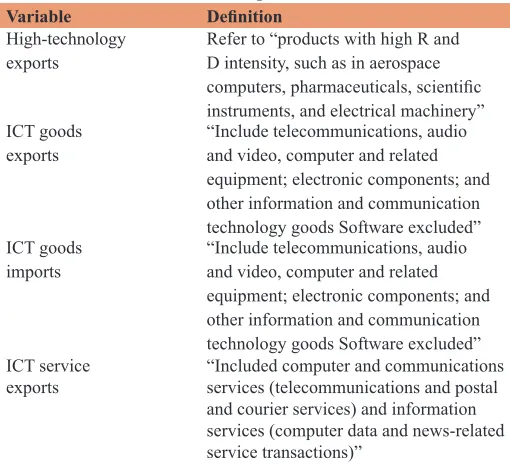
Relying on above mentioned literature, we will point out that if the FDI has an effect on the diffusion of ICT. Therefore, in our study we will focus on four variables are: High-technology exports, ICT goods exports, ICT goods imports, and ICT service exports. According to word bank those variables are defined as shown Table 1.
3. RESEARCH HYPOTHESES
Relying on the adopted constructs the researchers proposed the following hypotheses:
H1: High level of FDI has positive effect on High-technology exports.
Table 1: The definition of adopted variables
Variable Definition
High-technology
exports Refer to “products with high R and D intensity, such as in aerospace
computers, pharmaceuticals, scientific
instruments, and electrical machinery” ICT goods
exports “Include telecommunications, audio and video, computer and related
equipment; electronic components; and
other information and communication technology goods Software excluded” ICT goods
imports “Include telecommunications, audio and video, computer and related
equipment; electronic components; and
other information and communication technology goods Software excluded” ICT service
H2: High level of FDI has positive effect on ICT goods exports.
H3: High level of FDI has positive effect on ICT goods imports.
H4: High level of FDI has positive effect on ICT service exports.
4. RESEARCH MODEL
According to literature review and to the available statistics of the World Bank, the researches proposed the following research model that reflects the above hypotheses.
5. RESEARCH METHODOLOGY AND DATA
GATHERING
This paper explores the relationship between FDI and the IT exports and imports of Oman. In order to test the research hypotheses and reach the research goals; data was obtainedfromthe statistical data published by World Bank 2016.
Based on an extensive review of literature, data includes; statistical data about Oman on direct foreign investment and Omani IT exports were collected from 2000 to 2014.
Descriptive statistics for each of the study variables are provided in Table 2 the authors present the means for the sample of domestic firms, standard deviation, median, minimum and maximum.
Simple regression model is used to analyze the data andtest the hypotheses of the study. The dependent variable is the FDI, and the independent variables are: High-technology exports, ICT goods exports, ICT goods imports and ICT service exports which are classified according to the World Bank.
6. DATA ANALYSIS
As it is mentioned the methodology the collected data will be analyzed using descriptive analysis, and simple regression test.
6.1. Descriptive Analysis
From the table above we can see that mean for high-technology exports, ICT goods imports, ICT service exports and ICT goods exports 2.07, 3.4, 24.12 and 0.272 respectively. While the value of standard deviation of the variables are 1.74, 1.014, 7.84 and 0.15 respectively which can be interpreted that ICT service exports has the highest variations among study variables within the study period from 2000 until 2014.
6.2. Regression Analysis and Hypothesis Testing
Table 3 provides the results of regression analysis of the effect of FDI on high technology exports, the results show that beta value is −9.318 at 5% significant level which means there is a negative statistically effect for of FDI in sultanate of Oman on high technology exports. The value of R2 indicates that 30.2%
in high technology exports variation explained by this model, Also the value of Ftest is significant at 5% level which can be interpreted that the R2 value is significantly explained 30.2%.
Therefore, we reject the first hypothesis that says that high level of FDI has positive effect on High-technology exports, so it can be concluded that no existence of any relationship is and ad-hoc planning is the cause of these results.
Table 4 shows the results of regression analysis for effect of FDI on ICT goods exports, thevalue of beta is −7.17 at 10% significant level which means there is a negative statistically effect for of FDI in sultanate of Oman on ICT goods exports. The R2 value indicates
that 22.8% in ICT goods exportsvariation explained by this model, likewise, the value of Ftest is significant at 10% level which can be interpreted that the R2 value is significantly explained 22.8%.
Therefore, we reject the second hypothesis that says that high level of FDI has positive effect on ICT goods exports, so it can be concluded that no existence of any relationship is and ad-hoc planning is the cause of these results.
Table 5 displays regression results for effect of FDI on high technology exports, the beta value is −5.98 at 5% significant level which concludes there is a negative statistically effect for of FDI in sultanate of Oman on ICT goods imports. The value of R2
determine that 36.8% in ICT goods imports variation explained by FDI, in addition to that, the value of F test is significant at 1% level which can be interpreted that the R2 value is significantly
explained 36.8%. Consequently, we reject the third Hypothesis that says that High level of FDI has positive effect on ICT goods imports, so it can be concluded that no existence of any relationship is and ad-hoc planning is the cause of these results.
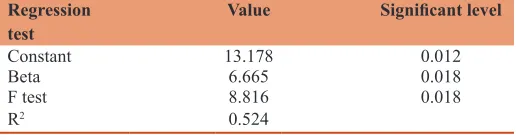
The results of regression analysis for effect of FDI on ICT service exports are listed in the Table 6, the results show that beta value is 6.65 at 5% significant level So, we can say that there is a positive statistically effect for of FDI in sultanate of Oman on ICT service exports. On the other hand, The R2 value determines that 52.4% in
ICT service exportsvariation explained by change in FDI, Also the value of Ftest is significant at 5% level which can be interpreted that the R-squared value is significantly explained 36.8%. So, we accept the forth hypothesis that says that High level of FDI has positive effect on ICT service exports, and this is the only
Table 2: The results of descriptive statistics of the study variables
Descriptive
statistics FDI High-technology exports ICT goods imports ICT service exports ICT goods exports
Mean 1,117,188,538.494 2.079836 3.419202 24.124702 0.272773
Median 1,039,791,937.99 2.167211 3.010750 22.271967 0.273734
SD 1,029,108,862.322 1.7461475 1.0147710 7.8448530 0.1592491
Minimum 5,201,560.4680 0.2754 2.1634 15.2412 0.0858
Maximum 3,332,119,636.00 5.7428 5.0629 38.0216 0.6011
positive conclusion of the listed above and one of the examples of this is Omantel that is exporting its services to several parties outside Oman.
ICT service exports= 13.178+6.665* FDI.
7. LIMITATIONS
Several limitations were existed during this study, firstly; there are no official statistics available according to the classifications of the World Bank and the only source of statistics is the World Bank. Secondly; the researchers faced lack of updated or historical statistics as there is no available statistics (before 2000 or after 2014) during conducting this study. Thirdly; the study was applied only in Oman and it should empirically be being applied also on different developing countries in several continents in Asia, South of America and Africa.
8. CONCLUSIONS
This study empirically examines the effect of FDI in ICT in Sultanate of Oman from 2000 to 2014 by using simple regression analysis mode. The results show that FDI does not have effect
on the high-technology exports, and ICT goods exports Which indicates that ICT sector in sultanate of Oman has not mature enough to attract the inflow of FDI all by itself. Also the results show that FDI does not have effect on the ICT goods imports which can be interpreted that FDI has not played important role in developing the technology infrastructure in sultanate of Oman which contribute later on in developing the country and increasing economic growth. On other hand the study finds a positive and significant effect of FDI on ICT service exports which indicates the FDI has played small role in improving technology infrastructure of sultanate of Oman by conducting the investments in ICT services sector that plays role in economic growth on long term and contributes in encouraging the investments in sultanate of Oman, Therefore, the study concludes that there is ad hoc planning for FDI planning in ICT.
REFERENCES
Alam, A. (2013), Electric power consumption, foreign direct investment
and economic growth: A comparative study of India and Pakistan. World Journal of Science, Technology and Sustainable Development,
10(1), 55-65.
Alraja, M.N. (2015), User acceptance of information technology: A field
study of an e-mail system adoption from the individual students’ perspective. Mediterranean Journal of Social Sciences, 6(6S1), 19-25.
Alraja, M.N., Hammami, S., Alhousary, T. (2015), Factors affecting
e-government services adoption: Field study. Journal of Theoretical and Applied Information Technology, 79(1), 65-69.
Alraja, M.N., Malkawi, N. (2015), E-business adoption in banking
sector: Empirical study. Indian Journal of Science and Technology, 8(27), 1-5.
Alraja, M.N., Mohammed, A. (2015), Customer acceptance of
e-commerce: Integrating perceived risk with TAM. International Journal of Applied Business and Economic Research, 13(2), 913-921. Blomström, M., Sjöholm, F. (1999), Technology transfer and spillovers:
Does local participation with multinationals matter? European Economic Review, 43(4), 915-923.
Brandl, B., Strohmer, S., Traxler, F. (2013), Foreign direct investment, labour relations and sector effects: US investment outflows to Europe.
The International Journal of Human Resource Management, 34(17),
3281-3304.
Cambazoğlu, B., Güneş, S. (2016), The relationship between foreign
exchange rate and foreign direct investment in Turkey. Economics, Management, and Financial Markets, 11(1), 284-293.
Campos, N., Kinoshita, Y. (2002), Foreign direct investment as technology
transferred: Some panel evidence from the transition economies. The
Manchester School, 70(3), 398-419.
Chaudhry, N.I., Mehmood, A., Mehmood, M.S. (2013), Empirical
relationship between foreign direct investment and economic growth: An ARDL co-integration approach for China. China Finance Review International, 3(1), 26-41.
Corrales, J., Westhoff, F. (2006), Information technology adoption and political regimes. International Studies Quarterly, 50(4), 911-933. Demir, F., Su, L. (2016), Total factor productivity, foreign direct
investment, and entry barriers in the Chinese automotive industry.
Emerging Markets Finance and Trade, 52(2), 302-321.
Eadie, R., Perera, S., Heaney, G. (2012), Capturing maturity of ICT
applications in construction processes. Journal of Financial Management of Property and Construction, 17(2), 176-194.
Farrell, D. (2004), The case for globalization the results of McKinsey’s
Table 3: Regression results between foreign direct investment and high technology exports
Regression test Value Significant level
Constant 3.121 0
Beta −9.318 0.034
F test 5.612 0.034
R2 0.302
Table 4: Regression results between foreign direct investment and ICT goods exports
Regression test Value Significant level
Constant 0.335 0
Beta −7.17 0.084
F test 3.551 0.084
R2 0.228
ICT: Information and communication technology
Table 5: Regression results between foreign direct investment and ICT goods imports
Regression test Value Significant level
Constant 4.087 0
Beta −5.98 0.017
F test 7.557 0.017
R2 0.368
ICT: Information and communication technology
Table 6: Regression results between foreign direct investment and ICT service exports
Regression
test Value Significant level
Constant 13.178 0.012
Beta 6.665 0.018
F test 8.816 0.018
R2 0.524
latest study of the pros and cons of emerging market foreign investment. International Economy, 18(1), 52-55.
Figini, P., Görg, H. (1999), Multinational companies and wage inequality
in the host country: The case of Ireland. Weltwirtschaftliches Archive, 135(4), 594-612.
Figini, P., Görg, H. (2011), Does foreign direct investment affect wage inequality? An empirical investigation. The World Economy, 34(9),
1455-1475.
Gault, F., Peterson, G. (2003), Measuring the diffusion of information
and communication technology in society and its effects: Canadian experience. International Statistical Review, 71(1), 49-57.
Gulde, M., Kähkönen, M., Keller, M. (2000), Pros and Cons of
Currency Board Arrangements in the Lead-up to EU Accession and
Participation in the Euro Zone (No. 0-1). International Monetary
Fund.
Hammami, S., Alraja, A.N., Jamil, S. (2015), The role of it in enhancing
productivity at higher education institutions from staff and students’ perspective-evidence from Oman. Journal of Theoretical and Applied
Information Technology, 80(3), 464-472.
Husain, S., Nazim, M. (2015), Use of different information and
communication technologies in Indian academic libraries. Library Review, 64(1-2), 135-153.
IMF. (2012), Republic of Croatia: Selected Issues. Washington, D.C:
International Monetary Fund.
Karahanna, E., Straub, D.W., Chervany, N.L. (1999), Information technology adoption across time: A cross-sectional comparison of pre-adoption and post-pre-adoption beliefs. MIS Quarterly, 23(2), 183-213.
Leitão, J., Baptista, R. (2011), Inward FDI and ICT: Are they a joint
technological driver of entrepreneurship? International Journal of
Technology Transfer and Commercialisation, 10(3-4), 268-288. Mah, J.S. (2015), The effect of foreign direct investment inflows on
income inequality: Evidence from China. Global Economy Journal,
15(4), 443-453.
Mishal, Z., Abulaila, Z. (2007), The impact of foreign direct investment
and imports on economic growth: The case of Jordan. Journal of Economic and Administrative Sciences, 23(1), 1-31.
OECD. (2008), OECD Benchmark Definition of Foreign Direct
Investment. Paris: OECD.
Srinivasan, P., Kalaivani, M., Ibrahim, P. (2011), An empirical
investigation of foreign direct investment and economic growth in SAARC nations. Journal of Asia Business Studies, 5(2), 232-248.
Tahat, K., Whelan, S. (2014), A Research Proposal for Investigating
the Effect of Foreign Direct Investments on Technology Transfer in the Arabian Gulf (GCC). International Conference of Integrated
Information (IC-ININFO 2014). Madrid, Spain: AIP Conference Proceedings 1644, 193(2015). p193-198.
Uddin, M.A., Ahmar, F., Alraja, M.N. (2016), E-examinations for
management students in Oman. International Journal of Applied Business and Economic Research, 14(1), 87-95.
Volos, C.K., Kyprianidis, I.M., Stouboulos, I.N. (2015), The effect of
foreign direct investment in economic growth from the perspective of nonlinear dynamics. Journal of Engineering Science and Technology Review, 8(1), 1-7.
Vukšić, G. (2016), Effects of private ownership, trade, and foreign direct
investment on labor productivity growth in transition economies: Evidence from the Croatian manufacturing industry. Emerging Markets Finance and Trade, 52(2), 322-335.
World-Bank. (2016), Data. World Bank. Retrieved from The World Bank.
Available from: http://www.data.worldbank.org/.
Xu, X., Sheng, Y. (2012), Productivity spillovers from foreign direct
investment: Firm-level evidence from China. World Development,
40(1), 62-74.
Yaprakli, S. (2006), Türkiye’de doðrudan yabancý yatýrýmlarýn ekonomik belirleyicileri üzerine ekonometrik bir analiz (an