ISSN: 2286-2668 © College of Management (NUPSPA) & Tritonic Books
Emotional Knowledge: the Hidden Part
of the Knowledge Iceberg
Constantin BRĂTIANU Faculty of Business Administration Bucharest University of Economic Studies 2-2A Calea Grivitei, sector 3, 010731, Bucharest, Romania
Ivona ORZEA Faculty of Business Administration Bucharest University of Economic Studies 2-2A Calea Grivitei, sector 3, 010731, Bucharest, Romania
Abstract. According to Daniel Kahneman (2011), our thinking process is based on two sys-tems: system 1 operates automatically and quickly, with little awareness of voluntary control, system2 operates slowly and constructs thoughts in a logic order. System 1 processes actually emotional knowledge using our unconscious cognitive capability. Cognitive scientists dis-covered that we are primarily emotional decision makers, which means that managers and leaders need to rely on their emotional knowledge. The purpose of this paper is to present a qualitative and quantitative research concerning the paradox of emotional knowledge. That means that on one hand most of us ignore emotional knowledge by identifying knowledge with cognitive knowledge, and on the other hand by using emotional knowledge in decision making. The qualitative research has been done by reflecting on knowledge management, strategic management and change management literature concerning emotional knowledge and emotional intelligence, while the quantitative research has been done by conceiving a questionnaire and using it in an academic environment. A total of 1200 questionnaires were distributed to the students of Bucharest University of Economic Studies, and we got a response rate of 37%. Each questionnaire contains 40 questions concerning the awareness, education, transfer, and management of emotional knowledge. The data has been processed with the help of the specialized software SPSS version 19, and AMOS version 18. Statisti-cal analysis includes both exploratory and confirmatory factorial analysis. The results of the statistical analysis reveal the main influence factors affecting our understanding of emotional knowledge, the way we learn through education about emotional knowledge, the way this knowledge is transferred, and the importance of using it by managers and leaders.
Introduction
It is well known the metaphor of the knowledge iceberg: knowledge may be conceived as an iceberg whose visible part represents explicit knowledge, and the hidden part representing tacit knowledge. The hidden part is much larger than the visible part of the iceberg, fact that reflects the ratio between the tacit knowledge and explicit knowledge. As Polanyi used to say, we may know much more than we can tell. “I shall reconsider human knowledge by starting from the fact that we can know more than we can tell. This fact seems obvious enough; but it is not easy to say exactly what it means. Take an example. We know a person’s face, and can recognize it among a thousand, indeed among a million. Yet we usually cannot tell how we recognize a face we know. So most of this knowledge cannot be put into words” (Polanyi, 1983, p.4). However, tacit knowledge is a fuzzy concept containing a mixture of experience, subjective insights, intuitions, hunches, ideals, values, and emotions. In order to make a step forward in understanding knowledge nature we may change the old dyad of explicit knowledge-tacit knowledge (Nonaka, 1994; Nonaka & Takeuchi, 1995) into a new dyad composed of cognitive knowledge-emotional knowl-edge (Brătianu & Andriessen, 2008; Brătianu, 2011).
The purpose of this paper is to present a qualitative and quantitative re-search concerning the paradox of emotional knowledge. That means that on one hand most of us ignore emotional knowledge by identifying knowledge with cognitive knowledge, and on the other hand by using emotional knowl-edge together with cognitive knowlknowl-edge in decision making. The qualitative research has been done by reflecting on knowledge management, strategic management and change management concerning emotional knowledge and emotional intelligence, while the quantitative research has been done by conceiving a questionnaire and using it in an academic environment. This research has been stimulated by the following questions: (a) How much are students aware of the importance played by emotional knowledge in decision making and business? (b) What are the specific ways of transferring tional knowledge? (c) How much education helped them to understand emo-tions and emotional knowledge? and (d) How important is to use efficiently emotional knowledge?
Emotional knowledge
Nonaka and Takeuchi consider tacit knowledge the hidden part of the iceberg, and that emotional knowledge is an important part of it. Subjective insights and intuitions belong to this category of emotional knowledge (Nonaka & Takeuchi, 1995). Emotional knowledge is created by emotions, and integrat-ed together with cognitive knowlintegrat-edge into our mental representation of the world. Emotions can be simply described as being specific reactions to events, agents and their actions, and objects (O’Rorke & Ortony, 1994). Moreover, emotion is fundamental in decision making, being like a spectrum of know-how that allows people to have adequate reactions to different external forces. Emotions contain emotional knowledge generated by emotional triggers (Im-mordino-Yang & Damasio, 2007).
cogni-tive knowledge, and it is generated in the rationality domain; (2) thoughts and ideas are different entities and there is no interaction between them; (c) thoughts and ideas reflect same complex reality and they interact in the deci-sion making.
Based on the metaphor of thermodynamics, especially on the transformation between mechanical energy and thermal energy, Bratianu makes a step for-ward and advances the idea of a continuous dynamics between the cognitive knowledge and emotional knowledge (Brătianu, 2011). That means that cog-nitive knowledge can be transformed into emotional knowledge, and emo-tional knowledge can be transformed into cognitive knowledge, respectively. This dynamics represents actually the engine of the decision making, powered by the two systems of thinking, as shown by Kahneman (2011, p.21): “System 1 operates automatically and quickly, with little or no effort and no sense of voluntary control. System 2 allocates attention to the effortful mental activities that demand it, including complex computations. The operations of System 2 are often associated with the subjective experience of agency, choice, and concentra-tion”. Knowledge dynamics is important also for the way we are aware of our emotions and we manage them in our personal and professional life (Fenton-O’Creevy et al., 2011; Koole, 2009; Lagattuta & Wellman, 2001; Lindquist & Barrett, 2008; Miller et al., 2005; Reus & Liu, 2004). Understanding and using efficiently emotional knowledge is an important capability of managers and leaders (Bass & Riggio, 2006; Daft, 2008; Ekman, 2003; Hess & Bacigalupo, 2010; Jordan et al., 2013; Madden et al., 2012; Miller et al., 2012; Nag & Gioia, 2012). Although Kotter (2012) is discussing the dual management system, his argument for using emotions in decision making may be considered as a ge-neric one. Emotional knowledge is also essential in complex organizational processes like strategies implementation through change management (Kot-ter, 1996; Mohrman & Lawler, 2012; Rafferty et al., 2013). Our qualitative re-search leads to a challenging result: the existence of knowledge dynamics, as a continuous transformation process of cognitive knowledge into emotional knowledge, and vice versa.
Research methodology
The instrument used in our research was the questionnaire. The design and elaboration of this questionnaire to collect the quantitative data went through four phases: (1) literature analysis; (2) elaboration of the first draft of the ques-tionnaire; (3) testing the questionnaire, and (4) improving its content, and elaboration of the final version. Literature analysis helped us to understand different perspectives in interpreting emotional knowledge, and the way we learn and use this kind of knowledge. The main ideas of this research we have presented in the first part of this paper. In the second phase we design the ba-sic structure of the questionnaire, considering four main pillars: awareness of emotional knowledge, the specific way of transferring emotional knowledge, education for emotional knowledge and using emotional knowledge. We de-signed the first draft of the questionnaire with 40 questions able to capture the respondents views concerning emotional knowledge as the hidden part of the knowledge iceberg. This first draft of the questionnaire was tested within a group of experts in knowledge management. The testing phase had as the main purpose the evaluation of the accuracy of the questions used and pos-sible suggestions for improving the questionnaire. Based on the received sug-gestions we elaborated the final version of the questionnaire. The first part of the questionnaire contains items to describe the general profile of the respon-dents (age, gender, and level of education). The second part contains 40 asser-tions aiming at measuring respondent’s agreement level with each of them us-ing a Likert scale with five divisions: 1 (strongly disagree), 2 (disagree), 3 (nei-ther agree nor disagree), 4 (agree), and 5 (strongly agree). For our research we considered the academic environment, and we distributed by mail 1200 questionnaires to undergraduate and graduate students from the Bucharest University of Economic Studies, from all its 11 faculties. The rate of response was of 37%, resulting in 444 valid questionnaires, which means a sufficiently large volume of data to obtain relevant results. The results obtained through the data collection process were analyzed using the specialized statistical soft-ware SPSS version 19, and AMOS version 18.
Results analysis and discussions
have; (2) how much do they know about the specific way of transferring emo-tional knowledge; (3) how much they learned about emoemo-tional knowledge in schools, as a direct result of school’s curriculum, and (4) how much do they know about knowledge dynamics and the importance of emotional knowl-edge in decision making. We have chosen as methods of analysis exploratory factorial analysis and confirmatory factorial analysis. Exploratory factorial analysis has the role of underlining the factors that could be identified from the sentences under analysis. Furthermore, to validate the exploratory facto-rial analysis and to obtain an exact measure of the processes of learning and using in business emotional knowledge a confirmatory factorial analysis was undergone.
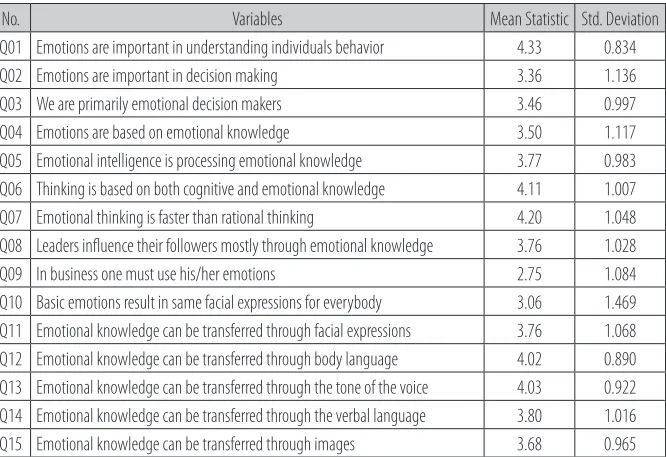
The structure of the statistical population we investigated can be characterized by the followings: 81.56% undergraduate students with ages belonging to the interval of 19-23 years old, and 18.44% graduate students with ages belonging to the interval of 24-30 years old. This composition reflects the general struc-ture of the undergraduate and graduate programs offered by our university. Among all the respondents, 63% are young ladies and 37% are young men. Some significant results from the descriptive statistics are presented in Table 1. For all the 40 variables the minimum value is 1, and the maximum value is 5.
Table 1. Descriptive statistics
No. Variables Mean Statistic Std. Deviation
No. Variables Mean Statistic Std. Deviation Q16 Emotional knowledge can be transferred through dancing 3.64 1.056 Q17 Emotional knowledge can be transferred through music 3.93 0.972 Q18 Emotional knowledge can be transferred through touching 3.77 1.049 Q19 Most of our communication is done through emotional knowledge 3.50 0.918
Q20 Communicating emotional knowledge depends on the context much more than communicating cognitive knowledge 3.55 0.957
Q21 We learn about emotional knowledge in family 3.86 0.974 Q22 We learn about emotional knowledge in primary and secondary schools 2.95 1.152 Q23 We learn about emotional knowledge in high schools 3.11 1.175 Q24 We learn about emotional knowledge in university 3.00 1.216 Q25 We learn about emotional knowledge directly from our own experience 4.58 0.758
Q26 We learn in schools and university how to understand, and to manage emotional knowledge 2.66 1.215
Q27 We learn in schools and university how to communicate efficiently our emotional knowledge 2.74 1.196
Q28 We had in schools and university special courses about emotions and emotional knowledge 2.38 1.323
Q29 We can understand other people emotions only if we understand our own emotions 3.91 1.093
Q30 Education in schools and university should contribute much more to understanding and using efficiently our emotional knowledge 4.11 0.980
Q31 Using emotional knowledge we can understand much better people we work with 4.26 0.837
Q32 We can improve decision making by using our emotional knowledge 3.70 1.058
Q33 In negotiations we communicate better by using consciously both cognitive and emotional knowledge 3.98 0.968
Q34 In our mental process cognitive knowledge can be transformed into emotional knowledge and vice versa 3.49 0.951
Q35 Positive thinking is based on positive emotional knowledge 3.92 0.968 Q36 Negative thinking is based on negative emotional knowledge 3.76 1.068 Q37 Leadership involves both emotional knowledge and cognitive knowledge 4.29 0.878
Q38 Emotional knowledge is more important than cognitive knowledge in motivating people 3.82 0.986
Q39 Emotional knowledge is more important than cognitive knowledge in change management 3.24 1.006
Analyzing the statistic mean of the first 10 variables we remark a relatively low awareness of the importance of emotional knowledge in decision making (ex. Q02=3.36 and Q03=3.46). Furthermore, respondents are students in econom-ics and business, and most of them cannot understand the practical impor-tance of emotional knowledge in doing business (Q09=2.75). That means that for most of them the cognitive knowledge is the dominant kind of knowledge in decision making and solving business problems. From the next group of 10 variables we learn that most of the students know how emotional knowl-edge can be transferred (ex. Q12=4.02 and Q13=4.03), but they don’t know the relative high importance of it in our communication (ex. Q19=3.50 and Q20=3.55). This conclusion comes as a logic consequence of the low aware-ness they have about the emotional knowledge. Examining carefully the next group of 10 variables we get the explanation for the above conclusions. Stu-dents learn very little about emotions and emotional knowledge in schools and universities (ex. Q22=2.95 and Q26=2.66). There is a lack of such kind of courses in their curriculum (Q28=2.38), and they learn about this emotional knowledge from their direct experience (Q25=4.58). Performing a detailed analysis of all the courses offered in the undergraduate and graduate programs in our university we found only one course in the curriculum of the Business Administration graduate program about Knowledge Management, while such kind of courses are extremely important for educating future specialists in economics and business. This assertion is supported by the respondents per-ception of the need of using efficiently emotional knowledge, as we see in the last group of 10 variables (ex. Q31=4.26 and Q37=4.29).
Table 2. KMO and Barlett test
Kaiser-Meyer-Olkin test 0.831
Barlett test
Approx. Chi-Square 5878.471
Df. 780
Sig. 0.000
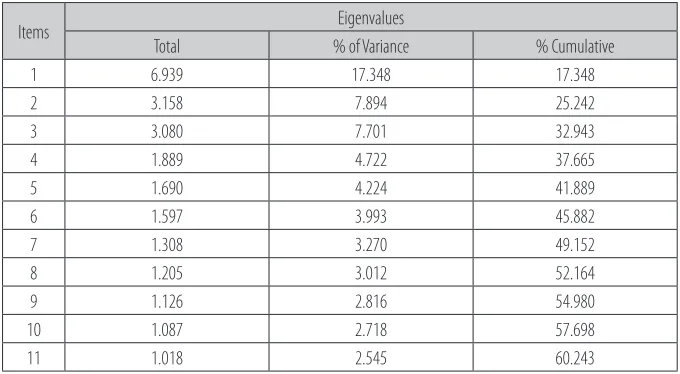
The first step in the application of factorial analysis onto the set of data was the principal components extraction, by using the varimax orthogonal rota-tion. This rotation tries to maximize the variance of the factors components, leading to a smaller loading of variables onto every factor, and making the interpretation of the identified factors more facile. Thus, through the vari-max orthogonal rotation we have obtained 11 identifiable factors comprising 60.243% of the information embedded in the original set of data (Table 3).
Table 3. Total variance explained for the first extraction
Items Eigenvalues
Total % of Variance % Cumulative
1 6.939 17.348 17.348
2 3.158 7.894 25.242
3 3.080 7.701 32.943
4 1.889 4.722 37.665
5 1.690 4.224 41.889
6 1.597 3.993 45.882
7 1.308 3.270 49.152
8 1.205 3.012 52.164
9 1.126 2.816 54.980
10 1.087 2.718 57.698
11 1.018 2.545 60.243
knowledge (Q11-Q18). Most of the respondents know the fact that emotional knowledge can be transferred mainly through the body language and the tone of the voice.
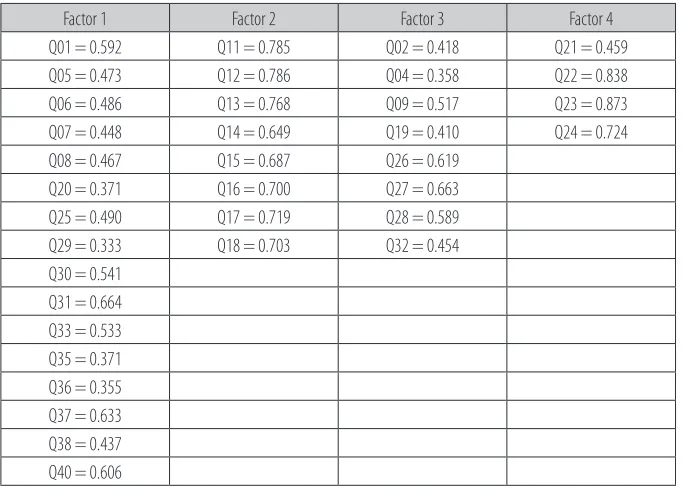
Table 4. Rotated component matrix for 4 factors extracted
Factor 1 Factor 2 Factor 3 Factor 4
Q01 = 0.592 Q11 = 0.785 Q02 = 0.418 Q21 = 0.459 Q05 = 0.473 Q12 = 0.786 Q04 = 0.358 Q22 = 0.838 Q06 = 0.486 Q13 = 0.768 Q09 = 0.517 Q23 = 0.873 Q07 = 0.448 Q14 = 0.649 Q19 = 0.410 Q24 = 0.724 Q08 = 0.467 Q15 = 0.687 Q26 = 0.619
Q20 = 0.371 Q16 = 0.700 Q27 = 0.663 Q25 = 0.490 Q17 = 0.719 Q28 = 0.589 Q29 = 0.333 Q18 = 0.703 Q32 = 0.454 Q30 = 0.541
Q31 = 0.664 Q33 = 0.533 Q35 = 0.371 Q36 = 0.355 Q37 = 0.633 Q38 = 0.437 Q40 = 0.606
The third factor contributes to the 7.701% of the total variance, and contains 8 variables. It focuses mainly on the importance of emotional knowledge in our communication, and the ability we have in handling it. The fourth factor contributes only to 4.701% of the total variance, and contains 4 variables. It fo-cuses mainly on the way formal education contributes to understanding and development of emotional knowledge. As we have seen from the descriptive statistics, formal education has almost no contribution to our understanding and using efficiently emotional knowledge.
Table 5. Reliability statistics
Factors Cronbach’s Alpha No. of items
1 0.813 16
2 0.882 8
3 0.663 8
4 0.764 4
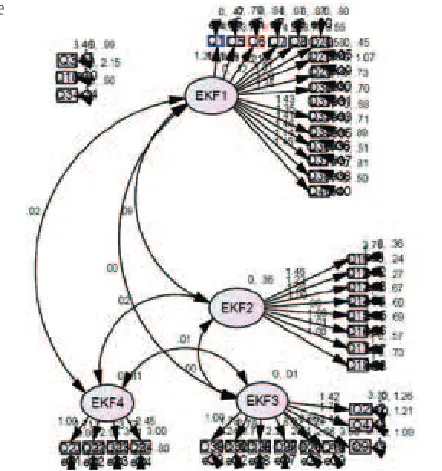
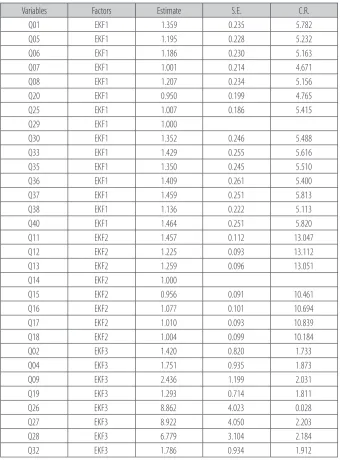
To validate the results obtained we have run a confirmatory factorial analysis. Unlike the exploratory factorial analysis, in a confirmatory factorial analysis the variables are already observed and the aim of the analysis is to refine the influence measurement scale of each sentence comprised in the identified fac-tors (Figure 1). We abbreviate with EKF – Emotional Knowledge Factor. As we can see there are three variables that do not have any direct influence on the four factors. They are: Q03 – We are primarily emotional decision makers, Q10 – Basic emotions result in same facial expression for everybody, and Q34 – In our mental process cognitive knowledge can be transformed into emotional knowledge and vice versa. That means that these variables have a generic value for the whole emotional knowledge management, and not just for one of the main factors identified using the explanatory factorial analysis.
From the confirmatory factorial analysis using the software AMOS version 18, we obtained the synthetic data presented in the Table 6, that shows a good concordance with the exploratory factorial analysis.
Table 6. Confirmatory analysis results with AMOS version 18
Variables Factors Estimate S.E. C.R.
Q01 EKF1 1.359 0.235 5.782
Q05 EKF1 1.195 0.228 5.232
Q06 EKF1 1.186 0.230 5.163
Q07 EKF1 1.001 0.214 4.671
Q08 EKF1 1.207 0.234 5.156
Q20 EKF1 0.950 0.199 4.765
Q25 EKF1 1.007 0.186 5.415
Q29 EKF1 1.000
Q30 EKF1 1.352 0.246 5.488
Q33 EKF1 1.429 0.255 5.616
Q35 EKF1 1.350 0.245 5.510
Q36 EKF1 1.409 0.261 5.400
Q37 EKF1 1.459 0.251 5.813
Q38 EKF1 1.136 0.222 5.113
Q40 EKF1 1.464 0.251 5.820
Q11 EKF2 1.457 0.112 13.047
Q12 EKF2 1.225 0.093 13.112
Q13 EKF2 1.259 0.096 13.051
Q14 EKF2 1.000
Q15 EKF2 0.956 0.091 10.461
Q16 EKF2 1.077 0.101 10.694
Q17 EKF2 1.010 0.093 10.839
Q18 EKF2 1.004 0.099 10.184
Q02 EKF3 1.420 0.820 1.733
Q04 EKF3 1.751 0.935 1.873
Q09 EKF3 2.436 1.199 2.031
Q19 EKF3 1.293 0.714 1.811
Q26 EKF3 8.862 4.023 0.028
Q27 EKF3 8.922 4.050 2.203
Q28 EKF3 6.779 3.104 2.184
Variables Factors Estimate S.E. C.R.
Q39 EKF3 1.000
Q21 EKF4 1.000
Q22 EKF4 2.707 0.393 6.885
Q23 EKF4 3.168 0.456 6.943
Q24 EKF4 2.453 0.368 6.666
Conclusions
Emotional knowledge has been recognized as a distinctive component of the tacit knowledge and the hidden part of the knowledge iceberg only recently, when research in cognitive science revealed the role of emotions in the deci-sion making and mental processes. As that research demonstrates, cognitive knowledge and emotional knowledge are inextricably intertwined. There is a powerful dynamics of thoughts and emotions, that can be understood by using the thermodynamics metaphor. That means that cognitive knowledge may transform into emotional knowledge and vice versa, like energy from one form into another one. This is a challenging hypothesis based on metaphorical analysis that cognitive scientists have yet to prove.
understanding of life and society. It is time to reconsider these students cur-riculum, especially to students in economics and business by introduce new courses about behavior economics and complex decision making, with emo-tional knowledge playing an important part.
Acknowledgements: This paper has been presented at the European Con-ference on Knowledge Management, Kaunas University of Technology, Lith-uania, September 5-6, 2013.
References
Bass, B.M., and Riggio, R.E. (2006). Transformational leadership. London: Lawrence Erlbaum Associates Publishers.
Brătianu, C. (2011). Changing paradigm for knowledge metaphors from dynamics to thermodynamics, Systems Research and Behavioral Science, 28, 160-169.
Brătianu, C., and Andriessen, D. (2008). Knowledge as energy: a meta-phorical analysis, Proceedings of the 9th European Conference on Knowledge
Management (75-82). Southampton Solent University, UK, 4-5 September 2008. Reading: Academic Publishing.
Daft, L.R. (2008). The leadership experience. London: Thomson South-Western.
Damasio, A.R. (1994). Descartes’ error: emotion, reason and the human brain. New York: Avon Books.
Damasio, A.R. (1999). The feeling of what happens. New York: Harcourt Brace.
Ekman, P.E. (2003). Emotions revealed. Recognizing faces and feelings to improve communication and emotional life. New York: Times Books.
Fauconnier, G., and Turner, M. (2002). The way we think. Conceptual blending and the mind’s hidden complexities. New York: Basic Books.
Fenton-O’Creevy, M., Soane, E., Nicholson, N., and William, P. (2011). Thinking, feeling and deciding: the influence of emotions in decision making and performance of traders. Journal of Organizational Behavioral, 32, 1044-1061.
Frith, C. (2007). Making up the mind. How the brain creates our mental world. Oxford: Blackwell Publishing.
Hill, D. (2008). Emotionomics. Leveraging emotions for business success. London: Kogan Page.
Immordino-Yang, M.H., and Damasio, A.R. (2007). We feel, therefore we learn: The relevance of affective and social neuroscience to education. Mind, Brain, and Education, 1 (1), 3-10.
Jordan, J., Brown, M.E., Trevino, L.K., and Finkelstein, S. (2013). Someone to look up to: executive-follower ethical reasoning and perceptions on ethical leadership. Journal of Management, 39 (3), 660-683.
Kahneman, D. (2011). Thinking, fast and slow. New York: Farrar, Straus and Giroux.
Kaufman, S.F. (1994). The martial artist’s book of five rings. The definitive interpretaition of Miyamoto Musashi’s classic book of strategy. Boston: Tuttle Publishing.
Koole, S.L. (2009). The psychology of emotion regulation: an integrative review. Cognition and Emotion, 23 (1), 4-41.
Kotter, J.P. (1996). Leading change. Boston: Harvard Business School Press. Kotter, J.P. (2008). A sense of urgency. Boston: Harvard Business School Press.
Kotter, J.P. (2012). Accelerate. Harvard Business Review, November, 44-58. Kotter, J.P. (2002) The heart of change. Real-life stories of how people change their organizations. Boston: Harvard Business School Press.
Lagattuta, K.H., and Wellman, H.M. (2001). Thinking about the past: ear-ly knowledge about links between prior experience, thinking, and emotion.
Child Development, 72 (1), 82-102.
LeDoux, J. (1999). The emotional brain. London: Phoenix.
Lindquist, K.A., and Barrett, L.F. (2008). Constructing emotion. The expe-rience of fear as a conceptual act. Psychological Science, 19 (9), 898-903.
Madden, L.T., Duchon, D., Madden, T.H., and Plowman, D.A. (2012). Emergent organizational capacity for compassion. Academy of Management Review, 37 (4), 689-708.
Miller, A., Gouley, K.K., Seifer, R., Zakriski, A., Eguia, M., and Vergnani, M. (2005). Emotion knowledge skills in low-income elementary school chil-dren: associations with social status and peer experience. Social Development, 14 (4), 637-651.
Miller, T., Wesley, II, C.L., and Williams, D.E. (2012). Educating the minds of caring hearts: comparing the views of practitioners and educators on the importance of social entrepreneurship competencies. Academy of Manage-ment Learning and Education, 11 (3), 349-370.
Nag, R., and Gioia, D.A. (2012). From common to uncommon knowledge: foundations of firm-specific use of knowledge as a resource. Academy of Man-agement Journal, 55 (2), 421-457.
Nonaka, I. (1994). A dynamic theory of organizational knowledge cre-ation. Organization Science, 5 (1), 14-37.
Nonaka, I., and Takeuchi, H. (1995). The knowledge creating company. How Japanese companies create thedynamics of innovation. New York: Oxford Uni-versity Press.
Nonaka, I., and Zhu, Z. (2012). Pragmatic strategy. Eastern wisdom, global success. Cambridge: Cambridge University Press.
Ohmae, K. (1982). The mind of the strategist. The art of Japanese Business. New York: McGraw-Hill.
O’Rorke, and P., Ortony, A. (1994). Explaining emotions, Cognitive Sci-ence, 18, 283-323.
Polanyi, M. (1983). The tacit dimension. Gloucester: Peter Smith.
Rafferty, A.E., Jimmieson, N.L., and Armenakis, A.D. (2013). Change readiness: a multilevel review. Journal of Management, 39 (1), 110-135.