Vol. 6, No. 1, 2018, 39-47 ISSN: 2321 – 9238 (online) Published on 18 March 2018 www.researchmathsci.org
DOI: http://dx.doi.org/10.22457/pindac.v6n1a5
39
Progress in
A Practical Application of the Generalized Cutting Stock
Algorithm
W.D.D.Madhavee, N.Saldin, U.C.Vaidyarathna and C.J.Jayawardene* Department of Mathematics, University of Colombo, Colombo 3, Sri Lanka
*Corresponding author. Email: [email protected]
Received 28 February 2018; accepted 15 March 2018
Abstract. A watered-down version of the cutting stock algorithm has existed for a few centuries before the industrial revolution but no real formulation or solution to the prob-lem was known other than for a few heuristic algorithms used under specific cases per-taining to the logging industry. The first formulations and solutions of the cutting stock problem was published about 6 decades ago by Gilmore and Gomory in the Operation research journal [6]. In that, they have explained the concept by using crude optimiza-tion techniques which are not applicable to most condioptimiza-tions found in the contemporary business environment. Our research project involves cutting wooden sheets and wooden rods of specific dimensions based on the requirements of the customers of Moratuwa Timber Work (MTW). The main focus of this paper is to find the optimal cutting pat-terns by minimizing the wastage and the trim loss. This is achieved with the aid of a web enabled database, using Java codes and Lingo programs.
Keywords: Cutting Stock Problem; Linear and Integer Programming; LINGO AMS Mathematics Subject Classification (2010): 90C10, 90C05, 90C90 1. Introduction
The cutting stock algorithm relates to a wide range of industries. This situation has created an impetus with financial incentives to find more efficient algorithms to deal with different scenarios. In particular, if we consider the furniture industry where cutting wooden material play a pivotal role, many variations of the algorithms are used when cutting wood in order to reduce wastage. For example, if we need to produce wooden rods for chairs, we have to use the one-dimensional cutting method which requires the use of a single cutting blade. However, if we consider the two- dimensional or the three-dimensional cutting method, we will need to accommodate slanted or oblique cutting method which requires the use of wedged shape cutting tools, double blades or jigsaw blades. Therefore, in a more general setting, in order to implement our algorithm, we need to take in to consideration the additional constraints related to the cutting methods and the cutting equipment which need to be used.
40
dimensions. Our main focus in this paper was to find the optimal cutting patterns by minimizing the wastage. Our research project was done under the following assumptions. 1. All wooden pieces required to manufacture the furniture are cut from the sheets
and rods that are exclusively in the current stock.
2. The stock consists of sufficient sheets and rods in order to manufacture the re-quired furniture.
In the main part of the project, we solved the problem with the aid of a web enabled database, using Java codes and Lingo programs. More specifically, we implemented the program in 4 stages. In stage 1, the database was updated according to the customer input obtained via the web. In stage 2, a Java code was developed and implemented, in order to generate all possible cutting patterns. In stage 3, an Integer Program was formulated using the cutting patterns obtained in stage 2 and subsequently a Lingo Program was generated to update the database. In the final stage, which is stage 4, the updated database results were redirected to the customers through the web.
2. History
With the introduction of computer-based solutions in nineteen seventies, different variations of this problem were tackled by many authors.
Some of the approaches that mushroomed in the following decades related to variations of this cutting plane algorithm are the Enumerative approach [17,18], the Sequential approach [1,21], the Knapsack approach [7,11], the Branch and Bound approach [4,5,9,22], the Synergistic approach [10,13], the Dynamic Programming approach [3,12], the Tree search algorithm approach [2], the Genetic algorithms approach [16,19], the Column Generation algorithm approach [2,5,8,22] and the Vishwanath and Bagchi algorithm approach [15].
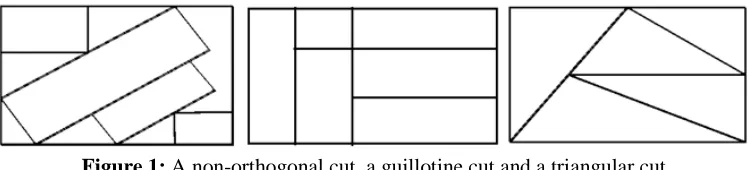
With the advancement of the industrial revolution, there was a massive demand for cutting different materials in different shapes and orientations.
Figure 1: A non-orthogonal cut, a guillotine cut and a triangular cut
3. Formulation of the problem
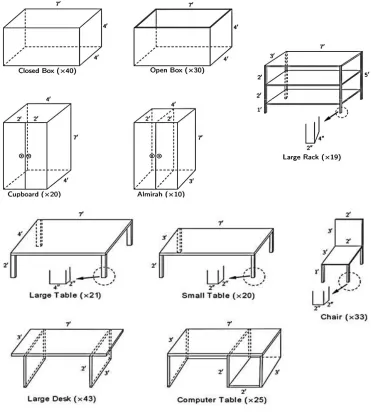
The dimensions of an order to make furniture items received by MTW are listed below.
The storage house of MTW has
10'×4', 6'×6'and 4'×3'and wooden rods with the
sheets and rods will be used to manufacture the ordered items problem, the following variables are defined.
41 Formulation of the problem
The dimensions of an order to make furniture items received by MTW are listed below.
Figure 2: Ordered furniture
The storage house of MTW has wooden sheets which are 1/2'' thick with the dimensions 3'and wooden rods with the dimensions 2''×2''×5'and 2''
sheets and rods will be used to manufacture the ordered items. In order the following variables are defined.
The dimensions of an order to make furniture items received by MTW are listed below.
42
Table 1: Cutting patterns
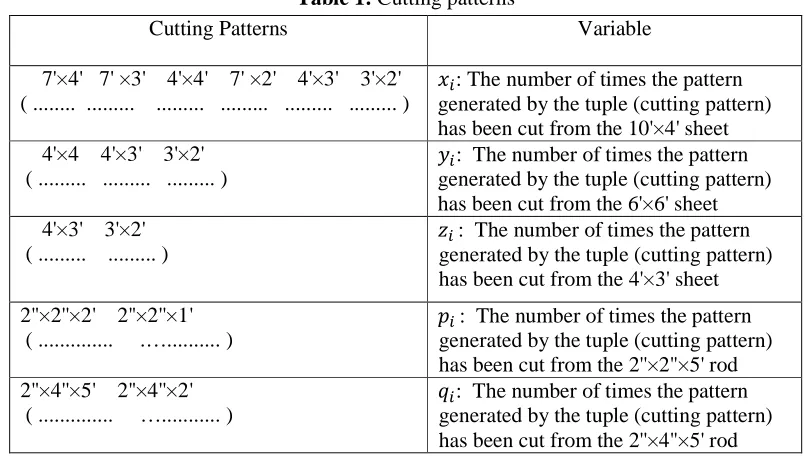
In order to identify all possible cutting patterns, the following assumptions were made regarding the method of cutting.
• We will start cutting the pieces from the left-hand corner of the sheet. The selection of the pieces to be cut will be in accordance with the descending order of the area, corresponding to the individual pieces.
• The sawdust produced by cutting has no effect on the wastage.
• In implementing the algorithm, initially we changed the orientation of the pieces (including the sheets) to have length greater than their width.
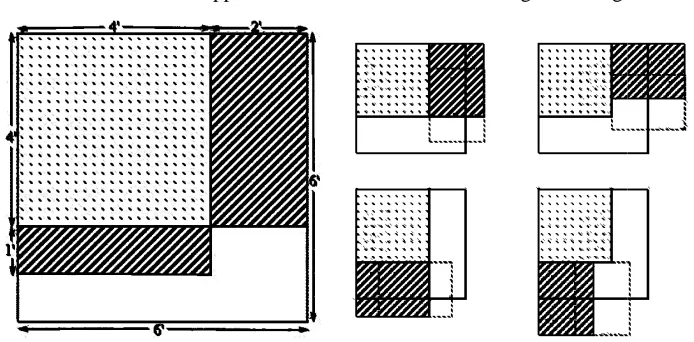
To generate a new cutting pattern, we first set up a heuristic algorithm by taking in to account that the total area of the individual pieces is less than the area of the wooden sheet. However, this heuristic algorithm didn’t handle all possible cases satisfactorily. For example, we had a problem with cutting the pattern (1, 1, 0) which corresponds to cutting one 4'×4' piece and one 4'×3' piece from a 6'×6' sheet. Though this cutting pattern satisfies the constraint corresponding to the total area (i.e., 4'×4'+ 4'×3' ≤ 6'×6' (Figure
3)), in reality it is impossible to cut a 4'×4' piece and a 4'×3' piece from the given 6'×6' sheet as depicted in figure 4.
Suppose that we have a new pattern and it successfully satisfies the heuristic algorithm condition related to total area as explained earlier. To overcome the problem and obtain a more refined solution, we fine tuned the algorithm as follows. The first step is to create a solution matrix C, initialized to one, where the corresponding nm elements of the matrix refer to the 1'×1' wooden pieces of the n’×m’ wooden sheet. The second step is to create a k-tuple (, , … , )where ri represents the number of ai×bi pieces that are desired to be cut.
Cutting Patterns Variable
7'×4' 7' ×3' 4'×4' 7' ×2' 4'×3' 3'×2' ( ... ... ... ... ... ... )
: The number of times the pattern generated by the tuple (cutting pattern) has been cut from the 10'×4' sheet 4'×4 4'×3' 3'×2'
( ... ... ... )
: The number of times the pattern generated by the tuple (cutting pattern) has been cut from the 6'×6' sheet 4'×3' 3'×2'
( ... ... )
: The number of times the pattern generated by the tuple (cutting pattern) has been cut from the 4'×3' sheet 2''×2''×2' 2''×2''×1'
( ... .…... )
: The number of times the pattern generated by the tuple (cutting pattern) has been cut from the 2''×2''×5' rod 2''×4''×5' 2''×4''×2'
( ... …... )
Figure 3: The cutting the pattern (1,1,0) satisfying the area constraint
Next, select a submatrix with the dimensions
cutting assumptions) and check if all of its elements are 1. If all elements of the sub m trix are 1 (this is achieved by comparing the area of the piece being cut, i.e.
the summation of the elements of the sele
sponding to the dimensions of the submatrix can be cut. To reflect that the piece is cut, we update the matrix along with the tuple. The tuple is updated by reducing 1 from that the new tuple will read
its elements. Next provided that, check if another
submatrices and shifting the submatrix horizontally one cell at a time till it reaches the right most possible position. When the end of the row is reached,
ning of the next row in lexicographical order till we reach the end of the sheet, so that all possible submatrices are checked. In the case when a submatrix cannot be found,
ize the same method by considering the submatrix
changed) and proceed in the same manner by updating the tuple and the matrix accor ingly.
We repeat this process recursively and a successful reduction to a will indicate an acceptable pattern
indicate an unacceptable pattern
In our Java program we evaluated the feasibility of each pattern calculated the corresponding wastage of the feasible patterns.
Once all the variables were generated we obtain the follo that in the following output
43
The cutting the pattern (1,1,0) Figure 4: The impracticality of cutting the satisfying the area constraint pattern (1, 1, 0)
Next, select a submatrix with the dimensions from the top left corner (as per cutting assumptions) and check if all of its elements are 1. If all elements of the sub m trix are 1 (this is achieved by comparing the area of the piece being cut, i.e.
the summation of the elements of the selected submatrix), it will imply that a piece corr sponding to the dimensions of the submatrix can be cut. To reflect that the piece is cut, we update the matrix along with the tuple. The tuple is updated by reducing 1 from that the new tuple will read( 1, , … , . The submatrix is update by assigning 0 to
its elements. Next provided that, 1, the new first entry of the tuple is non
piece could be cut. Likewise, this can be continued, by selecting
shifting the submatrix horizontally one cell at a time till it reaches the right most possible position. When the end of the row is reached, we move to the begi ning of the next row in lexicographical order till we reach the end of the sheet, so that all possible submatrices are checked. In the case when a submatrix cannot be found,
ize the same method by considering the submatrix (orientation of the piece is
changed) and proceed in the same manner by updating the tuple and the matrix accor
We repeat this process recursively and a successful reduction to a
will indicate an acceptable pattern , , … , whereas the alternative scenario will
indicate an unacceptable pattern , , … , .
In our Java program we evaluated the feasibility of each pattern corresponding wastage of the feasible patterns.
ll the variables were generated we obtain the following output. It is worth noting output is represented by Xi etc.
cutting the
from the top left corner (as per cutting assumptions) and check if all of its elements are 1. If all elements of the sub ma-trix are 1 (this is achieved by comparing the area of the piece being cut, i.e. and
cted submatrix), it will imply that a piece corre-sponding to the dimensions of the submatrix can be cut. To reflect that the piece is cut, we update the matrix along with the tuple. The tuple is updated by reducing 1 from so
is update by assigning 0 to the new first entry of the tuple is non-zero, we piece could be cut. Likewise, this can be continued, by selecting shifting the submatrix horizontally one cell at a time till it reaches the move to the begin-ning of the next row in lexicographical order till we reach the end of the sheet, so that all possible submatrices are checked. In the case when a submatrix cannot be found, we
util-(orientation of the piece is changed) and proceed in the same manner by updating the tuple and the matrix
accord-We repeat this process recursively and a successful reduction to a 0,0, … ,0 tuple whereas the alternative scenario will
In our Java program we evaluated the feasibility of each pattern separately and
44 10'×4' Sheet
(7'×4'),(7'×3'),(4'×4'),(7'×2' ), (4'×3'), (3'×2')
X1 →(0, 0, 0, 0, 0, 1) - 34 X2 →(0, 0, 0, 0, 0, 2) - 28 X3 →(0, 0, 0, 0, 0, 3) - 22 X4 →(0, 0, 0, 0, 0, 4) - 16 X5 →(0, 0, 0, 0, 0, 5) - 10 X6 →(0, 0, 0, 0, 0, 6) - 4 X7 →(0, 0, 0, 0, 1, 0) - 28 X8 →(0, 0, 0, 0, 1, 1) - 22 X9 →(0, 0, 0, 0, 1, 2) - 16 X10→(0, 0, 0, 0, 1, 3) - 10 X11 →(0, 0, 0, 0, 1, 4) - 4 X12→(0, 0, 0, 0, 2, 0) - 16 X13→(0, 0, 0, 0, 2, 1) - 10 X14→(0, 0, 0, 1, 0, 0) - 26 X15→(0, 0, 0, 1, 0, 1) - 20 X16→(0, 0, 0, 1, 0, 2) - 14 X17 →(0, 0, 0, 1, 0, 3) - 8 X18 →(0, 0, 0, 1, 0, 4) - 2 X19→(0, 0, 0, 1, 1, 0) - 14 X20 →(0, 0, 0, 1, 1, 1) - 8 X21 →(0, 0, 0, 1, 1, 2) - 2 X22→(0, 0, 0, 2, 0, 0) - 12 X23→(0, 0, 0, 2, 0, 1) - 6 X24→(0, 0, 0, 2, 0, 2) - 0 X25→(0, 0, 0, 2, 1, 0) - 0 X26→(0, 0, 1, 0, 0, 0) - 24 X27→(0, 0, 1, 0, 0, 1) - 18 X28→(0, 0, 1, 0, 0, 2) - 12
X29 →(0, 0, 1, 0, 0, 3) - 6 X30 →(0, 0, 1, 0, 0, 4) - 0 X31→(0, 0, 1, 0, 1, 0) - 12 X32→(0, 0, 1, 0, 1, 1) - 6 X33→(0, 0, 2, 0, 0, 0) - 8 X34→(0, 0, 2, 0, 0, 1) - 2 X35→(0, 1, 0, 0, 0, 0) - 19 X36→(0, 1, 0, 0, 0, 1) - 13 X37→(0, 1, 0, 0, 0, 2) - 7 X38→(0, 1, 0, 0, 1, 0) - 7 X39→(1, 0, 0, 0, 0, 0) - 12 X40→(1, 0, 0, 0, 0, 1) - 6 X41→(1, 0, 0, 0, 0, 2) - 0 X42→(1, 0, 0, 0, 1, 0) – 0
6'×6' Sheet
(4'×4'), (4'×3'), (3'×2')
Y1 →(0, 0, 1) - 30
Y2 →(0, 0, 2) - 24
Y3 →(0, 0, 3) - 18
Y4 →(0, 0, 4) - 12
Y5 →(0, 0, 5) - 6
Y6 →(0, 0, 6) - 0
Y7 →(0, 1, 0) - 24
Y8 →(0, 1, 1) - 18
Y9 →(0, 1, 2) - 12
Y10 →(0, 1, 3) - 6
Y11 →(0, 2, 0) - 12
Y12 → (0, 2, 1) - 6
Y13 → (0, 2, 2) - 0
Y14 →(1, 0, 0) - 20
Y15 →(1, 0, 1) - 14
Y16 →(1, 0, 2)– 8
Y17 →(1, 0, 3) – 2
4'×3' Sheet (4'×3'), (3'×2')
Z1 →(0, 1) - 6
Z2 →(1, 0) – 0
Wooden bars - 2"×2"×5' (2''×2''×2'), (2''×2''×1')
P1→(0, 1) – 4
P2→(0, 2) - 3
P3→(0, 3) - 2
P4→(0, 4) - 1
P5→(0, 5) - 0
P6→(1, 0) - 3
P7→(1, 1) - 2
P8→(1, 2) - 1
P9→(1, 3) - 0
P10→(2, 0) - 1
P11→(2, 1) - 0
Wooden bars - 2"×4"×5' (2''×4''×5'), (2''×4''×2')
Q1→(0, 1) - 3
Q2→(0, 2) - 1
Q3→(1, 0) - 0
We formulated the Integer program using the following variables.
, = the error of the pattern that corresponds to , = the error of the pattern that corresponds to ,= the error of the pattern that corresponds to ,= the error of the pattern that corresponds to ,= the error of the pattern that corresponds to
Therefore, the objective function is to:
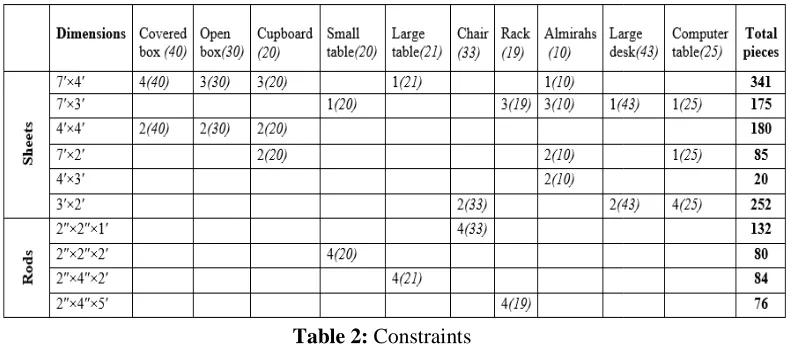
The constraints correspond to the following table
The Integer Program that w
! = 34 + 28 + 10 & + 2 ' + 24 ( + 2 + 0 + 12) + 2* + 0)+
Subject to
)+ &+ + = + (+ *+ '= (+ *+ '+ )+
180 (Number of 4'×4' wooden pieces) + + (+ *+
(Number of 7'×2' wooden pieces) *+ '+ )+ &+
+ *+ '+ )+ & pieces)
+ 2 + 3 + 4 + 3 *+ 4 '+ &+ 2
(+ 2 *+ &+ 2 + 2+ + 2( (+ *+ '+ )+ 2
45 espond to the following table:
Table 2: Constraints
that was formulated is given below:
+ 22 + 16 + 10 + 4 (+ 28 *+ 22 &+ 4 + 16 + 10 + 26 + 20 +
+ 14 )+ 8 &+ 2 + 12 + 6 + 0
(+ 18 *+ 12 '+ 6 )+ 0 &+ 12 + 6 + 19 + 13 (+ 7 *+ 7 '+ 12 )+ 6 + 30+ 24+ 18+ 12+ 6+ 0(+
)+ 6&+ 12+ 6+ 0+ 20+ 14 + 6+ 0+ 4+ 3+ 2+ + 0+ + &+ 0+ 3+ + 0
= 341(Number of 7'×4' wooden pieces) = 175 (Number of 7'×3' wooden pieces) + &+ + + 2 + 2 + + + 4' wooden pieces)
+ '+ )+ &+ + 2 + 2 + 2 + Number of 7'×2' wooden pieces)
+ 2 + 2 + )+ &+ + + &+ 2+ 2+ 2+ = 20 (Number of 4'
+ 5 + 6 (+ '+ 2 )+ 3 &+ 4 + +
+ + 2 + *+ 2 '+ 3 )+ 4 &+ + + 2+ 3+ 4+ 5+ 6(+ '+
(+ 3*+ = 252 (Number of 3'×2' wooden pieces) &+ 2= 80 (Number of 2''×2''×2'wooden pieces of rods)
'+ 16 ) 14 (+ 8 *
+ 0 6 + 8
&+ 0 24*+ 18' + 8(
3(+ 2*+ '
+ (+ *=
+ 2 = 85
+ + '+ Number of 4'×3' wooden
46
+2+ 3+ 4+ 5+ *+ 2'+ 3)+ =132
(Number of 2''×2''×1'wooden pieces of rods)
= 76(Number of 2''×4''×5'wooden pieces of rods)
+ 2= 84 (Number of 2''×4''×2'wooden pieces of rods)
≥ 0 01 22 !3 45 !675
≥ 0 01 22 !3 45 !675
≥ 0 01 22 !3 45 !675
≥ 0 01 22 !3 45 !675
≥ 0 01 22 !3 45 !675
The optimal solution of the integer program was generated using a Lingo package. Note that the minimum error for the order that was received was 6960ft2.
4. Development of the website
To obtain the order request of MTW customers and to notify the customers of the final decisions regarding the order details, we developed a dynamic website using an Avata theme.
Acknowledgments. The authors would like to thank Ms. B.L.Samarasekara for her valuable time and cooperation. Also, we are grateful to the referees for their valuable comments for improvement of the paper.
REFERENCES
1. R.C.Art, An approach to the two-dimensional irregular cutting stock problem, Ph.D.,
diss., Massachusetts Institute of Technology (1966).
2. J.E.Beasley, An exact two-dimensional non-guillotine cutting tree search procedure,
Operations Research, 33(1) (1985) 49-64.
3. G.F.Cintra, F.K.Miyazawa, Y.Wakabayashi and E.C.Xavier, Algorithms for
two-dimensional cutting stock and strip packing problems using dynamic programming and column generation. European Journal of Operational Research, 191(1) (2008) 61-85.
4. V.D.Cung, M.Hifi and B.Cun, Constrained two‐dimensional cutting stock problems a
best‐first branch‐and‐bound algorithm, International Transactions in Operational
Research, 7(3) (2000) 185-210.
5. J.V.De.Carvalho, Exact solution of bin‐packing problems using column generation
and branch‐and‐bound, Annals of Operations Research, 86 (1999) 629-659.
6. P.C.Gilmore and R.E.Gomory, A linear programming approach to the cutting-stock
problem, Operations research, 9(6) (1961) 849-859.
7. P.C.Gilmore and R.E.Gomory, A linear programming approach to the cutting stock
47
8. P.C.Gilmore and R.E.Gomory, Multistage cutting stock problems of two and more
dimensions, Operations Research, 13(1) (1965) 94-120.
9. M.Gradisar and P.Trkman, A combined approach to the solution to the general
one-dimensional cutting stock problem, Computers & Operations Research, 32(7) (2005) 1793-1807.
10. M.Gradisar, G.Resinovic and M.Kljajic, A hybrid approach for optimization of
one-dimensional cutting, European Journal of Operational Research, 119 (3) (1999) 719-728.
11. R.W.Haessler and P.E.Sweeney, Cutting stock problems and solution procedures,
European Journal of Operational Research, 54(2) (1991)141-150.
12. M.J.Haims and H.Freeman, A multistage solution of the template-layout problem,
IEEE Transactions on Systems Science and Cybernetics, 6(2) (1970) 145-151.
13. D.Jaliff and A.Dagnino, An object-oriented tool-kit for building CSP decision
sup-port systems, Systems, Man and Cybernetics, 4 (1995) 3201-3206.
14. B.Kroger, Guillotineable bin packing: A genetic approach, European Journal of
Op-erational Research, 84(3) (1995) 645-661.
15. C.Leon, G.Miranda, C.Rodríguez and C.Segura, 2D cutting stock problem: a new
parallel algorithm and bounds, Euro-Par 2007 Parallel Processing, (2007) 795-804.
16. T.W.Leung, C.H.Yung and M.D.Troutt, Applications of genetic search and simulated
annealing to the two-dimensional non-guillotine cutting stock problem, Computers &
industrial engineering, 40(3) (2001) 201-214.
17. A.Lodi, S.Martello and D.Vigo, Recent advances on two-dimensional bin packing
problems, Discrete Applied Mathematics, 123(1) (2002) 379-396.
18. A.Lodi, S.Martello and M.Monaci, Two-dimensional packing problems - a survey.
European Journal of Operational Research, 141(2) (2002) 241-252.
19. G.C.Onwubolu and M.Mutingi, A genetic algorithm approach for the cutting stock
problem, Journal of Intelligent Manufacturing, 14(2) (2003) 209-218.
20. A.H.G.Rinnooy Kan, J.R.De Wit and R.T.Wijmenga, Nonorthogonal twodimen
-sional cutting patterns, Management Science, 33(5) (1987) 670-684.
21. R.Vahrenkamp, Random search in the one-dimensional cutting stock problem,
Euro-pean Journal of Operational Research, 95(1) (1996) 191-200.
22. P.H.Vance, C.Barnhart, E.L.Johnson and G.L.Nemhauser, Solving binary cutting
stock problems by column generation and branch-and-bound, Computational