Northeast Historical Archaeology
Volume 23
Article 5
1994
The Clay Pipe Assemblage from an 18- and
19th-Century Aboriginal Consumer Site in the Upper
Mid-Continent
C.S. "Paddy" Reid
Follow this and additional works at:
http://orb.binghamton.edu/neha
Part of the
Archaeological Anthropology Commons
This Article is brought to you for free and open access by The Open Repository @ Binghamton (The ORB). It has been accepted for inclusion in Northeast Historical Archaeology by an authorized editor of The Open Repository @ Binghamton (The ORB). For more information, please contact
Recommended Citation
Reid, C.S. "Paddy" (1994) "The Clay Pipe Assemblage from an 18- and 19th-Century Aboriginal Consumer Site in the Upper Mid-Continent,"Northeast Historical Archaeology: Vol. 23 23, Article 5.
Consumer Site in the Upper Mid-Continent
Cover Page Footnote
I badgered many colleagues by telephone in preparing this paper (especially for examples of Fiolet pipes), from Michigan to Minnesota to Manitoba as well as Ontario, and I thank them for their assistance and patience. Special thanks to Jennifer Hamilton of the Canadian Park Service in Winnipeg for tracking down Fiolets in their collections.
Northeast Historical ArchaeologyNol. 23, 1994 79
THECLA Y PIPE ASSEMBLAGE FROM AN 18TH- AND
19TH- CENTURY ABORIGINAL CONSUMER SITE IN
THE UPPER MID-CONTINENT
C. S. "Paddy" Reid
Four years of excavations at the multi-component Ballynacree site (DkKp-8), located at the mouth of the Winnipeg River in northwestern Ontario, uncovered a large number of fur trade artifacts spanning virtually the entire period from initial French contact to the end of the fur trade era in the late 19th century. The clay pipe assemblage serves as· an example of some unusual aspects of a major aboriginal village site, as. opposed to a fur trade post site,. as the quantities, time ranges, and types of pipes are at variance with those expected from such a site.
Quatre annees de fouilles effectuees au site Ballynacree (DkKp-8), complexe situe a l'embrouchure de la riviere Winnipeg dans le Nord-Ouest de ['Ontario, ont mis au jour un grand nombre d'artefacts relies
a
la traite des fourruresa
partir des premiers contacts avec les Franr;ais jusqu'a la fin de ce type de commerce dans les dernieres annees du XIXe siecle. L'assemblage de pipes en argile constitue un exemple de certains aspects inhabituels d'un grand site de village aborigene, par opposition a un site de poste de traite des fourrures, parce que les quantites, les intervalles de temps et les genres de pipes different de ceuX attendus d'un tel site.Introduction
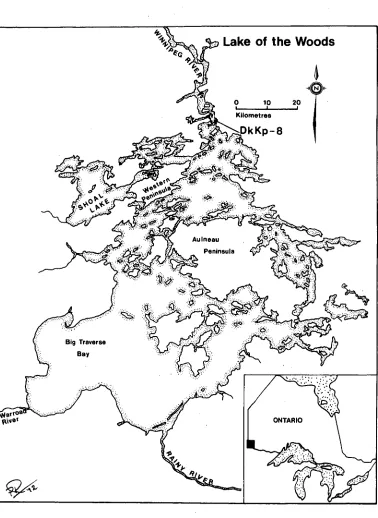
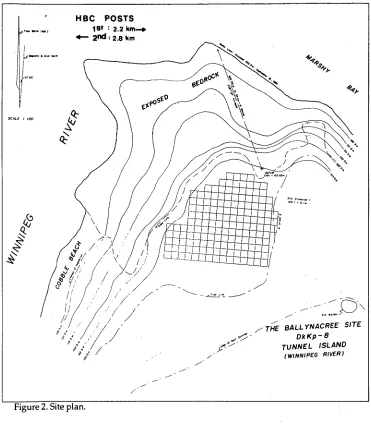
The Ballynacree site (FIG. 1, 2) has been identified as the home village of the Cree chief La Marte Blanche (Reid 1985), who was a major ally of French explorer Pierre Gaultier De Varennes, Sieur de la VerEmdrye, who founded Fort St. Charles on Lake of the Woods in 1732 (Burpee 1927: 9). The site is stratified with· Archaic, Laurel, Blackduck, Selkirk, Sandy Lake, French Fur Trade, English Fur Trade, and Post~Confederation historical com-ponents. It is.situated on an island near the source of the Winnipeg River at a point where residents could control traffic moving up and downstream from the two portages between Lake of the Woods and the Winnipeg River.
The site was threatened by severe water erosion caused by hydroelectric dams, and a four-year-long rescue exca-vation yielded over 100,000 artifacts (see Reid and Rajnovich 1983, 1985, 1991; Reid 1985, n.d.). For the purposes of this paper, the term "consumer site" indiCates an aboriginal village other than aboriginal dwellings directly ad-jacent to a trading establishment and is meant to be descriptive only.
The Assemblage
Lake of the Woods
0 10
Kilometres
HBC POSTS
1St: 2.2 km-+
+-2nd : 2.8 km
SCALE 1100 ~
~
~
Figure 2. Site plan.
Table 1. Pipe fragment frequencies.
Item N
Bowls and fragments 59 Stems and fragments 46 Heel/ spur fragments 5 Mouthpieces 2
Total 112
Northeast Historical ArchileologyNol. 23, 1994 81
,. ...
0":;::;.-.r/
/
%
52.6 41.1
4.5
1.8
100.0
---/THE
'"• c•-·-·
IDSJ•o 1 .,----~
__;_ -~ - f..--/ "
----
, .. ... .BALL YNACRE:£ SITE DkKp-8 TUNNEL ISLAND
Figure 3. Plate of six reconstructed pipes.
stub-stemmed varieties, and all are typical of an assemblage from the lat-ter half of the 19th century.
Bowls
There is a remarkable-indeed perhaps almost unique for an excavated assemblage-paucity of decoration in this sample from an aboriginal con-sumer site (as opposed to a fur trade post site): 52 (88.1%) of the bowls and fragments are plain. This total includes TD pipes with no other decoration on the bowl. Only seven bowls and fragments {11.9%) are decorated.
Plain
Forty-eight (81.35%) of the bowls and/ or fragments are undecorated,
without a picture, pattern, or the label TD. This figure may be misleading to some degree as 44 of the fragments in the sample are small enough that even if the letters "TD," for example, ap-peared on the back (smoker's side) of the bowl it would not necessarily show on a small fragment. Nonetheless, the figure is not wildly inaccurate as all or part of the letters "T" or "D" would ap-pear on some of the fragments if the in-tact bowl had them.
Decorated
I
I
\--~/'
T D
a
b
c
Figure 4. Line drawings of selected pipes.
pipes at other 19th-century sites in Ontario with both Dixon and Bannerman makers' marks (Kenyon 1984). Of the remainder, one is fluted-a design very populfluted-ar in the 19th century with virtually all pipe manufacturers (see Kenyon 1980; Walker 1971). One pipe has a raised design that may be part of a turban from a human effigy design, and an-other has a pair of crossed lacrosse sticks above a ball on each side of the bowl (FIGS. 3C, 4B). One pipe has mo-tifs commemorating Queen Victoria's
Northeast Historical Archaeology/Vol. 23, 1994 83
' '~ (. 72 WWHITE
o.__--'-_...___,_-L---is c M.
I~
Diamond Jubilee of 1897 (FIGS. 3B, 4C), a very small fragment has a raised floral design, and another has an incised motif, although its small size makes the design indecipherable. Only one has sufficient stem to show a mak-er's mark-the lacrosse design is a Dixon's/Montreal pipe.
TD
Table 2. Marked pipe stems.
Mark Dates N %
Dixon's Montreal 1876-1894 9 52.9 Fiolet (a) St. Orner 1765-1921 5 29.4 Bannerman Montreal 1858-1907 2 11.8 W. White Scotland 1805-1955 1 5.9 Total
pipe type and mold number, G78, and the letters "D" and "0" are present on opposite sides of the spur. The second
(FIG. 3A) is a Bannerman/Montreal pipe with an impressed TD. The remaining two are seemingly identical: both have small impressed TDs, are exactly the same size and shape, and bear identical mold marks. One pipe is definitely a Dixon's/Montreal (FIG. 3F), but the stem on the second (FIG. 3D)
is broken close to the bow 1 and no maker's mark remains. It is probably a Dixon's pipe, however. (This pipe is not included in the values in Table 2.)
It should be noted that the "lacrosse" Dixon's pipe also bears the impressed letters "TD" (FIGS. 3C, 4B).
Stems and Mouthpieces
The 46 stem fragments and 2 mouth-pieces are undecorated except for mak-er's marks on 12 items: six Dixon's, five Fiolet, and one Bannerman. None are glazed or varnished, a largely 19th-century practice (wax also was used), to prevent the smoker's lips from sticking to the porous clay. This may indicate that these are pipes from the cheapest price range. Since the assemblage is predominantly 19th century (see discus-sion below), the Harrington and Binford methods for dating pipes by bore diameters (Harrington 1954; Binford 1962) were not considered appropriate. In addition the sample
17 100.0
size is too small to employ either method effectively.
Heels and Spurs
Of the five heel and spur frag-ments, one shows a Dixon's/Montreal maker's mark. A second fragment bears the opposing marks of "G" and "3."
Among the bowls there are nine specimens complete enough to deter-mine presence or absence of spurs. All three of the Dixon's bowls (including the hypothesized Dixon's bowls dis-cussed above) have spurs, as do the Bannerman, the Queen Victoria Dia-mond Jubilee, and theW. White bowls. The bowl decorated with raised dots and geometric designs is hypothesized to be either a Dixon's or a Bannerman bowl also has a spur.
Comparisons and Discussion
General Comparisons TD Pipes
Dixon's, Bannerman) and in all likeli-hood the final one also is a Dixon's. The TD has a continent-wide, indeed world-wide, distribution, making com-parisons relatively meaningless if the TD alone is used as a reference point. What is significant at Ballynacree is the huge preponderance of pipes of Montreal origin.
Dixon's and Bannerman Pipes .
Dixon's, Hendersons, and Banner-man were the three main Montreal pipe manufacturers in this period. In 1875; Bannerman even opened a pipe manu-factory at Rouses Point in New York state (Sudbury 1980), which survived only until 1884. Montreal pipes are rel-atively widespread in their distribu-tion across the upper mid-continent, but not in the same large quantities as the Scottish-made pipes (Walker 1971). It
is not the presence of Montreal pipes at Ballynacree that is surpnsmg (although the absence of Hendersons is), but rather their preponderance in a market saturated with Scottish-made pipes. Date ranges for these Bally-nacree pipes are shown in Table 2.
Fiolet Pipes
French pipes are fairly widely dis-tributed over North America, but are hardly profuse. Fiolet is represented at Fort Coteau duLac and Sillery in Que-bec (Walker 1971: 34) and at the Caleb Pusey House in Pennsylvania (Alexander 1978). They also appear at two North West Mounted Police forts in western Canada, Fort Walsh and Fort Battleford (Jennifer Hamilton, personal communication, 1992). In these cases they represent a small fraction of the assemblage; at Ballynacree,
Northeast Historical Archaeology/Val. 23, 1994 85
however, they represent 29.4% of the assemblage.
W. White Pipe
At the beginning · of this pipe analysis it was predicted, given the statistical data from the growing number of published fur trade era sites, that Glasgow pipes such as those manufactured by W. White would predominate. That only 5.9% of the sample (represented by a single pipe) is Scottish is puzzling, as is the fact that there are no identified pre-1891 Scot-tish (Glasgow) pipes.
Discussion
There are a number of anomalies in the Ballynacree site clay pipe assem-blage; each is summarized below. The first is the very high proportion of un-decorated pipes, which is particularly unusual on mid- to late 19th-century sites, especially aboriginal consumer sites.
Second, there is a very high proportion of Montreal pipes at Ballynacree, comprising 63% of the identified makers' marks. Since the Montreal industry had a limited duration, this is unusual. In addition, the Montreal industry enjoyed only moderate success against the flood of Glasgow-made pipes that spread over North America in the 19th century (lain Walker, personal communication, 1974, quoted in full in Reid 1977: 62-63). Oddly, despite their occurrence at Longlac Post (Dawson 1969), Fort Pic (Gall 1969), Fort Lennox (Barka 1978), and the Ern:tatinger House (Reid 1977), there are no Hendersons of Montreal pipes.
supplied the Hudson's Bay Company (HBC) with pipes from 1831 to at least 1870 (Walker, personal communication, 1974 in Reid 1977), and Ballynacree is located only 2.2 km from the first loca-tion of the HBC Pat Portage Post and 2.8 km from the second, post-1836, loca-tion. Both locations, like Ballynacree, are on the Winnipeg River; therefore, not only was access easy, but HBC ca-noes/boats must have been passing the Ballynacree village regularly. Walker (1974 in Reid 1977) further commented that "every time [Ford] pipes are found they are either on HBC sites or on na-tive sites within a convenient range of a HBC site."
The Ballynacree assemblage dates primarily to the late 19th century (see
TAB. 2 and the 1897 pipe). The site has Archaic, Laurel, Blackduck, Selkirk, Sandy Lake, French fur trade, and En-glish fur trade components, and yet there are no early white clay pipes. The Fiolets, which could have been early (1765 plus), were excavated in as-sociation with the remaining pipes, and while W. White began business in 1805, this specimen is marked "SCOTLAND" and hence post-dates the United States McKinley Tariff Act of 1891. The earlier historical strata are notable for the presence of stone pipes and absence of clay pipes (Reid n.d.).
There is a remarkable lack of vari-ety in the assemblage in terms of the pipe makers represented, even less if the Montreal pipes are grouped to-gether. This is unexpected for an abo-riginal consumer site of the fur trade period. One would expect to see more Glasgow pipes-Murray and McDougall pipes, for example (again see Walker, personal communication, 1974 in Reid 1977).
The second highest frequency of makers is Fiolet of St. Orner, a French
manufacturer; they comprise 29.4% of the identified makers' marks. This emphasizes the unusual nature of the assemblage with its preponderance of Montreal pipes and low frequency of Glasgow pipes. Equally curious is the absence of other French manufacturers such as Gambier (who is represented at the Ermatinger House) (Reid 1977).
Because over 90% of the Bally-nacree site was excavated (see Reid and Rajnovich 1991: 193-194, and FIG. 2), one of the research objectives included the formulation of "patterns" for abo-riginal consumer sites during the fur trade (as opposed to fur trade posts) for the area west of Lake Superior. This was particularly important since so few "consumer" sites have been fully exca-vated, let alone published.
As mentioned above it was expected that an aboriginal village site pipe as-semblage would reflect those of fur trade post sites; this is not the case, at least for the Ballynacree Site. It is therefore hypothesized that aborigi-nal sites not directly adjacent to fur trade posts exhibit a pattern of cultural selection-at least in the case of traded clay pipes-that does not necessarily reflect the pipe assemblages at the posts themselves. This pattern also may be reflected in the other sub-assemblages on aboriginal sites of the fur trade period, refuting the often-held assumption that the aboriginal participants in the fur trade were merely "consumers."
Acknowledgments
pa-tience. Special thanks to Jennifer Hamilton of the Canadian Park Service in Winnipeg for tracking down Fiolets in their collections.
References Alexander, L. T.
1978 Clay Tobacco Smoking Pipes from the Caleb Pusey House. The Ar-chaeological Society of Delaware, Paper 9. Wilmington.
Barka, Norman F.
1978 The Archaeology of Fort Lennox, Ile-aux-Noix, Quebec, 1964 Sea-son. History and Archaeology 20. National Historic Parks and Sites Branch, Parks Canada, Ottawa.
Binford, Lewis R.
1962 A New Method of Calculating Dates from Kaolin Pipe Stem Sam-I'les. Southeastern Archaeological Conference Newsletter 19(1): 19-21.
Burpee, Lawrence
J.,
ed.1927 Journals and Letters of Pierre Gaultier De Varennes, De La Verendrye and His Sons. Cham-plain Society Publication 24. Toronto.
Dawson, Kenneth C. A.
1969 Archaeological Investigations at the Site of the Longlac Historic Trading Post, Thunder Bay Dis-trict Ontario. Ontario Archaeol-ogy 12.
Gall, Patricia L.
1969 The Excavation of Fort Pic, On-tario. Ontario Archaeology 10: 34-63.
Harrington, J. C.
1954 Dating Stem Fragments of Seven-teenth and EighSeven-teenth Century Clay Tobacco Pipes. Quarterly Bulletin of the Archaeological So-ciety of VIrginia 9(1): 9-13.
Northeast Historical Archaeology/Vol. 23, 1994 87
Kenyon, Thomas
1980 Nineteenth Century Notes: The 4-Band Fluted Pipe. Kewa (News-letter of the London ChaJ?ter, Ontario Archaeological Society) 9: 80-89.
1982a Nineteenth Century Notes: "Fancy" TO Clay Tobacco Pipes, Part 1. Kewa 3: 82-83.
1982b Nineteenth Century Notes: Plain TO Clay Tobacco Pipes, Part II. Kewa 4: 82-84.
1984 Nineteenth Century Notes: Clay Tobacco Pipes with Marked Sterns. Kewa 8: 84-:-88.
Oswald, Adrian
1975 Clay Pipes for the Archaeologist. British Archaeological Reports 14. Oxford.
Reid, C. S. "Paddy"
n.d. The Sacredness of Carved Stone Pipes in the Oiibwa-Cree Area of the Northern Mid-Continent: A ' Spatial and Te~poral Dilemma.
The Wisconsin Archaeologist. 1977 Mansion in the Wilderness: The
Archaeology of the Ermatinger House. Ministry of Culture and Recreation, Historical Planning and Research Branch, Research Report 10. Historical Planning Research Branch, Toronto. 1985 La Verendrye's Cree Guide and
the Ballynacree Suite. Paper pre-sented at the Midwest Archaeo-logical Conference, East Lansing, MI.
Reid, C. S. "Paddy," and Grace Rajnovich 1983 The Ballynacree Site in
North-western Ontario: A House at the Laurel-Blackduck Crossroads. Arch Notes (Newsletter of the On-tario Archaeological Society) 83-86: 5-9.
1985 Laurel Architecture: Five Case Studies. Minnesota Archaeologist 44(2): 5-30.
1991 Laurel: A Re-Evaluation of the Spatial, Social and Temporal Paradigms. Canadian Journal of Archaeology 15: 193-234.
Sudbury, Bryon
Walker, lain C.
1971 Nineteenth Century Clay Tobacco Pipes. Ontario Archaeology 16: 19-35.
1977 Clay Tobacco Pipes with Particu-lar Reference to the Bristol Indus-try. History and Archaeology 11, National Historic Parks and Sites Branch, Parks Canada, Ottawa.
C. S. "Paddy" Reid Staff Archaeologist Cultural Programs Branch Ministry of Culture, Tourism, and
Recreation
2nd Flr., 227 Second Street South Kenora, Ontario