Northeast Historical Archaeology
Volume 14
Article 4
1985
Comparing Museum Collections with
Archaeological Collections: An Example Using a
Class of Ceramic Items
Lynne Sussman
Follow this and additional works at:
http://orb.binghamton.edu/neha
Part of the
Archaeological Anthropology Commons
This Article is brought to you for free and open access by The Open Repository @ Binghamton (The ORB). It has been accepted for inclusion in Northeast Historical Archaeology by an authorized editor of The Open Repository @ Binghamton (The ORB). For more information, please contact [email protected].
Recommended Citation
Sussman, Lynne (1985) "Comparing Museum Collections with Archaeological Collections: An Example Using a Class of Ceramic Items,"Northeast Historical Archaeology: Vol. 14 14, Article 4.
50
COMPARING MUSEUM
COLLECTIONS WITH
ARCHAEOLOGICAL
COLLECTIONS: AN
EXAMPLE USING A
CLASS OF CERAMIC
ITEMS
Museum v. Archaeological Collections/Sussman
seum pieces are never acquired for domestic use; rather, they are selected for any num-ber of intellectual, aesthetic, or even acci-dental reasons.
Lynne Sussman
An analysis of decorations and shapes is under-taken to examine the development of industrial slipwares. These materials are then compared with creamwares, pearlwares, and whitewares. The samples are drawn from archaeological, mu-seum, and private collections. The author then offers a consideration of the nature of the differ-ences between the archaeological and the museum collections.
Introduction
In 1984 I completed a study of an attrac-tive group of ceramics called industrial slip-ware (mocha-banded, cable, etc.)-a factory-made fine earthenware with slip decoration. An important part of the study required statistical analysis to reveal historical change (or lack of change) in industrial slipware. The changes were observed by comparing relative frequencies of decora-tions and shapes on a series of chron-ologically-sequential bodies or fabrics-creamware, pearlware, and whiteware (Sus-sman 1985: Part Ill).
The sample consisted of 775 excavated artifacts, but originally had also included 242 pieces from museum and private collec-tions. I knew that a sample made from museum and private collections might not be representative of objects acquired and used in the past. In an archaeological sam-ple the pieces were originally acquired for normal household use. When they broke the sherds were all treated equally as garbage-none were saved for special treatment. Ob-jects in museum collections, however, were selected for reasons entirely different from those motivating the original buyers.
Mu-While it is commonly believed that mate-rial from archaeological sites is representa-tive, generally, of items which were made and used in the past, one cannot prove or guarantee that this is so. Only by comparing an archaeological assemblage that is un-equivocally known to be representative of a given universe of objects is proof possible. One can, however, take steps to avoid obvious bias in the sample-by having one's assem-blage composed of material from a number of sites which span a range oflocales, dates, and types of occupants. The 25 archaeological sites from which the sample under discussion was drawn were Canadian and American sites occupied from the 18th to the late-19th centuries and whose contexts include military, domestic, and commercial occupa-tions. All the recognizable slipware from each site was recorded. There was some con-cern over a preponderance of artifacts from military contexts, but this was laid to rest after statistical tests comparing the slipware from military contexts with that from non-military contexts (the same tests were used to compare museum and archaeological as-semblages) revealed that the two groups were not significantly different from one an-other.
Northeast Historical Archaeo/ogyNol. 14, 1985
functions, decorations, and prices. Perhaps for this reason the material did not evince the classic archaeology/museum dichot-omy-archaeology has what broke whereas museums have what did not break (a simpli-fied version of archaeology gets the every-day items vs. museums get the cherished heirlooms). My intuition told me that the two samples represented the same popula-tion and the dutifully-applied statistical tests were expected to confirm this. My in-tuition was wrong.
When the two samples were compared and tested by discriminant analysis, the results revealed that the decorations and shapes of the museum sample were a subset of the decorations and shapes of the archaeological sample. In other words, the archaeological sample was representative of the museum sample but not vice-versa (FIG. 1). The
impli-cations were disquieting. If only the archae-ological sample were studied, little informa-tion would be missed by the omission of the museum pieces. On the other hand, if only the museum pieces were studied, a great deal of information would be overlooked. It
was at this point that our statisticians ad-vised me to abandon the museum sample.
Discussion
With the industrial slipware study safely completed, there was time to consider two nagging questions: 1) How different were the two samples from each other? and
2) What were the specific differences? It transpired that the museum and archaeolog-ical collections of industrial slipware were even more distinct from each other than we originally suspected. Below are excerpts from a memorandum by Richard Ayles-worth, Scientific Computing Division
(Ayles-worth 1985): ·
The hypothesis being tested is that the subset of your sample consisting of museum pieces can be considered representative of the entire sample. The significance statements are of the form: The hypothesis is rejected with xx% confidence .... I have provided the significance results below, treating each ware as a separate
51
Figure 1. The entire sample of unmarked pieces included artifacts from excavated archaeological sites and items from museum and private collections. The archaeological sample was statistically representative of most of the sample, but the museum sample was not statistically representative of the archaeological sample.
population, and combining them into one pop-ulation. See Table 1 [below]. And I have shown the significance results achieved if we use them all simultaneously. This will show which of the features is most important in defining the difference between the museum and ar-chaeological pieces. The figures in the table are the significance levels achieved, as percents; a dash means that the level is less than 95%.
Thus, for example, we are 99.8% confident that there is a difference between museum and archaeological collections of pearlware with respect to the major decorations. In contrast, we are less than 95% confident that there is a difference between their white-ware collections with respect to the major decoration.
The most damaging result (if we were hoping to treat the two collections as one population) is the combination of all fea-tures on all wares. We are 99.999% confi-dent that, as a group, the industrial slipware in museum collections differs from that in archaeological collections.
differ-52 Museum v. Archaeological Collections!Sussman
TABLE 1
RESULTS OF STATISTICAL ANALYSIS OF SIGNIFICANCE OF FEATURES OF MUSEUM VS. ARCHAEOLOGICAL SAMPLE
1 2
Feature Cream ware Pearl ware
3 White ware
4
Yellow ware All
Major decoration 99.0 99.8
Ancillary decoration 99.95
Rim treatment
Shape 99.99 99.999
All 99.99 99.999
ences between museum and archaeological collections.
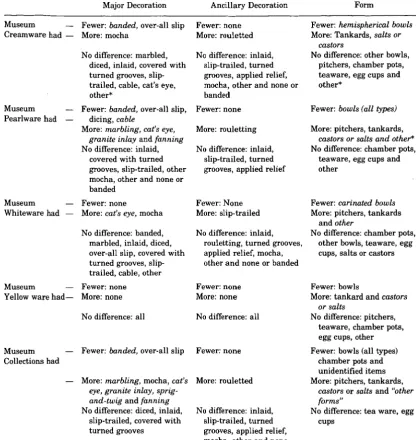
The results recorded in Table 1 answer the first question of how the two samples dif-fered from one another. Table 2 specifies the sources of these differences.
Interpretation of Results
Any museum or private collection, with the best of intentions, does not achieve or even aim at proportional representation. A military museum, for example, may have regimental unifprms from all ranks, but it will not have several thousand privates' uniforms to every general's uniform. An archaeological collection, while it may or may not be representative of the universe of artifacts, is much more likely to contain artifacts (of similar fragility) in the same proportion as they were when bought and used.
This understandable difference in the creation of the two types of collections is the basis of some of the observed differences in the collections of industrial slipware. The most commonly occurring slip-decorated form on archaeological sites and in histori-cal documents is the bowl. Bowls consti-tuted more than half of the slip-decorated objects recorded from archaeological sites. It
was not surprising, therefore, that bowls were underrepresented in museums. The same reasoning also explains the relative dearth of banded items in museums; band-ing beband-ing the most common type (26%) of
99.98 99.98
99.0 99.8
99.8 99.98
99.999 99.999
slip-decoration in archaeological collections. There were, conversely, in museum and private collections, significantly more ob-jects with some of the rarest decorations and shapes. In Table 2, those decorations and shapes are indicated whose scarcity or abundance in museum and private collec-tions seems to be linked to this understand-able failure in proportional representation of very common or very rare types.
The remaining differences, which are plentiful, are inexplicable. One can dream up reasons why museum and private collec-tions may have more or fewer of certain types of objects, but it is impossible to verify these reasons. For example, the relatively small number of chamber pots in museums and private collections could be the conse-quence of collectors' prudery. Or the rela-tively large numbers of mocha-decorated ob-jects may be the result of that decoration's aesthetic appeal.
jus-Northeast Historical ArchaeologyNol. 14, 1985
Major Decoration
Museum Fewer: banded, over-all slip
Creamware had - More: mocha
Museum Pearlware had
Museum Whiteware had
No difference: marbled, diced, inlaid, covered with turned grooves, slip-trailed, cable, eat's eye, other*
Fewer: banded, over-all slip, dicing, cable
More: marbling, eat's eye, granite inlay and fanning No difference: inlaid,
covered with turned grooves, slip-trailed, other mocha, other and none or banded
Fewer: none
More: eat's eye, mocha
No difference: banded, marbled, inlaid, diced, over-all slip, covered with turned grooves, slip-trailed, cable, other
Museum Fewer: none
Yellow ware had- More: none
No difference: all
TABLE 2
Ancillary Decoration
Fewer: none More: rouletted
No difference: inlaid, slip-trailed, turned grooves, applied relief, mocha, other and none or banded
Fewer: none
More: rouletting
No difference: inlaid, slip-trailed, turned grooves, applied relief
Fewer: None More: slip-trailed
No difference: inlaid, rouletting, turned grooves, applied relief, mocha, other and none or banded
Fewer: none More: none
No difference: all
Museum - Fewer: banded, over-all slip Fewer: none
Collections had
More: marbling, mocha, eat's eye, granite inlay, sprig-and-twig and fanning No difference: diced, inlaid,
slip-trailed, covered with turned grooves
More: rouletted
No difference: inlaid, slip-trailed, turned grooves, applied relief, mocha, other and none
*"other" refers to rare decorations and shapes (fewer than 3 occurrences)
53
Form
Fewer: hemispherical bowls
More: Tankards, salts or castors
No difference: other bowls, pitchers, chamber pots, tea ware, egg cups and other*
Fewer: bowls (all types)
More: pitchers, tankards, castors or salts and other* No difference: chamber pots,
teaware, egg cups and other
Fewer: carinated bowls
More: pitchers, tankards and other
No difference: chamber pots, other bowls, teaware, egg cups, salts or castors
Fewer: bowls
More: tankard and castors or salts
No difference: pitchers, teaware, chamber pots, egg cups, other
Fewer: bowls (all types) chamber pots and unidentified items More: pitchers, tankards,
castors or salts and "other
forms"
No difference: tea ware, egg cups
tified in including the museum pieces if I had been interested only in rim decoration on whiteware and yellow ware.
I do not begrudge the time spent in exam-ining and recording museum collections. The very fact that they contained items not
54
wholly (or even largely) on museum pieces to interpret the past would be suspect. There is no reason, on the other hand, to underes-timate the value of museum collections as rich sources of research material. Almost any student of material culture history will have gained a large part of his or her under-standing of a group of artifacts through museum and private collections, either indi-rectly from publications or diindi-rectly from the artifacts.
References
Aylesworth, Richard K.
1985 Classification of Ceramics. Memorandum
dated 05 November, from R. K. Aylesworth,
Museum v. Archaeological Col/ections/Sussman
Scientific Computing Division, A. S. Q. M. E. Branch, Systems and Information Director-ate, Environment Canada, Ottawa, Canada, to Lynne Sussman.
Sussman, Lynne
1985 Industrial Slipware: A Study of'Dip't'
Ceram-ics. Manuscript on file, National Historic Parks and Sites, Ottawa, Canada.
Author:
Lynne Sussman